- Market Value (2025): USD 1.8 Bn
- Estimated Value (2026): USD 2.1 Bn
- Forecast Value (2036): USD 13.0 Bn
- CAGR (2026-2036): 20.0%
What is the Edge Auto Chips Market forecast to be worth by 2036?
USD 2.1 billion in 2026 to USD 13.0 billion by 2036 at a 20.0% CAGR.
- The edge auto chips market was valued at USD 1.8 billion in 2025.
- Demand is projected to increase from USD 2.1 billion in 2026 to USD 13.0 billion by 2036.
- The market is forecast to record 20.0% CAGR from 2026 to 2036 as automakers shift inference, sensing and power-control tasks onto vehicle platforms.
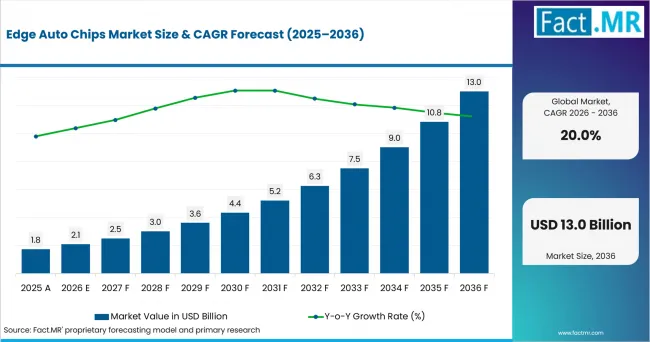
Edge Auto Chips Market Value Analysis | Source: Fact.MR
What are the defining numbers behind Edge Auto Chips Market growth?
USD 10.9 billion absolute opportunity by 2036, led by Edge AI, 2.5D packaging and automotive end use.
- Demand Drivers in the Market
- Vehicle platform teams need local inference capacity because camera and radar data lose value when safety responses wait for remote processing.
- Powertrain engineers need faster switching and current control supported by hybrid and electric platforms that raise chip content per vehicle.
- ADAS software teams need functional-safety evidence and update-ready silicon before they approve chips for production programs.
- Automotive procurement teams need packaging choices that shorten signal paths and manage heat within compact control units.
- Key Segments Analyzed
- By Architecture: Edge AI is expected to hold 44.0% share in 2026 because perception and cockpit workloads require local processing.
- By Packaging: 2.5D is projected to account for 44.0% share in 2026, supported by shorter interconnects and higher memory bandwidth.
- By Function: Inference is anticipated to capture 42.0% share in 2026 owing to rising ADAS and in-cabin AI workloads.
- By End Use: Automotive is estimated to represent 36.0% share in 2026, shaped by safety programs and vehicle networking requirements.
- By Integration: Discrete is forecast to hold 48.0% share in 2026 as modular sourcing remains practical across mixed vehicle platforms.
- Analyst Opinion at Fact.MR
- Shambhu Nath Jha, Principal Consultant at Fact.MR, states, "Edge auto chips are becoming a design decision tied to latency, safety evidence and system cost. The next phase is expected to favor suppliers that connect silicon with software tools and automotive-grade documentation. Vehicle teams want parts that fit a platform roadmap without adding extra validation work."
- Strategic Implications
- Chip vendors should document functional-safety coverage and software maturity before design teams reach production freeze.
- Tier-one module suppliers should connect packaging choices to heat, board area and service access inside vehicle control units.
- Automakers should compare discrete and module strategies by vehicle generation so redesign cost stays visible.
- Software teams should validate inference behavior on production-grade silicon before feature commitments reach homologation schedules.
The UK is projected to post 25.1% CAGR through 2036, led by zero-emission vehicle registrations and safety-electronics content. South Korea is anticipated to record 24.4% CAGR, supported by exports and semiconductor strength. The USA is forecast to advance at 22.5% CAGR as electrified light-duty sales lift chip content. Germany is estimated to grow at 17.8% CAGR owing to vehicle-electronics depth. Japan is expected to reach 17.4% CAGR as hybrid platforms and local semiconductor programs shape demand.
How does the Edge Auto Chips Market break down by segment?
Edge AI leads Architecture at 44.0%; Discrete leads Integration at 48.0%.
Which Architecture dominates?
Edge AI holds 44.0% share in 2026.
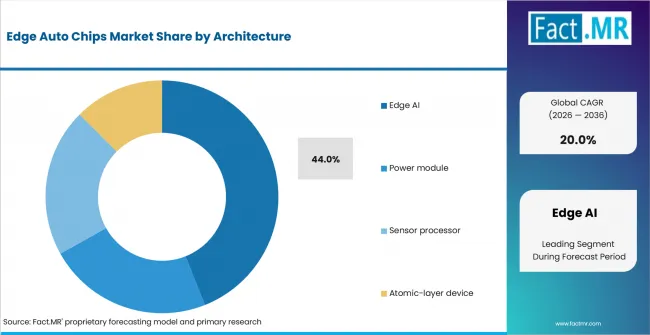
Edge Auto Chips Market Analysis By Architecture | Source: Fact.MR
Edge AI is expected to lead Architecture because vehicle features increasingly rely on local model execution. Power module chips remain necessary for electrified drivetrains and thermal control. Sensor processors support camera, radar and cabin systems where raw data must be filtered before it reaches a central computer. Atomic-layer devices remain early in adoption, but they point toward tighter leakage and power control in future automotive compute.
What leads the Packaging segment?
2.5D leads with 44.0% share in 2026.
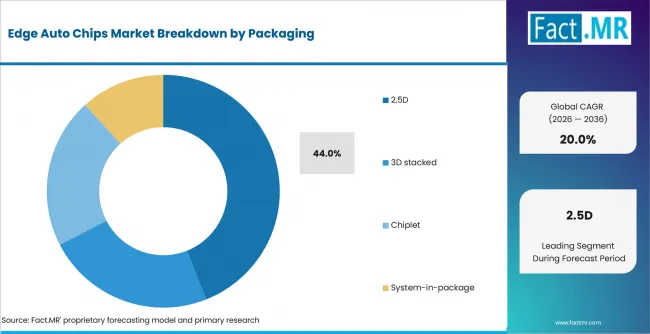
Edge Auto Chips Market Analysis By Packaging | Source: Fact.MR
2.5D packaging is projected to lead because it improves memory access without moving every design to full 3D stacking. Chiplet packaging supports design reuse across vehicle generations. System-in-package formats remain useful when automakers want tested blocks that combine compute, power management and communication in a smaller footprint. The packaging decision is tied to thermal paths as much as raw compute.
How does Function shape demand?
Inference accounts for 42.0% share in 2026.
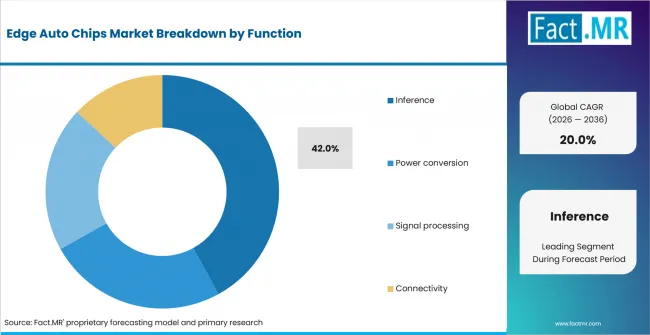
Edge Auto Chips Market Analysis By Function | Source: Fact.MR
Inference is anticipated to lead Function because perception, driver monitoring and cockpit personalization depend on local decisions. Power conversion grows with electric platforms and onboard energy management. Signal processing remains relevant where radar, audio and camera streams need fast filtering. Connectivity chips support software-defined vehicle functions that rely on secure data movement inside the car.
What supports Automotive within End Use?
Automotive holds 36.0% share in 2026.
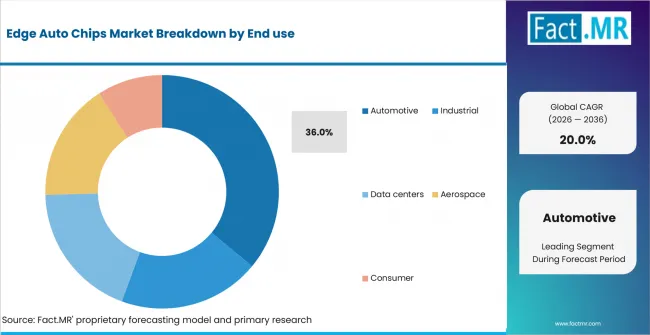
Edge Auto Chips Market Analysis By End Use | Source: Fact.MR
Automotive is estimated to lead End Use because the vehicle is the direct deployment point for safety and edge AI chips. Industrial applications use similar edge-compute methods, although qualification cycles differ. Data centers influence design tools and packaging know-how without forming the same product boundary. Aerospace and consumer use cases remain adjacent when they use vehicle-grade reliability or low-power inference methods.
What leads Integration?
Discrete leads with 48.0% share in 2026.
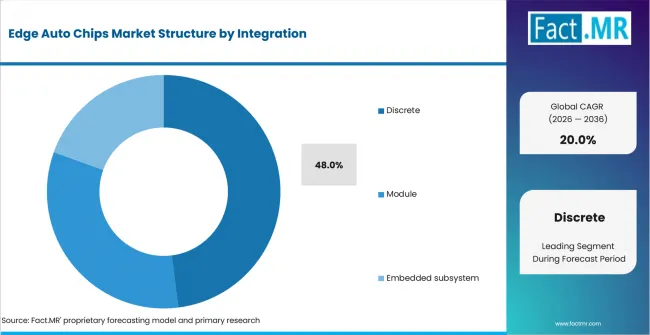
Edge Auto Chips Market Analysis By Integration | Source: Fact.MR
Discrete integration is forecast to lead because many vehicle programs still qualify chips as replaceable and dedicated parts. Modules gain attention when heat spreading and board space become tight. Embedded subsystems fit designs where the automaker wants a tested electronics block with fewer separate sourcing steps. STMicroelectronics N.V. introduced the Stellar P3E automotive microcontroller in February 2026 with built-in AI acceleration for edge intelligence.
What is accelerating Edge Auto Chips Market adoption, and what is holding it back?
Vehicle-edge inference drives it; validation complexity restrains it.
| DRIVER | (~) % IMPACT ON CAGR | GEOGRAPHIC RELEVANCE | IMPACT TIMELINE |
|---|---|---|---|
| Vehicle-edge inference for ADAS and cabins | +2.1% | North America, Europe, East Asia | Short term (<= 2 years) |
| Electrified powertrain chip content | +1.7% | USA, UK, South Korea | Medium term (2-4 years) |
| Packaging density and bandwidth | +1.2% | Japan, Germany, South Korea | Medium term (2-4 years) |
| Safety-led procurement | +0.8% | USA, Europe, Japan | Long term (>= 4 years) |
Source: Fact.MR analysis. Updated Aug 26, 2026
- Vehicle-edge inference for ADAS and cabins: ADAS and cabin features need short response times. NXP introduced the S32R47 imaging radar processors in May 2025 for Level 2+ to Level 4 autonomous driving. The processors integrate high-performance radar computing to process sensor data in real time within automotive radar systems.
- Packaging density and bandwidth: 2.5D and chiplet choices shorten compute-to-memory paths. They help vehicle programs add bandwidth without a full electronics redesign. Packaging density is expected to carry more weight as centralized compute boxes handle safety and cabin tasks.
- Safety-led procurement: Buyers ask for safety documentation before silicon reaches vehicle programs. Qualcomm Technologies, Inc. and Hyundai Mobis announced on January 6, 2025 that Snapdragon Ride Flex would support cockpit, ADAS and automated-driving functions on a single chipset. Qualcomm Technologies, Inc. states that the platform supports safety- and non-safety-critical applications on one chip, including a solution addressing freedom from interference.
| OPPORTUNITY | (~) % IMPACT ON CAGR | GEOGRAPHIC RELEVANCE | IMPACT TIMELINE |
|---|---|---|---|
| Centralized vehicle compute | +1.4% | USA, Germany, Japan | Medium term (2-4 years) |
| Edge AI cockpit and driver monitoring | +1.1% | USA, UK, South Korea | Short term (<= 2 years) |
| Discrete accelerator upgrades | +0.7% | Global | Medium term (2-4 years) |
Source: Fact.MR analysis. Updated Aug 26, 2026
- Centralized vehicle compute: Consolidated control units are expected to widen the addressable chip value per vehicle. The architecture brings cockpit and ADAS workloads closer to shared processors. Suppliers that support mixed-criticality workloads gain a clearer route into platform programs.
- Edge AI cockpit and driver monitoring: Cabin systems need local recognition for driver state, voice and display behavior. HMI functions add volume for low-power inference chips. Chip vendors can compete through latency, memory footprint and software support that shorten model deployment work.
- Discrete accelerator upgrades: Discrete parts let automakers upgrade one compute path without requalifying a full electronics module. This route suits radar, camera and cockpit functions where model performance changes faster than the vehicle platform.
| RESTRAINT | (~) % IMPACT ON CAGR | GEOGRAPHIC RELEVANCE | IMPACT TIMELINE |
|---|---|---|---|
| Long automotive qualification cycles | -0.8% | Global | Short term (<= 2 years) |
| Thermal and power limits in compact ECUs | -0.6% | Global | Medium term (2-4 years) |
| Platform cost pressure | -0.5% | Europe, East Asia | Medium term (2-4 years) |
Source: Fact.MR analysis. Updated Aug 26, 2026
- Long automotive qualification cycles: Automotive chips must clear safety, reliability and software checks before volume deployment. A supplier change affects validation documents and software integration. That cycle slows the move from proven controllers to newer edge AI silicon.
- Thermal and power limits in compact ECUs: Control units restrict chip power budgets. Suppliers must prove sustained performance under heat, vibration and long service-life assumptions. This constraint favors processors that deliver useful inference within fixed thermal envelopes.
- Platform cost pressure: Entry and mid-range vehicles place tight limits on electronics cost. Discrete chips remain practical where a module adds too much bill-of-materials pressure. Cost discipline therefore shapes which edge features reach high-volume platforms first.
Which countries are scaling the Edge Auto Chips Market through 2036?
- The country comparison spans 7.7 percentage points and forms three practical growth bands across the forecast period.
- The United Kingdom remains 0.7 percentage point above South Korea as zero-emission vehicle registrations raise electronic content per vehicle.
- South Korea remains 1.9 percentage points above the USA through vehicle exports and electronics manufacturing depth.
- The USA remains 4.7 percentage points above Germany as electrified light-duty sales lift chip content.
- Germany remains 0.4 percentage point above Japan through vehicle electronics, industrial capability and semiconductor policy support.
- Japan closes the displayed range as hybrid vehicles and cautious EV uptake shape design demand.
Comparable CAGRs can create different entry conditions due to compute availability, platform cycles, safety rules and enterprise semiconductor depth. Full report coverage includes North America, Latin America, Western Europe, Eastern Europe, East Asia, South Asia & Pacific, Middle East & Africa.
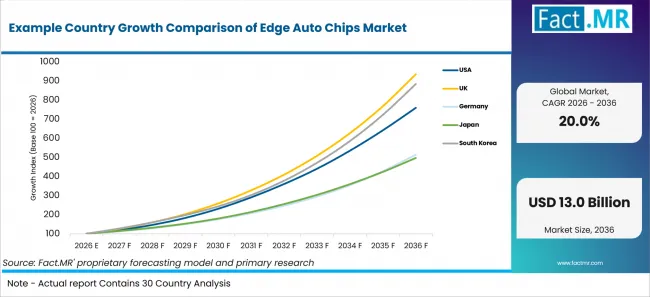
Example Country Growth Comparison Of Edge Auto Chips Market | Source: Fact.MR
| Country | CAGR (2026-2036) |
|---|---|
| United Kingdom | 25.1% |
| South Korea | 24.4% |
| USA | 22.5% |
| Germany | 17.8% |
| Japan | 17.4% |
Source: Fact.MR analysis. Updated Aug 26, 2026
What supports the United Kingdom outlook?
25.1% CAGR through 2036, driven by ZEV registration growth and vehicle-safety electronics.
The United Kingdom offers a clear route for edge auto chips because electrified platforms are adding more control and safety electronics. DfT reported in April 2026 that 528,000 zero-emission vehicles were first registered in 2025, up 24% from 2024. The country is projected to post 25.1% CAGR through 2036 as automakers add local processing for battery, ADAS and cockpit functions.
How is South Korea scaling Edge Auto Chips Market demand?
24.4% CAGR through 2036, supported by exports and electronics manufacturing depth.
South Korea links edge-chip demand to export platforms and local semiconductor capability. MOTIR reported in January 2026 that automobile exports reached USD 72.0 billion in 2025, the third straight year above USD 70 billion. The market is anticipated to record 24.4% CAGR through 2036 as vehicle electronics programs draw on domestic chip and display supply chains.
What supports USA adoption?
22.5% CAGR through 2036, supported by electrified light-duty sales and ADAS reporting.
The USA is moving edge auto chips into a large light-duty vehicle base where safety and electrification remain visible purchase drivers. The U.S. Energy Information Administration reported on July 27, 2026 that hybrid-electric, battery-electric and plug-in hybrid-electric vehicles accounted for 24% of new U.S. light-duty vehicle sales in Q2 2026. The country is forecast to advance at 22.5% CAGR through 2036 as local inference and power-control chips support software-defined platforms.
What is supporting Germany growth?
17.8% CAGR through 2036, shaped by vehicle electrification and electronics depth.
Germany has a large vehicle base and a strong engineering network for safety electronics. The German Environment Agency reported that Germany had 2.03 million electric passenger cars and 4.36 million hybrid passenger cars in the 2026 vehicle stock; its underlying KBA source refers to vehicle stock as of January 1 of the respective year. The country is estimated to grow at 17.8% CAGR through 2036 as chiplet and 2.5D designs support software-defined platforms with limited board space.
How does Japan perform?
17.4% CAGR through 2036, led by hybrid strength and domestic semiconductor support.
Japan has a cautious EV transition but a deep base of hybrid control systems and vehicle electronics. The IEA reported in Global EV Outlook 2026 that Japan electric car sales were just above 100,000 in 2025, while hybrids accounted for around one-third of car sales. Japan is expected to reach 17.4% CAGR through 2036 as automakers use edge chips in hybrid control, ADAS and cabin monitoring
Who leads the Edge Auto Chips Market?
NXP Semiconductors N.V. and Qualcomm Technologies, Inc. are active in vehicle-edge compute, while Renesas Electronics Corporation and STMicroelectronics N.V. are active in automotive control and safety processing.
NXP Semiconductors N.V. is active through its S32 automotive processors and radar-processing portfolio, including the S32R47 imaging radar processor announced in May 2025 for Level 2+ to Level 4 autonomous-driving applications. Qualcomm Technologies, Inc. competes through Snapdragon Ride Flex and the broader Snapdragon Digital Chassis, which support consolidation of cockpit, ADAS and automated-driving workloads for software-defined vehicles. These platforms combine automotive compute performance with functional-safety capabilities and supporting software ecosystems.
Renesas Electronics Corporation supports multi-domain vehicle computing through its R-Car portfolio and its high-performance SoC development work with Honda, which combines the R-Car X5 series with AI acceleration for centralized vehicle control. STMicroelectronics N.V. adds automotive edge intelligence through the Stellar P3E microcontroller announced in February 2026. Ambarella, Inc. provides automotive AI vision and multi-sensor processing through its CV3-AD family, while Hailo Technologies Ltd. supplies discrete automotive-grade AI accelerators for local neural-network inference. Functional safety, power and thermal efficiency, and mature software-development ecosystems are therefore important competitive considerations across these automotive edge-computing platforms.
Which companies are the key providers?
Key companies include NXP Semiconductors N.V., Qualcomm Technologies, Inc., Renesas Electronics Corporation, STMicroelectronics N.V., Ambarella, Inc. and Hailo Technologies Ltd.
- NXP Semiconductors N.V.
- Qualcomm Technologies, Inc.
- Renesas Electronics Corporation
- STMicroelectronics N.V.
- Ambarella, Inc.
- Hailo Technologies Ltd.
Bibliography
- Ambarella, Inc. (2025, January 30). Gauzy and Ambarella harness power of AI for breakthroughs in advanced driver assistance systems (ADAS), including Ford Trucks.
- Department for Transport. (2026, April 29). Vehicle licensing statistics, United Kingdom: 2025. GOV.UK.
- International Energy Agency. (2026, May 20). Trends in electric cars. In Global EV Outlook 2026.
- Ministry of Trade, Industry and Resources. (2026, January 15). Automobile exports hit record high of $72 billion in 2025.
- NXP Semiconductors. (2025, May 8). NXP unveils third-generation imaging radar processors for Level 2+ to 4 autonomous driving.
- Qualcomm Technologies, Inc. (2025, January 6). Qualcomm and Hyundai Mobis to power next-generation ADAS and digital cockpit systems.
- Semiconductor Industry Association. (2026, February 6). Global annual semiconductor sales increase 25.6% to $791.7 billion in 2025.
- STMicroelectronics. (2026, February 10). STMicroelectronics introduces the first automotive microcontroller with AI acceleration for edge intelligence.
- Umweltbundesamt. (2026, May 15). Verkehrsinfrastruktur und Fahrzeugbestand.
- U.S. Energy Information Administration. (2026, July 27). Hybrid sales rise while battery electric sales remain lower after tax credit expiration.
This Report Answers
- The report explains where edge auto chips are used across architecture and packaging choices.
- Segment analysis identifies Edge AI and Discrete integration as the two leading subsegments by 2026 share.
- Country analysis examines the United Kingdom, South Korea, USA, Germany and Japan.
- Competitive analysis reviews NXP Semiconductors N.V., Qualcomm Technologies, Inc., Renesas Electronics Corporation, STMicroelectronics N.V., Ambarella, Inc. and Hailo Technologies Ltd..
- Application analysis assesses how latency, power use and safety documentation influence purchase decisions.
What does the Edge Auto Chips Market cover?
Edge AI, power module, sensor processor and atomic-layer devices used inside vehicle electronics.
The automotive semiconductor category covers a wider chip base across vehicles. The Edge Auto Chips Market focuses on parts that process data or control power near the sensor or electronic control unit. Adjacent automotive electronics include complete vehicle systems, so this report keeps the chip-level boundary. ADAS central controller platforms remain adjacent when the processor is sold inside a complete controller.
The assessment is narrower than the complete vehicle electronics stack because it excludes full ECUs sold as systems. The boundary centers on chip-level value where the component supports local vehicle compute, safety sensing or power control.
What is included in the scope?
Automotive-grade chips used for local vehicle compute, power control and signal handling.
The scope includes Edge AI, power module, sensor processor and atomic-layer device architectures. Packaging coverage includes 2.5D, 3D stacked, chiplet and system-in-package formats. Adjacent automotive power electronics help define the power-conversion side of the boundary. HBM for automotive AI processors is referenced when memory packaging changes edge-compute design. Electric vehicle components are relevant where drivetrain electronics raise chip content.
What is excluded from the scope?
Cloud-only AI accelerators and general consumer chips are outside the scope.
The scope excludes data-center accelerators, consumer electronics processors and general industrial chips unless they are qualified for automotive edge use. It also excludes complete vehicle ECUs when chip content is bundled into the broader module value. Automotive radar sensors are covered when the processor value is separable from the complete sensing unit. Automotive printed circuit boards are enabling hardware outside direct chip revenue. Traction inverter systems are treated at the semiconductor-control layer. Automotive power inductors remain adjacent passive components.
How Was the Analysis Built?
The analysis draws on 120+ sources, 35+ company portfolios, 25+ countries, and more than 20 industry interviews.
- Primary Research: Primary research includes discussions with automakers, tier-one electronics teams, chip suppliers, packaging specialists and ADAS engineers. These interviews examine sourcing priorities, software readiness, validation hurdles and the conditions that influence wider market acceptance.
- Desk Research: Desk research covers government vehicle statistics, regulator publications, company releases, semiconductor association data and official technology pages. Every evidence point used in the analysis is recorded in the bibliography.
- Market Sizing and Forecasting: Market estimates combine vehicle electronics content, historical values, forecast endpoints, segment shares, country-level growth, architecture mix and provider participation.
- Data Validation and Update Cycle: Findings are compared with public data, company activity, safety rules and vehicle-electronics adoption. Regular updates review launches, partnerships, procurement trends and changes in commercial deployment.
Segmentation
What is the report’s scope and coverage?
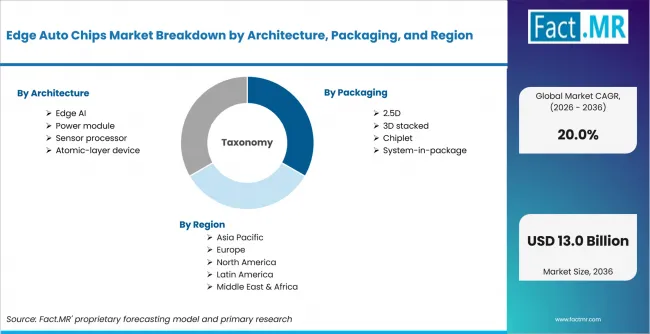
Edge Auto Chips Market Breakdown By Architecture, Packaging, And Region | Source: Fact.MR
| Attribute | Details |
|---|---|
| Quantitative Units | USD billion |
| Market Definition | Vehicle-grade edge chips used to process data, control power and manage signals close to sensors, actuators or electronic control units. |
| Architecture | Edge AI; Power module; Sensor processor; Atomic-layer device |
| Packaging | 2.5D; 3D stacked; Chiplet; System-in-package |
| Function | Inference; Power conversion; Signal processing; Connectivity |
| End Use | Automotive; Industrial; Data centers; Aerospace; Consumer |
| Integration | Discrete; Module; Embedded subsystem |
| Regions Covered | North America; Latin America; Western Europe; Eastern Europe; East Asia; South Asia & Pacific; Middle East & Africa |
| Countries Covered | United Kingdom; South Korea; USA; Germany; Japan |
| Key Companies Profiled | NXP Semiconductors N.V.; Qualcomm Technologies, Inc.; Renesas Electronics Corporation; STMicroelectronics N.V.; Ambarella, Inc.; Hailo Technologies Ltd. |
| Forecast Period | 2026 to 2036 |
| Approach | Hybrid top-down and bottom-up approach using vehicle electronics content, architecture mix, packaging adoption, country growth and provider portfolio review. |
Source: Fact.MR analysis. Updated Aug 26, 2026
How is the market segmented?
-
By Architecture:
- Edge AI
- Power module
- Sensor processor
- Atomic-layer device
-
By Packaging:
- 2.5D
- 3D stacked
- Chiplet
- System-in-package
-
By Function:
- Inference
- Power conversion
- Signal processing
- Connectivity
-
By End Use:
- Automotive
- Industrial
- Data centers
- Aerospace
- Consumer
-
By Integration:
- Discrete
- Module
- Embedded subsystem
-
By Region:
- North America
- Latin America
- Western Europe
- Eastern Europe
- East Asia
- South Asia & Pacific
- Middle East & Africa
Frequently Asked Questions
How big is the Edge Auto Chips Market in 2026?
What is the CAGR of the Edge Auto Chips Market from 2026 to 2036?
Which architecture leads the Edge Auto Chips Market?
Which integration leads the Edge Auto Chips Market?
Which companies are profiled in the Edge Auto Chips Market?
Who worked on this report


Preview the report firsthand - request a free sample
Free SampleGet the brochure for pricing and purchase details
Download PDF