- Market Value (2025): USD 8.4 Bn
- Estimated Value (2026): USD 9.2 Bn
- Forecast Value (2036): USD 21.8 Bn
- CAGR (2026-2036): 9.0%
What is the Electromagnetic Compatibility Test Equipment and Testing Services Market forecast to be worth by 2036?
USD 9.2 billion to USD 21.8 billion by 2036 at a 9.0% CAGR.
- The electromagnetic compatibility test equipment and testing services market reached USD 8.4 billion in 2025.
- Demand is projected to increase from USD 9.2 billion in 2026 to USD 21.8 billion by 2036.
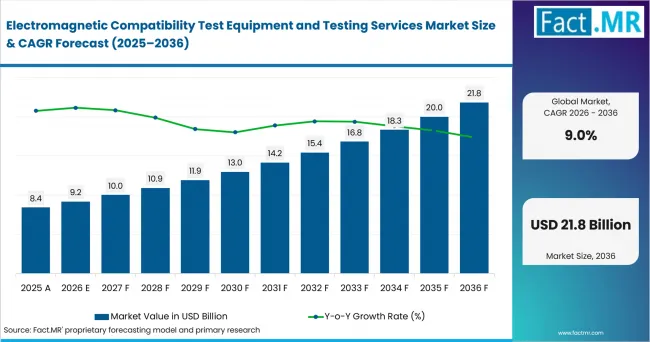
Electromagnetic Compatibility Test Equipment And Testing Services Market Value Analysis | Source: Fact.MR
What are the defining numbers behind Electromagnetic Compatibility Test Equipment and Testing Services Market growth?
An absolute opportunity of USD 12.6 billion is expected between 2026 and 2036.
- Demand Drivers in the Market
- Product-market access increasingly depends on demonstrated electromagnetic compatibility. Under the EU EMC Directive, manufacturers must complete the applicable conformity assessment and technical documentation before placing CE-marked electrical or electronic equipment on the market. This creates recurring demand for accredited testing services and compliant measurement systems.
- The number of connected and radio-enabled products is expanding the range of devices requiring emissions and immunity assessment. The U.S. Federal Communications Commission states that most radiofrequency devices must be tested to demonstrate compliance with its technical rules, while its equipment-authorization programme relies on defined measurement procedures.
- Vehicle electrification is raising EMC complexity because electric drivetrains introduce high-voltage batteries, power converters and fast-switching semiconductor systems alongside sensitive communication and safety electronics. UN Regulation No. 10 applies electromagnetic-compatibility requirements to vehicles and their electrical or electronic components, supporting demand for specialized automotive EMC testing.
- Electric car sales reached 21 million units in 2025, representing one-quarter of new car sales worldwide. Higher EV production increases the volume of inverters, battery-management systems and electronic control units that must be tested for interference before vehicle approval and commercial production.
- Product redesign and software or hardware changes can require additional validation because modifications may alter emissions or immunity performance. This creates repeat demand for pre-compliance testing during development and formal compliance testing before market launch.
- Key Segments Analyzed
- EMC Testing Services account for 43.0% of the Offering Type segment in 2026, supported by demand for specialized laboratories and calibrated test environments.
- Compliance Testing holds 41.0% of the Testing Application segment in 2026 because product approval often requires documented evidence of conformity with applicable standards.
- Automotive represents 39.0% of the End-use Industry segment in 2026 as vehicles integrate more power electronics and connected control systems.
- Original Equipment Manufacturers account for 42.0% of the Customer Category segment in 2026 because they carry responsibility for product conformity before commercial release.
- Conducted Emission Testing holds 40.0% of the Testing Methodology segment in 2026 due to its role in measuring interference transferred through cables and power connections.
How does the Electromagnetic Compatibility Test Equipment and Testing Services Market break down by segment?
The market is segmented by Offering Type, Testing Application, End-use Industry, Customer Category and Testing Methodology.
Why do EMC Testing Services lead Offering Type?
EMC Testing Services are projected to account for a 43.0% share in 2026.
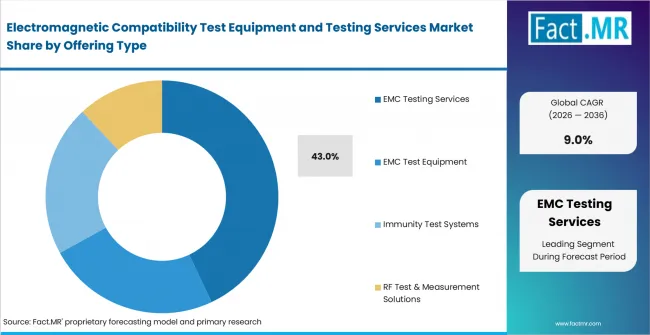
Electromagnetic Compatibility Test Equipment And Testing Services Market Analysis By Offering Type | Source: Fact.MR
Testing services lead because formal EMC assessment requires controlled environments and calibrated instruments that many manufacturers cannot justify maintaining internally. External laboratories provide access to receivers, antennas and test chambers alongside engineers familiar with product-specific standards.
Service providers also allow manufacturers to separate early-stage troubleshooting from final certification testing. This is particularly relevant for companies launching products across several jurisdictions, where measurement procedures and documentation requirements may differ.
The FCC describes equipment testing as central to its authorization programme for ensuring that radiofrequency devices comply with technical rules. This reinforces the value of qualified laboratories that can produce reliable evidence for regulatory submissions.
Why does Compliance Testing lead Testing Application?
Compliance Testing is projected to account for a 41.0% share in 2026.
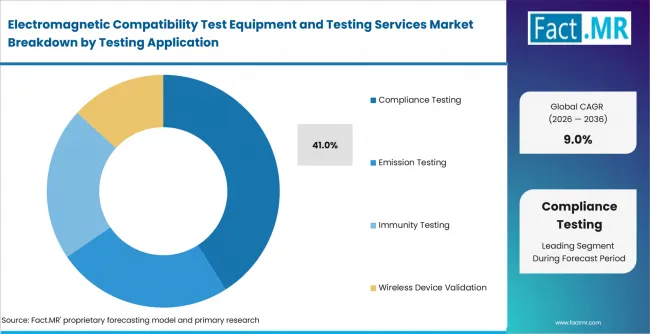
Electromagnetic Compatibility Test Equipment And Testing Services Market Analysis By Testing Application | Source: Fact.MR
Compliance Testing leads because manufacturers must establish that equipment does not generate unacceptable electromagnetic interference and can operate adequately in its intended environment. Testing results become part of the documentation used to support market access and product approval.
In the European Union, CE marking can be applied only after the manufacturer has tested the product and completed the prescribed conformity-assessment process. This turns EMC testing into a required commercial step for many electrical and electronic products sold in the region.
Pre-compliance work remains important during design, but formal compliance testing carries greater commercial weight because a failed assessment can delay production or prevent market entry.
Why does Automotive lead End-use Industry?
Automotive is projected to account for a 39.0% share in 2026.
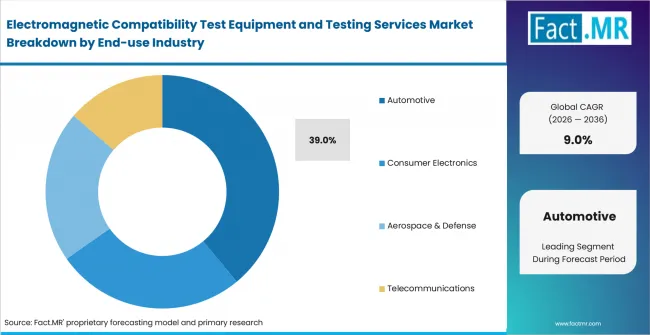
Electromagnetic Compatibility Test Equipment And Testing Services Market Analysis By End Use Industry | Source: Fact.MR
Automotive leads because modern vehicles contain numerous electronic systems operating close to high-power electrical components. Electric motors and power converters can generate electromagnetic noise, while braking controls and communication systems must continue operating without disruption.
UN Regulation No. 10 applies to vehicle electromagnetic compatibility and covers electrical or electronic components intended for installation in vehicles. This creates testing requirements at component and complete-vehicle levels.
The transition to electric mobility strengthens the requirement. Nearly 22 million electric cars were produced worldwide in 2025, up more than 25% from the previous year, increasing demand for EMC validation across battery and power-electronics systems.
Why do Original Equipment Manufacturers lead Customer Category?
Original Equipment Manufacturers are projected to account for a 42.0% share in 2026.
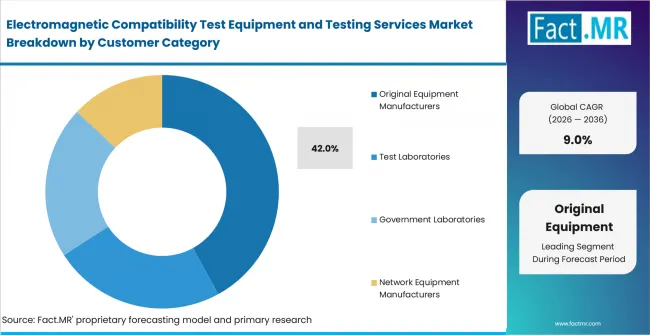
Electromagnetic Compatibility Test Equipment And Testing Services Market Analysis By Customer Category | Source: Fact.MR
OEMs lead because they are responsible for confirming that finished products meet applicable EMC requirements before commercial release. Even when components are sourced from suppliers, the complete product must be assessed in its final operating configuration.
OEMs also conduct testing throughout development to identify interference before tooling and production are finalized. Early detection can reduce redesign cost and prevent delays during certification.
Large manufacturers may maintain internal pre-compliance capabilities, but they still use accredited external laboratories for independent assessment and market-specific certification.
Why does Conducted Emission Testing lead Testing Methodology?
Conducted Emission Testing is projected to account for a 40.0% share in 2026.
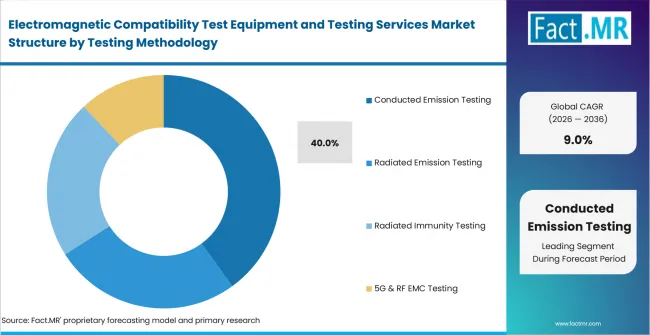
Electromagnetic Compatibility Test Equipment And Testing Services Market Analysis By Testing Methodology | Source: Fact.MR
Conducted Emission Testing leads because unwanted electrical noise can travel through power leads and connected cables into other equipment or shared networks. Testing measures this interference across defined frequency ranges and helps engineers determine whether filters or grounding changes are required.
The methodology is widely used because it can identify interference close to its source during product development. It also forms part of established EMC measurement procedures for several classes of electrical and radiofrequency equipment. The FCC maintains recognized procedures for testing RF devices against its technical requirements.
Radiated emissions and immunity testing remain necessary, but conducted testing often provides an earlier and more repeatable indication of power-line interference.
What is accelerating Electromagnetic Compatibility Test Equipment and Testing Services Market adoption, and what is holding it back?
Drivers Impact Analysis
| Driver | (~) % Impact on CAGR | Geographic Relevance | Impact Timeline |
|---|---|---|---|
| Adoption and integration | +1.6% | Global | Short term (≤ 2 years) |
| Regulatory and compliance support | +1.4% | USA, Germany and UK | Short term (≤ 2 years) |
| Channel and access expansion | +1.1% | Global | Medium term (2–4 years) |
| Clear specification and documentation | +0.9% | USA, UK and Canada | Medium term (2–4 years) |
| Cost and efficiency gains | +0.6% | Global | Long term (≥ 4 years) |
Source: Fact.MR analysis. Updated Aug 7, 2026
Opportunity Impact Analysis
| Opportunity | (~) % Impact on CAGR | Geographic Relevance | Impact Timeline |
|---|---|---|---|
| Emerging application expansion | +1.0% | Global | Medium term (2–4 years) |
| Premium and specialist positioning | +0.8% | USA, UK and Germany | Medium term (2–4 years) |
| Channel and partner expansion | +0.7% | Global | Long term (≥ 4 years) |
| Standards and compliance alignment | +0.5% | USA, Canada and Singapore | Long term (≥ 4 years) |
Source: Fact.MR analysis. Updated Aug 7, 2026
Restraints Impact Analysis
| Restraint | (~) % Impact on CAGR | Geographic Relevance | Impact Timeline |
|---|---|---|---|
| Cost and complexity | -1.1% | Global | Short term (≤ 2 years) |
| Specification and compliance checks | -0.9% | USA, UK and Germany | Short term (≤ 2 years) |
| Substitution by lower-cost alternatives | -0.7% | Import-dependent markets | Medium term (2–4 years) |
| Supply chain and pricing pressure | -0.5% | Global | Long term (≥ 4 years) |
Source: Fact.MR analysis. Updated Aug 7, 2026
Which countries are scaling the Electromagnetic Compatibility Test Equipment and Testing Services Market fastest?
- USA: Demand is supported by extensive development of radiofrequency devices, automotive electronics and connected equipment. Manufacturers require formal EMC testing before product authorization and commercial release.
- Germany: Growth is linked to the country’s automotive and industrial manufacturing base. Increasing use of power electronics and connected control systems creates demand for component-level and complete-system EMC assessment.
- Japan: Japan’s strength in automotive electronics and precision equipment supports continued investment in emissions and immunity testing. Product exporters also require evidence aligned with multiple international standards.
- UK: Demand is supported by aerospace, medical-device and electronics development. Independent laboratories remain important for manufacturers that need accredited testing without maintaining specialist chambers internally.
- India: Expansion of domestic electronics and electric vehicle manufacturing is increasing demand for pre-compliance testing and formal certification infrastructure.
- South Korea: The country’s semiconductor, automotive and consumer-electronics industries require advanced EMC testing for high-frequency systems and export-oriented products.
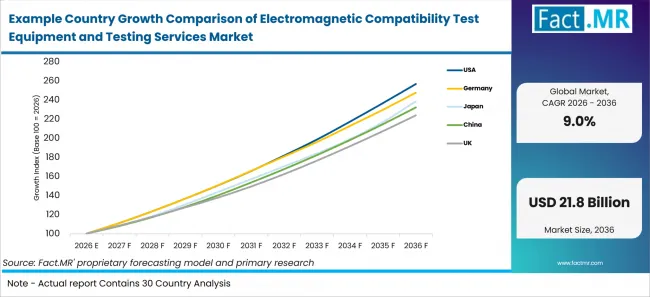
Example Country Growth Comparison Of Electromagnetic Compatibility Test Equipment And Testing Services Market | Source: Fact.MR
| Country | CAGR, 2026–2036 |
|---|---|
| USA | 9.9% |
| Germany | 9.5% |
| Japan | 9.1% |
| UK | 8.4% |
| India | 8.0% |
| South Korea | 7.6% |
Source: Fact.MR analysis. Updated Aug 7, 2026
What is driving USA’s growth through 2036?
The USA is forecast to expand at a 9.9% CAGR from 2026 to 2036.
Growth is supported by the Federal Communications Commission’s equipment-authorization framework. Radiofrequency devices must comply with technical and authorization requirements before they can be marketed or imported, creating recurring demand for accredited testing laboratories and calibrated EMC equipment.
Demand is also expanding as vehicles and connected devices incorporate more wireless functions. Manufacturers increasingly require pre-compliance testing during product development so that interference problems can be corrected before formal certification.
What is driving Germany’s growth through 2036?
Germany is forecast to expand at a 9.5% CAGR from 2026 to 2036.
Germany’s automotive and industrial-electronics base generates extensive EMC testing requirements. Electric drivetrains and connected vehicle systems must operate without disrupting safety controls or communication networks, increasing demand for complete-vehicle and component-level assessment.
EU rules also require equipment within the scope of the EMC Directive to limit emissions and maintain adequate immunity. Manufacturers must complete conformity assessment and technical documentation before products enter the market.
What is driving Japan’s growth through 2036?
Japan is forecast to expand at a 9.1% CAGR from 2026 to 2036.
Japan’s position in automotive electronics and precision electrical equipment supports demand for high-accuracy emissions and immunity testing. Products sold under the country’s electrical safety framework must meet requirements intended to prevent hazards and electromagnetic interference.
Export-oriented manufacturers also require test results compatible with standards in North America and Europe, increasing the value of laboratories that can support several regulatory markets.
What is driving the UK’s growth through 2036?
The UK is forecast to expand at an 8.4% CAGR from 2026 to 2036.
Demand is supported by aerospace, medical-device and electronics development, where interference can affect safety-critical functions. Manufacturers require controlled chamber testing and documented results across both emissions and immunity performance.
The need to serve domestic and overseas markets encourages companies to work with laboratories that can test against UK requirements alongside EU and international standards.
What is driving India’s growth through 2036?
India is forecast to expand at an 8.0% CAGR from 2026 to 2036.
Domestic manufacturing of electronics and electric vehicles is increasing the need for pre-compliance testing and formal certification capacity. As local companies move from assembly toward product design, EMC assessment becomes relevant earlier in the engineering process.
Testing providers can reduce development risk by identifying grounding and shielding problems before manufacturers commit to large production runs.
What is driving South Korea’s growth through 2036?
South Korea is forecast to expand at a 7.6% CAGR from 2026 to 2036.
South Korea’s semiconductor and automotive industries support demand for high-frequency EMC testing. Products increasingly combine wireless connectivity with dense electronic assemblies, creating more potential coupling paths between components.
Export exposure adds another requirement. Manufacturers need repeatable testing and documentation that can support authorization in multiple destination markets.
Who leads the Electromagnetic Compatibility Test Equipment and Testing Services Market?
SGS SA is positioned as a leading provider through its international laboratory network and broad conformity-assessment capabilities. Bureau Veritas, Intertek, TÜV SÜD, DEKRA, Eurofins and UL Solutions compete through testing, inspection and certification services across automotive and industrial products.
Rohde & Schwarz, Keysight Technologies and Anritsu participate primarily through EMC measurement equipment. Their portfolios include receivers and signal-analysis systems used by laboratories and manufacturers for conducted or radiated testing.
Competition depends on laboratory accreditation and geographic coverage. Product-specific expertise also matters because automotive components and medical devices are assessed under different standards and operating conditions.
Regulation creates a durable demand base. The FCC requires RF equipment to be properly authorized before sale or import in the USA, while the EU EMC Directive governs both emissions and immunity for electrical equipment. UN Regulation No. 10 provides the international framework for vehicle electromagnetic compatibility.
Large testing groups are better placed to support multinational certification programmes. Equipment manufacturers compete through measurement accuracy and automation, while regional laboratories can gain business through faster scheduling and specialized engineering support.
Which companies are the key providers?
Key companies include SGS SA; Bureau Veritas SA; Intertek Group plc; TÜV SÜD AG; Rohde & Schwarz GmbH & Co. KG; Keysight Technologies, Inc.; DEKRA SE; Eurofins Scientific SE; UL Solutions Inc.; and Anritsu Corporation.
- SGS SA
- Bureau Veritas SA
- Intertek Group plc
- TÜV SÜD AG
- Rohde & Schwarz GmbH & Co. KG
- Keysight Technologies, Inc.
- DEKRA SE
- Eurofins Scientific SE
- UL Solutions Inc.
- Anritsu Corporation
Bibliography
- European Commission. (2026). Electromagnetic Compatibility Directive 2014/30/EU.
- European Commission. (2026). CE Marking.
- European Union. (2026). Reducing Interference Between Electrical and Electronic Devices. EUR-Lex.
- Federal Communications Commission. (2026). Equipment Authorization.
- Federal Communications Commission. (2026). Equipment Authorization Procedures.
- Ministry of Economy, Trade and Industry, Japan. (2023). Electrical Appliances and Materials Safety Act: Regulatory Instructions.
- United Nations Economic Commission for Europe. (2026). UN Regulation No. 10: Electromagnetic Compatibility.
This Report Answers
- The report examines demand for EMC test equipment and testing services across offering types, testing applications and end-use industries.
- Segment analysis identifies the leading categories and their shares within the 2026 market.
- Country analysis compares growth across the USA, Germany, Japan, China, the UK, India and South Korea.
- Competitive analysis reviews global testing groups alongside specialist EMC equipment manufacturers.
- Application analysis assesses emissions, immunity and compliance testing requirements across automotive, electronics and other regulated industries.
What does the Electromagnetic Compatibility Test Equipment and Testing Services Market cover?
The market covers equipment and professional services used to evaluate whether electrical and electronic products operate without causing or experiencing unacceptable electromagnetic interference.
The analysis includes EMC testing services, test equipment and immunity systems used for compliance assessment, product development and certification. It examines offering type, testing application, end-use industry, customer category and testing methodology.
What is included in the scope?
The scope includes pre-compliance testing and formal certification testing for electrical systems, electronic products and vehicle components. It covers conducted and radiated emissions testing, immunity testing, electrostatic-discharge assessment and radiofrequency EMC validation.
Equipment coverage includes spectrum analysers, EMC receivers, signal generators and immunity-test systems. Testing demand from automotive OEMs, electronics manufacturers, laboratories and certification bodies is assessed across major global regions.
What is excluded from the scope?
The scope excludes general product testing that does not evaluate electromagnetic emissions or immunity. Mechanical testing, chemical analysis and environmental durability testing are outside the market unless performed as part of an integrated EMC assessment.
Standalone wireless-performance testing is also excluded when it does not involve electromagnetic compatibility or regulatory compliance.
How Was the Analysis Built?
The analysis draws on more than 120 sources, over 35 company portfolios and more than 20 industry interviews across at least 25 countries.
- Primary Research: Interviews with testing laboratories, equipment manufacturers, OEMs and certification specialists examine testing demand, laboratory utilization and purchasing requirements.
- Desk Research: The review covers EMC regulations, product-authorization frameworks, technical standards and company disclosures.
- Market Sizing and Forecasting: Estimates combine equipment installations, testing volumes, service pricing and demand across automotive, electronics and other regulated industries.
- Data Validation and Update Cycle: Findings are cross-checked against public regulations, laboratory activity and company portfolios. Updates account for changes in technical standards and product-certification requirements.
Segmentation
What is the report's scope and coverage?
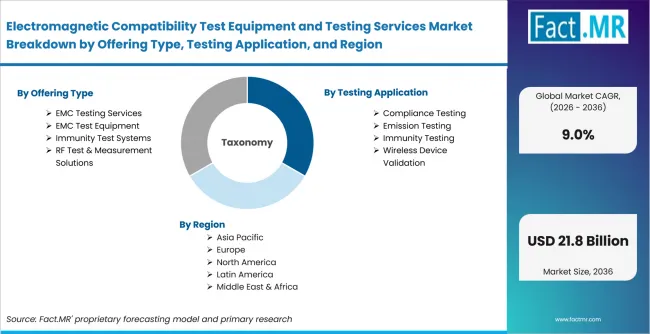
Electromagnetic Compatibility Test Equipment And Testing Services Market Breakdown By Offering Type, Testing Application, And Region | Source: Fact.MR
| Attribute | Details |
|---|---|
| Quantitative Units | USD billion in 2026 to USD billion by 2036 at a CAGR |
| Market Definition | Electromagnetic Compatibility Test Equipment and Testing Services products sold across the covered segments and applications |
| Segments Covered | Offering Type; Testing Application; End-use Industry; Customer Category; Testing Methodology |
| Regions Covered | North America; Latin America; Europe; East Asia; South Asia and Pacific; Middle East and Africa |
| Countries Covered | USA; Germany; Japan; China; UK; India; South Korea |
| Key Companies Profiled | SGS SA; Bureau Veritas SA; Intertek Group plc; TÜV SÜD AG; Rohde & Schwarz GmbH & Co. KG; and others |
| Forecast Period | 2026 to 2036 |
| Approach | Hybrid top-down and bottom-up approach using segment demand; share; country growth; channel visibility; pricing; and company portfolio review |
Source: Fact.MR analysis. Updated Aug 7, 2026
How is the market segmented?
-
By Offering Type
- EMC Testing Services
- Pre-compliance Testing
- Certification Services
- EMC Test Equipment
- Spectrum Analyzers
- EMI Receivers
- Immunity Test Systems
- ESD Simulators
- Surge Generators
- RF Test & Measurement Solutions
- Vector Signal Generators
- Vector Network Analyzers
- EMC Testing Services
-
By Testing Application
- Compliance Testing
- Regulatory Certification
- Product Qualification
- Emission Testing
- Radiated Emission
- Conducted Emission
- Immunity Testing
- Electrostatic Discharge (ESD)
- Electrical Fast Transient (EFT)
- Wireless Device Validation
- 5G Device Certification
- IoT Device Validation
- Compliance Testing
-
By End-use Industry
- Automotive
- Automotive Electronics
- Electric Vehicles
- Consumer Electronics
- Industrial Electronics
- Medical Devices
- Aerospace & Defense
- Defense Electronics
- Aviation Systems
- Telecommunications
- Network Infrastructure
- Semiconductor Manufacturing
- Automotive
-
By Customer Category
- Original Equipment Manufacturers
- Tier-1 Suppliers
- Device Manufacturers
- Test Laboratories
- Research Institutions
- Certification Bodies
- Government Laboratories
- Public Testing Agencies
- Accredited Test Facilities
- Network Equipment Manufacturers
- Telecom Equipment Vendors
- Semiconductor Companies
- Original Equipment Manufacturers
-
By Testing Methodology
- Conducted Emission Testing
- RF Conducted Testing
- Line Impedance Stabilization Network (LISN) Testing
- Radiated Emission Testing
- Semi-anechoic Chamber Testing
- Open Area Test Site (OATS)
- Radiated Immunity Testing
- ESD Compliance Testing
- EFT/Burst Testing
- 5G & RF EMC Testing
- Antenna Performance Testing
- RF Shielded Chamber Testing
- Conducted Emission Testing
-
By Region
- North America
- Latin America
- Western Europe
- Eastern Europe
- East Asia
- South Asia and Pacific
- Middle East & Africa
Frequently Asked Questions
Which Offering Type leads the market?
Which Testing Application leads the market?
Which End-use Industry leads the market?
Which Customer Category leads the market?
Which Testing Methodology leads the market?
Which country records the highest listed CAGR?
What is the primary driver in this market?
What is the main restraint?
Which companies are included in the market assessment?
Who worked on this report


Preview the report firsthand - request a free sample
Free SampleGet the brochure for pricing and purchase details
Download PDF