- Base Value(2026): 0.5 Bn
- Estimated Value(2026): 0.5 Bn
- Forecast Value (2036): 1.2 Bn
- CAGR (2026 - 2036): 9.8%
Endocrine Disruptor Removal Agents Market Forecast and Outlook 2026 to 2036
The global market for endocrine disruptor removal agents is entering a period of significant growth, driven by escalating scientific consensus and regulatory action concerning the health impacts of these pervasive contaminants. Projected to expand from USD 0.48 billion in 2026 to USD 1.22 billion by 2036, the market is forecast to advance at a CAGR of 9.8% over the assessment period.
Key Takeaways from the Endocrine Disruptor Removal Agents Market
- Market Value for 2026: USD 0.48 Billion
- Market Value for 2036: USD 1.22 Billion
- Forecast CAGR (2026-2036): 9.8%
- Leading Removal Agent Type Share (2026): Activated Carbon & Adsorbents (30%)
- Leading Application Area Share (2026): Municipal Wastewater Treatment (34%)
- Leading Removal Mechanism Share (2026): Adsorption-Based Removal (32%)
- Key Players in the Market: Veolia Water Technologies, Ecolab, Kemira Oyj., SUEZ Water Technologies, Solenis
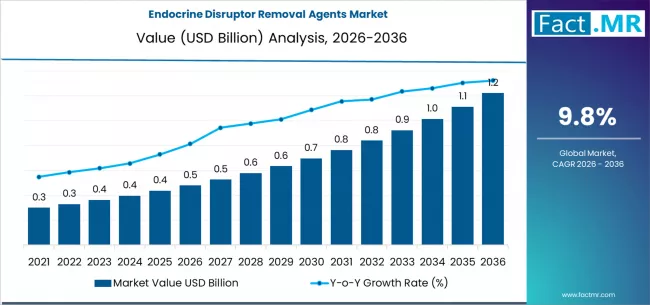
Endocrine Disruptor Removal Agents Market Market Value Analysis | Source: Fact.MR
Activated carbon and advanced adsorbents represent the leading removal agent type, capturing a 30% market share. Municipal wastewater treatment is the primary application area, accounting for 34% of demand. Adsorption-based removal remains the dominant mechanism, with a 32% share, due to its proven ability to sequester a broad range of endocrine-disrupting compounds from water matrices.
This growth is fundamentally linked to increasing global regulation of EDCs such as, bisphenol-A (BPA), phthalates, and certain pesticides, in water discharges and drinking water. These chemicals, which can interfere with hormonal systems at very low concentrations, are inadequately removed by conventional biological treatment. Specialized chemical and physical agents are therefore critical for utilities and industries to mitigate ecological risks, protect drinking water sources, and comply with emerging safety standards that recognize the unique threat posed by hormonal activity.
Market innovation focuses on enhancing the selectivity, capacity, and cost-effectiveness of removal technologies for diverse EDC structures. The development of these targeted solutions is essential for enabling comprehensive water treatment strategies that address not just chemical oxygen demand but also specific biological toxicity, safeguarding both human health and aquatic ecosystems.
Metric
| Metric | Value |
|---|---|
| Market Value (2026) | USD 0.48 Billion |
| Market Forecast Value (2036) | USD 1.22 Billion |
| Forecast CAGR (2026-2036) | 9.8% |
Source: Fact.MR analysis. Updated Dec 30, 2025
Category
| Category | Segments |
|---|---|
| Removal Agent Type | Activated Carbon & Adsorbents, Advanced Oxidation Chemicals, Bio-Based & Enzymatic Breakdown Agents, Ion Exchange & Resin-Based Agents, Other Specialty Endocrine Disruptor Removal Agents |
| Application Area | Municipal Wastewater Treatment, Industrial & Chemical Effluent, Drinking Water Treatment, Pharmaceutical/Healthcare Waste Streams, Specialized Pilot & Research Treatment |
| Removal Mechanism | Adsorption-Based Removal, Chemical Oxidation & Degradation, Biochemical & Enzymatic Deactivation, Precipitation & Coagulation, Hybrid & Emerging Technologies |
| Region | North America, Latin America, Western Europe, Eastern Europe, East Asia, South Asia & Pacific, MEA |
Source: Fact.MR analysis. Updated Dec 30, 2025
Segmental Analysis
By Removal Agent Type, Which Segment Offers a Versatile First Line of Defense?
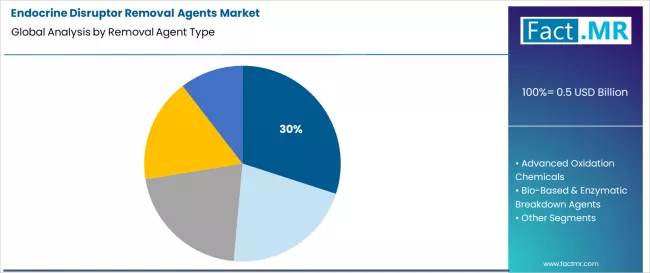
Endocrine Disruptor Removal Agents Market Analysis By Removal Agent Type | Source: Fact.MR
Activated carbon and adsorbents lead the market with a 30% share. Their widespread use stems from a non-specific, physical removal mechanism effective against many hydrophobic EDCs like certain pesticides and industrial plasticizers.
The technology is well-understood and can be deployed via powdered (PAC) or granular (GAC) forms within existing treatment infrastructure. This retrofittability makes adsorption the most pragmatic initial step for utilities under pressure to act, providing significant reductions in EDC load without requiring a complete process overhaul.
By Application Area, Where is the Regulatory Pressure Most Acute?
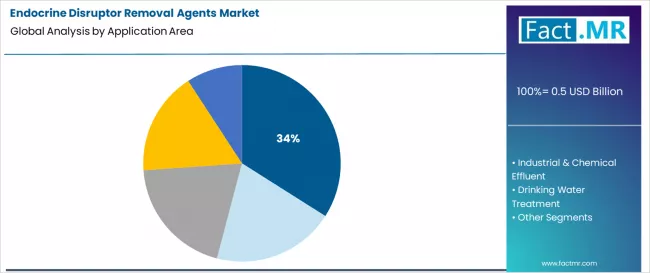
Endocrine Disruptor Removal Agents Market Analysis By Application Area | Source: Fact.MR
Municipal wastewater treatment represents the largest application area, holding a 34% share. WWTPs are recognized as major convergence points for EDCs from domestic, industrial, and urban runoff sources. Regulatory frameworks, particularly in Europe under the EU Water Framework Directive's priority substances list, are increasingly mandating control at this discharge point.
Upgrading municipal plants with tertiary treatment stages featuring targeted removal agents is viewed as the most effective large-scale intervention to reduce environmental exposure, driving substantial and sustained demand.
By Removal Mechanism, Which Process Aligns with Existing Plant Operations?
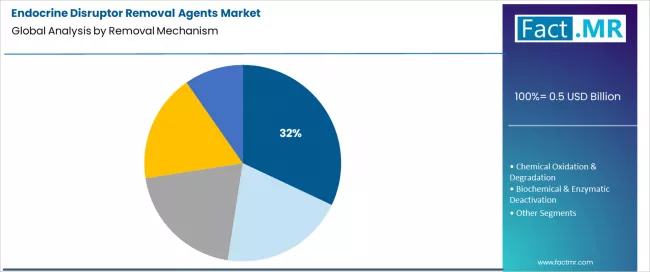
Endocrine Disruptor Removal Agents Market Analysis By Removal Mechanism | Source: Fact.MR
Adsorption-based removal is the leading mechanism, commanding a 32% share. This process integrates seamlessly into conventional treatment trains, often requiring only the addition of contact tanks or the substitution of filter media.
Its operational simplicity and the ability to use it as a polishing step after biological treatment make it a preferred choice for risk-averse municipal operators. The capability to handle variable flows and contaminant loads further solidifies adsorption’s role as the foundational removal strategy for many water agencies tackling EDCs.
What are the Drivers, Restraints, and Key Trends of the Endocrine Disruptor Removal Agents Market?
The primary market driver is the accelerating pace of scientific research linking EDC exposure to adverse health outcomes, which is translating into stricter regulatory standards for water quality. Listing of compounds like nonylphenol and certain phthalates as priority substances under EU and other regulations creates a direct compliance mandate. Growing public awareness and concern about “everywhere chemicals” in water supplies also pressure water providers and industries to adopt removal technologies proactively, even in advance of formal regulation.
A significant market restraint is the high diversity and often low concentrations of EDCs, which challenge treatment efficiency and economics. Many EDCs are polar or charged, reducing the effectiveness of conventional adsorbents. Advanced treatment methods like oxidation or specialized resins can have high operational costs and may produce transformation products of unknown toxicity. The lack of standardized, routine monitoring protocols for EDCs in many regions also makes it difficult to quantify removal performance and justify investment.
Key trends include the development of tailored adsorbent materials such as molecularly imprinted polymers and surface-modified carbons designed with high affinity for specific EDC classes like estrogens or perfluorinated compounds. There is increasing research into bio-augmentation and enzymatic processes that use specific microbial consortia or enzymes to biodegrade EDCs in a targeted manner. The market is also moving toward integrated treatment trains that combine advanced oxidation to break down complex molecules followed by adsorption or biological filtration to remove residuals and transformation products.
Analysis of the Endocrine Disruptor Removal Agents Market by Key Countries
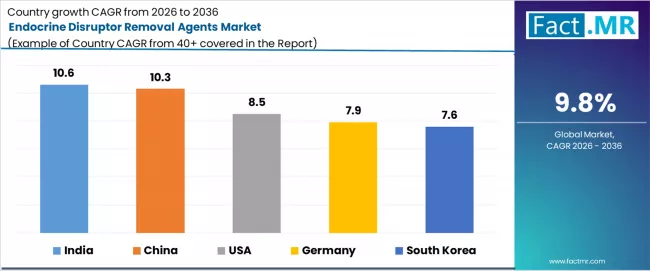
Endocrine Disruptor Removal Agents Market Cagr Analysis By Country | Source: Fact.MR
| Country | CAGR (2026-2036) |
|---|---|
| India | 10.60% |
| China | 10.30% |
| USA | 8.50% |
| Germany | 7.90% |
| South Korea | 7.60% |
Source: Fact.MR analysis. Updated Dec 30, 2025
How do India’s Water Quality Priorities and Industrial Growth Intersect?
India’s leading CAGR of 10.60% is driven by its severe surface water pollution and growing awareness of industrial chemical impacts. National missions to clean major rivers are beginning to address micropollutants, while the expansion of textiles, plastics, and pharmaceutical manufacturing creates urgent need for effluent treatment. This combination of regulatory momentum and industrial scale positions India as a high-growth market for both adsorption media and advanced treatment chemicals.
What is the Impact of China’s Evolving Environmental Standards on Industry?
China’s 10.30% growth is linked to its continuous tightening of chemical discharge standards and its focus on upgrading industrial wastewater treatment, particularly in chemical parks. The government’s push for green manufacturing and the control of persistent organic pollutants is driving investment in advanced treatment capable of removing EDCs. Large-scale retrofits of municipal plants in key watersheds further contribute to demand for proven removal technologies.
How does the USA’s Regulatory Framework and Focus on PFAS Influence the Market?
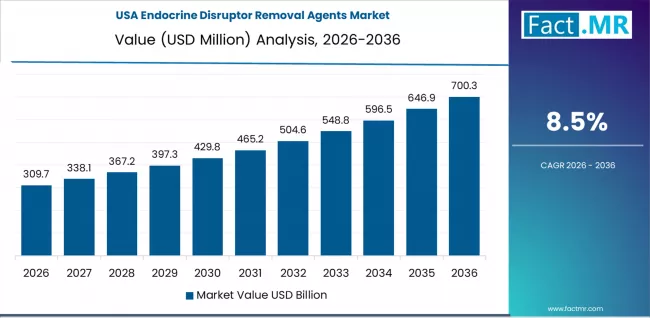
Endocrine Disruptor Removal Agents Market Country Value Analysis | Source: Fact.MR
The USA’s 8.50% CAGR is supported by regulatory actions under the Safe Drinking Water Act and Clean Water Act targeting specific EDCs, with PFAS (which have endocrine-disrupting properties) being a major current focus.
State-level regulations often lead national policy, creating early markets for removal technologies. The strong emphasis on drinking water safety and groundwater remediation propels demand for ion exchange resins, advanced adsorbents, and oxidation systems validated for EDC removal.
Why is Germany a Center for Advanced Water Engineering and Precautionary Policy?
Germany’s 7.90% growth reflects its stringent implementation of the EU’s precautionary principle and its leadership in water engineering. German utilities are mandated to implement advanced treatment for micropollutant removal, making ozonation followed by activated carbon filtration a standard upgrade path.
The market demands high-reliability, engineered systems and focuses on comprehensive removal to protect sensitive aquatic ecosystems, fostering innovation in treatment process integration.
What Role does South Korea’s Technological Innovation and Water Reuse Play?
South Korea’s 7.60% growth is anchored in its national strategy for technological leadership and high rates of water reuse, which require advanced barriers against bioactive contaminants.
Government-funded research into novel nanomaterials and electrochemical oxidation for micropollutant removal accelerates technology commercialization. This environment creates a sophisticated market for next-generation removal agents and smart, compact treatment systems for industrial and urban applications.
Competitive Landscape of the Endocrine Disruptor Removal Agents Market
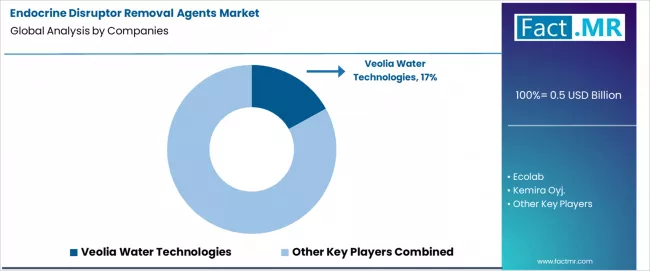
Endocrine Disruptor Removal Agents Market Analysis By Company | Source: Fact.MR
Global water technology corporations that offer comprehensive chemical, equipment, and service solutions define the competitive landscape. Leaders like Veolia and SUEZ compete by providing integrated treatment systems, combining their own chemical products including oxidants and adsorbents with proprietary process designs and digital optimization tools.
Competition centers on demonstrating full-scale efficacy data for a broad spectrum of EDCs, offering cost-effective waste management for spent media, and providing regulatory compliance support. A key differentiator is the ability to deliver performance-guaranteed, end-to-end solutions that reduce client risk in meeting complex new water quality standards.
Key Players in the Endocrine Disruptor Removal Agents Market
- Veolia Water Technologies
- Ecolab
- Kemira Oyj.
- SUEZ Water Technologies
- Solenis
Segmentation
Scope of Report
| Items | Values |
|---|---|
| Quantitative Units | USD Billion |
| Removal Agent Type | Adsorbents, Advanced Oxidation, Bio-Based/Enzymatic Agents, Ion Exchange Resins, Specialty Agents |
| Application Area | Municipal WWT, Industrial Effluent, Drinking Water, Healthcare Streams, Pilot Systems |
| Removal Mechanism | Adsorption, Chemical Oxidation, Biochemical Deactivation, Precipitation, Hybrid Technologies |
| Key Countries | India, China, USA, Germany, South Korea |
| Key Companies | Veolia Water Technologies, Ecolab, Kemira Oyj., SUEZ Water Technologies, Solenis |
| Additional Analysis | Analysis of EDC physicochemical properties (log Kow, pKa) and treatability; competitive adsorption in presence of natural organic matter; identification and toxicity assessment of oxidation byproducts; regeneration and disposal pathways for spent resins and carbon; development and validation of bioassays for endocrine activity monitoring. |
Source: Fact.MR analysis. Updated Dec 30, 2025
Market by Segments
-
Removal Agent Type :
- Activated Carbon & Adsorbents
- Advanced Oxidation Chemicals
- Bio-Based & Enzymatic Breakdown Agents
- Ion Exchange & Resin-Based Agents
- Other Specialty Endocrine Disruptor Removal Agents
-
Application Area :
- Municipal Wastewater Treatment
- Industrial & Chemical Effluent
- Drinking Water Treatment
- Pharmaceutical/Healthcare Waste Streams
- Specialized Pilot & Research Treatment
-
Removal Mechanism :
- Adsorption-Based Removal
- Chemical Oxidation & Degradation
- Biochemical & Enzymatic Deactivation
- Precipitation & Coagulation
- Hybrid & Emerging Technologies
-
Region :
-
North America
- USA
- Canada
-
Latin America
- Brazil
- Mexico
- Argentina
- Rest of Latin America
-
Western Europe
- Germany
- UK
- France
- Spain
- Italy
- BENELUX
- Rest of Western Europe
-
Eastern Europe
- Russia
- Poland
- Czech Republic
- Rest of Eastern Europe
-
East Asia
- China
- Japan
- South Korea
- Rest of East Asia
-
South Asia & Pacific
- India
- ASEAN
- Australia
- Rest of South Asia & Pacific
-
MEA
- Saudi Arabia
- UAE
- Turkiye
- Rest of MEA
-
Frequently Asked Questions
How big is the endocrine disruptor removal agents market in 2026?
What will be the size of endocrine disruptor removal agents market in 2036?
How much will be the endocrine disruptor removal agents market growth between 2026 and 2036?
What are the key product types in the endocrine disruptor removal agents market?
Which application area segment to contribute significant share in the endocrine disruptor removal agents market in 2026?
Who worked on this report


Preview the report firsthand - request a free sample
Free SampleGet the brochure for pricing and purchase details
Download PDF