- Base Value(2025): 285 Mn
- Forecast Value (2035): 469 Mn
- CAGR (2035): 4.2%
Ex Vivo Neural Recorders Market Outlook 2025 to 2035
The global Ex vivo neural recorders market is expected to reach USD 469 million by 2035, up from USD 285 million in 2025. During the forecast period 2025 to 2035, the industry is projected to expand at a CAGR of 5.1%.
Ex vivo neural recorders the market are spurred by the rapid increases in neuroscience research in the field and the expansion of the use of high-throughput electrophysiology systems. Market growth is driven by increasing demand for the right drug discovery, neurotoxicology research, and neuroprosthetic development.
The combination of multi-electrode arrays with optical imaging and AI-based data analysis increases the accuracy and efficiency of data. Increased investment in academic, pharmaceutical, and biotechnology research also drives up the need of ex vivo neural recording solutions.
Quick Stats for Ex vivo neural recorders market
- Industry Value (2025): USD 285 million
- Projected Value (2035): USD 469 million
- Forecast CAGR (2025 to 2035): 5.1%
- Leading Segment (2025): Microelectrode Arrays (MEAs) (46.2% Market Share)
- Fastest Growing Country (2025-2035): India (5.5% CAGR)
- Top Key Players: Axion BioSystems, 3Brain, Plexon Inc, Multi Channel Systems, Med64, Blackrock Neurotech, Cambridge, Neurotech, and NeuroNexus
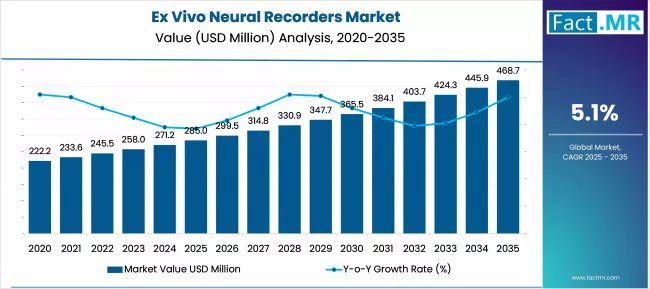
Ex Vivo Neural Recorders Market Market Value Analysis | Source: Fact.MR
What are the drivers of the Ex Vivo Neural Recorders Market?
Ex vivo neural recorders market has been growing in the recent years and investigative organizations and pharmaceutical companies are paying more attention to precision, effectiveness, and automation of neuroscience and drug discovery experiments. The high-throughput, accurate neural recording systems demand are growing, and this is promoting the use of state-of-art microelectrode arrays and optical recording models.
State-of-the-art solutions that combine AI, machine learning, and real-time data analytics make predictions, minimize the errors of the experiment, and improve workflow. Long-term stable materials and devices improve tissue viability and reliability of recording. Cooperation among neuronal technology manufacturers, research institutions and biotechnological companies encourages innovations, open-source solutions, and worldwide research developments.
What are the regional trends of the Ex Vivo Neural Recorders Market?
The Ex vivo neural recorders market has uneven regional activity due to research infrastructure, investment in healthcare, and technology.
North America is on the forefront with high demand of academic and pharmaceutical research institutions, which have high funding and well-developed neuroscience programs.
Europe focuses on accuracy, repeatability and association with regulatory requirements, leading to the use of long-lasting and energy efficient neural recording systems.
Asia-Pacific is growing at an alarming rate with China, Japan, and India spending a lot of money on neuroscience and drug research and neurotechnology.
Gradually Latin America is becoming more accepting, Middle East and Africa are keen on creating research capacity and partnerships to enhance innovation in neural recording technologies.
What are the challenges and restraining factors of the Ex Vivo Neural Recorders Market?
The challenges that the Ex vivo neural recorders market may be experiencing are as follows, it is expensive to start up, is technical, and needs maintenance. Multi-electrode arrays and optical recording systems are costly and can only be used by larger research laboratories and new biotech companies. These causes the differences in the performance and reliability of data because the laboratory infrastructure, regulatory standards, and experimentation protocols may vary significantly across regions.
The costs of operation may be affected by the concept of tissue viability and electrode degradation. Also, lack of skilled workforce to operate advanced systems, disjointed supply chains, and non-uniformity in the experimentation processes limit the ability to scale and slow consistency in adoption, especially in developing countries.
Country-Wise Insights
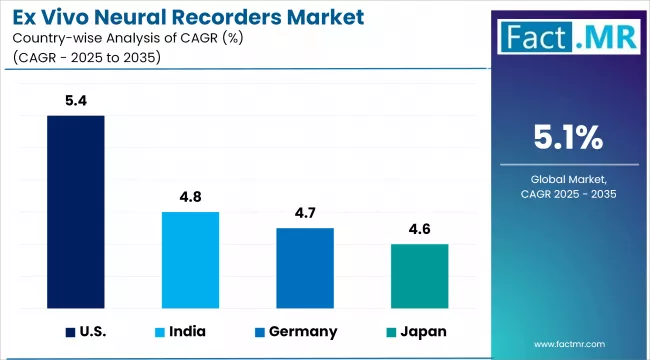
Ex Vivo Neural Recorders Market Cagr Analysis By Country | Source: Fact.MR
United States leads with advanced neural research and automation
The Ex vivo neural recorder market in the United States is growing at a very high rate owing to strong investment in neuroscience, universities, and pharmaceutical research and development. Boston, San Francisco, and New York have large biotech centers that are driving the need to acquire functional microelectrode arrays, as well as optical recording systems.
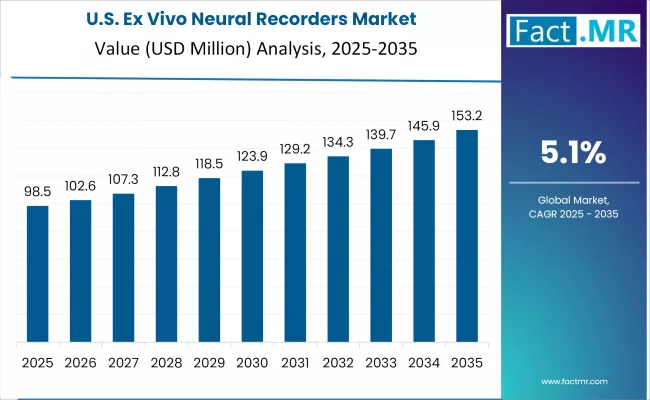
Ex Vivo Neural Recorders Market Country Value Analysis | Source: Fact.MR
Implementation of high-throughput neural recordings platforms that are automated, combined with AI and data analytics, increase accuracy and productivity. Special attention to reproducibility, compliance with regulations, and collaborative research projects increases innovation.
The U.S. is a powerful player that provides ex vivo neural recording solutions due to its strong funding, well-trained personnel, and collaborations between neurotechnology businesses and research institutes.
Germany emphasizes precision, reproducibility, and high-performance neural systems
The market of the Ex vivo neural recorders in Germany is increasing in order with the high focus on quality and precision in research and pharmaceutical innovation. In other cities like Berlin, Munich and Heidelberg, there are pre-eminent academic and biotech research institutes which depend on high-resolution MEA and optical neural recording systems.
Regulatory mechanisms that increase safety and sustainability favorable to markets are present, and the need to have reproducible, high-performance neural data stimulates the use of sophisticated automated systems. The collaboration between universities, biotech companies, and technology providers promotes neurotechnological innovation. In Germany, the emphasis of the country on standardization and data accuracy, as well as long-lasting equipment, makes it one of the main European centers of ex vivo neural recording.
Japan grows via neurotechnology investments and automated recording platforms
The growth rate of Japan market of Ex vivo neural recorders is high because of the growing investment on neuroscience research, neurotechnology and drug discovery. There are major research institutes and pharmacy companies in Tokyo, Osaka and Kyoto and these cities practice using multi-electrode arrays and optogenetic recording systems.
Experimental efficiency and accuracy can be improved by adopting automated and high-resolution ex vivo neural recording platforms. The focus on energy-saving, long-lasting, and accurate equipment is in line with the sustainability and research credibility. The relationships between universities, biotech companies, and neural technology vendors and government-sponsored innovation projects allow Japan to become a prominent market leader in Asia in the field of advanced ex vivo neural recording.
Category-Wise Analysis
MEAs lead the market with advanced multi-neuron recording capabilities
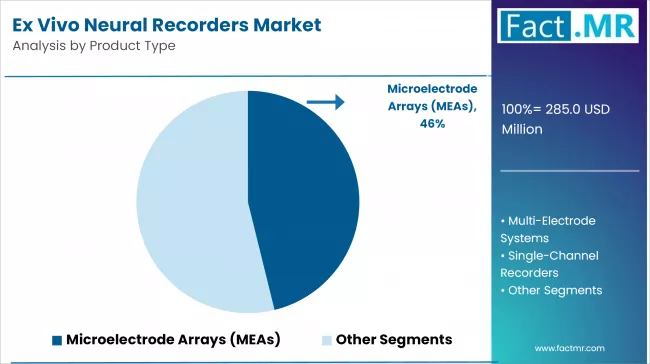
Ex Vivo Neural Recorders Market Analysis By Product Type | Source: Fact.MR
Microelectrode Arrays (MEAs) prevail in the Ex Vivo Neural Recorders Market because of their high capability of recording electrical signals of a number of neurons at a given time. They offer high spatial and temporal resolution and are important in investigating the neural connectivity, synaptic plasticity and brain slice activity. The constant demand is driven by increased use in neurodegenerative disease models, organoid models, and drug testing models.
Current innovations in 3D MEAs, flexible electrode materials, and microfluidic integration are more useful in improving their performance. Their affordability, flexibility and the fact that they can be used with academic and commercial research applications make MEAs the most popular category of products in this emerging neuroscience market.
Neuroscience research dominates due to rising demand for neural data
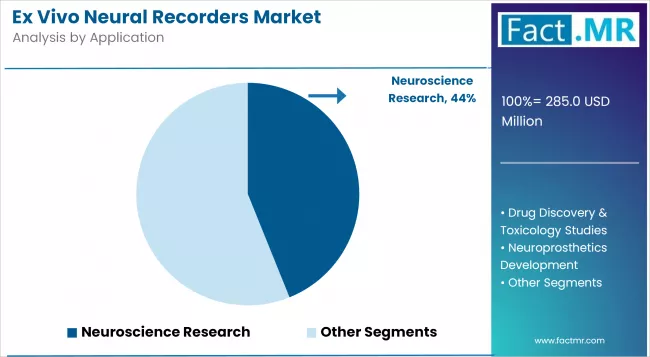
Ex Vivo Neural Recorders Market Analysis By Application | Source: Fact.MR
The greatest segment of the Ex Vivo Neural Recorders Market is used in Neuroscience Research with a significant proportion of total usage. It forms the basis of the neuronal network behavior, brain mapping, and neurophysiological disorders. The increase in the segment is driven by the increased investment in brain programs, more sophisticated electrophysiological methods, and the need to have real-time brain information.
Ex vivo systems are now being used in greater numbers to confirm both in vitro and in vivo results to give control environments and enable a very accurate analysis. With the increasing cases of neurological diseases, including Alzheimer, Parkinson, and epilepsy, the study of neuroscience still provides the world with technological innovations and advances of instruments.
Academic & research institutions remain key adopters driving innovation growth
Academic and Research Institutions constitute the initial users of ex vivo neural recording equipment with the highest number of installations across the globe. Such systems are used in these institutions to get basic neuroscience, pharmacological validation, and neurotechnology studies that are translational. The acquisition of high-performance recording tools is highly funded by government grants and academic collaborations.
The learning ecosystem promotes innovation in electrode design, data analysis, and hybrid neural interfaces. Moreover, universities are incubators of the initial levels of neurotech startups, broadening the application spectrum of the neural recorders. As more and more research is being done between biology, physics and engineering, this segment keeps the market growth and knowledge creation pegged.
Competitive Analysis
Key players in the Ex vivo neural recorders market include Axion BioSystems, 3Brain, Plexon Inc, Multi Channel Systems, Med64, Blackrock Neurotech, Cambridge, Neurotech and NeuroNexus.
The ex vivo neural recorders market is a pretty tight race, where players try to set themselves apart through technology, product quality, material innovation, and regional presence. The big names in the industry are SKF, Timken, Rexnord, NSK, KOYO, JTEKT, and ITT Corporation, and they focus on conveyor rollers, industrial rubber rollers, composite rollers, and asphalt rollers. Market players are employing R and D of long-lasting materials, precision engineering, and compatibility with automation to get a competitive edge. The outsourcing of OEMs, logistics, and manufacturing companies is contributing to the increase in market penetration. Price, reliability, technological integration, energy efficiency, and the ability to deliver high-performance rollers in all industries, constructions, and manufacturing industries worldwide, are some of the aspects that intensify the competition.
Recent Development
- In October 2024, Bioscience at Harvard presented the Mesh MEA organoid platform that allows the recording of electrophysiology signals from the inside of 3D organoids in real time and thus substantially increasing the internal-access recordings in ex vivo organoid systems .
- In January 2024, Harvard et al. reported a soft implantable device with dozens of sensors, which was able to achieve stable single-neuron recordings over months with improved biocompatibility.
Fact.MR has provided detailed information about the price points of key manufacturers of Ex Vivo Neural Recorders Market positioned across regions, sales growth, production capacity, and speculative technological expansion, in the recently published report.
Methodology and Industry Tracking Approach
The global ex vivo neural recorders market (2025) survey was conducted among 7,500 people from 25 different countries. Each key market had at least 200 participants. End users made up two-thirds of the respondents and included academic institutions, pharmaceutical and biotech companies. The remaining one-third were industry experts like neuroscientists, regulatory advisors, and instrumentation specialists. Information relating to product adoption, preferences for recording systems, technological integration, pricing trends, and research opportunities were gathered from September 2024 to August 2025. Market projections were created by means of more than 170 secondary sources, such as company reports, patents, scientific publications, and regulatory standards, along with statistical tools like regression analysis and scenario-based forecasting.
With Fact.MR monitoring consumer behavior, product efficacy, industry trends, and market opportunities since 2018, this report is becoming an authoritative source of information that stakeholders can rely on.
Segmentation
Segmentation of Ex Vivo Neural Recorders Market
-
By Product Type :
- Microelectrode Arrays (MEAs)
- Multi-Electrode Systems
- Single-Channel Recorders
- Optical Neural Recorders
- Other Accessories & Consumables
-
By Application :
- Neuroscience Research
- Drug Discovery & Toxicology Studies
- Neuroprosthetics Development
- Electrophysiological Studies
- Other Academic and Industrial Research
-
By Technology :
- Electrophysiology-Based Systems
- Optogenetics-Based Systems
- Hybrid Systems (Electrical + Optical)
-
By End Use Industry :
- Academic & Research Institutions
- Pharmaceutical & Biotechnology Companies
- CROs (Contract Research Organizations)
- Medical Device & Neurotechnology Companies
-
By Region :
- North America
- Latin America
- Western Europe
- Eastern Europe
- East Asia
- South Asia & Pacific
- Middle East & Africa
Frequently Asked Questions
What was the Global Ex Vivo Neural Recorders Market Size Reported by Fact.MR for 2025?
Who are the Major Players Operating in the Ex Vivo Neural Recorders Market?
What is the Estimated Valuation of the Ex Vivo Neural Recorders Market in 2035?
What Value CAGR did the Ex Vivo Neural Recorders Market Exhibit Over the Last Five Years?
Who worked on this report


Preview the report firsthand - request a free sample
Free SampleGet the brochure for pricing and purchase details
Download PDF