- Market Value (2025): USD 6.2 Bn
- Estimated Value (2026): USD 6.8 Bn
- Forecast Value (2036): USD 16.4 Bn
- CAGR (2026-2036): 9.2%
What is the Extended Hot-Hold Trays Market forecast to be worth by 2036?
USD 6.8 billion in 2026 to USD 16.4 billion by 2036 at a 9.2% CAGR.
- The Extended Hot-Hold Trays Market reached USD 6.2 billion in 2025.
- Demand is forecast to increase from USD 6.8 billion in 2026 to USD 16.4 billion by 2036.
- The market is forecast to record 9.2% CAGR from 2026 to 2036.
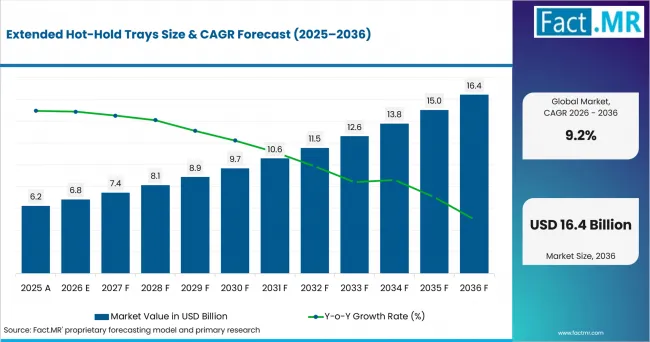
Extended Hot Hold Trays Value Analysis | Source: Fact.MR
What are the defining numbers behind Extended Hot-Hold Trays Market growth?
An absolute opportunity of USD 9.6 billion is expected between 2026 and 2036.
- Demand Drivers in the Market
- Foodservice teams need foodservice packaging that keeps prepared meals protected during holding and delivery. On June 11, 2026, the USDA Economic Research Service reported that inflation-adjusted U.S. food-away-from-home spending reached USD 1.41 trillion in 2025.
- Prepared-food makers need ready-meal trays and lidding structures that tolerate heat while preserving seal performance. Stable web handling and a wide sealing window are likely to reduce line adjustments during regular runs.
- Converters need sustainable plastic packaging structures as pack rules put more weight on recycling. Mono-material designs are likely to gain attention when they preserve seal performance and food protection.
- High-volume packers need barrier films that run on current equipment without losing print or sealing quality. Polymer orientation and compatible barrier layers therefore influence pack testing. Coated mono-web structures add another option for plastic tray formats and lids used with prepared foods.
- Key Segments Analyzed
- By Polymer Platform: PE mono-material is likely to hold 36.0% share in 2026. Converters can combine printable webs with sealant layers while keeping the structure within one polyethylene family.
- By Barrier Technology: EVOH-compatible barrier is forecast to account for 31.0% share in 2026. Food packs need oxygen protection without returning to complex foil or mixed-polymer structures.
- By Format: Printed rollstock is forecast to capture 29.0% share in 2026. Continuous web formats support high-volume form-fill-seal and lidding operations.
- By End-use: Snacks are estimated to represent 33.0% share in 2026. High packaging volumes support demand for printed barrier structures that protect product quality during delivery.
- Analyst Opinion at Fact.MR
- Shambhu Nath Jha, Principal Consultant at Fact.MR, states, “The plant test is whether a pack change survives the packing line and the food-holding cycle. Converters are likely to favor structures that preserve barrier and seal integrity while reducing pack complexity. Firms that combine film design with print control and line testing are better placed to support test programs.”
- Strategic Implications
- Barrier-material firms should show how EVOH-compatible or coated structures protect oxygen-sensitive foods while supporting recycling goals for the complete pack. The European Commission confirmed on February 11, 2025 that Regulation (EU) 2025/40 had entered into force.
- Printing specialists should align inks and coatings with mono-pack designs so graphics remain stable during converting and filling. Performance should remain consistent during storage and hot-hold handling.
- Food-pack makers should test pack changes on actual tray and lidding lines before wider use. Form-fill-seal trials should confirm web handling and seal behavior under plant conditions.
China leads at 10.9% CAGR through its large catering base and expanding prepared-food channels. France follows at 9.7% as food-manufacturing scale and European packaging rules support recyclable tray and lidding designs. The USA reaches 8.5% through high foodservice volumes and established prepared-meal channels. Japan also records 8.5%, supported by its large food-processing base and strict packaging requirements. Germany posts 8.3% as ready-meal production and packaging redesign sustain demand for heat-tolerant tray and lidding systems.
How does the Extended Hot-Hold Trays Market break down by segment?
PE mono-material is forecast to lead Polymer Platform at 36.0% share in 2026; while Snacks lead End-use at 33.0% share.
Which Polymer Platform leads?
PE mono-material is likely to hold 36.0% share in 2026.
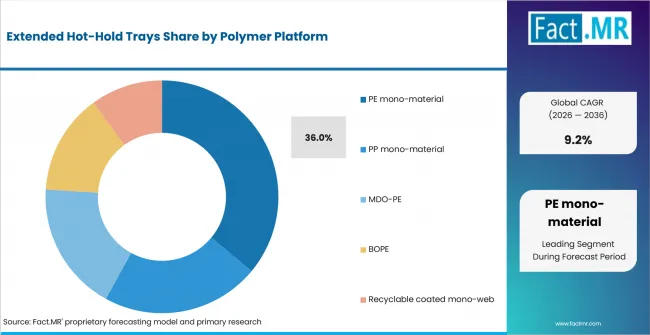
Extended Hot Hold Trays Analysis By Polymer Platform | Source: Fact.MR
PE mono-material is likely to lead because one polymer family can support print webs and sealant layers. Matte MDO polyethylene films show how an oriented PE structure can support print-web performance. BOPE provides another oriented route while PP remains useful where higher temperature resistance is required.
What leads the Barrier Technology segment?
EVOH-compatible barrier is forecast to account for 31.0% share in 2026.
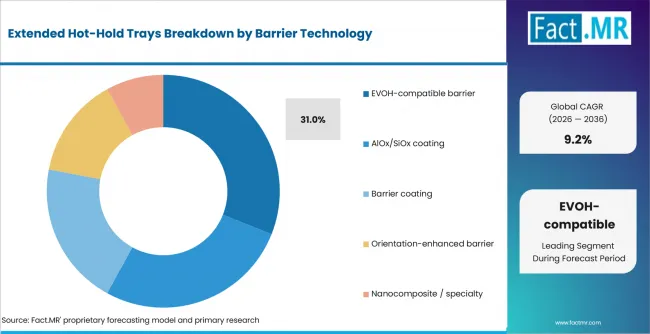
Extended Hot Hold Trays Analysis By Barrier Technology | Source: Fact.MR
EVOH-compatible barrier structures are likely to lead where oxygen control is required. AlOx and SiOx coatings offer thin barrier layers while other coatings can be tuned to food and converting conditions.
Barrier choice is likely to place more weight on recycling and lower material use. Firms therefore need systems that protect food while keeping the final structure suited to sorting and recycling. EVOH-compatible and coated structures are likely to gain attention when they preserve pack results without adding extra layers.
How does Format shape demand?
Printed rollstock is forecast to hold 29.0% share in 2026.
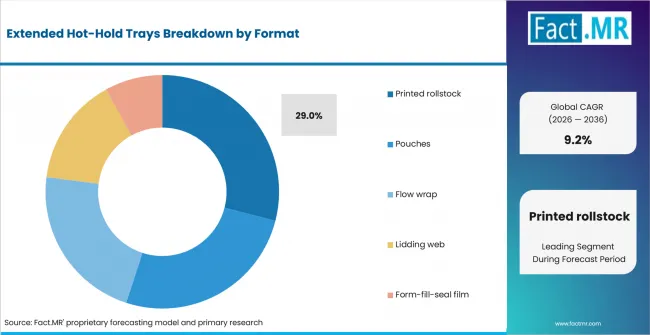
Extended Hot Hold Trays Analysis By Format | Source: Fact.MR
Printed rollstock is likely to fit large converting operations because continuous webs support stable graphics and automated handling. Pouches and flow wrap address portioned formats while lidding web connects directly with tray-sealing operations. In these lines lidding machines control heat and pressure during pack closure.
Printed rollstock is likely to remain useful where converters need stable graphics and controlled web transport at high line speeds. Material choice still depends on sealing temperature and the barrier needs of the packed food.
What supports Snacks within End-use?
Snacks are estimated to represent 33.0% share in 2026.
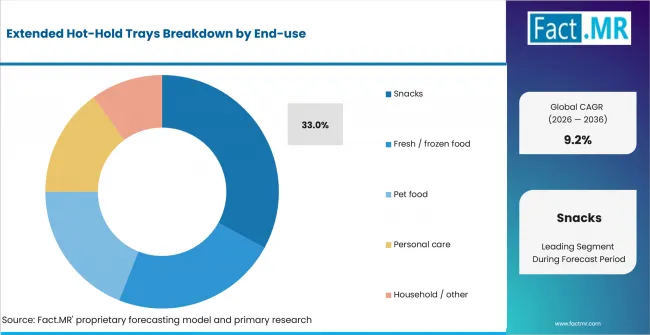
Extended Hot Hold Trays Analysis By End Use | Source: Fact.MR
Snacks are likely to lead the end-use mix because printed barrier structures support large unit volumes. Fresh food packaging adds thermal demands while pet food requires durable seals and dependable barrier control.
High-volume foodservice channels are likely to increase demand for packs that can be filled and sealed consistently across regular runs. Compact film handling is likely to support continuous-web formats in large plants.
What is accelerating Extended Hot-Hold Trays Market adoption, and what is holding it back?
Prepared-food volume and recyclable barrier redesign drive it; heat-performance testing and film trade-offs restrain it.
Drivers Impact Analysis
| DRIVER | (~) % IMPACT ON CAGR | GEOGRAPHIC RELEVANCE | IMPACT TIMELINE |
|---|---|---|---|
| Prepared-food and foodservice volume | +1.8% | North America, East Asia | Short term (<= 2 years) |
| Mono-material packaging redesign | +1.5% | Europe, North America | Medium term (2-4 years) |
| Barrier and shelf-life requirements | +1.2% | Global | Medium term (2-4 years) |
| High-speed converting and printing needs | +0.9% | Global | Long term (>= 4 years) |
Opportunity Impact Analysis
| OPPORTUNITY | (~) % IMPACT ON CAGR | GEOGRAPHIC RELEVANCE | IMPACT TIMELINE |
|---|---|---|---|
| Recycle-ready tray and lidding combinations | +1.3% | Europe, North America | Medium term (2-4 years) |
| Heat-stable mono-PE and mono-PP structures | +1.0% | Global | Long term (>= 4 years) |
| Coated mono-web barrier systems | +0.8% | Europe, East Asia | Short term (<= 2 years) |
Restraints Impact Analysis
| RESTRAINT | (~) % IMPACT ON CAGR | GEOGRAPHIC RELEVANCE | IMPACT TIMELINE |
|---|---|---|---|
| Heat and seal-window qualification | -0.8% | Global | Short term (<= 2 years) |
| Barrier-recyclability trade-offs | -0.6% | Europe, North America | Medium term (2-4 years) |
| Conversion cost and equipment validation | -0.4% | Global | Long term (>= 4 years) |
Which countries are scaling the Extended Hot-Hold Trays Market through 2036?
- China leads the country comparison at 10.9% CAGR and France follows at 9.7% across the 2026 to 2036 period.
- The USA and Japan are each forecast at 8.5% CAGR while Germany is projected at 8.3% through 2036.
- Country performance is likely to differ with prepared-food scale and pack rules. Converter test needs are forecast to shape adoption at plant level.
Comparable growth rates are likely to create different entry conditions across the five countries. Foodservice activity shapes pack volumes while rules and installed equipment influence the pace of pack testing.
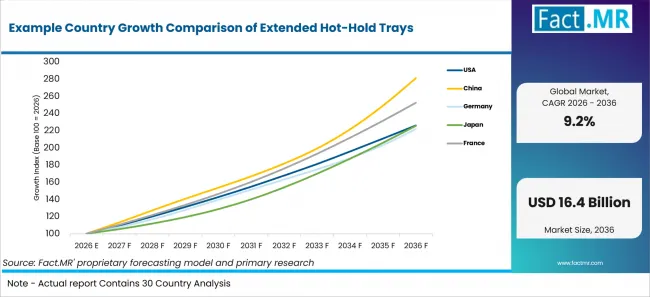
Example Country Growth Comparison Of Extended Hot Hold Trays | Source: Fact.MR
| Country | CAGR (2026-2036) |
|---|---|
| United States | 8.5% |
| China | 10.9% |
| Germany | 8.3% |
| Japan | 8.5% |
| France | 9.7% |
What supports USA adoption?
8.5% CAGR, backed by high foodservice volumes and established prepared-meal channels.
U.S. foodservice scale is likely to sustain demand for tray and lidding systems that tolerate filling and holding conditions. Large restaurant and central-kitchen networks provide a broad use base for packs that must seal reliably during high-throughput production. Pack changes are likely to gain faster acceptance when they preserve line speed and fit current tray-sealing equipment.
How is China scaling demand?
10.9% CAGR, driven by a large catering base and expanding prepared-food channels.
China combines high catering activity with large-scale food processing and delivery. The National Bureau of Statistics reported on 20 January 2026 that catering income reached 5,798.2 billion yuan in 2025. The scale of this channel is likely to support prepared-food packs where sealing consistency and compact handling are buyer needs.
What is supporting Germany’s adoption?
8.3% CAGR, backed by ready-meal production and packaging redesign needs.
Germany has a measurable prepared-meal base that is likely to support tray and lidding demand. Destatis reported on 14 January 2026 that domestic production reached 1.7 million tonnes of ready meals in 2024. These volumes create regular testing needs for packaging that guards food quality and maintains dependable sealing on current equipment.
How does Japan perform?
8.5% CAGR, led by a large food-processing base and strict pack standards.
Japan’s processed-food sector provides a substantial use base for barrier and lidding materials. On April 1, 2026, USDA Foreign Agricultural Service reported that Japan’s food processing sector was valued at USD 174 billion in 2025. Food makers are likely to maintain tight control over seal integrity and pack appearance across compact retail formats.
What supports France growth?
9.7% CAGR, backed by food-manufacturing scale and European pack rules.
France combines a large food-manufacturing base with pressure for more recyclable pack design. Food processors are likely to favor tray and lidding systems that balance barrier needs with line fit. Pack changes are expected to move faster when converters can meet food-contact rules without adding extra process steps.
Who leads the Extended Hot-Hold Trays Market?
Amcor, Sabert, Anchor Packaging, Coveris, Huhtamaki, and ProAmpac form the profiled competitive group in the Extended Hot-Hold Trays Market. Their market relevance comes from food-contact packaging, tray systems, barrier structures, and related converting capabilities used for prepared-food and hot-hold applications.
Amcor is associated with tray-pack development that combines convenience, barrier performance, and sustainability considerations. Coveris adds a monomaterial packaging approach for refrigerated foods, aligning its portfolio with the wider shift toward simpler structures that still protect food and maintain sealing performance.
ProAmpac competes through recyclable and recycle-ready mono-material packaging technologies, while Sabert, Anchor Packaging, and Huhtamaki broaden the provider set across food-contact tray and related packaging requirements. Their inclusion reflects the need for suppliers that can support practical pack formats rather than stand-alone raw materials or equipment.
Which companies are the key providers?
Key companies include Amcor; Sabert; Anchor Packaging; Coveris; Huhtamaki; and ProAmpac.
- Amcor
- Sabert
- Anchor Packaging
- Coveris
- Huhtamaki
- ProAmpac
Bibliography
- Zeballos, E., & Sinclair, W. (2026, June 11). Total U.S. food spending reached $2.51 trillion in 2025. U.S. Department of Agriculture, Economic Research Service.
- National Bureau of Statistics of China. (2026, January 20). Total retail sales of consumer goods in December 2025.
- Statistisches Bundesamt (Destatis). (2026, January 14). Produktion von Fertiggerichten binnen fünf Jahren mengenmäßig um 25,6 % gestiegen [Production of ready meals increased by 25.6% in volume within five years].
- U.S. Department of Agriculture, Foreign Agricultural Service. (2026, April 1). Food processing ingredients annual (Report No. JA2026-0012).
- Amcor. (2025, June 24). Amcor and Cofigeo partner to create multi-compartment tray designed for convenience and sustainability.
- Directorate-General for Environment. (2025, February 11). New rules enter into force for a more sustainable and competitive packaging economy. European Commission.
- Coveris. (2025, September 10). Coveris combines freshness and sustainability with new monomaterial pack for refrigerated goods.
- ProAmpac. (2025, March 4). Bolstering sustainable packaging leadership, ProAmpac expands intellectual property portfolio.
This Report Answers
- The report explains how polymer platform and barrier technology shape pack choices for extended hot-hold and prepared-food uses.
- Segment analysis reviews printed rollstock and pouches alongside flow wrap and lidding web. Form-fill-seal film is assessed against the 2026 segment shares.
- Competition review covers the profiled companies across flexible packaging and lidding. It also covers barrier structures and related tray-packaging capability.
- Use analysis considers heat stability and barrier control together with sealing and printing. Line fit is assessed because it influences pack testing.
What does the Extended Hot-Hold Trays Market cover?
The study covers tray and barrier-pack systems built around the defined polymer and barrier categories. Related thermoform packaging is included when it supports tray or lidding functions used in hot-hold and adjacent listed end uses.
The taxonomy covers PE and PP mono-material platforms alongside MDO-PE and BOPE. Coated mono-web structures and the defined barrier methods remain within scope.
What is included in the scope?
The scope includes tray-pack designs and barrier films that use the defined polymer and barrier categories. Printed rollstock and lidding web remain included alongside on-the-go food packaging formats and the other listed end uses.
Barrier study includes EVOH-compatible structures and oxide coatings alongside orientation-enhanced systems. Adjacent fresh meat packaging informs shelf-life context while oriented polyethylene films provide film context for MDO-PE structures.
What is excluded from the scope?
The scope excludes tray or film products that fall outside the defined polymer platform and barrier technology taxonomy. Raw resin sold without converted packaging remains outside the market boundary.
Stand-alone processing and sealing equipment is used only as operating context and remains outside market sizing.
How Was the Analysis Built?
The analysis draws on 120+ sources, 35+ company portfolios, 25+ countries, and more than 20 industry interviews.
- Primary Research: Primary research includes discussions with manufacturers, service providers, technology developers, distributors, end users, and subject-matter experts. These conversations examine purchasing priorities, product adoption, operational challenges, approval requirements, competitive positioning, and the factors that influence wider market acceptance.
- Desk Research: Desk research covers government statistics, regulatory publications, company filings, trade data, technical studies, industry associations, standards, public policy, and other authoritative sources. Every source used in the analysis is documented in the bibliography.
- Market Sizing and Forecasting: Market estimates combine historical performance, demand indicators, pricing and volume trends, segment shares, company participation, country-level growth, adoption patterns, investment activity, and barriers to market expansion.
- Data Validation and Update Cycle: Findings are validated by comparing primary interviews with public data, company activity, regulatory changes, trade patterns, and industry developments. Regular updates review new product launches, capacity changes, partnerships, approvals, and shifts in commercial adoption.
What is the report’s scope and coverage?
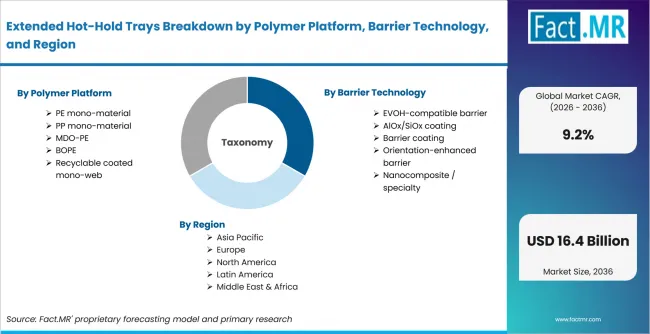
Extended Hot Hold Trays Breakdown By Polymer Platform, Barrier Technology, And Region | Source: Fact.MR
| Attribute | Details |
|---|---|
| Quantitative Units | USD billion in 2026 to USD billion by 2036 at a CAGR |
| Market Definition | Tray and associated barrier-pack systems designed for hot-hold food uses and the listed adjacent end uses. The study uses the defined polymer platform; barrier technology; format; and end-use taxonomy. |
| Polymer Platform | PE mono-material; PP mono-material; MDO-PE; BOPE; Recyclable coated mono-web |
| Barrier Technology | EVOH-compatible barrier; AlOx/SiOx coating; Barrier coating; Orientation-enhanced barrier; Nanocomposite / specialty |
| Format | Printed rollstock; Pouches; Flow wrap; Lidding web; Form-fill-seal film |
| End-use | Snacks; Fresh / frozen food; Pet food; Personal care; Household / other |
| Regions Covered | North America; Latin America; Western Europe; Eastern Europe; East Asia; South Asia & Pacific; Middle East & Africa |
| Countries Covered | United States; China; Germany; Japan; France |
| Key Companies Profiled | Amcor; Sabert; Anchor Packaging; Coveris; Huhtamaki; ProAmpac |
| Forecast Period | 2026 to 2036 |
| Approach | Hybrid top-down and bottom-up approach using foodservice demand signals and prepared-food production. Pack rules and segment shares support the model. Country growth and provider portfolio review complete the approach. |
How is the market segmented?
-
By Polymer Platform
- PE mono-material
- PP mono-material
- MDO-PE
- BOPE
- Recyclable coated mono-web
-
By Barrier Technology
- EVOH-compatible barrier
- AlOx/SiOx coating
- Barrier coating
- Orientation-enhanced barrier
- Nanocomposite / specialty
-
By Format
- Printed rollstock
- Pouches
- Flow wrap
- Lidding web
- Form-fill-seal film
-
By End-use
- Snacks
- Fresh / frozen food
- Pet food
- Personal care
- Household / other
-
By Region
- North America
- Latin America
- Western Europe
- Eastern Europe
- East Asia
- South Asia & Pacific
- Middle East & Africa