- Market Value (2025): USD 604.8 Mn
- Estimated Value (2026): USD 733.0 Mn
- Forecast Value (2036): USD 5013.4 Mn
- CAGR (2026-2036): 21.2%
What is the Fast-Charge Enabling Graphene Coatings Market forecast to be worth by 2036?
USD 733.0 million in 2026 to USD 5013.4 million by 2036, at a 21.2% CAGR.
- The Fast-Charge Enabling Graphene Coatings Market was valued at USD 604.8 million in 2025.
- Demand is projected to increase from USD 733.0 million in 2026 to USD 5013.4 million by 2036.
- The market is forecast to grow at a 21.2% CAGR from 2026 to 2036. Battery-material teams and cell makers are seeking faster charging without reducing electrode life.
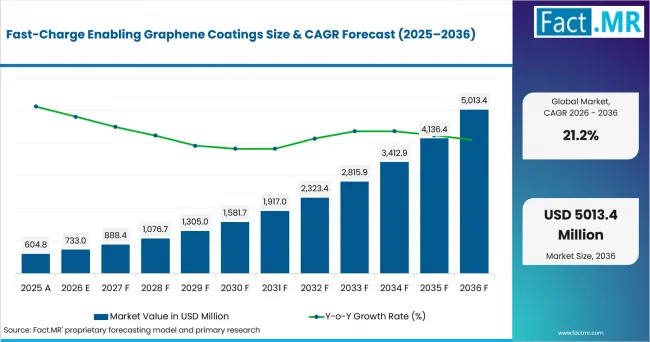
Fast Charge Enabling Graphene Coatings Value Analysis | Source: Fact.MR
What are the defining numbers behind Fast-Charge Enabling Graphene Coatings Market growth?
USD 4280.4 million absolute opportunity by 2036, led by graphene shells on cathode particles, fast-charge performance targets and EV cells.
- Demand Drivers in the Market
- EV-cell teams need cathode coatings that move electrons quickly during fast charging. The coating must also protect active particles from repeated stress.
- Cathode-material producers need coatings that work with NMC and other common chemistries. Testing must show clear gains at both the particle and electrode level.
- Battery-pack teams need stable fast charging over many cycles. They therefore test graphene layers for conductivity, heat response, and high-voltage protection.
- Grid-storage systems need cells that can cycle often and deliver steady power. This expands the use of conductive coatings beyond vehicle batteries.
- Key Segments Analyzed
- By Coating Architecture: Graphene shell on cathode particles is expected to hold 37.0% share in 2026 because a conformal interface can place conductive carbon directly around active cathode material.
- By Cathode Chemistry: NMC is projected to account for 30.0% share in 2026 as nickel-manganese-cobalt materials remain relevant to EV cells that balance energy density with power delivery.
- By Fast-Charge Performance Target: Fast charge is anticipated to capture 34.0% share in 2026 owing to the direct commercial need to reduce charging time while managing electrode stress.
- By Application: EV cells are estimated to represent 48.0% share in 2026 as vehicle battery deployment creates the broadest qualification pathway for fast-charge cathode coatings.
- Analyst Opinion at Fact.MR
- Shambhu Nath Jha, Principal Consultant at Fact.MR, states, “The qualification bottleneck is more important than the graphene label itself. Cell developers need repeatable coating coverage and evidence that the cathode remains stable at higher charging rates. Suppliers that combine consistent graphene dispersion with cathode-process compatibility are expected to secure the clearest route from laboratory validation to commercial cell programs.”
- Strategic Implications
- Cathode-material producers should test coating uniformity and electrical results on particles first. They can then move to larger electrode trials.
- Cell makers should compare faster charging with cycle life. Shorter charging times should still keep battery life within the required range.
- Graphene producers should provide dispersion and surface data for each battery use. Cell makers need to know how the material behaves in the chosen cathode process.
- EV and specialty-battery developers should prioritize repeatable pilot lots and traceable quality control during scale-up. NanoXplore announced on September 17, 2026 that it had been selected as a qualified supplier under Canada’s Defence Drone Initiative Marketplace; the qualification covers NanoXplore graphene-enhanced composites and graphene-enhanced lithium-ion cells produced by VoltaXplore.
Switzerland is forecast to record 23.4% CAGR through 2036 as vehicle electrification and charging-network expansion increase the addressable battery base. South Korea is projected to post 22.9% as domestic EV registrations and battery-manufacturing capability expand. The USA is anticipated to reach 21.4% through grid-storage additions and battery-supply-chain investment. Japan is estimated at 19.8% as national battery policy emphasizes power density and next-generation cells. Germany is forecast at 18.3% as BEV registrations and fast-charging infrastructure continue to rise.
How does the Fast-Charge Enabling Graphene Coatings Market break down by segment?
EV cells lead Application at 48.0%; graphene shell on cathode particles leads Coating Architecture at 37.0%.
Which Coating Architecture leads?
Graphene shell on cathode particles is expected to hold 37.0% share in 2026.
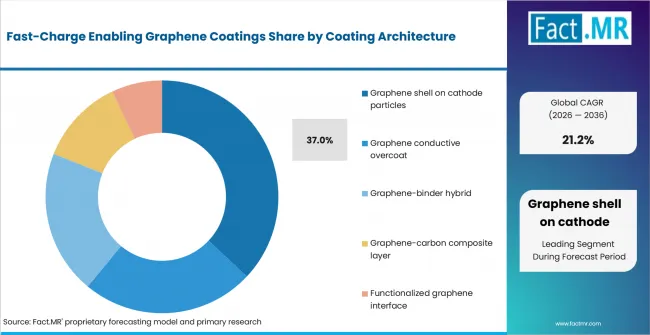
Fast Charge Enabling Graphene Coatings Analysis By Coating Architecture | Source: Fact.MR
Graphene shells place conductive material directly around active cathode particles. The architecture is expected to improve electron pathways while keeping the coating close to the electrochemically active surface. Conductive overcoats act at electrode level and graphene-binder hybrids integrate conductivity into the binder network. A U.S. Department of Energy-hosted Argonne presentation dated June 11, 2019 shows NCM622 and NCM811 cathode materials supplied to Volexion to enable its proprietary graphene coating technology.
What leads the Cathode Chemistry segment?
NMC is projected to account for 30.0% share in 2026.
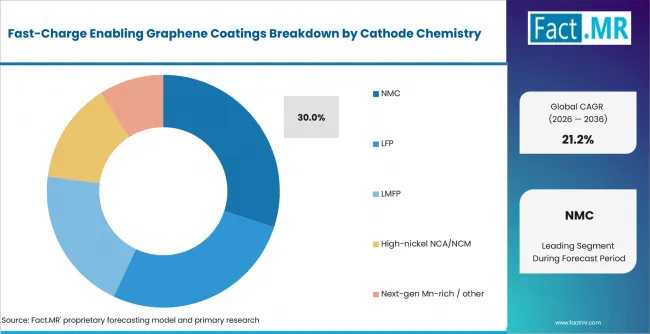
Fast Charge Enabling Graphene Coatings Analysis By Cathode Chemistry | Source: Fact.MR
NMC is expected to lead because EV cells need both high energy density and strong power output. Graphene is tested as a coating within the cathode system. LFP and LMFP create phosphate-based alternatives, while high-nickel NCA/NCM raises surface-stability requirements. Japan’s METI revised its battery strategy in June 2026 to include power density, alongside energy density, as a dimension of battery competitiveness. This policy direction supports greater focus on technologies and materials designed for high-output battery performance.
How does Fast-Charge Performance Target shape demand?
Fast charge is anticipated to capture 34.0% share in 2026.
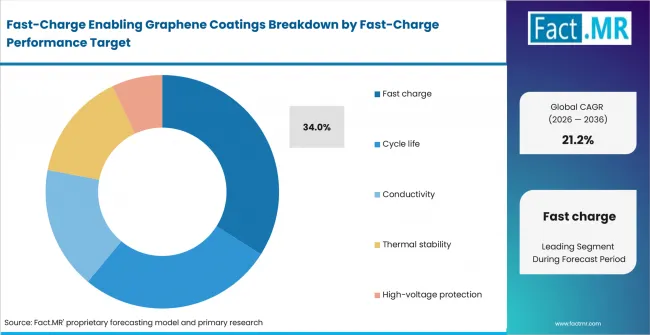
Fast Charge Enabling Graphene Coatings Analysis By Fast Charge Performance Target | Source: Fact.MR
Fast charge is expected to lead because charging time matters to EV users. Coatings must keep good electrical paths as current rises. They must also limit stress on cathode particles. Cycle life, conductivity, thermal stability and high-voltage protection remain adjacent targets. The IEA reported in May 2026 that light-duty vehicles represented more than 85% of global EV battery deployment in 2025.
What supports EV cells within Application?
EV cells are estimated to represent 48.0% share in 2026.
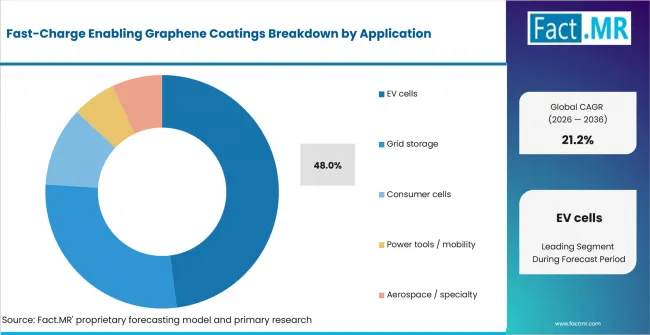
Fast Charge Enabling Graphene Coatings Analysis By Application | Source: Fact.MR
EV cells are expected to lead because vehicle batteries must handle high energy use and shorter charging stops. Material changes move through electrode and finished-cell checks before vehicle integration. Grid storage places more weight on cycling and stationary power delivery, while consumer and specialty cells create smaller high-power programs. The application mix therefore keeps EV qualification at the center of commercial coating development.
What is accelerating Fast-Charge Enabling Graphene Coatings Market adoption, and what is holding it back?
Demand is supported by fast-charge needs. Uneven coatings and long cell tests can slow wider use.
Drivers Impact Analysis
| DRIVER | (~) % IMPACT ON CAGR | GEOGRAPHIC RELEVANCE | IMPACT TIMELINE |
|---|---|---|---|
| EV fast-charge requirements | +3.2% | North America, Europe, East Asia | Short term (<= 2 years) |
| Cathode conductivity improvement | +2.7% | Global | Short term (<= 2 years) |
| Battery manufacturing expansion | +2.1% | USA, Japan, South Korea | Medium term (2-4 years) |
| Grid-storage buildout | +1.5% | North America, Europe | Medium term (2-4 years) |
| Specialty high-power cells | +1.0% | Global | Long term (>= 4 years) |
Source: Fact.MR analysis. Updated Sep 22, 2026
Opportunity Impact Analysis
| OPPORTUNITY | (~) % IMPACT ON CAGR | GEOGRAPHIC RELEVANCE | IMPACT TIMELINE |
|---|---|---|---|
| Drop-in cathode particle coatings | +2.0% | Global | Short term (<= 2 years) |
| High-nickel cathode protection | +1.6% | East Asia, North America, Europe | Medium term (2-4 years) |
| Graphene-enabled specialty batteries | +1.1% | North America, Europe | Medium term (2-4 years) |
| Grid and high-power stationary cells | +0.8% | North America, Europe, East Asia | Long term (>= 4 years) |
Source: Fact.MR analysis. Updated Sep 22, 2026
Restraints Impact Analysis
| RESTRAINT | (~) % IMPACT ON CAGR | GEOGRAPHIC RELEVANCE | IMPACT TIMELINE |
|---|---|---|---|
| Cell-level qualification time | -1.0% | Global | Short term (<= 2 years) |
| Coating uniformity at scale | -0.8% | Global | Medium term (2-4 years) |
| Added process cost | -0.6% | North America, Europe, East Asia | Medium term (2-4 years) |
| Competing conductive materials | -0.4% | Global | Long term (>= 4 years) |
Source: Fact.MR analysis. Updated Sep 22, 2026
Which countries are scaling Fast-Charge Enabling Graphene Coatings Market fastest?
- The displayed country range spans 5.1 percentage points, from Switzerland at 23.4% to Germany at 18.3% CAGR through 2036.
- Switzerland remains 0.5 percentage point above South Korea as plug-in vehicle penetration and charging infrastructure broaden the battery-use base.
- South Korea remains 1.5 percentage points above the USA as domestic EV registrations expand alongside a large battery manufacturing ecosystem.
- The USA remains 1.6 percentage points above Japan through grid-storage additions and federal support for battery materials and manufacturing.
- Japan remains 1.5 percentage points above Germany as its revised battery strategy targets higher power density and a 150 GWh annual domestic manufacturing base.
Similar growth rates come from different market drivers. Switzerland benefits from EV use and a dense charging network. South Korea combines EV demand with battery production. The USA has strong storage demand. Japan supports new battery technology, while Germany is adding BEVs and fast chargers.
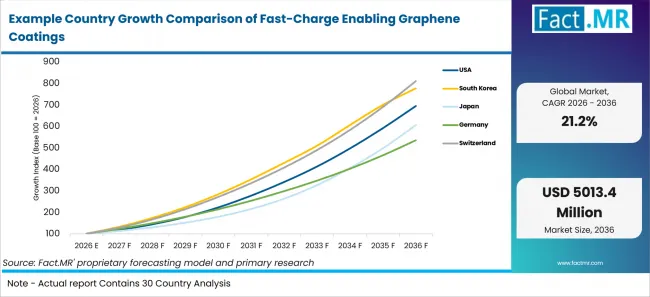
Example Country Growth Comparison Of Fast Charge Enabling Graphene Coatings | Source: Fact.MR
| Country | CAGR (2026-2036) |
|---|---|
| Switzerland | 23.4% |
| South Korea | 22.9% |
| United States | 21.4% |
| Japan | 19.8% |
| Germany | 18.3% |
Source: Fact.MR analysis. Updated Sep 22, 2026
How is Switzerland scaling demand?
23.4% CAGR, supported by plug-in vehicle uptake and charging-network expansion.
Swiss battery developers are expected to evaluate graphene cathode coatings through vehicle and specialty-cell programs where charge acceptance has a clear operating value. The Federal Statistical Office reported in February 2026 that Switzerland registered 232,602 new passenger cars in 2025 and electric-car registrations increased 16%. That shift enlarges the installed EV base for materials designed around faster charging. Qualification is expected to remain centered on coating uniformity, cell-level cycle retention and compatibility with established cathode processing.
What supports South Korea adoption?
22.9% CAGR, driven by EV uptake and an established battery manufacturing base.
South Korea’s battery ecosystem is expected to provide several routes for graphene coating trials across NMC and other commercial cathode chemistries. The Ministry of Land, Infrastructure and Transport reported in January 2026 that electric vehicles represented 13% of new vehicle registrations in 2025. Domestic cell manufacturing gives material developers access to electrode and pack validation within the same industrial base. Commercial progress is expected to depend on repeatable dispersion, stable coating thickness and measurable fast-charge gains at production scale.
What supports USA adoption?
21.4% CAGR, led by battery manufacturing investment and grid-storage additions.
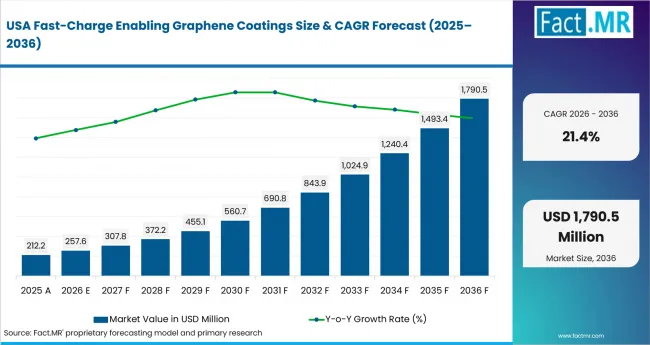
Fast Charge Enabling Graphene Coatings Country Value Analysis | Source: Fact.MR
The United States is expected to combine vehicle-cell development with a large stationary-storage route for fast-charge and high-power coating technologies. The U.S. Energy Information Administration reported in February 2026 that developers added a record 15 GW of utility-scale battery storage in 2025. That capacity broadens the application base beyond passenger vehicles and gives coating suppliers another path for cycle-life validation. Commercial adoption is expected to favor technologies that integrate with existing cathode workflows and show cell-level gains that justify an added coating step.
How is Japan developing demand?
19.8% CAGR, backed by battery industrial policy and power-density targets.
Japan’s battery strategy is expected to keep power performance and domestic manufacturing capability closely linked. The Ministry of Economy, Trade and Industry revised the Battery and Power Industry Strategy in June 2026 and set a target for 150 GWh of annual domestic manufacturing capacity from 2030 to the mid-2030s. The same policy framework places power density alongside energy density as a competitiveness measure. Graphene cathode coatings are therefore expected to be judged on reproducible output gains, chemistry compatibility and fit with Japanese cell qualification practices.
What is supporting Germany adoption?
18.3% CAGR, shaped by BEV registrations and charging infrastructure.
Germany’s automotive engineering base is expected to keep fast-charge performance tied to repeatable cell qualification and vehicle-level durability. The Federal Statistical Office reported in January 2026 that around 545,100 battery-electric cars were newly registered in 2025 and represented 19.1% of passenger-car registrations. That vehicle volume supports continued testing of cathode materials aimed at faster charge acceptance. Graphene coating suppliers are expected to compete through process consistency, documented electrode behavior and compatibility with high-volume automotive manufacturing.
Who leads the Fast-Charge Enabling Graphene Coatings Market?
Volexion has direct relevance to cathode encapsulation, with U.S. Department of Energy-hosted evidence documenting graphene coating of NCM cathode materials and Volexion describing its technology as graphene encapsulation of lithium-ion cathode active materials.
NanoXplore participates through graphene production and graphene-enhanced battery-cell development. HydroGraph supplies graphene materials evaluated in battery and supercapacitor applications.HydroGraph reported in January 2025 that its graphene products had been selected during 2024 for testing and use in projects involving battery materials and supercapacitors. Competitive differentiation across these suppliers can involve material purity, batch consistency, dispersion behavior, conductivity and application-development support.
Which companies are the key providers?
Companies profiled include Volexion; NanoXplore; NanoGraf; and HydroGraph.
- Volexion
- NanoXplore
- NanoGraf
- HydroGraph
Bibliography
- International Energy Agency. (2026, May 20). Electric vehicle batteries. In Global EV Outlook 2026.
- U.S. Energy Information Administration. (2026, February 20). New U.S. electric generating capacity expected to reach a record high in 2026.
- Statistisches Bundesamt (Destatis). (2026, January 22). E-Autos und Plug-in-Hybride: Ausstattung in Haushalten hängt stark vom Einkommen ab [Electric cars and plug-in hybrids: Household ownership depends strongly on income].
- Ministry of Economy, Trade and Industry. (2026, June 2). “Battery Industry Strategy” revised as the “Battery and Power Industry Strategy”.
- Federal Statistical Office. (2026, February 4). Renewed surge in electric vehicles [Press release].
- NanoXplore Inc. (2026, September 17). NanoXplore and VoltaXplore qualify to supply Canada’s Defence Drone Initiative Marketplace.
- HydroGraph Clean Power Inc. (2025, January 14). HydroGraph to participate in January investor conferences.
This Report Answers
- The report explains where fast-charge enabling graphene coatings fit across cathode-particle, electrode and interface architectures. It also compares the profiled cathode chemistries and performance targets.
- Segment analysis identifies the leading profiled subsegments and explains the technical reasons cell developers may prioritize each coating route.
- Country analysis examines Switzerland, South Korea, the United States, Japan and Germany using the country CAGRs and current official battery or vehicle indicators.
- Competitive analysis reviews the six profiled companies against current evidence of graphene, coating or battery activity with company market-share values omitted.
- Application analysis assesses EV cells, grid storage and specialty uses where fast charging, conductivity and cycle life influence material qualification.
What does the Fast-Charge Enabling Graphene Coatings Market cover?
The market covers graphene-based coatings and interfaces applied at the lithium-ion cathode to improve charge-rate capability and conductive pathways. It overlaps with material development in the lithium-ion battery cathode market and with conductive surface technologies tracked in the thermal graphene coatings market.
The assessment focuses on cathode-side graphene functions across NMC, LFP, LMFP and high-nickel systems. Wider material context comes from the graphene coating market and the graphene energy storage market.
What is included in the scope?
Included architectures cover particle shells, conductive overcoats, binder hybrids, graphene-carbon composite layers and functionalized interfaces. Upstream material context is considered through the graphene market and the adjacent graphene electrodes market.
Applications include EV cells, grid storage, consumer cells, power tools and specialty batteries. Downstream battery context is connected with the lithium-ion battery market and the battery electrolyte additives market.
What is excluded from the scope?
The revenue boundary focuses on cathode coatings and interfaces. Anode-centered graphene technologies are treated within the separate graphene battery anodes market, while broader coating additives are tracked in the graphene-based coating additives market.
Complete battery packs, standalone anode systems and electrolyte formulations fall outside the core revenue boundary when they are sold independently of a cathode graphene coating function. The analysis therefore remains centered on coating materials and interface technologies used directly with the cathode or cathode electrode.
How Was the Analysis Built?
The analysis draws on 120+ sources, 35+ company portfolios, 25+ countries, and more than 20 industry interviews.
- Primary Research: The study uses interviews with manufacturers, technology teams, distributors, end users, and industry experts. These talks cover buying needs, product use, operatingissues, approvals, competition, and market adoption.
- Desk Research: Desk research covers government statistics, regulatory publications, company filings, trade data, technical studies, industry associations, standards, public policy, and other authoritative sources. Every source used in the analysis is documented in the bibliography.
- Market Sizing and Forecasting: Market estimates use past results, demand trends, prices, volumes, segment shares, company activity, country growth, adoption, investment, and barriers to growth.
- Data Validation and Update Cycle: Findings are validated by comparing primary interviews with public data, company activity, regulatory changes, trade patterns, and industry developments. Regular updates review new product launches, capacity changes, partnerships, approvals, and shifts in commercial adoption.
Segmentation
What is the report’s scope and coverage?
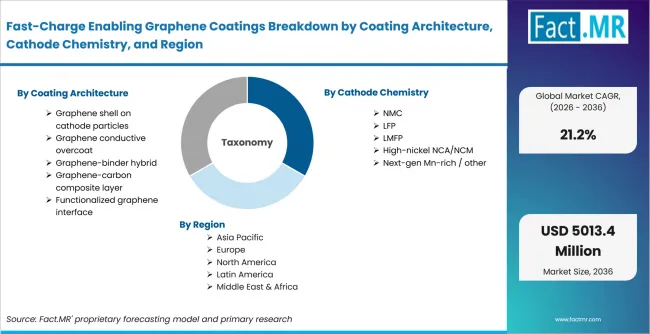
Fast Charge Enabling Graphene Coatings Breakdown By Coating Architecture, Cathode Chemistry, And Region | Source: Fact.MR
| Attribute | Details |
|---|---|
| Quantitative Units | USD million |
| Market Definition | Graphene-based coatings and interfaces applied to lithium-ion battery cathode materials or electrodes to improve charge-rate capability, conductivity, cycle performance, thermal stability or high-voltage behavior. |
| Coating Architecture | Graphene shell on cathode particles; Graphene conductive overcoat; Graphene-binder hybrid; Graphene-carbon composite layer; Functionalized graphene interface |
| Cathode Chemistry | NMC; LFP; LMFP; High-nickel NCA/NCM; Next-gen Mn-rich / other |
| Fast-Charge Performance Target | Fast charge; Cycle life; Conductivity; Thermal stability; High-voltage protection |
| Application | EV cells; Grid storage; Consumer cells; Power tools / mobility; Aerospace / specialty |
| Regions Covered | North America; Latin America; Western Europe; Eastern Europe; East Asia; South Asia & Pacific; Middle East & Africa |
| Countries Covered | United States; South Korea; Japan; Germany; Switzerland |
| Key Companies Profiled | Volexion; NanoXplore; NanoGraf; HydroGraph |
| Forecast Period | 2026 to 2036 |
| Approach | Hybrid top-down and bottom-up assessment using market values and segment shares, official battery and EV indicators, application demand, country-level adoption and verified provider portfolios. |
Source: Fact.MR analysis. Updated Sep 22, 2026
How is the market segmented?
-
By Coating Architecture:
- Graphene shell on cathode particles
- Graphene conductive overcoat
- Graphene-binder hybrid
- Graphene-carbon composite layer
- Functionalized graphene interface
-
By Cathode Chemistry:
- NMC
- LFP
- LMFP
- High-nickel NCA/NCM
- Next-gen Mn-rich / other
-
By Fast-Charge Performance Target:
- Fast charge
- Cycle life
- Conductivity
- Thermal stability
- High-voltage protection
-
By Application:
- EV cells
- Grid storage
- Consumer cells
- Power tools / mobility
- Aerospace / specialty
-
By Region:
- North America
- Latin America
- Western Europe
- Eastern Europe
- East Asia
- South Asia & Pacific
- Middle East & Africa
Frequently Asked Questions
How big is the fast-charge enabling graphene coatings market in 2026?
What is the CAGR of the fast-charge enabling graphene coatings market from 2026 to 2036?
Which coating architecture leads the fast-charge enabling graphene coatings market?
Which application leads the fast-charge enabling graphene coatings market?
Which companies are profiled in the fast-charge enabling graphene coatings market?
Who worked on this report


Preview the report firsthand - request a free sample
Free SampleGet the brochure for pricing and purchase details
Download PDF