- Market size in 2025:USD 238.3
- Estimated market size in 2026:USD 256.0 million
- Projected market size by 2036:USD 753.5 million
- CAGR (2026-2036):11.4%
What is the fermented scalp essences market forecast to be worth by 2036?
USD 256.0 million in 2026 to USD 753.5 million by 2036, at 11.4% CAGR.
- The fermented scalp essences market crossed a valuation of USD 238.3 million in 2025.
- Demand is expected to increase from USD 256.0 million in 2026 to USD 753.5 million by 2036.
- The market is forecast to record 11.4% CAGR from 2026 to 2036 as scalp-first beauty routines shift from shampoo-only care toward leave-on hydration, barrier support and treatment-led premiumization.
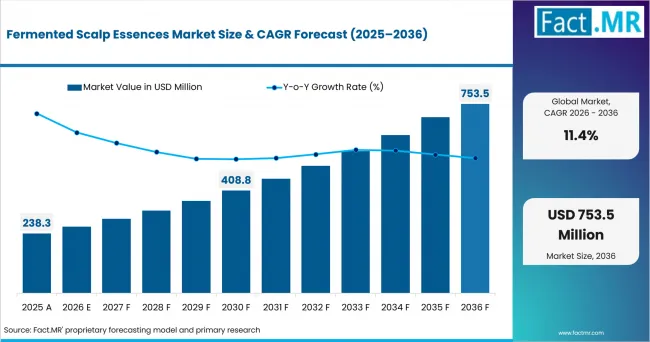
Fermented Scalp Essences Market Market Value Analysis | Source: Fact.MR
What are the defining numbers behind fermented scalp essences growth?
USD 497.5 million absolute opportunity by 2036, led by South Korea and China.
- Demand Drivers in the Market
- Beauty retailers are expanding scalp-first shelves as consumers treat scalp dryness and sensitivity like facial skin concerns.
- Formulators are using fermented bases to support softer texture stories without shifting products into medical hair-loss claims.
- DTC brands are likely to test scalp essences because subscription and routine-led ordering fit leave-on daily products.
- Salons are expected to use scalp diagnostics and treatment menus to explain why an essence belongs after cleansing.
- Key Segments Analyzed
- By Fermentation Base: Rice Ferment is expected to hold 31.0% share in 2026 because Asian beauty buyers already link rice-derived ingredients with softness and scalp comfort.
- By Active Base: Ceramides are likely to account for 28.0% share in 2026 as barrier repair remains the easiest scalp benefit to explain.
- By Hair Concern: Barrier Repair is projected to capture 30.0% share in 2026 because sensitivity, tightness and post-cleanse dryness are routine-led concerns.
- By Channel: Prestige Beauty is expected to hold 34.0% share in 2026 due to premium education and ingredient-led merchandising.
- By Positioning: Skinification of Haircare is projected to hold 40.0% share in 2026 as scalp serums borrow language from facial care routines.
- By Geography: South Korea is projected to record 13.2% CAGR through 2036 because K-beauty export pull strengthens ferment-led scalp positioning.
- Analyst Opinion at Fact.MR
- Shambhu Nath Jha, Senior Analyst at Fact.MR, states, "Fermented scalp essences sit at the point where hair care starts to behave like skin care. I expect winners to be brands that explain scalp comfort in plain terms and prove that the formula works inside a repeatable routine."
- Strategic Implications
- Beauty brands should keep the ferment base visible on the front-of-pack story and avoid vague wellness language.
- Retailers need education cards that connect scalp concern, product texture and frequency of use.
- Ingredient suppliers should document ferment identity and compatibility with ceramides, niacinamide and peptides.
- DTC operators need reorder prompts because essence formats rely on routine continuity more than one-time discovery.
Fermented scalp essences form a small but fast-moving subcategory within scalp treatments and premium hair care. The estimate uses brand portfolio mapping, channel price checks and a top-down share test against hair care treatment sales.
South Korea is projected to record 13.2% CAGR through 2036 because K-beauty export pull and ferment-led formulation credibility support early adoption. China is expected to expand at 12.4% CAGR through 2036 because online beauty discovery and scalp-care positioning remain active. The United States is forecast to grow at 11.9% CAGR through 2036 due to retailer shelf expansion and salon-to-DTC education. Japan is expected to advance at 11.5% CAGR through 2036 as gentle leave-on care fits premium hair routines. Germany, France and the United Kingdom grow below the top Asian markets because ingredient scrutiny and pharmacy proof slow new claims.
How does the fermented scalp essences market break down by segment?
Rice ferment leads at 31.0%; skinification of haircare leads at 40.0%.
Which fermentation base dominates?
Rice Ferment holds 31.0% share in 2026.
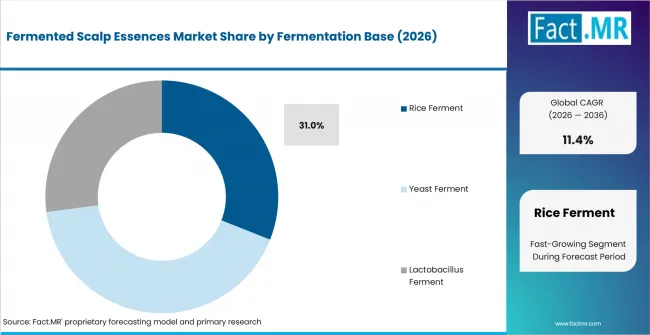
Fermented Scalp Essences Market Analysis By Fermentation Base | Source: Fact.MR
Rice Ferment is expected to hold 31.0% share in 2026 because it gives brands a familiar bridge between Asian beauty routines and scalp health. The base works well for products that promise comfort, hydration and softer scalp feel without making medical claims.
Which active base dominates?
Ceramides account for 28.0% share in 2026.
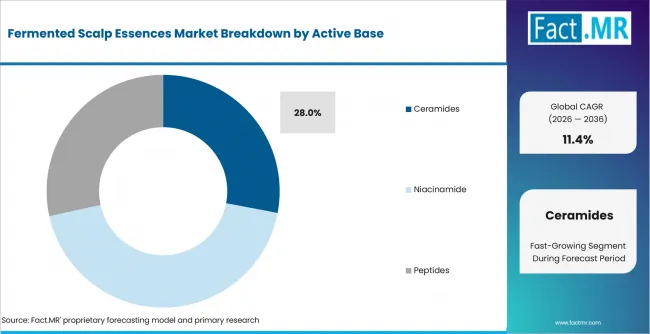
Fermented Scalp Essences Market Analysis By Active Base | Source: Fact.MR
Ceramides lead because barrier language is easier to explain than complex microbiome claims. Brands are also borrowing proof cues from skin care ingredients as scalp care shifts toward facial-care logic.
Which hair concern dominates?
Barrier Repair holds 30.0% share in 2026.
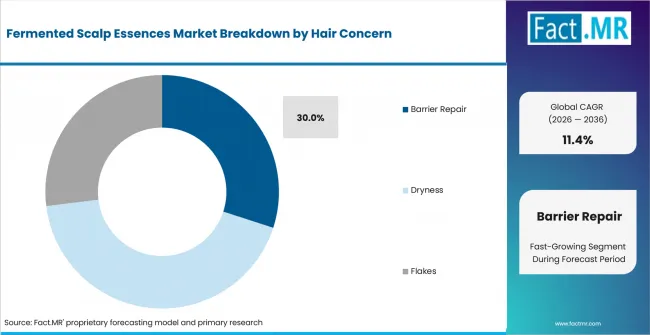
Fermented Scalp Essences Market Analysis By Hair Concern | Source: Fact.MR
Barrier Repair leads because consumers understand tightness, itch and dryness after cleansing. Fermented essences also fit discussions around the skin microbiome when brands keep claims within cosmetic comfort and balance.
Which channel dominates?
Prestige Beauty leads with 34.0% share in 2026.
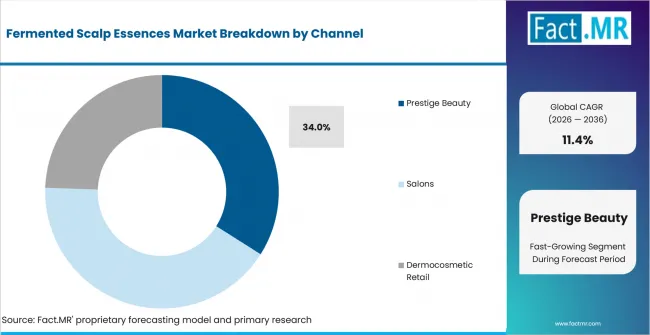
Fermented Scalp Essences Market Analysis By Channel | Source: Fact.MR
Prestige Beauty leads because staff education and product sampling help explain a new scalp step. Higher price points also support smaller bottles, stronger packaging and more active-led formulas.
Which positioning dominates?
Skinification of Haircare holds 40.0% share in 2026.
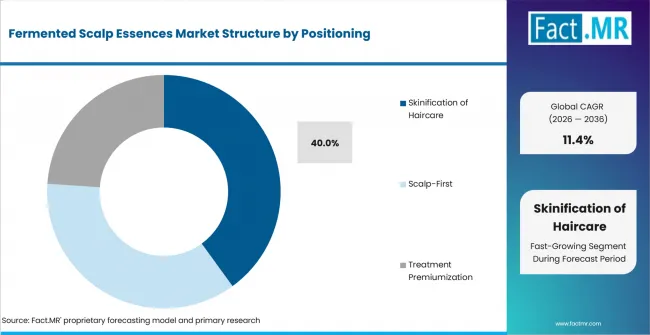
Fermented Scalp Essences Market Analysis By Positioning | Source: Fact.MR
Skinification of Haircare leads because brands are moving from cleansing claims toward treatment routines. This shift sits close to personal care active ingredients because actives now shape scalp product pricing and retailer placement.
What is accelerating fermented scalp essences adoption, and what is holding it back?
Scalp-first routines and ferment-led beauty positioning drive it, while weak benefit proof and confusion with oils or tonics restrain it.
Drivers Impact Analysis
| DRIVER | (~) % IMPACT ON CAGR | GEOGRAPHIC RELEVANCE | IMPACT TIMELINE |
|---|---|---|---|
| Scalp routines moving beyond shampoo | +2.1% | Global, strongest in prestige beauty | Short term (up to 2 years) |
| Fermented ingredient stories gaining retail space | +1.8% | South Korea, Japan, China | Medium term (2-4 years) |
| DTC subscriptions supporting repeat use | +1.4% | UNITED STATES, UK, South Korea | Medium term (2-4 years) |
| Salon scalp checks supporting education | +1.1% | UNITED STATES, Japan, Germany | Short term (up to 2 years) |
| Barrier-care language moving into hair products | +0.9% | Global, strongest in dermocosmetic retail | Long term (4+ years) |
- Scalp Routines Beyond Shampoo
- Consumers are adding leave-on scalp steps after cleansing because dryness and tightness are easier to feel than hair repair. The United States Census Bureau reported that nonstore retailers were up 12.2% from last year in May 2026. This supports online discovery for small treatment formats that need education before trial. Brands that explain the use moment clearly are better placed than brands that rely on ingredient names alone.
- Ferment Story on Shelf
- Fermented bases help brands stand apart in crowded scalp aisles without making drug-like hair regrowth claims. The logic is close to natural skin care products because consumers already connect natural-positioned actives with comfort and routine use. This driver is strongest in South Korea and Japan because ferment language is already familiar in beauty categories. It becomes more useful when paired with simple claims such as hydration, barrier support and flake comfort.
- Premium Treatment Pricing
- Scalp essences depend on premium pricing because a small bottle must justify a new routine step. The channel logic overlaps with premium beauty and personal care products as buyers accept treatment prices when benefits are easy to understand. The effect is most visible in prestige beauty and salon retail. It is weaker in mass retail because shoppers compare scalp essences with lower-priced oils and shampoos.
Opportunity Impact Analysis
| OPPORTUNITY | (~) % IMPACT ON CAGR | GEOGRAPHIC RELEVANCE | IMPACT TIMELINE |
|---|---|---|---|
| Hydration-first scalp essence packs | +1.9% | UNITED STATES, South Korea, UK | Short term (up to 2 years) |
| Fermented active blends for sensitivity | +1.6% | Japan, Germany, France | Medium term (2-4 years) |
| Salon diagnostic add-on sales | +1.3% | UNITED STATES, Japan, South Korea | Medium term (2-4 years) |
| Marketplace mini-size trial packs | +1.0% | China, UNITED STATES, UK | Short term (up to 2 years) |
| Dermocosmetic scalp barrier ranges | +0.8% | Germany, France, Japan | Long term (4+ years) |
- Hydration-First Essence Packs
- Hydration-first packs give brands a safer first entry point than density or regrowth claims. Kat Burki describes Natural Moisturizing Factors + HA for Scalp as a light formula designed to support hydration and dryness comfort. This shows how simple scalp language can carry a leave-on serum across retail and online channels.
- Fermented Active Blends
- Fermented bases can be paired with ceramides, niacinamide and peptides when suppliers document stability and skin feel. This creates room for biomimetic ingredients in scalp products that need a treatment story without medical positioning. The opportunity is strongest in products for sensitivity and dryness. Buyers are likely to reward formulas that reduce routine complexity and stay easy to layer under styling products.
- Salon Diagnostic Add-Ons
- Salons can convert scalp checks into product education because the service explains why a leave-on essence is needed. Kérastase launched Première in 2024 and continues to frame hair repair through skinification actives. This supports the broader move toward diagnosis-led premium hair routines.
Restraints Impact Analysis
| RESTRAINT | (~) % IMPACT ON CAGR | GEOGRAPHIC RELEVANCE | IMPACT TIMELINE |
|---|---|---|---|
| Claim proof gaps around ferment benefits | -1.5% | Global | Short term (up to 2 years) |
| Confusion with oils and tonics | -1.2% | UNITED STATES, UK, China | Medium term (2-4 years) |
| Ingredient scrutiny in regulated channels | -1.1% | EU, UNITED STATES, Japan | Medium term (2-4 years) |
| Slow repeat use after trial | -0.8% | Global, strongest in marketplaces | Short term (up to 2 years) |
| Higher unit price versus shampoos | -0.7% | Mass retail markets | Long term (4+ years) |
- Proof Gap Around Ferments
- Fermented ingredients can sound useful on shelf, but buyers need a clear reason to pay more. The U.S. Food and Drug Administration requires serious cosmetic adverse events to be reported within 15 business days. This pushes brands to keep benefit language disciplined and avoid claims that look medical.
- Confusion with Oils
- Scalp essences may be compared with oils, tonics and serums that consumers already know. This slows conversion because shoppers need to understand texture, frequency and expected feel before adding another step.
- EU Ingredient Scrutiny
- European launches face heavier ingredient review when actives and botanical extracts are used in leave-on products. The European Commission listed Regulation (EU) 2024/996 as an amendment covering Vitamin A, alpha-arbutin and related cosmetic substances. This supports more careful label and formula checks for premium scalp products.
Which countries are scaling fermented scalp essences fastest?
South Korea leads at 13.2%. China follows at 12.4% and the United States follows at 11.9%. Japan reaches 11.5% and Germany reaches 10.7%.
Based on regional analysis, the fermented scalp essences market is segmented into East Asia and North America. It also covers Western Europe and South Asia and Pacific. Latin America and Middle East and Africa are included.
| Country | CAGR |
|---|---|
| South Korea | 13.2% |
| China | 12.4% |
| United States | 11.9% |
| Japan | 11.5% |
| Germany | 10.7% |
| France | 10.3% |
| United Kingdom | 10.1% |
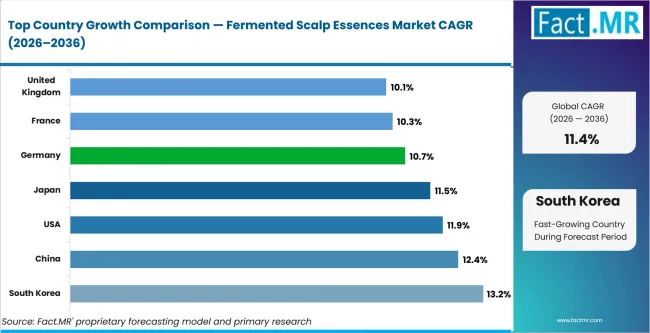
Fermented Scalp Essences Market Cagr Analysis By Country | Source: Fact.MR
What is powering South Korea’s lead?
13.2% CAGR, supported by K-beauty export reach and ferment-led scalp product credibility.
South Korea enters this category from a supply-side advantage because its beauty exporters already sell ingredient-led routines across regions. Korean cosmetics exports reached USD 8.52 billion in the first nine months of 2025. This export base gives ferment-led scalp essences a faster path into cross-border marketplaces and prestige retailers. South Korea is projected to record a 13.2% CAGR through 2036, supported by K-beauty routine exports and local formulation depth.
How is China scaling adoption?
12.4% CAGR, driven by online beauty discovery and scalp-care category expansion.
China is expected to expand at 12.4% CAGR through 2036 because shoppers discover scalp treatments through e-commerce and content-led beauty channels. The U.S. International Trade Administration reported China cosmetics sales of USD 134.3 billion in 2023. That scale allows specialty scalp formats to grow from a very small base when product education is clear. Buyers are expected to favor credible ingredient stories and value bundles.
What supports the United States outlook?
11.9% CAGR, supported by retailer education and DTC replenishment logic.
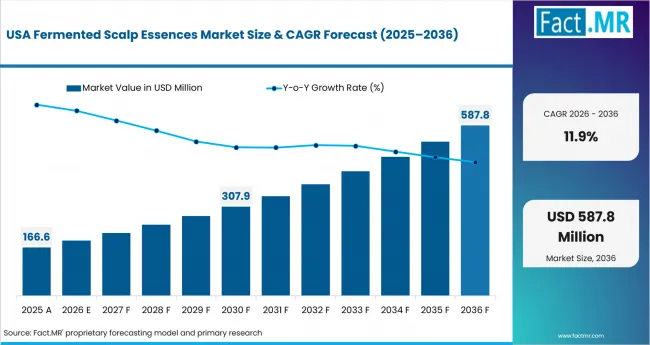
Fermented Scalp Essences Market Country Value Analysis | Source: Fact.MR
United States buyers treat scalp care as a problem-solution category rather than a general hair-care add-on. The market is forecast to grow at 11.9% CAGR through 2036 as prestige retailers, salons and DTC brands explain hydration and density routines. The U.S. Food and Drug Administration issued December 2024 guidance on cosmetic facility registration and product listings. That compliance backdrop pushes brands to keep ingredient files and label records ready before scaling.
Why is Japan an important market?
11.5% CAGR, backed by premium routines and low-irritation product expectations.
Japan’s scalp-care demand is shaped by careful ingredient review and preference for gentle textures. Japan is expected to advance at 11.5% CAGR through 2036 because fermented essences fit premium routines that value comfort and consistency. Product success depends on subtle claims and proof that the formula does not disturb styling. Suppliers with mild textures and low-fragrance positioning are expected to gain better shelf access. Japan also intersects with organic hair care as buyers compare gentle positioning and routine use.
What underpins Germany’s growth?
10.7% CAGR, backed by pharmacy-led proof standards and a large personal care base.
Germany’s growth is shaped by buyers who expect ingredient transparency before paying premium prices. Germany is projected to rise at 10.7% CAGR through 2036 because dermocosmetic retail and salon channels can explain scalp barrier care. Cosmetics Europe valued Germany’s cosmetics and personal care retail sales at EUR 18.0 billion in 2025. The country’s rate stays below East Asia because claim review and fragrance scrutiny slow trial.
Why does France matter for premium scalp care?
10.3% CAGR, supported by prestige beauty and salon-led hair treatment routines.
France is forecast at 10.3% CAGR through 2036 because premium hair care already has a strong salon and prestige base. Fermented scalp essences can scale when brands use elegant textures and restrained claims. The main limit is buyer caution around botanical actives and fragrance labelling.
How is the United Kingdom adopting fermented scalp essences?
10.1% CAGR, owing to online beauty content and treatment-led retail shelves.
The United Kingdom is expected to post 10.1% CAGR through 2036 as online beauty discovery supports trial for scalp essences. Adoption is strongest where retailers explain scalp hydration through simple routines. The rate remains below Asia because the ferment story still needs stronger consumer education.
Who leads the fermented scalp essences landscape?
Kat Burki and Act+Acre lead through scalp-first product language. Gallinée, Kérastase and Living Proof extend salon-backed treatment credibility.
Brand ownership was checked before finalization. Kérastase is part of L’Oréal Groupe. Living Proof is held within Unilever Prestige.
Competition is led by brands that make scalp care easy to understand inside a weekly routine. This overlaps with nourishing hair and skin care because buyers compare scalp comfort, texture and active story before choosing a product.
Act+Acre and Gallinée compete through scalp detox and pre-shampoo treatment. Whamisa compete through concern-led active systems. Ingredient-led ranges such as Mediterranean hair and scalp nutra-active blends show how hair wellness suppliers can build adjacent product stories around scalp nutrition and routine support.
Brands best placed through 2036 are those that combine ferment identity with plain benefit language. The strongest position belongs to suppliers that can explain scalp hydration, barrier comfort and routine frequency without drifting into drug-style claims.
Which companies are the key players?
Kat Burki and Act+Acre are profiled as brand-level competitors. Gallinée and Kérastase are included. Living Proof, Whamisa are included. Aromatica is included.
- Kat Burki
- Act+Acre
- Gallinée
- Kérastase (L’Oréal Groupe)
- Living Proof (Unilever Prestige)
- Whamisa
- Aromatica
Bibliography
- U.S. Food and Drug Administration. (2026, March 13). Modernization of Cosmetics Regulation Act of 2022 (MoCRA). U.S. Department of Health and Human Services.
- U.S. Food and Drug Administration. (2026, March 6). Registration and listing of cosmetic product facilities and products. U.S. Department of Health and Human Services.
- U.S. Census Bureau. (2026, June 17). Advance monthly sales for retail and food services, May 2026. U.S. Department of Commerce.
- National Bureau of Statistics of China. (2026, January 20). Total retail sales of consumer goods in December 2025. National Bureau of Statistics of China.
- European Commission. (2024, April 3). Commission Regulation (EU) 2024/996 amending Regulation (EC) No. 1223/2009 as regards the use of Vitamin A, Alpha-Arbutin and Arbutin and certain substances with potential endocrine disrupting properties in cosmetic products. European Commission.
- Cosmetics Europe. (2026). Our industry: The socio-economic contribution of the European cosmetics and personal care industry. Cosmetics Europe.
- Korea.net. (2025, October 7). Cosmetics exports on record pace with USD 8.52B through Q3. Korean Culture and Information Service.
- Unilever. (2024, May 9). 10 years, 10 brands: Vasiliki Petrou on Unilever Prestige’s growth. Unilever PLC.
This Report Addresses
- Strategic intelligence on fermented scalp essences across fermentation base, active base and hair concern.
- Segment analysis covers Rice Ferment and Ceramides. It also covers Barrier Repair, Prestige Beauty and Skinification of Haircare.
- Regional outlook covers South Korea and China. It also covers the United States, Japan and Germany. France and the United Kingdom are included.
- Competitive analysis covers Kat Burki and Act+Acre. It also covers Gallinée, Kérastase and Living Proof. Whamisa, and Aromatica are included.
- Channel assessment covers prestige beauty and salons. It also covers dermocosmetic retail, DTC and marketplaces.
- Product assessment covers rice ferment and yeast ferment. It also covers lactobacillus ferment, kombucha-derived and botanical fermented essences.
- Primary interviews and brand portfolio checks support the forecast. Official source review and channel validation also support the forecast.
What does the fermented scalp essences market cover?
Leave-on scalp essences built with rice ferment and yeast ferment. The scope also covers lactobacillus, kombucha and botanical fermentation bases.
The fermented scalp essences market covers water-light or serum-like scalp products that use fermentation-derived ingredients for comfort, hydration and barrier support. It includes scalp essences sold through prestige beauty and salons. It also covers dermocosmetic retail, direct-to-consumer sites and marketplaces.
What is included in the scope?
Fermented leave-on scalp essences and treatment essences sold as hair wellness products.
The scope includes fermented scalp essences and scalp hydrators. It also covers barrier-support leave-on treatments and premium scalp-first products. It covers products using rice ferment and yeast ferment. It also covers lactobacillus ferment, kombucha-derived ingredients and botanical fermented essences.
What is excluded from the scope?
Standard shampoos, medical hair-loss drugs and rinse-off masks without a fermented scalp-essence position.
The scope excludes medicated dandruff shampoos, prescription hair-loss drugs and general hair oils. It also excludes rinse-off hair masks unless the product is clearly positioned as a fermented scalp essence.
How was the analysis built?
100+ sources and 35+ brand portfolios. The analysis also uses 25+ countries and 20+ interviews.
- Primary Research:
- Primary research includes interviews with beauty retailers, salon operators and DTC brand planners. It also includes input from cosmetic formulators and ingredient distributors.
- Desk Research:
- Desk research reviews cosmetic regulation, scalp-care product lines and company product pages. It also covers beauty channel signals from official retail and trade datasets.
- Market-Sizing and Forecasting:
- Forecasting uses a top-down share model from premium hair treatment sales. It is cross-checked with brand counts, price ladders and online channel intensity.
- Data Validation and Update Cycle:
- Forecasts are validated through channel checks and brand portfolio review. Regulatory updates and active scalp serum launches help confirm the direction of the estimate.
Segmentation
What is the report’s scope and coverage?
| Attribute | Details |
|---|---|
| Quantitative Units | USD Million in 2026 to USD Million by 2036 at CAGR |
| Market Definition | Leave-on fermented scalp essences positioned for scalp hydration, comfort and barrier support |
| Fermentation Base | Rice Ferment, Yeast Ferment, Lactobacillus Ferment, Kombucha-Derived, Botanical Ferment |
| Active Base | Ceramides, Niacinamide, Peptides, Prebiotics, Sunscreens, Fermented Ingredients |
| Hair Concern | Barrier Repair, Dryness, Flakes, Sebum Control, Density, Sensitivity, UV Exposure |
| Channel | Prestige Beauty, Salons, Dermocosmetic Retail, DTC, Marketplaces |
| Positioning | Skinification of Haircare, Scalp-First Routines, Treatment Premiumization |
| Regions Covered | East Asia, North America, Western Europe, South Asia and Pacific, Latin America, Middle East and Africa |
| Countries Covered | South Korea, China, United States, Japan, Germany, France, United Kingdom |
| Key Companies Profiled | Kat Burki, Act+Acre, Gallinée, Kérastase (L’Oréal Groupe), Living Proof (Unilever Prestige), Whamisa, Aromatica |
| Forecast Period | 2026 to 2036 |
| Approach | Hybrid top-down and bottom-up approach using brand portfolios, channel checks, price ladders and source validation |
How is the market segmented?
-
By Fermentation Base:
- Rice Ferment
- Yeast Ferment
- Lactobacillus Ferment
- Kombucha-Derived
- Botanical Ferment
-
By Active Base:
- Ceramides
- Niacinamide
- Peptides
- Prebiotics
- Sunscreens
- Fermented Ingredients
-
By Hair Concern:
- Barrier Repair
- Dryness
- Flakes
- Sebum Control
- Density
- Sensitivity
- UV Exposure
-
By Channel:
- Prestige Beauty
- Salons
- Dermocosmetic Retail
- DTC
- Marketplaces
-
By Positioning:
- Skinification
- Scalp-First
- Treatment Premiumization
-
By Region
- North America
- United States
- Canada
- Mexico
- Latin America
- Brazil
- Argentina
- Rest of Latin America
- Europe
- Germany
- United Kingdom
- France
- Italy
- Spain
- Rest of Europe
- Asia Pacific
- China
- India
- Japan
- South Korea
- ASEAN
- Middle East & Africa
- GCC Countries
- South Africa
- UAE
- Rest of Middle East & Africa
- North America
Frequently Asked Questions
Which fermentation base leads the Fermented Scalp Essences Market?
Which country expands faster in the Fermented Scalp Essences Market?
How does China perform in the Fermented Scalp Essences Market?
How does the United States perform in the Fermented Scalp Essences Market?
Which channel leads the Fermented Scalp Essences Market?
What is the primary driver in the Fermented Scalp Essences Market?
What is the main restraint in the Fermented Scalp Essences Market?
Why are ceramides important in this market?
Who leads the Fermented Scalp Essences Market?
Who worked on this report


Preview the report firsthand - request a free sample
Free SampleGet the brochure for pricing and purchase details
Download PDF