- Market Value (2025): USD 1.4 Bn
- Estimated Value (2026): USD 1.5 Bn
- Forecast Value (2036): USD 2.8 Bn
- CAGR (2026-2036): 6.6%
What is the Fetal Bovine Serum Market forecast to be worth by 2036?
USD 1.5 billion in 2026 to USD 2.8 billion by 2036 at 6.6% CAGR.
- The fetal bovine serum market reached USD 1.4 billion in 2025 as laboratories and biopharmaceutical users maintained spending on validated serum grades.
- Demand is projected to increase from USD 1.5 billion in 2026 to USD 2.8 billion by 2036.
- The market is forecast to record 6.6% CAGR from 2026 to 2036 owing to cell-culture use in biologics and vaccine research.
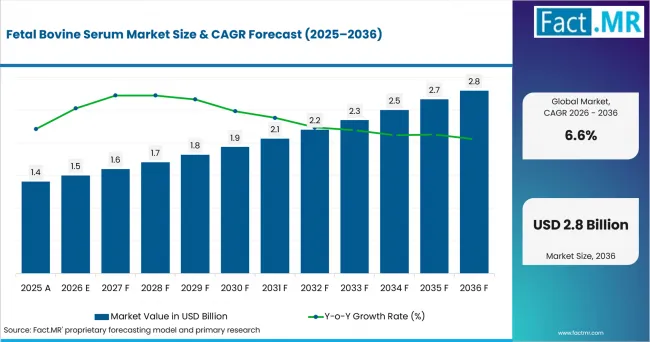
Fetal Bovine Serum Market Value Analysis | Source: Fact.MR
What are the defining numbers behind Fetal Bovine Serum Market growth?
USD 1.3 billion absolute opportunity by 2036.
- Demand Drivers in the Market
- Standard fetal bovine serum remains the first evaluated grade when laboratories need broad cell-line compatibility and predictable growth performance.
- Biopharmaceutical process work supports repeat demand where serum quality affects assay stability and early development comparability across cell culture supplements.
- Traceable origin and lot documentation are expected to guide provider selection when customers compare US-origin and South America-origin serum.
- Key Segments Analyzed
- By Product Type: Standard Fetal Bovine Serum is projected to hold 35.3% share in 2026 because it works as the first reference grade for routine laboratory use.
- By Application: Cell Culture is expected to account for 31.7% share in 2026 where routine maintenance and assay setup remain the main use cases.
- By End User: With 31.5% share in 2026, Biopharmaceutical Companies are estimated to lead end use through discovery and process support.
- By Distribution Channel: Direct Sales are forecast to hold 32.2% share in 2026 where customers need batch reservation before larger orders.
- By Source Type: US-Origin Serum is anticipated to represent 37.7% share in 2026 as customers look for clearer origin and traceability files.
- Analyst Opinion at Fact.MR
- Shambhu Nath Jha, Principal Consultant at Fact.MR, states, “Fetal bovine serum demand is expected to depend less on broad catalog access and more on lot control. Origin proof and documentation quality shape whether a customer keeps the same provider after lot review.”
- Strategic Implications
- Laboratory procurement teams should reserve qualified lots early when serum performance affects assay continuity. This is important for cell line development work where serum changes often force another internal review.
- Serum providers are expected to strengthen proposals by pairing origin files with technical support for biologics manufacturing. Customers are expected to value a provider that explains how lot testing reduces approval delays.
- Investors should separate direct FBS exposure from broader media demand. Demand connected with stem cell therapy becomes commercially relevant only when serum use remains approved inside the customer workflow.
Germany leads at 8.6% CAGR, supported by strict quality reviews and supplier documentation. Brazil follows at 7.9% CAGR as distribution and laboratory access improve. Australia records 4.6% CAGR through reliable serum sourcing. The USA reaches 7.3% CAGR, Canada 5.3% CAGR, the UK 6.6% CAGR and Japan 5.3% CAGR, reflecting structured procurement and quality-led purchasing.
How does the Fetal Bovine Serum Market break down by segment?
Standard Fetal Bovine Serum is expected to lead Product Type at 35.3% share in 2026. Cell Culture is projected to lead Application at 31.7% share in 2026.
Which product type dominates?
Standard Fetal Bovine Serum is projected to account for 35.3% share in 2026.
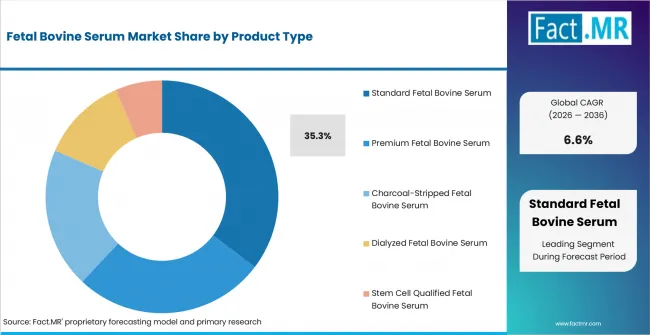
Fetal Bovine Serum Market Analysis By Product Type | Source: Fact.MR
Standard Fetal Bovine Serum leads where laboratories need a familiar grade for routine cell growth and assay setup. US Origin FBS and International Origin FBS remain important when documentation or import review changes the order decision.
Why does Cell Culture lead Application?
Cell Culture is expected to hold 31.7% share in 2026.
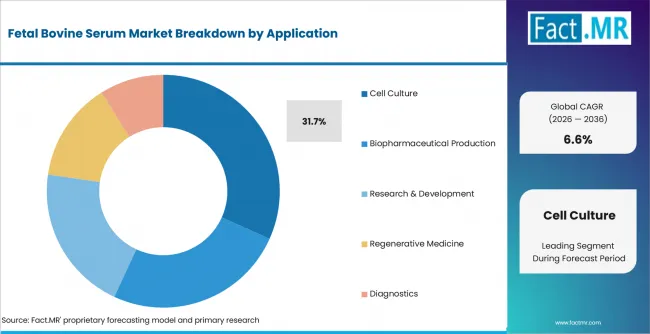
Fetal Bovine Serum Market Analysis By Application | Source: Fact.MR
Routine cell maintenance gives Cell Culture the largest use base. Mammalian Cell Culture and Primary Cell Culture add demand when researchers need attachment support and recovery after passaging. Biopharmaceutical Production and Vaccine Manufacturing require stronger documentation before wider use.
What supports Biopharmaceutical Companies within End User?
Biopharmaceutical Companies are estimated to represent 31.5% share in 2026.
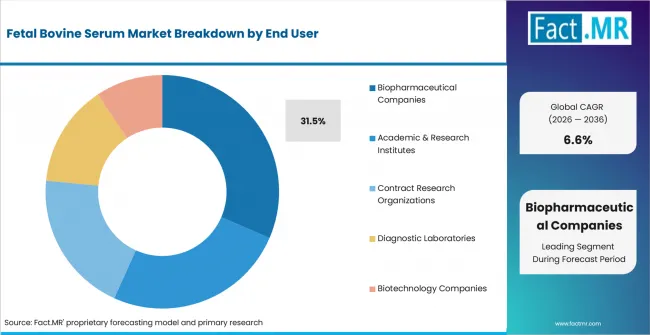
Fetal Bovine Serum Market Analysis By End User | Source: Fact.MR
Biopharmaceutical Companies lead since serum supports discovery and process-development work before products move into stricter production settings. Vaccine Manufacturers and Biologics Manufacturers need deeper files. Academic and research institutes usually place smaller orders but influence early grade selection.
How does Direct Sales shape demand?
Direct Sales are forecast to account for 32.2% share in 2026.
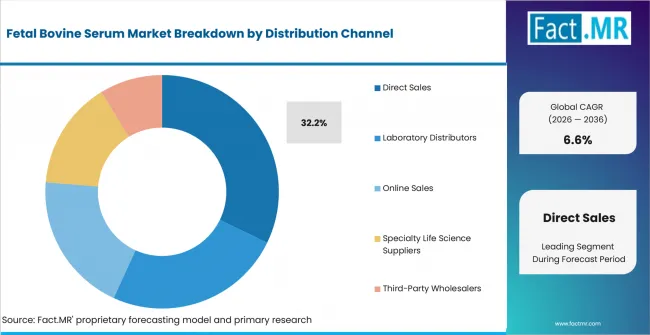
Fetal Bovine Serum Market Analysis By Distribution Channel | Source: Fact.MR
Direct Sales leads through batch reservation and certificate review for larger accounts. Key Account Sales and Institutional Supply Contracts serve repeat programs. Laboratory Distributors and Authorized Distributors remain useful when smaller customers need quick access and local support.
What supports US-Origin Serum within Source Type?
US-Origin Serum is anticipated to hold 37.7% share in 2026.
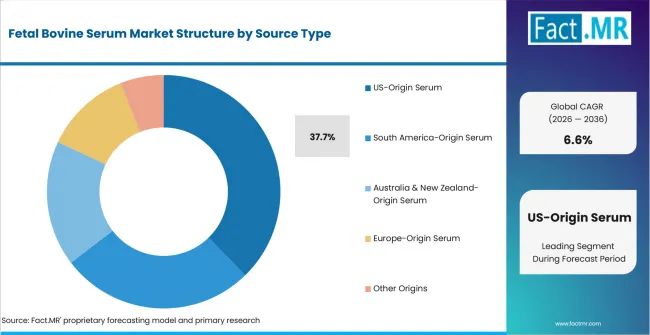
Fetal Bovine Serum Market Analysis By Source Type | Source: Fact.MR
US-Origin Serum leads with stronger customer comfort around origin proof and traceability documents. FDA-Compliant Serum and USDA Traceable Serum meet tighter file needs.
What is accelerating Fetal Bovine Serum Market adoption, and what is holding it back?
Demand is expected to rise through the use of qualified serum in cell culture and biologics research. Batch differences and growing interest in serum-free alternatives may slow adoption.
Drivers Impact Analysis
| DRIVER | (~) % IMPACT ON CAGR | GEOGRAPHIC RELEVANCE | IMPACT TIMELINE |
|---|---|---|---|
| Standard serum specification pull | +1.8% | Germany, USA, Canada | Short term (<= 2 years) |
| Cell culture workflow demand | +1.5% | Brazil and research-led markets | Short term (<= 2 years) |
| Biopharmaceutical validation needs | +1.2% | Germany, USA, UK | Medium term (2-4 years) |
| Direct sales and lot reservation | +0.9% | USA, Canada, Australia | Medium term (2-4 years) |
| Origin and traceability preference | +0.7% | Germany, Japan, Australia | Long term (>= 4 years) |
Source: Fact.MR analysis. Updated Jul 31, 2026
- Standard serum specification pull: Routine users are expected to keep standard FBS in purchasing plans where one validated grade supports several assays.
- Cell culture workflow demand: Laboratories need serum that supports growth and recovery without repeated method changes across established cell lines.
- Biopharmaceutical validation needs: Development teams are expected to favor providers that provide certificates and batch records during lot approval.
Opportunity Impact Analysis
| OPPORTUNITY | (~) % IMPACT ON CAGR | GEOGRAPHIC RELEVANCE | IMPACT TIMELINE |
|---|---|---|---|
| Lot-matched workflow packages | +1.1% | Germany and USA | Medium term (2-4 years) |
| Documentation-led premium grades | +0.9% | Japan, Canada, UK | Medium term (2-4 years) |
| Distributor support in emerging accounts | +0.8% | Brazil and Latin America | Medium term (2-4 years) |
| Hybrid media transition support | +0.6% | Biopharma and research clusters | Long term (>= 4 years) |
Source: Fact.MR analysis. Updated Jul 31, 2026
- Lot-matched workflow packages: Providers that pair FBS with cell culture media are expected to reduce purchasing friction for users that want fewer vendor changes.
- Documentation-led premium grades: Premium and low-endotoxin products create opportunity where customers need clearer evidence before sensitive workflows.
- Distributor support in emerging accounts: Regional distributors are expected to improve conversion when they offer cold-chain reliability and technical help.
Restraints Impact Analysis
| RESTRAINT | (~) % IMPACT ON CAGR | GEOGRAPHIC RELEVANCE | IMPACT TIMELINE |
|---|---|---|---|
| Lot variability and revalidation burden | -1.2% | Global | Short term (<= 2 years) |
| Price sensitivity around qualified serum | -0.9% | Brazil and academic accounts | Short term (<= 2 years) |
| Animal-origin regulatory review | -0.7% | USA, UK, Germany | Medium term (2-4 years) |
| Serum-free workflow substitution | -0.6% | Biopharma and advanced research | Long term (>= 4 years) |
Source: Fact.MR analysis. Updated Jul 31, 2026
- Lot variability and revalidation burden: A new lot is expected to change cell behavior in some workflows and extend approval work before larger volume is accepted.
- Price sensitivity around qualified serum: Smaller laboratories are expected to delay premium-grade purchases when price gaps are not matched by visible workflow benefits.
- Animal-origin regulatory review: Customers are expected to ask for clearer origin and collection files before adopting unfamiliar serum sources.
Which countries are scaling Fetal Bovine Serum Market fastest?
- Germany leads through strict quality review and strong provider documentation. Brazil follows through distributor access and laboratory support, while Australia benefits from trusted serum origins and dependable sourcing records.
- The USA and Canada form a steadier middle group supported by mature research and diagnostic demand. The UK remains selective on documentation and cost.
- Japan grows slowest because customers apply high quality standards and replace qualified serum lots cautiously over time.
- Comparable CAGRs create different entry conditions across these countries. Provider performance depends on lot evidence and service depth. Commercial readiness reflects confidence that serum changes do not interrupt validated workflows.
The full report provides country-level CAGR analysis across North America; Latin America; Europe; East Asia; South Asia and Oceania; and the Middle East and Africa.
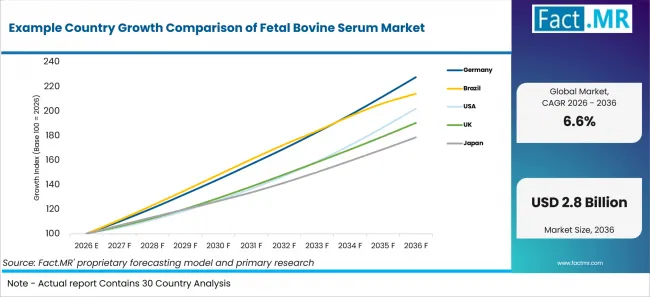
Example Country Growth Comparison Of Fetal Bovine Serum Market | Source: Fact.MR
| Country | CAGR (2026-2036) |
|---|---|
| Germany | 8.6% |
| Brazil | 7.9% |
| Australia | 4.6% |
| USA | 7.3% |
| Canada | 5.3% |
| UK | 6.6% |
| Japan | 6.0% |
Source: Fact.MR analysis. Updated Jul 31, 2026
What supports Germany adoption?
7.6% CAGR, supported by quality-led procurement and provider documentation.
Germany’s growth reflects a market where research and biopharmaceutical users examine certificates before accepting serum. Origin records and batch consistency affect approval timing.
How is Brazil scaling demand?
6.9% CAGR, driven by laboratory access and distributor support.
Brazil’s growth is tied to wider use of cell culture in research and diagnostic settings. Regional distributors matter because customers need delivery certainty and practical guidance.
What is shaping Australia through 2036?
6.7% CAGR, backed by origin credibility and service reliability.
Australia’s growth reflects the value placed on recognized serum origin and dependable documentation. Biopharmaceutical and research users are expected to select providers that reduce origin questions. Service reliability becomes important when laboratories plan repeat cell-culture runs.
How does the USA perform?
6.3% CAGR, supported by mature life-science procurement and direct sales.
The USA’s growth is shaped by established laboratory networks and structured purchasing processes. Direct Sales gains importance where larger customers reserve lots and request technical files before repeat orders.
What supports Canada demand?
6.0% CAGR, backed by research use and institutional laboratory demand.
Canada’s growth reflects steady use across research institutions and biotechnology accounts. Customers are expected to value service access and reliable delivery. US-Origin Serum documentation remains useful where laboratories compare regional availability with quality expectations.
How is the UK developing demand?
5.6% CAGR, led by controlled laboratory spending and validation discipline.
The UK’s growth is expected to remain selective since customers compare price and documentation strength before expanding serum purchases. Replacement activity dominates where laboratories avoid unnecessary method changes.
What supports Japan’s growth?
5.0% CAGR, backed by quality expectations and careful provider review.
Japan’s growth reflects a market where reliability and technical documentation influence purchasing more than volume expansion. Customers are expected to move carefully before changing serum lots.
Who leads the Fetal Bovine Serum Market?
Thermo Fisher Scientific and Merck KGaA show the broadest commercial visibility in fetal bovine serum. Cytiva and Corning Incorporated compete through cell culture supplements. PAN-Biotech and Biowest strengthen the provider set through serum and channel support.
Competition is expected to depend on certified origin and lot consistency. Technical documentation matters more than company scale alone. Providers that connect serum products with vaccine research and biologics workflows are expected to gain stronger approval from quality-led customers.
Which companies are the key providers?
Key companies include Thermo Fisher Scientific; Merck KGaA; Cytiva; Corning Incorporated; PAN-Biotech; and Biowest.
- Thermo Fisher Scientific
- Merck KGaA
- Cytiva
- Corning Incorporated
- PAN-Biotech
- Biowest
Bibliography
- World Health Organization. (2024, February 2). Quality assurance of pharmaceuticals: A compendium of guidelines and related materials—Volume 2: Good manufacturing practices and inspection (10th ed.).
- European Medicines Agency. (2024, January 3). ICH Q5A(R2) guideline on viral safety evaluation of biotechnology products derived from cell lines of human or animal origin.
- U.S. Food and Drug Administration. (2024, April). Safety testing of human allogeneic cells expanded for use in cell-based medical products: Draft guidance for industry.
This Report Answers
- The report provides strategic intelligence on the Fetal Bovine Serum Market across Product Type and Application choices that shape cell culture purchasing.
- Segment analysis covers Standard Fetal Bovine Serum and Cell Culture as the share leaders within the 2026 market.
- Country outlook evaluates Germany and Brazil alongside Australia and the USA. Canada and the UK appear with Japan to complete the profiled growth comparison.
- Competitive analysis profiles Thermo Fisher Scientific and Merck KGaA alongside Cytiva and Corning Incorporated. PAN-Biotech and Biowest to complete the provider set.
- Source-type assessment covers US-Origin Serum and FDA-Compliant Serum. USDA Traceable Serum and South America-Origin Serum complete the source view alongside Australia & New Zealand-Origin Serum.
What does the Fetal Bovine Serum Market cover?
Fetal bovine serum products are cell culture supplements where growth performance and origin documentation determine approval.
The market covers standard and specialty serum grades used in research and diagnostics. Biologics development and vaccine work remain included with regenerative medicine studies.
What is included in the scope?
Fetal bovine serum products are used by biopharmaceutical companies and vaccine manufacturers. Research institutes and CROs are included. Diagnostic laboratories and
biotechnology companies are included when serum use affects cell culture workflows.
The scope includes Product Type and Application. End User and Distribution Channel complete the coverage with Source Type. Coverage spans standard and origin-specific serum grades. Premium and ultra-low endotoxin products are included when they are sold for cell culture use.
What is excluded from the scope?
General media and unrelated biological reagents remain outside this market.
The scope excludes serum-free media without FBS and separate bovine serum albumin. Finished biologic drugs and vaccines are excluded. Unrelated diagnostic consumables remain outside the boundary unless revenue depends directly on fetal bovine serum use.
How Was the Analysis Built?
The analysis draws on 120+ sources, 35+ company portfolios, 25+ countries, and more than 20 interviews.
- Primary Research: Interviews with manufacturers, retailers, salon operators, and experts examine purchase priorities, adoption, approval requirements, and competitive positioning.
- Desk Research: Desk research covers government statistics, regulatory publications, company filings, trade data, technical studies, industry associations, standards, and public policy.
- Market Sizing and Forecasting: Estimates combine historical performance, demand indicators, pricing, segment shares, company participation, country growth, adoption patterns, and barriers to expansion.
- Data Validation and Update Cycle: Findings are validated against public data, company activity, regulatory changes, product launches, recalls, and adoption shifts.
Segmentation
What is the report's scope and coverage?
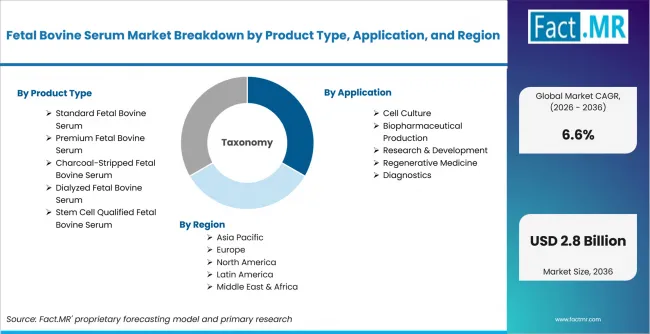
Fetal Bovine Serum Market Breakdown By Product Type, Application, And Region | Source: Fact.MR
| Quantitative Units | USD billion in 2026 to USD billion by 2036 at CAGR |
|---|---|
| Market Definition | Commercial fetal bovine serum products used as animal-derived cell culture supplements where lot consistency and origin documentation affect purchase approval |
| Product Type | Standard Fetal Bovine Serum; US Origin FBS; International Origin FBS; Premium Fetal Bovine Serum; Ultra-Low Endotoxin FBS |
| Application | Cell Culture; Mammalian Cell Culture; Primary Cell Culture; Biopharmaceutical Production; Vaccine Manufacturing |
| End User | Biopharmaceutical Companies; Vaccine Manufacturers; Biologics Manufacturers; Academic & Research Institutes; Contract Research Organizations |
| Distribution Channel | Direct Sales; Key Account Sales; Institutional Supply Contracts; Laboratory Distributors; Authorized Distributors |
| Source Type | US-Origin Serum; FDA-Compliant Serum; USDA Traceable Serum; South America-Origin Serum; Australia & New Zealand-Origin Serum |
| Regions Covered | North America; Latin America; Europe; East Asia; South Asia and Oceania; Middle East and Africa |
| Countries Covered | Germany; Brazil; Australia; USA; Canada; UK; Japan |
| Key Companies Profiled | Thermo Fisher Scientific; Merck KGaA; Cytiva; Corning Incorporated; PAN-Biotech; Biowest |
| Forecast Period | 2026 to 2036 |
| Approach | Hybrid top-down and bottom-up approach using serum demand indicators; product-grade mix; country growth; channel behavior; company participation; and public evidence |
Source: Fact.MR analysis. Updated Jul 31, 2026
How is the market segmented?
-
By Product Type
- Standard Fetal Bovine Serum
- US Origin FBS
- International Origin FBS
- Premium Fetal Bovine Serum
- Triple Filtered FBS
- Ultra-Low Endotoxin FBS
- Charcoal-Stripped Fetal Bovine Serum
- Hormone-Depleted FBS
- Lipid-Reduced FBS
- Dialyzed Fetal Bovine Serum
- Low Molecular Weight Dialyzed FBS
- Protein-Optimized Dialyzed FBS
- Stem Cell Qualified Fetal Bovine Serum
- ESC Qualified FBS
- iPSC Qualified FBS
- Standard Fetal Bovine Serum
-
By Application
- Cell Culture
- Mammalian Cell Culture
- Primary Cell Culture
- Biopharmaceutical Production
- Vaccine Manufacturing
- Monoclonal Antibody Production
- Research & Development
- Drug Discovery
- Toxicology Studies
- Regenerative Medicine
- Stem Cell Therapy
- Tissue Engineering
- Diagnostics
- Diagnostic Kit Development
- Clinical Research
- Cell Culture
-
By End User
- Biopharmaceutical Companies
- Vaccine Manufacturers
- Biologics Manufacturers
- Academic & Research Institutes
- Universities
- Public Research Laboratories
- Contract Research Organizations
- Preclinical CROs
- Clinical Research Providers
- Diagnostic Laboratories
- Clinical Diagnostic Labs
- Molecular Testing Labs
- Biotechnology Companies
- Cell Therapy Developers
- Gene Therapy Companies
- Biopharmaceutical Companies
-
By Distribution Channel
- Direct Sales
- Key Account Sales
- Institutional Supply Contracts
- Laboratory Distributors
- Authorized Distributors
- Scientific Equipment Suppliers
- Online Sales
- Manufacturer Websites
- E-commerce Platforms
- Specialty Life Science Suppliers
- Laboratory Reagent Suppliers
- Biotech Supply Networks
- Third-Party Wholesalers
- Regional Wholesalers
- Global Trading Companies
- Direct Sales
-
By Source Type
- US-Origin Serum
- FDA-Compliant Serum
- USDA Traceable Serum
- South America-Origin Serum
- Brazilian Origin Serum
- Uruguayan Origin Serum
- Australia & New Zealand-Origin Serum
- Australian Serum
- New Zealand Serum
- Europe-Origin Serum
- EU Traceable Serum
- UK Origin Serum
- Other Origins
- Canadian Serum
- Other Certified Sources
- US-Origin Serum
-
By Region
- North America
- Latin America
- Europe
- East Asia
- South Asia and Oceania
- Middle East and Africa
Frequently Asked Questions
Which Product Type leads the market?
Which Application leads the market?
Which End User leads the market?
Which Distribution Channel leads the market?
Which Source Type leads the market?
Which country records the highest listed CAGR?
What is the primary driver in this market?
What is the main restraint?
Why do biopharmaceutical companies lead demand?
Who worked on this report


Preview the report firsthand - request a free sample
Free SampleGet the brochure for pricing and purchase details
Download PDF