- Base Value(2025): 14.4 Bn
- Estimated Value(2026): 15.9 Bn
- Forecast Value (2036): 37.8 Bn
- CAGR (2026 - 2036): 9.1%
Fill Finish Manufacturing Market Forecast and Outlook 2026 to 2036
In 2025, the fill finish manufacturing market was valued at approximately USD 14.4 billion. Based on Fact.MR analysis, demand for fill finish manufacturing services is estimated to reach around USD 15.9 billion in 2026 and expand to nearly USD 37.8 billion by 2036, reflecting a CAGR of 9.1% during the forecast period. Market expansion is linked to rising injectable drug pipelines, growing biologics and vaccine production, and increased outsourcing of sterile fill finish operations to specialized manufacturing partners.
The market adds roughly USD 21.9 billion in value over the forecast window, reflecting sustained compounding tied to capacity expansion rather than episodic demand spikes. Early period growth is supported by vaccine and monoclonal antibody fill volumes, while mid period momentum aligns with increased adoption of prefilled syringes and cartridge based delivery formats. In later years, value growth is increasingly influenced by cell and gene therapy programs, which require low batch, high precision fill finish infrastructure with stringent contamination control and inspection standards.
The United States leads growth at 9.8% CAGR, supported by biologics manufacturing scale and strong CMO outsourcing activity. Germany follows at 9.3%, driven by regulated injectable production and export oriented pharmaceutical manufacturing. Japan records 8.9%, aligned with domestic biologics demand and aging population related therapeutics. China posts 8.7%, supported by expanding vaccine and biosimilar capacity, while South Korea at 8.2% benefits from investment in biologics manufacturing hubs and contract fill finish services.
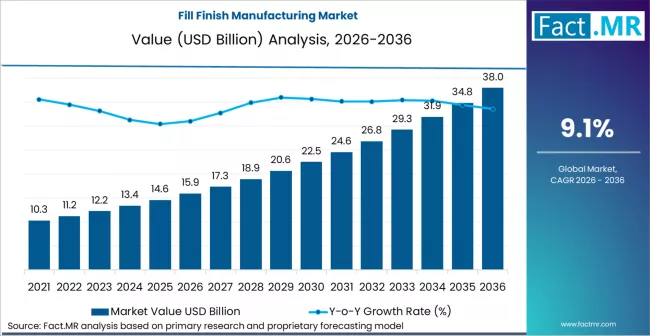
Fill Finish Manufacturing Market Market Value Analysis | Source: Fact.MR
Summary of Fill Finish Manufacturing Market
- Market Definition
- The fill finish manufacturing market comprises sterile pharmaceutical production activities in which formulated drug products are aseptically filled into final containers such as vials, prefilled syringes, cartridges, ampoules, and bottles, followed by sealing and inspection for commercial distribution.
- Core Demand Drivers
- Expansion of injectable drug pipelines, particularly biologics, vaccines, and advanced therapies, increases reliance on validated sterile fill finish capacity rather than in-house manufacturing.
- Regulatory pressure around sterility assurance, contamination control, and inspection outcomes elevates the value of experienced CDMOs with proven compliance records.
- Growing preference for prefilled syringes and ready-to-use formats supports investment in automated, closed-system filling lines with higher throughput and lower risk profiles.
- Key Segments Analyzed
- Product type: Prefilled syringes represent the largest share due to dose accuracy, ease of administration, and reduced preparation steps in clinical settings.
- Application: Vaccines account for the highest volume share, reflecting large-batch immunization programs and strict aseptic requirements.
- Geography: North America and Europe lead value realization, while East Asia shows sustained capacity expansion tied to biologics manufacturing investments.
- Analyst Opinion at Fact.MR
- Shambhu Nath Jha, Principal Consultant at Fact.MR, states, “For decision-makers, the fill finish segment is no longer a back-end manufacturing step but a strategic capacity constraint, where regulatory track record, automation depth, and contamination risk management increasingly determine outsourcing choices and long-term supply security.”
- Strategic Implications for Stakeholders
- Pharmaceutical and biotech companies should prioritize partners with proven inspection histories and scalable aseptic infrastructure rather than short-term capacity availability.
- CDMOs benefit from investing in isolator-based, highly automated lines to capture higher-value biologics and cell and gene therapy programs.
- Regional capacity planning should align with regulatory harmonization and export-oriented injectable production strategies.
- Methodology Overview
- Insights are derived from primary interviews with CDMOs, pharmaceutical manufacturers, and quality professionals, combined with analysis of GMP inspection data, capacity disclosures, and injectable production trends referenced against FDA and WHO manufacturing guidance.
Fill Finish Manufacturing Market
| Metric | Value |
|---|---|
| Market Value (2026) | USD 15.9 billion |
| Forecast Value (2036) | USD 37.8 billion |
| Forecast CAGR (2026-2036) | 9.1% |
Source: Fact.MR analysis. Updated Feb 25, 2026
Fill Finish Manufacturing Market Definition
The fill finish manufacturing market covers pharmaceutical production activities where sterile drug products are filled into final containers such as vials, syringes, cartridges, or ampoules and sealed for distribution. This stage follows drug formulation and is critical for maintaining sterility, dose accuracy, and product integrity. Fill finish operations are used for biologics, vaccines, injectables, and other parenteral drugs supplied to healthcare systems. Manufacturing controls, sterility assurance, and facility requirements are regulated by drug manufacturing frameworks issued by the US Food and Drug Administration and global health authorities. [1]
Fill Finish Manufacturing Market Inclusions
The report covers global and regional market size estimates in volume and value terms with a forecast period from 2026 to 2036. Segmentation includes dosage form, container type, manufacturing scale, and end use across pharmaceutical and biotechnology companies. The scope includes demand patterns for contract fill finish services, pricing benchmarks, and regional capacity distribution.
Fill Finish Manufacturing Market Exclusions
The scope excludes upstream drug discovery, active pharmaceutical ingredient production, and formulation development prior to filling. Primary packaging material manufacturing such as vial glass or rubber stoppers is not included. Secondary packaging, labeling, logistics, and cold chain distribution services are excluded. Clinical trial site operations, hospital compounding, laboratory scale filling, and non-commercial pilot lines are also outside the scope.
Fill Finish Manufacturing Market Research Methodology
- Primary Research: Interviews were conducted with contract development and manufacturing organizations, pharmaceutical producers, quality assurance professionals, and regulatory compliance managers.
- Desk Research: Desk research used current good manufacturing practice guidance, inspection outcomes, and regulatory publications issued by the US Food and Drug Administration and the World Health Organization, along with company filings.
- Market Sizing and Forecasting: Estimates were developed using installed fill finish capacity, utilization rates, drug production volumes, and outsourcing trends across injectable therapies.
- Data Validation and Update Cycle: Data was cross checked against regulatory inspection databases, capacity disclosures, trade information, and public healthcare manufacturing investments before updates were finalized.
Fill Finish Manufacturing Market Segmental Analysis
Fill Finish Manufacturing Market Analysis by Product Type
Fill Finish Manufacturing Market Analysis By Product Type | Source: Fact.MR
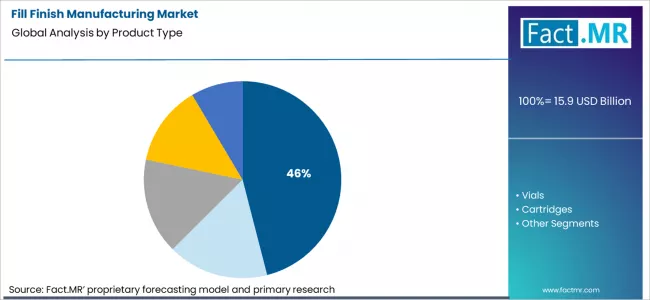
Based on Fact.MR analysis, consumption of prefilled syringes is estimated to hold 46% share of the global fill finish manufacturing market. Fact.MR analysts note prefilled syringes lead due to dose accuracy, reduced contamination risk, and ease of administration in clinical settings. As per Fact.MR, this product type addresses pharmaceutical manufacturer requirements for ready-to-use formats, reduced overfill, and compatibility with automated filling lines, supporting large-scale production of injectable therapies across regulated manufacturing environments worldwide today serving hospitals, clinics, and vaccination programs.
- Drug packaging oversight: Injectable drug container systems are regulated under pharmaceutical packaging and device combination product frameworks. [2]
- Operational efficiency: Fact.MR analysts note prefilled formats reduce preparation steps before administration.
- Contamination control: Closed systems lower handling-related contamination risk.
Fill Finish Manufacturing Market Analysis by Application
CC | Source: Fact.MR
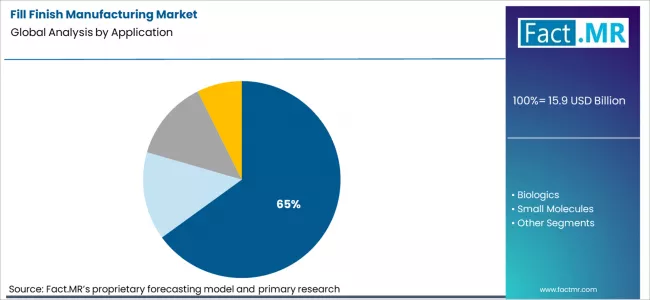
Based on Fact.MR analysis, consumption of fill finish services for vaccine manufacturing is estimated to hold 65% share of the global market. Fact.MR analysts note vaccines lead due to high-volume immunization programs and strict sterility requirements. As per Fact.MR, vaccine applications address public health needs for scalable, validated filling operations capable of handling large batch sizes under cold chain and aseptic conditions, supporting national and international vaccination initiatives worldwide today across public health systems.
- Public health framework: Vaccine manufacturing and filling operations are governed by national immunization and biologics regulations. [3]
- Volume intensity: Fact.MR analysts note vaccine programs require large-scale fill finish capacity.
- Quality focus: Vaccine filling demands stringent aseptic process control.
Fill Finish Manufacturing Market Drivers, Restraints, and Opportunities
Fact.MR analysis indicates that the fill finish manufacturing market exists as a critical segment within biopharmaceutical production focused on aseptic filling, capping, and packaging of injectable products such as vaccines, therapeutic biologics, and sterile solutions. As per Fact.MR assessment, fill finish operations are governed by regulatory standards and quality frameworks that include Current Good Manufacturing Practice (cGMP) requirements enforced by the U.S. Food and Drug Administration (FDA), which define facility, process, and sterility assurance expectations for sterile manufacturing and aseptic processing. [4] Fact.MR analysts observe that the current market size is driven by rising global demand for vaccines, monoclonal antibodies, and gene therapies where sterile fill finish capacity and compliance with stringent quality systems are prerequisites for product approval and commercial distribution.
Fact.MR is of the opinion that current market dynamics reflect a transition from legacy manual filling operations toward automated and closed-system fill finish platforms that enhance process reliability and reduce contamination risk. Based on Fact.MR assessment, traditional semi-automated filling lines continue to serve smaller production runs because of lower initial capital requirements, but demand is increasing for fully automated systems with robotics, isolators, and real-time environmental monitoring where high throughput and sterility assurance are specified. Advanced automated technologies typically carry higher per-unit pricing due to complexity, validation requirements, and integration with quality control systems, meaning realised market value can increase even where overall shipment volumes grow at a measured pace. Fact.MR analysis suggests that this mix of moderate volume adoption and premium system placement will shape near-term market progression.
- Regulatory cGMP requirements: Fact.MR analysts note that U.S. FDA cGMP requirements for sterile drug manufacturing influence facility design, process controls, and validation planning for fill finish manufacturing operations.
- Shift to automation and closed systems: Based on Fact.MR assessment, adoption of automated fill finish platforms with isolators, robotics, and environmental monitoring supports demand in commercial vaccine and biologic production programmes that prioritise sterility and throughput.
- Asia Pacific biopharma investment growth: Fact.MR opines that expanding biopharmaceutical manufacturing investments in China, India, and Southeast Asia support regional uptake of advanced fill finish operations as companies seek local production capacity for vaccines and injectable therapies.
Regional Analysis
Based on regional assessment, the fill finish manufacturing sector is analyzed across North America, Europe, East Asia, and other major biopharmaceutical production hubs, spanning more than 40 countries. Regional performance varies according to biologics production capacity expansion, regulatory compliance standards, contract manufacturing activity, and investment in sterile injectable manufacturing infrastructure.
Fill Finish Manufacturing Market CAGR Analysis by Country (2026-2036)
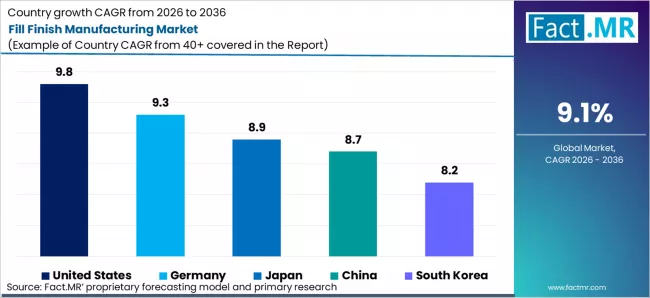
Fill Finish Manufacturing Market Cagr Analysis By Country | Source: Fact.MR
| Country | CAGR |
|---|---|
| United States | 9.8% |
| Germany | 9.3% |
| Japan | 8.9% |
| China | 8.7% |
| South Korea | 8.2% |
Source: Fact.MR analysis. Updated Feb 25, 2026
Source: Fact.MR analysis, based on proprietary forecasting models and primary research.
Demand for Fill Finish Manufacturing Services in Asia Pacific
Asia Pacific shows steady demand for fill finish manufacturing services driven by expansion of biologics vaccines and sterile injectables production. Sales growth reflects increasing local pharmaceutical capacity contract development partnerships and regulatory upgrades in aseptic processing. China Japan and South Korea contribute through domestic biologics pipelines and export oriented manufacturing. Procurement favors validated facilities isolator based filling lines and compliance with GMP standards. Market expansion reflects clinical trial activity technology transfer agreements and capacity additions across sterile manufacturing hubs regionwide.
- China: Demand for fill finish manufacturing services in China is projected to rise at 8.7% CAGR through 2036. Growth reflects expansion of domestic biologics production and increasing use of GMP compliant aseptic facilities, as per Fact.MR.
- Japan: Demand for fill finish manufacturing services in Japan is projected to rise at 8.9% CAGR through 2036. Adoption reflects established biologics pipelines and continued investment in sterile injectable capacity, according to Fact.MR.
- South Korea: Demand for fill finish manufacturing services in South Korea is projected to rise at 8.2% CAGR through 2036. Usage is supported by export focused biologics production and contract manufacturing activity, as per Fact.MR.
Fact.MR’s analysis of the Fill Finish Manufacturing Market in Asia Pacific consists of country-wise assessment that includes China, Japan, and South Korea. Readers can find sterile capacity trends and contract manufacturing insights.
Analysis On Fill Finish Manufacturing Sales in North America
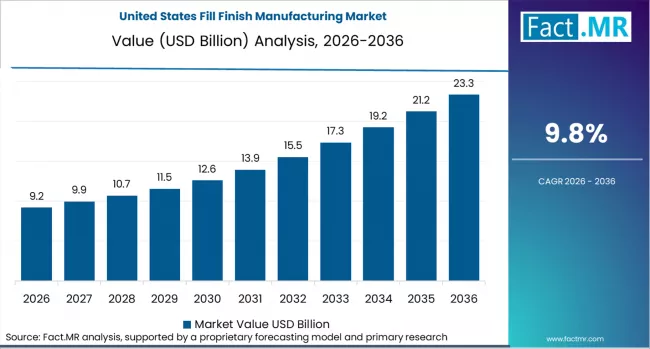
Fill Finish Manufacturing Market Country Value Analysis | Source: Fact.MR
North America demonstrates strong sales of fill finish manufacturing services supported by large biologics pipelines and outsourcing to specialized CDMOs. Demand is linked to FDA compliance high value injectable drugs and vaccine production. The United States anchors regional volume through advanced aseptic facilities and established pharmaceutical networks. Procurement emphasizes validation redundancy and regulatory track record. Growth reflects expansion of prefilled syringe formats cell and gene therapy products and scaling of clinical to commercial manufacturing across sterile injectable markets nationally.
- United States: Demand for fill finish manufacturing services in the United States is projected to rise at 9.8% CAGR through 2036. Sales are driven by outsourcing of biologics vaccine and injectable production to FDA compliant facilities, as per Fact.MR.
Fact.MR’s analysis of the Fill Finish Manufacturing Market in North America consists of country-wise assessment that includes the United States. Readers can find outsourcing trends and sterile production references.
Outlook On Fill Finish Manufacturing Capacity in Europe
Europe reflects structured growth in fill finish manufacturing capacity supported by established pharmaceutical production and regulatory alignment under EMA frameworks. Demand is shaped by biologics expansion vaccine supply and sterile injectable outsourcing. Germany contributes significantly through advanced aseptic facilities and contract manufacturers. Procurement favors validated cleanroom operations and EU GMP certification. Market growth reflects pipeline expansion increased demand for prefilled formats and regional investment in sterile filling infrastructure across commercial pharmaceutical manufacturing networks regionwide today.
- Germany: Demand for fill finish manufacturing services in Germany is projected to rise at 9.3% CAGR through 2036. Usage reflects strong contract manufacturing presence and expansion of sterile injectable production capacity, according to Fact.MR.
Fact.MR’s analysis of the Fill Finish Manufacturing Market in Europe consists of country-wise assessment that includes Germany. Readers can find EMA compliance trends and sterile capacity development insights.
Competitive Landscape for Fill Finish Manufacturing Market Players
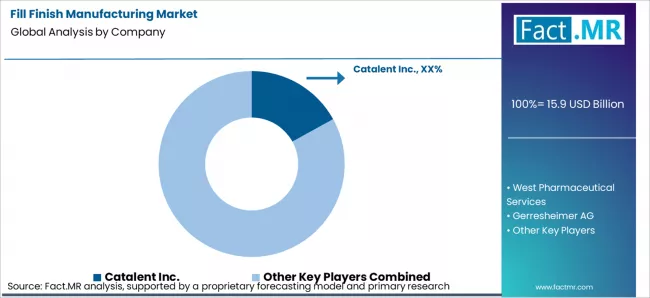
Fill Finish Manufacturing Market Analysis By Company | Source: Fact.MR
As per Fact.MR analysis, the 2026 fill finish manufacturing market is defined by validated process reliability, regulatory compliance, and multi-platform integration, which determine competitive advantage. Catalent Inc. and West Pharmaceutical Services lead with high-throughput, quality-verified fill finish capabilities, which strengthens adoption in biologics, vaccines, and sterile drug products. Gerresheimer AG and Lonza Group AG focus on validated vial and syringe systems with proven sterility assurance, which reduces contamination risk and enhances regulatory acceptance. Samsung Biologics and WuXi Biologics provide scalable end-to-end fill finish solutions with documented process reproducibility, which improves supply continuity and supports global commercial launches. Recipharm AB and Vetter Pharma emphasize validated aseptic manufacturing and multi-dose format expertise, which increases adoption in complex biologic and specialty pharmaceutical programs. Boehringer Ingelheim and AGC Biologics focus on GMP-compliant facilities and rigorous in-line quality control, which strengthens trust among OEM and contract manufacturing clients. Across the market, validated process reliability, regulatory adherence, and integrated manufacturing capabilities form enduring competitive moats, reducing reliance on pricing or isolated equipment claims.
Recent Industry Developments
- American Injectables Expands FDA-Approved Sterile Fill-Finish Facility (Aug 19, 2025): American Injectables, a CDMO in Brooksville, Florida, announced an expansion of its FDA-approved sterile fill-finish facility, adding new aseptic syringe and vial lines, formulation/R&D capacity, and enhanced commercial packaging services. The expansion targets clinical to commercial scale projects and increases capacity for 2026 bookings. [5]
- Simtra BioPharma Solutions Completes New Fill/Finish Facility in Germany (Oct 27, 2025): Simtra BioPharma Solutions announced the completion of its new fill/finish manufacturing facility in Halle (Westfalen), Germany. The expanded site increases production for sterile injectables and adds capacity to support global demand. The expansion reflects growth in contract manufacturing for critical therapeutics. [6]
Key Players in Fill Finish Manufacturing Market
- Catalent Inc.
- West Pharmaceutical Services
- Gerresheimer AG
- Lonza Group AG
- Samsung Biologics
- WuXi Biologics
- Recipharm AB
- Vetter Pharma
- Boehringer Ingelheim
- AGC Biologics
Bibliography
- [1] U.S. Food and Drug Administration. (2024). Pharmaceutical quality resources: Sterile drug manufacturing and aseptic processing. U.S. Department of Health and Human Services; World Health Organization. (2024). Standards and specifications for pharmaceutical manufacturing. World Health Organization.
- [2] U.S. Food and Drug Administration. (2024). Container closure systems for drug packaging. U.S. Department of Health and Human Services.
- [3] Centers for Disease Control and Prevention. (2024). Vaccine storage, handling, and administration guidelines. U.S. Department of Health and Human Services.
- [4] U.S. Food and Drug Administration. (2024). Drug manufacturing: Current good manufacturing practice (cGMP) requirements. U.S. Department of Health and Human Services.
- [5] American Injectables. (2025). American Injectables expands FDA-approved sterile fill-finish manufacturing facility [Press release]. American Injectables.
- [6] Simtra BioPharma Solutions. (2025). Simtra BioPharma Solutions completes construction of new fill-finish manufacturing facility in Germany [Press release]. Simtra BioPharma Solutions.
This Report Addresses
- Market intelligence to enable structured strategic decision-making across global sterile fill finish capacity markets, spanning pharma, biotech, and CDMO outsourcing ecosystems
- Global market size assessment and 10-year revenue forecasts from 2026 to 2036, built using installed aseptic capacity, utilization rates, injectable pipeline scaling, and outsourcing penetration assumptions
- Growth opportunity mapping across container formats and service platforms, with emphasis on prefilled syringes and other ready-to-use delivery systems that drive higher-value automated filling investments
- Segment and regional revenue forecasts covering all major product types (prefilled syringes, vials, cartridges, ampoules, bottles) and key therapeutic applications including vaccines, biologics, small molecules, and cell & gene therapies
- Competition strategy assessment benchmarking leading manufacturers and CDMOs on regulatory inspection track record, sterility assurance capability, containment design, automation depth, and inspection/visual QC compliance performance
- Technology roadmap tracking covering isolator-based filling, closed-system processing, robotics-enabled handling, automated inspection, and real-time environmental monitoring architectures
- Regulatory impact analysis covering cGMP-driven facility and process validation requirements, contamination control expectations, and sterile manufacturing guidance issued by the U.S. FDA and global health authorities
- Country-level growth assessment highlighting differentiated demand and capacity expansion trajectories across the United States, Germany, Japan, China, and South Korea
- Strategic implications for sponsors and CDMOs focused on long-term supply security, qualification readiness, and scalable aseptic infrastructure rather than short-term capacity availability
- Market report delivery in PDF, Excel datasets, PPT formats, and interactive dashboards for executive, quality, operations, procurement, and manufacturing planning teams
Segmentation
Scope of the Report
| Metric | Value |
|---|---|
| Quantitative Units | USD 15.9 billion (2026) to USD 37.8 billion (2036), CAGR 9.1% |
| Market Definition | The fill finish manufacturing market covers sterile drug product filling and sealing into final containers such as prefilled syringes, vials, cartridges, ampoules, and bottles. It ensures sterility, dose accuracy, and product integrity for vaccines, biologics, injectables, and other parenteral drugs. Operations follow strict aseptic processing, inspection compliance, and regulatory validation under frameworks issued by US FDA and WHO. |
| Product Type Segmentation | Prefilled Syringes, Vials, Cartridges, Ampoules, Bottles |
| Application Segmentation | Vaccines, Biologics, Small Molecules, Cell & Gene Therapies, Other (Veterinary, Diagnostic Applications) |
| End Use Segmentation | Pharmaceutical Companies, Contract Manufacturing Organizations, Biotechnology Companies, Other End Users |
| Regions Covered | Asia Pacific, Europe, North America, Latin America, Middle East & Africa |
| Countries Covered | United States, Germany, Japan, China, South Korea, India, and other countries in respective regions |
| Key Companies Profiled | Catalent Inc., West Pharmaceutical Services, Gerresheimer AG, Lonza Group AG, Samsung Biologics, WuXi Biologics, Recipharm AB, Vetter Pharma, Boehringer Ingelheim, AGC Biologics |
| Forecast Period | 2026 to 2036 |
| Approach | Hybrid top-down and bottom-up modeling validated with primary interviews of pharmaceutical manufacturers, CDMOs, and biotechnology companies; cross-checked with regulatory filings, production capacity data, and industry reports. |
Source: Fact.MR analysis. Updated Feb 25, 2026
Fill Finish Manufacturing Market Analysis by Segments
-
Product Type :
- Prefilled Syringes
- Vials
- Cartridges
- Ampoules
- Bottles
-
Application :
- Vaccines
- Biologics
- Small Molecules
- Cell & Gene Therapies
- Others (veterinary, diagnostic applications)
-
End Use :
- Pharmaceutical Companies
- Contract Manufacturing Organizations
- Biotechnology Companies
- Others
-
Region :
- Asia Pacific
- India
- China
- Japan
- South Korea
- Indonesia
- Australia & New Zealand
- ASEAN
- Rest of Asia Pacific
- Europe
- Germany
- Italy
- France
- United Kingdom
- Spain
- Benelux
- Nordics
- Central & Eastern Europe
- Rest of Europe
- North America
- United States
- Canada
- Mexico
- Latin America
- Brazil
- Argentina
- Chile
- Rest of Latin America
- Middle East & Africa
- Kingdom of Saudi Arabia
- United Arab Emirates
- South Africa
- Turkey
- Rest of Middle East & Africa
- Asia Pacific
Frequently Asked Questions
What is the market size of fill finish manufacturing in 2026?
What is the projected market value by 2036?
What is the expected CAGR for 2026–2036?
How much incremental value will the market add over the forecast window?
What does “fill finish manufacturing” mean?
Why is this market growing structurally, not cyclically?
Which product type leads the market?
Which application area accounts for the highest volume share?
How do biologics influence demand for fill finish services?
Why are cell and gene therapies important to long-term value growth?
What role does outsourcing play in market expansion?
What makes regulatory compliance a “value driver” here?
What technology trends are shaping the market?
Why is automation becoming more critical?
Which country is projected to grow fastest among those listed?
What supports growth in Germany and Japan?
What drives expansion in China and South Korea?
What are the main end users of fill finish services?
What’s included vs excluded in this market scope?
What is the long-term outlook for the fill finish manufacturing market?
Who worked on this report


Preview the report firsthand - request a free sample
Free SampleGet the brochure for pricing and purchase details
Download PDF