Filter Cloth Market (2026 - 2036)
Filter Cloth Market Size and Share Forecast Outlook 2026 to 2036
Core Findings
Filter Cloth Market Forecast Outlook 2026 to 2036
The filter cloth market is projected to reach USD 2.1 billion in 2026, growing to USD 3.2 billion by 2036, with a CAGR of 4%.
Key Takeaways from Filter Cloth Market
- Filter Cloth Market Value (2026): USD 2.1 billion
- Filter Cloth Market Forecast Value (2036): USD 3.2 billion
- Filter Cloth Market Forecast CAGR 2026 to 2036: 4%
- Leading Segment in Filter Cloth Market: Standard Finish or Treatment (48%)
- Key Growth Region in Filter Cloth Market: Asia Pacific
- Key Players in Filter Cloth Market: Sefar AG, ANDRITZ AG, Valmet Oyj, GKD – Gebr. Kufferath AG, AstenJohnson LLC, Albany International Corp., Clear Edge Filtration LLC, Micronics, Inc., FLSmidth & Co. A/S, BWF Group
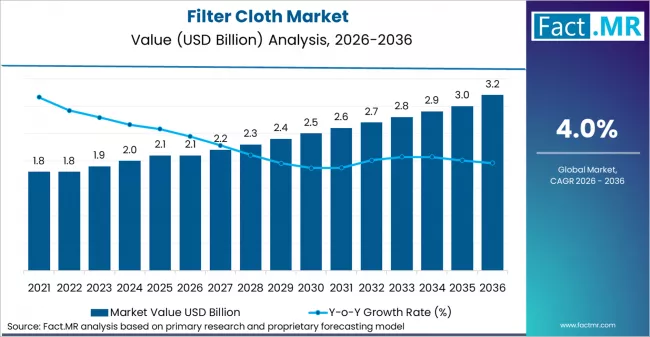
These figures signal steady, long-term demand, driven by consistent needs for filtration solutions in industries such as water treatment, mining, and manufacturing. The moderate growth rate suggests that purchasing behavior will remain cautious, with buyers seeking reliable, cost-effective products that meet ongoing regulatory standards.
Supplier confidence is likely to strengthen as industries commit to maintaining and upgrading filtration systems over time. This reflects a market where long-term relationships and quality assurance will be key to retaining customers. While the growth is not explosive, the market indicates a sustainable trend, where suppliers can benefit from continuous demand rather than sudden spikes. Companies will need to focus on long-term commitments to both product innovation and customer service to ensure a steady position in this growing sector.
Filter Cloth Market
| Metric | Value |
|---|---|
| Estimated Value in (2026E) | USD 2.1 billion |
| Forecast Value in (2036F) | USD 3.2 billion |
| Forecast CAGR 2026 to 2036 | 4% |
Category
| Category | Segments |
|---|---|
| Material | Polypropylene; Polyester; Nylon; PTFE or Other |
| Weave Type | Plain; Twill; Satin |
| Equipment | Filter Press; Belt Filter; Rotary Vacuum; Other |
| End Use | Mining and Minerals; Chemical; Food; Wastewater |
| Finish or Treatment | Standard; Heat-set; Coated or Repellent |
| Region | North America; Europe; Asia Pacific; Latin America; Middle East & Africa |
Segmental Analysis
What Is the Impact of Finish or Treatment on the Filter Cloth Market?
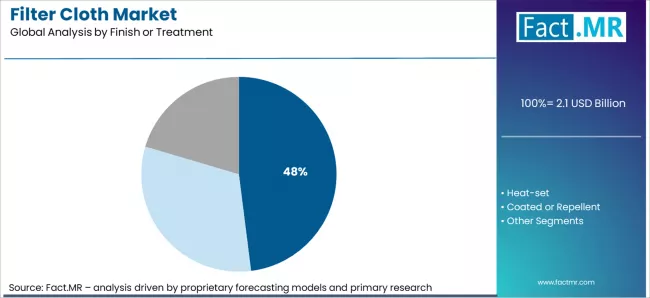
In the filter cloth market, the finish or treatment applied to the cloth significantly influences its performance and suitability for various applications. Standard finish holds the largest market share at 48%, as it is commonly used for general filtration processes across industries like mining, water treatment, and chemicals. Standard-treated filter cloths provide reliable filtration without additional treatments, offering cost-effective solutions. Heat-set and coated or repellent treatments are also in demand for specialized applications, where higher resistance to heat, chemicals, or fouling is required. As industries continue to focus on durability and efficiency, the demand for filter cloths with standard finishes will remain a primary driver in the market.
What Is the Impact of Equipment on the Filter Cloth Market?
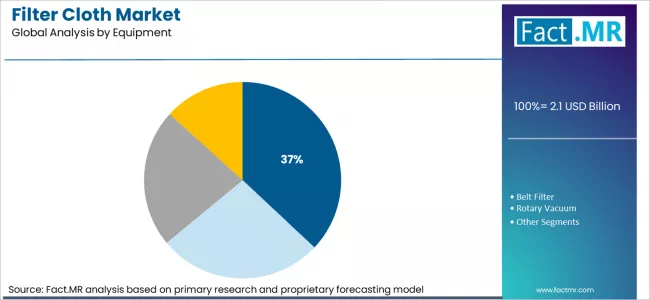
Equipment type is a critical factor in determining the demand for filter cloth, with filter press systems holding a 37% share. Filter presses are widely used in solid-liquid separation processes and require filter cloths to capture solids efficiently while allowing liquids to pass through. The cloth's durability, permeability, and resistance to wear are essential for optimizing filter press performance. Other equipment types, such as belt filters and rotary vacuum systems, also contribute to market growth, particularly in industries that require continuous filtration. As the need for efficient and durable filtration systems increases, the demand for high-quality filter cloths for various equipment types will continue to drive the market forward.
What are the Drivers, Restraints, and Key Trends in the Filter Cloth Market?
- Drivers: Demand for filter cloth is shaped by requirements to separate solids from liquids in mining, chemicals, food and beverage, wastewater treatment, and industrial process streams. Process engineers specify filter cloth that delivers consistent permeability, tensile strength, and abrasion resistance to support reliable dewatering, clarification, and solid capture. Procurement teams prioritize materials that conform to defined mesh sizes, fabric weave integrity, and chemical compatibility to meet application specific performance needs. Regulatory limits on effluent quality and particulate emissions influence adoption of higher performance filter media, affecting sourcing and inventory planning.
- Restraints: High cost of specialized filter fabrics constrains adoption where budgets are limited or where lower grade alternatives are tolerated. Some operations face challenges ensuring filter cloth performance under variable feedstock conditions, which can require frequent replacement and adjustment of tensioning or support structures.
- Trend 1: Development of engineered yarns and coatings that improve durability and chemical resistance.
- Trend 2: Expansion of modular filter cloth formats that simplify installation and change out across diverse filter housings.
Analysis of the Filter Cloth Market by Key Country
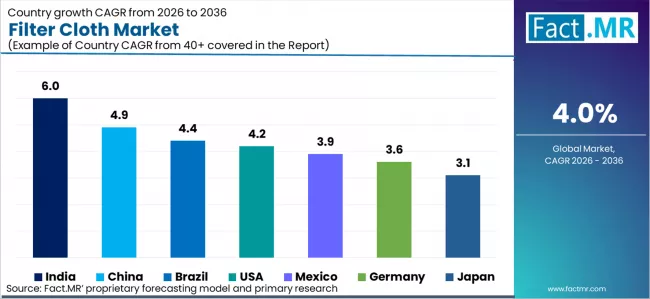
| Country | CAGR 2026 to 2036 |
|---|---|
| USA | 4.2% |
| China | 4.9% |
| India | 6% |
| Germany | 3.6% |
| Japan | 3.1% |
| Brazil | 4.4% |
| Mexico | 3.9% |
The report covers an in-depth analysis of 40+ countries; top-performing countries are highlighted below.
What is the Outlook on the Filter Cloth Market in the USA?
USA market in filter cloths is projected to grow at a CAGR of 4.2% from 2026 to 2036. The demand for filter cloths is increasing due to their wide application across industries like water treatment, mining, and food processing. These cloths are essential for separating solid particles from liquids and gases, ensuring clean and safe products. As industrial activities in the USA expand, along with increasing focus on environmental protection and wastewater treatment, the market for filter cloths is expected to continue growing steadily, supported by rising regulatory requirements for filtration systems.
What is the Demand for Filter Cloths in China?
China sales of filter cloths are expected to grow at a CAGR of 4.9% from 2026 to 2036. As China continues its rapid industrialization, the demand for high-quality filtration solutions in industries such as mining, textile manufacturing, and wastewater treatment is rising. Filter cloths are essential for ensuring efficient filtration and improving the overall quality of industrial processes. With China’s growing emphasis on industrial efficiency and environmental protection, the market for filter cloths is expected to expand steadily, driven by both domestic and international demand.
What is the Sales Outlook on Filter Cloths in India?
India demand for filter cloths is projected to grow at a CAGR of 6% from 2026 to 2036. The demand is being driven by the rapid expansion of India’s manufacturing, mining, and textile sectors. Filter cloths play a crucial role in various industries where solid-liquid separation is necessary, including water treatment and chemical manufacturing. As India continues to industrialize and adopt more sustainable practices in manufacturing and waste management, the market for filter cloths is expected to experience significant growth, supported by increasing investments in industrial processes and wastewater treatment infrastructure.
What is the Demand for Filter Cloths in Germany?
Germany market in filter cloths is forecast to grow at a CAGR of 3.6% from 2026 to 2036. Germany’s industrial sectors, particularly automotive, chemicals, and water treatment, rely on high-performance filtration systems to maintain operational efficiency and meet environmental standards. Filter cloths are used in numerous industrial processes to separate solids from liquids and gases. While the market in Germany is mature, the growing focus on sustainability, environmental protection, and energy-efficient manufacturing processes will continue to support steady demand for filter cloths.
What is the Sales Outlook on Filter Cloths in Japan?
Japan demand for filter cloths is set to grow at a CAGR of 3.1% from 2026 to 2036. Japan’s demand for filtration solutions is driven by the country’s strong manufacturing and water treatment industries, where filtration is essential for maintaining product quality and environmental compliance. Filter cloths are critical in applications such as wastewater treatment, chemical processing, and food production. Despite being a mature market, steady demand for high-quality filtration systems and the country’s ongoing commitment to environmental protection will continue to support moderate growth in the filter cloth market.
What is the Market Expansion Outlook for Filter Cloths in Brazil?
Brazil demand for filter cloths is projected to grow at a CAGR of 4.4% from 2026 to 2036. Brazil’s expanding manufacturing, mining, and water treatment sectors are increasing the demand for filtration solutions, particularly filter cloths. These cloths are used for solid-liquid separation processes in industries like mining, chemicals, and food processing. With Brazil’s ongoing investments in industrial development and wastewater treatment infrastructure, the market for filter cloths is expected to grow steadily, supported by both local and regional demand for efficient filtration systems.
What is the Market Expansion Outlook for Filter Cloths in Mexico?
Mexico sales of filter cloths are expected to grow at a CAGR of 3.9% from 2026 to 2036. Mexico’s growing industrial sectors, including mining, food and beverage, and water treatment, are driving the demand for filter cloths, which are essential for solid-liquid separation in various applications. The need for high-performance filtration solutions is increasing as industries focus on improving efficiency and meeting environmental standards. As Mexico continues to expand its manufacturing base and infrastructure, the market for filter cloths is expected to grow steadily, supported by both domestic demand and international trade.
How Are Key Players Competing in the Filter Cloth Market?
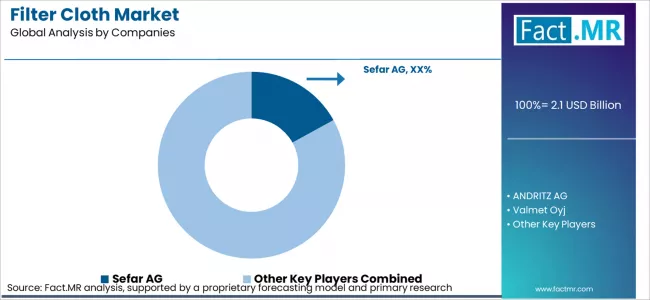
Competition in the filter cloth market is driven by media performance, weave precision, and resistance to chemical and mechanical wear. Sefar AG and ANDRITZ AG supply high precision woven and engineered fabrics tailored for consistent porosity and strength across dewatering and separation applications. Valmet Oyj and GKD – Gebr. Kufferath AG focus on filter cloth systems that balance filtration efficiency with durability under cyclic load conditions. AstenJohnson LLC and Albany International Corp. provide textiles designed for high throughput and dimensional stability. Clear Edge Filtration LLC and Micronics, Inc. offer advanced filter media that support fine particle capture and extended service intervals. FLSmidth & Co. A/S and BWF Group emphasize materials engineered for resistance to abrasion and chemical exposure in heavy industrial environments. Competitive positioning is defined by media uniformity, lifecycle performance, and conformity to industry filtration standards that support diverse process requirements.
Key Players of the Filter Cloth Market
- Sefar AG
- ANDRITZ AG
- Valmet Oyj
- GKD – Gebr. Kufferath AG
- AstenJohnson LLC
- Albany International Corp.
- Clear Edge Filtration LLC
- Micronics, Inc.
- FLSmidth & Co. A/S
- BWF Group
Scope of the Report
| Items | Values |
|---|---|
| Quantitative Units (2026) | USD Billion |
| Material | Polypropylene, Polyester, Nylon, PTFE or Other |
| Weave Type | Plain, Twill, Satin |
| Equipment | Filter Press, Belt Filter, Rotary Vacuum, Other |
| End Use | Mining and Minerals, Chemical, Food, Wastewater |
| Finish or Treatment | Standard, Heat-set, Coated or Repellent |
| Regions Covered | North America, Europe, Asia Pacific, Latin America, Middle East & Africa |
| Countries Covered | United States, Canada, Mexico, Germany, United Kingdom, France, Japan, South Korea, China, India, Brazil, and other countries |
| Key Companies Profiled | Sefar AG, ANDRITZ AG, Valmet Oyj, GKD – Gebr. Kufferath AG, AstenJohnson LLC, Albany International Corp., Clear Edge Filtration LLC, Micronics, Inc., FLSmidth & Co. A/S, BWF Group |
| Additional Attributes | Dollar revenue by material, weave type, equipment, end use, finish or treatment, and region; regional demand trends, competitive landscape, technological advancements in filter cloth production, operational performance optimization initiatives, and product development strategies |
Filter Cloth Market Key Segments
-
Material :
- Polypropylene
- Polyester
- Nylon
- PTFE or Other
-
Weave Type :
- Plain
- Twill
- Satin
-
Equipment :
- Filter Press
- Belt Filter
- Rotary Vacuum
- Other
-
End Use :
- Mining and Minerals
- Chemical
- Food
- Wastewater
- Other
-
Finish or Treatment :
- Standard
- Heat-set
- Coated or Repellent
-
Region :
- North America
- USA
- Canada
- Mexico
- Europe
- Germany
- UK
- France
- Italy
- Spain
- Rest of Europe
- Asia Pacific
- China
- Japan
- South Korea
- India
- Australia
- Rest of Asia Pacific
- Latin America
- Brazil
- Argentina
- Rest of Latin America
- Middle East and Africa
- Kingdom of Saudi Arabia
- United Arab Emirates
- South Africa
- Rest of Middle East and Africa
- Other Regions
- Oceania
- Central Asia
- Other Markets
- North America
Bibliographies
- International Organization for Standardization. (2024). ISO 29461-1: Textile filter media - Characterization of nonwoven filter fabrics for liquid filtration. ISO.
- ASTM International. (2023). ASTM F795-88(2023): Standard practice for testing air permeability of textile fabrics. ASTM International.
- European Committee for Standardization. (2024). EN 779: Particulate air filters for general ventilation - Determination of filtration performance. CEN.
- U.S. Environmental Protection Agency. (2023). Air pollution control technology fact sheet: Fabric filters (baghouses). EPA.
- World Health Organization. (2023). WHO guidelines on particulate matter (PM2.5 and PM10) and industrial dust control. WHO.
Table of Content
- Executive Summary
- Global Market Outlook
- Demand to side Trends
- Supply to side Trends
- Technology Roadmap Analysis
- Analysis and Recommendations
- Market Overview
- Market Coverage / Taxonomy
- Market Definition / Scope / Limitations
- Research Methodology
- Chapter Orientation
- Analytical Lens and Working Hypotheses
- Market Structure, Signals, and Trend Drivers
- Benchmarking and Cross-market Comparability
- Market Sizing, Forecasting, and Opportunity Mapping
- Research Design and Evidence Framework
- Desk Research Programme (Secondary Evidence)
- Company Annual and Sustainability Reports
- Peer-reviewed Journals and Academic Literature
- Corporate Websites, Product Literature, and Technical Notes
- Earnings Decks and Investor Briefings
- Statutory Filings and Regulatory Disclosures
- Technical White Papers and Standards Notes
- Trade Journals, Industry Magazines, and Analyst Briefs
- Conference Proceedings, Webinars, and Seminar Materials
- Government Statistics Portals and Public Data Releases
- Press Releases and Reputable Media Coverage
- Specialist Newsletters and Curated Briefings
- Sector Databases and Reference Repositories
- FMR Internal Proprietary Databases and Historical Market Datasets
- Subscription Datasets and Paid Sources
- Social Channels, Communities, and Digital Listening Inputs
- Additional Desk Sources
- Expert Input and Fieldwork (Primary Evidence)
- Primary Modes
- Qualitative Interviews and Expert Elicitation
- Quantitative Surveys and Structured Data Capture
- Blended A10oach
- Why Primary Evidence is Used
- Field Techniques
- Interviews
- Surveys
- Focus Groups
- Observational and In-context Research
- Social and Community Interactions
- Stakeholder Universe Engaged
- C-suite Leaders
- Board Members
- Presidents and Vice Presidents
- R&D and Innovation Heads
- Technical Specialists
- Domain Subject-matter Experts
- Scientists
- Physicians and Other Healthcare Professionals
- Governance, Ethics, and Data Stewardship
- Research Ethics
- Data Integrity and Handling
- Primary Modes
- Tooling, Models, and Reference Databases
- Desk Research Programme (Secondary Evidence)
- Data Engineering and Model Build
- Data Acquisition and Ingestion
- Cleaning, Normalisation, and Verification
- Synthesis, Triangulation, and Analysis
- Quality Assurance and Audit Trail
- Market Background
- Market Dynamics
- Drivers
- Restraints
- Opportunity
- Trends
- Scenario Forecast
- Demand in Optimistic Scenario
- Demand in Likely Scenario
- Demand in Conservative Scenario
- Opportunity Map Analysis
- Product Life Cycle Analysis
- Supply Chain Analysis
- Investment Feasibility Matrix
- Value Chain Analysis
- PESTLE and Porter’s Analysis
- Regulatory Landscape
- Regional Parent Market Outlook
- Production and Consumption Statistics
- Import and Export Statistics
- Market Dynamics
- Global Market Analysis 2021 to 2025 and Forecast, 2026 to 2036
- Historical Market Size Value (USD Million) Analysis, 2021 to 2025
- Current and Future Market Size Value (USD Million) Projections, 2026 to 2036
- Y to o to Y Growth Trend Analysis
- Absolute $ Opportunity Analysis
- Global Market Pricing Analysis 2021 to 2025 and Forecast 2026 to 2036
- Global Market Analysis 2021 to 2025 and Forecast 2026 to 2036, By Material
- Introduction / Key Findings
- Historical Market Size Value (USD Million) Analysis By Material, 2021 to 2025
- Current and Future Market Size Value (USD Million) Analysis and Forecast By Material, 2026 to 2036
- Polypropylene
- Polyester
- Nylon
- PTFE or Other
- Polypropylene
- Y to o to Y Growth Trend Analysis By Material, 2021 to 2025
- Absolute $ Opportunity Analysis By Material, 2026 to 2036
- Global Market Analysis 2021 to 2025 and Forecast 2026 to 2036, By Weave Type
- Introduction / Key Findings
- Historical Market Size Value (USD Million) Analysis By Weave Type, 2021 to 2025
- Current and Future Market Size Value (USD Million) Analysis and Forecast By Weave Type, 2026 to 2036
- Plain
- Twill
- Satin
- Plain
- Y to o to Y Growth Trend Analysis By Weave Type, 2021 to 2025
- Absolute $ Opportunity Analysis By Weave Type, 2026 to 2036
- Global Market Analysis 2021 to 2025 and Forecast 2026 to 2036, By Equipment
- Introduction / Key Findings
- Historical Market Size Value (USD Million) Analysis By Equipment, 2021 to 2025
- Current and Future Market Size Value (USD Million) Analysis and Forecast By Equipment, 2026 to 2036
- Filter Press
- Belt Filter
- Rotary Vacuum
- Other
- Filter Press
- Y to o to Y Growth Trend Analysis By Equipment, 2021 to 2025
- Absolute $ Opportunity Analysis By Equipment, 2026 to 2036
- Global Market Analysis 2021 to 2025 and Forecast 2026 to 2036, By End Use
- Introduction / Key Findings
- Historical Market Size Value (USD Million) Analysis By End Use, 2021 to 2025
- Current and Future Market Size Value (USD Million) Analysis and Forecast By End Use, 2026 to 2036
- Mining and Minerals
- Chemical
- Food
- Wastewater
- Mining and Minerals
- Y to o to Y Growth Trend Analysis By End Use, 2021 to 2025
- Absolute $ Opportunity Analysis By End Use, 2026 to 2036
- Global Market Analysis 2021 to 2025 and Forecast 2026 to 2036, By Finish or Treatment
- Introduction / Key Findings
- Historical Market Size Value (USD Million) Analysis By Finish or Treatment, 2021 to 2025
- Current and Future Market Size Value (USD Million) Analysis and Forecast By Finish or Treatment, 2026 to 2036
- Standard
- Heat-set
- Coated or Repellent
- Standard
- Y to o to Y Growth Trend Analysis By Finish or Treatment, 2021 to 2025
- Absolute $ Opportunity Analysis By Finish or Treatment, 2026 to 2036
- Global Market Analysis 2021 to 2025 and Forecast 2026 to 2036, By Region
- Introduction
- Historical Market Size Value (USD Million) Analysis By Region, 2021 to 2025
- Current Market Size Value (USD Million) Analysis and Forecast By Region, 2026 to 2036
- North America
- Latin America
- Western Europe
- Eastern Europe
- East Asia
- South Asia and Pacific
- Middle East & Africa
- Market Attractiveness Analysis By Region
- North America Market Analysis 2021 to 2025 and Forecast 2026 to 2036, By Country
- Historical Market Size Value (USD Million) Trend Analysis By Market Taxonomy, 2021 to 2025
- Market Size Value (USD Million) Forecast By Market Taxonomy, 2026 to 2036
- By Country
- USA
- Canada
- Mexico
- By Material
- By Weave Type
- By Equipment
- By End Use
- By Finish or Treatment
- By Country
- Market Attractiveness Analysis
- By Country
- By Material
- By Weave Type
- By Equipment
- By End Use
- By Finish or Treatment
- Key Takeaways
- Latin America Market Analysis 2021 to 2025 and Forecast 2026 to 2036, By Country
- Historical Market Size Value (USD Million) Trend Analysis By Market Taxonomy, 2021 to 2025
- Market Size Value (USD Million) Forecast By Market Taxonomy, 2026 to 2036
- By Country
- Brazil
- Chile
- Rest of Latin America
- By Material
- By Weave Type
- By Equipment
- By End Use
- By Finish or Treatment
- By Country
- Market Attractiveness Analysis
- By Country
- By Material
- By Weave Type
- By Equipment
- By End Use
- By Finish or Treatment
- Key Takeaways
- Western Europe Market Analysis 2021 to 2025 and Forecast 2026 to 2036, By Country
- Historical Market Size Value (USD Million) Trend Analysis By Market Taxonomy, 2021 to 2025
- Market Size Value (USD Million) Forecast By Market Taxonomy, 2026 to 2036
- By Country
- Germany
- UK
- Italy
- Spain
- France
- Nordic
- BENELUX
- Rest of Western Europe
- By Material
- By Weave Type
- By Equipment
- By End Use
- By Finish or Treatment
- By Country
- Market Attractiveness Analysis
- By Country
- By Material
- By Weave Type
- By Equipment
- By End Use
- By Finish or Treatment
- Key Takeaways
- Eastern Europe Market Analysis 2021 to 2025 and Forecast 2026 to 2036, By Country
- Historical Market Size Value (USD Million) Trend Analysis By Market Taxonomy, 2021 to 2025
- Market Size Value (USD Million) Forecast By Market Taxonomy, 2026 to 2036
- By Country
- Russia
- Poland
- Hungary
- Balkan & Baltic
- Rest of Eastern Europe
- By Material
- By Weave Type
- By Equipment
- By End Use
- By Finish or Treatment
- By Country
- Market Attractiveness Analysis
- By Country
- By Material
- By Weave Type
- By Equipment
- By End Use
- By Finish or Treatment
- Key Takeaways
- East Asia Market Analysis 2021 to 2025 and Forecast 2026 to 2036, By Country
- Historical Market Size Value (USD Million) Trend Analysis By Market Taxonomy, 2021 to 2025
- Market Size Value (USD Million) Forecast By Market Taxonomy, 2026 to 2036
- By Country
- China
- Japan
- South Korea
- By Material
- By Weave Type
- By Equipment
- By End Use
- By Finish or Treatment
- By Country
- Market Attractiveness Analysis
- By Country
- By Material
- By Weave Type
- By Equipment
- By End Use
- By Finish or Treatment
- Key Takeaways
- South Asia and Pacific Market Analysis 2021 to 2025 and Forecast 2026 to 2036, By Country
- Historical Market Size Value (USD Million) Trend Analysis By Market Taxonomy, 2021 to 2025
- Market Size Value (USD Million) Forecast By Market Taxonomy, 2026 to 2036
- By Country
- India
- ASEAN
- Australia & New Zealand
- Rest of South Asia and Pacific
- By Material
- By Weave Type
- By Equipment
- By End Use
- By Finish or Treatment
- By Country
- Market Attractiveness Analysis
- By Country
- By Material
- By Weave Type
- By Equipment
- By End Use
- By Finish or Treatment
- Key Takeaways
- Middle East & Africa Market Analysis 2021 to 2025 and Forecast 2026 to 2036, By Country
- Historical Market Size Value (USD Million) Trend Analysis By Market Taxonomy, 2021 to 2025
- Market Size Value (USD Million) Forecast By Market Taxonomy, 2026 to 2036
- By Country
- Kingdom of Saudi Arabia
- Other GCC Countries
- Turkiye
- South Africa
- Other African Union
- Rest of Middle East & Africa
- By Material
- By Weave Type
- By Equipment
- By End Use
- By Finish or Treatment
- By Country
- Market Attractiveness Analysis
- By Country
- By Material
- By Weave Type
- By Equipment
- By End Use
- By Finish or Treatment
- Key Takeaways
- Key Countries Market Analysis
- USA
- Pricing Analysis
- Market Share Analysis, 2025
- By Material
- By Weave Type
- By Equipment
- By End Use
- By Finish or Treatment
- Canada
- Pricing Analysis
- Market Share Analysis, 2025
- By Material
- By Weave Type
- By Equipment
- By End Use
- By Finish or Treatment
- Mexico
- Pricing Analysis
- Market Share Analysis, 2025
- By Material
- By Weave Type
- By Equipment
- By End Use
- By Finish or Treatment
- Brazil
- Pricing Analysis
- Market Share Analysis, 2025
- By Material
- By Weave Type
- By Equipment
- By End Use
- By Finish or Treatment
- Chile
- Pricing Analysis
- Market Share Analysis, 2025
- By Material
- By Weave Type
- By Equipment
- By End Use
- By Finish or Treatment
- Germany
- Pricing Analysis
- Market Share Analysis, 2025
- By Material
- By Weave Type
- By Equipment
- By End Use
- By Finish or Treatment
- UK
- Pricing Analysis
- Market Share Analysis, 2025
- By Material
- By Weave Type
- By Equipment
- By End Use
- By Finish or Treatment
- Italy
- Pricing Analysis
- Market Share Analysis, 2025
- By Material
- By Weave Type
- By Equipment
- By End Use
- By Finish or Treatment
- Spain
- Pricing Analysis
- Market Share Analysis, 2025
- By Material
- By Weave Type
- By Equipment
- By End Use
- By Finish or Treatment
- France
- Pricing Analysis
- Market Share Analysis, 2025
- By Material
- By Weave Type
- By Equipment
- By End Use
- By Finish or Treatment
- India
- Pricing Analysis
- Market Share Analysis, 2025
- By Material
- By Weave Type
- By Equipment
- By End Use
- By Finish or Treatment
- ASEAN
- Pricing Analysis
- Market Share Analysis, 2025
- By Material
- By Weave Type
- By Equipment
- By End Use
- By Finish or Treatment
- Australia & New Zealand
- Pricing Analysis
- Market Share Analysis, 2025
- By Material
- By Weave Type
- By Equipment
- By End Use
- By Finish or Treatment
- China
- Pricing Analysis
- Market Share Analysis, 2025
- By Material
- By Weave Type
- By Equipment
- By End Use
- By Finish or Treatment
- Japan
- Pricing Analysis
- Market Share Analysis, 2025
- By Material
- By Weave Type
- By Equipment
- By End Use
- By Finish or Treatment
- South Korea
- Pricing Analysis
- Market Share Analysis, 2025
- By Material
- By Weave Type
- By Equipment
- By End Use
- By Finish or Treatment
- Russia
- Pricing Analysis
- Market Share Analysis, 2025
- By Material
- By Weave Type
- By Equipment
- By End Use
- By Finish or Treatment
- Poland
- Pricing Analysis
- Market Share Analysis, 2025
- By Material
- By Weave Type
- By Equipment
- By End Use
- By Finish or Treatment
- Hungary
- Pricing Analysis
- Market Share Analysis, 2025
- By Material
- By Weave Type
- By Equipment
- By End Use
- By Finish or Treatment
- Kingdom of Saudi Arabia
- Pricing Analysis
- Market Share Analysis, 2025
- By Material
- By Weave Type
- By Equipment
- By End Use
- By Finish or Treatment
- Turkiye
- Pricing Analysis
- Market Share Analysis, 2025
- By Material
- By Weave Type
- By Equipment
- By End Use
- By Finish or Treatment
- South Africa
- Pricing Analysis
- Market Share Analysis, 2025
- By Material
- By Weave Type
- By Equipment
- By End Use
- By Finish or Treatment
- USA
- Market Structure Analysis
- Competition Dashboard
- Competition Benchmarking
- Market Share Analysis of Top Players
- By Regional
- By Material
- By Weave Type
- By Equipment
- By End Use
- By Finish or Treatment
- Competition Analysis
- Competition Deep Dive
- Sefar AG
- Overview
- Product Portfolio
- Profitability by Market Segments (Product/Age /Sales Channel/Region)
- Sales Footprint
- Strategy Overview
- Marketing Strategy
- Product Strategy
- Channel Strategy
- ANDRITZ AG
- Valmet Oyj
- GKD – Gebr. Kufferath AG
- AstenJohnson LLC
- Albany International Corp.
- Clear Edge Filtration LLC
- Micronics, Inc.
- FLSmidth & Co. A/S
- BWF Group
- Sefar AG
- Competition Deep Dive
- Assumptions & Acronyms Used
List Of Table
- Table 1: Global Market Value (USD Million) Forecast by Region, 2021 to 2036
- Table 2: Global Market Value (USD Million) Forecast by Material, 2021 to 2036
- Table 3: Global Market Value (USD Million) Forecast by Weave Type, 2021 to 2036
- Table 4: Global Market Value (USD Million) Forecast by Equipment, 2021 to 2036
- Table 5: Global Market Value (USD Million) Forecast by End Use, 2021 to 2036
- Table 6: Global Market Value (USD Million) Forecast by Finish or Treatment, 2021 to 2036
- Table 7: North America Market Value (USD Million) Forecast by Country, 2021 to 2036
- Table 8: North America Market Value (USD Million) Forecast by Material, 2021 to 2036
- Table 9: North America Market Value (USD Million) Forecast by Weave Type, 2021 to 2036
- Table 10: North America Market Value (USD Million) Forecast by Equipment, 2021 to 2036
- Table 11: North America Market Value (USD Million) Forecast by End Use, 2021 to 2036
- Table 12: North America Market Value (USD Million) Forecast by Finish or Treatment, 2021 to 2036
- Table 13: Latin America Market Value (USD Million) Forecast by Country, 2021 to 2036
- Table 14: Latin America Market Value (USD Million) Forecast by Material, 2021 to 2036
- Table 15: Latin America Market Value (USD Million) Forecast by Weave Type, 2021 to 2036
- Table 16: Latin America Market Value (USD Million) Forecast by Equipment, 2021 to 2036
- Table 17: Latin America Market Value (USD Million) Forecast by End Use, 2021 to 2036
- Table 18: Latin America Market Value (USD Million) Forecast by Finish or Treatment, 2021 to 2036
- Table 19: Western Europe Market Value (USD Million) Forecast by Country, 2021 to 2036
- Table 20: Western Europe Market Value (USD Million) Forecast by Material, 2021 to 2036
- Table 21: Western Europe Market Value (USD Million) Forecast by Weave Type, 2021 to 2036
- Table 22: Western Europe Market Value (USD Million) Forecast by Equipment, 2021 to 2036
- Table 23: Western Europe Market Value (USD Million) Forecast by End Use, 2021 to 2036
- Table 24: Western Europe Market Value (USD Million) Forecast by Finish or Treatment, 2021 to 2036
- Table 25: Eastern Europe Market Value (USD Million) Forecast by Country, 2021 to 2036
- Table 26: Eastern Europe Market Value (USD Million) Forecast by Material, 2021 to 2036
- Table 27: Eastern Europe Market Value (USD Million) Forecast by Weave Type, 2021 to 2036
- Table 28: Eastern Europe Market Value (USD Million) Forecast by Equipment, 2021 to 2036
- Table 29: Eastern Europe Market Value (USD Million) Forecast by End Use, 2021 to 2036
- Table 30: Eastern Europe Market Value (USD Million) Forecast by Finish or Treatment, 2021 to 2036
- Table 31: East Asia Market Value (USD Million) Forecast by Country, 2021 to 2036
- Table 32: East Asia Market Value (USD Million) Forecast by Material, 2021 to 2036
- Table 33: East Asia Market Value (USD Million) Forecast by Weave Type, 2021 to 2036
- Table 34: East Asia Market Value (USD Million) Forecast by Equipment, 2021 to 2036
- Table 35: East Asia Market Value (USD Million) Forecast by End Use, 2021 to 2036
- Table 36: East Asia Market Value (USD Million) Forecast by Finish or Treatment, 2021 to 2036
- Table 37: South Asia and Pacific Market Value (USD Million) Forecast by Country, 2021 to 2036
- Table 38: South Asia and Pacific Market Value (USD Million) Forecast by Material, 2021 to 2036
- Table 39: South Asia and Pacific Market Value (USD Million) Forecast by Weave Type, 2021 to 2036
- Table 40: South Asia and Pacific Market Value (USD Million) Forecast by Equipment, 2021 to 2036
- Table 41: South Asia and Pacific Market Value (USD Million) Forecast by End Use, 2021 to 2036
- Table 42: South Asia and Pacific Market Value (USD Million) Forecast by Finish or Treatment, 2021 to 2036
- Table 43: Middle East & Africa Market Value (USD Million) Forecast by Country, 2021 to 2036
- Table 44: Middle East & Africa Market Value (USD Million) Forecast by Material, 2021 to 2036
- Table 45: Middle East & Africa Market Value (USD Million) Forecast by Weave Type, 2021 to 2036
- Table 46: Middle East & Africa Market Value (USD Million) Forecast by Equipment, 2021 to 2036
- Table 47: Middle East & Africa Market Value (USD Million) Forecast by End Use, 2021 to 2036
- Table 48: Middle East & Africa Market Value (USD Million) Forecast by Finish or Treatment, 2021 to 2036
List Of Figures
- Figure 1: Global Market Pricing Analysis
- Figure 2: Global Market Value (USD Million) Forecast 2021 to 2036
- Figure 3: Global Market Value Share and BPS Analysis by Material, 2026 and 2036
- Figure 4: Global Market Y to o to Y Growth Comparison by Material, 2026 to 2036
- Figure 5: Global Market Attractiveness Analysis by Material
- Figure 6: Global Market Value Share and BPS Analysis by Weave Type, 2026 and 2036
- Figure 7: Global Market Y to o to Y Growth Comparison by Weave Type, 2026 to 2036
- Figure 8: Global Market Attractiveness Analysis by Weave Type
- Figure 9: Global Market Value Share and BPS Analysis by Equipment, 2026 and 2036
- Figure 10: Global Market Y to o to Y Growth Comparison by Equipment, 2026 to 2036
- Figure 11: Global Market Attractiveness Analysis by Equipment
- Figure 12: Global Market Value Share and BPS Analysis by End Use, 2026 and 2036
- Figure 13: Global Market Y to o to Y Growth Comparison by End Use, 2026 to 2036
- Figure 14: Global Market Attractiveness Analysis by End Use
- Figure 15: Global Market Value Share and BPS Analysis by Finish or Treatment, 2026 and 2036
- Figure 16: Global Market Y to o to Y Growth Comparison by Finish or Treatment, 2026 to 2036
- Figure 17: Global Market Attractiveness Analysis by Finish or Treatment
- Figure 18: Global Market Value (USD Million) Share and BPS Analysis by Region, 2026 and 2036
- Figure 19: Global Market Y to o to Y Growth Comparison by Region, 2026 to 2036
- Figure 20: Global Market Attractiveness Analysis by Region
- Figure 21: North America Market Incremental Dollar Opportunity, 2026 to 2036
- Figure 22: Latin America Market Incremental Dollar Opportunity, 2026 to 2036
- Figure 23: Western Europe Market Incremental Dollar Opportunity, 2026 to 2036
- Figure 24: Eastern Europe Market Incremental Dollar Opportunity, 2026 to 2036
- Figure 25: East Asia Market Incremental Dollar Opportunity, 2026 to 2036
- Figure 26: South Asia and Pacific Market Incremental Dollar Opportunity, 2026 to 2036
- Figure 27: Middle East & Africa Market Incremental Dollar Opportunity, 2026 to 2036
- Figure 28: North America Market Value Share and BPS Analysis by Country, 2026 and 2036
- Figure 29: North America Market Value Share and BPS Analysis by Material, 2026 and 2036
- Figure 30: North America Market Y to o to Y Growth Comparison by Material, 2026 to 2036
- Figure 31: North America Market Attractiveness Analysis by Material
- Figure 32: North America Market Value Share and BPS Analysis by Weave Type, 2026 and 2036
- Figure 33: North America Market Y to o to Y Growth Comparison by Weave Type, 2026 to 2036
- Figure 34: North America Market Attractiveness Analysis by Weave Type
- Figure 35: North America Market Value Share and BPS Analysis by Equipment, 2026 and 2036
- Figure 36: North America Market Y to o to Y Growth Comparison by Equipment, 2026 to 2036
- Figure 37: North America Market Attractiveness Analysis by Equipment
- Figure 38: North America Market Value Share and BPS Analysis by End Use, 2026 and 2036
- Figure 39: North America Market Y to o to Y Growth Comparison by End Use, 2026 to 2036
- Figure 40: North America Market Attractiveness Analysis by End Use
- Figure 41: North America Market Value Share and BPS Analysis by Finish or Treatment, 2026 and 2036
- Figure 42: North America Market Y to o to Y Growth Comparison by Finish or Treatment, 2026 to 2036
- Figure 43: North America Market Attractiveness Analysis by Finish or Treatment
- Figure 44: Latin America Market Value Share and BPS Analysis by Country, 2026 and 2036
- Figure 45: Latin America Market Value Share and BPS Analysis by Material, 2026 and 2036
- Figure 46: Latin America Market Y to o to Y Growth Comparison by Material, 2026 to 2036
- Figure 47: Latin America Market Attractiveness Analysis by Material
- Figure 48: Latin America Market Value Share and BPS Analysis by Weave Type, 2026 and 2036
- Figure 49: Latin America Market Y to o to Y Growth Comparison by Weave Type, 2026 to 2036
- Figure 50: Latin America Market Attractiveness Analysis by Weave Type
- Figure 51: Latin America Market Value Share and BPS Analysis by Equipment, 2026 and 2036
- Figure 52: Latin America Market Y to o to Y Growth Comparison by Equipment, 2026 to 2036
- Figure 53: Latin America Market Attractiveness Analysis by Equipment
- Figure 54: Latin America Market Value Share and BPS Analysis by End Use, 2026 and 2036
- Figure 55: Latin America Market Y to o to Y Growth Comparison by End Use, 2026 to 2036
- Figure 56: Latin America Market Attractiveness Analysis by End Use
- Figure 57: Latin America Market Value Share and BPS Analysis by Finish or Treatment, 2026 and 2036
- Figure 58: Latin America Market Y to o to Y Growth Comparison by Finish or Treatment, 2026 to 2036
- Figure 59: Latin America Market Attractiveness Analysis by Finish or Treatment
- Figure 60: Western Europe Market Value Share and BPS Analysis by Country, 2026 and 2036
- Figure 61: Western Europe Market Value Share and BPS Analysis by Material, 2026 and 2036
- Figure 62: Western Europe Market Y to o to Y Growth Comparison by Material, 2026 to 2036
- Figure 63: Western Europe Market Attractiveness Analysis by Material
- Figure 64: Western Europe Market Value Share and BPS Analysis by Weave Type, 2026 and 2036
- Figure 65: Western Europe Market Y to o to Y Growth Comparison by Weave Type, 2026 to 2036
- Figure 66: Western Europe Market Attractiveness Analysis by Weave Type
- Figure 67: Western Europe Market Value Share and BPS Analysis by Equipment, 2026 and 2036
- Figure 68: Western Europe Market Y to o to Y Growth Comparison by Equipment, 2026 to 2036
- Figure 69: Western Europe Market Attractiveness Analysis by Equipment
- Figure 70: Western Europe Market Value Share and BPS Analysis by End Use, 2026 and 2036
- Figure 71: Western Europe Market Y to o to Y Growth Comparison by End Use, 2026 to 2036
- Figure 72: Western Europe Market Attractiveness Analysis by End Use
- Figure 73: Western Europe Market Value Share and BPS Analysis by Finish or Treatment, 2026 and 2036
- Figure 74: Western Europe Market Y to o to Y Growth Comparison by Finish or Treatment, 2026 to 2036
- Figure 75: Western Europe Market Attractiveness Analysis by Finish or Treatment
- Figure 76: Eastern Europe Market Value Share and BPS Analysis by Country, 2026 and 2036
- Figure 77: Eastern Europe Market Value Share and BPS Analysis by Material, 2026 and 2036
- Figure 78: Eastern Europe Market Y to o to Y Growth Comparison by Material, 2026 to 2036
- Figure 79: Eastern Europe Market Attractiveness Analysis by Material
- Figure 80: Eastern Europe Market Value Share and BPS Analysis by Weave Type, 2026 and 2036
- Figure 81: Eastern Europe Market Y to o to Y Growth Comparison by Weave Type, 2026 to 2036
- Figure 82: Eastern Europe Market Attractiveness Analysis by Weave Type
- Figure 83: Eastern Europe Market Value Share and BPS Analysis by Equipment, 2026 and 2036
- Figure 84: Eastern Europe Market Y to o to Y Growth Comparison by Equipment, 2026 to 2036
- Figure 85: Eastern Europe Market Attractiveness Analysis by Equipment
- Figure 86: Eastern Europe Market Value Share and BPS Analysis by End Use, 2026 and 2036
- Figure 87: Eastern Europe Market Y to o to Y Growth Comparison by End Use, 2026 to 2036
- Figure 88: Eastern Europe Market Attractiveness Analysis by End Use
- Figure 89: Eastern Europe Market Value Share and BPS Analysis by Finish or Treatment, 2026 and 2036
- Figure 90: Eastern Europe Market Y to o to Y Growth Comparison by Finish or Treatment, 2026 to 2036
- Figure 91: Eastern Europe Market Attractiveness Analysis by Finish or Treatment
- Figure 92: East Asia Market Value Share and BPS Analysis by Country, 2026 and 2036
- Figure 93: East Asia Market Value Share and BPS Analysis by Material, 2026 and 2036
- Figure 94: East Asia Market Y to o to Y Growth Comparison by Material, 2026 to 2036
- Figure 95: East Asia Market Attractiveness Analysis by Material
- Figure 96: East Asia Market Value Share and BPS Analysis by Weave Type, 2026 and 2036
- Figure 97: East Asia Market Y to o to Y Growth Comparison by Weave Type, 2026 to 2036
- Figure 98: East Asia Market Attractiveness Analysis by Weave Type
- Figure 99: East Asia Market Value Share and BPS Analysis by Equipment, 2026 and 2036
- Figure 100: East Asia Market Y to o to Y Growth Comparison by Equipment, 2026 to 2036
- Figure 101: East Asia Market Attractiveness Analysis by Equipment
- Figure 102: East Asia Market Value Share and BPS Analysis by End Use, 2026 and 2036
- Figure 103: East Asia Market Y to o to Y Growth Comparison by End Use, 2026 to 2036
- Figure 104: East Asia Market Attractiveness Analysis by End Use
- Figure 105: East Asia Market Value Share and BPS Analysis by Finish or Treatment, 2026 and 2036
- Figure 106: East Asia Market Y to o to Y Growth Comparison by Finish or Treatment, 2026 to 2036
- Figure 107: East Asia Market Attractiveness Analysis by Finish or Treatment
- Figure 108: South Asia and Pacific Market Value Share and BPS Analysis by Country, 2026 and 2036
- Figure 109: South Asia and Pacific Market Value Share and BPS Analysis by Material, 2026 and 2036
- Figure 110: South Asia and Pacific Market Y to o to Y Growth Comparison by Material, 2026 to 2036
- Figure 111: South Asia and Pacific Market Attractiveness Analysis by Material
- Figure 112: South Asia and Pacific Market Value Share and BPS Analysis by Weave Type, 2026 and 2036
- Figure 113: South Asia and Pacific Market Y to o to Y Growth Comparison by Weave Type, 2026 to 2036
- Figure 114: South Asia and Pacific Market Attractiveness Analysis by Weave Type
- Figure 115: South Asia and Pacific Market Value Share and BPS Analysis by Equipment, 2026 and 2036
- Figure 116: South Asia and Pacific Market Y to o to Y Growth Comparison by Equipment, 2026 to 2036
- Figure 117: South Asia and Pacific Market Attractiveness Analysis by Equipment
- Figure 118: South Asia and Pacific Market Value Share and BPS Analysis by End Use, 2026 and 2036
- Figure 119: South Asia and Pacific Market Y to o to Y Growth Comparison by End Use, 2026 to 2036
- Figure 120: South Asia and Pacific Market Attractiveness Analysis by End Use
- Figure 121: South Asia and Pacific Market Value Share and BPS Analysis by Finish or Treatment, 2026 and 2036
- Figure 122: South Asia and Pacific Market Y to o to Y Growth Comparison by Finish or Treatment, 2026 to 2036
- Figure 123: South Asia and Pacific Market Attractiveness Analysis by Finish or Treatment
- Figure 124: Middle East & Africa Market Value Share and BPS Analysis by Country, 2026 and 2036
- Figure 125: Middle East & Africa Market Value Share and BPS Analysis by Material, 2026 and 2036
- Figure 126: Middle East & Africa Market Y to o to Y Growth Comparison by Material, 2026 to 2036
- Figure 127: Middle East & Africa Market Attractiveness Analysis by Material
- Figure 128: Middle East & Africa Market Value Share and BPS Analysis by Weave Type, 2026 and 2036
- Figure 129: Middle East & Africa Market Y to o to Y Growth Comparison by Weave Type, 2026 to 2036
- Figure 130: Middle East & Africa Market Attractiveness Analysis by Weave Type
- Figure 131: Middle East & Africa Market Value Share and BPS Analysis by Equipment, 2026 and 2036
- Figure 132: Middle East & Africa Market Y to o to Y Growth Comparison by Equipment, 2026 to 2036
- Figure 133: Middle East & Africa Market Attractiveness Analysis by Equipment
- Figure 134: Middle East & Africa Market Value Share and BPS Analysis by End Use, 2026 and 2036
- Figure 135: Middle East & Africa Market Y to o to Y Growth Comparison by End Use, 2026 to 2036
- Figure 136: Middle East & Africa Market Attractiveness Analysis by End Use
- Figure 137: Middle East & Africa Market Value Share and BPS Analysis by Finish or Treatment, 2026 and 2036
- Figure 138: Middle East & Africa Market Y to o to Y Growth Comparison by Finish or Treatment, 2026 to 2036
- Figure 139: Middle East & Africa Market Attractiveness Analysis by Finish or Treatment
- Figure 140: Global Market - Tier Structure Analysis
- Figure 141: Global Market - Company Share Analysis
- FAQs -
How big is the filter cloth market in 2026?
The global filter cloth market is estimated to be valued at USD 2.1 billion in 2026.
What will be the size of filter cloth market in 2036?
The market size for the filter cloth market is projected to reach USD 3.2 billion by 2036.
How much will be the filter cloth market growth between 2026 and 2036?
The filter cloth market is expected to grow at a 4.0% CAGR between 2026 and 2036.
What are the key product types in the filter cloth market?
The key product types in filter cloth market are polypropylene, polyester, nylon and ptfe or other.
Which weave type segment to contribute significant share in the filter cloth market in 2026?
In terms of weave type, plain segment to command 34.0% share in the filter cloth market in 2026.