- Market Value (2025): USD 167.3 Mn
- Estimated Value (2026): USD 178.0 Mn
- Forecast Value (2036): USD 330.0 Mn
- CAGR (2026-2036): 6.4%
What is the Flat-Pack Expo Booths Market forecast to be worth by 2036?
USD 178.0 million in 2026 to USD 330.0 million by 2036 at 6.4% CAGR.
- The flat-pack expo booths market surpassed a value of USD 167.3 million in 2025 as exhibitors increased spending on parcel-friendly logistics and small-team installation.
- Market value is estimated at USD 178.0 million in 2026 and is forecast to reach USD 330.0 million by 2036.
- The market is forecast to record 6.4% CAGR from 2026 to 2036 as regional exhibitors and online purchase channels widen access to packaged booth kits.
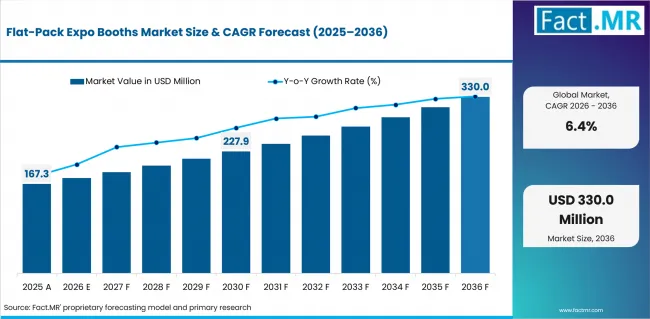
Flat Pack Expo Booths Market Value Analysis | Source: Fact.MR
What are the defining numbers behind Flat-Pack Expo Booths Market growth?
USD 152.0 million absolute opportunity by 2036, led by Snap-lock frames and Courier cartons alongside SME exhibitors and Direct online sales.
- Demand Drivers in the Market
- Parcel-friendly logistics is expected to make compact packed dimensions a formal purchase condition. Exhibitors compare carton size and damage risk before they approve a kit for repeated show use.
- Small-team installation is anticipated to support demand where regional exhibitors cannot rely on large setup crews. Clear instructions and indexed parts reduce mistakes when staff change between events.
- Growth of regional exhibitors is projected to favor systems that move between smaller shows without custom site work. The buying case improves when the same kit preserves brand quality across several venues.
- Online purchase availability is expected to widen access for smaller exhibitors and agencies. Product pages need installed size, packed size and replacement support before remote customers commit budget.
- Key Segments Analyzed
- By Assembly Method: Snap-lock frames are anticipated to capture 27.0% share in 2026. The method reduces tool dependence and helps staff repeat the same setup sequence.
- By Shipping Format: Courier cartons are forecast to represent 32.0% share in 2026. The format suits exhibitors that need booth packages to move through standard parcel networks.
- By Buyer Group: SME exhibitors are estimated to command 34.0% share in 2026. Smaller firms need lower storage burden and faster installation before they commit to owned booth kits.
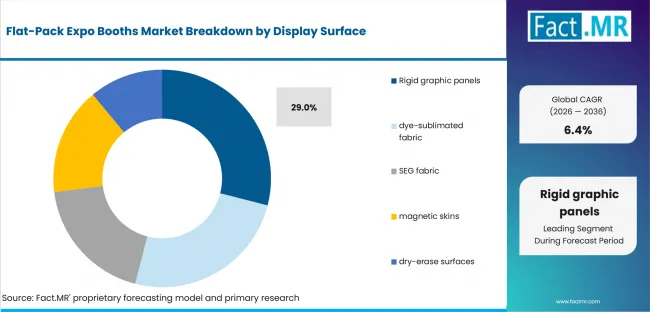
- By Display Surface: Rigid graphic panels are projected to hold 29.0% share in 2026. Their lead reflects better visual consistency after repeated handling and repositioning.
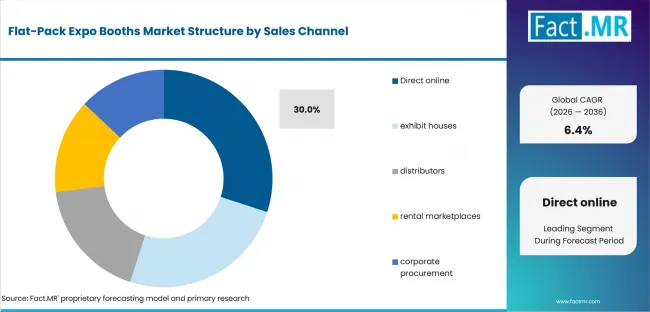
- By Sales Channel: Direct online is expected to account for 30.0% share in 2026. Purchasers use this route to compare kit size, graphic options and replacement parts before contacting sales staff.
- Analyst Opinion at Fact.MR
- Shambhu Nath Jha, Sr. Consultant at Fact.MR, states “Flat-pack expo booth purchasing depends on whether a compact package still looks like a complete brand space after repeated use. Providers that prove packed dimensions, setup steps and replacement-part availability are expected to gain stronger approval from regional exhibitors and agencies.”
- Strategic Implications
- Exhibitors should document show frequency and available setup labor before selecting a flat-pack package. This review helps compare owned kits with rental options and prevents a one-event purchase from becoming a storage burden.
- Providers improve lifetime value when reusable frames are separated from replaceable graphics. The approach supports graphic design refreshes without forcing a full booth replacement.
- Agencies and venue partners should test packed dimensions before offering a kit across several clients. Digital signage systems belong in the plan only when power access and transport weight fit the booth plan.
China is projected to record a 8.6% CAGR from 2026 to 2036. UAE is anticipated to record a 7.1% CAGR from 2026 to 2036. USA is forecast to record a 6.4% CAGR from 2026 to 2036. Japan is estimated to record a 6.3% CAGR from 2026 to 2036. United Kingdom is expected to post a 6.1% CAGR from 2026 to 2036. Germany is projected to record a 5.8% CAGR from 2026 to 2036.
How does the Flat-Pack Expo Booths Market break down by segment?
Snap-lock frames lead Assembly Method at 27.0% share. Courier cartons lead Shipping Format at 32.0% share in 2026.
Why do Snap-lock frames lead Assembly Method?
Snap-lock frames are anticipated to hold 27.0% share in 2026.
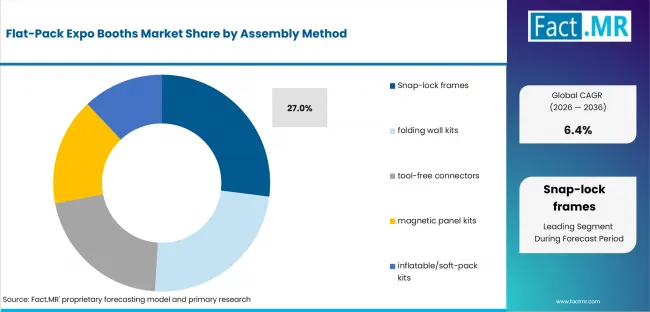
Flat Pack Expo Booths Market Analysis By Assembly Method | Source: Fact.MR
Snap-lock frames give exhibitors a repeatable installation method without heavy tool use. They are favored when local staff need a clear sequence that keeps panels aligned after several events. Folding wall kits and tool-free connectors serve similar needs. Magnetic panel kits and inflatable or soft-pack kits remain useful where the brief places more weight on lower shipping weight or flexible shapes.
What makes Courier cartons the leading Shipping Format?
Courier cartons are forecast to represent 32.0% share in 2026.
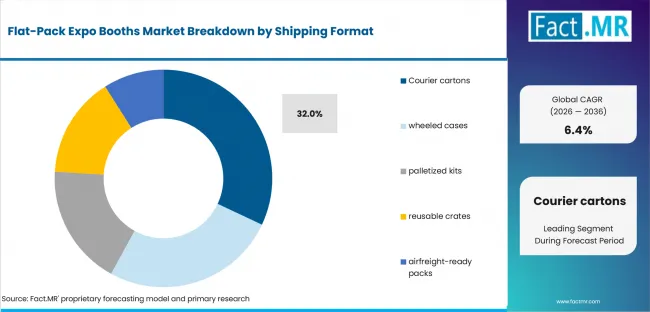
Flat Pack Expo Booths Market Analysis By Shipping Format | Source: Fact.MR
Courier cartons match the shipping route used by smaller exhibitors and regional agencies. The format reduces dependence on pallet freight and makes delivery easier to plan before the event. Wheeled cases and reusable crates remain important when protection needs are higher. Palletized kits and airfreight-ready packs serve larger programs where custom packaging controls are needed.
Why do SME exhibitors lead Buyer Group?
SME exhibitors hold 34.0% share in 2026.
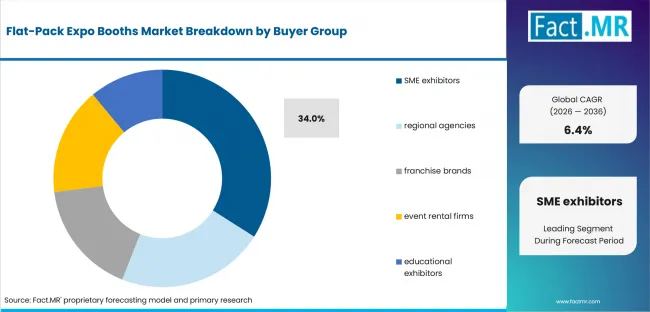
Flat Pack Expo Booths Market Analysis By Buyer Group | Source: Fact.MR
SME exhibitors require a professional booth without the cost and storage burden of a custom stand. Flat-pack kits give these customers a repeatable display asset for local and regional shows. Regional agencies and franchise brands extend the base through multi-location programs. Event rental firms and educational exhibitors add demand where budgets require simple reuse.
How do Rigid graphic panels lead Display Surface?
Rigid graphic panels are projected to hold 29.0% share in 2026.
Flat Pack Expo Booths Market Analysis By Display Surface | Source: Fact.MR
Rigid graphic panels maintain a cleaner visual plane after repeated packing and assembly. The format is useful when exhibitors want a stable image surface without shifting fabric tension. Dye-sublimated fabric and SEG fabric remain useful where lower weight matters. Magnetic skins and dry-erase surfaces serve faster message changes and backlit displays support higher visibility.
What keeps Direct online ahead in Sales Channel?
Direct online is expected to account for 30.0% share in 2026.
Flat Pack Expo Booths Market Analysis By Sales Channel | Source: Fact.MR
Direct online leads where purchasers compare dimensions, graphic choices and lead times before speaking with a provider. This route favors standard kits with clear drawings and replacement-part options. Exhibit houses and distributors remain relevant for service-heavy programs. Rental marketplaces and corporate procurement channels serve buyers that need support beyond the basic kit.
What is accelerating Flat-Pack Expo Booths Market adoption, and what is holding it back?
Parcel-friendly logistics is anticipated to remain the primary demand catalyst. Damage during parcel handling is expected to restrain adoption when packaging design and support terms are unclear.
Drivers Impact Analysis
| DRIVER | (~) % IMPACT ON CAGR | GEOGRAPHIC RELEVANCE | IMPACT TIMELINE |
|---|---|---|---|
| Parcel-friendly logistics | +1.7% | China and UAE | Short term (<= 2 years) |
| Small-team installation | +1.3% | Mature exhibition markets | Short term (<= 2 years) |
| Growth of regional exhibitors | +1.0% | Global | Medium term (2-4 years) |
| Online purchase availability | +0.7% | North America and Europe | Medium term (2-4 years) |
Source: Fact.MR analysis. Updated Jul 27, 2026
- Parcel-friendly logistics: Compact cartons are expected to raise adoption when freight planning becomes part of the event brief. The driver is strongest where exhibitors need one booth package to work across several venues.
- Small-team installation: Tool-light assembly is projected to matter where exhibitors work with limited staff. Providers strengthen the case when every kit includes clear instructions, labeled parts and fast replacement support.
- Growth of regional exhibitors: Regional show participation is anticipated to increase the need for affordable booth assets. These users prefer packages that are simple to store and consistent across repeated deployments.
- Online purchase availability: Direct product comparison is expected to move more booth selection into online channels. Installed dimensions and packed weight need to be visible before a purchaser commits budget.
Opportunity Impact Analysis
| OPPORTUNITY | (~) % IMPACT ON CAGR | GEOGRAPHIC RELEVANCE | IMPACT TIMELINE |
|---|---|---|---|
| Subscription replacement graphics | +1.1% | Germany and Japan | Short term (<= 2 years) |
| Standardized export packs | +0.8% | China and UAE | Medium term (2-4 years) |
| Guided mobile assembly | +0.6% | USA and UK | Medium term (2-4 years) |
Source: Fact.MR analysis. Updated Jul 27, 2026
- Subscription replacement graphics: Repeat exhibitors are expected to refresh messages more often than booth frames. A subscription offer works when graphics arrive fitted to the existing kit and do not create new setup steps.
- Standardized export packs: Export-ready packaging is projected to help providers serve agencies and exhibitors across borders. The opportunity depends on protecting frames, panels and connectors without increasing freight complexity.
- Guided mobile assembly: Step-by-step mobile support is expected to reduce setup errors for small crews. The same content works with 3D rendering files when providers need clearer previews before installation.
Restraints Impact Analysis
| RESTRAINT | (~) % IMPACT ON CAGR | GEOGRAPHIC RELEVANCE | IMPACT TIMELINE |
|---|---|---|---|
| Damage during parcel handling | -1.2% | Highly regulated venues | Short term (<= 2 years) |
| Limited large-format rigidity | -0.9% | Global | Medium term (2-4 years) |
| Buyer confusion over true installed size | -0.6% | Cost-sensitive regional markets | Short term (<= 2 years) |
Source: Fact.MR analysis. Updated Jul 27, 2026
- Damage during parcel handling: Parcel movement is expected to create hesitation when panels or connectors arrive without enough protection. Stronger cases and replacement-part access reduce this restraint.
- Limited large-format rigidity: Large visual surfaces are expected to be harder to stabilize inside compact packages. Providers need to show when an upsized system requires stronger frames or a different shipping format.
- Buyer confusion over true installed size: Online purchasers are expected to misjudge booth footprint when drawings and packed dimensions are unclear. Better diagrams and measured examples help reduce returns and support calls.
Which countries are scaling Flat-Pack Expo Booths Market fastest?
A global growth rate represents the weighted average of all markets included in the analysis. It therefore does not need to match the growth rate of every individual market within the coverage set. The six countries presented are illustrative examples. Their comparison with the global figure shows how national market conditions can differ from the overall average.
- The countries are distinguished less by their CAGRs, which remain within a range of 1.8 percentage points, and more by the spacing between their market positions. China and the UAE form a compact upper group. The USA, Japan and the U.K. create a closely aligned middle cluster while Germany occupies a more separated position.
- China records a notable position because multi-city exhibition activity supports booth kits that can move between venues with limited custom work. The UAE remains close to China in CAGR terms but follows a different route through high event turnover and international participation. Both markets favor compact shipping although their service requirements differ.
- The USA and Japan are closely aligned despite different adoption models. USA demand reflects measurement-led procurement and comparisons between ownership and rental. Japan places greater emphasis on compact venue planning and consistent installation quality. The U.K. remains near this group through recurring exhibitions and replacement-graphic demand. Germany follows a more measured pattern because technical review and frame-rigidity documentation can extend approval timing.
- Markets with broadly similar CAGRs can therefore create substantially different entry conditions. These differences become relevant when providers compare deployment timing and service support. Carton protection, assembly guidance and replacement-part availability can influence adoption more than the CAGR gap alone.
The full report examines these dynamics for every market included in the study. It provides country-level CAGR analysis across North America, Latin America, Europe, East Asia, South Asia, Oceania, and the Middle East and Africa.
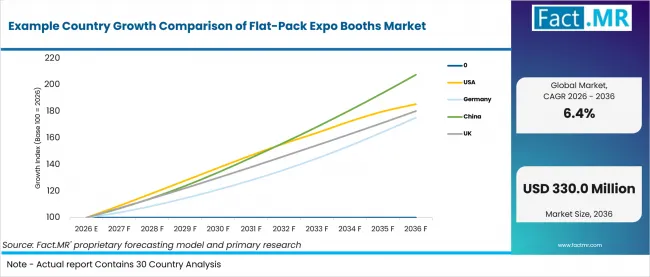
Example Country Growth Comparison Of Flat Pack Expo Booths Market | Source: Fact.MR
| Country | CAGR (2026-2036) |
|---|---|
| UAE | 7.1% |
| USA | 6.4% |
| Japan | 6.3% |
| UK | 6.1% |
| Germany | 5.8% |
Source: Fact.MR analysis. Updated Jul 27, 2026
Why does the UAE benefit from rapid event turnover?
7.1% CAGR, driven by high event throughput and international participation.
UAE demand is forecast to rise where venues handle frequent business events and exhibitors need fast booth turnover. Flat-pack formats help customers avoid extra freight burden between consecutive shows. Providers are expected to prove that compact packaging does not weaken the installed booth or delay setup. Local service support is important because event schedules leave little room for missing parts or unclear assembly steps. This need keeps after-sales contact visible during planning.
What shapes flat-pack booth adoption across the USA?
6.4% CAGR, supported by measurement-led exhibitor procurement.
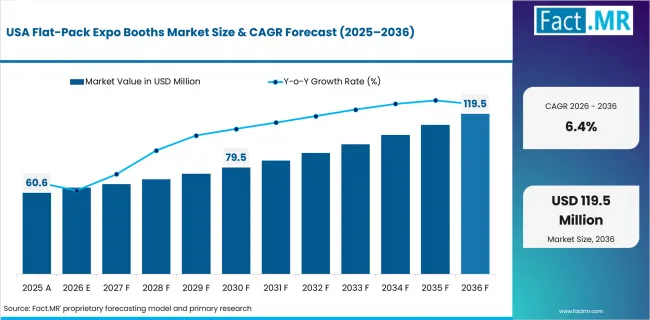
Flat Pack Expo Booths Market Country Value Analysis | Source: Fact.MR
The USA market is expected to favor booth systems that connect event spending with repeatable outcomes. Exhibitors compare owned kits, rental options and managed service before approving budgets. Direct online channels gain relevance when product drawings and package dimensions reduce uncertainty. Providers are expected to perform better when they explain how the booth supports repeated use without creating storage or service problems for smaller event teams during each event season.
Why do compact venue requirements matter in Japan?
6.3% CAGR, backed by compact systems and reliable operation.
Japan’s growth is shaped by compact venue planning and careful installation discipline. Customers are expected to prefer systems that maintain panel alignment after repeated assembly. Rigid graphic panels and courier cartons remain useful when providers keep the package simple and consistent. The purchase case improves when instructions are clear enough for small teams and the installed booth keeps a neat visual finish after transport. This supports careful reordering before the next event.
How are recurring exhibitions supporting the U.K. market?
6.1% CAGR, led by recurring exhibitions and repeat users.
The UK market is projected to benefit from exhibitors that return to business events with updated messaging. Subscription replacement graphics give these users a reason to keep the same booth structure longer. Providers strengthen retention by combining storage guidance, graphic refreshes and quick dispatch. Customers are expected to favor systems that can move between smaller shows without looking improvised or creating extra setup work. This makes repeat programs easier to manage.
What influences purchasing decisions across Germany?
5.8% CAGR, driven by technical review and trade-fair discipline.
Germany’s forecast reflects a market where booth systems face close checks before installation. Exhibitors are expected to ask for clear drawings, frame rigidity information and handling instructions. Adoption improves when compact packaging is matched with reliable installed size and stable visual presentation. Providers are expected to gain confidence from customers when they document how parts fit together and how the kit performs after repeated use.
Who leads the Flat-Pack Expo Booths Market?
Nomadic Display and Classic Exhibits bring established portable-display experience while ExpoDisplays and Skyline Exhibits broaden access through modular products and regional service coverage.
Nomadic Display competes through reusable exhibit systems designed for repeated transport and assembly. Classic Exhibits supports buyers that require modular booth configurations with dependable structural performance. ExpoDisplays adds online product access and standardized kits for smaller exhibitors. Skyline Exhibits contributes a wider support network for customers that require design help and local installation guidance. Exponents extends the provider group through customisable booth packages and managed exhibition support.
Competition through 2036 is expected to center on whether compact booth packages can retain a professional appearance after repeated shipping and setup. Buyers are likely to compare packed dimensions and installation effort alongside graphic replacement options and service response. Product documentation will also matter because unclear footprints or missing assembly details can delay purchasing decisions. Providers that combine durable cases with easy part replacement and consistent after-sales support may secure more repeat business from exhibitors and regional agencies.
Which companies are the key providers?
Key companies include Nomadic Display, Classic Exhibits, ExpoDisplays, Skyline Exhibits, and Exponents.
- Nomadic Display
- Classic Exhibits
- ExpoDisplays
- Skyline Exhibits
- Exponents
What is the report’s scope and coverage?
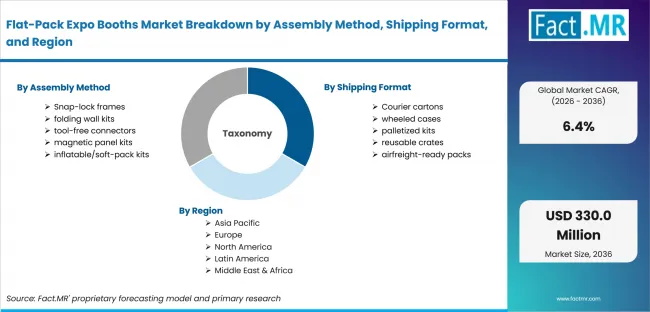
Flat Pack Expo Booths Market Breakdown By Assembly Method, Shipping Format, And Region | Source: Fact.MR
| Attribute | Details |
|---|---|
| Quantitative Units | USD 178.0 million in 2026 to USD 330.0 million by 2036 at 6.4% CAGR |
| Market Definition | Portable booth packages engineered to ship in compact cartons or cases and assemble with limited tools when sold as a complete commercial event solution |
| Assembly Method | Snap-lock frames; folding wall kits; tool-free connectors; magnetic panel kits; inflatable/soft-pack kits |
| Shipping Format | Courier cartons; wheeled cases; palletized kits; reusable crates; airfreight-ready packs |
| Buyer Group | SME exhibitors; regional agencies; franchise brands; event rental firms; educational exhibitors |
| Display Surface | Rigid graphic panels; dye-sublimated fabric; SEG fabric; magnetic skins; dry-erase surfaces |
| Sales Channel | Direct online; exhibit houses; distributors; rental marketplaces; corporate procurement |
| Regions Covered | North America; Latin America; Europe; East Asia; South Asia and Pacific; Middle East and Africa |
| Countries Covered | USA; Canada; Brazil; Mexico; Germany; U.K.; France; Italy; Spain; South Korea; Japan; Australia & New Zealand; GCC Countries; South Africa; UAE |
| Key Companies Profiled | Nomadic Display; Classic Exhibits; ExpoDisplays; Skyline Exhibits; Exponents |
| Forecast Period | 2026 to 2036 |
| Approach | Hybrid top-down and bottom-up approach using exhibition demand indicators; assembly-method preferences; shipping format choices; buyer group behavior; display-surface selection; online sales activity; country growth; provider participation and adoption patterns |
Source: Fact.MR analysis. Updated Jul 27, 2026
How is the market segmented?
-
By Assembly Method:
- Snap-lock frames
- Folding wall kits
- Tool-free connectors
- Magnetic panel kits
- Inflatable/soft-pack kits
-
By Shipping Format:
- Courier cartons
- Wheeled cases
- Palletized kits
- Reusable crates
- Airfreight-ready packs
-
By Buyer Group:
- SME exhibitors
- Regional agencies
- Franchise brands
- Event rental firms
- Educational exhibitors
-
By Display Surface:
- Rigid graphic panels
- Dye-sublimated fabric
- SEG fabric
- Magnetic skins
- Dry-erase surfaces
-
By Sales Channel:
- Direct online
- Exhibit houses
- Distributors
- Rental marketplaces
- Corporate procurement
-
By Region:
- North America
- USA
- Canada
- Latin America
- Brazil
- Mexico
- Rest of Latin America
- Europe
- Germany
- U.K.
- France
- Italy
- Spain
- Rest of Europe
- East Asia
- South Korea
- Japan
- China
- South Asia & Oceania
- India
- Australia & New Zealand
- Rest of South Asia & Oceania
- Middle East & Africa
- GCC Countries
- South Africa
- UAE
- Rest of Middle East & Africa
- North America
Bibliography
- The State Council of the People’s Republic of China. (2025, January 10). China sees surge in industrial and technological expos in 2024: Report.
- U.S. Census Bureau. (2026, May 18). Quarterly retail e-commerce sales: First quarter 2026. U.S. Department of Commerce.
- Ministry of Economy, Trade and Industry. (2025, August 26). Results of FY2024 e-commerce market survey compiled. Government of Japan.
- Nomadic Display. Portable, modular and custom trade show display systems.
- Classic Exhibits. Modular exhibit systems and portable display solutions.
- ExpoDisplays. Trade show displays, exhibits and booth systems.
- Skyline Exhibits. (2026, July 15). Custom modular vs. fully custom exhibits.
- Exponents. Custom trade show booth rentals and modular exhibit solutions.
This Report Answers
- The report provides strategic intelligence on the flat-pack expo booths market across Assembly Method and Shipping Format choices that shape compact booth purchasing and repeated exhibition use.
- Segment analysis covers Snap-lock frames and Courier cartons as the share leaders within the 2026 market. SME exhibitors, Rigid graphic panels and Direct online sales complete the segment view.
- Country outlook evaluates China and the UAE alongside the USA and Japan. The U.K. and Germany complete the growth comparison across the profiled markets.
- Competitive analysis profiles Nomadic Display and Classic Exhibits alongside ExpoDisplays and Skyline Exhibits. Exponents completes the provider set.
- Display and purchasing assessment covers Rigid graphic panels and replacement graphics alongside Direct online purchasing. Packed dimensions, assembly guidance and replacement-part support complete the commercial evaluation.
What does the Flat-Pack Expo Booths Market cover?
Portable booth packages are engineered to ship in compact cartons or cases and assemble with limited tools.
The flat-pack expo booths market covers flat-packed frames, wall kits, cases, graphics and connectors sold as an installable exhibition booth package. Commercial value comes from the configured product and its direct event function. The covered solution needs to be usable within an exhibition workflow. Unrelated display parts remain outside the scope.
The market differs from broader event equipment because the boundary is defined by compact shipping and repeatable assembly. Custom site-built stands, venue labor charges, freight brokerage and standalone printed graphics remain outside the valuation.
What is included in the scope?
Flat-pack expo booth systems are used by SME exhibitors, regional agencies, franchise brands, event rental firms and educational exhibitors.
The scope includes assembly method and shipping format alongside buyer group, display surface and sales channel. Coverage spans snap-lock frames, folding wall kits, tool-free connectors, magnetic panel kits and inflatable or soft-pack kits. Courier cartons, wheeled cases, palletized kits, reusable crates and airfreight-ready packs follow the same product-use rule.
Components remain in scope when they are sold as part of the complete flat-pack expo booth solution and contribute directly to compact shipping, setup speed and repeated event use.
What is excluded from the scope?
Custom site-built stands, venue labor charges, freight brokerage and standalone printed graphics remain outside the scope.
The scope excludes unrelated venue construction, general event management, floor-space rental and services that do not deliver the defined product function. The value of the event, venue or exhibitor business in which the solution is used remains outside the scope.
How Was the Analysis Built?
The analysis draws on 120+ sources, 35+ company portfolios, 25+ countries, and more than 20 industry interviews.
- Primary Research: Primary research includes discussions with manufacturers, service providers, technology developers, distributors, end users, procurement teams, and subject-matter experts. These conversations examine purchasing priorities, product adoption, operational challenges, approval requirements, competitive positioning, and the factors that influence wider market acceptance.
- Desk Research: Desk research covers government statistics, regulatory publications, company filings, trade data, technical studies, industry associations, standards, public policy, and other authoritative sources. Every source used in the analysis is documented in the bibliography.
- Market Sizing and Forecasting: Market estimates combine historical performance, demand indicators, pricing and volume trends, segment shares, company participation, country-level growth, adoption patterns, investment activity, and barriers to market expansion.
- Data Validation and Update Cycle: Findings are validated by comparing primary interviews with public data, company activity, regulatory changes, trade patterns, and industry developments. Regular updates review new product launches, capacity changes, partnerships, approvals, procurement trends, and shifts in commercial adoption.
Frequently Asked Questions
Which Assembly Method leads the market?
Which Shipping Format leads the market?
Which Buyer Group leads the market?
Which Display Surface leads the market?
Which Sales Channel leads the market?
Which country records the highest listed CAGR?
What is the primary driver in this market?
What is the main restraint?
Why do SME exhibitors lead demand?
Who worked on this report


Preview the report firsthand - request a free sample
Free SampleGet the brochure for pricing and purchase details
Download PDF