- Market Value (2025): USD 1.5 Bn
- Estimated Value (2026): USD 1.7 Bn
- Forecast Value (2036): USD 6.8 Bn
- CAGR (2026-2036): 14.8%
What is the Flushable Soluble Films Market forecast to be worth by 2036?
USD 1.7 billion in 2026 to USD 6.8 billion by 2036, at a 14.8% CAGR.
- The Flushable Soluble Films Market was valued at USD 1.5 billion in 2025.
- Demand is projected to increase from USD 1.7 billion in 2026 to USD 6.8 billion by 2036.
- The market is forecast to record a 14.8% CAGR from 2026 to 2036 as unit-dose users and hygiene-product developers seek films that dissolve in water and limit persistent packaging residues.
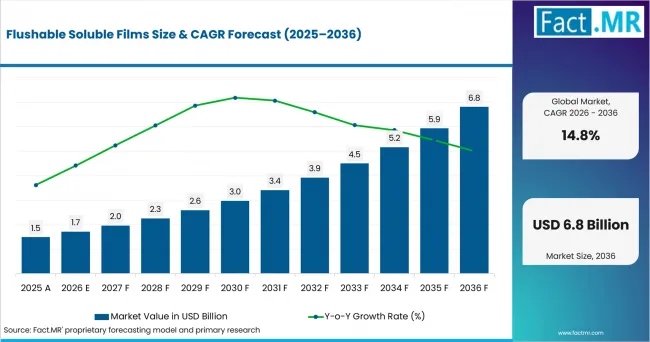
Flushable Soluble Films Value Analysis | Source: Fact.MR
What are the defining numbers behind Flushable Soluble Films Market growth?
USD 5.1 billion absolute opportunity by 2036, led by PVOH/PVA, unit-dose pouches and microplastic-free positioning.
- Demand Drivers in the Market
- Home-care formulators need cold-water films that release concentrated detergent during standard wash cycles while keeping the pre-measured dose sealed until use.
- Hygiene-product developers need dispersible structures that reduce the chance of intact plastic-based components reaching sewer systems after disposal.
- Agrochemical manufacturers need pre-measured packs that reduce direct operator contact with concentrated formulations during mixing and application.
- Food and specialty-product brands need controlled dissolution that protects a dry or concentrated dose during storage while allowing rapid release at the point of use.
- Wastewater-sensitive product developers need material systems with controlled breakup behavior and clear end-of-life documentation. This requirement is expected to widen technical screening beyond simple dissolution speed when films are used in hygiene and flushable formats.
- Key Segments Analyzed
- By Material Platform: PVOH/PVA is expected to hold 31.0% share in 2026 because it combines film formation with adjustable water solubility across unit-dose formats.
- By Dissolution: Cold-water is projected to account for 29.0% share in 2026 owing to household washing and other applications where dissolution must begin at low temperatures.
- By Application: Unit-dose pouches are anticipated to capture 36.0% share in 2026 as pre-measured delivery reduces handling and simplifies dosing.
- By Environmental Position: Microplastic-free claim is estimated to represent 34.0% share in 2026 because brands are placing greater weight on the fate of packaging after use.
- Analyst Opinion at Fact.MR
- Shambhu Nath Jha, Principal Consultant at Fact.MR, states, “Flushable soluble films face a stricter test than simple water solubility. Suppliers are expected to pair predictable dissolution with storage strength and application-level end-of-life evidence.”
- Strategic Implications
- Film manufacturers should document dissolution curves by water temperature and film gauge. In December 2025, England’s Department for Environment, Food & Rural Affairs published guidance on the plastic wet-wipes ban, clarifying product scope, exemptions, and enforcement requirements and increasing the importance of clearly documenting material composition for affected hygiene products.
- Home-care brands should validate pouch sealing against liquid formulation chemistry because premature softening can create leakage before the dose reaches the wash cycle.
- Hygiene developers should separate “flushable” performance from broad biodegradability claims and document how the complete product behaves in sewer-relevant conditions.
- Agrochemical packers should pair soluble films with accurate filling and sealing controls so each sachet delivers a repeatable dose while limiting direct handling.
China is forecast at 15.7% CAGR through 2036. The USA and Japan are each projected at 15.2%, followed by Germany at 15.0% and France at 14.5%.
How does the Flushable Soluble Films Market break down by segment?
Unit-dose pouches lead Application at 36.0%; microplastic-free claim leads Environmental Position at 34.0%.
Which Material Platform dominates?
PVOH/PVA is expected to hold 31.0% share in 2026.
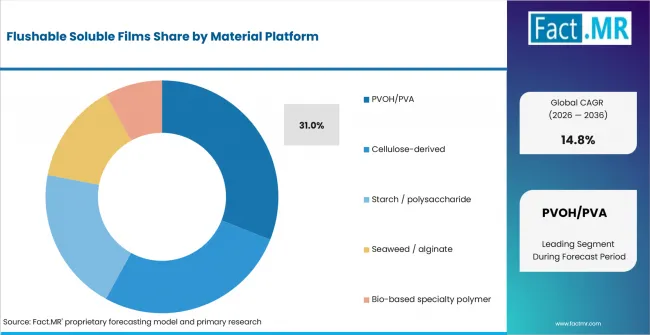
Flushable Soluble Films Analysis By Material Platform | Source: Fact.MR
PVOH/PVA is expected to hold 31.0% share in 2026. Its tunable water sensitivity and established film processing support detergent, agrochemical and specialty-dose formats. Kuraray and Aicello both maintain commercial PVOH/PVA film portfolios, reinforcing converter access to application-specific grades.
What leads the Dissolution segment?
Cold-water is projected to account for 29.0% share in 2026.
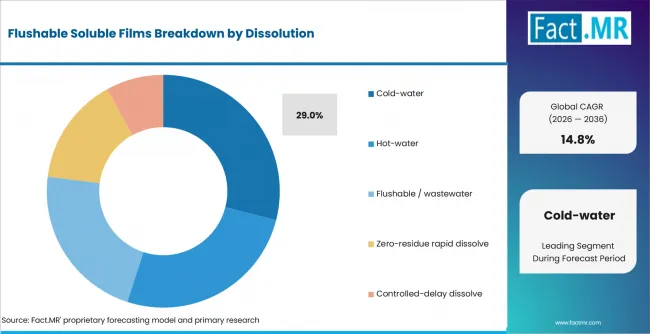
Flushable Soluble Films Analysis By Dissolution | Source: Fact.MR
Cold-water films are projected to hold 29.0% share in 2026. They suit products designed to dissolve at low water temperatures, especially laundry and cleaning doses. Aicello lists multiple SOLUBLON® water-soluble film grades with solubility starting above 1°C for applications including detergent and agricultural-chemical packaging.
How does Application shape demand?
Unit-dose pouches are anticipated to hold 36.0% share in 2026.
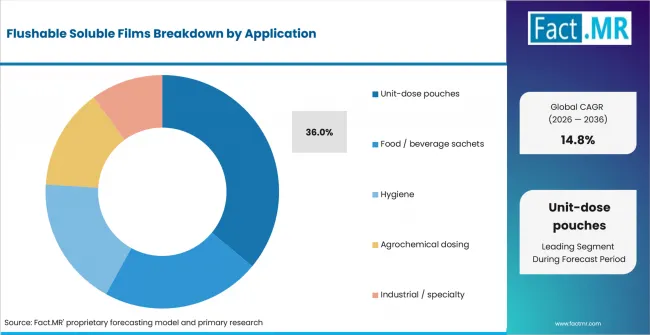
Flushable Soluble Films Analysis By Application | Source: Fact.MR
Unit-dose pouches are anticipated to capture 36.0% share in 2026. They combine measured dosing with closed handling for concentrated products. MonoSol identifies laundry and automatic dishwashing as established applications, while industrial and agrochemical packs extend the same dosing logic beyond home care.
What supports Environmental Position?
Microplastic-free claim is estimated to represent 34.0% share in 2026.
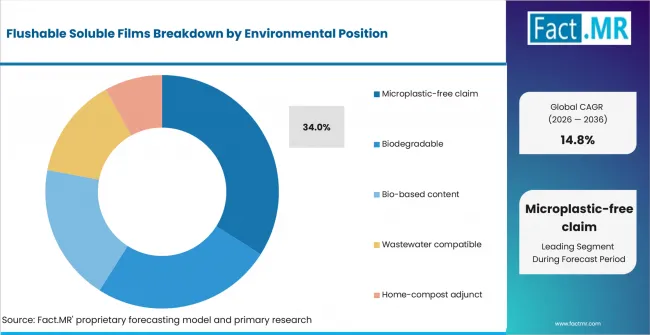
Flushable Soluble Films Analysis By Environmental Position | Source: Fact.MR
Microplastic-free claim is estimated to represent 34.0% share in 2026. Buyers increasingly separate dissolution from broader end-of-life claims. Aquapak describes Hydropol as a dissolvable material designed to avoid persistent microplastic release, while wastewater compatibility and biodegradation remain application-specific qualification points.
What is accelerating Flushable Soluble Films Market adoption, and what is holding it back?
Unit-dose convenience and wastewater-sensitive design accelerate adoption; qualification and end-of-life proof restrain it.
Drivers Impact Analysis
| DRIVER | (~) % IMPACT ON CAGR | GEOGRAPHIC RELEVANCE | IMPACT TIMELINE |
|---|---|---|---|
| Unit-dose home-care conversion | +2.0% | Global | Short term (<= 2 years) |
| Flushable hygiene redesign | +1.6% | North America, Europe, East Asia | Medium term (2-4 years) |
| Agrochemical precision dosing | +1.3% | Europe, East Asia, North America | Medium term (2-4 years) |
| Microplastic-focused material selection | +1.0% | Europe, Japan, USA | Long term (>= 4 years) |
Opportunity Impact Analysis
| OPPORTUNITY | (~) % IMPACT ON CAGR | GEOGRAPHIC RELEVANCE | IMPACT TIMELINE |
|---|---|---|---|
| Dissolvable hygiene structures | +1.4% | Europe, North America | Medium term (2-4 years) |
| Food and ingredient sachets | +1.0% | Global | Long term (>= 4 years) |
| Industrial measured-dose packs | +0.8% | Global | Medium term (2-4 years) |
| Bio-based soluble blends | +0.6% | Europe, Japan | Long term (>= 4 years) |
Restraints Impact Analysis
| RESTRAINT | (~) % IMPACT ON CAGR | GEOGRAPHIC RELEVANCE | IMPACT TIMELINE |
|---|---|---|---|
| Premature moisture sensitivity | -0.8% | Global | Short term (<= 2 years) |
| Flushability qualification burden | -0.7% | Europe, North America, Japan | Medium term (2-4 years) |
| Formulation-film compatibility limits | -0.5% | Global | Short term (<= 2 years) |
| Claim scrutiny across end-of-life routes | -0.4% | Europe, North America | Long term (>= 4 years) |
Which countries are scaling the Flushable Soluble Films Market fastest?
- China leads the supplied country range at 15.7% CAGR as dosing applications develop beside wastewater upgrades.
- The USA and Japan are each forecast at 15.2%, with different household and wastewater demand conditions.
- Germany is projected at 15.0% through appliance use and agricultural dosing applications.
- France is estimated at 14.5% as cleaning economics and exposure controls shape qualification.
- The displayed range spans 1.2 percentage points from China to France.
Comparable CAGRs create different entry conditions across the five countries. Wastewater systems, appliance use, chemical handling rules and local converting support shape how quickly soluble-film formats can be qualified.
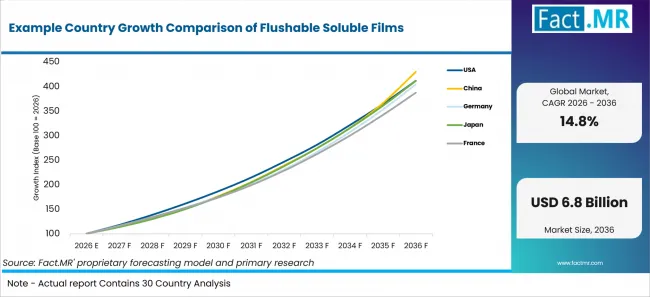
Example Country Growth Comparison Of Flushable Soluble Films | Source: Fact.MR
| Country | CAGR (2026-2036) |
|---|---|
| United States | 15.2% |
| China | 15.7% |
| Germany | 15.0% |
| Japan | 15.2% |
| France | 14.5% |
What supports USA adoption?
15.2% CAGR, supported by unit-dose home care and soluble specialty packaging.
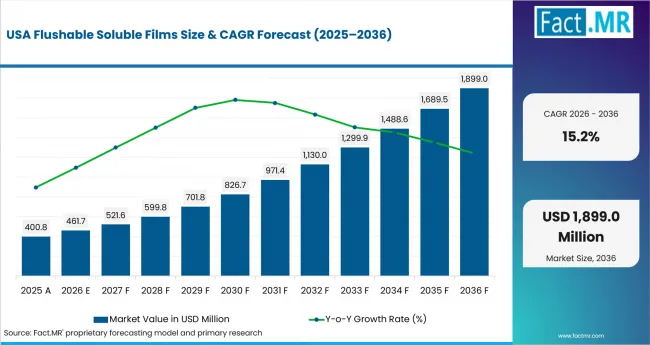
Flushable Soluble Films Country Value Analysis | Source: Fact.MR
U.S. household structure supports measured-dose convenience. The U.S. Census Bureau reported in December 2025 that the country had 39.7 million one-person households. Smaller packs and pre-measured home-care formats are expected to fit this user base because dose preparation is simplified. MonoSol’s domestic water-soluble film presence supports laundry, dishwashing and specialty applications. Growth is expected to depend on consistent cold-water dissolution and formulation compatibility across concentrated liquids and powders.
How is China scaling demand?
15.7% CAGR, shaped by wastewater upgrades and concentrated product delivery.
China combines a large chemical-processing base with continuing wastewater-system development. China’s State Council reported on 28 January 2026, citing a Ministry of Ecology and Environment official, that the national rural domestic sewage treatment rate had reached 55% by 2025. Wider treatment coverage is expected to increase attention to downstream material behavior in soluble and flushable formats. Cold-water films can serve concentrated cleaning and industrial doses that enter water-based processes. Local qualification is expected to focus on storage stability and predictable dissolution under varied use conditions.
What supports Germany adoption?
15.0% CAGR, supported by appliance penetration and measured-dose chemical handling.
Germany has a mature appliance base that supports repeated use of measured detergent formats. A Destatis table updated on 9 December 2025 reports an equipment stock of 80.0 dishwashers per 100 German households for 2023. This installed base is expected to support recurring demand for soluble laundry and dishwashing doses. Agricultural chemicals create a second route for pre-measured sachets where precise transfer is useful. Converters are expected to favor film grades that combine seal reliability with dissolution performance across household and specialty formulations.
How does Japan perform?
15.2% CAGR, led by detergent production and wastewater-sensitive design.
Japan combines domestic PVOH capability with a technically demanding detergent market. METI reported in March 2026 that synthetic detergent production reached 72,833 tonnes in January 2026. That manufacturing base is expected to support soluble-film use in concentrated unit doses and controlled-release formats. Kuraray maintains domestic PVOH and water-soluble film operations, giving converters access to locally produced material platforms. Supplier selection is expected to emphasize precise temperature response and stable storage performance.
What is supporting France adoption?
14.5% CAGR, supported by cleaning applications and exposure-aware dosing.
France presents demand routes in household cleaning and controlled chemical dosing. In June 2026, France’s Statistical Data and Studies Service reported that wastewater-management expenditure reached EUR 17.0 billion in 2023. Continued investment in wastewater systems is expected to keep disposal performance visible in flushable product design. Plant-protection applications provide another route for pre-measured soluble sachets where controlled transfer is valuable. Film suppliers are expected to compete on dissolution consistency and documentation suited to each end-use claim.
Who leads the Flushable Soluble Films Market?
Kuraray participates through PVOH resin and water-soluble film operations, including its MonoSol business. MonoSol supplies water-soluble PVOH films for laundry and automatic-dishwashing detergent packets and supports additional applications including agrochemicals, food ingredients, and water-treatment products. Kuraray also maintains dedicated PVOH resin operations under brands including KURARAY POVAL™.
Aicello remains active through its SOLUBLON® water-soluble film portfolio for liquid, liquid-and-powder, powder, and tablet applications. The company offers cold-, warm-, and hot-water-soluble grades, with several grades suitable for thermoforming and vertical form-fill-seal processing. Its application listings include liquid and powder detergents, agricultural chemicals, and other packaged products.
Aquapak Polymers supplies Hydropol™, a PVOH-based material used in water-soluble applications and dissolvable nonwoven structures. Its Hydropol nonwoven portfolio includes wet and dry wipes, personal-hygiene products, filtration, and medical applications. Aquapak reports that its nonwoven material has passed EDANA GD4 flushability testing and provides water-solubility and biodegradation performance relevant to wastewater disposal.
Arrow GreenTech markets WATERSOL™ PVA films across applications including agrochemicals, detergent and home-care packaging, specialty chemicals, laundry bags, and other industrial uses. The company describes its films as water soluble and suitable for unit-dose packaging of liquid and powder products.
Across these portfolios, supplier differentiation includes dissolution characteristics, film-processing compatibility, mechanical performance, dosing functionality, and application-specific technical support. For hygiene applications, wastewater compatibility and flushability testing provide additional performance criteria, while detergent, water-treatment, and agrochemical applications place emphasis on controlled dissolution and accurate dosing.
Which companies are the key providers?
Key provider groups/brands include Kuraray (including its MonoSol water-soluble-film business); Aicello; Aquapak Polymers; and Arrow GreenTech.
- Kuraray (including MonoSol)
- Aicello
- Aquapak Polymers
- Arrow GreenTech
Bibliography
- U.S. Census Bureau. (2025, December 2). Census Bureau releases new estimates on America’s families and living arrangements.
- Xinhua. (2026, January 28). China reports notable progress in ecological, environmental protection during 14th Five-Year Plan period. The State Council of the People’s Republic of China.
- Federal Statistical Office (Destatis). (2025, December 9). Equipment of households with electrical household appliances and others by territory.
- Ministry of Economy, Trade and Industry. (2026, March 19). Indices of industrial production: Actual figures, January 2026 [Data table].
- Service des données et études statistiques. (2026, June 12). La dépense de gestion des eaux usées en 2023 [Wastewater management expenditure in 2023].
- Department for Environment, Food & Rural Affairs. (2025, December 17). Plastic wet wipes ban.
- Aquapak Polymers Ltd. (2025, March 12). Hydropol™ set to revolutionise disposable hygiene products, making them dissolvable, fully flushable, microplastic free and preventing them forming fatbergs.
- Kuraray Co., Ltd. (2025, September 26). Kuraray acquires ISCC PLUS certification at three sites in Japan.
This Report Answers
- The report explains how material platform and dissolution temperature influence soluble-film selection across unit-dose, hygiene and specialty applications.
- Segment analysis identifies the supplied 2026 share leaders and explains the operational reasons users select each film type.
- Country analysis compares the five supplied growth rates and links them to household cleaning, wastewater and agricultural handling conditions.
- Competitive analysis verifies active providers across PVOH/PVA, soluble specialty polymers and application-specific film systems.
What does the Flushable Soluble Films Market cover?
The Flushable Soluble Films Market covers films and film-based structures designed to dissolve or disperse after contact with water. Adjacent water soluble packaging provides context for pouch and capsule formats, while polyvinyl alcohol films provide upstream material context.
The assessment considers environmental positioning where it is directly linked to film behavior. Related biopolymer films and polyvinyl alcohol markets frame alternative material and resin choices while the market values in this report remain unchanged.
What is included in the scope?
The scope includes cold-water, hot-water and wastewater-oriented grades alongside rapid-dissolve and controlled-delay products. Adjacent dispersible instant pouches illustrate food and premix use, while agricultural films provide context for farm-related polymer applications.
Environmental positioning covers microplastic-free, biodegradable, bio-based, wastewater-compatible and home-compost-adjunct claims when supported by the material or product design. Related sustainable plastic packaging and high-recyclability mono-material flexible packaging provide adjacent packaging context.
What is excluded from the scope?
The scope boundary centers on soluble or dispersible film structures whose water response forms part of product function. Conventional protective packaging and wet wipes remain adjacent categories when water-triggered dissolution sits outside the finished-product design.
How Was the Analysis Built?
The analysis draws on 120+ sources, 35+ company portfolios, 25+ countries, and more than 20 industry interviews.
- Primary Research: Primary research includes discussions with manufacturers, service providers, technology developers, distributors, end users, and subject-matter experts. These conversations examine purchasing priorities, product adoption, operational challenges, approval requirements, competitive positioning, and the factors that influence wider market acceptance.
- Desk Research: Desk research covers government statistics, regulatory publications, company filings, trade data, technical studies, industry associations, standards, public policy, and other authoritative sources. Every source used in the analysis is documented in the bibliography.
- Market Sizing and Forecasting: Market estimates combine historical performance, demand indicators, pricing and volume trends, segment shares, company participation, country-level growth, adoption patterns, investment activity, and barriers to market expansion.
- Data Validation and Update Cycle: Findings are validated by comparing primary interviews with public data, company activity, regulatory changes, trade patterns, and industry developments. Regular updates review new product launches, capacity changes, partnerships, approvals, and shifts in commercial adoption.
What is the report’s scope and coverage?
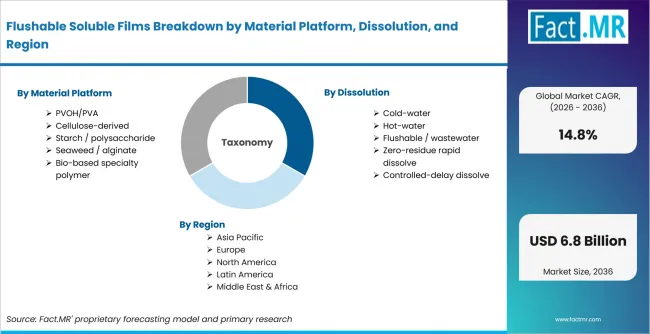
Flushable Soluble Films Breakdown By Material Platform, Dissolution, And Region | Source: Fact.MR
| Attribute | Details |
|---|---|
| Quantitative Units | USD billion in 2026 to USD billion by 2036 at a CAGR |
| Market Definition | Films and film-based structures designed to dissolve or disperse in water for unit-dose, hygiene, food, agrochemical and specialty applications, including products positioned for flushable or wastewater-compatible use. |
| Material Platform | PVOH/PVA; Cellulose-derived; Starch/polysaccharide; Seaweed/alginate; Bio-based specialty polymer |
| Dissolution | Cold-water; Hot-water; Flushable/wastewater; Zero-residue rapid dissolve; Controlled-delay dissolve |
| Application | Unit-dose pouches; Food/beverage sachets; Hygiene; Agrochemical dosing; Industrial/specialty |
| Environmental Position | Microplastic-free claim; Biodegradable; Bio-based content; Wastewater compatible; Home-compost adjunct |
| Regions Covered | North America; Latin America; Western Europe; Eastern Europe; East Asia; South Asia & Pacific; Middle East & Africa |
| Countries Covered | United States; China; Germany; Japan; France |
| Key Companies Profiled | Kuraray (including MonoSol); Aicello; Aquapak Polymers; Arrow GreenTech |
| Forecast Period | 2026 to 2036 |
| Approach | Hybrid demand-side and supplier review using unit-dose applications, dissolution performance, wastewater considerations, company portfolios, public statistics and country-level adoption indicators. |
How is the market segmented?
-
By Material Platform
- PVOH/PVA
- Cellulose-derived
- Starch / polysaccharide
- Seaweed / alginate
- Bio-based specialty polymer
-
By Dissolution
- Cold-water
- Hot-water
- Flushable / wastewater
- Zero-residue rapid dissolve
- Controlled-delay dissolve
-
By Application
- Unit-dose pouches
- Food / beverage sachets
- Hygiene
- Agrochemical dosing
- Industrial / specialty
-
By Environmental Position
- Microplastic-free claim
- Biodegradable
- Bio-based content
- Wastewater compatible
- Home-compost adjunct
-
By Region
- North America
- Latin America
- Western Europe
- Eastern Europe
- East Asia
- South Asia & Pacific
- Middle East & Africa