- Base Value(2026): 680.4 Mn
- Estimated Value(2026): 680.4 Mn
- Forecast Value (2036): 1045.8 Mn
- CAGR (2026 - 2036): 4.4%
Flux Injection System Market Forecast Outlook 2026 to 2036
The flux injection system market is projected to reach USD 680.4 million in 2026, growing to USD 1,045.8 million by 2036, with a CAGR of 4.4%.
Key Takeaways from Flux Injection System Market
- Flux Injection System Market Value (2026): USD 680.4 million
- Flux Injection System Market Forecast Value (2036): USD 1,045.8 million
- Flux Injection System Market Forecast CAGR 2026 to 2036: 4.4%
- Leading Segment in Flux Injection System Market: Fully Automatic (62%)
- Key Growth Region in Flux Injection System Market: India (6.3%)
- Key Players in Flux Injection System Market: Primetals Technologies Limited, SMS group GmbH, Danieli & C. Officine Meccaniche S.p.A., Tenova S.p.A., Sarralle S. Coop., Küttner GmbH & Co. KG, TMT Machinery & Equipment Ltd., Foseco (a Vesuvius plc business), Toshiba Mitsubishi-Electric Industrial Systems Corporation (TMEIC), Siemens AG
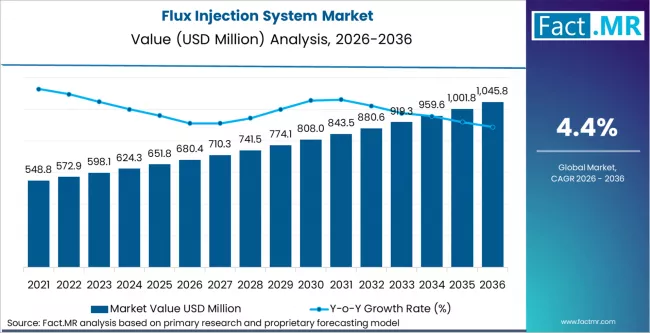
Flux Injection System Market Market Value Analysis | Source: Fact.MR
The market’s performance will be heavily influenced by cost structures, particularly the high initial investment required for R&D and system integration. Companies with robust pricing control will be better positioned to capture value by offering differentiated solutions that command premium prices.
Margin concentration will likely grow as larger players benefit from economies of scale and more efficient production processes. Smaller firms, by contrast, will need to focus on niche applications or regional markets to remain competitive. The key to value capture will not be in simply increasing volume but in offering tailored solutions with higher margins, especially in industries where precision and reliability are prioritized over cost alone. As a result, strategic investments in innovation and long-term customer relationships will drive market leadership.
Flux Injection System Market
| Metric | Value |
|---|---|
| Estimated Value in (2026E) | USD 680.4 million |
| Forecast Value in (2036F) | USD 1,045.8 million |
| Forecast CAGR 2026 to 2036 | 4.4% |
Source: Fact.MR analysis. Updated Jan 27, 2026
Category
| Category | Segments |
|---|---|
| Injection Method | Wire Injection; Powder Injection; Combined Systems |
| Target Process | Ladle Refining; Tundish or Continuous Casting; EAF or BOF Secondary Metallurgy |
| Automation Level | Fully Automatic; Manual or Semi-Automatic |
| Material Family | C/Alloying Powders; Ca-based (CaSi/Ca); Mg-based |
| Region | North America; Europe; Asia Pacific; Latin America; Middle East & Africa |
Source: Fact.MR analysis. Updated Jan 27, 2026
Segmental Analysis
What Is the Impact of Injection Method on the Flux Injection System Market?
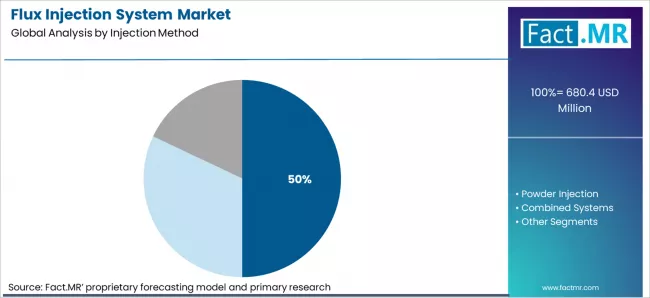
Flux Injection System Market Analysis By Injection Method | Source: Fact.MR
In the flux injection system market, the injection method plays a key role in determining the efficiency and application of flux injection systems. Wire injection leads the market with a 50% share, as this method is commonly used in metal casting and welding processes, providing precise control over the flux application. Wire injection systems are ideal for applications that require consistent and uniform flux deposition, ensuring high-quality results in industries such as automotive, aerospace, and manufacturing. As the demand for precision and automation in manufacturing processes continues to grow, the wire injection method will remain a dominant force in the market.
What Is the Impact of Automation Level on the Flux Injection System Market?
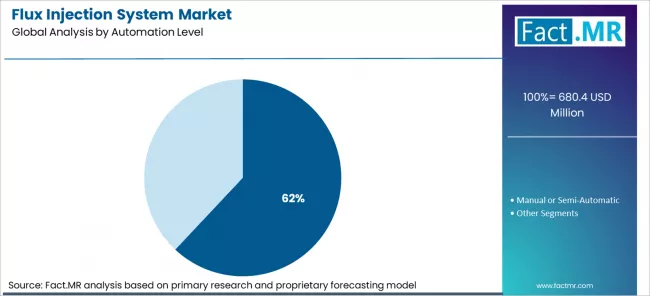
Flux Injection System Market Analysis By Automation Level | Source: Fact.MR
Automation level is a crucial factor in enhancing the efficiency and reliability of flux injection systems, with fully automatic systems holding a 62% share. Fully automatic flux injection systems provide greater consistency, reduce labor costs, and improve throughput, making them ideal for high-volume production environments. These systems are widely used in industries like automotive manufacturing and industrial applications, where high precision and repeatability are critical. As industries continue to adopt automation to improve production efficiency and quality, the demand for fully automatic flux injection systems will continue to drive growth in the market.
What are the Drivers, Restraints, and Key Trends in the Flux Injection System Market?
- Drivers: Demand for flux injection systems is shaped by requirements to improve soldering quality and process control in electronics assembly, automotive wiring harnesses, and PCB manufacturing. Process engineers specify these systems to deliver controlled flux application, reduce voids, and support consistent wetting across varied component densities. Procurement teams prioritize solutions that integrate with reflow ovens, wave solder lines, and automated assembly platforms while providing repeatable application and minimal waste. Quality assurance protocols and industry standards for solder joint reliability influence adoption of precise flux injection technologies.
- Restraints: High equipment and integration costs constrain uptake among smaller contract manufacturers and low volume producers with limited capital budgets. Some operations face challenges aligning flux injection systems with legacy assembly lines, increasing engineering effort. Variability in board designs and component mixes requires adaptable application profiles, which can complicate system specification.
- Trend 1: Development of systems with enhanced control algorithms and real time adjustment to maintain consistent flux deposition.
- Trend 2: Expansion of modular and scalable configurations that support diverse line speeds and product mixes.
Analysis of the Flux Injection System Market by Key Country
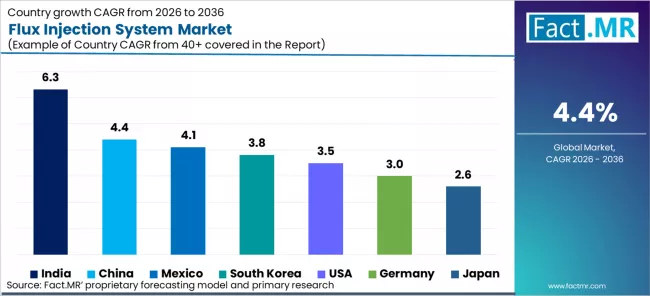
Flux Injection System Market Cagr Analysis By Country | Source: Fact.MR
| Country | CAGR (2026–2036) |
|---|---|
| USA | 3.5% |
| China | 4.4% |
| India | 6.3% |
| Germany | 3% |
| Japan | 2.6% |
| South Korea | 3.8% |
| Mexico | 4.1% |
Source: Fact.MR analysis. Updated Jan 27, 2026
The report covers an in-depth analysis of 40+ countries; top-performing countries are highlighted below.
What is the Outlook on the Flux Injection System Market in the USA?
USA market in flux injection systems is projected to grow at a CAGR of 3.5% from 2026 to 2036. The demand for these systems is driven by the need for precise flux application in industries such as automotive, electronics, and manufacturing. Flux injection systems are critical for ensuring the integrity and reliability of soldering and welding processes, which are essential for product performance and durability. While the market is more mature in the USA, steady demand for high-quality systems and adherence to industry standards will support continued growth.
What is the Demand for Flux Injection Systems in China?
China sales of flux injection systems are expected to grow at a CAGR of 4.4% from 2026 to 2036. As China continues to lead global manufacturing, particularly in automotive and electronics, the demand for efficient and accurate flux injection systems is rising. These systems are essential for ensuring the precision and quality of soldering and welding processes. With China’s growing focus on improving product quality and adhering to international standards, the market for flux injection systems is expected to continue growing steadily.
What is the Sales Outlook on Flux Injection Systems in India?
India demand for flux injection systems is projected to grow at a CAGR of 6.3% from 2026 to 2036. India’s expanding manufacturing and automotive sectors are driving the demand for flux injection systems, which are essential for maintaining product quality in soldering and welding applications. As industries continue to adopt advanced technologies to improve production efficiency and safety, the market for flux injection systems in India is expected to grow at a strong pace, supported by increasing industrialization and quality control standards.
What is the Demand for Flux Injection Systems in Germany?
Germany market in flux injection systems is forecast to grow at a CAGR of 3% from 2026 to 2036. Germany’s advanced manufacturing industries, particularly in automotive, electronics, and industrial equipment, are driving the demand for reliable and precise flux injection systems. These systems are essential for ensuring high-quality soldering and welding applications, which are critical for product performance and durability. While the market in Germany is mature, the ongoing demand for innovation and quality control will continue to drive steady growth in the market for flux injection systems.
What is the Sales Outlook on Flux Injection Systems in Japan?
Japan demand for flux injection systems is set to grow at a CAGR of 2.6% from 2026 to 2036. Japan’s automotive and electronics industries, which require high levels of precision and quality in manufacturing, are driving the demand for flux injection systems. These systems are crucial for ensuring that soldering and welding processes meet stringent quality standards. The market in Japan is mature, but steady demand for high-performance systems will continue to support moderate growth in the market for flux injection systems.
What is the Market Expansion Outlook for Flux Injection Systems in South Korea?
South Korea demand for flux injection systems is projected to grow at a CAGR of 3.8% from 2026 to 2036. South Korea’s advanced manufacturing sectors, particularly in electronics and automotive, are increasing the need for flux injection systems to ensure the quality and precision of soldering and welding applications. As the country continues to innovate and adopt advanced manufacturing technologies, the market for flux injection systems in South Korea is expected to grow steadily, supported by the ongoing focus on product quality and performance.
What is the Market Expansion Outlook for Flux Injection Systems in Mexico?
Mexico sales of flux injection systems are expected to grow at a CAGR of 4.1% from 2026 to 2036. Mexico’s growing manufacturing base, particularly in automotive and electronics, is driving the demand for efficient and reliable flux injection systems. These systems are essential for maintaining product quality and ensuring that soldering and welding processes meet industry standards. With the country’s focus on expanding its industrial base and improving manufacturing capabilities, the market for flux injection systems in Mexico is expected to grow steadily.
How Are Key Players Competing in the Flux Injection System Market?
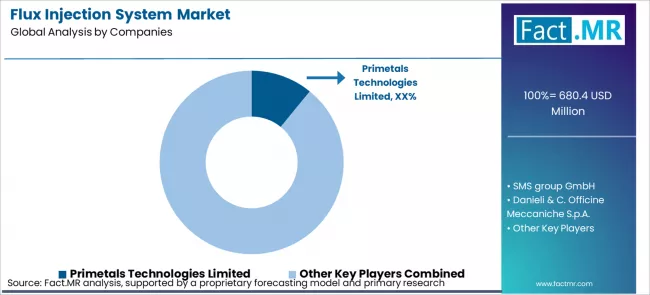
Flux Injection System Market Analysis By Company | Source: Fact.MR
Competition in the flux injection system market is shaped by system efficiency, process control precision, and integration with steelmaking operations. Primetals Technologies Limited and SMS group GmbH supply flux injection systems that offer regulated injection rates and uniform dispersion, supporting refined steel quality. Danieli & C. Officine Meccaniche S.p.A. and Tenova S.p.A. focus on solutions designed for seamless integration with converters and electric arc furnaces, emphasising control accuracy under varying melt conditions. Sarralle S. Coop. and Küttner GmbH & Co. KG provide systems engineered for optimized refractory interaction and reduced energy consumption. TMT Machinery & Equipment Ltd. and Foseco (a Vesuvius plc business) deliver tailored flux delivery technologies that support specific steel grades and production scales. Toshiba Mitsubishi Electric Industrial Systems Corporation (TMEIC) and Siemens AG integrate advanced automation and digital controls to enhance real time monitoring and process stability. Competitive positioning is defined by injection consistency, system reliability under high thermal stress, and compatibility with existing steelmaking infrastructure.
Key Players of the Flux Injection System Market
- Primetals Technologies Limited
- SMS group GmbH
- Danieli & C. Officine Meccaniche S.p.A.
- Tenova S.p.A.
- Sarralle S. Coop.
- Küttner GmbH & Co. KG
- TMT Machinery & Equipment Ltd.
- Foseco (a Vesuvius plc business)
- Toshiba Mitsubishi-Electric Industrial Systems Corporation (TMEIC)
- Siemens AG
Bibliographies
- International Organization for Standardization. (2023). ISO 14284: Steel and iron - Sampling and preparation of samples for the determination of chemical composition.
- American Iron and Steel Institute. (2023). Secondary steelmaking and ladle metallurgy practices. AISI Technical Report.
- World Steel Association. (2024). Steelmaking process routes and secondary metallurgy technologies. Worldsteel Association.
- ASM International. (2023). ASM Handbook, Volume 1: Properties and selection - Irons, steels, and high-performance alloys.
Segmentation
Scope of the Report
| Items | Values |
|---|---|
| Quantitative Units (2026) | USD Million |
| Injection Method | Wire Injection, Powder Injection, Combined Systems |
| Target Process | Ladle Refining, Tundish or Continuous Casting, EAF or BOF Secondary Metallurgy |
| Automation Level | Fully Automatic, Manual or Semi-Automatic |
| Material Family | C/Alloying Powders, Ca-based (CaSi/Ca), Mg-based |
| Regions Covered | North America, Europe, Asia Pacific, Latin America, Middle East & Africa |
| Countries Covered | United States, Canada, Mexico, Germany, United Kingdom, France, Japan, South Korea, China, India, Brazil, and other countries |
| Key Companies Profiled | Primetals Technologies Limited, SMS group GmbH, Danieli & C. Officine Meccaniche S.p.A., Tenova S.p.A., Sarralle S. Coop., Küttner GmbH & Co. KG, TMT Machinery & Equipment Ltd., Foseco (a Vesuvius plc business), Toshiba Mitsubishi-Electric Industrial Systems Corporation (TMEIC), Siemens AG |
| Additional Attributes | Dollar revenue by injection method, target process, automation level, and material family; regional demand trends, competitive landscape, technological advancements in flux injection systems, operational performance optimization initiatives, and product development strategies |
Source: Fact.MR analysis. Updated Jan 27, 2026
Flux Injection System Market Key Segments
-
Injection Method :
- Wire Injection
- Powder Injection
- Combined Systems
-
Target Process :
- Ladle Refining
- Tundish or Continuous Casting
- EAF or BOF Secondary Metallurgy
-
Automation Level :
- Fully Automatic
- Manual or Semi-Automatic
-
Material Family :
- C/Alloying Powders
- Ca-based (CaSi/Ca)
- Mg-based
-
Region :
- North America
- USA
- Canada
- Mexico
- Europe
- Germany
- UK
- France
- Italy
- Spain
- Rest of Europe
- Asia Pacific
- China
- Japan
- South Korea
- India
- Australia
- Rest of Asia Pacific
- Latin America
- Brazil
- Argentina
- Rest of Latin America
- Middle East and Africa
- Kingdom of Saudi Arabia
- United Arab Emirates
- South Africa
- Rest of Middle East and Africa
- Other Regions
- Oceania
- Central Asia
- Other Markets
- North America
Frequently Asked Questions
How big is the flux injection system market in 2026?
What will be the size of flux injection system market in 2036?
How much will be the flux injection system market growth between 2026 and 2036?
What are the key product types in the flux injection system market?
Which target process segment to contribute significant share in the flux injection system market in 2026?
Who worked on this report


Preview the report firsthand - request a free sample
Free SampleGet the brochure for pricing and purchase details
Download PDF