Fugitive Dust Control Chemicals Market Size, Share, Growth and Forecast (2026 - 2036)

The Fugitive Dust Control Chemicals Market is segmented by Chemistry, by Application Area, by Surface, by End User, by Application Method, and Region. Forecast for 2026 to 2036.

What is the fugitive dust control chemicals market forecast to be worth by 2036?

USD 1.2 billion in 2026 to USD 2.4 billion by 2036, at 7.2% CAGR.

  • The fugitive dust control chemicals market crossed a valuation of USD 1.09 billion in 2025.
  • Demand is expected to increase from USD 1.2 billion in 2026 to USD 2.4 billion by 2036.
  • The market is forecast to record 7.2% CAGR during 2026 to 2036 as mine haul roads and construction corridors shift toward longer-lasting chemical controls.
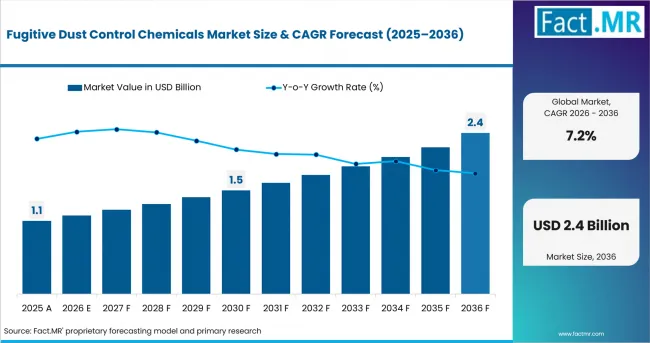
Fugitive Dust Control Chemicals Market Value Analysis

What are the defining numbers behind fugitive dust control chemicals growth?

USD 1.2 billion absolute opportunity by 2036, led by mine haul roads and lignosulfonate chemistry.

  • Demand Drivers in the Market
    • Mine operators need treated haul roads because truck traffic creates continuous dust under dry operating conditions.
    • Public agencies use road palliatives to reduce complaints and improve driving safety on gravel routes.
    • Construction teams need surface binders when open soil, cut-and-fill work and debris handling create off-site dust.
    • Ports and rail yards need stockpile controls because coal and ore piles can release particles during wind events.
  • Key Segments Analyzed
    • By Chemistry: Lignosulfonates are expected to hold 31.0% share in 2026 because they suit soil binding at lower treatment cost.
    • By Application Area: Mine haul roads lead with 38.0% share in 2026 as heavy trucks require repeated surface treatment.
    • By Surface: Soil accounts for 29.0% share in 2026 due to its high dust release under wind and vehicle movement.
    • By End User: Mining companies are projected to account for 42.0% share in 2026 through large internal road networks.
    • By Application Method: Liquid spray application is expected to hold 43.0% share in 2026 because mobile water trucks and spray bars are already installed at many sites.
    • By Geography: North America is expected to hold 33.0% share in 2026 through mining, construction and municipal road programs.
  • Analyst Opinion at Fact.MR
    • Shambhu Nath Jha, Principal Analyst at Fact.MR, states, "I see this market as an operations-control market, not a simple chemical supply category. Buyers ask whether a product holds the road surface under real traffic and whether the supplier can prove treatment life. Providers that combine formulation choice, dosing discipline and field support are better placed to win recurring programs."
  • Strategic Implications
    • Chemical suppliers should pair binders with application guidance because site conditions decide treatment life.
    • Mining companies need product trials that compare water savings, surface durability and re-treatment intervals.
    • Municipal buyers should specify runoff limits and road-surface life before choosing chloride-based products.
    • Dosing equipment suppliers can gain share by linking chemical consumption to treated-road performance records.

Dust binding and soil stabilization chemicals form the core of this market. The Mine Safety and Health Administration lowered the permissible exposure limit for respirable crystalline silica to 50 micrograms per cubic meter for a full-shift exposure in April 2024. [1] This supports chemical dust control use where haul roads, ore transfer points and stockpiles add respirable particle risk. Demand also overlaps with dust suppression chemicals used across mining and construction sites.

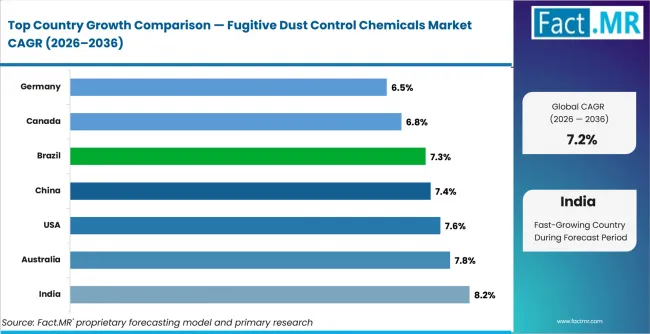
India is projected to record 8.2% CAGR through 2036 as coal output and infrastructure work keep treated roads in use. Australia is expected to expand at 7.8% CAGR because open-cut mining and port corridors need repeated dust treatment. The United States is forecast to grow at 7.6% CAGR as the 2024 silica rule raises control expectations at mine sites. China is expected to advance at 7.4% CAGR because coal production scale sustains chemical use on internal roads and conveyors. Brazil is projected to rise at 7.3% CAGR as iron ore and metallic mineral handling remain core sources of dust exposure.

How does the fugitive dust control chemicals market break down by segment?

Lignosulfonates lead at 31.0%; mine haul roads lead at 38.0%.

Which chemistry dominates?

Lignosulfonates hold 31.0% share in 2026.
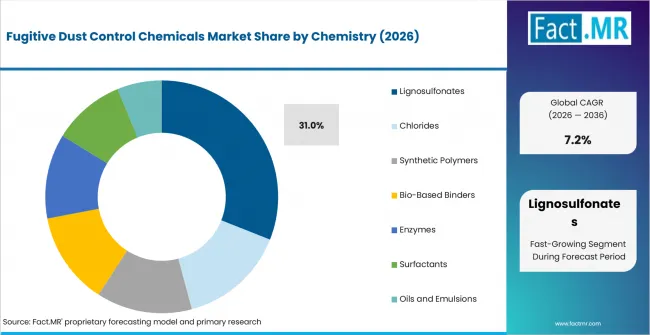
Fugitive Dust Control Chemicals Market Analysis By Chemistry

Lignosulfonates are expected to hold 31.0% share in 2026 because they balance cost, dilution ease and particle binding on unpaved roads. Chlorides remain common where buyers need hygroscopic moisture retention, with calcium chloride and magnesium chloride used in many road programs. Synthetic polymers expand where longer service life and lower chloride runoff matter more than lowest upfront price.

Which application area dominates?

Mine haul roads hold 38.0% share in 2026.
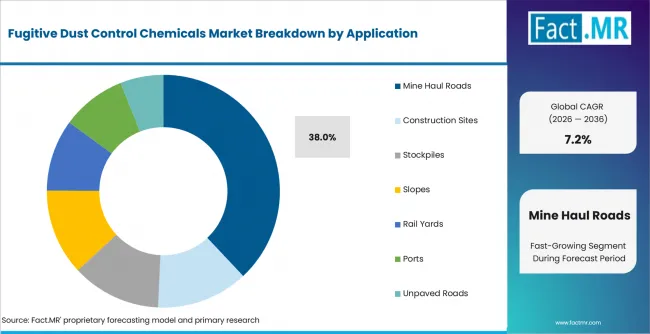
Fugitive Dust Control Chemicals Market Analysis By Application

Mine haul roads lead because truck traffic repeatedly breaks the road surface and lifts fines into the air. The segment is projected to capture 38.0% share in 2026 as mines use recurring spray programs, binders and surface stabilizers to keep roads passable. Ore transfer areas also support dust and emission control chemicals where loading, crushing and conveying create material losses.

Which surface dominates?

Soil holds 29.0% share in 2026.
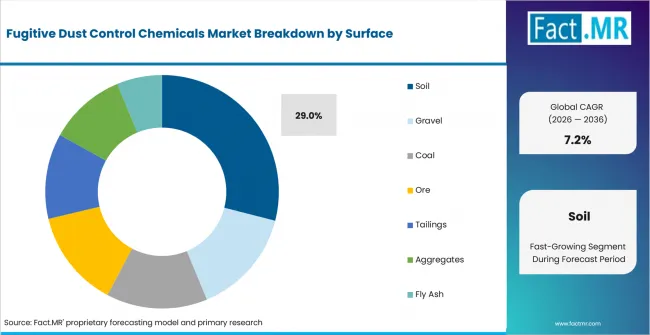
Fugitive Dust Control Chemicals Market Analysis By Surface

Soil accounts for 29.0% share in 2026 because exposed earth releases fine particles under wind and repeated vehicle movement. Gravel is close behind in municipal and mine-road programs, while coal, ore and tailings need chemistry that can handle product value, moisture sensitivity and runoff limits. Construction debris adds short-duration demand where projects need temporary dust compliance.

Which end user dominates?

Mining companies hold 42.0% share in 2026.
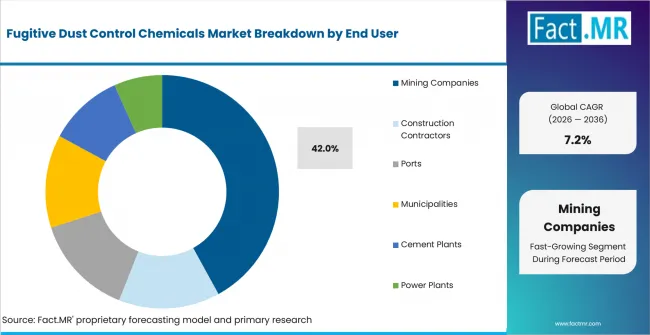
Fugitive Dust Control Chemicals Market Analysis By End User

Mining companies are likely to account for 42.0% share in 2026 because their haul roads, stockpiles, dumps and transfer points create repeat chemical demand. Coal, iron ore and aggregate operations need predictable treatment because traffic cannot stop for frequent water-only spraying. Cement plants and power plants add demand where limestone, clinker, fly ash and coal handling require surface-level dust reduction.

Which application method dominates?

Liquid spray application holds 43.0% share in 2026.

Liquid spray application leads because mines, municipalities and construction sites already use water trucks, spray bars and fixed dosing systems. The method is expected to hold 43.0% share in 2026 as operators add chemical concentrate into existing water distribution. Powder spreading and foaming systems remain useful in defined areas, but large surfaces favor mobile liquid application.

What is accelerating fugitive dust control chemical demand, and what is holding it back?

Silica exposure rules and water-saving road programs drive it; runoff limits and uneven field performance restrain it.

Fugitive Dust Control Chemicals Market Opportunity Matrix Growth Vs Value

The main driver is water productivity. Chemical palliatives extend the useful effect of water trucks, which matters in remote mines and dry municipal roads. Construction sites also use binders where open soil and polymer-treated materials need temporary control; related demand sits near construction polymers used in site preparation and civil works.

The main restraint is field variability. Chlorides can face corrosion and runoff limits, while polymer binders need correct dilution and curing time. Mechanical options such as dry type dust control systems and dust extraction systems can also be specified where dust is generated inside processing plants instead of on open surfaces.

Where do the biggest fugitive dust control chemical opportunities sit?

Mine-road dosing, municipal gravel roads and stockpile sealing.

  • Mine-Road Dosing: Suppliers can link chemical consumption to road condition, traffic load and watering frequency.
  • Municipal Gravel Roads: County and rural road teams can use seasonal treatments where resident complaints and visibility risks repeat each dry season.
  • Stockpile Sealing: Ports, rail yards and plants can use crusting agents where coal, ore and aggregate piles face wind exposure.

Which countries are scaling fugitive dust control chemicals fastest?

India 8.2%, Australia 7.8%, United States 7.6%, China 7.4%, Brazil 7.3%, Canada 6.8%, Germany 6.5%.

Based on regional analysis, the fugitive dust control chemicals market is segmented into North America, Europe, East Asia, South Asia, Latin America, and Middle East and Africa.

Top Country Growth Comparison Fugitive Dust Control Chemicals Market Cagr (2026 2036)

Country CAGR
India 8.2%
Australia 7.8%
United States 7.6%
China 7.4%
Brazil 7.3%
Canada 6.8%
Germany 6.5%

Fugitive Dust Control Chemicals Market Cagr Analysis By Country

What is powering India’s lead?

8.2% CAGR, supported by coal production scale and infrastructure work.

India is projected to record 8.2% CAGR through 2036 as coal production, captive mining and road construction keep treated surfaces in use. The Press Information Bureau of India reported that coal production reached 1,047.57 million tonnes in FY 2024-25, up 4.99% from FY 2023-24. [3] Mining operators and contractors need products that hold road fines between watering cycles. Suppliers with field crews near coal belts and large infrastructure corridors gain stronger access.

Why is Australia important for mine-road treatment?

7.8% CAGR, supported by open-cut mining and export corridors.

Australia is expected to expand at 7.8% CAGR through 2036 because open-cut coal, iron ore and bauxite operations need dust programs across long haul-road networks. The Australian Government Department of Industry, Science and Resources forecast coal export volumes at 205 million tonnes in 2024-25 and 201 million tonnes by 2026-27 in its September 2025 resources outlook. [4] This volume keeps road treatment, stockpile sealing and port corridor suppression active. Suppliers that combine chemistry with haul-road audits can compete beyond one-off product sales.

What supports the United States outlook?

7.6% CAGR, supported by silica compliance and construction spending.
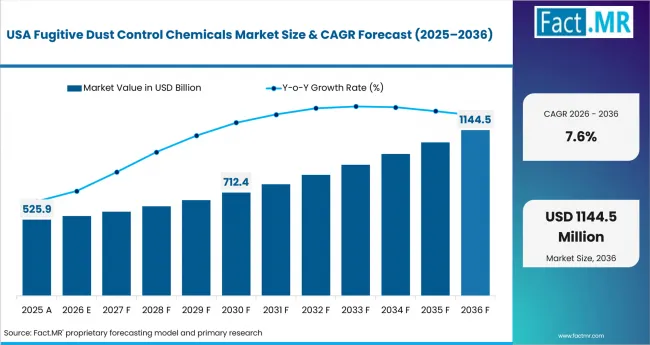
Fugitive Dust Control Chemicals Market Country Value Analysis

The United States is forecast to advance at 7.6% CAGR through 2036 as mine operators and contractors tighten open-dust controls. The U.S. Energy Information Administration reported 512.5 million short tons of coal production in 2024 and 524 producing coal mines in its November 2025 Annual Coal Report. [5] The U.S. Census Bureau also estimated April 2026 construction spending at a seasonally adjusted annual rate of USD 2,172.4 billion. [6] Demand favors suppliers that can document treatment performance for both mine sites and large civil projects.

How is China scaling chemical dust control?

7.4% CAGR, supported by coal output scale and internal material handling.

China is expected to advance at 7.4% CAGR through 2036 because coal, ore and construction material movement create large exposed-surface needs. The International Energy Agency reported that China’s coal output grew 6% in the first half of 2025 compared with the same period in 2024. [7] Chemical dust control demand is concentrated in mine roads, coal yards, transfer points and industrial logistics zones. Local application partners matter because site rules and product registration can differ by province.

What underpins Brazil’s growth?

7.3% CAGR, backed by iron ore handling and mineral trade activity.

Brazil is projected to rise at 7.3% CAGR through 2036 because iron ore, bauxite and aggregates generate dust at mine benches, roads, rail yards and ports. The Brazilian Mining Association reported that mining sector revenue totaled R$298.8 billion in 2025, a 10.3% increase from 2024. [8] Chemical suppliers need distributor coverage near Minas Gerais and Pará, where mining revenue is concentrated. Port and rail applications add demand for crusting agents and wetting chemistries.

Why does Canada remain a steady market?

6.8% CAGR, supported by mineral production and remote-site treatment needs.

Canada is forecast at 6.8% CAGR through 2036 as mineral operations and gravel access roads require dust control under seasonal weather swings. Natural Resources Canada reported that the value of Canada’s mineral production reached $64.3 billion in 2024, with production across 60 minerals and metals at almost 200 mines. [9] Buyers favor products that can be applied during short maintenance windows and still handle freeze-thaw damage. Distribution depth and technical support decide repeat orders.

How does Germany perform?

6.5% CAGR, supported by industrial sites and environmental compliance needs.

Germany is expected to post 6.5% CAGR through 2036 as quarrying, recycling yards, industrial construction and port material handling sustain dust-control demand. Eurostat and German public statistics show steady construction and industrial material flows, but stricter environmental expectations keep product selection conservative. Buyers often compare chloride runoff, polymer life and application documentation before approving site use. Growth is below India and Australia because fewer very large mine-road programs are added each year.

Who leads the fugitive dust control chemicals landscape?

Global Road Technology, Soilworks, Midwest Industrial Supply and Dust-A-Side lead through field application depth and mine-road programs.

Fugitive Dust Control Chemicals Market Analysis By Company

Fugitive dust control chemicals are supplied by specialist road-treatment companies and broader industrial chemical providers. Global Road Technology offers dust control, soil stabilization, erosion control and water-management products for mining, civil and resource-sector use. Soilworks sells soil stabilizers and dust control agents such as Durasoil and Soiltac. Midwest Industrial Supply focuses on mine haul roads, access roads and rail applications. Dust-A-Side provides dust suppression and haul-road management across mining, processing and community-road settings. These suppliers compete with broader dust suppressants portfolios where buyers need local availability.

Solenis supports mining dust control through Zalta dust suppressant products and mineral processing aids. SNF offers FLOMIN DCA dust control agents for mining and material handling. Quaker Houghton is the current company name for Quaker Chemical and Houghton International; its DUSTGRIP products are positioned for mine dust suppression. Competition through 2036 is expected to depend on treatment life, site service, chemistry breadth and the ability to document lower water frequency.

Suppliers that understand soil type, road crown, traffic volume and water chemistry are better placed. Product-only sellers can lose contracts when the first application fails under heavy trucks. Service-led providers can defend repeat programs when they show road condition, water reduction and lower rework in simple operating records.

Which companies are the key players?

Global Road Technology, Soilworks, Midwest Industrial Supply, Dust-A-Side, Solenis, SNF and Quaker Houghton.

  • Global Road Technology
  • Soilworks
  • Midwest Industrial Supply
  • Dust-A-Side
  • Solenis
  • SNF
  • Quaker Houghton

Bibliography

  • [1] U.S. Department of Labor. (2024, April 16). Department of Labor issues final rule reducing silica dust exposure, better protecting miners’ health. Mine Safety and Health Administration.
  • [2] Occupational Safety and Health Administration. (n.d.). Respirable crystalline silica: Construction. U.S. Department of Labor.
  • [3] Press Information Bureau. (2025, April 4). India’s coal boom: Production surpasses one billion tonnes. Ministry of Coal, Government of India.
  • [4] Department of Industry, Science and Resources. (2025, October 7). Resources and energy quarterly: September 2025. Australian Government.
  • [5] U.S. Energy Information Administration. (2025, November 19). Annual Coal Report 2024. U.S. Department of Energy.
  • [6] U.S. Census Bureau. (2026, June 1). Monthly construction spending, April 2026.
  • [7] International Energy Agency. (2025, December 17). Coal 2025: Executive summary.
  • [8] Brazilian Mining Institute. (2026, February 3). Mining industry increases revenue, investments and share of trade balance surplus in 2025.
  • [9] Natural Resources Canada. (2026, February 27). Minerals and the economy. Government of Canada.
  • [10] Global Road Technology. (n.d.). Erosion control solutions: Cost-effective dust control.
  • [11] Solenis. (n.d.). Zalta™ dust suppressants.
  • [12] Dust-A-Side. (2025). Company overview 2025.

This Report Addresses

  • Strategic intelligence on fugitive dust control chemicals across chemistry, application area and end user.
  • Segment analysis covering Lignosulfonates, Mine Haul Roads, Soil, Mining Companies and Liquid Spray application.
  • Regional outlook covering India, Australia, United States, China, Brazil, Canada and Germany.
  • Competitive analysis of Global Road Technology, Soilworks, Midwest Industrial Supply, Dust-A-Side, Solenis, SNF and Quaker Houghton.
  • Chemical assessment covering binders, chlorides, polymers, surfactants, oils, emulsions and bio-based products.
  • Application assessment covering unpaved roads, stockpiles, construction sites, rail yards and port material handling.
  • Primary interviews, official source review, supplier checks and application logic support the forecast.

What does the fugitive dust control chemicals market cover?

Chemical binders, suppressants and palliatives used to control loose particles from roads, stockpiles and work sites.

The fugitive dust control chemicals market covers chemical products that bind soil, coal, ore, aggregates, tailings and construction debris to reduce airborne particles. It includes lignosulfonates, chlorides, synthetic polymers, surfactants, oils, emulsions and bio-based binders. The market differs from mechanical dust collection because the service focus is open-source dust prevention on exposed surfaces. Road teams often compare these products with road dust-control additives when unpaved routes need longer treatment life.

What is included in the scope?

Dust suppressants and chemical surface binders for open-source dust control.

The scope includes chemical products applied to unpaved roads, mine haul roads, construction sites, stockpiles, slopes, rail yards and ports. It covers liquid, emulsion, powder and blended formulations sold for fugitive dust suppression. It includes chemical sales linked to soil, gravel, coal, ore, tailings, aggregates, fly ash and construction debris. Application support and recurring treatment programs are included when chemical product revenue is part of the contract.

What is excluded from the scope?

Mechanical collectors, water-only spraying and unrelated road construction materials.

The scope excludes dust collectors, baghouses, cyclones and enclosed filtration equipment sold without surface-treatment chemicals. Those systems are treated separately from chemical palliatives, even when a facility also installs industrial bag dust filters. The scope also excludes water-only dust control programs, asphalt, concrete, cement and road base materials, personal protective equipment, air monitoring instruments and ventilation systems.

How was the analysis built?

100+ sources, 45+ supplier portfolios, 30+ countries, 22+ interviews.

  • Primary Research:
    • Primary research includes interviews with dust suppressant formulators, mine road supervisors, municipal road teams and environmental compliance managers. It includes input from dosing-equipment providers and distributors that handle recurring road-treatment programs.
  • Desk Research:
    • Desk research reviews Mine Safety and Health Administration rules, Occupational Safety and Health Administration silica controls, mining output data, construction activity and supplier product portfolios. It also covers company service lines for haul-road management and material handling dust control.
  • Market-Sizing and Forecasting:
    • Forecasting uses treated surface area, application frequency, average chemical dosage, end-use weighting and country mining activity. Chemical intensity was adjusted by surface type because coal, ore, gravel and tailings do not retain binders in the same way.
  • Data Validation and Update Cycle:
    • Forecasts are validated through supplier capability checks and site-use logic. Official mining, construction and silica-rule updates help confirm the direction of market use.

What is the report’s scope and coverage?
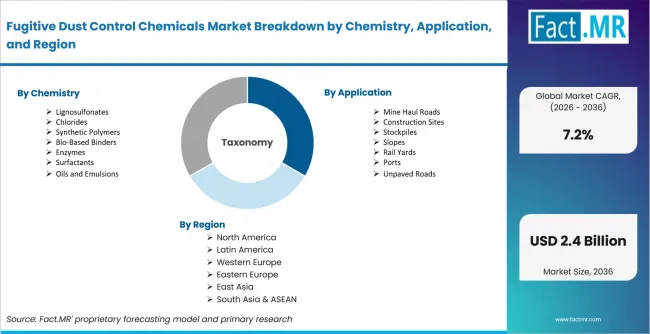
Fugitive Dust Control Chemicals Market Breakdown By Chemistry, Application, And Region

Attribute Details
Quantitative Units USD Billion in 2026 to USD Billion by 2036
Market Definition Chemical binders, suppressants and palliatives used to control fugitive dust from roads, stockpiles, slopes and work sites
Chemistry Lignosulfonates, Chlorides, Synthetic Polymers, Bio-Based Binders, Enzymes, Surfactants, Oils and Emulsions
Application Area Unpaved Roads, Mine Haul Roads, Construction Sites, Stockpiles, Slopes, Rail Yards, Ports
Surface Soil, Gravel, Coal, Ore, Tailings, Aggregates, Fly Ash, Construction Debris
End User Mining Companies, Construction Contractors, Ports, Municipalities, Cement Plants, Power Plants
Application Method Liquid Spray, Tanker Truck, Spray Bar, Foaming System, Fixed Dosing, Dry Spreading
Regions Covered North America, Europe, East Asia, South Asia, Latin America, Middle East and Africa
Countries Covered India, Australia, United States, China, Brazil, Canada, Germany
Key Companies Profiled Global Road Technology, Soilworks, Midwest Industrial Supply, Dust-A-Side, Solenis, SNF, Quaker Houghton
Forecast Period 2026 to 2036
Approach Hybrid top-down and bottom-up approach using treated surface area, application frequency, average dosage, mining indicators, construction indicators and supplier validation

How is the market segmented?

  • By Chemistry:

    • Lignosulfonates
    • Chlorides
    • Synthetic Polymers
    • Bio-Based Binders
    • Enzymes
    • Surfactants
    • Oils and Emulsions
  • By Application Area:

    • Unpaved Roads
    • Mine Haul Roads
    • Construction Sites
    • Stockpiles
    • Slopes
    • Rail Yards
    • Ports
  • By Surface:

    • Soil
    • Gravel
    • Coal
    • Ore
    • Tailings
    • Aggregates
    • Fly Ash
    • Construction Debris
  • By End User:

    • Mining Companies
    • Construction Contractors
    • Ports
    • Municipalities
    • Cement Plants
    • Power Plants
  • By Application Method:

    • Liquid Spray
    • Tanker Truck
    • Spray Bar
    • Foaming System
    • Fixed Dosing
    • Dry Spreading
  • By Region

    • North America
      • United States
      • Canada
      • Mexico
    • Latin America
      • Brazil
      • Argentina
      • Rest of Latin America
    • Europe
      • Germany
      • United Kingdom
      • France
      • Italy
      • Spain
      • Rest of Europe
    • Asia Pacific
      • China
      • India
      • Japan
      • South Korea
      • ASEAN
    • Middle East & Africa
      • GCC Countries
      • South Africa
      • UAE
      • Rest of Middle East & Africa

- Frequently Asked Questions -

Which chemistry leads the Fugitive Dust Control Chemicals Market?

Lignosulfonates lead with 31.0% share in 2026 because they balance cost, dilution ease and soil binding on unpaved surfaces.

Which country expands faster in the Fugitive Dust Control Chemicals Market?

India is projected to record 8.2% CAGR through 2036 as coal output and infrastructure work keep treated roads in use.

How does Australia perform in the Fugitive Dust Control Chemicals Market?

Australia is expected to expand at 7.8% CAGR through 2036 because open-cut mining and port corridors need repeated dust treatment.

How does the United States perform in the Fugitive Dust Control Chemicals Market?

The United States is forecast to grow at 7.6% CAGR through 2036 as silica compliance and construction activity support chemical dust control.

How does China perform in the Fugitive Dust Control Chemicals Market?

China is expected to advance at 7.4% CAGR through 2036 because coal output scale sustains chemical use on roads and conveyors.

How does Brazil perform in the Fugitive Dust Control Chemicals Market?

Brazil is projected to rise at 7.3% CAGR through 2036 as iron ore and metallic mineral handling remain sources of dust exposure.

What is the primary driver in the Fugitive Dust Control Chemicals Market?

The primary driver is the need to reduce respirable dust from open roads, stockpiles and work sites under stricter worker-safety expectations.

What is the main restraint in the Fugitive Dust Control Chemicals Market?

The main restraint is field variability because soil type, rainfall, traffic load and curing time can change chemical performance.

Why are mine haul roads important in this market?

Mine haul roads are important because heavy trucks repeatedly break road surfaces and create recurring treatment needs.

Table of Content

  1. Executive Summary
    • Global Market Outlook
    • Demand to side Trends
    • Supply to side Trends
    • Technology Roadmap Analysis
    • Analysis and Recommendations
  2. Market Overview
    • Market Coverage / Taxonomy
    • Market Definition / Scope / Limitations
  3. Research Methodology
    • Chapter Orientation
    • Analytical Lens and Working Hypotheses
      • Market Structure, Signals, and Trend Drivers
      • Benchmarking and Cross-market Comparability
      • Market Sizing, Forecasting, and Opportunity Mapping
    • Research Design and Evidence Framework
      • Desk Research Programme (Secondary Evidence)
        • Company Annual and Sustainability Reports
        • Peer-reviewed Journals and Academic Literature
        • Corporate Websites, Product Literature, and Technical Notes
        • Earnings Decks and Investor Briefings
        • Statutory Filings and Regulatory Disclosures
        • Technical White Papers and Standards Notes
        • Trade Journals, Industry Magazines, and Analyst Briefs
        • Conference Proceedings, Webinars, and Seminar Materials
        • Government Statistics Portals and Public Data Releases
        • Press Releases and Reputable Media Coverage
        • Specialist Newsletters and Curated Briefings
        • Sector Databases and Reference Repositories
        • Fact.MR Internal Proprietary Databases and Historical Market Datasets
        • Subscription Datasets and Paid Sources
        • Social Channels, Communities, and Digital Listening Inputs
        • Additional Desk Sources
      • Expert Input and Fieldwork (Primary Evidence)
        • Primary Modes
          • Qualitative Interviews and Expert Elicitation
          • Quantitative Surveys and Structured Data Capture
          • Blended Approach
        • Why Primary Evidence is Used
        • Field Techniques
          • Interviews
          • Surveys
          • Focus Groups
          • Observational and In-context Research
          • Social and Community Interactions
        • Stakeholder Universe Engaged
          • C-suite Leaders
          • Board Members
          • Presidents and Vice Presidents
          • R&D and Innovation Heads
          • Technical Specialists
          • Domain Subject-matter Experts
          • Scientists
          • Physicians and Other Healthcare Professionals
        • Governance, Ethics, and Data Stewardship
          • Research Ethics
          • Data Integrity and Handling
      • Tooling, Models, and Reference Databases
    • Data Engineering and Model Build
      • Data Acquisition and Ingestion
      • Cleaning, Normalisation, and Verification
      • Synthesis, Triangulation, and Analysis
    • Quality Assurance and Audit Trail
  4. Market Background
    • Market Dynamics
      • Drivers
      • Restraints
      • Opportunity
      • Trends
    • Scenario Forecast
      • Demand in Optimistic Scenario
      • Demand in Likely Scenario
      • Demand in Conservative Scenario
    • Opportunity Map Analysis
    • Product Life Cycle Analysis
    • Supply Chain Analysis
    • Investment Feasibility Matrix
    • Value Chain Analysis
    • PESTLE and Porter’s Analysis
    • Regulatory Landscape
    • Regional Parent Market Outlook
    • Production and Consumption Statistics
    • Import and Export Statistics
  5. Global Market Analysis 2021 to 2025 and Forecast, 2026 to 2036
    • Historical Market Size Value (USD Million) Analysis, 2021 to 2025
    • Current and Future Market Size Value (USD Million) Projections, 2026 to 2036
      • Y to o to Y Growth Trend Analysis
      • Absolute $ Opportunity Analysis
  6. Global Market Pricing Analysis 2021 to 2025 and Forecast 2026 to 2036
  7. Global Market Analysis 2021 to 2025 and Forecast 2026 to 2036, By Chemistry
    • Introduction / Key Findings
    • Historical Market Size Value (USD Million) Analysis By Chemistry , 2021 to 2025
    • Current and Future Market Size Value (USD Million) Analysis and Forecast By Chemistry , 2026 to 2036
      • Lignosulfonates
      • Chlorides
      • Synthetic Polymers
      • Bio-Based Binders
      • Enzymes
      • Surfactants
      • Oils and Emulsions
    • Y to o to Y Growth Trend Analysis By Chemistry , 2021 to 2025
    • Absolute $ Opportunity Analysis By Chemistry , 2026 to 2036
  8. Global Market Analysis 2021 to 2025 and Forecast 2026 to 2036, By Application
    • Introduction / Key Findings
    • Historical Market Size Value (USD Million) Analysis By Application, 2021 to 2025
    • Current and Future Market Size Value (USD Million) Analysis and Forecast By Application, 2026 to 2036
      • Mine Haul Roads
      • Construction Sites
      • Stockpiles
      • Slopes
      • Rail Yards
      • Ports
      • Unpaved Roads
    • Y to o to Y Growth Trend Analysis By Application, 2021 to 2025
    • Absolute $ Opportunity Analysis By Application, 2026 to 2036
  9. Global Market Analysis 2021 to 2025 and Forecast 2026 to 2036, By Surface
    • Introduction / Key Findings
    • Historical Market Size Value (USD Million) Analysis By Surface, 2021 to 2025
    • Current and Future Market Size Value (USD Million) Analysis and Forecast By Surface, 2026 to 2036
      • Soil
      • Gravel
      • Coal
      • Ore
      • Tailings
      • Aggregates
      • Fly Ash
      • Construction Debris
    • Y to o to Y Growth Trend Analysis By Surface, 2021 to 2025
    • Absolute $ Opportunity Analysis By Surface, 2026 to 2036
  10. Global Market Analysis 2021 to 2025 and Forecast 2026 to 2036, By End User
    • Introduction / Key Findings
    • Historical Market Size Value (USD Million) Analysis By End User, 2021 to 2025
    • Current and Future Market Size Value (USD Million) Analysis and Forecast By End User, 2026 to 2036
      • Mining Companies
      • Construction Contractors
      • Ports
      • Municipalities
      • Cement Plants
      • Power Plants
    • Y to o to Y Growth Trend Analysis By End User, 2021 to 2025
    • Absolute $ Opportunity Analysis By End User, 2026 to 2036
  11. Global Market Analysis 2021 to 2025 and Forecast 2026 to 2036, By Application
    • Introduction / Key Findings
    • Historical Market Size Value (USD Million) Analysis By Application, 2021 to 2025
    • Current and Future Market Size Value (USD Million) Analysis and Forecast By Application, 2026 to 2036
      • Liquid Spray
      • Tanker Truck
      • Spray Bar
      • Foaming System
      • Fixed Dosing
      • Dry Spreading
    • Y to o to Y Growth Trend Analysis By Application, 2021 to 2025
    • Absolute $ Opportunity Analysis By Application, 2026 to 2036
  12. Global Market Analysis 2021 to 2025 and Forecast 2026 to 2036, By Region
    • Introduction
    • Historical Market Size Value (USD Million) Analysis By Region, 2021 to 2025
    • Current Market Size Value (USD Million) Analysis and Forecast By Region, 2026 to 2036
      • North America
      • Latin America
      • Western Europe
      • Eastern Europe
      • East Asia
      • South Asia and Pacific
      • Middle East & Africa
    • Market Attractiveness Analysis By Region
  13. North America Market Analysis 2021 to 2025 and Forecast 2026 to 2036, By Country
    • Historical Market Size Value (USD Million) Trend Analysis By Market Taxonomy, 2021 to 2025
    • Market Size Value (USD Million) Forecast By Market Taxonomy, 2026 to 2036
      • By Country
        • USA
        • Canada
        • Mexico
      • By Chemistry
      • By Application
      • By Surface
      • By End User
      • By Application
    • Market Attractiveness Analysis
      • By Country
      • By Chemistry
      • By Application
      • By Surface
      • By End User
      • By Application
    • Key Takeaways
  14. Latin America Market Analysis 2021 to 2025 and Forecast 2026 to 2036, By Country
    • Historical Market Size Value (USD Million) Trend Analysis By Market Taxonomy, 2021 to 2025
    • Market Size Value (USD Million) Forecast By Market Taxonomy, 2026 to 2036
      • By Country
        • Brazil
        • Chile
        • Rest of Latin America
      • By Chemistry
      • By Application
      • By Surface
      • By End User
      • By Application
    • Market Attractiveness Analysis
      • By Country
      • By Chemistry
      • By Application
      • By Surface
      • By End User
      • By Application
    • Key Takeaways
  15. Western Europe Market Analysis 2021 to 2025 and Forecast 2026 to 2036, By Country
    • Historical Market Size Value (USD Million) Trend Analysis By Market Taxonomy, 2021 to 2025
    • Market Size Value (USD Million) Forecast By Market Taxonomy, 2026 to 2036
      • By Country
        • Germany
        • UK
        • Italy
        • Spain
        • France
        • Nordic
        • BENELUX
        • Rest of Western Europe
      • By Chemistry
      • By Application
      • By Surface
      • By End User
      • By Application
    • Market Attractiveness Analysis
      • By Country
      • By Chemistry
      • By Application
      • By Surface
      • By End User
      • By Application
    • Key Takeaways
  16. Eastern Europe Market Analysis 2021 to 2025 and Forecast 2026 to 2036, By Country
    • Historical Market Size Value (USD Million) Trend Analysis By Market Taxonomy, 2021 to 2025
    • Market Size Value (USD Million) Forecast By Market Taxonomy, 2026 to 2036
      • By Country
        • Russia
        • Poland
        • Hungary
        • Balkan & Baltic
        • Rest of Eastern Europe
      • By Chemistry
      • By Application
      • By Surface
      • By End User
      • By Application
    • Market Attractiveness Analysis
      • By Country
      • By Chemistry
      • By Application
      • By Surface
      • By End User
      • By Application
    • Key Takeaways
  17. East Asia Market Analysis 2021 to 2025 and Forecast 2026 to 2036, By Country
    • Historical Market Size Value (USD Million) Trend Analysis By Market Taxonomy, 2021 to 2025
    • Market Size Value (USD Million) Forecast By Market Taxonomy, 2026 to 2036
      • By Country
        • China
        • Japan
        • South Korea
      • By Chemistry
      • By Application
      • By Surface
      • By End User
      • By Application
    • Market Attractiveness Analysis
      • By Country
      • By Chemistry
      • By Application
      • By Surface
      • By End User
      • By Application
    • Key Takeaways
  18. South Asia and Pacific Market Analysis 2021 to 2025 and Forecast 2026 to 2036, By Country
    • Historical Market Size Value (USD Million) Trend Analysis By Market Taxonomy, 2021 to 2025
    • Market Size Value (USD Million) Forecast By Market Taxonomy, 2026 to 2036
      • By Country
        • India
        • ASEAN
        • Australia & New Zealand
        • Rest of South Asia and Pacific
      • By Chemistry
      • By Application
      • By Surface
      • By End User
      • By Application
    • Market Attractiveness Analysis
      • By Country
      • By Chemistry
      • By Application
      • By Surface
      • By End User
      • By Application
    • Key Takeaways
  19. Middle East & Africa Market Analysis 2021 to 2025 and Forecast 2026 to 2036, By Country
    • Historical Market Size Value (USD Million) Trend Analysis By Market Taxonomy, 2021 to 2025
    • Market Size Value (USD Million) Forecast By Market Taxonomy, 2026 to 2036
      • By Country
        • Kingdom of Saudi Arabia
        • Other GCC Countries
        • Turkiye
        • South Africa
        • Other African Union
        • Rest of Middle East & Africa
      • By Chemistry
      • By Application
      • By Surface
      • By End User
      • By Application
    • Market Attractiveness Analysis
      • By Country
      • By Chemistry
      • By Application
      • By Surface
      • By End User
      • By Application
    • Key Takeaways
  20. Key Countries Market Analysis
    • USA
      • Pricing Analysis
      • Market Share Analysis, 2025
        • By Chemistry
        • By Application
        • By Surface
        • By End User
        • By Application
    • Canada
      • Pricing Analysis
      • Market Share Analysis, 2025
        • By Chemistry
        • By Application
        • By Surface
        • By End User
        • By Application
    • Mexico
      • Pricing Analysis
      • Market Share Analysis, 2025
        • By Chemistry
        • By Application
        • By Surface
        • By End User
        • By Application
    • Brazil
      • Pricing Analysis
      • Market Share Analysis, 2025
        • By Chemistry
        • By Application
        • By Surface
        • By End User
        • By Application
    • Chile
      • Pricing Analysis
      • Market Share Analysis, 2025
        • By Chemistry
        • By Application
        • By Surface
        • By End User
        • By Application
    • Germany
      • Pricing Analysis
      • Market Share Analysis, 2025
        • By Chemistry
        • By Application
        • By Surface
        • By End User
        • By Application
    • UK
      • Pricing Analysis
      • Market Share Analysis, 2025
        • By Chemistry
        • By Application
        • By Surface
        • By End User
        • By Application
    • Italy
      • Pricing Analysis
      • Market Share Analysis, 2025
        • By Chemistry
        • By Application
        • By Surface
        • By End User
        • By Application
    • Spain
      • Pricing Analysis
      • Market Share Analysis, 2025
        • By Chemistry
        • By Application
        • By Surface
        • By End User
        • By Application
    • France
      • Pricing Analysis
      • Market Share Analysis, 2025
        • By Chemistry
        • By Application
        • By Surface
        • By End User
        • By Application
    • India
      • Pricing Analysis
      • Market Share Analysis, 2025
        • By Chemistry
        • By Application
        • By Surface
        • By End User
        • By Application
    • ASEAN
      • Pricing Analysis
      • Market Share Analysis, 2025
        • By Chemistry
        • By Application
        • By Surface
        • By End User
        • By Application
    • Australia & New Zealand
      • Pricing Analysis
      • Market Share Analysis, 2025
        • By Chemistry
        • By Application
        • By Surface
        • By End User
        • By Application
    • China
      • Pricing Analysis
      • Market Share Analysis, 2025
        • By Chemistry
        • By Application
        • By Surface
        • By End User
        • By Application
    • Japan
      • Pricing Analysis
      • Market Share Analysis, 2025
        • By Chemistry
        • By Application
        • By Surface
        • By End User
        • By Application
    • South Korea
      • Pricing Analysis
      • Market Share Analysis, 2025
        • By Chemistry
        • By Application
        • By Surface
        • By End User
        • By Application
    • Russia
      • Pricing Analysis
      • Market Share Analysis, 2025
        • By Chemistry
        • By Application
        • By Surface
        • By End User
        • By Application
    • Poland
      • Pricing Analysis
      • Market Share Analysis, 2025
        • By Chemistry
        • By Application
        • By Surface
        • By End User
        • By Application
    • Hungary
      • Pricing Analysis
      • Market Share Analysis, 2025
        • By Chemistry
        • By Application
        • By Surface
        • By End User
        • By Application
    • Kingdom of Saudi Arabia
      • Pricing Analysis
      • Market Share Analysis, 2025
        • By Chemistry
        • By Application
        • By Surface
        • By End User
        • By Application
    • Turkiye
      • Pricing Analysis
      • Market Share Analysis, 2025
        • By Chemistry
        • By Application
        • By Surface
        • By End User
        • By Application
    • South Africa
      • Pricing Analysis
      • Market Share Analysis, 2025
        • By Chemistry
        • By Application
        • By Surface
        • By End User
        • By Application
  21. Market Structure Analysis
    • Competition Dashboard
    • Competition Benchmarking
    • Market Share Analysis of Top Players
      • By Regional
      • By Chemistry
      • By Application
      • By Surface
      • By End User
      • By Application
  22. Competition Analysis
    • Competition Deep Dive
      • Global Road Technology
        • Overview
        • Product Portfolio
        • Profitability by Market Segments (Product/Age /Sales Channel/Region)
        • Sales Footprint
        • Strategy Overview
          • Marketing Strategy
          • Product Strategy
          • Channel Strategy
      • Soilworks
      • Midwest Industrial Supply
      • Dust-A-Side
      • Solenis
      • SNF
      • Quaker Houghton
  23. Assumptions & Acronyms Used

List Of Table

  • Table 1: Global Market Value (USD Million) Forecast by Region, 2021 to 2036
  • Table 2: Global Market Value (USD Million) Forecast by Chemistry , 2021 to 2036
  • Table 3: Global Market Value (USD Million) Forecast by Application, 2021 to 2036
  • Table 4: Global Market Value (USD Million) Forecast by Surface, 2021 to 2036
  • Table 5: Global Market Value (USD Million) Forecast by End User, 2021 to 2036
  • Table 6: Global Market Value (USD Million) Forecast by Application, 2021 to 2036
  • Table 7: North America Market Value (USD Million) Forecast by Country, 2021 to 2036
  • Table 8: North America Market Value (USD Million) Forecast by Chemistry , 2021 to 2036
  • Table 9: North America Market Value (USD Million) Forecast by Application, 2021 to 2036
  • Table 10: North America Market Value (USD Million) Forecast by Surface, 2021 to 2036
  • Table 11: North America Market Value (USD Million) Forecast by End User, 2021 to 2036
  • Table 12: North America Market Value (USD Million) Forecast by Application, 2021 to 2036
  • Table 13: Latin America Market Value (USD Million) Forecast by Country, 2021 to 2036
  • Table 14: Latin America Market Value (USD Million) Forecast by Chemistry , 2021 to 2036
  • Table 15: Latin America Market Value (USD Million) Forecast by Application, 2021 to 2036
  • Table 16: Latin America Market Value (USD Million) Forecast by Surface, 2021 to 2036
  • Table 17: Latin America Market Value (USD Million) Forecast by End User, 2021 to 2036
  • Table 18: Latin America Market Value (USD Million) Forecast by Application, 2021 to 2036
  • Table 19: Western Europe Market Value (USD Million) Forecast by Country, 2021 to 2036
  • Table 20: Western Europe Market Value (USD Million) Forecast by Chemistry , 2021 to 2036
  • Table 21: Western Europe Market Value (USD Million) Forecast by Application, 2021 to 2036
  • Table 22: Western Europe Market Value (USD Million) Forecast by Surface, 2021 to 2036
  • Table 23: Western Europe Market Value (USD Million) Forecast by End User, 2021 to 2036
  • Table 24: Western Europe Market Value (USD Million) Forecast by Application, 2021 to 2036
  • Table 25: Eastern Europe Market Value (USD Million) Forecast by Country, 2021 to 2036
  • Table 26: Eastern Europe Market Value (USD Million) Forecast by Chemistry , 2021 to 2036
  • Table 27: Eastern Europe Market Value (USD Million) Forecast by Application, 2021 to 2036
  • Table 28: Eastern Europe Market Value (USD Million) Forecast by Surface, 2021 to 2036
  • Table 29: Eastern Europe Market Value (USD Million) Forecast by End User, 2021 to 2036
  • Table 30: Eastern Europe Market Value (USD Million) Forecast by Application, 2021 to 2036
  • Table 31: East Asia Market Value (USD Million) Forecast by Country, 2021 to 2036
  • Table 32: East Asia Market Value (USD Million) Forecast by Chemistry , 2021 to 2036
  • Table 33: East Asia Market Value (USD Million) Forecast by Application, 2021 to 2036
  • Table 34: East Asia Market Value (USD Million) Forecast by Surface, 2021 to 2036
  • Table 35: East Asia Market Value (USD Million) Forecast by End User, 2021 to 2036
  • Table 36: East Asia Market Value (USD Million) Forecast by Application, 2021 to 2036
  • Table 37: South Asia and Pacific Market Value (USD Million) Forecast by Country, 2021 to 2036
  • Table 38: South Asia and Pacific Market Value (USD Million) Forecast by Chemistry , 2021 to 2036
  • Table 39: South Asia and Pacific Market Value (USD Million) Forecast by Application, 2021 to 2036
  • Table 40: South Asia and Pacific Market Value (USD Million) Forecast by Surface, 2021 to 2036
  • Table 41: South Asia and Pacific Market Value (USD Million) Forecast by End User, 2021 to 2036
  • Table 42: South Asia and Pacific Market Value (USD Million) Forecast by Application, 2021 to 2036
  • Table 43: Middle East & Africa Market Value (USD Million) Forecast by Country, 2021 to 2036
  • Table 44: Middle East & Africa Market Value (USD Million) Forecast by Chemistry , 2021 to 2036
  • Table 45: Middle East & Africa Market Value (USD Million) Forecast by Application, 2021 to 2036
  • Table 46: Middle East & Africa Market Value (USD Million) Forecast by Surface, 2021 to 2036
  • Table 47: Middle East & Africa Market Value (USD Million) Forecast by End User, 2021 to 2036
  • Table 48: Middle East & Africa Market Value (USD Million) Forecast by Application, 2021 to 2036

List Of Figures

  • Figure 1: Global Market Pricing Analysis
  • Figure 2: Global Market Value (USD Million) Forecast 2021-2036
  • Figure 3: Global Market Value Share and BPS Analysis by Chemistry , 2026 and 2036
  • Figure 4: Global Market Y-o-Y Growth Comparison by Chemistry , 2026-2036
  • Figure 5: Global Market Attractiveness Analysis by Chemistry
  • Figure 6: Global Market Value Share and BPS Analysis by Application, 2026 and 2036
  • Figure 7: Global Market Y-o-Y Growth Comparison by Application, 2026-2036
  • Figure 8: Global Market Attractiveness Analysis by Application
  • Figure 9: Global Market Value Share and BPS Analysis by Surface, 2026 and 2036
  • Figure 10: Global Market Y-o-Y Growth Comparison by Surface, 2026-2036
  • Figure 11: Global Market Attractiveness Analysis by Surface
  • Figure 12: Global Market Value Share and BPS Analysis by End User, 2026 and 2036
  • Figure 13: Global Market Y-o-Y Growth Comparison by End User, 2026-2036
  • Figure 14: Global Market Attractiveness Analysis by End User
  • Figure 15: Global Market Value Share and BPS Analysis by Application, 2026 and 2036
  • Figure 16: Global Market Y-o-Y Growth Comparison by Application, 2026-2036
  • Figure 17: Global Market Attractiveness Analysis by Application
  • Figure 18: Global Market Value (USD Million) Share and BPS Analysis by Region, 2026 and 2036
  • Figure 19: Global Market Y-o-Y Growth Comparison by Region, 2026-2036
  • Figure 20: Global Market Attractiveness Analysis by Region
  • Figure 21: North America Market Incremental Dollar Opportunity, 2026-2036
  • Figure 22: Latin America Market Incremental Dollar Opportunity, 2026-2036
  • Figure 23: Western Europe Market Incremental Dollar Opportunity, 2026-2036
  • Figure 24: Eastern Europe Market Incremental Dollar Opportunity, 2026-2036
  • Figure 25: East Asia Market Incremental Dollar Opportunity, 2026-2036
  • Figure 26: South Asia and Pacific Market Incremental Dollar Opportunity, 2026-2036
  • Figure 27: Middle East & Africa Market Incremental Dollar Opportunity, 2026-2036
  • Figure 28: North America Market Value Share and BPS Analysis by Country, 2026 and 2036
  • Figure 29: North America Market Value Share and BPS Analysis by Chemistry , 2026 and 2036
  • Figure 30: North America Market Y-o-Y Growth Comparison by Chemistry , 2026-2036
  • Figure 31: North America Market Attractiveness Analysis by Chemistry
  • Figure 32: North America Market Value Share and BPS Analysis by Application, 2026 and 2036
  • Figure 33: North America Market Y-o-Y Growth Comparison by Application, 2026-2036
  • Figure 34: North America Market Attractiveness Analysis by Application
  • Figure 35: North America Market Value Share and BPS Analysis by Surface, 2026 and 2036
  • Figure 36: North America Market Y-o-Y Growth Comparison by Surface, 2026-2036
  • Figure 37: North America Market Attractiveness Analysis by Surface
  • Figure 38: North America Market Value Share and BPS Analysis by End User, 2026 and 2036
  • Figure 39: North America Market Y-o-Y Growth Comparison by End User, 2026-2036
  • Figure 40: North America Market Attractiveness Analysis by End User
  • Figure 41: North America Market Value Share and BPS Analysis by Application, 2026 and 2036
  • Figure 42: North America Market Y-o-Y Growth Comparison by Application, 2026-2036
  • Figure 43: North America Market Attractiveness Analysis by Application
  • Figure 44: Latin America Market Value Share and BPS Analysis by Country, 2026 and 2036
  • Figure 45: Latin America Market Value Share and BPS Analysis by Chemistry , 2026 and 2036
  • Figure 46: Latin America Market Y-o-Y Growth Comparison by Chemistry , 2026-2036
  • Figure 47: Latin America Market Attractiveness Analysis by Chemistry
  • Figure 48: Latin America Market Value Share and BPS Analysis by Application, 2026 and 2036
  • Figure 49: Latin America Market Y-o-Y Growth Comparison by Application, 2026-2036
  • Figure 50: Latin America Market Attractiveness Analysis by Application
  • Figure 51: Latin America Market Value Share and BPS Analysis by Surface, 2026 and 2036
  • Figure 52: Latin America Market Y-o-Y Growth Comparison by Surface, 2026-2036
  • Figure 53: Latin America Market Attractiveness Analysis by Surface
  • Figure 54: Latin America Market Value Share and BPS Analysis by End User, 2026 and 2036
  • Figure 55: Latin America Market Y-o-Y Growth Comparison by End User, 2026-2036
  • Figure 56: Latin America Market Attractiveness Analysis by End User
  • Figure 57: Latin America Market Value Share and BPS Analysis by Application, 2026 and 2036
  • Figure 58: Latin America Market Y-o-Y Growth Comparison by Application, 2026-2036
  • Figure 59: Latin America Market Attractiveness Analysis by Application
  • Figure 60: Western Europe Market Value Share and BPS Analysis by Country, 2026 and 2036
  • Figure 61: Western Europe Market Value Share and BPS Analysis by Chemistry , 2026 and 2036
  • Figure 62: Western Europe Market Y-o-Y Growth Comparison by Chemistry , 2026-2036
  • Figure 63: Western Europe Market Attractiveness Analysis by Chemistry
  • Figure 64: Western Europe Market Value Share and BPS Analysis by Application, 2026 and 2036
  • Figure 65: Western Europe Market Y-o-Y Growth Comparison by Application, 2026-2036
  • Figure 66: Western Europe Market Attractiveness Analysis by Application
  • Figure 67: Western Europe Market Value Share and BPS Analysis by Surface, 2026 and 2036
  • Figure 68: Western Europe Market Y-o-Y Growth Comparison by Surface, 2026-2036
  • Figure 69: Western Europe Market Attractiveness Analysis by Surface
  • Figure 70: Western Europe Market Value Share and BPS Analysis by End User, 2026 and 2036
  • Figure 71: Western Europe Market Y-o-Y Growth Comparison by End User, 2026-2036
  • Figure 72: Western Europe Market Attractiveness Analysis by End User
  • Figure 73: Western Europe Market Value Share and BPS Analysis by Application, 2026 and 2036
  • Figure 74: Western Europe Market Y-o-Y Growth Comparison by Application, 2026-2036
  • Figure 75: Western Europe Market Attractiveness Analysis by Application
  • Figure 76: Eastern Europe Market Value Share and BPS Analysis by Country, 2026 and 2036
  • Figure 77: Eastern Europe Market Value Share and BPS Analysis by Chemistry , 2026 and 2036
  • Figure 78: Eastern Europe Market Y-o-Y Growth Comparison by Chemistry , 2026-2036
  • Figure 79: Eastern Europe Market Attractiveness Analysis by Chemistry
  • Figure 80: Eastern Europe Market Value Share and BPS Analysis by Application, 2026 and 2036
  • Figure 81: Eastern Europe Market Y-o-Y Growth Comparison by Application, 2026-2036
  • Figure 82: Eastern Europe Market Attractiveness Analysis by Application
  • Figure 83: Eastern Europe Market Value Share and BPS Analysis by Surface, 2026 and 2036
  • Figure 84: Eastern Europe Market Y-o-Y Growth Comparison by Surface, 2026-2036
  • Figure 85: Eastern Europe Market Attractiveness Analysis by Surface
  • Figure 86: Eastern Europe Market Value Share and BPS Analysis by End User, 2026 and 2036
  • Figure 87: Eastern Europe Market Y-o-Y Growth Comparison by End User, 2026-2036
  • Figure 88: Eastern Europe Market Attractiveness Analysis by End User
  • Figure 89: Eastern Europe Market Value Share and BPS Analysis by Application, 2026 and 2036
  • Figure 90: Eastern Europe Market Y-o-Y Growth Comparison by Application, 2026-2036
  • Figure 91: Eastern Europe Market Attractiveness Analysis by Application
  • Figure 92: East Asia Market Value Share and BPS Analysis by Country, 2026 and 2036
  • Figure 93: East Asia Market Value Share and BPS Analysis by Chemistry , 2026 and 2036
  • Figure 94: East Asia Market Y-o-Y Growth Comparison by Chemistry , 2026-2036
  • Figure 95: East Asia Market Attractiveness Analysis by Chemistry
  • Figure 96: East Asia Market Value Share and BPS Analysis by Application, 2026 and 2036
  • Figure 97: East Asia Market Y-o-Y Growth Comparison by Application, 2026-2036
  • Figure 98: East Asia Market Attractiveness Analysis by Application
  • Figure 99: East Asia Market Value Share and BPS Analysis by Surface, 2026 and 2036
  • Figure 100: East Asia Market Y-o-Y Growth Comparison by Surface, 2026-2036
  • Figure 101: East Asia Market Attractiveness Analysis by Surface
  • Figure 102: East Asia Market Value Share and BPS Analysis by End User, 2026 and 2036
  • Figure 103: East Asia Market Y-o-Y Growth Comparison by End User, 2026-2036
  • Figure 104: East Asia Market Attractiveness Analysis by End User
  • Figure 105: East Asia Market Value Share and BPS Analysis by Application, 2026 and 2036
  • Figure 106: East Asia Market Y-o-Y Growth Comparison by Application, 2026-2036
  • Figure 107: East Asia Market Attractiveness Analysis by Application
  • Figure 108: South Asia and Pacific Market Value Share and BPS Analysis by Country, 2026 and 2036
  • Figure 109: South Asia and Pacific Market Value Share and BPS Analysis by Chemistry , 2026 and 2036
  • Figure 110: South Asia and Pacific Market Y-o-Y Growth Comparison by Chemistry , 2026-2036
  • Figure 111: South Asia and Pacific Market Attractiveness Analysis by Chemistry
  • Figure 112: South Asia and Pacific Market Value Share and BPS Analysis by Application, 2026 and 2036
  • Figure 113: South Asia and Pacific Market Y-o-Y Growth Comparison by Application, 2026-2036
  • Figure 114: South Asia and Pacific Market Attractiveness Analysis by Application
  • Figure 115: South Asia and Pacific Market Value Share and BPS Analysis by Surface, 2026 and 2036
  • Figure 116: South Asia and Pacific Market Y-o-Y Growth Comparison by Surface, 2026-2036
  • Figure 117: South Asia and Pacific Market Attractiveness Analysis by Surface
  • Figure 118: South Asia and Pacific Market Value Share and BPS Analysis by End User, 2026 and 2036
  • Figure 119: South Asia and Pacific Market Y-o-Y Growth Comparison by End User, 2026-2036
  • Figure 120: South Asia and Pacific Market Attractiveness Analysis by End User
  • Figure 121: South Asia and Pacific Market Value Share and BPS Analysis by Application, 2026 and 2036
  • Figure 122: South Asia and Pacific Market Y-o-Y Growth Comparison by Application, 2026-2036
  • Figure 123: South Asia and Pacific Market Attractiveness Analysis by Application
  • Figure 124: Middle East & Africa Market Value Share and BPS Analysis by Country, 2026 and 2036
  • Figure 125: Middle East & Africa Market Value Share and BPS Analysis by Chemistry , 2026 and 2036
  • Figure 126: Middle East & Africa Market Y-o-Y Growth Comparison by Chemistry , 2026-2036
  • Figure 127: Middle East & Africa Market Attractiveness Analysis by Chemistry
  • Figure 128: Middle East & Africa Market Value Share and BPS Analysis by Application, 2026 and 2036
  • Figure 129: Middle East & Africa Market Y-o-Y Growth Comparison by Application, 2026-2036
  • Figure 130: Middle East & Africa Market Attractiveness Analysis by Application
  • Figure 131: Middle East & Africa Market Value Share and BPS Analysis by Surface, 2026 and 2036
  • Figure 132: Middle East & Africa Market Y-o-Y Growth Comparison by Surface, 2026-2036
  • Figure 133: Middle East & Africa Market Attractiveness Analysis by Surface
  • Figure 134: Middle East & Africa Market Value Share and BPS Analysis by End User, 2026 and 2036
  • Figure 135: Middle East & Africa Market Y-o-Y Growth Comparison by End User, 2026-2036
  • Figure 136: Middle East & Africa Market Attractiveness Analysis by End User
  • Figure 137: Middle East & Africa Market Value Share and BPS Analysis by Application, 2026 and 2036
  • Figure 138: Middle East & Africa Market Y-o-Y Growth Comparison by Application, 2026-2036
  • Figure 139: Middle East & Africa Market Attractiveness Analysis by Application
  • Figure 140: Global Market - Tier Structure Analysis
  • Figure 141: Global Market - Company Share Analysis

Fugitive Dust Control Chemicals Market

Buy Report Now