- Market Value (2025): USD 3.1 Bn
- Estimated Value (2026): USD 3.3 Bn
- Forecast Value (2036): USD 6.4 Bn
- CAGR (2026-2036): 6.9%
What is the Functional Chewing Gum Products Market forecast to be worth by 2036?
USD 3.3 Billion in 2026 to USD 6.4 billion by 2036 at a 6.9% CAGR.
- The Functional Chewing Gum Products Market reached USD 3.1 billion in 2025.
- Demand is projected to increase from USD 3.3 billion in 2026 to USD 6.4 billion by 2036.
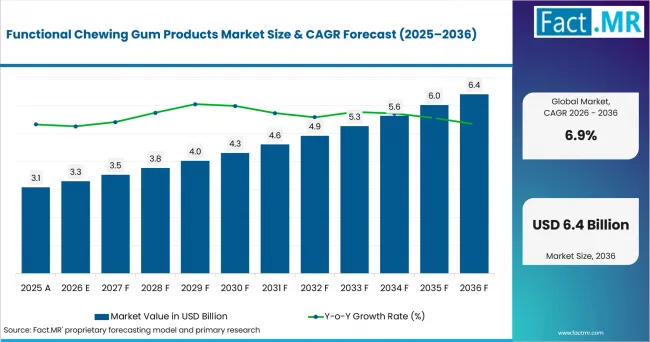
Functional Chewing Gum Products Market Value Analysis | Source: Fact.MR
What are the defining numbers behind Functional Chewing Gum Products Market growth?
An absolute opportunity of USD 3,131 million is expected between 2026 and 2036.
- Demand Drivers in the Market
- Sugar-free gum has a regulatory and clinical foundation for oral-care positioning. The European Union permits claims that sugar-free chewing gum contributes to tooth mineralisation and plaque-acid neutralisation when the stated conditions are met. The American Dental Association also notes that chewing sugar-free gum increases saliva flow and can reduce plaque acid. This gives oral-care gum a defined benefit proposition beyond refreshment.
- Pressure to reduce free-sugar exposure supports sugar-free formulations. The World Health Organization identifies free sugars as a primary dietary factor in dental caries. For gum manufacturers, replacing sugar with polyols or other permitted sweeteners can align the product with dental-health positioning while retaining the familiar chewing format.
- Caffeinated gum broadens the category into alertness and focus. The U.S. Army has used caffeinated gum as a rapid-delivery format for maintaining alertness in selected operational settings, showing that gum can function as a measured stimulant delivery system. Commercial products must still manage caffeine dose, labelling and responsible-use communication.
- Established gum portfolios provide manufacturing and distribution infrastructure for functional extensions. Mars currently markets several sugar-free gum brands, while LOTTE uses xylitol gum as an oral-care product in Japan. Functional products can therefore be developed within familiar gum formats rather than requiring an entirely new consumption behaviour.
- Direct online selling gives smaller functional brands a route to explain ingredient systems and benefit positioning outside the checkout aisle. Simply Gum currently sells xylitol-sweetened gum through its own online channel, illustrating how functional gum can be merchandised around formulation and use case rather than impulse purchase alone.
- Key Segments Analyzed
- Oral & dental care accounts for 30.0% of Functional Benefit in 2026 because sugar-free chewing gum has recognised dental-health claims and a familiar role in saliva stimulation and plaque-acid control.
- Coated pellet gum represents 47.0% of Format in 2026 as the piece-based format supports portion control, durable handling and flavour delivery across sugar-free and functional gum lines.
- Sugar-free holds 71.0% of Sugar Content in 2026 because dental positioning and free-sugar reduction favour formulations based on non-sugar sweeteners.
- Supermarkets/hypermarkets account for 34.0% of Distribution in 2026 because gum remains a low-unit-price product suited to routine grocery traffic and checkout merchandising, including functional variants.
- Analyst Opinion at Fact.MR
- Shambhu Nath Jha, Principal Consultant at Fact.MR, states, “Functional chewing gum is purchased when the benefit is easy to understand at the point of use. Oral-care gum has an established claims framework, while energy and wellness formats need clear dosing and ingredient communication. Suppliers that connect benefit, formulation and channel strategy are better placed to convert a familiar confectionery format into repeat functional use.”
- Strategic Implications
- Oral-care gum suppliers should build communication around permitted claim wording and the conditions attached to each claim. Broad wellness language creates avoidable regulatory risk when a specific dental claim is available.
- Energy and focus gum should use piece-level caffeine disclosure and clear serving guidance. The convenience of rapid oral delivery increases the importance of dose control and responsible-use communication.
- Sugar-free product development should balance sweetener choice with texture and flavour retention. The formulation must support the functional position without making the chewing experience noticeably weaker than conventional gum.
- Supermarkets remain the reach channel, while pharmacies and online stores can support products that need more explanation. Packaging and claims should therefore be adapted to the amount of information available in each channel.
How does the Functional Chewing Gum Products Market break down by segment?
The market is segmented by Functional Benefit, Format, Sugar Content and Distribution.
Why does Oral & dental care lead Functional Benefit?
Oral & dental care leads Functional Benefit in 2026.
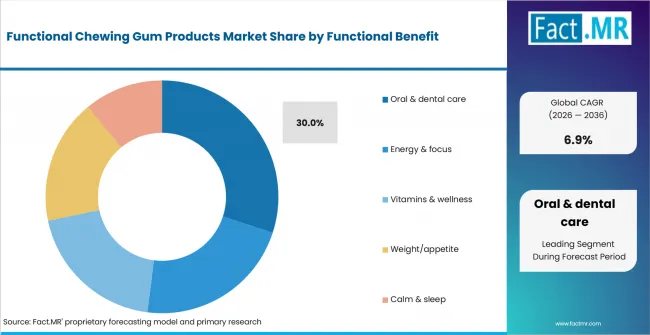
Functional Chewing Gum Products Market Analysis By Functional Benefit | Source: Fact.MR
Oral-care gum leads because the chewing action itself can stimulate saliva, while sugar-free formulations have recognised dental-health positioning. The European Union permits specific claims for sugar-free chewing gum related to tooth mineralisation and plaque-acid neutralisation, giving manufacturers a defined route to communicate benefit when claim conditions are met.
The American Dental Association also states that sugar-free gum can increase saliva flow and help reduce plaque acid. For buyers, this makes oral-care gum easier to position around a repeatable everyday occasion than benefit categories that depend on less familiar ingredients or more complex claims.
Why does Coated pellet gum lead Format?
Coated pellet gum leads Format in 2026.
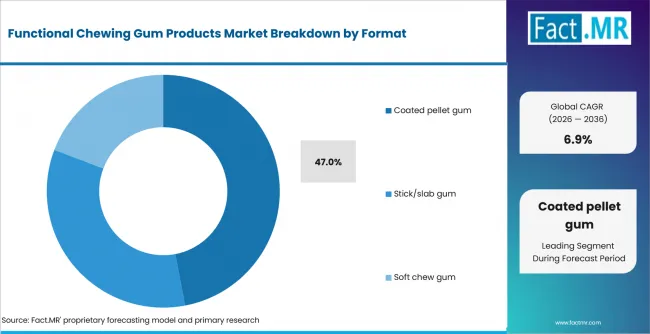
Functional Chewing Gum Products Market Analysis By Format | Source: Fact.MR
Coated pellets fit functional gum because each piece provides a consistent serving unit and the outer coating supports flavour release while protecting the gum during handling. The format also works well in bottles, blister packs and compact packs that encourage repeated use during the day.
Commercial portfolios reinforce this format. Sugar-free lines from established gum manufacturers commonly use coated pellets, while LOTTE uses the format for xylitol-positioned oral-care gum. Buyers therefore receive a functional product in a form that already fits gum manufacturing and consumer routines.
Why does Sugar-free lead Sugar Content?
Sugar-free leads Sugar Content in 2026.
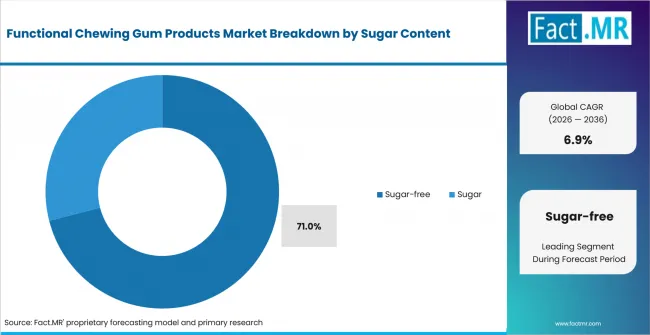
Functional Chewing Gum Products Market Analysis By Sugar Content | Source: Fact.MR
Sugar-free leads because the principal functional benefit in the market is oral and dental care. The World Health Organization identifies free sugars as a dietary driver of dental caries, while permitted European and Great Britain claims specifically recognise qualifying sugar-free chewing gum for plaque-acid neutralisation and tooth mineralisation.
This alignment affects product development and purchasing. A functional gum brand can use a sugar-free base for oral-care positioning and then layer flavour or other actives onto the same platform, reducing the need to maintain separate sugared formulations for each benefit concept.
Why do Supermarkets/hypermarkets lead Distribution?
Supermarkets/hypermarkets lead Distribution in 2026.
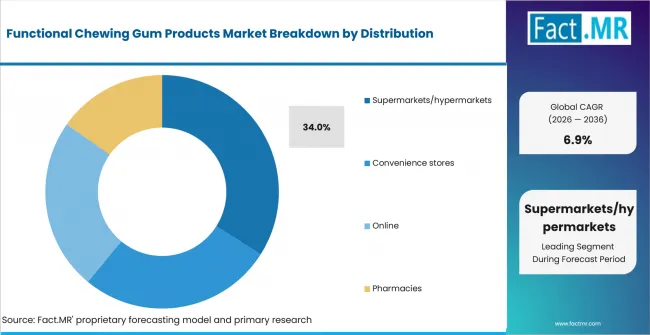
Functional Chewing Gum Products Market Analysis By Distribution | Source: Fact.MR
Supermarkets and hypermarkets lead because gum is compact, low-ticket and frequently purchased during routine shopping. Functional variants can use the same shelf and checkout infrastructure as conventional gum while adding a benefit cue on the pack.
Pharmacies and online channels remain relevant when the product needs more explanation, such as caffeine dose or dental-health positioning. They extend the market rather than replacing the reach available through grocery retail.
What is accelerating Functional Chewing Gum Products Market adoption, and what is holding it back?
Drivers Impact Analysis
| Driver | (~) % Impact on CAGR | Geographic Relevance | Impact Timeline |
|---|---|---|---|
| Approved dental-health claims for sugar-free and xylitol gum | +1.3% | Europe, North America | Near term |
| Energy and focus gum as a coffee-alternative occasion | +1.1% | North America, Europe | Mid term |
| Vitamin and mineral fortification broadening functional benefits | +0.9% | Global | Mid term |
| Pharmacy and online channel expansion for functional gum | +0.7% | Europe, East Asia | Long term |
Source: Fact.MR analysis. Updated Aug 19, 2026
Opportunity Impact Analysis
| Opportunity | (~) % Impact on CAGR | Geographic Relevance | Impact Timeline |
|---|---|---|---|
| Calm, sleep and stress-management gum formats for daytime dosing | +0.9% | North America, Europe | Mid term |
| Subscription and trial-bundle models in online grocery | +0.7% | Global | Long term |
| Oral-care gum co-merchandising with dental and pharmacy ranges | +0.6% | Europe, North America | Mid term |
Source: Fact.MR analysis. Updated Aug 19, 2026
Restraints Impact Analysis
| Restraint | (~) % Impact on CAGR | Geographic Relevance | Impact Timeline |
|---|---|---|---|
| Regulatory constraints on caffeine content and health-claim substantiation | -0.7% | Europe, North America | Near term |
| Sugar-sweetener perception and sweetener-cost volatility | -0.5% | Global | Mid term |
| Retail shelf-space competition from conventional confectionery | -0.4% | Global | Long term |
Source: Fact.MR analysis. Updated Aug 19, 2026
Which countries are scaling the Functional Chewing Gum Products Market through 2036?
- United States: Sugar-free gum has an established oral-care role through ADA guidance, while U.S. Army use of caffeinated gum demonstrates a separate focus and alertness occasion. This gives functional gum more than one credible use case within the same portable format.
- Italy: Perfetti Van Melle expanded its gum portfolio through the 2023 acquisition of Mondelēz International’s developed-market gum business. The enlarged brand and manufacturing base supports continued product development in sugar-free and benefit-positioned gum across Europe.
- Germany: Germany’s federal health portal recommends sugar-free chewing gum as a way to stimulate saliva in oral-care contexts. That public-health familiarity supports products positioned around dental care and breath management rather than confectionery alone.
- United Kingdom: The Great Britain Nutrition and Health Claims Register includes authorised claims for qualifying sugar-free chewing gum, including plaque-acid neutralisation. This gives brands a defined regulatory framework for dental-health communication.
- Spain: The General Council of Dentists of Spain advises that sugar-free xylitol gum can be used when brushing is temporarily not possible, while making clear that gum does not replace brushing. This supports a practical oral-care occasion for sugar-free products.
- Japan: LOTTE markets Xylitol gum as a Foods for Specified Health Uses product for dental health. The link between gum and a regulated functional benefit supports continued development of oral-care formats in the country.
Country CAGR (2026-2036)
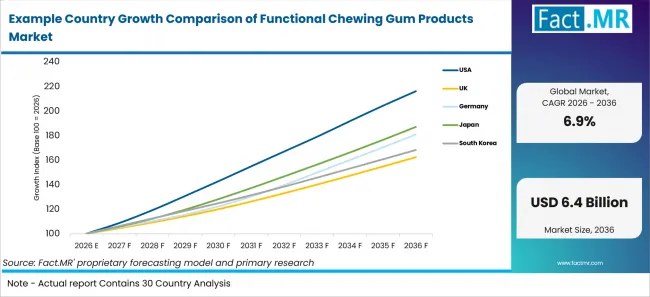
Example Country Growth Comparison Of Functional Chewing Gum Products Market | Source: Fact.MR
| Country | CAGR (2026-2036) |
|---|---|
| United States | 8.95% |
| Italy | 7.53% |
| Germany | 6.45% |
| United Kingdom | 7.23% |
| Spain | 8.02% |
| Japan | 6.59% |
Source: Fact.MR analysis. Updated Aug 19, 2026
What is driving United States growth through 2036?
United States is forecast to expand at an 8.95% CAGR from 2026 to 2036.
Demand conditions include benefit diversity within the gum format. The American Dental Association recognises the saliva-stimulating role of sugar-free gum, while U.S. military performance guidance has used caffeinated gum for alertness in selected settings. These two use cases support distinct oral-care and focus propositions without changing the basic product format.
Mars also maintains a broad U.S. gum portfolio that includes sugar-free brands such as Extra. Existing manufacturing and retail infrastructure gives functional extensions a practical route into mainstream distribution when the benefit is communicated clearly.
What is driving Italy growth through 2036?
Italy is forecast to expand at a 7.53% CAGR from 2026 to 2036.
Italy combines established gum industry capability through Perfetti Van Melle. The company completed the acquisition of Mondelēz International’s gum business in the United States, Canada and Europe in 2023, adding brands and manufacturing assets to its portfolio.
The European Union’s authorised sugar-free gum claims provide a common framework for oral-care positioning across Italy and other EU markets. This supports functional product development around compliant dental messaging rather than broad, unsubstantiated health language.
What is driving Germany growth through 2036?
Germany is forecast to expand at a 6.45% CAGR from 2026 to 2036.
German public-health guidance gives sugar-free gum a practical oral-care role. The federal health portal notes that chewing sugar-free gum can stimulate saliva, while German dental organisations continue to emphasise sugar reduction as part of caries prevention.
For manufacturers, this creates a clear fit for oral-care gum sold through grocery and drug channels. EU health-claim rules further define which dental benefits can be communicated on qualifying sugar-free products.
What is driving United Kingdom growth through 2036?
United Kingdom is forecast to expand at a 7.23% CAGR from 2026 to 2036.
The Great Britain Nutrition and Health Claims Register retains authorised claims for sugar-free chewing gum related to plaque-acid neutralisation and tooth mineralisation. Brands therefore have a defined compliance route for oral-care positioning after the UK’s departure from the EU regulatory system.
This matters commercially because functional gum relies on concise pack communication. A permitted claim can explain why a product is different from standard refreshment gum without requiring lengthy education at the point of sale.
What is driving Spain growth through 2036?
Spain is forecast to expand at an 8.02% CAGR from 2026 to 2036.
Spain has a practical oral-care use case for sugar-free gum. The General Council of Dentists of Spain advises that sugar-free xylitol gum can be chewed when brushing is temporarily not possible, while stating that it does not replace normal toothbrushing.
That positioning supports gum as an adjunct to daily oral care, especially for on-the-go use. Functional brands can build on this familiar behaviour while remaining within EU rules for nutrition and health claims.
What is driving Japan growth through 2036?
Japan is forecast to expand at a 6.59% CAGR from 2026 to 2036.
Japan has an established example of functional gum through LOTTE’s Xylitol brand. The company markets a Xylitol gum product under the Foods for Specified Health Uses framework with dental-health positioning, linking the gum format directly to a regulated functional benefit.
This reduces the behavioural gap between confectionery and wellness use. Product developers can build around familiar chewing occasions while differentiating through sweetener systems and functional claims that meet local requirements.
Who leads the Functional Chewing Gum Products Market?
Mars Wrigley supplies gum through an established portfolio and broad retail presence. Mars currently markets Extra and Orbit. Its portfolio also includes 5 Gum and Doublemint, giving the business a base across sugar-free and conventional gum formats that can support functional extensions.
Perfetti Van Melle Group B.V. strengthened its gum portfolio after acquiring Mondelēz International’s developed-market gum business in the United States, Canada and Europe in 2023. Mondelēz International, Inc. retained its gum business in Latin America and across Asia, the Middle East and Africa. The two companies therefore remain distinct participants, but their geographic roles changed after the transaction.
LOTTE Co., Ltd. competes through a direct oral-care proposition in Japan, where its Xylitol gum is marketed with functional dental positioning. Simply Gum competes through natural-ingredient and xylitol-sweetened products sold directly online, giving it a differentiated route to consumers seeking ingredient transparency.
Haleon plc brings oral-health and vitamins category capability, although its current public brand portfolio is concentrated outside conventional chewing gum. Its relevance is therefore closer to consumer-health adjacency than to mass-market gum manufacturing. Competition across the market depends on claim eligibility and formulation quality. Suppliers must also preserve flavour and reach retail channels where the intended benefit can be explained.
Which companies are the key providers?
- Mars Wrigley
- Mondelēz International, Inc.
- Perfetti Van Melle Group B.V.
- LOTTE Co., Ltd.
- Haleon plc
- Simply Gum
Research Sources and Bibliography
- European Food Safety Authority. (2010). Scientific Opinion on the substantiation of health claims related to sugar-free chewing gum and dental and oral health. EFSA Journal.
- European Commission. (2026). EU Register on Nutrition and Health Claims. European Commission.
- American Dental Association. (2023). Chewing Gum. American Dental Association.
- World Health Organization. (2025). Sugars and Dental Caries: WHO Technical Note. World Health Organization.
- UK Government. (2025). Great Britain Nutrition and Health Claims Register. Department of Health and Social Care.
- U.S. Army. (2020). Sleep: The Force Multiplier. United States Army.
- U.S. Food and Drug Administration. (2024). Spilling the Beans: How Much Caffeine is Too Much? U.S. Department of Health and Human Services.
- Federal Ministry of Health, Germany. (2021). Bad Breath: Causes and Treatment. gesund.bund.de.
- Federal Dental Association, Germany. (2025). Healthy Mouth: Saliva and Sugar-Free Chewing Gum. Bundeszahnärztekammer.
- General Council of Dentists of Spain. (2023). Recommendations for Maintaining Good Oral Health During the Holiday Period. Consejo General de Dentistas de España.
- Mars, Incorporated. (2026). Mars Brands: A-Z. Mars, Incorporated.
- Mondelēz International, Inc. (2023). Mondelēz International Completes Sale of Developed Market Gum Business to Perfetti Van Melle. Mondelēz International, Inc.
- Perfetti Van Melle Group B.V. (2023). Perfetti Van Melle Closes Gum Brand Acquisition. Perfetti Van Melle Group B.V.
- LOTTE Co., Ltd. (2026). XYLITOL Brand Site. LOTTE Co., Ltd.
- Simply Gum. (2026). Sugar Free Peppermint Gum and Brand Information. Simply Gum.
- Haleon plc. (2026). Our Brands. Haleon plc.
This Report Answers
- The report explains how oral-care, energy and other functional benefits shape demand for chewing gum beyond basic refreshment.
- Segment analysis compares the roles of coated pellets, stick or slab formats and soft chews within functional product development.
- The assessment examines how sugar-free positioning affects dental-health communication and formulation strategy.
- Country analysis explains the regulatory and commercial mechanisms supporting growth across the listed markets.
- Competitive analysis reviews current gum portfolios, the Mondelēz-Perfetti Van Melle transaction and the role of adjacent consumer-health companies.
What does the Functional Chewing Gum Products Market cover?
The Functional Chewing Gum Products Market covers chewing gums sold with a defined benefit beyond basic refreshment. Included benefit positions are oral and dental care, energy and focus, vitamins and wellness, weight and appetite, and calm and sleep support.
The assessment follows the stated segmentation by Functional Benefit, Format, Sugar Content and Distribution. It includes coated pellet gum, stick or slab gum and soft chew gum sold through supermarkets and hypermarkets, convenience stores, online channels and pharmacies.
What is included in the scope?
The scope includes sugar-free and sugared chewing gum when the product is formulated or marketed around one of the stated functional benefits. Examples include oral-care gum based on sugar-free or xylitol formulations and caffeinated gum positioned for alertness or focus.
Both established confectionery brands and specialist functional-gum brands are included when revenue comes from finished chewing gum sold through the covered distribution channels.
What is excluded from the scope?
The scope excludes conventional chewing gum sold only for flavour, breath freshening or confectionery use without a functional benefit position. Nicotine-replacement gum and other medicated gums regulated as medicines are outside the market.
Gum base, sweeteners, flavours and other raw materials are excluded when sold separately. Gum manufacturing machinery and adjacent formats such as gummies, lozenges, mints and oral sprays are also outside the assessment.
How Was the Analysis Built?
Fact.MR is of the opinion that this assessment combines primary research with a structured review of public information and industry evidence relevant to the market.
- Primary Research: Relevant respondent groups include chewing-gum manufacturers, confectionery product developers, retail buyers, distributors, oral-care specialists and regulatory professionals involved in formulation, claims review and channel selection.
- Desk Research: The review uses government and regulatory health-claim registers, dental-health guidance, public company product information and current corporate disclosures relevant to gum portfolios and functional positioning.
- Market Sizing and Forecasting: Estimates combine functional-benefit demand with format mix, sugar-content mix, distribution-channel activity and country-level growth. Company portfolio changes are considered where they alter geographic participation or product coverage.
- Data Validation and Update Cycle: Evidence is reviewed against the defined market scope, segment boundaries and forecast period. The assessment is updated when source data, technology conditions, regulation or supplier activity materially changes the outlook.
Segmentation
Research Scope and Coverage
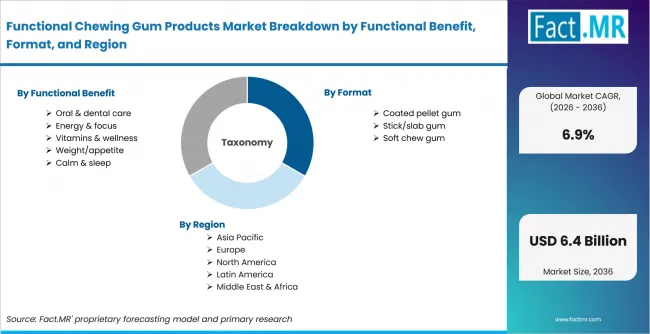
Functional Chewing Gum Products Market Breakdown By Functional Benefit, Format, And Region | Source: Fact.MR
| Attribute | Details |
|---|---|
| Quantitative Units | USD million in 2026 to USD million by 2036 at a CAGR |
| Market Definition | Chewing gum products formulated and positioned to provide a defined functional benefit beyond basic refreshment, including oral and dental care, energy and focus, vitamins and wellness, weight and appetite, and calm and sleep support |
| Segments Covered | Functional Benefit; Format; Sugar Content; Distribution |
| Regions Covered | North America; Latin America; Western Europe; Eastern Europe; East Asia; South Asia & Pacific; Middle East & Africa |
| Countries Covered | United States; Italy; Germany; United Kingdom; Spain; Japan |
| Key Companies Profiled | Mars Wrigley; Mondelēz International, Inc.; Perfetti Van Melle Group B.V.; LOTTE Co., Ltd.; Haleon plc; Simply Gum |
| Forecast Period | 2026 to 2036 |
| Base Year | 2025 |
| Market Value, 2026 | USD 3,300 million |
| Market Value, 2036 | USD 6,431 million |
| CAGR, 2026-2036 | 6.9% |
| Absolute Opportunity | USD 3,131 million |
| Approach | Hybrid top-down and bottom-up assessment using functional-benefit demand, product format, sugar-content mix, distribution-channel activity, country growth and company portfolio review |
Source: Fact.MR analysis. Updated Aug 19, 2026
Market Breakdown by Segments
-
By Functional Benefit
- Oral & dental care
- Energy & focus
- Vitamins & wellness
- Weight/appetite
- Calm & sleep
-
By Format
- Coated pellet gum
- Stick/slab gum
- Soft chew gum
-
By Sugar Content
- Sugar-free
- Sugar
-
By Distribution
- Supermarkets/hypermarkets
- Convenience stores
- Online
- Pharmacies
-
By Region
- North America
- Latin America
- Western Europe
- Eastern Europe
- East Asia
- South Asia & Pacific
- Middle East & Africa
Frequently Asked Questions
What is the Functional Chewing Gum Products Market value in 2026?
At what CAGR is the market projected to grow?
What is the projected market value by 2036?
Which Functional Benefit leads the market?
Which Format leads the market?
Which Sugar Content category leads the market?
Which Distribution channel leads the market?
What CAGR is recorded for United States?
What is the primary driver in this market?
What is the main restraint?
Which companies are included in the market assessment?
Who worked on this report


Preview the report firsthand - request a free sample
Free SampleGet the brochure for pricing and purchase details
Download PDF