- Market Value (2025): USD 340.8 Mn
- Estimated Value (2026): USD 360.2 Mn
- Forecast Value (2036): USD 626.4 Mn
- CAGR (2026-2036): 5.7%
Longevity Scan Clinic Equipment Market Forecast and Outlook 2026 to 2036
Fact.MR studies that the global longevity scan clinic equipment market crossed a valuation of USD 340.8 million in 2025 and is projected to grow from USD 360.2 million in 2026 to USD 626.4 million by 2036. Demand for longevity scan clinic equipment is expected to increase at a CAGR of 5.7% over the forecast period.
Demand for longevity scan clinic equipment is rising as preventive health providers expand access to whole-body imaging, body-composition assessment, and vascular screening. Clinics are combining diagnostic imaging systems with personalized health assessments to identify potential risks before symptoms become apparent. For example, in June 2026, Neko Health announced enhancements to its Health Scan experience, including body-composition measurements and wearable-data integration. Similar improvements in integrated screening are projected to support sales of imaging equipment across dedicated longevity clinics and preventive health facilities.
Key Takeaways from the Longevity Scan Clinic Equipment Market
- Longevity Scan Clinic Equipment Market Value (2025): USD 340.8 million
- Longevity Scan Clinic Equipment Market Value (2026): USD 360.2 million
- Longevity Scan Clinic Equipment Market Forecast Value (2036): USD 626.4 million
- Longevity Scan Clinic Equipment Market Forecast CAGR (2026–2036): 5.7%
- Leading Imaging Equipment Segment: Whole-body MRI (27.2%)
- Key Market Participants: Siemens Healthineers, GE HealthCare, Koninklijke Philips N.V., Canon Medical Systems Corporation, Hologic, Inc., FUJIFILM Corporation, Esaote S.p.A., and Neko Health
- Key Growth Regions: United States, China, Japan, Germany, and South Korea
Adoption of advanced imaging systems is supported by the need to combine structural imaging with preventive assessments of body composition and vascular health. Whole-body MRI and retinal or vascular imaging together account for 52.9% of 2026 imaging equipment demand. Equipment suppliers are competing through image quality, scan efficiency, software integration, and the ability to support broader diagnostic workflows. Similar expansion in preventive imaging capabilities is projected to drive sales of longevity scan clinic equipment through 2036.
Longevity Scan Clinic Equipment Market
| Metric | Value |
|---|---|
| Estimated Value in 2026 | USD 360.2 million |
| Forecast Value in 2036 | USD 626.4 million |
| Forecast CAGR (2026 to 2036) | 5.7% |
Source: Fact.MR analysis. Updated Nov 19, 2026
Source: Fact.MR analysis Category
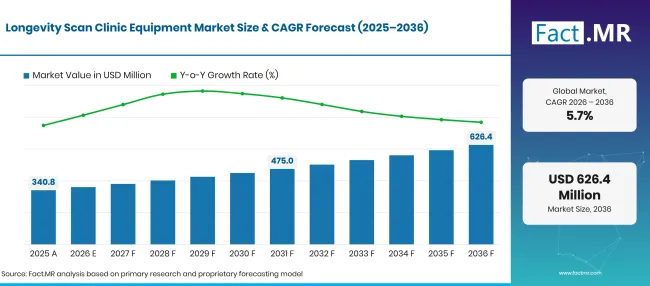
Longevity Scan Clinic Equipment Forecast Global | Source: Fact.MR
| Category | Segments |
|---|---|
| Longevity Imaging Equipment | Whole-body MRI, Low-dose CT, Ultrasound platforms, DEXA body composition, Retinal / vascular imaging |
| Contract / Payment Model | Employer / payer contract, Annual subscription, Pay-per-visit, Bundled care package, Project / consulting fee |
| Delivery Channel | Dedicated facility, Hospital / medical group, At-home / virtual, Employer site, Hospitality / residential partner |
| Service Beneficiary | Older adults, At-risk adults, Healthy adults, Family / caregivers, Corporate executives |
| Region | United States, China, Japan, Germany, South Korea |
Source: Fact.MR analysis. Updated Nov 19, 2026
Source: Fact.MR analysis.
Segmental Analysis
Why does whole-body MRI lead demand in the Longevity Scan Clinic Equipment Market?
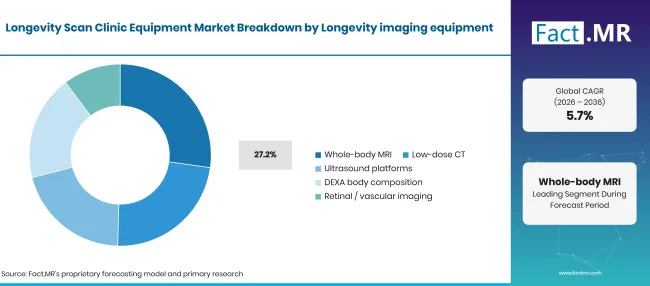
Longevity Scan Clinic Equipment Breakdown Longevity Imaging Equipment | Source: Fact.MR
Demand for whole-body MRI equipment accounts for 27.2% of imaging equipment demand in 2026, about USD 97.97 million. Whole-body MRI enables clinics to examine multiple anatomical regions through a single imaging session, supporting broad preventive assessments. In January 2026, Siemens Healthineers received U.S. FDA clearance for its MAGNETOM Flow 1.5T MRI platform, which incorporates AI-based image reconstruction to improve image quality and scan efficiency. These technological improvements are expected to encourage the adoption of whole-body MRI systems among longevity clinics and preventive diagnostic providers.
How are employer and payer contracts shaping sales in the Longevity Scan Clinic Equipment Market?
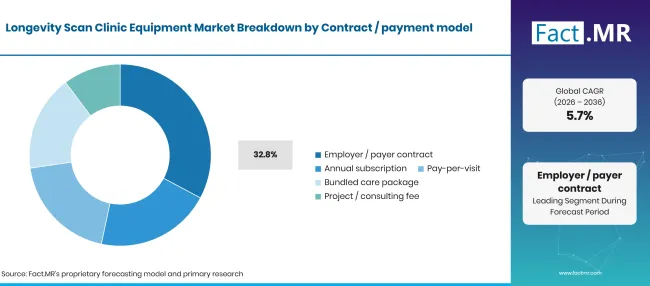
Longevity Scan Clinic Equipment Breakdown Contract Payment Model | Source: Fact.MR
Employer / payer contracts segment represents 32.8% of contract and payment model sales in 2026, about USD 118.15 million. Employer-sponsored healthcare coverage and payer-funded healthcare arrangements provide an established foundation for institutional procurement of preventive diagnostic services. According to the U.S. Bureau of Labor Statistics, 71% of private-industry workers had access to employer-sponsored medical care plans in March 2026. Additionally, Medicare Advantage payments are projected to reach USD 615 billion in 2026, according to MedPAC. The widespread availability of employer-sponsored coverage and the scale of payer-managed healthcare financing create opportunities for longevity clinics to establish institutional screening contracts and expand access to advanced imaging services.
Why do dedicated facilities lead demand by delivery channel?
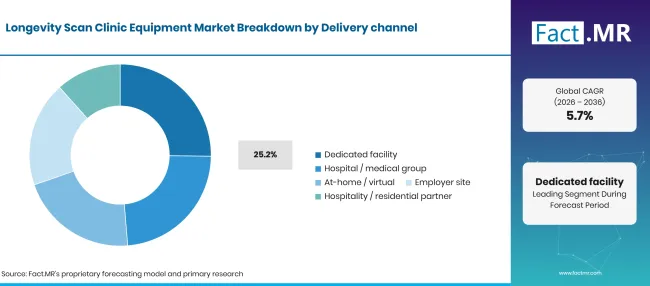
Longevity Scan Clinic Equipment Breakdown Delivery Channel | Source: Fact.MR
Demand for dedicated longevity facilities is supported by growing consumer interest in comprehensive preventive health assessments conducted outside conventional hospital settings. Dedicated facilities to hold a 25.2% of delivery channel demand in 2026, about USD 90.77 million. These centers can organize imaging, body-composition measurements, and preventive consultations around a coordinated patient visit. Their specialized operating model supports equipment utilization across multiple screening services without relying entirely on conventional hospital workflows. In June 2026, Neko Health enhanced its Health Scan with body-composition measurements and wearable-data integration, illustrating the development of dedicated, multi-component preventive assessment services. Similar expansion in integrated screening is projected to drive sales through dedicated longevity facilities.
How are older adults influencing sales in the Longevity Scan Clinic Equipment Market?
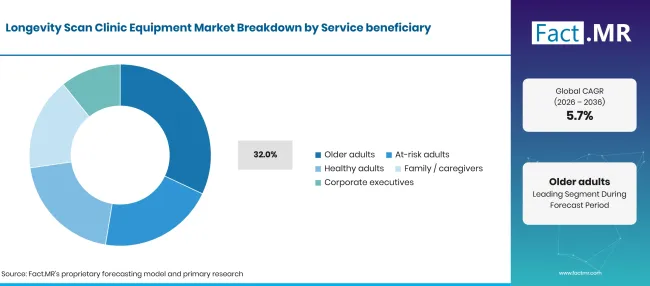
Longevity Scan Clinic Equipment Breakdown Service Beneficiary | Source: Fact.MR
Adoption of longevity scan clinic equipment among older adults is supported by the increasing need for regular monitoring of age-related health changes. Changes in bone density, muscle mass, body composition, and cardiovascular health encourage the use of advanced diagnostic technologies in preventive assessments. Clinics can integrate DEXA, MRI, and vascular imaging into screening programs to provide a broader evaluation of age-related health risks. Older adults to capture 32.0% of service beneficiary demand in 2026, about USD 115.26 million. Growing adoption of comprehensive diagnostic assessments among older adults is expected to support the use of longevity scan clinic equipment in this beneficiary segment.
Longevity Scan Clinic Equipment Market – Drivers, Restraints & Trends
- Drivers:
Population aging is increasing the need for diagnostic services that assess age-related health risks. In September 2026, Japan's Statistics Bureau reported that adults aged 65 and above numbered 36.24 million, representing 29.6% of the population. This demographic shift supports demand for imaging used in bone-density, body-composition, and vascular assessments. Equipment suppliers are developing systems that help clinics deliver broader preventive examinations. Similar demand for age-related screening is projected to drive sales of longevity scan clinic equipment.
- Restraints:
Demand for longevity scan clinic equipment is constrained by the high capital investment required to establish imaging facilities. MRI and CT systems require substantial equipment expenditure, specialized rooms, trained operators, maintenance, and compliance with radiation-safety requirements where applicable. Dedicated longevity clinics must also maintain sufficient scan volumes to justify equipment utilization. These costs can limit expansion among smaller providers and make equipment purchases dependent on patient volumes, reimbursement arrangements, and subscription revenue.
- Opportunity – AI-powered quantitative imaging and automated risk assessment:
In May 2026, researchers reported the use of artificial intelligence to analyze whole-body MRI scans from more than 66,000 participants, identifying relationships between muscle quality, fat distribution, and cardiometabolic health risks. The findings demonstrate the potential of AI-based imaging analysis to extract detailed health indicators beyond conventional BMI measurements. Greater adoption of automated image analysis and quantitative reporting is expected to encourage longevity clinics to invest in advanced MRI systems and supporting diagnostic software.
- Trend – Growing adoption of photon-counting CT technology:
In November 2026, the Radiological Society of North America (RSNA) highlighted advances in photon-counting CT as an emerging medical imaging trend, particularly for improved tissue characterization, quantitative imaging, and applications across cardiovascular and pulmonary assessments. The technology can provide detailed anatomical information while supporting radiation-dose optimization. Increasing interest in advanced imaging capabilities is expected to encourage investments in next-generation CT equipment among specialized longevity clinics and preventive diagnostic centers.
Trend – Expansion of low-field MRI systems:
In November 2026, RSNA identified more accessible low-field MRI approaches as an emerging development in medical imaging. These systems are attracting attention for their potential to improve imaging accessibility and support alternative scanning environments. Greater availability of compact and accessible MRI technologies can help diagnostic providers expand imaging capacity and serve patients across different healthcare settings. This development is expected to create additional opportunities for MRI equipment adoption among preventive diagnostic facilities and specialized longevity clinics.
Longevity Scan Clinic Equipment Market by Analysis by Key Country
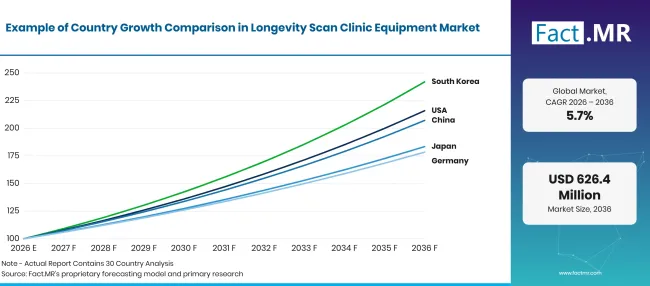
Longevity Scan Clinic Equipment Growth Index | Source: Fact.MR
| Country | CAGR (2026–2036) |
|---|---|
| United States | 8.0% |
| China | 7.6% |
| South Korea | 9.2% |
| Japan | 6.3% |
| Germany | 6.0% |
Source: Fact.MR analysis. Updated Nov 19, 2026
Source: Fact.MR analysis.
What is driving longevity scan clinic equipment demand in the United States?
Demand for longevity scan clinic equipment in the United States is projected to capture 8.0% CAGR through 2036. According to the U.S.
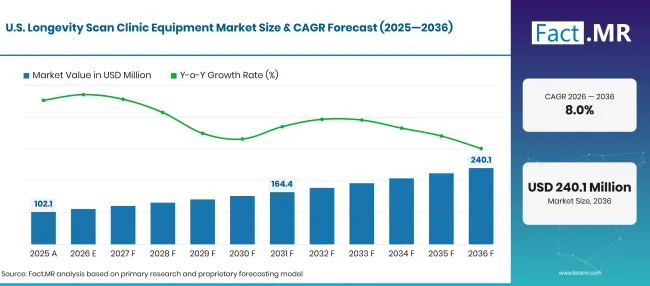
Longevity Scan Clinic Equipment Forecast Usa | Source: Fact.MR
Census Bureau's 2026 population estimates, the population aged 65 and above reached approximately 64.6 million in 2025, reflecting a growing base of older adults who may require age-related health assessments. Imaging providers are expanding access to MRI, CT, and body-composition services to support preventive screening. Adoption of diagnostic assessment among aging consumers is projected to drive sales of longevity scan clinic equipment in the United States.
How is China's aging population supporting longevity scan clinic equipment sales?
Adoption of longevity scan clinic equipment in China is projected to grow at a 7.6% CAGR through 2036.
China's National Bureau of Statistics reported in February 2026 that people aged 60 and above accounted for 23.0% of the population at the end of 2025, representing approximately 323.38 million people. This large aging population supports the need for diagnostic services that assess bone health, cardiovascular risks, and age-related changes. Demand for preventive imaging is projected to drive sales of longevity scan clinic equipment in China.
Why is South Korea recording the fastest growth in longevity scan clinic equipment demand?
Sales of longevity scan clinic equipment in South Korea is estimated to record a 9.2% CAGR, the fastest among the five key countries.
Statistics Korea's October 2026 older-adult statistics reported that people aged 65 and above represented 21.6% of the country's population in 2026. The same release reported a health-screening participation rate of 68.9% among older adults in 2024. This combination of population aging and established screening participation supports the need for imaging equipment across preventive health facilities. Similar demand for regular health assessments is projected to drive sales of longevity scan clinic equipment in South Korea.
How is Japan's aging population shaping longevity scan clinic equipment demand?
Demand for longevity scan clinic equipment in Japan is projected to grow at a 6.3% CAGR through 2036.
Japan's Statistics Bureau reported in September 2026 that people aged 65 and above numbered 36.24 million, accounting for 29.6% of the population. This demographic profile supports the need for diagnostic assessments covering bone density, vascular health, and age-related changes in body composition. Imaging providers can combine MRI, DEXA, and ultrasound services to address these requirements. Similar demand for age-related diagnostic services is projected to support sales of longevity scan clinic equipment in Japan.
What is supporting longevity scan clinic equipment sales in Germany?
Adoption of longevity scan clinic equipment in Germany is set to record a 6.0% CAGR through 2036.
Germany's Federal Statistical Office reported in August 2026 that the population aged 65 and above reached 19.3 million in 2025, representing 23% of the country's population. The growing older-adult population increases the relevance of imaging for assessing bone density, cardiovascular health, and other age-related conditions. Similar demand for diagnostic imaging in preventive and clinical settings is projected to drive sales of longevity scan clinic equipment in Germany.
Competitive Landscape for Longevity Scan Clinic Equipment Market
Competition in the longevity scan clinic equipment market includes diversified medical imaging manufacturers and specialist preventive-health technology providers. Siemens Healthineers, GE HealthCare, Koninklijke Philips N.V., and Canon Medical Systems Corporation compete across advanced imaging platforms, including MRI, CT, and ultrasound. Hologic, Inc. and FUJIFILM Corporation participate in diagnostic imaging and related healthcare technologies, while Esaote S.p.A. supplies dedicated MRI and ultrasound systems. Neko Health differs from traditional equipment manufacturers through its integrated preventive scanning model, combining proprietary scanning technology with clinical assessments and digital health information.
Competition is increasingly shaped by image quality, scan speed, AI-assisted workflows, equipment integration, and the ability to support multiple screening applications. In January 2026, Siemens Healthineers received FDA clearance for its MAGNETOM Flow 1.5T MRI platform. In March 2026, Esaote introduced new MyLab E85 GTS and MyLab C30 GTS Edition ultrasound systems, alongside MRI and imaging-workflow innovations. In October 2026, GE HealthCare introduced LOGIQ Focus, a general-imaging ultrasound system with AI-enabled workflow tools. These developments illustrate suppliers' focus on imaging performance and efficient diagnostic workflows.
Recent Developments
- In October 2026, GE HealthCare introduced LOGIQ Focus, a general-imaging ultrasound system designed to combine advanced image quality with AI-enabled workflow and productivity tools.
- In July 2026, Canon Medical Systems USA introduced CLEAR Motion across its Aquilion ONE CT portfolio and expanded availability of PIQE deep-learning reconstruction technology.
- In March 2026, Esaote introduced the MyLab E85 GTS and MyLab C30 GTS Edition ultrasound systems, alongside AI-supported MRI and enterprise-imaging innovations.
- In January 2026, FUJIFILM India unveiled its FCT iStream CT platform, FFDM Sophinity digital mammography, FDR Smart X Essential digital radiography, and Fenix healthcare IT solutions at IRIA 2026.
Key Players in Longevity Scan Clinic Equipment Market
Key companies operating in the market include Siemens Healthineers, GE HealthCare, Koninklijke Philips N.V., Canon Medical Systems Corporation, Hologic, Inc., FUJIFILM Corporation, Esaote S.p.A., and Neko Health.
- Siemens Healthineers
- GE HealthCare
- Koninklijke Philips N.V.
- Canon Medical Systems Corporation
- Hologic, Inc.
- FUJIFILM Corporation
- Esaote S.p.A.
- Neko Health
Longevity Scan Clinic Equipment Market by Segments
-
Longevity Imaging Equipment
- Whole-body MRI
- Low-dose CT
- Ultrasound platforms
- DEXA body composition
- Retinal / vascular imaging
-
Contract / Payment Model
- Employer / payer contract
- Annual subscription
- Pay-per-visit
- Bundled care package
- Project / consulting fee
-
Delivery Channel
- Dedicated facility
- Hospital / medical group
- At-home / virtual
- Employer site
- Hospitality / residential partner
-
Service Beneficiary
- Older adults
- At-risk adults
- Healthy adults
- Family / caregivers
- Corporate executives
-
Region
- North America
- United States
- Canada
- Mexico
- Europe
- Germany
- United Kingdom
- France
- Italy
- Spain
- Rest of Europe
- Asia Pacific
- China
- India
- Japan
- South Korea
- Australia
- Rest of Asia Pacific
- Latin America
- Brazil
- Mexico
- Argentina
- Rest of Latin America
- Middle East & Africa
- GCC Countries
- South Africa
- Rest of Middle East & Africa
- North America
Bibliography
- Canon Medical Systems USA, Inc. (2026, July 7). Canon introduces advanced AI-powered CT technologies to improve image quality and workflow efficiency.
Esaote. (2026, March 2). ECR 2026: Esaote Group introduces breakthroughs in ultrasound, MRI and enterprise imaging.
Federal Statistical Office of Germany. (2026, August 18). Population of older people aged 65 and above.
FUJIFILM India. (2026, January 30). FUJIFILM India introduces advance imaging and healthcare IT solutions to support India’s preventive healthcare ambition.
GE HealthCare. (2026, October 19). GE HealthCare expands general imaging ultrasound portfolio with LOGIQ Focus, elevating everyday ultrasound performance.
Medicare Payment Advisory Commission. (2026, March 12). The Medicare Advantage program: Status report. In March 2026 report to the Congress: Medicare payment policy (Chapter 12).
National Bureau of Statistics of China. (2026, February 28). Statistical communiqué of the People’s Republic of China on the 2025 national economic and social development.
Neko Health. (2026, June 22). Neko Health announces advancements to its Health Scan experience, fueling the future of proactive healthcare.
Radiological Society of North America. (2026, May 5). AI model analyses body composition to predict health risks.
Radiological Society of North America. (2026, November 2). RSNA 2026 trending topics.
Siemens Healthineers. (2026, January 8). Siemens Healthineers receives FDA clearance for 70cm MAGNETOM Flow 1.5 Tesla magnetic resonance platform for virtually helium-free imaging.
Statistics Bureau of Japan. (2026, September 20). Statistical topics No. 149: Older people in Japan, based on statistics.
National Data Agency. (2026, October 1). 2026 statistics on older adults. Government of the Republic of Korea.
U.S. Bureau of Labor Statistics. (2026, September 25). Employee benefits in the United States, March 2026. U.S. Department of Labor.
U.S. Census Bureau. (2026, April 9). Census Bureau releases new 2025 U.S. population estimates by age and sex.
Segmentation
Scope of Report
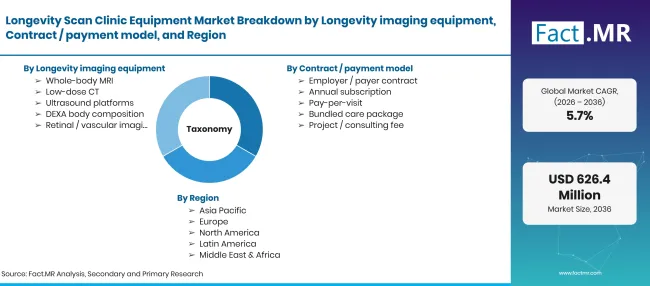
Longevity Scan Clinic Equipment Taxonomy | Source: Fact.MR
| Items | Values |
|---|---|
| Quantitative Units (2026) | USD 360.2 million |
| Longevity Imaging Equipment | Whole-body MRI, Low-dose CT, Ultrasound platforms, DEXA body composition, Retinal / vascular imaging |
| Contract / Payment Model | Employer / payer contract, Annual subscription, Pay-per-visit, Bundled care package, Project / consulting fee |
| Delivery Channel | Dedicated facility, Hospital / medical group, At-home / virtual, Employer site, Hospitality / residential partner |
| Service Beneficiary | Older adults, At-risk adults, Healthy adults, Family / caregivers, Corporate executives |
| Regions Covered | North America, Latin America, Europe, East Asia, South Asia and Pacific, Middle East & Africa |
| Countries Covered | United States, China, Japan, Germany, South Korea, and other countries |
| Key Companies Profiled | Siemens Healthineers, GE HealthCare, Koninklijke Philips N.V., Canon Medical Systems Corporation, Hologic, Inc., FUJIFILM Corporation, Esaote S.p.A., Neko Health |
| Additional Attributes | Dollar revenue in the Longevity Scan Clinic Equipment Market is segmented by imaging equipment, contract and payment model, delivery channel, service beneficiary, and region. |
Source: Fact.MR analysis. Updated Nov 19, 2026
Source: Fact.MR analysis.
Frequently Asked Questions
How big is the global Longevity Scan Clinic Equipment Market in 2026?
What will be the size of the Longevity Scan Clinic Equipment Market by 2036?
How fast will the Longevity Scan Clinic Equipment Market grow during the forecast period?
Which imaging equipment segment holds the largest share of the Longevity Scan Clinic Equipment Market?
Which contract and payment model leads the Longevity Scan Clinic Equipment Market?
Who worked on this report


Preview the report firsthand - request a free sample
Free SampleGet the brochure for pricing and purchase details
Download PDF