- Market Value (2025): USD 23.1 Mn
- Estimated Value (2026): USD 26.9 Mn
- Forecast Value (2036): USD 125.6 Mn
- CAGR (2026-2036): 16.7%
Menopause Hormone Wearables Market Forecast and Outlook 2026 to 2036
Fact.MR analyse the global menopause hormone wearables market crossed a valuation of USD 23.1 million in 2025 and is projected to grow from USD 26.9 million in 2026 to USD 125.6 million by 2036. Demand for menopause hormone wearables is expected to increase at a CAGR of 16.7% over the forecast period.
Demand for menopause hormone wearables is increasing as consumers seek continuous monitoring of physiological changes associated with perimenopause and menopause. Wearable technologies and connected testing solutions can help users track temperature fluctuations, symptom patterns, and other physiological indicators that may provide information about hormonal transitions. Integration of optical sensing, biomarker assessment, and digital symptom tracking is expanding the range of monitoring approaches available to consumers. Greater interest in personalized menopause management is projected to support sales of connected wearable devices and supporting technologies through 2036.
Key Takeaways from the Menopause Hormone Wearables Market
- Menopause Hormone Wearables Market Value (2025): USD 23.1 million
- Menopause Hormone Wearables Market Value (2026): USD 26.9 million
- Menopause Hormone Wearables Market Forecast Value (2036): USD 125.6 million
- Menopause Hormone Wearables Market Forecast CAGR (2026–2036): 16.7%
- Leading Hormone Assessment Approach: Optical proxy estimation (29.8%)
- Leading Sales Channel: Retail electronics (27.2%)
- Key Market Participants: Peri (IdentifyHer Limited), Embr Labs, Inc., Amira Health, Thermband, and Celsius Innovations Ltd. (MyCelsius)
- Key Growth Regions: United States, China, Japan, Germany, and the United Kingdom
Growing interest in personalized menopause management is encouraging the development of wearable devices that combine physiological sensing with digital symptom tracking. Optical proxy estimation and algorithmic symptom tracking together account for 52.3% of hormone assessment approach demand in 2026. Companies are exploring different sensing technologies, wearable configurations, and data-processing methods to make menopause-related health monitoring more accessible. Similar advances in connected health monitoring are projected to support sales of menopause hormone wearables through 2036.
Menopause Hormone Wearables Market
| Metric | Value |
|---|---|
| Estimated Value in 2026 | USD 26.9 million |
| Forecast Value in 2036 | USD 125.6 million |
| Forecast CAGR (2026 to 2036) | 16.7% |
Source: Fact.MR analysis. Updated Nov 19, 2026
Source: Fact.MR analysis Category
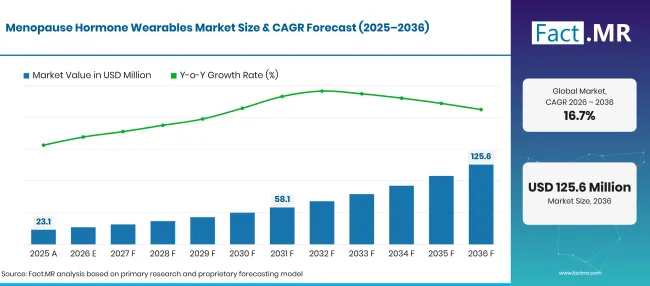
Menopause Hormone Wearables Market Forecast Global | Source: Fact.MR
| Category | Segments |
|---|---|
| Hormone Assessment Approach | Optical proxy estimation, Interstitial fluid sensing, Sweat-based biomarker sensing, Connected urine testing, Algorithmic symptom tracking |
| Device Form Factor | Wrist / finger wearable, Head / ear wearable, Foot / body wearable, Home tabletop / fixture, Portable accessory |
| Data Processing | On-device algorithm, Smartphone companion, Cloud AI, Clinician-linked dashboard, Hybrid edge-cloud |
| Sales Channel | Retail electronics, Brand direct online, Pharmacy / wellness retail, Clinical / professional, B2B / institutional |
| Region | United States, China, Japan, Germany, United Kingdom |
Source: Fact.MR analysis. Updated Nov 19, 2026
Source: Fact.MR analysis.
Segmental Analysis
Why does optical proxy estimation lead demand in the Menopause Hormone Wearables Market?
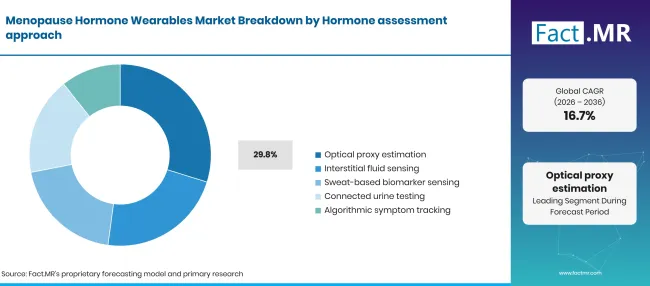
Menopause Hormone Wearables Market Breakdown Hormone Assessment Approach | Source: Fact.MR
Optical proxy estimation accounts for 29.8% of hormone assessment approach demand in 2026, about USD 8.02 million. Optical sensing technologies can capture physiological signals such as changes in blood volume, pulse patterns, and skin-related responses that may help identify patterns associated with menopause symptoms. Peri by IdentifyHer uses optical, temperature, motion, and electrodermal sensors together with machine-learning analysis to track perimenopause symptoms. Growing interest in continuous, non-invasive physiological monitoring is expected to support demand for optical proxy estimation technologies.
How are wrist and finger wearables shaping demand in the Menopause Hormone Wearables Market?
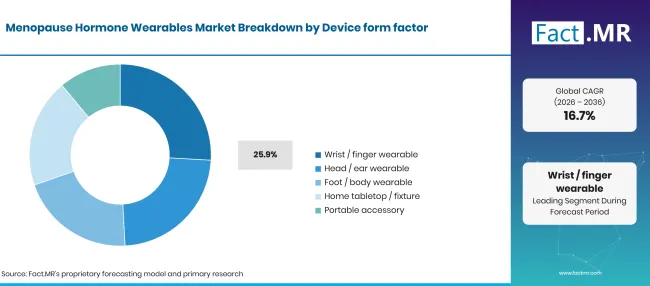
Menopause Hormone Wearables Market Breakdown Device Form Factor | Source: Fact.MR
Adoption of Wrist / finger wearables hold 25.9% of device form factor demand in 2026, about USD 6.97 million. These devices offer convenient access to continuous physiological monitoring without requiring users to conduct repeated manual measurements. Wrist-based products such as Embr Wave provide targeted temperature control for menopausal hot flashes, while Thermaband Zone combines temperature sensing with cooling and warming functions. Their wearable designs support discreet use during daily activities and sleep. Increasing preference for portable menopause-management technologies is projected to support demand for wrist and finger devices.
Why does on-device algorithm processing lead demand in the Menopause Hormone Wearables Market?
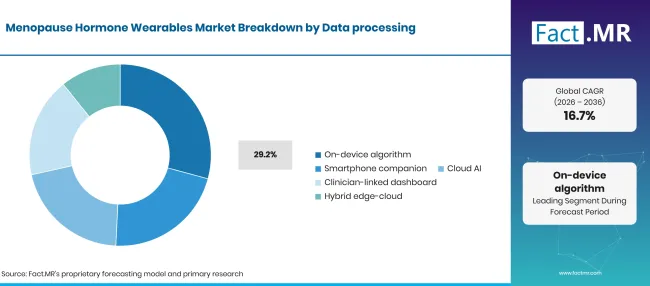
Menopause Hormone Wearables Market Breakdown Data Processing | Source: Fact.MR
Demand for the on-device algorithm processing represents 29.2% of data processing demand in 2026, about USD 7.85 million. Wearable devices collect multiple physiological signals that require processing to identify changes in temperature, activity, sleep, and other symptom-related indicators. Local algorithmic analysis can convert sensor readings into personalized insights while reducing dependence on continuous cloud connectivity. Peri combines multiple sensor inputs through machine-learning analysis to identify patterns associated with hot flashes, night sweats, and sleep disturbances. Greater demand for personalized and continuous symptom interpretation is expected to support adoption of on-device processing technologies.
Why does retail electronics lead sales in the Menopause Hormone Wearables Market?
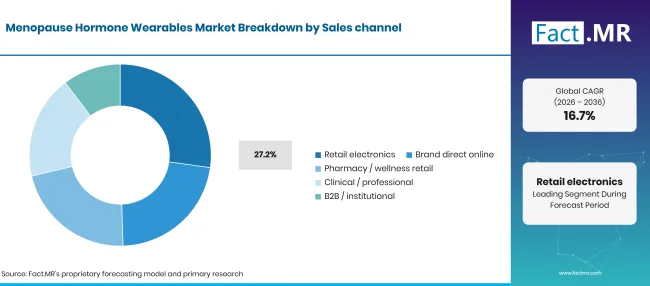
Menopause Hormone Wearables Market Breakdown Sales Channel | Source: Fact.MR
Retail electronics segment to lead with 27.2% of sales channel demand in 2026, about USD 7.32 million. Wearable menopause-management products are increasingly positioned as consumer wellness technologies that can be purchased without requiring a conventional clinical appointment. Retail electronics channels provide access to connected devices, wearable accessories, and smartphone-compatible health technologies. Embr Labs offers its Embr Wave 2 wristband through its consumer-facing online store, illustrating the direct availability of menopause-related wearable products through electronics-oriented retail channels. Growing consumer interest in self-managed menopause support is projected to encourage sales through retail electronics outlets.
Menopause Hormone Wearables Market – Drivers, Restraints & Trends
- Drivers – Increasing demand for personalized menopause management:
Women are showing greater interest in understanding changes in sleep, temperature regulation, and other physiological indicators during perimenopause and menopause. Wearable devices can collect continuous information and help users identify symptom patterns over time. Peri by IdentifyHer combines multiple biosensors with machine-learning analysis to provide personalized symptom insights. Growing interest in data-supported menopause management is expected to drive sales of menopause hormone wearables.
- Restraints – Limitations in direct hormone measurement:
Many wearable devices identify physiological changes associated with menopause rather than directly measuring estrogen, progesterone, or other hormone concentrations. Optical signals, skin temperature, and electrodermal activity are indirect indicators and can be influenced by physical activity, environmental conditions, stress, and individual variation. This can create challenges in establishing measurement accuracy and clinical reliability. The need for laboratory confirmation and professional interpretation may limit adoption among consumers seeking precise hormone measurements.
- Opportunity – Expansion of continuous biosensing technologies:
In April 2026, Peri launched its wearable device specifically designed for perimenopause symptom tracking. The product combines optical, motion, temperature, and electrodermal sensors to identify patterns associated with hot flashes, night sweats, sleep, and other symptoms. This development illustrates the potential of multi-sensor monitoring to provide more detailed information about menopause-related physiological changes. Increasing availability of continuous biosensing solutions is expected to create opportunities for wearable manufacturers and digital health technology providers.
- Trend – Increasing adoption of wearable temperature-regulation technologies:
Menopause-focused wearable manufacturers are developing devices that combine temperature sensing with personalized cooling and warming functions. Thermaband Zone offers automatic or manually activated thermal relief and an accompanying application for monitoring temperature-related events. Similarly, Embr Wave 2 provides wrist-based cooling and warming functions designed to improve thermal comfort during hot flashes and night sweats. Greater interest in non-pharmaceutical symptom-management technologies is expected to support demand for temperature-regulating wearables.
- Trend – Integration of wearable sensors with digital symptom tracking:
Menopause wearable developers are combining physiological sensors with smartphone applications to organize symptom information and provide personalized insights. Peri converts sensor signals into information about hot flashes, sleep disturbances, anxiety, and menstrual-cycle patterns. Thermaband Zone also provides application-based information about thermal events, triggers, and symptom duration. Increasing demand for connected menopause-management solutions is expected to encourage the development of wearable devices with integrated digital monitoring capabilities.
Menopause Hormone Wearables Market Analysis by Key Country
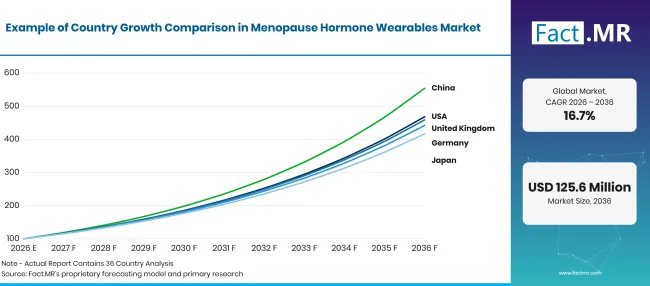
Menopause Hormone Wearables Market Growth Index | Source: Fact.MR
| Country | CAGR (2026–2036) |
|---|---|
| United States | 16.7% |
| Japan | 15.3% |
| Germany | 16.0% |
| United Kingdom | 16.5% |
| China | 18.7% |
Source: Fact.MR analysis. Updated Nov 19, 2026
Source: Fact.MR analysis.
What is driving menopause hormone wearables demand in the United States?
Demand for menopause hormone wearables in the United States is estimated to grow at a 16.7% CAGR through 2036.
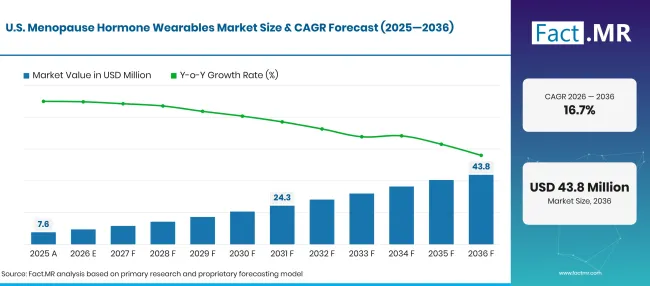
Menopause Hormone Wearables Market Forecast Usa | Source: Fact.MR
Growth is supported by consumer interest in personalized health monitoring, connected wellness devices, and digital solutions for managing menopause symptoms. The presence of wearable technology companies and direct-to-consumer health brands supports product development and commercialization. Companies such as Embr Labs and Amira Health are developing wearable technologies focused on thermal comfort and menopause-related symptom management. Increasing consumer acceptance of connected health products is expected to support sales of menopause hormone wearables in the United States.
How is Japan supporting menopause hormone wearables market growth?
The menopause hormone wearables market in Japan is projected to expand at a 15.3% CAGR through 2036.
An aging population and increasing interest in women's health management create opportunities for technologies addressing menopause-related changes. Japanese consumers are also familiar with wearable electronics and connected health-monitoring products. Devices that combine physiological sensing, sleep monitoring, and temperature-related symptom tracking can support more structured menopause management. Growing interest in preventive wellness and personalized monitoring is expected to support demand for menopause hormone wearables in Japan.
Why is Germany recording growth in menopause hormone wearables demand?
Sales of menopause hormone wearables in Germany are projected to increase at a 16.0% CAGR through 2036.
Demand is supported by increasing awareness of menopause-related health requirements and interest in non-invasive monitoring technologies. Wearable devices can provide information about sleep, temperature changes, and physiological responses, helping consumers understand symptom patterns. Growing availability of connected wellness products and digital health applications is expected to support adoption among women seeking convenient menopause-management solutions.
What is supporting menopause hormone wearables sales in the United Kingdom?
Demand for menopause hormone wearables in the United Kingdom is projected to grow at a 16.5% CAGR through 2036.
Increasing awareness of menopause symptoms and workplace-related menopause support is encouraging interest in accessible health-monitoring technologies. Companies such as Celsius Innovations Ltd. are developing wearable cooling solutions for hot flashes and night sweats, while Peri offers continuous symptom tracking through a dedicated wearable device. Increasing interest in personalized menopause support and consumer wellness technologies is expected to drive sales in the United Kingdom.
Why is China expected to record the fastest growth in the Menopause Hormone Wearables Market?
China is projected to record the fastest growth among the five key countries, with a 18.7% CAGR through 2036.
Expansion of the consumer electronics industry, increasing digital health adoption, and growing interest in women's wellness technologies are creating opportunities for connected wearable products. Local and international manufacturers can address demand through affordable wearable sensors, smartphone-integrated monitoring systems, and temperature-management devices. Increasing availability of consumer health technologies is expected to support the adoption of menopause hormone wearables in China.
Competitive Landscape for Menopause Hormone Wearables Market
Competition in the menopause hormone wearables market includes specialized femtech companies and consumer wellness technology developers. Peri (IdentifyHer Limited) focuses on continuous biosensing and symptom tracking for perimenopause, using optical, temperature, motion, and electrodermal signals. Amira Health develops the Terra system, which combines a wearable sensor with a cooling system to address nighttime hot flashes. Thermaband develops the Zone wearable thermostat, offering temperature regulation and menopause-related digital insights.
Embr Labs, Inc. participates through its Embr Wave wristband, which delivers personalized cooling and warming sensations for thermal discomfort. Celsius Innovations Ltd. offers MyCelsius, a wearable cooling bracelet designed to provide relief from hot flashes and night sweats. These companies address different aspects of menopause management, including physiological monitoring, symptom tracking, and thermal comfort.
Competition is increasingly shaped by sensor accuracy, wearable comfort, battery performance, algorithmic interpretation, smartphone integration, and personalization. Peri's multi-sensor approach illustrates the development of continuous symptom-monitoring devices, while Amira Health and Thermaband focus on combining sensing with automated temperature management. Companies are also exploring direct-to-consumer sales and application-based services to strengthen customer engagement.
Recent Developments
- In April 2026, Peri launched its wearable device specifically designed for perimenopause symptom tracking, combining multiple biosensors with machine-learning analysis.
- In 2026, Amira Health continued developing its Terra system, which combines wearable sensing with a connected cooling system for nighttime menopause-related hot flashes.
- In 2026, Thermaband promoted its Zone wearable thermostat, featuring automatic or manual cooling and warming functions alongside application-based menopause insights.
- In 2026, Celsius Innovations Ltd. promoted MyCelsius, a wearable cooling bracelet with adjustable cooling intensities and a night mode designed for thermal comfort.
- In May 2026, Embr Labs introduced an open-source research API and software development kit (SDK) for its Embr Wave 2 wearable in May 2026. The development enables researchers to control thermal stimulation through integrated research systems, supporting further investigation into temperature-based management of hot flashes and other thermal discomfort symptoms.
Key Players in Menopause Hormone Wearables Market
Key companies operating in the market include Peri (IdentifyHer Limited), Embr Labs, Inc., Amira Health, Thermaband, and Celsius Innovations Ltd. (MyCelsius).
- Peri (IdentifyHer Limited)
- Embr Labs, Inc.
- Amira Health
- Thermaband
- Celsius Innovations Ltd. (MyCelsius)
Scope of Report
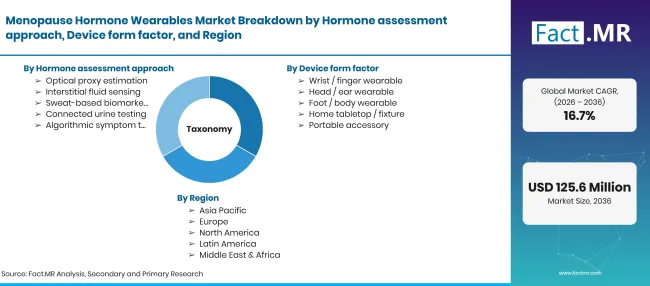
Menopause Hormone Wearables Market Taxonomy | Source: Fact.MR
| Items | Values |
|---|---|
| Quantitative Units (2026) | USD 26.9 million |
| Hormone Assessment Approach | Optical proxy estimation, Interstitial fluid sensing, Sweat-based biomarker sensing, Connected urine testing, Algorithmic symptom tracking |
| Device Form Factor | Wrist / finger wearable, Head / ear wearable, Foot / body wearable, Home tabletop / fixture, Portable accessory |
| Data Processing | On-device algorithm, Smartphone companion, Cloud AI, Clinician-linked dashboard, Hybrid edge-cloud |
| Sales Channel | Retail electronics, Brand direct online, Pharmacy / wellness retail, Clinical / professional, B2B / institutional |
| Regions Covered | North America, Europe, East Asia |
| Countries Covered | United States, Japan, Germany, United Kingdom, China |
| Key Companies Profiled | Peri (IdentifyHer Limited), Embr Labs, Inc., Amira Health, Thermaband, Celsius Innovations Ltd. |
| Additional Attributes | Market revenue is segmented by hormone assessment approach, device form factor, data processing, sales channel, and region. |
Source: Fact.MR analysis. Updated Nov 19, 2026
Source: Fact.MR analysis.
Menopause Hormone Wearables Market by Segments
-
Hormone Assessment Approach
- Optical proxy estimation
- Interstitial fluid sensing
- Sweat-based biomarker sensing
- Connected urine testing
- Algorithmic symptom tracking
-
Device Form Factor
- Wrist / finger wearable
- Head / ear wearable
- Foot / body wearable
- Home tabletop / fixture
- Portable accessory
-
Data Processing
- On-device algorithm
- Smartphone companion
- Cloud AI
- Clinician-linked dashboard
- Hybrid edge-cloud
-
Sales Channel
- Retail electronics
- Brand direct online
- Pharmacy / wellness retail
- Clinical / professional
- B2B / institutional
-
Region
- North America
- United States
- Canada
- Mexico
- Europe
- Germany
- United Kingdom
- France
- Italy
- Spain
- Rest of Europe
- East Asia
- China
- Japan
- South Korea
- Rest of East Asia
- South Asia and Pacific
- India
- Australia
- Rest of South Asia and Pacific
- Latin America
- Brazil
- Mexico
- Argentina
- Rest of Latin America
- Middle East & Africa
- GCC Countries
- South Africa
- Rest of Middle East & Africa
- North America
Bibliography
- Amira Health Inc. (2026, February 27). TERRA (U.S. Trademark Application Serial No. 99673629). United States Patent and Trademark Office.
Barnes, B. (2026, February 5). Stanford-founded startup develops wearable for continuous hormone monitoring. The Stanford Daily.
Embr Labs. (2025, January 15). Feel more energized: 6 new temperature tools to enhance your day with Embr Wave.
Embr Labs. (2026, May 7). Embr Labs accelerates global leadership in digital thermal health with clinical validation, Japanese patent expansion, and open-source SDK for Embr Wave 2.
IdentifyHer Limited. (2025, January 7). Introducing the Peri Report: Where perimenopause meets progress.
Massachusetts Institute of Technology, Department of Mechanical Engineering. (2025, June 15). Engineering better sleep during menopause.
Templado, D. (2026, February 16). Clair unveils non-invasive hormone tracking wearable for women. Wareable.
Frequently Asked Questions
How big is the global Menopause Hormone Wearables Market in 2026?
What will be the size of the Menopause Hormone Wearables Market by 2036?
How fast will the Menopause Hormone Wearables Market grow during the forecast period?
Which hormone assessment approach holds the largest share of the Menopause Hormone Wearables Market?
Which device form factor leads the Menopause Hormone Wearables Market?
Which data processing segment holds the largest share?
Which sales channel holds the largest share of the Menopause Hormone Wearables Market?
Which country is expected to record the fastest growth?
Who are the key companies operating in the Menopause Hormone Wearables Market?
Who worked on this report


Preview the report firsthand - request a free sample
Free SampleGet the brochure for pricing and purchase details
Download PDF