- Base Value(2025): 36.0 Bn
- Estimated Value(2026): 38.4 Bn
- Forecast Value (2036): 72.8 Bn
- CAGR (2026 - 2036): 6.6%
Gemstone Market Forecast and Outlook 2026 to 2036
In 2025, the gemstone market was valued at approximately USD 36.0 billion. Based on Fact.MR analysis, the market is estimated to reach USD 38.4 billion in 2026 and USD 72.8 billion by 2036, expanding at a CAGR of 6.6% during the forecast period. Market progression reflects sustained demand for certified gemstones in fine jewelry, rising use of gemstones as alternative investment assets, and continued premiumization across diamond and colored stone categories.
The market adds roughly USD 36.8 billion in value over the forecast horizon, indicating strong compounding driven by value growth rather than pure volume expansion. Early period growth is supported by recovery in global jewelry retail and renewed consumer spending in premium segments. Mid period performance is influenced by increased traceability requirements, lab certification adoption, and branded gemstone sourcing by major jewelers. In the later years, value growth increasingly reflects investment driven demand for diamonds and colored stones, alongside higher realization from ethically sourced and origin certified gemstones.
South Korea leads growth at 7.2% CAGR, supported by rising luxury consumption and strong branded jewelry penetration. The United Kingdom follows at 6.9%, driven by demand for certified diamonds and colored gemstones in both jewelry and investment channels. Germany records 6.7% as high value craftsmanship and luxury retail sustain market expansion. The United States grows at 6.3%, anchored in bridal jewelry demand and growing interest in gemstone backed personal investment. Japan posts a relatively moderate 5.0%, reflecting mature consumer demand and stable replacement driven purchasing patterns.

Gemstone Market Market Value Analysis | Source: Fact.MR
Gemstone Market Definition
The gemstone market covers the mining, cutting, grading, and trade of natural precious and semi-precious stones sold for jewelry and ornamental use. Gemstones are mineral crystals valued for color, clarity, hardness, and rarity. Supply begins with extraction and proceeds through processing and distribution to manufacturers and retailers. Market activity follows classifications and production reporting published by the US Geological Survey. [1] Primary demand comes from jewelry fabrication, with secondary demand from collectors and ceremonial uses. Pricing reflects grading standards, origin, and treatment disclosure.
Gemstone Market Inclusions
The report covers global and regional market size estimates in volume and value with a forecast from 2026 to 2036. Segmentation spans stone type, precious and semi-precious, application across jewelry and ornamental use, and end use by consumer and institutional buyers. The scope also tracks pricing benchmarks and international trade flows reported through UN Comtrade [2] by commodity codes.
Gemstone Market Exclusions
The scope excludes synthetic gemstones, laboratory grown diamonds, and imitation stones such as cubic zirconia. Downstream finished goods including jewelry, watches, and decorative objects are not included. Mining equipment, cutting tools, and grading services are excluded. Speculative trading in collectibles, museum specimens, and non-commercial artisanal production without recorded volumes is also outside the scope and private investment holdings globally.
Gemstone Market Research Methodology
- Primary Research: Primary research involved interviews with mining operators, gemstone processors, traders, jewelry manufacturers, and wholesalers to confirm supply chains, grades, and sales channels.
- Desk Research: Desk research used production statistics from geological agencies, customs records, and national mining registries, along with company annual reports and audited disclosures.
- Market Sizing and Forecasting: Market sizing applied a hybrid top down and bottom up model using mine output, recovery rates, cutting yields, and reported trade volumes to estimate apparent consumption. Forecasts extended trends by stone type and end use.
- Data Validation and Update Cycle: Data validation relied on cross checks between production, export, and import records, reconciliation of pricing ranges, and review of inconsistencies. Updates occur when official statistics or filings are revised.
Summary of Gemstone Market
-
Market definition
- The gemstone market covers the mining, cutting, grading, and trade of natural precious and semi-precious stones used mainly in jewelry and ornamental applications, where value depends on grading, origin disclosure, and treatment transparency.
-
Demand drivers
- Certified gemstones support value preservation behavior among consumers and investors, with grading reports and origin disclosure guiding purchase decisions.
- Jewelry consumption linked to weddings, gifting, and luxury retail sustains baseline demand, supported by consumer protection frameworks such as. [3]
- Global production reporting and classification by geological agencies such as [4] reinforce pricing benchmarks and trade confidence.
-
Key Segments Analyzed
- Product type: Diamonds lead with about 45% share due to standardized grading, high resale familiarity, and strong bridal demand.
- Application: Jewelry and ornaments account for roughly 73% of total value, reflecting cultural and gifting use across regions.
- Geography: High growth appears in South Korea and Western Europe, while the United States remains anchored in bridal and investment-driven demand.
-
Analyst opinion at FMI
- Shambhu Nath Jha, Principal Consultant at Fact.MR, opines, ‘CXOs will find this report useful for understanding how certification credibility, origin traceability, and discretionary luxury spending patterns shape long-term value realization in the gemstone market.’
-
Strategic Implications / Executive Takeaways
- Focus sourcing on certified and origin-disclosed stones to protect pricing integrity.
- Balance diamond portfolios with selected colored stones to diversify value exposure.
- Align retail strategy with investment-oriented buyers alongside traditional jewelry customers.
-
Methodology
- Market sizing based on mine output, recovery rates, cutting yields, and recorded trade flows.
- Validation through reconciliation of production, export, and import statistics from official records.
- Forecasts extended by stone type and end use using verified historical benchmarks.
Segmental Analysis
Gemstone Market Analysis by Product Type

Gemstone Market Analysis By Product Type | Source: Fact.MR
Based on Fact.MR analysis, consumption of diamonds is estimated to hold 45% share of the global gemstone market. Fact.MR analysts note that diamonds dominate due to their established role in fine jewelry, standardized grading systems, and high consumer recognition across global markets. As per Fact.MR, this product type addresses buyer demand for durability, resale familiarity, and long-term value retention, particularly in bridal and investment-driven purchases, where clarity, cut, and certification frameworks influence purchasing decisions across mature and emerging consumer markets worldwide on a sustained basis.
- Resource classification: Diamonds are documented and classified as industrial and gemstone minerals by national geological agencies.[5]
- Retail preference: Fact.MR analysts note diamonds remain the primary gemstone stocked by fine jewelry retailers due to predictable consumer demand.
- Certification reliance: Diamond purchases are commonly supported by grading reports, reinforcing buyer confidence and resale acceptance.
Gemstone Market Analysis by Application
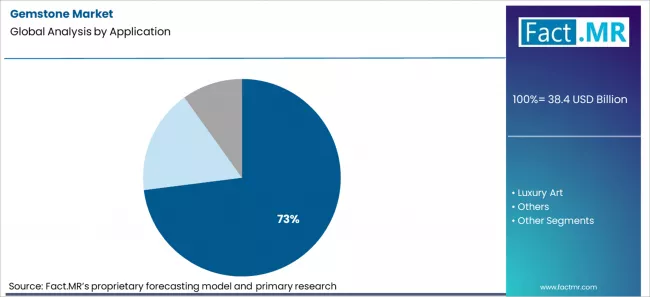
Gemstone Market Analysis By Application | Source: Fact.MR
Based on Fact.MR analysis, consumption of gemstones in jewelry and ornaments is estimated to hold 73% share of the global market. Fact.MR opines that this application leads due to consistent use of precious and semi-precious stones in personal adornment across cultural, ceremonial, and gifting contexts. As per Fact.MR, jewelry applications address consumer demand for aesthetic value, symbolic meaning, and craftsmanship, supported by established retail channels and long-standing purchasing traditions in both developed and emerging economies globally.
- Consumer protection: Jewelry marketing and gemstone disclosure practices are regulated under federal consumer protection guidelines.
- Cultural linkage: Fact.MR analysts note gemstone jewelry demand is supported by weddings, festivals, and gifting traditions.
- Retail dominance: Jewelry stores remain the primary sales channel for gemstone consumption by value.
Gemstone Market Drivers, Restraints, And Opportunities
Fact.MR analysis indicates that the gemstone market exists as a distinct natural and engineered asset category encompassing precious and semi-precious stones traded for jewellery, ornamental use, and investment purposes. As per Fact.MR assessment, gemstone quality and pricing are influenced by clarity, colour, carat, and cut standards defined by established grading frameworks; regulatory clarification and customs valuation systems such as those outlined by the United States Customs and Border Protection (CBP) Harmonized Tariff Schedule help classify gemstone imports and determine duty assessments. Fact.MR analysts observe that the current market size is shaped by traditional jewellery demand, consumer preference for certified stones, and structured trading mechanisms in key global hubs such as India, Thailand, and the United Arab Emirates.
Fact.MR is of the opinion that present market dynamics reflect a transition between conventional mined gemstones and alternate sources such as lab-grown gems and treated stones that aim to match natural quality attributes at differing price points. Based on Fact.MR assessment, natural gemstones continue to account for larger historic value, but growth is occurring in segments where certification and traceability frameworks reassure buyers about origin and composition. Lab-grown gemstones and stones with controlled treatments typically carry lower per-unit pricing yet attract demand among value-oriented consumers; this results in mixed value impacts across segments, with some categories expanding rapidly in volume while premium natural stones retain pricing strength. Fact.MR analysis suggests that this interplay between volume adoption and pricing differentials will define near-term market movement.
- Classification and customs valuation norms: Fact.MR analysts note that trade classification systems such as the United States Customs and Border Protection (CBP) Harmonized Tariff Schedule influence how gemstones are categorised, assessed, and valued in import/export trade, affecting supply chain pricing and market flows
- Shift toward alternate sources: Based on Fact.MR assessment, rising consumer acceptance of lab-grown and treated gemstones supports volume growth in segments that value affordability and traceability.
- Growth in luxury demand hubs: Fact.MR opines that expanding jewellery consumption in markets such as China, India, and the Middle East sustains regional demand for both natural and lab-grown gemstones, supporting diversified market channels and trading platforms.
Regional Analysis
Based on regional assessment, the gemstone sector is analyzed across North America, Europe, East Asia, and other key consumer and trading markets, spanning more than 40 countries. Regional performance varies according to consumer spending on luxury goods, cultural preferences for gemstones, and the role of organized retail and international trade hubs. The analysis also presents a comparative market attractiveness evaluation grounded in region-specific demand trends.
Gemstone Market CAGR Analysis by Country (2026-2036)
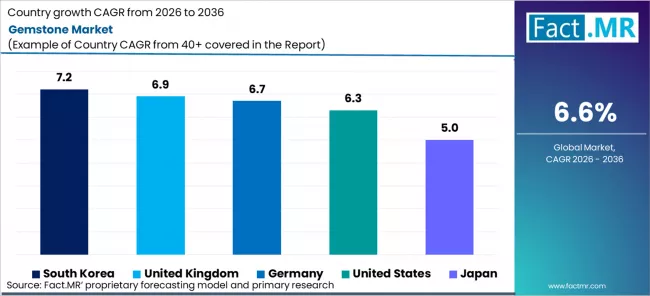
Gemstone Market Cagr Analysis By Country | Source: Fact.MR
| Country | CAGR |
|---|---|
| South Korea | 7.2% |
| United Kingdom | 6.9% |
| Germany | 6.7% |
| United States | 6.3% |
| Japan | 5.0% |
Source: Fact.MR analysis. Updated Feb 21, 2026
Source: Fact.MR analysis, based on proprietary forecasting models and primary research.
Asia Pacific Gemstone Market Analysis
Asia Pacific operates as a consumption and processing driven gemstone region supported by strong jewelry manufacturing bases and established domestic retail demand. Demand is shaped by cultural jewelry usage, gifting traditions, and organized retail expansion. Regional activity includes cutting polishing trading and finished jewelry integration across domestic and export markets. Consumption spans precious and semi-precious stones across fashion jewelry fine jewelry and ceremonial use supported by department stores specialty retailers and online platforms throughout major urban centers.
- South Korea: Demand for gemstones in South Korea is projected to rise at 7.20% CAGR through 2036. Consumption is supported by premium jewelry retail expansion, gifting culture, and growing presence of branded jewelry chains, as per Fact.MR.
- Japan: Demand for gemstones in Japan is projected to rise at 5.0% CAGR through 2036. Usage reflects stable luxury consumption, replacement purchases, and established department store based jewelry retail, according to Fact.MR.
Fact.MR’s analysis of the Gemstone Market in Asia Pacific consists of country-wise assessment that includes South Korea and Japan. Readers can find retail structure insights, consumption trends, and trade related demand references.
Europe Gemstone Market Analysis
Europe functions as a mature gemstone consumption region shaped by established luxury markets strong retail networks and steady replacement demand. Consumption is concentrated in fine jewelry fashion accessories and heritage jewelry segments supported by department stores specialty boutiques and branded retailers. Demand is supplied through imports and regional trading hubs with purchasing influenced by fashion cycles gifting occasions and discretionary consumer spending across Western European economies and urban retail centers throughout the region.
- United Kingdom: Demand for gemstones in the United Kingdom is projected to rise at 6.90% CAGR through 2036. Consumption is driven by fine jewelry retail, gifting occasions, and strong presence of luxury and heritage jewelry brands, as per Fact.MR.
- Germany: Demand for gemstones in Germany is projected to rise at 6.7% CAGR through 2036. Usage reflects stable luxury consumption, organized retail penetration, and steady replacement demand within the jewelry segment, according to Fact.MR.
Fact.MR’s analysis of the Gemstone Market in Europe consists of country-wise assessment that includes the United Kingdom and Germany. Readers can find retail demand patterns, trade structure insights, and consumption references.
North America Gemstone Market Analysis
North America operates as a consumption led gemstone region supported by high disposable income levels established luxury retail and strong gifting driven demand. Consumption spans engagement jewelry fashion accessories and premium ornamentation. Distribution is dominated by branded jeweler’s specialty stores and ecommerce platforms. Demand is influenced by seasonal purchasing cycles replacement trends and marketing driven product differentiation across precious and semi-precious gemstone categories in mature consumer markets.
- United States: Demand for gemstones in the United States is projected to rise at 6.3% CAGR through 2036. Consumption is supported by engagement jewelry sales gifting occasions and strong penetration of organized retail and online jewelry platforms, as per Fact.MR.
Fact.MR’s analysis of the Gemstone Market in North America consists of country-wise assessment that includes the United States. Readers can find retail distribution insights, consumption behavior references, and demand structure analysis.
Competitive Landscape of Gemstone Market
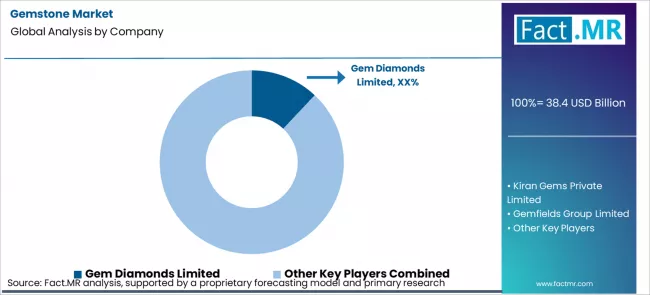
Gemstone Market Analysis By Company | Source: Fact.MR
As per Fact.MR analysis, the 2026 gemstone market is defined by verified quality, ethical sourcing, and multi-channel distribution, which determine competitive advantage. Gem Diamonds Limited and PJSC ALROSA leverage vertically integrated mining and grading capabilities, which strengthens adoption among global jewelers seeking high-purity diamonds. Kiran Gems Private Limited and Gemfields Group focus on bulk gemstone sourcing with certified ethical and conflict-free assurances, which improves trust among manufacturers and retailers. Anglo American plc (De Beers Group) and Lucara Diamond Corp emphasise technological innovation in sorting and grading, which reduces supply variability and enhances valuation transparency. Pandora A/S and Brilliant Earth Group target branded retail and consumer-focused ethical sourcing, which strengthens customer loyalty in premium segments. Sarine Technologies provides advanced grading and laser mapping solutions, which improves traceability and verification accuracy. Fenix Diamonds, Guebelin Gem Lab Ltd, and Rio2 Limited support niche markets with specialized certifications and regional mining portfolios, which enhances penetration in high-value luxury segments. Across the market, verified quality, ethical sourcing, and integrated supply networks create enduring competitive moats that outweigh reliance on price or standalone product claims.
Recent Industry Developments
- De Beers: Strategic Price Cuts & Exit Plans: In January 2026, De Beers implemented its first major official price cut in over a year to combat a "freefalling" market where lab-grown stones now command 50% of the market share. Parent company Anglo American is currently pursuing a "dual-track separation" to sell or spin off De Beers after the unit recorded a $189 million loss in early 2025. [6]
- Gemfields: Ruby Production Breakthrough: Gemfields is finalizing the commissioning of its second processing plant at the Montepuez ruby mine in Mozambique as of February 2026. This $70 million facility is designed to triple ore processing capacity from 200 to 600 tons per hour, aiming to stabilize the supply of high-quality rubies despite a 34% drop in overall auction revenue in 2025. [7]
Key Players in Gemstone Market
- Gem Diamonds Limited
- Kiran Gems Private Limited
- Gemfields Group Limited
- PJSC ALROSA
- Anglo American plc (De Beers Group)
- Pandora A/S
- Brilliant Earth Group, Inc.
- Lucara Diamond Corp
- Sarine Technologies
- Fenix Diamonds
- Guebelin Gem Lab Ltd
- Rio2 Limited
Bibliography
- [1] U.S. Geological Survey. (2024). Gemstones: Statistics and information. National Minerals Information Center, U.S. Department of the Interior.
- [2] United Nations. (2024). UN Comtrade database: International trade statistics. United Nations Statistics Division.
- [3] Federal Trade Commission. (2023). Guides for the jewelry, precious metals, and pewter industries. Federal Trade Commission.
- [4] U.S. Geological Survey. (2024). Gemstones-Production, supply, and market data. National Minerals Information Center, U.S. Department of the Interior.
- [5] U.S. Geological Survey. (2024). Diamond statistics and information. National Minerals Information Center, U.S. Department of the Interior.
- [6] Anglo American plc. (2026). De Beers pricing update and strategic review disclosure. Anglo American Group - Investor and Media Communications.
- [7] Gemfields Group Limited. (2026). Operational update on Montepuez ruby mine expansion. Gemfields Group - Corporate Announcements.
Segmentation
Scope of the Report
| Metric | Value |
|---|---|
| Quantitative Units | USD 38.4 billion (2026) to USD 72.8 billion (2036), at a CAGR of 6.6% |
| Market Definition | The gemstone market covers the mining, cutting, grading, and trade of natural precious and semi-precious stones used for jewelry, ornaments, and personal investment. Market activity spans extraction, processing, and distribution to manufacturers, retailers, and investors. Pricing is influenced by grading standards, origin, and treatment disclosure. |
| Product Type Segmentation | Diamond, Emerald, Ruby, Sapphire, Opal, Spinel, Pearls, Others |
| Application Segmentation | Jewelry & Ornaments, Luxury Art, Others |
| End Use Segmentation | Jewelers, Industrial, Personal Investment |
| Regions Covered | Asia Pacific, Europe, North America, Latin America, Middle East & Africa |
| Countries Covered | India, China, Japan, South Korea, Indonesia, Australia & New Zealand, ASEAN, Rest of Asia Pacific, Germany, Italy, France, United Kingdom, Spain, Benelux, Nordics, Central & Eastern Europe, Rest of Europe, United States, Canada, Mexico, Brazil, Argentina, Chile, Rest of Latin America, Kingdom of Saudi Arabia, United Arab Emirates, South Africa, Turkey, Rest of Middle East & Africa |
| Key Companies Profiled | Gem Diamonds Limited, Kiran Gems Private Limited, Gemfields Group Limited, PJSC ALROSA, Anglo American plc (De Beers Group), Pandora A/S, Brilliant Earth Group, Lucara Diamond Corp, Sarine Technologies, Fenix Diamonds, Guebelin Gem Lab Ltd, Rio2 Limited |
| Forecast Period | 2026 to 2036 |
| Approach | Hybrid top-down and bottom-up modeling validated through primary interviews with mining operators, gemstone processors, traders, jewelry manufacturers, and wholesalers. Market sizing supported by mine production, cutting yields, trade statistics, grading reports, and import/export data from UN Comtrade and USGS. |
Source: Fact.MR analysis. Updated Feb 21, 2026
Gemstone Market Analysis by Segments
-
By Product Type :
- Diamond
- Emerald
- Ruby
- Sapphire
- Opal
- Spinel
- Pearls
- Others
-
By Application :
- Jewelry & Ornaments
- Luxury Art
- Others
-
By End Use :
- Jewelers
- Industrial
- Personal Investment
-
Region :
- Asia Pacific
- India
- China
- Japan
- South Korea
- Indonesia
- Australia & New Zealand
- ASEAN
- Rest of Asia Pacific
- Europe
- Germany
- Italy
- France
- United Kingdom
- Spain
- Benelux
- Nordics
- Central & Eastern Europe
- Rest of Europe
- North America
- United States
- Canada
- Mexico
- Latin America
- Brazil
- Argentina
- Chile
- Rest of Latin America
- Middle East & Africa
- Kingdom of Saudi Arabia
- United Arab Emirates
- South Africa
- Turkey
- Rest of Middle East & Africa
- Asia Pacific
Frequently Asked Questions
How large is the gemstone market in 2026?
What will the market size be by 2036?
What CAGR is expected for 2026–2036?
What was the market value in 2025?
How much absolute value will the market add over the forecast horizon?
What is the core demand logic behind this market’s growth?
What is the primary use-case for gemstones by value?
Which product type leads the market?
What is driving early-period growth in the forecast window?
What shapes mid-period performance?
What drives later-year value expansion?
Which country grows the fastest through 2036 in your dataset?
What is the growth outlook for the United Kingdom?
How fast is Germany expected to grow?
What is the United States growth outlook?
Why is Japan relatively slower than the other countries listed?
What role does certification play in gemstone demand?
How do origin and treatment disclosure affect pricing?
Which end-use category is evolving fastest in value terms?
What are the most important strategic levers for suppliers and retailers?
Who worked on this report


Preview the report firsthand - request a free sample
Free SampleGet the brochure for pricing and purchase details
Download PDF