- Base Value(2026): 894.0 Mn
- Estimated Value(2026): 894.0 Mn
- Forecast Value (2036): 1512.7 Mn
- CAGR (2026 - 2036): 5.4%
Glass Laser Engraving Machine Market Forecast and Outlook 2026 to 2036
The global glass laser engraving machine market is projected to expand from USD 894 million in 2026 to around USD 1,512.7 million by 2036, representing a CAGR of 5.4%.
Key Takeaways from Glass Laser Engraving Machine Market
- Glass Laser Engraving Machine Market Value 2026: USD 894 million
- Glass Laser Engraving Machine Market Forecast Value 2036: USD 1,512.7 million
- Glass Laser Engraving Machine Market Forecast CAGR: 5.4%
- Key Growth Regions in Glass Laser Engraving Machine Market: U.S., Japan, South Korea, Europe, Germany, China, U.K., Brazil
- Key Players in Glass Laser Engraving Machine Market: Trotec, Epilog Laser, Gravotech, GCC LaserPro, Thunder Laser, OMTech, Han’s Laser, Universal Laser Systems, Lotus Laser, CERMETEK
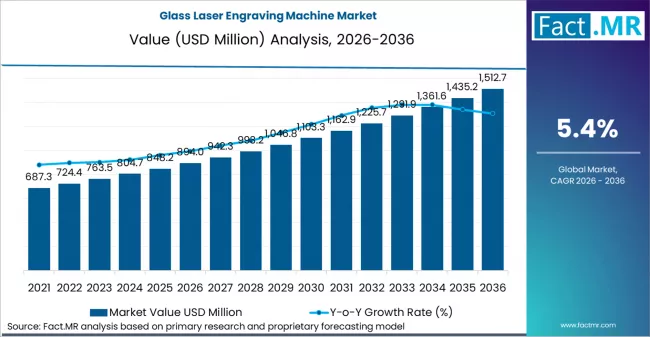
Glass Laser Engraving Machine Market Market Value Analysis | Source: Fact.MR
CO₂ lasers lead the market due to their precision, adaptability, and ability to handle mid-format glass with consistent engraving quality. Fiber, UV, and green laser systems complement the range, serving specialized applications such as large-format architectural glass, fine detailing, and high-volume production requirements. Mid-format work envelopes remain the most widely used, supporting efficient processing of awards, gifts, décor items, and architectural panels.
North America, with the U.S. as the primary market, shows significant adoption, while Japan, South Korea, Europe, and China are also experiencing steady growth. Direct OEM channels account for the bulk of installations, whereas distributors and online sales serve additional demand streams. Manufacturers emphasize operational reliability, precision, and flexibility to handle different glass types and varying product designs. Features such as modular housings, easy maintenance, and compatibility with diverse glass dimensions are increasingly valued by end-users. Rising demand for decorative and functional glass products across multiple sectors is expected to continue driving market expansion throughout the forecast period.
Glass Laser Engraving Machine Market
| Metric | Value |
|---|---|
| Estimated Value in (2026E) | USD 894 million |
| Forecast Value in (2036F) | USD 1,512.7 million |
| Forecast CAGR (2026 to 2036) | 5.4% |
Source: Fact.MR analysis. Updated Jan 27, 2026
Category
| Category | Segments |
|---|---|
| Laser Source | CO₂ Laser; Fiber Laser; UV Laser; Green or Other |
| Work Envelope | Mid-Format; Large-Format; Desktop or Benchtop; Other |
| End Use | Awards or Gifts or Decor; Architectural Glass; Electronics and Optics; Industrial Marking; Other |
| Sales Channel | Direct OEM; Distributors; Online; Other |
| Region | North America; Europe; Asia Pacific; Latin America; Middle East & Africa |
Source: Fact.MR analysis. Updated Jan 27, 2026
Segmental Analysis
By Laser Source, Which Segment Holds the Dominant Share in the Glass Laser Engraving Machine Market?
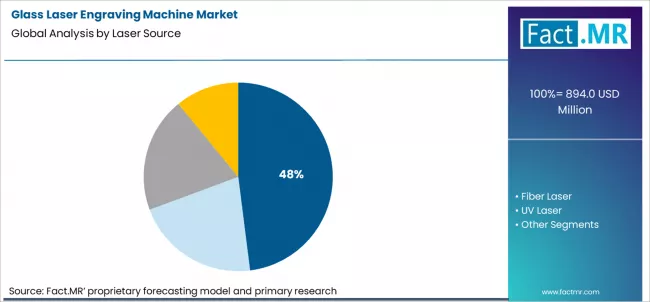
Glass Laser Engraving Machine Market Analysis By Laser Source | Source: Fact.MR
In terms of laser source, CO₂ lasers account for a 48.0% share, making them the most widely used option in the glass laser engraving machine market. Users favor CO₂ systems due to their stable engraving performance and compatibility with a broad range of glass thicknesses.
- CO₂ laser machines are commonly selected for decorative and precision engraving tasks across standard glass formats.
- Proven operating reliability supports continued preference across commercial and small scale production environments.
By Work Envelope, Which Segment Accounts for the Largest Share in the Glass Laser Engraving Machine Market?
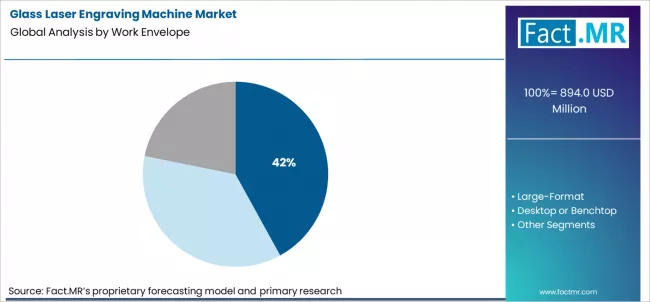
Glass Laser Engraving Machine Market Analysis By Work Envelope | Source: Fact.MR
Mid format systems hold a 42.0% share, representing the leading work envelope category. This format balances workspace capacity with floor space efficiency across engraving operations.
- Mid format machines support flexibility across varied glass product sizes.
- Adoption remains strong among users managing mixed volume engraving requirements.
By End Use, Which Segment Leads Demand in the Glass Laser Engraving Machine Market?
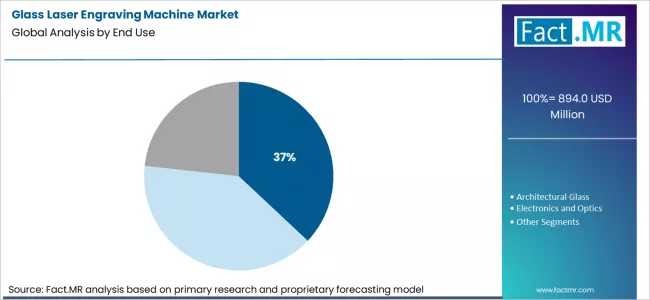
Glass Laser Engraving Machine Market Analysis By End Use | Source: Fact.MR
Awards, gifts, and decor applications represent the largest end use segment with a 37.0% share. Customization demand and short production runs drive consistent usage of engraving equipment within this category.
- Engraving machines support personalization requirements across decorative glass products.
- Demand aligns with frequent design variation and small batch production needs.
By Sales Channel, Which Segment Maintains the Highest Share in the Glass Laser Engraving Machine Market?
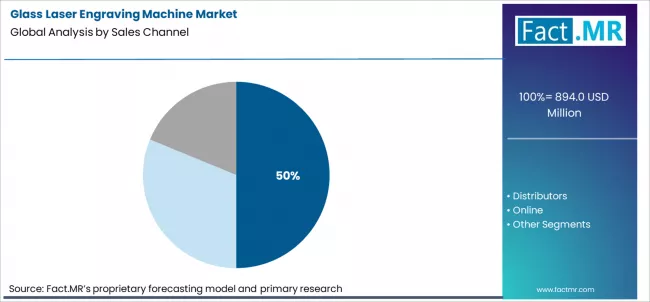
Glass Laser Engraving Machine Market Analysis By Sales Channel | Source: Fact.MR
Direct OEM sales account for a 50.0% share, positioning this channel as the primary route to market. Buyers often engage directly with manufacturers to align machine specifications with operational requirements.
- Direct sourcing supports equipment customization and technical support alignment.
- Purchasing patterns reflect preference for manufacturer backed installation and service arrangements.
What are the Drivers, Restraints, and Key Trends of the Glass Laser Engraving Machine Market?
- Drivers: Demand is growing from businesses that want permanent, high quality marking on glass for awards, décor, architectural panels, and electronic components, as laser engraving offers clean detail, repeatability, and the ability to personalize glass without physical contact or consumables.
- Restraint: Glass engraving requires precise control of laser power and focus, and variations in glass thickness, coating, or composition can lead to cracking or inconsistent results, increasing setup time and limiting ease of use for new or smaller operators.
- Trend 1: CO₂ lasers remain widely used for decorative and mid format applications, while UV and green laser systems are gaining attention for finer engraving on coated, thin, or technical glass used in electronics and optics.
- Trend 2: Buyers are showing stronger interest in compact desktop and mid format machines sold through direct OEM and online channels, reflecting demand for flexible systems that support customization, short runs, and in house production without complex infrastructure.
Analysis of the Glass Laser Engraving Machine Market by Key Country
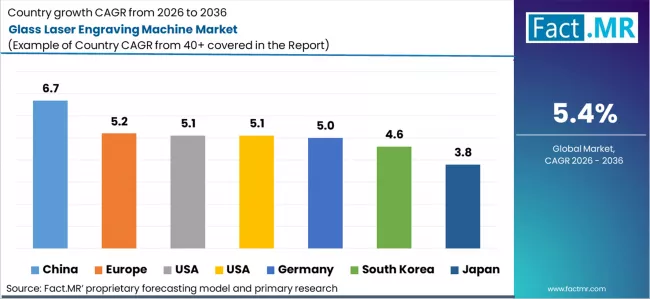
Glass Laser Engraving Machine Market Cagr Analysis By Country | Source: Fact.MR
| Country | CAGR |
|---|---|
| China | 6.7% |
| Brazil | 6.2% |
| Europe | 5.2% |
| U.S. | 5.1% |
| U.K. | 5.1% |
| Germany | 5.0% |
| South Korea | 4.6% |
| Japan | 3.8% |
Source: Fact.MR analysis. Updated Jan 27, 2026
The report covers an in depth analysis of 8 countries; higher growth markets are highlighted below.
What Is Driving Growth of Glass Laser Engraving Machines in China?
China records the strongest growth at 6.7%, supported by expanding use of engraved glass across consumer décor, architectural applications, and electronics components. CO₂ and UV laser systems are widely adopted to handle varied glass thickness and surface finishes. Buyers focus on throughput, stable beam quality, and compatibility with high volume production environments.
- Expansion of decorative and architectural glass applications supports machine demand.
- High volume manufacturing favors stable laser performance.
How Is Brazil Emerging as a High-Growth Market for Glass Laser Engraving Equipment?
Brazil is projected to grow at 6.2%, driven by rising demand for customized glass products in gifts, awards, and interior décor. Mid format laser engraving machines are commonly used by small and mid sized workshops. Purchasing decisions emphasize ease of operation and flexibility across different glass items.
- Growth in customized décor supports engraving equipment demand.
- Mid format systems suit workshop scale production.
What Is Supporting Market Expansion Across Europe?
Europe is expected to expand at 5.2%, supported by steady demand from architectural glass, electronics, and optics applications. UV and fiber laser systems are used where fine detail and minimal surface stress are required. Buyers value precision, repeatability, and integration with digital design workflows.
- Architectural and electronics demand sustains machine adoption.
- Precision requirements favor UV and fiber lasers.
What Defines Market Conditions in the U.S.?
The U.S. market is forecast to grow at 5.1%, shaped by demand for personalized glass products and industrial marking applications. Desktop and mid format machines are widely used by engraving studios and small manufacturers. Purchasing focuses on reliability, software capability, and service support.
- Personalization trends support engraving machine usage.
- Software integration influences buying decisions.
How Is the U.K. Positioned in the Glass Laser Engraving Machine Market?
The U.K. is projected to grow at 5.1%, driven by steady demand from signage, awards, and specialty glass producers. Compact laser systems support short run and customized engraving work. Buyers prioritize ease of setup and consistent engraving quality.
- Short run production supports compact system demand.
- Custom engraving sustains steady equipment usage.
What Role Does Germany Play in Market Development?
Germany is expected to grow at 5.0%, reflecting strong emphasis on precision manufacturing and process control. Glass laser engraving machines are used for technical marking and architectural elements. Demand aligns with investment cycles in advanced manufacturing and fabrication sectors.
- Precision focused industries support machine demand.
- Capital investment cycles shape purchasing activity.
How Is South Korea Contributing to Market Growth?
South Korea is forecast to grow at 4.6%, driven by demand from electronics and display related glass processing. Fiber and UV laser systems are used for detailed engraving on functional glass components. Buyers emphasize accuracy and compatibility with automated production lines.
- Electronics applications support adoption of advanced laser systems.
- Automation compatibility influences equipment selection.
What Factors Shape Market Development in Japan?
Japan is expected to register a CAGR of 3.8%, reflecting mature glass processing industries and cautious capital spending. CO₂ laser systems remain widely used for decorative and specialty engraving. Demand remains steady as production processes are already optimized for quality and efficiency.
- Mature processing infrastructure sustains baseline demand.
- Long equipment lifecycles limit rapid expansion.
Competitive Landscape of the Glass Laser Engraving Machine Market
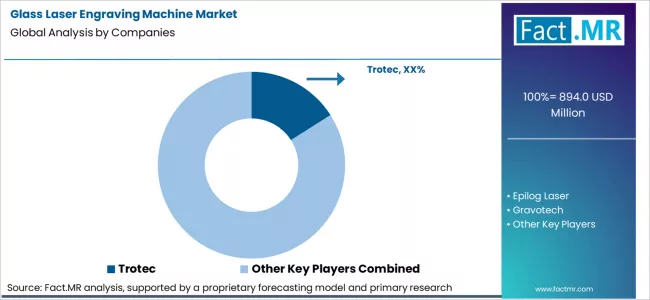
Glass Laser Engraving Machine Market Analysis By Company | Source: Fact.MR
The glass laser engraving machine market serves a wide mix of creative, industrial, and architectural applications where precision marking and visual finish matter as much as reliability. These machines are used to engrave awards, gifts, decorative panels, signage, architectural glass, and technical components for electronics and optics. Buyers typically look for clean engraving quality, consistent depth control, and machines that are easy to operate across different glass thicknesses and formats. Competition in this market is shaped by engraving clarity, machine versatility, software usability, and after-sales support.
Manufacturers differentiate through laser source selection and system design. CO₂ lasers dominate glass engraving due to their compatibility with non-metallic materials and smooth surface results, while UV and green lasers are gaining traction for finer detail and minimal micro-cracking in precision applications. Desktop and benchtop systems appeal to small studios and customization businesses, whereas mid- and large-format machines are preferred for architectural and commercial-scale work. Sales strategies vary between direct OEM engagement, distributor networks, and online channels, depending on customer scale and technical complexity.
Market players include Trotec, Epilog Laser, Gravotech, GCC LaserPro, Thunder Laser, OMTech, Han’s Laser, Universal Laser Systems, Lotus Laser, and CERMETEK. Established global brands lead in precision and software integration, while newer entrants compete on price accessibility and flexible machine configurations.
Key Players in the Glass Laser Engraving Machine Market
- Trotec
- Epilog Laser
- Gravotech
- GCC LaserPro
- Thunder Laser
- OMTech
- Han’s Laser
- Universal Laser Systems
- Lotus Laser
- CERMETEK
Bibliography
- United Nations Industrial Development Organization. (2024). Laser processing technologies and advanced manufacturing applications. Vienna, Austria: UNIDO.
- International Trade Centre. (2024). Global trade trends in laser systems and industrial marking equipment. Geneva, Switzerland: ITC.
- Organisation for Economic Co-operation and Development. (2024). Digital manufacturing, photonics adoption, and precision processing technologies. Paris, France: OECD.
- U.S. Department of Commerce, International Trade Administration. (2024). Photonics, laser equipment, and advanced manufacturing industry overview. Washington, DC: ITA.
- World Intellectual Property Organization. (2025). Technological developments in laser engraving, photonics, and non-contact material processing. Geneva, Switzerland: WIPO.
Segmentation
Scope of the Report
| Items | Values |
|---|---|
| Quantitative Units 2026 | USD 894 Million |
| Laser Source | CO₂ laser systems, Fiber laser systems, UV laser systems, Green and specialty wavelength lasers |
| Work Envelope | Desktop or benchtop systems, Mid-format engraving systems, Large-format glass engraving platforms |
| End Use | Awards gifts and decorative glass, Architectural glass applications, Electronics and optical components |
| Sales Channel | Direct OEM sales, Distributor networks, Online sales channels |
| Regions Covered | North America, Europe, Asia Pacific, Latin America, Middle East & Africa |
| Countries Covered | U.S., Japan, South Korea, Germany, China, U.K., Brazil |
| Key Companies Profiled | Trotec, Epilog Laser, Gravotech, GCC LaserPro, Thunder Laser, OMTech, Han’s Laser, Universal Laser Systems, Lotus Laser, CERMETEK |
| Additional Attributes | Dollar revenue by glass laser engraving machine laser source, work envelope, end use, and sales channel; regional demand trends; growth in architectural and decorative glass personalization; precision and surface finish requirements for brittle materials; adoption of compact desktop systems by small workshops; increasing use of UV and green lasers for fine-detail engraving |
Source: Fact.MR analysis. Updated Jan 27, 2026
Glass Laser Engraving Machine Market Segments
-
Laser Source:
- CO₂ Laser
- Fiber Laser
- UV Laser
- Green or Other
-
Work Envelope:
- Mid Format
- Large Format
- Desktop or Benchtop
-
End Use:
- Awards or Gifts or Decor
- Architectural Glass
- Electronics and Optics
-
Sales Channel:
- Direct OEM
- Distributors
- Online
-
Region:
- North America
- U.S.
- Canada
- Mexico
- Europe
- Germany
- Italy
- UK
- France
- Spain
- Netherlands
- Switzerland
- Rest of Europe
- Asia Pacific
- Japan
- Australia
- South Korea
- China
- India
- Rest of Asia Pacific
- Latin America
- Brazil
- Argentina
- Rest of Latin America
- Middle East and Africa
- United Arab Emirates
- South Africa
- Rest of Middle East and Africa
- North America
Frequently Asked Questions
How big is the glass laser engraving machine market in 2026?
What will be the size of glass laser engraving machine market in 2036?
How much will be the glass laser engraving machine market growth between 2026 and 2036?
What are the key product types in the glass laser engraving machine market?
Which work envelope segment to contribute significant share in the glass laser engraving machine market in 2026?
Who worked on this report


Preview the report firsthand - request a free sample
Free SampleGet the brochure for pricing and purchase details
Download PDF