Global Transformer Insulation Pressboards Market (2026 - 2036)
Global Transformer Insulation Pressboards Market Size and Share Forecast Outlook 2026 to 2036
Core Findings
Transformer Insulation Pressboards Market Forecast and Outlook 2026 to 2036
Valuation of the global transformer insulation pressboards market is projected to increase from around USD 1,294 million in 2026 to USD 1,825 million by 2036, reflecting a compound annual growth rate (CAGR) of about 3.5% during the forecast period. Market expansion is supported by sustained investment in power transmission and distribution infrastructure, transformer refurbishment programs, and grid modernization initiatives across both developed and emerging economies.
Key Takeaways from Transformer Insulation Pressboards Market
- Transformer Insulation Pressboards Market Value (2026): USD 1,294 million
- Transformer Insulation Pressboards Market Forecast Value (2036): USD 1,825 million
- Transformer Insulation Pressboards Market Forecast CAGR 2026 to 2036: 3.5%
- Leading Material Type: Cellulose Pressboard (Standard) (52%)
- Key Players: Weidmann Electrical Technology AG; Krempel GmbH; Von Roll Holding AG; Sichuan EM Technology Co., Ltd.; Jiangsu Jinda Insulation Materials Co., Ltd.; Baoding Aobo Insulation Material Co., Ltd.; DuPont de Nemours, Inc. (Nomex Components); Isolex / Insulect Corporation; Cottrell Paper Company; Trident Insulation Private Limited
- Key Growth Regions: Asia Pacific, Europe, North America
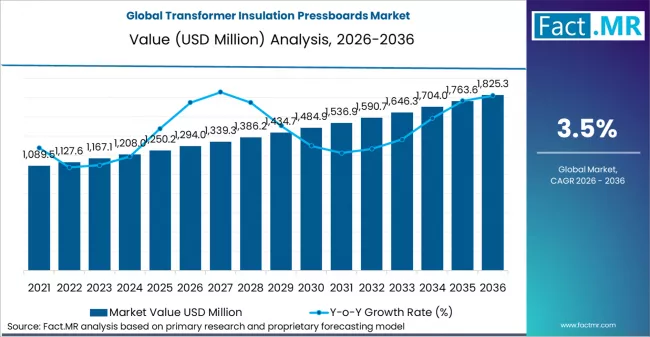
Transformer insulation pressboards play a critical role in ensuring dielectric strength, thermal stability, and mechanical integrity within power and distribution transformers. These materials enable long service life, operational safety, and reliability under high-voltage conditions. Growing deployment of renewable energy, expansion of high-voltage substations, and replacement of aging transformer fleets continue to reinforce demand for high-quality insulation pressboards.
Utilities, transformer OEMs, and industrial power users are expected to represent the largest share of demand in 2026, driven by emphasis on equipment reliability, compliance with international insulation standards, and long-term asset performance. Ongoing advancements in cellulose processing, moisture control, and thermal aging resistance allow manufacturers to deliver consistent quality at scale, positioning transformer insulation pressboards as essential components within global electrical infrastructure systems.
Sea Urchin and Roe Flavor Ingredients Market
| Metric | Value |
|---|---|
| Estimated Value in (2026E) | USD 1,294 million |
| Forecast Value in (2036F) | USD 1,825 million |
| Forecast CAGR (2026 to 2036) | 3.5 % |
Category
| Category | Segments |
|---|---|
| By Material Grade | Cellulose Pressboard (Standard) 48, High-Density/Laminated 26, Aramid-Reinforced 16, Specialty Coated 10. |
| By Application | Power Transformers 52, Distribution Transformers 32, Instrument/Traction 16. |
| By Form Factor | Pre-Compressed Sheets 40, Moulded Parts/Spacers 28, Cylinders/Rings 22, Laminates & Kits 10 |
| Sales Channel | Direct to OEM 62, Distributor/Converter 28, Aftermarket Service 10. |
| Region | North America; Europe; Asia Pacific; Latin America; Middle East & Africa |
Segmental Analysis
By Material Grade, Which Segment Holds the Dominant Share in the Transformer Insulation Pressboards Market?
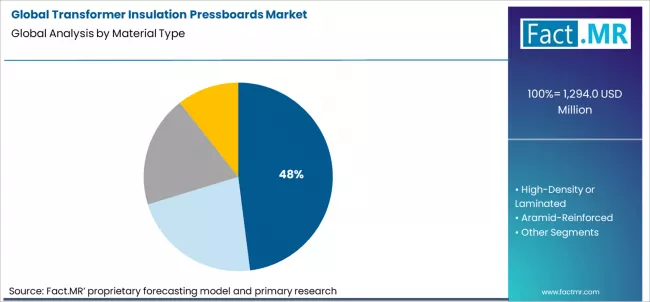
In terms of material grade, cellulose pressboard (standard) leads the transformer insulation pressboards market with an estimated 48% share in 2026. Transformer manufacturers and utilities continue to rely on standard cellulose pressboards due to their proven dielectric strength, mechanical stability, and long service life under high-voltage operating conditions. These materials remain widely accepted across international standards for both power and distribution transformers.
- Ongoing investments in cellulose processing, moisture control, and thermal aging resistance continue to strengthen adoption across large-scale transformer manufacturing facilities. Established supply chains and cost-effectiveness further reinforce the dominance of standard cellulose pressboards in core insulation applications.
- With utilities prioritizing reliability, safety, and lifecycle performance, cellulose pressboards remain the foundational insulation material within transformer design strategies, sustaining their leading market position.
By Application, Which Segment Registers the Highest Share in the Transformer Insulation Pressboards Market?
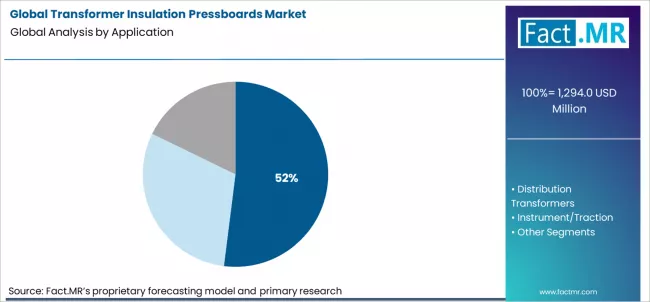
By application, power transformers represent the largest segment, accounting for approximately 52% share in 2026. High insulation thickness requirements, elevated voltage ratings, and long operational lifecycles drive substantial demand for pressboards in power transformer assemblies. Grid expansion projects, renewable energy integration, and replacement of aging transmission assets continue to support this segment.
- Transformer OEMs and grid operators emphasize robust insulation systems to ensure thermal stability and dielectric reliability in high-capacity transformers. Pressboards play a critical role in spacers, barriers, and structural insulation components within these systems.
- As global electricity demand grows and transmission infrastructure modernizes, power transformer applications are expected to remain the primary driver of insulation pressboard demand, supporting stable market expansion and long-term material utilization.
By Form Factor, Which Segment Holds the Dominant Share in the Transformer Insulation Pressboards Market?
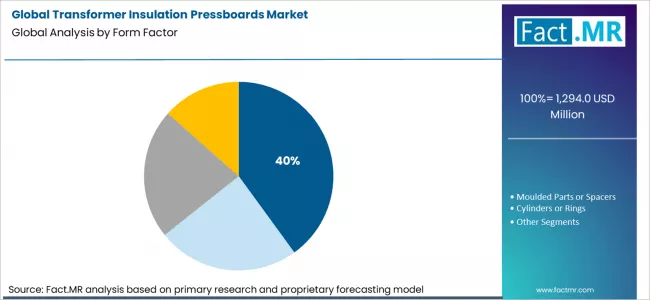
By form factor, pre-compressed sheets hold the dominant position in the transformer insulation pressboards market, accounting for around 40% share in 2026. Transformer manufacturers favor pre-compressed sheets due to their uniform thickness, dimensional stability, and ease of integration into core and winding insulation structures. These sheets are widely used for barriers, separators, and structural insulation components in both power and distribution transformers.
- Standardized manufacturing processes and compatibility with automated transformer assembly lines continue to support strong adoption.
- As OEMs focus on consistency, reliability, and efficient production workflows, pre-compressed sheets remain the preferred form factor across large-scale transformer manufacturing programs.
By Sales Channel, Which Segment Registers the Highest Share in the Transformer Insulation Pressboards Market?
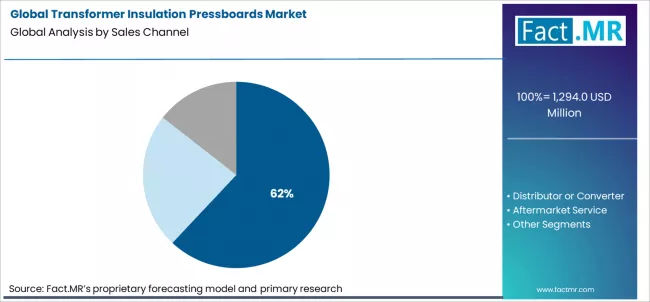
By sales channel, direct sales to OEMs represent the largest segment, capturing approximately 62% share in 2026. Transformer manufacturers typically source insulation pressboards directly from approved suppliers to ensure material traceability, quality consistency, and compliance with technical specifications and international standards.
- Direct OEM relationships allow pressboard producers to collaborate closely on material customization, testing, and certification requirements.
- As transformer production volumes remain concentrated among established OEMs and utilities prioritize long-term reliability, direct-to-OEM supply channels continue to dominate market distribution, reinforcing stable demand and long-term supplier partnerships.
What are the Drivers, Restraints, and Key Trends of the Transformer Insulation Pressboards Market?
- Drivers: Rising investment in power transmission and distribution infrastructure, along with grid modernization and renewable energy integration, is driving strong demand for reliable transformer insulation pressboards. Utilities and transformer manufacturers increasingly prioritize high dielectric strength, thermal stability, and long service life, making insulation pressboards essential components across power and distribution transformer installations.
- Restraint: Fluctuations in raw material availability, particularly high-quality cellulose pulp, and energy-intensive manufacturing processes increase production costs. In addition, strict qualification and certification requirements for transformer insulation materials extend approval timelines, limiting rapid adoption of new materials and constraining short-term market flexibility.
- Trend 1: Growing shift toward high-density, laminated, and thermally upgraded pressboards that offer improved mechanical strength, moisture resistance, and extended operational life for high-voltage transformer applications.
- Trend 2: Increasing focus on material optimization and precision-engineered pressboard components, including molded spacers and custom insulation kits, to support compact transformer designs, higher voltage ratings, and improved reliability in modern power systems.
Analysis of the Transformer Insulation Pressboards Market by Key Country
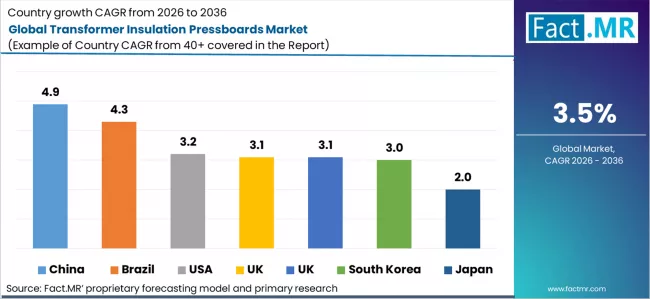
| Country | CAGR (2026 to 2036) |
|---|---|
| China | 4.9% |
| Brazil | 4.3% |
| U.S | 3.2% |
| UK | 3.1% |
| Germany | 3.1% |
| South Korea | 2.7% |
| Japan | 2.0% |
How Is Grid Expansion Accelerating Transformer Insulation Pressboard Demand in China?
Transformer insulation pressboard demand in China is projected to expand at a CAGR of 4.9% between 2026 and 2036. Growth is driven by large-scale transmission and distribution expansion, ultra-high-voltage (UHV) grid projects, and continued integration of renewable energy sources. Power sector research highlights sustained transformer manufacturing activity supported by state-backed infrastructure investment. Domestic transformer OEMs rely heavily on cellulose-based insulation pressboards for high-voltage reliability, reinforcing steady material demand. In addition, rising electricity demand from industrial clusters and urbanization continues to push transformer capacity additions. Local sourcing of insulation materials also strengthens supply chain stability and supports volume growth.
What Factors Are Sustaining Steady Demand for Transformer Insulation Pressboards in Brazil?
Brazil is expected to record a CAGR of 4.3% during the forecast period. Growth is supported by grid modernization, rural electrification programs, and replacement of aging transformers across transmission and distribution networks. Energy sector studies indicate rising investment in substation upgrades and regional grid resilience. These developments continue to support consistent demand for insulation pressboards used in power and distribution transformers.Hydropower integration and long-distance transmission projects further increase insulation requirements. Pressboards remain a preferred material due to durability and cost efficiency in large-scale grid applications.
What Is Driving Continued Adoption of Transformer Insulation Pressboards in the United States?
The U.S. market is projected to expand at a CAGR of 3.2% through 2036. Growth is linked to grid hardening initiatives, transformer replacement cycles, and rising electricity demand from industrial and data-center expansion. Industry reports highlight increasing focus on transformer reliability and lifespan extension, supporting steady procurement of insulation pressboards.Utilities prioritize materials with proven long-term performance to reduce outage risks. Federal and state-level infrastructure funding also supports sustained transformer refurbishment activity.
How Is the United Kingdom Supporting Transformer Insulation Pressboard Demand?
The UK transformer insulation pressboards market is expected to grow at a CAGR of 3.2%. Grid reinforcement, renewable integration, and substation upgrades are key demand drivers. Utilities prioritize insulation performance and long-term operational stability, sustaining consistent use of cellulose-based pressboards in transformer manufacturing and refurbishment.Offshore wind connections and distribution upgrades further contribute to insulation demand. Emphasis on reliability and safety keeps replacement-driven growth steady.
What Explains Moderate Growth in Germany’s Transformer Insulation Pressboards Market?
Germany is projected to grow at a CAGR of 3.1%. Demand is shaped by high-quality engineering standards, energy transition projects, and grid reliability requirements. Replacement demand and modernization of existing transformer assets remain the primary growth drivers rather than large-scale capacity expansion. High efficiency and durability standards favor premium insulation materials. Growth remains controlled due to a mature and well-maintained power infrastructure.
How Is South Korea Contributing to Market Expansion?
South Korea is expected to record a CAGR of 2.7%. Growth is supported by steady investment in transmission infrastructure and industrial power systems. Transformer manufacturers focus on efficiency and durability, maintaining stable demand for insulation pressboards despite a relatively mature grid environment. Incremental upgrades linked to smart grid development support insulation demand. Industrial power reliability remains a key driver rather than network expansion.
Why Is Growth More Measured in Japan’s Transformer Insulation Pressboards Market?
Japan is forecast to expand at a CAGR of 2.0%, reflecting a mature power infrastructure with long equipment replacement cycles. Demand is driven mainly by refurbishment, disaster-resilience upgrades, and incremental grid improvements rather than large-scale new installations.High quality and safety expectations sustain consistent material use. Market growth remains conservative due to limited expansion of transmission capacity.
Competitive Landscape of the Transformer Insulation Pressboards Market
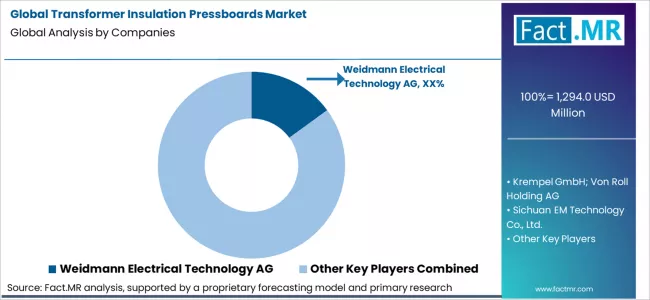
The transformer insulation pressboards market is characterized by competition among established electrical insulation material manufacturers, specialty cellulose processing companies, and integrated transformer component suppliers. Companies focus on material consistency, dielectric performance, moisture control, and compliance with international electrical standards to secure long-term supply agreements with transformer OEMs.
Market participants invest in advanced cellulose processing, precision manufacturing of molded insulation components, and quality assurance systems to meet stringent technical specifications. Leading suppliers maintain close collaboration with transformer manufacturers and utilities, supporting customized insulation solutions and application-specific designs. Competitive advantage is driven by engineering expertise, certification capabilities, and long-term reliability rather than aggressive price competition, reinforcing stable supplier-OEM relationships across global power infrastructure markets.
Weidmann Electrical Technology AG
- Krempel GmbH; Von Roll Holding AG
- Sichuan EM Technology Co., Ltd.
- Jiangsu Jinda Insulation Materials Co., Ltd.
- Baoding Aobo Insulation Material Co., Ltd.
- DuPont de Nemours, Inc. (Nomex Components)
- Isolex / Insulect Corporation;
- Cottrell Paper Company
- Trident Insulation Private Limited
Scope of Report
| Items | Values |
|---|---|
| Quantitative Units (2026) | USD 1,294 Million |
| By Material Grade | Cellulose Pressboard (Standard) 48, High-Density/Laminated 26, Aramid-Reinforced 16, Specialty Coated 10. |
| By Application | Power Transformers 52, Distribution Transformers 32, Instrument/Traction 16. |
| By Form Factor | Pre-Compressed Sheets 40, Moulded Parts/Spacers 28, Cylinders/Rings 22, Laminates & Kits 10 |
| Sales Channel | Direct to OEM 62, Distributor/Converter 28, Aftermarket Service 10. |
| Regions Covered | North America, Europe, Asia Pacific, Latin America, Middle East & Africa |
| Countries Covered | U.S., Canada, Germany, Italy, UK, France, Japan, Australia, and other countries |
| Key Companies Profiled | Weidmann Electrical Technology AG; Krempel GmbH; Von Roll Holding AG; Sichuan EM Technology Co., Ltd.; Jiangsu Jinda Insulation Materials Co., Ltd.; Baoding Aobo Insulation Material Co., Ltd.; DuPont de Nemours, Inc. (Nomex Components); Isolex / Insulect Corporation; Cottrell Paper Company; Trident Insulation Private Limited. |
| Additional Attributes | Dollar revenue by material grade, application, form factor, sales channel, and region; regional demand trends driven by grid expansion, renewable energy integration, and transformer replacement cycles; competitive landscape shaped by established electrical insulation manufacturers and specialized cellulose processing companies. |
Sea Urchin and Roe Flavor Ingredients Market by Segments
-
Material Type :
- Cellulose Pressboard (Standard)
- High-Density/Laminated
- Aramid-Reinforced
- Specialty Coated
-
Application :
- Power Transformers
- Distribution Transformers
- Instrument/Traction
-
Form Factor :
- Pre‑Compressed Sheets
- Moulded Parts/Spacers
- Cylinders/Rings
- Laminates & Kits
-
Sales Channel :
- Direct to OEM
- Distributor/Converter
- Aftermarket Service
-
Region :
- Asia Pacific
- Japan
- South Korea
- China
- Australia
- New Zealand
- Rest of Asia Pacific
- North America
- United States
- Canada
- Mexico
- Europe
- France
- Italy
- Spain
- Norway
- UK
- Rest of Europe
- Latin America
- Chile
- Peru
- Argentina
- Rest of Latin America
- Asia Pacific
Bibliography
- International Electro Technical Commission. (2023). Insulating materials for electrical equipment: Cellulosic pressboards for power and distribution transformers (IEC Technical Report). IEC.
- Institute of Electrical and Electronics Engineers. (2022). IEEE guide for insulation systems used in liquid-immersed power transformers. IEEE Power & Energy Society.
- European Committee for Standardization. (2023). Electrical insulation materials: Performance requirements and testing of cellulose-based pressboards for transformers (EN Technical Report). CEN.
- Journal of Electrical Insulation and Dielectric Phenomena Editorial Board. (2024). Thermal aging, moisture behavior, and dielectric performance of cellulose pressboards in power transformers. Journal of Electrical Insulation and Dielectric Phenomena, 31(2), 94-112.
- International Council on Large Electric Systems. (2023). Transformer insulation systems: Design practices, material selection, and long-term reliability considerations. CIGRÉ.
Table of Content
- Executive Summary
- Global Market Outlook
- Demand to side Trends
- Supply to side Trends
- Technology Roadmap Analysis
- Analysis and Recommendations
- Market Overview
- Market Coverage / Taxonomy
- Market Definition / Scope / Limitations
- Market Background
- Market Dynamics
- Drivers
- Restraints
- Opportunity
- Trends
- Scenario Forecast
- Demand in Optimistic Scenario
- Demand in Likely Scenario
- Demand in Conservative Scenario
- Opportunity Map Analysis
- Product Life Cycle Analysis
- Supply Chain Analysis
- Investment Feasibility Matrix
- Value Chain Analysis
- PESTLE and Porter’s Analysis
- Regulatory Landscape
- Regional Parent Market Outlook
- Production and Consumption Statistics
- Import and Export Statistics
- Market Dynamics
- Global Market Analysis 2021 to 2025 and Forecast, 2026 to 2036
- Historical Market Size Value (USD Million) Analysis, 2021 to 2025
- Current and Future Market Size Value (USD Million) Projections, 2026 to 2036
- Y to o to Y Growth Trend Analysis
- Absolute $ Opportunity Analysis
- Global Market Pricing Analysis 2021 to 2025 and Forecast 2026 to 2036
- Global Market Analysis 2021 to 2025 and Forecast 2026 to 2036, By Material Type
- Introduction / Key Findings
- Historical Market Size Value (USD Million) Analysis By Material Type, 2021 to 2025
- Current and Future Market Size Value (USD Million) Analysis and Forecast By Material Type, 2026 to 2036
- Cellulose Pressboard (Standard)
- High-Density or Laminated
- Aramid-Reinforced
- Specialty Coated
- Cellulose Pressboard (Standard)
- Y to o to Y Growth Trend Analysis By Material Type, 2021 to 2025
- Absolute $ Opportunity Analysis By Material Type, 2026 to 2036
- Global Market Analysis 2021 to 2025 and Forecast 2026 to 2036, By Application
- Introduction / Key Findings
- Historical Market Size Value (USD Million) Analysis By Application, 2021 to 2025
- Current and Future Market Size Value (USD Million) Analysis and Forecast By Application, 2026 to 2036
- Power Transformers
- Distribution Transformers
- Instrument/Traction
- Power Transformers
- Y to o to Y Growth Trend Analysis By Application, 2021 to 2025
- Absolute $ Opportunity Analysis By Application, 2026 to 2036
- Global Market Analysis 2021 to 2025 and Forecast 2026 to 2036, By Form Factor
- Introduction / Key Findings
- Historical Market Size Value (USD Million) Analysis By Form Factor, 2021 to 2025
- Current and Future Market Size Value (USD Million) Analysis and Forecast By Form Factor, 2026 to 2036
- Pre‑Compressed Sheets
- Moulded Parts or Spacers
- Cylinders or Rings
- Laminates and Kits
- Pre‑Compressed Sheets
- Y to o to Y Growth Trend Analysis By Form Factor, 2021 to 2025
- Absolute $ Opportunity Analysis By Form Factor, 2026 to 2036
- Global Market Analysis 2021 to 2025 and Forecast 2026 to 2036, By Sales Channel
- Introduction / Key Findings
- Historical Market Size Value (USD Million) Analysis By Sales Channel, 2021 to 2025
- Current and Future Market Size Value (USD Million) Analysis and Forecast By Sales Channel, 2026 to 2036
- Direct to OEM
- Distributor or Converter
- Aftermarket Service
- Direct to OEM
- Y to o to Y Growth Trend Analysis By Sales Channel, 2021 to 2025
- Absolute $ Opportunity Analysis By Sales Channel, 2026 to 2036
- Global Market Analysis 2021 to 2025 and Forecast 2026 to 2036, By Region
- Introduction
- Historical Market Size Value (USD Million) Analysis By Region, 2021 to 2025
- Current Market Size Value (USD Million) Analysis and Forecast By Region, 2026 to 2036
- North America
- Latin America
- Western Europe
- Eastern Europe
- East Asia
- South Asia and Pacific
- Middle East & Africa
- Market Attractiveness Analysis By Region
- North America Market Analysis 2021 to 2025 and Forecast 2026 to 2036, By Country
- Historical Market Size Value (USD Million) Trend Analysis By Market Taxonomy, 2021 to 2025
- Market Size Value (USD Million) Forecast By Market Taxonomy, 2026 to 2036
- By Country
- USA
- Canada
- Mexico
- By Material Type
- By Application
- By Form Factor
- By Sales Channel
- By Country
- Market Attractiveness Analysis
- By Country
- By Material Type
- By Application
- By Form Factor
- By Sales Channel
- Key Takeaways
- Latin America Market Analysis 2021 to 2025 and Forecast 2026 to 2036, By Country
- Historical Market Size Value (USD Million) Trend Analysis By Market Taxonomy, 2021 to 2025
- Market Size Value (USD Million) Forecast By Market Taxonomy, 2026 to 2036
- By Country
- Brazil
- Chile
- Rest of Latin America
- By Material Type
- By Application
- By Form Factor
- By Sales Channel
- By Country
- Market Attractiveness Analysis
- By Country
- By Material Type
- By Application
- By Form Factor
- By Sales Channel
- Key Takeaways
- Western Europe Market Analysis 2021 to 2025 and Forecast 2026 to 2036, By Country
- Historical Market Size Value (USD Million) Trend Analysis By Market Taxonomy, 2021 to 2025
- Market Size Value (USD Million) Forecast By Market Taxonomy, 2026 to 2036
- By Country
- Germany
- UK
- Italy
- Spain
- France
- Nordic
- BENELUX
- Rest of Western Europe
- By Material Type
- By Application
- By Form Factor
- By Sales Channel
- By Country
- Market Attractiveness Analysis
- By Country
- By Material Type
- By Application
- By Form Factor
- By Sales Channel
- Key Takeaways
- Eastern Europe Market Analysis 2021 to 2025 and Forecast 2026 to 2036, By Country
- Historical Market Size Value (USD Million) Trend Analysis By Market Taxonomy, 2021 to 2025
- Market Size Value (USD Million) Forecast By Market Taxonomy, 2026 to 2036
- By Country
- Russia
- Poland
- Hungary
- Balkan & Baltic
- Rest of Eastern Europe
- By Material Type
- By Application
- By Form Factor
- By Sales Channel
- By Country
- Market Attractiveness Analysis
- By Country
- By Material Type
- By Application
- By Form Factor
- By Sales Channel
- Key Takeaways
- East Asia Market Analysis 2021 to 2025 and Forecast 2026 to 2036, By Country
- Historical Market Size Value (USD Million) Trend Analysis By Market Taxonomy, 2021 to 2025
- Market Size Value (USD Million) Forecast By Market Taxonomy, 2026 to 2036
- By Country
- China
- Japan
- South Korea
- By Material Type
- By Application
- By Form Factor
- By Sales Channel
- By Country
- Market Attractiveness Analysis
- By Country
- By Material Type
- By Application
- By Form Factor
- By Sales Channel
- Key Takeaways
- South Asia and Pacific Market Analysis 2021 to 2025 and Forecast 2026 to 2036, By Country
- Historical Market Size Value (USD Million) Trend Analysis By Market Taxonomy, 2021 to 2025
- Market Size Value (USD Million) Forecast By Market Taxonomy, 2026 to 2036
- By Country
- India
- ASEAN
- Australia & New Zealand
- Rest of South Asia and Pacific
- By Material Type
- By Application
- By Form Factor
- By Sales Channel
- By Country
- Market Attractiveness Analysis
- By Country
- By Material Type
- By Application
- By Form Factor
- By Sales Channel
- Key Takeaways
- Middle East & Africa Market Analysis 2021 to 2025 and Forecast 2026 to 2036, By Country
- Historical Market Size Value (USD Million) Trend Analysis By Market Taxonomy, 2021 to 2025
- Market Size Value (USD Million) Forecast By Market Taxonomy, 2026 to 2036
- By Country
- Kingdom of Saudi Arabia
- Other GCC Countries
- Turkiye
- South Africa
- Other African Union
- Rest of Middle East & Africa
- By Material Type
- By Application
- By Form Factor
- By Sales Channel
- By Country
- Market Attractiveness Analysis
- By Country
- By Material Type
- By Application
- By Form Factor
- By Sales Channel
- Key Takeaways
- Key Countries Market Analysis
- USA
- Pricing Analysis
- Market Share Analysis, 2025
- By Material Type
- By Application
- By Form Factor
- By Sales Channel
- Canada
- Pricing Analysis
- Market Share Analysis, 2025
- By Material Type
- By Application
- By Form Factor
- By Sales Channel
- Mexico
- Pricing Analysis
- Market Share Analysis, 2025
- By Material Type
- By Application
- By Form Factor
- By Sales Channel
- Brazil
- Pricing Analysis
- Market Share Analysis, 2025
- By Material Type
- By Application
- By Form Factor
- By Sales Channel
- Chile
- Pricing Analysis
- Market Share Analysis, 2025
- By Material Type
- By Application
- By Form Factor
- By Sales Channel
- Germany
- Pricing Analysis
- Market Share Analysis, 2025
- By Material Type
- By Application
- By Form Factor
- By Sales Channel
- UK
- Pricing Analysis
- Market Share Analysis, 2025
- By Material Type
- By Application
- By Form Factor
- By Sales Channel
- Italy
- Pricing Analysis
- Market Share Analysis, 2025
- By Material Type
- By Application
- By Form Factor
- By Sales Channel
- Spain
- Pricing Analysis
- Market Share Analysis, 2025
- By Material Type
- By Application
- By Form Factor
- By Sales Channel
- France
- Pricing Analysis
- Market Share Analysis, 2025
- By Material Type
- By Application
- By Form Factor
- By Sales Channel
- India
- Pricing Analysis
- Market Share Analysis, 2025
- By Material Type
- By Application
- By Form Factor
- By Sales Channel
- ASEAN
- Pricing Analysis
- Market Share Analysis, 2025
- By Material Type
- By Application
- By Form Factor
- By Sales Channel
- Australia & New Zealand
- Pricing Analysis
- Market Share Analysis, 2025
- By Material Type
- By Application
- By Form Factor
- By Sales Channel
- China
- Pricing Analysis
- Market Share Analysis, 2025
- By Material Type
- By Application
- By Form Factor
- By Sales Channel
- Japan
- Pricing Analysis
- Market Share Analysis, 2025
- By Material Type
- By Application
- By Form Factor
- By Sales Channel
- South Korea
- Pricing Analysis
- Market Share Analysis, 2025
- By Material Type
- By Application
- By Form Factor
- By Sales Channel
- Russia
- Pricing Analysis
- Market Share Analysis, 2025
- By Material Type
- By Application
- By Form Factor
- By Sales Channel
- Poland
- Pricing Analysis
- Market Share Analysis, 2025
- By Material Type
- By Application
- By Form Factor
- By Sales Channel
- Hungary
- Pricing Analysis
- Market Share Analysis, 2025
- By Material Type
- By Application
- By Form Factor
- By Sales Channel
- Kingdom of Saudi Arabia
- Pricing Analysis
- Market Share Analysis, 2025
- By Material Type
- By Application
- By Form Factor
- By Sales Channel
- Turkiye
- Pricing Analysis
- Market Share Analysis, 2025
- By Material Type
- By Application
- By Form Factor
- By Sales Channel
- South Africa
- Pricing Analysis
- Market Share Analysis, 2025
- By Material Type
- By Application
- By Form Factor
- By Sales Channel
- USA
- Market Structure Analysis
- Competition Dashboard
- Competition Benchmarking
- Market Share Analysis of Top Players
- By Regional
- By Material Type
- By Application
- By Form Factor
- By Sales Channel
- Competition Analysis
- Competition Deep Dive
- Weidmann Electrical Technology AG
- Overview
- Product Portfolio
- Profitability by Market Segments (Product/Age /Sales Channel/Region)
- Sales Footprint
- Strategy Overview
- Marketing Strategy
- Product Strategy
- Channel Strategy
- Krempel GmbH; Von Roll Holding AG
- Sichuan EM Technology Co., Ltd.
- Jiangsu Jinda Insulation Materials Co., Ltd.
- Baoding Aobo Insulation Material Co., Ltd.
- DuPont de Nemours, Inc. (Nomex Components)
- Isolex / Insulect Corporation;
- Cottrell Paper Company
- Trident Insulation Private Limited
- Weidmann Electrical Technology AG
- Competition Deep Dive
- Assumptions & Acronyms Used
- Research Methodology
List Of Table
- Table 1: Global Market Value (USD Million) Forecast by Region, 2021 to 2036
- Table 2: Global Market Value (USD Million) Forecast by Material Type, 2021 to 2036
- Table 3: Global Market Value (USD Million) Forecast by Application, 2021 to 2036
- Table 4: Global Market Value (USD Million) Forecast by Form Factor, 2021 to 2036
- Table 5: Global Market Value (USD Million) Forecast by Sales Channel, 2021 to 2036
- Table 6: North America Market Value (USD Million) Forecast by Country, 2021 to 2036
- Table 7: North America Market Value (USD Million) Forecast by Material Type, 2021 to 2036
- Table 8: North America Market Value (USD Million) Forecast by Application, 2021 to 2036
- Table 9: North America Market Value (USD Million) Forecast by Form Factor, 2021 to 2036
- Table 10: North America Market Value (USD Million) Forecast by Sales Channel, 2021 to 2036
- Table 11: Latin America Market Value (USD Million) Forecast by Country, 2021 to 2036
- Table 12: Latin America Market Value (USD Million) Forecast by Material Type, 2021 to 2036
- Table 13: Latin America Market Value (USD Million) Forecast by Application, 2021 to 2036
- Table 14: Latin America Market Value (USD Million) Forecast by Form Factor, 2021 to 2036
- Table 15: Latin America Market Value (USD Million) Forecast by Sales Channel, 2021 to 2036
- Table 16: Western Europe Market Value (USD Million) Forecast by Country, 2021 to 2036
- Table 17: Western Europe Market Value (USD Million) Forecast by Material Type, 2021 to 2036
- Table 18: Western Europe Market Value (USD Million) Forecast by Application, 2021 to 2036
- Table 19: Western Europe Market Value (USD Million) Forecast by Form Factor, 2021 to 2036
- Table 20: Western Europe Market Value (USD Million) Forecast by Sales Channel, 2021 to 2036
- Table 21: Eastern Europe Market Value (USD Million) Forecast by Country, 2021 to 2036
- Table 22: Eastern Europe Market Value (USD Million) Forecast by Material Type, 2021 to 2036
- Table 23: Eastern Europe Market Value (USD Million) Forecast by Application, 2021 to 2036
- Table 24: Eastern Europe Market Value (USD Million) Forecast by Form Factor, 2021 to 2036
- Table 25: Eastern Europe Market Value (USD Million) Forecast by Sales Channel, 2021 to 2036
- Table 26: East Asia Market Value (USD Million) Forecast by Country, 2021 to 2036
- Table 27: East Asia Market Value (USD Million) Forecast by Material Type, 2021 to 2036
- Table 28: East Asia Market Value (USD Million) Forecast by Application, 2021 to 2036
- Table 29: East Asia Market Value (USD Million) Forecast by Form Factor, 2021 to 2036
- Table 30: East Asia Market Value (USD Million) Forecast by Sales Channel, 2021 to 2036
- Table 31: South Asia and Pacific Market Value (USD Million) Forecast by Country, 2021 to 2036
- Table 32: South Asia and Pacific Market Value (USD Million) Forecast by Material Type, 2021 to 2036
- Table 33: South Asia and Pacific Market Value (USD Million) Forecast by Application, 2021 to 2036
- Table 34: South Asia and Pacific Market Value (USD Million) Forecast by Form Factor, 2021 to 2036
- Table 35: South Asia and Pacific Market Value (USD Million) Forecast by Sales Channel, 2021 to 2036
- Table 36: Middle East & Africa Market Value (USD Million) Forecast by Country, 2021 to 2036
- Table 37: Middle East & Africa Market Value (USD Million) Forecast by Material Type, 2021 to 2036
- Table 38: Middle East & Africa Market Value (USD Million) Forecast by Application, 2021 to 2036
- Table 39: Middle East & Africa Market Value (USD Million) Forecast by Form Factor, 2021 to 2036
- Table 40: Middle East & Africa Market Value (USD Million) Forecast by Sales Channel, 2021 to 2036
List Of Figures
- Figure 1: Global Market Pricing Analysis
- Figure 2: Global Market Value (USD Million) Forecast 2021 to 2036
- Figure 3: Global Market Value Share and BPS Analysis by Material Type, 2026 and 2036
- Figure 4: Global Market Y to o to Y Growth Comparison by Material Type, 2026 to 2036
- Figure 5: Global Market Attractiveness Analysis by Material Type
- Figure 6: Global Market Value Share and BPS Analysis by Application, 2026 and 2036
- Figure 7: Global Market Y to o to Y Growth Comparison by Application, 2026 to 2036
- Figure 8: Global Market Attractiveness Analysis by Application
- Figure 9: Global Market Value Share and BPS Analysis by Form Factor, 2026 and 2036
- Figure 10: Global Market Y to o to Y Growth Comparison by Form Factor, 2026 to 2036
- Figure 11: Global Market Attractiveness Analysis by Form Factor
- Figure 12: Global Market Value Share and BPS Analysis by Sales Channel, 2026 and 2036
- Figure 13: Global Market Y to o to Y Growth Comparison by Sales Channel, 2026 to 2036
- Figure 14: Global Market Attractiveness Analysis by Sales Channel
- Figure 15: Global Market Value (USD Million) Share and BPS Analysis by Region, 2026 and 2036
- Figure 16: Global Market Y to o to Y Growth Comparison by Region, 2026 to 2036
- Figure 17: Global Market Attractiveness Analysis by Region
- Figure 18: North America Market Incremental Dollar Opportunity, 2026 to 2036
- Figure 19: Latin America Market Incremental Dollar Opportunity, 2026 to 2036
- Figure 20: Western Europe Market Incremental Dollar Opportunity, 2026 to 2036
- Figure 21: Eastern Europe Market Incremental Dollar Opportunity, 2026 to 2036
- Figure 22: East Asia Market Incremental Dollar Opportunity, 2026 to 2036
- Figure 23: South Asia and Pacific Market Incremental Dollar Opportunity, 2026 to 2036
- Figure 24: Middle East & Africa Market Incremental Dollar Opportunity, 2026 to 2036
- Figure 25: North America Market Value Share and BPS Analysis by Country, 2026 and 2036
- Figure 26: North America Market Value Share and BPS Analysis by Material Type, 2026 and 2036
- Figure 27: North America Market Y to o to Y Growth Comparison by Material Type, 2026 to 2036
- Figure 28: North America Market Attractiveness Analysis by Material Type
- Figure 29: North America Market Value Share and BPS Analysis by Application, 2026 and 2036
- Figure 30: North America Market Y to o to Y Growth Comparison by Application, 2026 to 2036
- Figure 31: North America Market Attractiveness Analysis by Application
- Figure 32: North America Market Value Share and BPS Analysis by Form Factor, 2026 and 2036
- Figure 33: North America Market Y to o to Y Growth Comparison by Form Factor, 2026 to 2036
- Figure 34: North America Market Attractiveness Analysis by Form Factor
- Figure 35: North America Market Value Share and BPS Analysis by Sales Channel, 2026 and 2036
- Figure 36: North America Market Y to o to Y Growth Comparison by Sales Channel, 2026 to 2036
- Figure 37: North America Market Attractiveness Analysis by Sales Channel
- Figure 38: Latin America Market Value Share and BPS Analysis by Country, 2026 and 2036
- Figure 39: Latin America Market Value Share and BPS Analysis by Material Type, 2026 and 2036
- Figure 40: Latin America Market Y to o to Y Growth Comparison by Material Type, 2026 to 2036
- Figure 41: Latin America Market Attractiveness Analysis by Material Type
- Figure 42: Latin America Market Value Share and BPS Analysis by Application, 2026 and 2036
- Figure 43: Latin America Market Y to o to Y Growth Comparison by Application, 2026 to 2036
- Figure 44: Latin America Market Attractiveness Analysis by Application
- Figure 45: Latin America Market Value Share and BPS Analysis by Form Factor, 2026 and 2036
- Figure 46: Latin America Market Y to o to Y Growth Comparison by Form Factor, 2026 to 2036
- Figure 47: Latin America Market Attractiveness Analysis by Form Factor
- Figure 48: Latin America Market Value Share and BPS Analysis by Sales Channel, 2026 and 2036
- Figure 49: Latin America Market Y to o to Y Growth Comparison by Sales Channel, 2026 to 2036
- Figure 50: Latin America Market Attractiveness Analysis by Sales Channel
- Figure 51: Western Europe Market Value Share and BPS Analysis by Country, 2026 and 2036
- Figure 52: Western Europe Market Value Share and BPS Analysis by Material Type, 2026 and 2036
- Figure 53: Western Europe Market Y to o to Y Growth Comparison by Material Type, 2026 to 2036
- Figure 54: Western Europe Market Attractiveness Analysis by Material Type
- Figure 55: Western Europe Market Value Share and BPS Analysis by Application, 2026 and 2036
- Figure 56: Western Europe Market Y to o to Y Growth Comparison by Application, 2026 to 2036
- Figure 57: Western Europe Market Attractiveness Analysis by Application
- Figure 58: Western Europe Market Value Share and BPS Analysis by Form Factor, 2026 and 2036
- Figure 59: Western Europe Market Y to o to Y Growth Comparison by Form Factor, 2026 to 2036
- Figure 60: Western Europe Market Attractiveness Analysis by Form Factor
- Figure 61: Western Europe Market Value Share and BPS Analysis by Sales Channel, 2026 and 2036
- Figure 62: Western Europe Market Y to o to Y Growth Comparison by Sales Channel, 2026 to 2036
- Figure 63: Western Europe Market Attractiveness Analysis by Sales Channel
- Figure 64: Eastern Europe Market Value Share and BPS Analysis by Country, 2026 and 2036
- Figure 65: Eastern Europe Market Value Share and BPS Analysis by Material Type, 2026 and 2036
- Figure 66: Eastern Europe Market Y to o to Y Growth Comparison by Material Type, 2026 to 2036
- Figure 67: Eastern Europe Market Attractiveness Analysis by Material Type
- Figure 68: Eastern Europe Market Value Share and BPS Analysis by Application, 2026 and 2036
- Figure 69: Eastern Europe Market Y to o to Y Growth Comparison by Application, 2026 to 2036
- Figure 70: Eastern Europe Market Attractiveness Analysis by Application
- Figure 71: Eastern Europe Market Value Share and BPS Analysis by Form Factor, 2026 and 2036
- Figure 72: Eastern Europe Market Y to o to Y Growth Comparison by Form Factor, 2026 to 2036
- Figure 73: Eastern Europe Market Attractiveness Analysis by Form Factor
- Figure 74: Eastern Europe Market Value Share and BPS Analysis by Sales Channel, 2026 and 2036
- Figure 75: Eastern Europe Market Y to o to Y Growth Comparison by Sales Channel, 2026 to 2036
- Figure 76: Eastern Europe Market Attractiveness Analysis by Sales Channel
- Figure 77: East Asia Market Value Share and BPS Analysis by Country, 2026 and 2036
- Figure 78: East Asia Market Value Share and BPS Analysis by Material Type, 2026 and 2036
- Figure 79: East Asia Market Y to o to Y Growth Comparison by Material Type, 2026 to 2036
- Figure 80: East Asia Market Attractiveness Analysis by Material Type
- Figure 81: East Asia Market Value Share and BPS Analysis by Application, 2026 and 2036
- Figure 82: East Asia Market Y to o to Y Growth Comparison by Application, 2026 to 2036
- Figure 83: East Asia Market Attractiveness Analysis by Application
- Figure 84: East Asia Market Value Share and BPS Analysis by Form Factor, 2026 and 2036
- Figure 85: East Asia Market Y to o to Y Growth Comparison by Form Factor, 2026 to 2036
- Figure 86: East Asia Market Attractiveness Analysis by Form Factor
- Figure 87: East Asia Market Value Share and BPS Analysis by Sales Channel, 2026 and 2036
- Figure 88: East Asia Market Y to o to Y Growth Comparison by Sales Channel, 2026 to 2036
- Figure 89: East Asia Market Attractiveness Analysis by Sales Channel
- Figure 90: South Asia and Pacific Market Value Share and BPS Analysis by Country, 2026 and 2036
- Figure 91: South Asia and Pacific Market Value Share and BPS Analysis by Material Type, 2026 and 2036
- Figure 92: South Asia and Pacific Market Y to o to Y Growth Comparison by Material Type, 2026 to 2036
- Figure 93: South Asia and Pacific Market Attractiveness Analysis by Material Type
- Figure 94: South Asia and Pacific Market Value Share and BPS Analysis by Application, 2026 and 2036
- Figure 95: South Asia and Pacific Market Y to o to Y Growth Comparison by Application, 2026 to 2036
- Figure 96: South Asia and Pacific Market Attractiveness Analysis by Application
- Figure 97: South Asia and Pacific Market Value Share and BPS Analysis by Form Factor, 2026 and 2036
- Figure 98: South Asia and Pacific Market Y to o to Y Growth Comparison by Form Factor, 2026 to 2036
- Figure 99: South Asia and Pacific Market Attractiveness Analysis by Form Factor
- Figure 100: South Asia and Pacific Market Value Share and BPS Analysis by Sales Channel, 2026 and 2036
- Figure 101: South Asia and Pacific Market Y to o to Y Growth Comparison by Sales Channel, 2026 to 2036
- Figure 102: South Asia and Pacific Market Attractiveness Analysis by Sales Channel
- Figure 103: Middle East & Africa Market Value Share and BPS Analysis by Country, 2026 and 2036
- Figure 104: Middle East & Africa Market Value Share and BPS Analysis by Material Type, 2026 and 2036
- Figure 105: Middle East & Africa Market Y to o to Y Growth Comparison by Material Type, 2026 to 2036
- Figure 106: Middle East & Africa Market Attractiveness Analysis by Material Type
- Figure 107: Middle East & Africa Market Value Share and BPS Analysis by Application, 2026 and 2036
- Figure 108: Middle East & Africa Market Y to o to Y Growth Comparison by Application, 2026 to 2036
- Figure 109: Middle East & Africa Market Attractiveness Analysis by Application
- Figure 110: Middle East & Africa Market Value Share and BPS Analysis by Form Factor, 2026 and 2036
- Figure 111: Middle East & Africa Market Y to o to Y Growth Comparison by Form Factor, 2026 to 2036
- Figure 112: Middle East & Africa Market Attractiveness Analysis by Form Factor
- Figure 113: Middle East & Africa Market Value Share and BPS Analysis by Sales Channel, 2026 and 2036
- Figure 114: Middle East & Africa Market Y to o to Y Growth Comparison by Sales Channel, 2026 to 2036
- Figure 115: Middle East & Africa Market Attractiveness Analysis by Sales Channel
- Figure 116: Global Market - Tier Structure Analysis
- Figure 117: Global Market - Company Share Analysis
- FAQs -
How big is the global transformer insulation pressboards market in 2026?
The global global transformer insulation pressboards market is estimated to be valued at USD 1,294.0 million in 2026.
What will be the size of global transformer insulation pressboards market in 2036?
The market size for the global transformer insulation pressboards market is projected to reach USD 1,825.3 million by 2036.
How much will be the global transformer insulation pressboards market growth between 2026 and 2036?
The global transformer insulation pressboards market is expected to grow at a 3.5% CAGR between 2026 and 2036.
What are the key product types in the global transformer insulation pressboards market?
The key product types in global transformer insulation pressboards market are cellulose pressboard (standard), high-density or laminated, aramid-reinforced and specialty coated.
Which application segment to contribute significant share in the global transformer insulation pressboards market in 2026?
In terms of application, power transformers segment to command 52.0% share in the global transformer insulation pressboards market in 2026.