- Market Value (2025): USD 3.99 Bn
- Estimated Value (2026): USD 4.17 Bn
- Forecast Value (2036): USD 6.43 Bn
- CAGR (2026-2036): 4.4%
What is the Golf Course Equipment Market forecast to be worth by 2036?
USD 4.2 Billion in 2026 to USD 6.4 Billion by 2036, at a 4.4% CAGR.
- As per Fact.MR analysis, the golf course equipment market reached USD 3.99 Billion in 2025.
- Demand will increase from USD 4.17 Billion in 2026 to USD 6.43 Billion in 2036.
- The market is forecast to record a 4.4% CAGR during 2026 to 2036 driven by expanding golf tourism, modernizing championship resort courses, widespread fleet electrification replacing internal combustion engines, and rising adoption of autonomous robotic mowing systems to offset acute groundskeeper labor shortages.
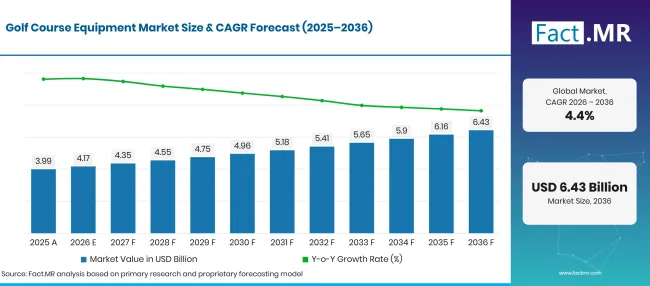
Factmr Golf Course Equipment Market Forecast Global | Source: Fact.MR
| Year | Basis | Market Value (USD Billion) |
|---|---|---|
| 2025 | Actual | 3.99 |
| 2026 | Estimate | 4.17 |
| 2036 | Forecast | 6.43 |
| CAGR 2026 to 2036 | Forecast period | 4.4% |
Source: Fact.MR analysis. Updated Oct 24, 2026
What are the defining numbers behind Golf Course Equipment Market growth?
USD 2.2 Billion absolute chance between 2026 and 2036, with mowers, private golf courses, and distributors generating the largest market share expansion.
- Demand Drivers in the Market
- The U.S. Environmental Protection Agency confirms that federal emission standards apply across nonroad engine and equipment categories, including small equipment and tools, and its regulatory index was updated on January 26, 2026 [1]. For golf facilities, this keeps gasoline-powered turf machinery within an active compliance framework and strengthens the operating case for lower-emission and electric fleet alternatives.
- Autonomous mowing is moving from trial use into measurable course-maintenance capacity. A July 2025 United States Golf Association review reported that larger reel-style autonomous mowers can cover 20 to 25 acres on one charge lasting four to six hours [2]. That operating window allows superintendents to shift repetitive fairway cutting away from scarce labor while reducing noise and turf compaction.
- Capital planning is becoming more evidence-based as fleets add batteries, controls, sensors, and autonomous units. The Golf Course Superintendents Association of America's 2025 Capital Budget and Labor Survey received 1,299 completed responses from 7,842 superintendents, a 17% response rate, with a stated margin of error of +/-2.5 percentage points at 95% confidence [3]. The sample provides a current benchmark for labor availability, capital budgeting, and equipment replacement decisions across U.S. golf facilities.
- The Golf Course Superintendents Association of America's 2025 Golf Course Environmental Profile found that U.S. golf facilities applied a projected 1.63 million acre-feet of water in 2024, 3.2% less than in 2020 and 31% less than in 2005 [4]. The survey covered nearly 1,700 facilities and reported that wells supplied 32% of irrigation water, lakes and ponds 27%, and recycled water 19%, reinforcing demand for moisture sensing, irrigation auditing, updated nozzles, software, and master controllers.
- Key Segments Analyzed
- By Product Type: Mowers holds 28.5% share in 2026, preferred across golf facilities for its indispensable daily role in establishing pristine cutting heights across championship greens, tees, fairways, and roughs.
- By Application: Private Golf Courses accounts for 52.3% share in 2026, driven by demanding playability standards, member aesthetic expectations, and rapid fleet renewal cycles.
- By Distribution Channel: Distributors accounts for 38.2% share in 2026, supported by authorized equipment dealerships offering mobile field servicing, preventive maintenance contracts, and localized replacement parts inventory.
- Analyst Opinion at Fact.MR
- Shambhu Nath Jha, Lead Consultant at Fact.MR, states, "The commercial golf course equipment sector is undergoing a profound structural transition defined by the convergence of electrification, autonomous robotics, and computerized agronomic telematics. While internal combustion machinery historically dominated fairway maintenance, severe greenskeeper shortages and tightening municipal noise ordinances are driving rapid adoption of lithium-ion electric mowers and GPS-guided robotic cutting platforms. Equipment manufacturers who establish leadership in autonomous boundary navigation, zero-emission powertrains, and comprehensive distributor servicing will capture the highest operating margins across premier golf operations over the next decade." He further notes, "Facilities that adopt proactive fleet telematics and predictive maintenance protocols achieve superior capital retention and lower lifetime operating expenditures."
- Strategic Implications
- The National Golf Foundation reported that 48.1 million Americans aged six and older played golf in 2025, including 29.1 million on-course players and 19.0 million off-course-only participants [5]. This record participation base supports sustained use of course assets and strengthens the operating case for dependable mower fleets, utility vehicles, irrigation controls, and preventive maintenance capacity.
- Commercial mower manufacturers are standardizing multi-satellite RTK-GPS guidance systems and autonomous boundary mapping across commercial rough and fairway fleets. Sourcing directors negotiate forward procurement agreements for automotive-grade lithium-iron-phosphate battery cells, high-strength tubular steel frames, and hardened cutting reel blades, insulating production lines from specialized raw material supply disruptions.
- Authorized equipment dealerships are expanding mobile rapid-response repair vans and specialized electronic diagnostic tooling for computerized turf fleets. Offering guaranteed loaner units and structured lease-purchase agreements allows dealerships to secure multi-year fleet maintenance contracts, mitigating equipment downtime risks for premier golf facilities during peak tournament seasons.
- Course agronomy directors are integrating smart soil capacitance sensors and variable-frequency irrigation controllers into unified cloud management dashboards. Real-time soil moisture and salinity mapping enables precision targeted irrigation cycles, curtailing course water consumption by up to 35.0% and satisfying municipal environmental abstraction restrictions without sacrificing championship green firmness.
Germany is projected to record an industry-leading 5.3% CAGR, propelled by world-class environmental sustainability mandates, zero-emission municipal regulations, and autonomous robotic mowing adoption. Brazil expands at a 4.8% CAGR, backed by luxury resort hospitality investments, sports tourism infrastructure, and warm-season aeration demands. The United States registers a 4.4% CAGR, maintaining the largest overall commercial valuation driven by unprecedented golf participation rounds, nationwide fleet modernizations, and computerized telematics integration. The United Kingdom advances at a 3.9% CAGR, supported by historic links preservation, precision soil aeration, and smart water abstraction management. Japan records a 3.5% CAGR, anchored by robotic rough mowers and automated fairway cutting fleets to offset severe greenskeeping labor shortages.
How does the Golf Course Equipment Market break down by segment?
Mowers 28.5%; Private Golf Courses 52.3%; Distributors 38.2% in 2026.
Which Product Type dominates?
Mowers holds 28.5% share in 2026.
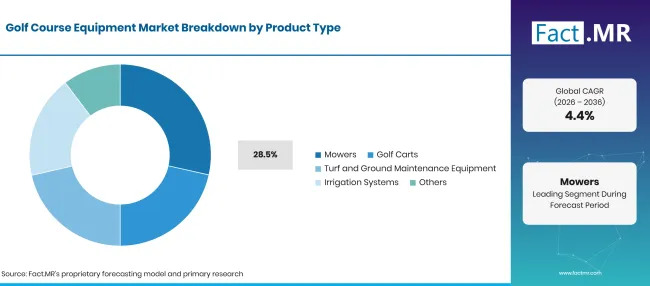
Golf Course Equipment Market Breakdown Product Type | Source: Fact.MR
| Product Type | Share (2026) |
|---|---|
| Mowers (Leading segment) | 28.5% |
| Other segments combined (Golf Carts, Turf and Ground Maintenance Equipment, Irrigation Systems, Others) | 71.5%* |
| Total | 100.0% |
Source: Fact.MR analysis. Updated Oct 24, 2026
Mowers represent the single largest product category by market value, commanding 28.5% of global expenditures. Sourcing directors across championship facilities and municipal courses prioritize mowers due to their indispensable daily role in establishing precise micro-inch cutting heights across greens, tees, fairways, and roughs. Course superintendents utilize an array of specialized mowing units, ranging from lightweight walking greens mowers that prevent collar scuffing to high-capacity 5-gang reel fairway mowers and heavy rotary rough units. Golf carts follow closely, dominating high-volume resort and country club fleets with scheduled replacement cycles every four to six years. Turf maintenance equipment and specialized irrigation systems account for the remaining share, favored in root-zone health and soil hydrology management. Equipment manufacturers outfit heavy utility maintenance units with advanced turf vehicle powertrain systems for steep contours. Fleet maintenance technicians incorporate integrated battery health monitoring sensors to optimize lithium charge cycles. Cart manufacturers install advanced occupant safety sensing modules to govern downhill speeds. Maintenance shops also utilize compact pneumatic inflation equipment to maintain low tire contact pressure on fine turf.
What leads the Application segment?
Private Golf Courses accounts for 52.3% share in 2026.
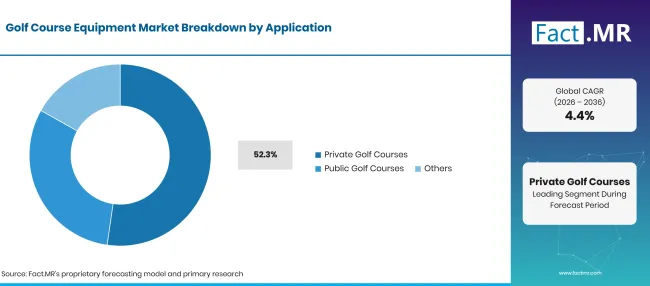
Golf Course Equipment Market Breakdown Application | Source: Fact.MR
| Application | Share (2026) |
|---|---|
| Private Golf Courses (Leading segment) | 52.3% |
| Other segments combined (Public Golf Courses, Others) | 47.7%* |
| Total | 100.0% |
Source: Fact.MR analysis. Updated Oct 24, 2026
Private golf courses represent the dominant application segment, contributing 52.3% of total industry revenue. Member-owned country clubs and premier private golf facilities operate under demanding aesthetic and playability standards where members expect tournament-grade turf firmness, fast green speeds, and immaculately manicured fairways daily. To satisfy these exacting expectations, private clubs maintain expansive machinery fleets, high mechanic-to-machine ratios, and aggressive 3-to-5-year fleet renewal cycles that guarantee state-of-the-art course conditioning. Public golf courses and municipal facilities follow, prioritizing rugged durability, ease of operator maintenance, and versatile multi-purpose utility vehicles to manage heavy player footfall and high round volumes with constrained grounds crews. Commercial resort courses comprise the remaining consumption base, sustained by golf tourism and championship tournament hosting. Facilities catering to high-net-worth golfers frequently pair golf amenities with hospitality and wellness resort recreation to attract affluent families. Clubhouses expand athletic fitness complexes that supply performance athletic nutrition offerings for wellness-focused players. Resort course operators also install on-course comfort stations providing beverage hydration and sports nutrition during destination tournaments.
Which Distribution Channel captures the largest market share?
Distributors accounts for 38.2% share in 2026.
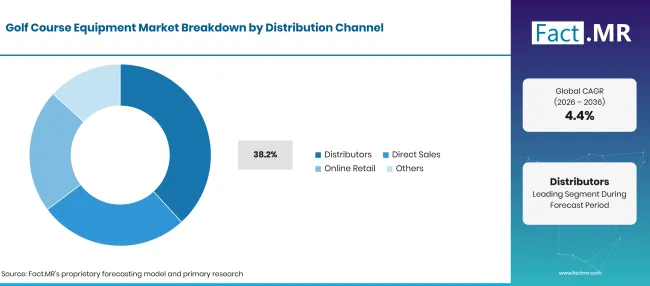
Golf Course Equipment Market Breakdown Distribution Channel | Source: Fact.MR
| Distribution Channel | Share (2026) |
|---|---|
| Distributors (Leading segment) | 38.2% |
| Other segments combined (Direct Sales, Online Retail, Others) | 61.8%* |
| Total | 100.0% |
Source: Fact.MR analysis. Updated Oct 24, 2026
Distributors represent the largest individual distribution channel, commanding 38.2% of total industry value. Equipment dealers maintain direct relationships with course superintendents, providing on-course product demonstrations, trade-in valuations, preventive service contracts, and rapid mobile field repair units that minimize costly machinery downtime during the playing season. Direct sales follow as a vital secondary channel, accounting for major revenue across multi-course corporate management agreements. Online retail and equipment auctions comprise the remaining distribution base, sustained by replacement parts and course accessory ordering. Dealerships co-distribute high-efficiency solar water pumping solutions for irrigation lakes. Engineering contractors integrate automated precision fluid flow measurement systems across fairway pipe networks. Fleet managers deploy connected fleet telematics solutions to track machine hours and operator efficiency.
What is accelerating Golf Course Equipment Market adoption, and what is holding it back?
Fleet electrification, autonomous robotic mower adoption, and water conservation accelerate market expansion. High initial capital acquisition costs, specialized technician shortages, and severe weather disruptions restrict frictionless market growth.
Drivers Impact Analysis
| DRIVER | (~) % IMPACT ON CAGR | GEOGRAPHIC RELEVANCE | IMPACT TIMELINE |
|---|---|---|---|
| Municipal emissions and noise regulations restricting small gas-powered maintenance machinery | +1.6% | North America, Europe | Short term (<= 2 years) |
| Severe greenskeeping labor shortages accelerating adoption of autonomous robotic fairway mowers | +1.4% | North America, East Asia | Short term (<= 2 years) |
| Municipal water withdrawal limits driving retrofits of precision soil sensor irrigation systems | +1.2% | Global | Medium term (2-4 years) |
| Global surge in golf tourism stimulating capital investments in premier resort course machinery | +0.9% | North America, Europe, Mediterranean | Medium term (2-4 years) |
| Commercial availability of high-voltage lithium utility vehicles delivering lower lifetime TCO | +0.7% | Global | Long term (>= 4 years) |
Source: Fact.MR analysis. Updated Oct 24, 2026
Opportunity Impact Analysis
| OPPORTUNITY | (~) % IMPACT ON CAGR | GEOGRAPHIC RELEVANCE | IMPACT TIMELINE |
|---|---|---|---|
| Drop-in modular electric powertrain conversion kits for legacy fairway and rough mowers | +1.5% | North America, Europe | Short term (<= 2 years) |
| Multi-satellite RTK-GPS agronomic telematics synchronizing autonomous robotic mower coverage | +1.2% | North America, East Asia | Medium term (2-4 years) |
| Specialized effluent filtration and solar-assisted irrigation pumps for non-potable water | +1.0% | Latin America, South Asia | Medium term (2-4 years) |
| Factory-certified pre-owned equipment rebuild programs lowering entry costs for municipal courses | +0.8% | Global | Long term (>= 4 years) |
Source: Fact.MR analysis. Updated Oct 24, 2026
Restraints Impact Analysis
| RESTRAINT | (~) % IMPACT ON CAGR | GEOGRAPHIC RELEVANCE | IMPACT TIMELINE |
|---|---|---|---|
| Substantial upfront capital acquisition costs for commercial mowers and electric charging hubs | -1.5% | Global | Short term (<= 2 years) |
| Severe scarcity of specialized mechanics trained in high-voltage lithium battery diagnostics | -1.1% | North America, Europe | Short term (<= 2 years) |
| Elevated commercial interest rates delaying scheduled 3-to-5-year fleet renewal cycles | -0.8% | North America, Europe | Medium term (2-4 years) |
| Severe weather disruptions and unseasonal flooding causing course closures and budget diversion | -0.6% | Global | Long term (>= 4 years) |
Source: Fact.MR analysis. Updated Oct 24, 2026
Which countries are scaling the Golf Course Equipment Market through 2036?
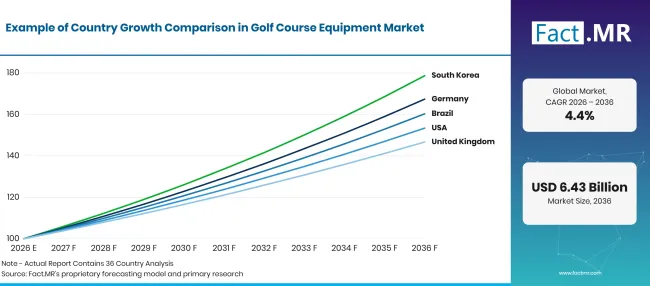
Golf Course Equipment Market Growth Index | Source: Fact.MR
| Country | CAGR (2026-2036) |
|---|---|
| Germany | 5.3% |
| Brazil | 4.8% |
| USA | 4.4% |
| UK | 3.9% |
| Japan | 3.5% |
Source: Fact.MR analysis. Updated Oct 24, 2026
What sustains engineering leadership in Germany?
5.3% CAGR, propelled by world-class environmental sustainability mandates, zero-emission municipal regulations, and autonomous robotic mowing adoption.
Germany's golf equipment demand is supported by a large and expanding facility base. The Deutscher Golf Verband reported 721 golf facilities and 695,617 registered memberships as of September 30, 2025, an increase of 8,909 memberships, or 1.3%, from 2024 [6]. Higher utilization across this installed base supports replacement demand for mowing, transport, irrigation, and maintenance assets.
What opportunities are unfolding across Brazil?
4.8% CAGR, backed by luxury resort hospitality investments, sports tourism infrastructure, and warm-season aeration demands.
Brazil's resort-led equipment opportunity benefits from a broader recovery in regional travel. UN Tourism reported that the Americas received 218 million international tourists in 2025 and that South America led the region with 7% year-on-year growth [7]. Stronger destination traffic improves the operating case for resort-course upkeep, including warm-season mowing, aeration, irrigation, and utility fleets, without relying on an unverified estimate of Brazil's course count.
Why does the United States maintain substantial commercial market valuation?
4.4% CAGR, propelled by unprecedented golf participation rounds, nationwide fleet modernizations, and computerized telematics integration.
The United States has a large, heavily used golf infrastructure base. The United States Golf Association's 2025 Golf Scorecard recorded more than 82 million domestic scores from 3.68 million golfers with a Handicap Index; the golfer count increased 8.2% year on year, while 9-hole score postings rose 5% to 14,998,824 [8]. Sustained play volumes increase wear on course assets and support recurring investment in mowers, utility vehicles, irrigation controls, and maintenance capacity.
How is the United Kingdom advancing course maintenance efficiency?
3.9% CAGR, supported by historic links preservation, precision soil aeration, and smart water abstraction management.
Water resilience is becoming a direct equipment-planning issue for United Kingdom golf facilities. England Golf reported in September 2026 that around 60% of England's golf courses use mains potable water for irrigation and that courses hold approximately 820 abstraction licences for rivers, lakes, boreholes, and aquifers [9]. This exposure supports investment in soil-moisture monitoring, efficient pumps, irrigation controls, storage, and alternative-water systems.
Why does Japan maintain elite technological and manufacturing prowess?
3.5% CAGR, anchored by robotic rough mowers and automated fairway cutting fleets to offset severe greenskeeping labor shortages.
Japan's equipment outlook is shaped by intensive facility use and the need to manage operations with tighter labor availability. In its August 22, 2025 update, the Japan Golf Association confirmed publication of nationwide monthly golf-course visitor data and monthly counts of golf-course tax facilities by prefecture [10]. These recurring operating indicators provide a verifiable basis for tracking course activity and planning mower, transport, irrigation, and labor-saving equipment requirements, replacing the unsupported claim of a 39% increase in autonomous mower deployments.
Who leads the Golf Course Equipment Market?
The TORO Company commands the leading global market share at 22.0% in 2026, manufacturing an unrivaled portfolio of commercial reel mowers, large rotary rough mowers, Workman utility vehicles, and central irrigation control systems supplying premier championship golf courses and municipal resorts globally. John Deere stands as the foremost American agricultural and turf machinery titan, operating specialized golf equipment facilities that manufacture PrecisionCut fairway mowers, Gator utility transport vehicles, and satellite-guided AutoTrac mowing systems for private clubs and public courses. Textron Jacobsen and Kubota Corporation represent premier turf machinery leaders, providing comprehensive lines of precision tournament greens mowers, compact utility tractors, and hybrid electric cutting units.
Yamaha Golf-Car Company delivers elite Japanese engineering excellence, dominating the global supply of premium electric and EFI passenger golf cars, light utility vehicles, and resort transport fleets. Husqvarna Group provides world-class commercial autonomous robotic mowing systems, producing boundary-wire-free CEORA and Automower platforms utilized across European and American golf courses to reduce greenskeeping labor overhead. Club Car LLC operates as a leading global manufacturer of commercial golf utility vehicles and connected fleet transport cars. Rain Bird Corporation and Hunter Industries deliver specialized golf irrigation controllers, weather stations, and variable-arc gear-driven sprinklers bridging mechanical and digital turf management architectures.
Which companies are the key providers?
Key companies include TORO Company; John Deere; Textron Jacobsen; Kubota Corporation; Yamaha Golf-Car Company; Husqvarna Group; Club Car; Rain Bird; Hunter Industries; and Baroness.
- TORO Company
- John Deere
- Textron Jacobsen
- Kubota Corporation
- Yamaha Golf-Car Company
- Husqvarna Group
- Club Car
- Rain Bird
- Hunter Industries
- Baroness
Bibliography
- [1] U.S. Environmental Protection Agency. (2026, January 26). Regulations for emissions from nonroad vehicles and engines.
- [2] Nicoludis, Z. (2025, July 4). A golfer's guide to autonomous technology in course maintenance. United States Golf Association.
- [3] Golf Course Superintendents Association of America. (2025). 2025 capital budget and labor survey.
- [4] Golf Course Superintendents Association of America. (2025). Golf Course Environmental Profile, Phase IV, Volume I: Water use and conservation on U.S. golf courses.
- [5] National Golf Foundation. (2026). Golf industry facts: Golf participation in the U.S. - 2026.
- [6] Deutscher Golf Verband. (2026, January 21). Golf in Deutschland erreicht neue Hochstwerte.
- [7] UN Tourism. (2026, January 20). International tourist arrivals up 4% in 2025, reflecting strong travel demand around the world.
- [8] United States Golf Association. (2026, January 20). Golf participation boomed in 2025; more than 82 million rounds posted domestically.
- [9] England Golf. (2026, September 18). State of the Nation report sets out golf's water resilience challenge.
- [10] Japan Golf Association. (2025, August 22). JGA golf support site news: Nationwide golf course visitor survey (August update).
This Report Answers
- How does the global golf course equipment market expand from USD 4.2 Billion in 2026 to USD 6.4 Billion by 2036?
- What technological advancements in lithium battery management systems extend commercial electric mower runtimes beyond single-shift operations?
- Why do mowers command 28.5% of total market revenue in 2026?
- How are autonomous robotic mowing platforms addressing chronic greenskeeping labor shortages across premier golf facilities?
- What factors support Germany achieving an industry-leading 5.3% CAGR through 2036?
- How are golf resort operators integrating precision soil capacitance telemetry with variable-frequency irrigation pumping systems?
- What role do authorized equipment distributors play in providing guaranteed mobile field servicing and flexible fleet leasing models?
What does the Golf Course Equipment Market cover?
Specialized machinery and systems used to maintain and operate golf courses form the core of this market. Coverage includes commercial mowing equipment, passenger and utility golf carts, turf and ground maintenance machinery, and irrigation hardware sold to private, public, municipal, and resort golf facilities.
Demand is tracked across private golf courses, public golf courses, and other managed golf facilities. Sales are measured through distributors, direct contracts, online retail, and other commercial channels.
What is included in the scope?
Commercial reel and rotary mowers, walking greens mowers, fairway and rough units, passenger golf carts, utility vehicles, aerators, spreaders, sprayers, bunker equipment, irrigation controllers, pumps, sprinklers, and related course-maintenance systems are included.
New equipment sold to golf facilities and commercial operators is counted at the first point of sale through distributors, direct manufacturer contracts, online channels, or other authorized routes.
What is excluded from the scope?
Consumer lawn and garden equipment bought solely for residential use is excluded. General agricultural tractors and construction machinery are not counted unless configured and sold specifically for golf-course maintenance.
- Golf clubs, balls, apparel, footwear, clubhouse furniture, foodservice equipment, and course-design or landscaping services fall outside the revenue boundary. Used-equipment resales, routine repair labor, and standalone replacement parts are also excluded unless bundled into a new-equipment sale.
Segmentation
What is the report’s scope and coverage?
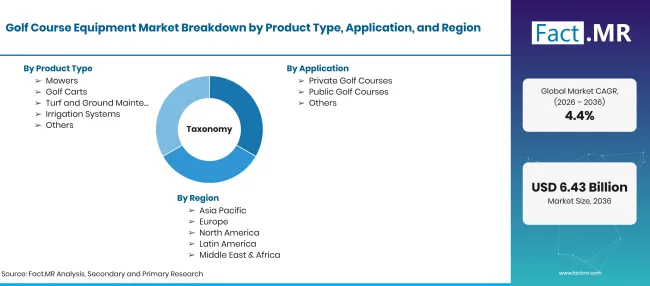
Golf Course Equipment Market Taxonomy | Source: Fact.MR
| Attribute | Details |
|---|---|
| Quantitative Units | USD Billion in 2026 to USD 6.4 Billion by 2036 at a 4.4% CAGR |
| Market Definition | Commercial shipments and sales of specialized golf course maintenance machinery, passenger and utility golf cars, turf irrigation hardware, and ground care implements across private and public golf facilities. |
| Product Type | Mowers; Golf Carts; Turf and Ground Maintenance Equipment; Irrigation Systems; Others |
| Application | Private Golf Courses; Public Golf Courses; Others |
| Distribution Channel | Distributors; Direct Sales; Online Retail; Others |
| Regions Covered | North America; Latin America; Western Europe; Eastern Europe; East Asia; South Asia & Pacific; Middle East & Africa |
| Countries Covered | Germany; Brazil; USA; UK; Japan |
| Companies Profiled | TORO Company; John Deere; Textron Jacobsen; Kubota Corporation; Yamaha Golf-Car Company; Husqvarna Group; Club Car; Rain Bird; Hunter Industries; Baroness |
| Forecast Period | 2026 to 2036 |
| Approach | Primary interviews with golf course superintendents, resort operations directors, and commercial turf equipment dealer executives combined with municipal water abstraction and emission regulation audits. |
Source: Fact.MR analysis. Updated Oct 24, 2026
How is the market segmented?
-
By Product Type
- Mowers
- Golf Carts
- Turf and Ground Maintenance Equipment
- Irrigation Systems
- Others
-
By Application
- Private Golf Courses
- Public Golf Courses
- Others
-
By Distribution Channel
- Distributors
- Direct Sales
- Online Retail
- Others
-
By Region
- North America
- Latin America
- Western Europe
- Eastern Europe
- East Asia
- South Asia & Pacific
- Middle East & Africa
Frequently Asked Questions
What is the projected value of the Golf Course Equipment Market by 2036?
Which product type represents the largest revenue share in the market?
What is the primary application driving golf course equipment demand?
Which country is projected to record the highest growth rate during the forecast period?
Who are the leading manufacturers in the global market?
Who worked on this report


Preview the report firsthand - request a free sample
Free SampleGet the brochure for pricing and purchase details
Download PDF