- Market Value (2025): USD 6.4 Bn
- Estimated Value (2026): USD 7.3 Bn
- Forecast Value (2036): USD 25.9 Bn
- CAGR (2026-2036): 13.5%
What is the GPU in Robotics and Smart Manufacturing Market forecast to be worth by 2036?
USD 7.3 billion in 2026 to USD 25.9 billion by 2036 at 13.5% CAGR.
- The GPU in robotics and smart manufacturing market crossed a valuation of USD 6.4 billion in 2025 as manufacturers expanded GPU use across robot perception and simulation.
- Demand is projected to increase from USD 7.3 billion in 2026 to USD 25.9 billion by 2036.
- The market is forecast to record 13.5% CAGR from 2026 to 2036.
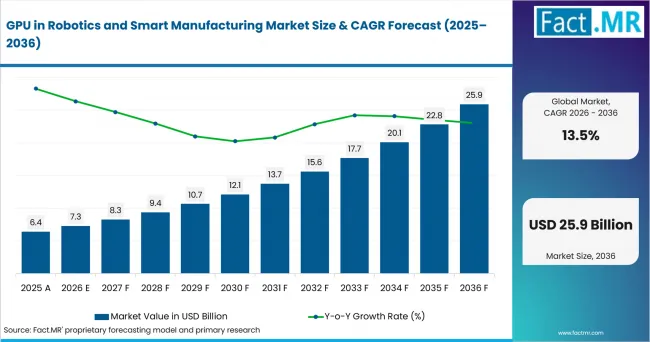
Gpu In Robotics And Smart Manufacturing Market Value Analysis | Source: Fact.MR
What are the defining numbers behind GPU in Robotics and Smart Manufacturing Market growth?
USD 18.5 billion absolute opportunity by 2036 is led by data center GPUs and industrial robotics.
- Demand Drivers in the Market
- Factory teams require GPU compute for visual inspection and robot guidance. Accelerator choices therefore influence how much AI capacity a plant can use on the production floor.
- AI training and inference for robotics are expected to raise demand for accelerator servers, embedded modules and validated deployment software.
- Smart factory programs need GPU-backed systems that connect production data with machine vision. The same requirement supports demand for digital twin tools.
- Automotive manufacturing is anticipated to remain a central use case because robot cells and inspection lines rely on high-throughput visual processing.
- Key Segments Analyzed
- By GPU Platform: Data Center GPUs are expected to hold 43.0% share in 2026 because centralized training and simulation require high-throughput accelerator capacity.
- By Manufacturing Application: Industrial Robotics is projected to account for 38.0% share in 2026 as production robots need faster perception and motion-control support.
- By End-use Industry: Automotive Manufacturing is anticipated to capture 35.0% share in 2026 due to dense robot installations and strict inspection needs.
- By Deployment Environment: On-premises Infrastructure is estimated to represent 46.0% share in 2026 since factories prefer local control over sensitive production data.
- By AI Compute Framework: Parallel GPU Computing is forecast to lead with 44.0% share in 2026 as robotics workloads process image, sensor and simulation data together.
- Analyst Opinion at Fact.MR
- Shambhu Nath Jha, Senior Consultant at Fact.MR, states, “GPU demand in robotics and smart manufacturing is moving from model training into daily plant operations. Manufacturers are expected to choose platforms that support simulation, real-time inference and secure local deployment.”
- Strategic Implications
- Manufacturers should classify robotics workloads by latency and data sensitivity before selecting cloud, hybrid or on-premises GPU infrastructure.
- GPU suppliers should align accelerators with AI server chassis designs and partner software that helps plants qualify robot models faster.
- Systems integrators can strengthen adoption by packaging compute, networking and security around factory-floor use cases instead of selling isolated accelerator capacity.
The USA follows at 14.2%. Germany reaches 13.6% and Japan records 13.0%. South Korea posts 12.4%, Canada reaches 11.8% and Singapore records 11.1%.
How does the GPU in Robotics and Smart Manufacturing Market break down by segment?
Data Center GPUs lead GPU Platform at 43.0% share in 2026. Industrial Robotics leads Manufacturing Application at 38.0%.
Why do Data Center GPUs lead GPU Platform?
Data Center GPUs are projected to account for 43.0% share in 2026.
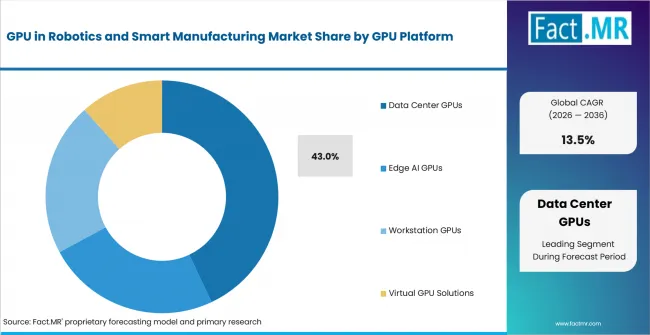
Gpu In Robotics And Smart Manufacturing Market Analysis By Gpu Platform | Source: Fact.MR
Data Center GPUs lead because industrial AI workloads often exceed single-controller capacity. Manufacturers use central GPU systems to train inspection models and prepare robot behavior before deployment.
What supports Industrial Robotics within Manufacturing Application?
Industrial Robotics is expected to hold 38.0% share in 2026.
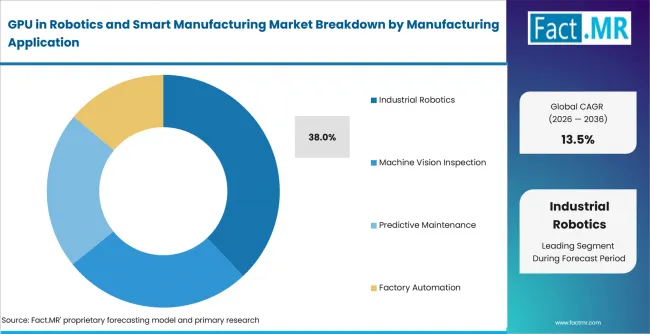
Gpu In Robotics And Smart Manufacturing Market Analysis By Manufacturing Application | Source: Fact.MR
Industrial Robotics gains priority when robot cells must interpret sensor data before acting. A factory robot program needs compute that can support perception, path planning and safe motion.
How does Automotive Manufacturing shape End-use Industry demand?
Automotive Manufacturing is anticipated to capture 35.0% share in 2026.
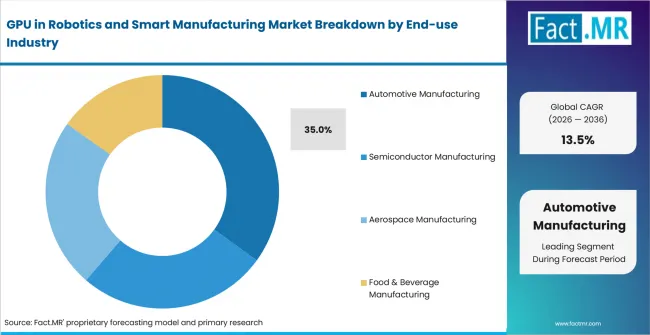
Gpu In Robotics And Smart Manufacturing Market Analysis By End Use Industry | Source: Fact.MR
Vehicle plants combine dense robot use with strict quality checks. GPU-enabled inspection supports body and paint lines. The same systems support assembly and component checks where missed defects carry direct cost.
What supports On-premises Infrastructure within Deployment Environment?
On-premises Infrastructure is estimated to represent 46.0% share in 2026.
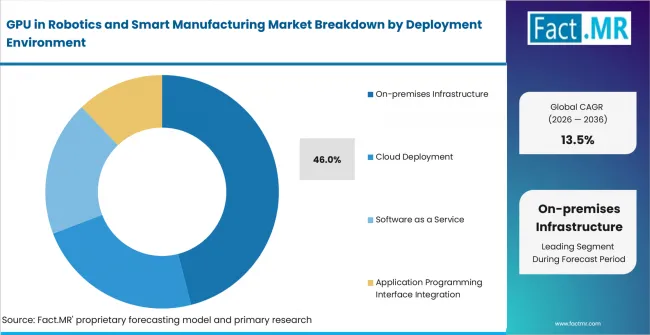
Gpu In Robotics And Smart Manufacturing Market Analysis By Deployment Environment | Source: Fact.MR
Factories use local compute when production decisions need low latency and tighter control of plant data. GPU asset planning matters when accelerators run for several years.
Why does Parallel GPU Computing lead AI Compute Framework?
Parallel GPU Computing is forecast to hold 44.0% share in 2026.
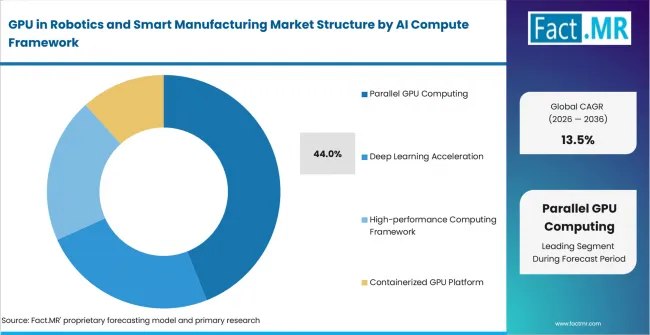
Gpu In Robotics And Smart Manufacturing Market Analysis By Ai Compute Framework | Source: Fact.MR
Robotics and smart manufacturing use many concurrent tasks. A modular robot setup may process vision and motion at the same time, which favors parallel execution.
What is accelerating GPU in Robotics and Smart Manufacturing Market adoption, and what is holding it back?
Demand is expected to rise through GPU-enabled robot perception and on-premises inference. Growth may be limited by capital requirements and capability gaps in smaller production environments.
Drivers Impact Analysis
| DRIVER | (~) % IMPACT ON CAGR | GEOGRAPHIC RELEVANCE | IMPACT TIMELINE |
|---|---|---|---|
| AI model training and simulation | High | Global | Short term (<= 2 years) |
| Robot perception and machine vision | High | China, USA, Germany | Short term (<= 2 years) |
| On-premises GPU infrastructure | Medium-High | Automotive and electronics clusters | Medium term (2-4 years) |
| Edge-cloud orchestration | Medium | North America, Europe, East Asia | Medium term (2-4 years) |
| Industrial software integration | Medium | Global | Long term (>= 4 years) |
Source: Fact.MR analysis. Updated Aug 8, 2026
- AI model training and simulation: Production teams are expected to use GPU systems to test robot behavior and inspection models before deployment.
- Robot perception and machine vision: Smart camera inspection lines are anticipated to raise demand for processors that can interpret visual data quickly.
- On-premises GPU infrastructure: Local compute is expected to gain preference where plants need predictable latency and tighter control over production data.
Opportunity Impact Analysis
| OPPORTUNITY | (~) % IMPACT ON CAGR | GEOGRAPHIC RELEVANCE | IMPACT TIMELINE |
|---|---|---|---|
| Edge AI deployment packages | Medium-High | USA, Germany, Japan | Short term (<= 2 years) |
| Digital twin and simulation workflows | Medium | Automotive and electronics clusters | Medium term (2-4 years) |
| Robot vision upgrades | Medium | China, South Korea, Singapore | Medium term (2-4 years) |
| AI-ready networking and security | Medium | North America and Europe | Long term (>= 4 years)\ |
Source: Fact.MR analysis. Updated Aug 8, 2026
- Edge AI deployment packages: Suppliers that combine GPU hardware with runtime software are expected to reduce adoption friction for plant teams.
- Digital twin and simulation workflows: Digital twin commissioning cells are anticipated to create opportunity where manufacturers need virtual testing before line changes.
- Robot vision upgrades: Existing factory robot installations are expected to support retrofit demand for better perception and inspection capability.
Restraints Impact Analysis
| RESTRAINT | (~) % IMPACT ON CAGR | GEOGRAPHIC RELEVANCE | IMPACT TIMELINE |
|---|---|---|---|
| Capital intensity and payback timing | Medium | Developing manufacturing markets | Short term (<= 2 years) |
| GPU supply and thermal design | Medium | Global | Short term (<= 2 years) |
| Factory data integration | Medium | Large multi-site manufacturers | Medium term (2-4 years) |
| Workforce and capability gaps | Low-Medium | Africa and Latin America | Long term (>= 4 years) |
Source: Fact.MR analysis. Updated Aug 8, 2026
- Capital intensity and payback timing: GPU servers and integration services raise project costs before manufacturers can measure productivity gains.
- GPU supply and thermal design: High-performance accelerators require careful power, cooling and lifecycle planning before they fit plant-floor infrastructure.
- Factory data integration: Older control systems can slow AI deployment because production data may not be clean or available in real time.
Which countries are scaling the GPU in Robotics and Smart Manufacturing Market fastest?
- The country comparison spans 3.6 percentage points and creates three practical growth bands across the forecast period.
- China remains 0.5 percentage point above the USA through domestic semiconductor self-sufficiency and factory automation programs.
- The USA remains 0.6 percentage point above Germany with AI infrastructure buildout and advanced manufacturing programs.
- Germany remains 0.6 percentage point above Japan through automotive manufacturing demand and industrial IoT use.
- Japan remains 0.6 percentage point above South Korea as precision equipment and automation know-how support production AI.
- South Korea remains 0.6 percentage point above Canada through memory manufacturing and electronics production depth.
- Canada remains 0.7 percentage point above Singapore with AI research capability and advanced manufacturing demand.
- Singapore closes the displayed range through electronics manufacturing depth and regional production support.
Comparable CAGRs can create different entry conditions due to factory scale and local engineering depth. Coverage includes North America, Latin America, Europe, East Asia, South Asia and Pacific, Middle East and Africa.
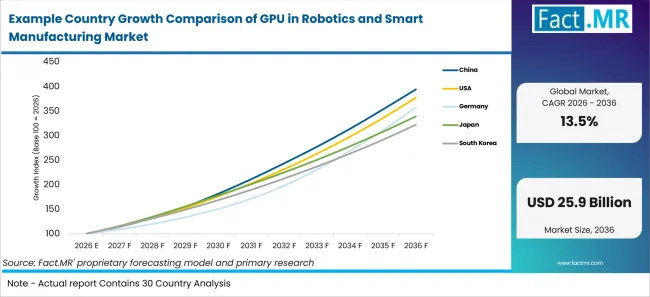
Example Country Growth Comparison Of Gpu In Robotics And Smart Manufacturing Market | Source: Fact.MR
| Country | CAGR (2026-2036) |
|---|---|
| China | 14.7% |
| USA | 14.2% |
| Germany | 13.6% |
| Japan | 13.0% |
| South Korea | 12.4% |
| Canada | 11.8% |
| Singapore | 11.1% |
Source: Fact.MR analysis. Updated Aug 8, 2026
What supports China adoption?
14.7% CAGR, supported by domestic semiconductor self-sufficiency and factory automation.
China’s demand is shaped by the push to localize production technology and reduce dependence on imported systems. GPU adoption is expected to grow where plant teams need stronger robot control, inspection accuracy and automated production intelligence.
How is the USA scaling demand?
14.2% CAGR, backed by AI infrastructure buildout and advanced manufacturing programs.
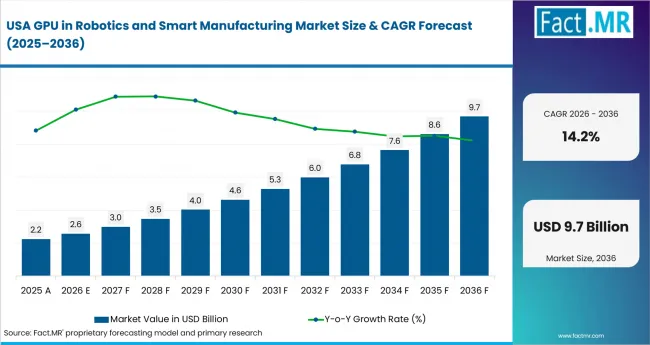
Gpu In Robotics And Smart Manufacturing Market Country Value Analysis | Source: Fact.MR
In the USA, adoption is tied to the country’s software depth and secure deployment needs. Manufacturers are likely to use GPU systems for simulation, robot learning and visual inspection as advanced factories connect AI models with production workflows.
What is driving Germany’s growth from 2026 to 2036?
13.6% CAGR, driven by automotive manufacturing and industrial IoT demand.
Germany’s growth comes from quality-focused production environments where automation must remain precise and repeatable. Automotive plants are expected to apply GPUs in inspection, factory analytics and robot validation when output consistency is closely monitored.
How is Japan developing demand?
13.0% CAGR, supported by advanced materials and equipment supply chain strength.
Japan’s adoption path reflects its deep manufacturing discipline and established automation base. GPU systems are expected to gain traction in precision production, robot control and equipment-linked workflows where process stability matters more than rapid rollout.
How does South Korea perform?
12.4% CAGR, led by memory manufacturing and electronics production.
South Korea benefits from electronics factories that require fast inspection and production feedback. GPU demand is likely to come from visual analytics, robotics workflows and manufacturing data processing across high-volume component and device production.
What supports Canada’s growth?
11.8% CAGR, backed by AI research capability and advanced manufacturing demand.
Canada represents a smaller but technically capable adoption base. Growth is expected to come through robotics pilots, inspection models and advanced manufacturing projects where AI research strength can move into controlled industrial use.
What supports Singapore’s growth?
11.1% CAGR, supported by electronics manufacturing depth and regional production support.
Singapore’s role is shaped by its compact manufacturing cluster and regional supply-chain position. GPU adoption is expected to focus on edge AI, inspection and production-support use cases where technical service access improves deployment confidence.
Who leads the GPU in Robotics and Smart Manufacturing Market?
NVIDIA and AMD carry the strongest fit in GPU-enabled robotics and smart manufacturing, while Intel and Qualcomm add embedded and industrial AI processor relevance.
Microsoft and IBM strengthen the software and secure deployment layer for factory AI workloads. Dell Technologies, HPE, Lenovo and Cisco extend the competitive field through servers, edge infrastructure, networking and AI-ready systems that help manufacturers run robot perception, simulation, inspection and on-premises inference across smart factory environments.
Which companies are the key providers?
Key companies include NVIDIA Corporation; Advanced Micro Devices, Inc.; Intel Corporation; Qualcomm Incorporated; Microsoft Corporation; IBM Corporation; Dell Technologies Inc.; Hewlett Packard Enterprise Company; Lenovo Group Limited; and Cisco Systems, Inc.
- NVIDIA Corporation
- Advanced Micro Devices, Inc.
- Intel Corporation
- Qualcomm Incorporated
- Microsoft Corporation
- IBM Corporation
- Dell Technologies Inc.
- Hewlett Packard Enterprise Company
- Lenovo Group Limited
- Cisco Systems, Inc.
Bibliography
- Advanced Micro Devices, Inc. (2026, January 5). AMD Introduces Ryzen AI Embedded Processor Portfolio, Powering AI-Driven Immersive Experiences in Automotive, Industrial and Physical AI.
- Cisco Systems, Inc. (2026, March 16). Cisco Secure AI Factory with NVIDIA Makes AI Easier to Deploy and Secure, Anywhere Organizations Need It.
- International Federation of Robotics. (2025, September 25). Global Robot Demand in Factories Doubles Over 10 Years.
- NVIDIA Corporation. (2026, March 16). NVIDIA and Global Robotics Leaders Take Physical AI to the Real World.
- Qualcomm Technologies, Inc. (2026, January 5). Qualcomm Introduces a Full Suite of Robotics Technologies, Powering Physical AI from Household Robots up to Full-Size Humanoids.
This Report Answers
- The report provides strategic intelligence on GPU Platform and Manufacturing Application choices.
- Segment analysis covers Data Center GPUs and Industrial Robotics as the 2026 share leaders.
- Country outlook evaluates China, USA, Germany, Japan, South Korea, Canada and Singapore.
- Competitive analysis profiles NVIDIA Corporation; Advanced Micro Devices, Inc.; Intel Corporation; Qualcomm Incorporated; Microsoft Corporation; IBM Corporation; Dell Technologies Inc.; Hewlett Packard Enterprise Company; Lenovo Group Limited; and Cisco Systems, Inc.
- Application assessment reviews robot perception, simulation, smart machine workloads and edge AI runtime.
What does the GPU in Robotics and Smart Manufacturing Market cover?
GPU systems are used to train, simulate and run AI workloads in robotics and smart manufacturing where visual processing, robot guidance and real-time decision support shape factory performance.
The GPU in Robotics and Smart Manufacturing Market covers GPU hardware, embedded accelerators, server infrastructure and software frameworks used in industrial robotics and smart factory systems. Coverage extends to factory robot control, machine vision, digital twins, simulation and on-premises AI compute. The market includes data center GPUs, edge GPUs, embedded GPU modules, workstation GPUs and integrated GPUs when GPU compute supports manufacturing or robotics workloads.
What is included in the scope?
GPU platforms are used across automotive manufacturing, electronics and semiconductor manufacturing, machinery and metal fabrication, consumer goods manufacturing and food and beverage manufacturing.
The scope includes GPU Platform and Manufacturing Application alongside End-use Industry, Deployment Environment and AI Compute Framework. Coverage spans Data Center GPUs, Edge GPUs, Embedded GPU Modules, Workstation GPUs and Integrated GPUs. Industrial Robotics, Machine Vision and Inspection, Digital Twin and Simulation, Predictive Maintenance and Production Planning are included where GPU acceleration supports factory operations. On-premises, hybrid edge-cloud, cloud-hosted GPU services, embedded edge devices and workstation environments are also included.
What is excluded from the scope?
General computing hardware and unrelated factory software remain outside the scope when GPU acceleration is not the main purchase driver.
The scope excludes standard industrial automation equipment that does not use GPU-based AI compute. Basic robotics hardware without GPU-enabled perception, simulation or inference is outside the market. General cloud services are excluded unless they are used for robotics training, simulation or manufacturing AI workloads. Office IT systems, non-industrial graphics use and unrelated server infrastructure are excluded when they do not support smart manufacturing or robotics deployment.
How Was the Analysis Built?
The analysis draws on 120+ sources, 35+ company portfolios, 25+ countries, and more than 20 interviews.
- Primary Research: Interviews with manufacturers, retailers, salon operators, and experts examine purchase priorities, adoption, approval requirements, and competitive positioning.
- Desk Research: Desk research covers government statistics, regulatory publications, company filings, trade data, technical studies, industry associations, standards, and public policy.
- Market Sizing and Forecasting: Estimates combine historical performance, demand indicators, pricing, segment shares, company participation, country growth, adoption patterns, and barriers to expansion.
- Data Validation and Update Cycle: Findings are validated against public data, company activity, regulatory changes, product launches, recalls, and adoption shifts.
Segmentation
What is the report’s scope and coverage?
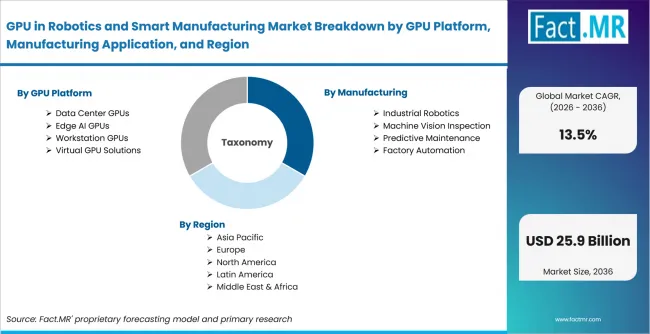
Gpu In Robotics And Smart Manufacturing Market Breakdown By Gpu Platform, Manufacturing Application, And Region | Source: Fact.MR
| Attribute | Details |
|---|---|
| Quantitative Units | USD billion in 2026 to USD billion by 2036 at CAGR |
| Market Definition | GPUs, embedded accelerators, server infrastructure and software frameworks used to train, simulate and run AI workloads in robotics and smart manufacturing |
| GPU Platform | Data Center GPUs; Edge GPUs; Embedded GPU Modules; Workstation GPUs; Integrated GPUs |
| Manufacturing Application | Industrial Robotics; Machine Vision and Inspection; Digital Twin and Simulation; Predictive Maintenance; Production Planning and Scheduling |
| End-use Industry | Automotive Manufacturing; Electronics and Semiconductor Manufacturing; Machinery and Metal Fabrication; Consumer Goods Manufacturing; Food and Beverage Manufacturing |
| Deployment Environment | On-premises Infrastructure; Hybrid Edge-cloud Infrastructure; Cloud-hosted GPU Services; Embedded Edge Devices; Workstation Environments |
| AI Compute Framework | Parallel GPU Computing; Computer Vision Frameworks; Robot Simulation Frameworks; Edge AI Runtime; Digital Twin Platforms |
| Regions Covered | North America; Latin America; Europe; East Asia; South Asia and Pacific; Middle East and Africa |
| Countries Covered | China; USA; Germany; Japan; South Korea; Canada; Singapore |
| Key Companies Profiled | NVIDIA Corporation; Advanced Micro Devices, Inc.; Intel Corporation; Qualcomm Incorporated; Microsoft Corporation; IBM Corporation; Dell Technologies Inc.; Hewlett Packard Enterprise Company; Lenovo Group Limited; Cisco Systems, Inc. |
| Forecast Period | 2026 to 2036 |
| Approach | Hybrid top-down and bottom-up approach using GPU demand; robotics adoption; deployment models; AI frameworks and growth |
Source: Fact.MR analysis. Updated Aug 8, 2026
How is the market segmented?
-
By GPU Platform
- Data Center GPUs
- Edge GPUs
- Embedded GPU Modules
- Workstation GPUs
- Integrated GPUs
-
By Manufacturing Application
- Industrial Robotics
- Machine Vision and Inspection
- Digital Twin and Simulation
- Predictive Maintenance
- Production Planning and Scheduling
-
By End-use Industry
- Automotive Manufacturing
- Electronics and Semiconductor Manufacturing
- Machinery and Metal Fabrication
- Consumer Goods Manufacturing
- Food and Beverage Manufacturing
-
By Deployment Environment
- On-premises Infrastructure
- Hybrid Edge-cloud Infrastructure
- Cloud-hosted GPU Services
- Embedded Edge Devices
- Workstation Environments
-
By AI Compute Framework
- Parallel GPU Computing
- Computer Vision Frameworks
- Robot Simulation Frameworks
- Edge AI Runtime
- Digital Twin Platforms
-
By Region
- North America
- Latin America
- Europe
- East Asia
- South Asia and Oceania
- Middle East and Africa
Frequently Asked Questions
How big is the GPU in robotics and smart manufacturing market in 2026?
What is the CAGR of the GPU in robotics and smart manufacturing market from 2026 to 2036?
Which GPU platform leads the GPU in robotics and smart manufacturing market?
Which manufacturing application leads the GPU in robotics and smart manufacturing market?
Who are the leading companies in the GPU in robotics and smart manufacturing market?
Who worked on this report


Preview the report firsthand - request a free sample
Free SampleGet the brochure for pricing and purchase details
Download PDF