- Market Value (2025): USD 877.0 Mn
- Estimated Value (2026): USD 920.0 Mn
- Forecast Value (2036): USD 1,484.4 Mn
- CAGR (2026-2036): 4.9%
What is the Hairy Cell Leukemia Market forecast to be worth by 2036?
USD 920.0 million in 2026 to USD 1,484.4 million by 2036 at 4.9% CAGR.
- The hairy cell leukemia market reached USD 877.0 million in 2025 as hematologists, cancer centers, hospital pharmacies and oncology drug suppliers increased spending where treatment demand is shaped by diagnosis, relapse monitoring and established use of purine analogues.
- Demand is projected to increase from USD 920.0 million in 2026 to USD 1,484.4 million by 2036.
- The market is forecast to record 4.9% CAGR from 2026 to 2036 because treatment demand is shaped by diagnosis, relapse monitoring and established use of purine analogues.
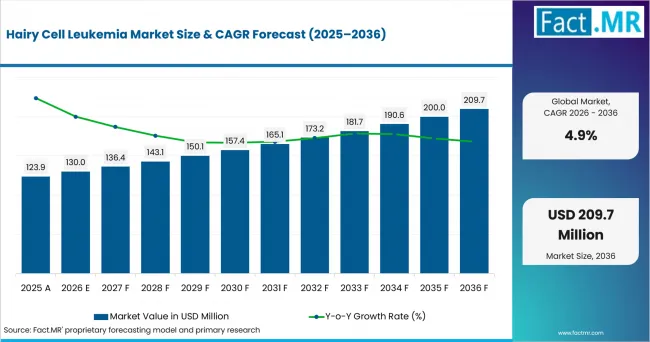
Hairy Cell Leukemia Market Value Analysis | Source: Fact.MR
What are the defining numbers behind Hairy Cell Leukemia Market growth?
USD 564.4 million absolute opportunity is expected by 2036.
- Demand Drivers in the Market
- Purine analog therapy leads because cladribine and pentostatin remain central options for many eligible patients with classic HCL.
- Classic hairy cell leukemia accounts for most diagnosed cases, so it anchors treatment volumes and follow-up pathways.
- Hospitals lead because diagnosis, therapy initiation, adverse-event management and relapse review are concentrated in hematology settings.
- Hospital pharmacies lead distribution because oncology medicines require controlled access, reimbursement handling and treatment-site coordination.
- Key Segments Analyzed
- By Treatment Type: Purine Analog Therapy is expected to hold 39.1% share in 2026 because cladribine and pentostatin remain established therapies for many eligible patients.
- By Disease Type: Classic Hairy Cell Leukemia is expected to hold 57.8% share in 2026 because classic HCL accounts for most diagnosed cases and sets the main treatment pathway.
- By End User: Hospitals are expected to hold 34.7% share in 2026 because hematology diagnosis, therapy initiation and adverse-event management are concentrated in hospital settings.
- By Distribution Channel: Hospital Pharmacies are expected to hold 34.7% share in 2026 because controlled oncology-drug access and reimbursement handling often run through hospital pharmacies.
- By Drug Class: Purine Analogues are expected to hold 34.7% share in 2026 because purine analogues remain central to first-line and follow-up treatment planning.
- Analyst Opinion at Fact.MR
- Anurag Sharma, Sr. Consultant at Fact.MR, states, "This is a rare-disease market, so growth comes from reliable diagnosis, treatment access and relapse management rather than broad patient volume. Suppliers have to support hematology workflows and reimbursement clarity."
- Strategic Implications
- Manufacturers should support clear treatment access, adverse-event management and relapse-monitoring pathways.
- Hospitals and pharmacies need coordinated reimbursement and supply planning because patient volumes are small but treatment timing matters.
- Companies developing targeted therapies should position them around relapsed, refractory or variant disease needs where purine analogues are not enough.
- South Korea is projected at 5.4%; USA is projected at 5.1%; Canada is projected at 4.8%; UK is projected at 4.7%; Australia is projected at 4.6%; Germany is projected at 4.3%; Japan is projected at 4.2% during 2026 to 2036. Country analysis is shaped by specialist hematology access, reimbursement systems and rare-disease referral pathways.
How does the Hairy Cell Leukemia Market break down by segment?
Purine Analog Therapy leads Treatment Type at 39.1% share in 2026, while Classic Hairy Cell Leukemia leads Disease Type at 57.8% share.
Why does Purine Analog Therapy lead Treatment Type?
Purine Analog Therapy is expected to account for 39.1% share in 2026.
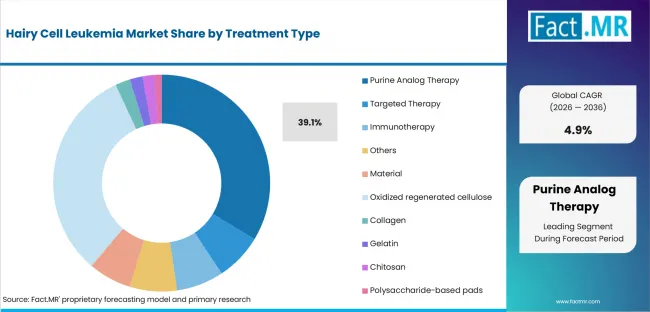
Hairy Cell Leukemia Market Analysis By Treatment Type | Source: Fact.MR
Purine Analog Therapy leads the treatment type segment because cladribine and pentostatin remain established therapies for many eligible patients.
Why does Classic Hairy Cell Leukemia lead Disease Type?
Classic Hairy Cell Leukemia is expected to account for 57.8% share in 2026.
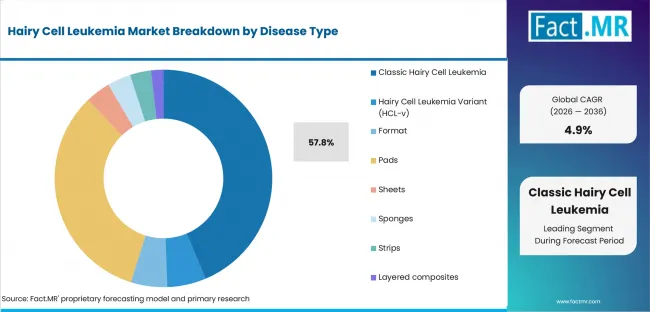
Hairy Cell Leukemia Market Analysis By Disease Type | Source: Fact.MR
Classic Hairy Cell Leukemia leads the disease type segment because classic HCL accounts for most diagnosed cases and sets the main treatment pathway.
Why does Hospitals lead End User?
Hospitals is expected to account for 34.7% share in 2026.
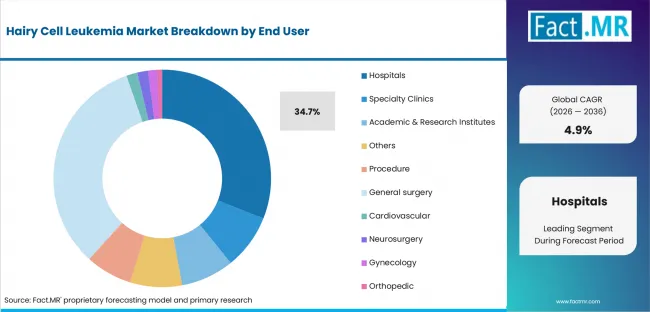
Hairy Cell Leukemia Market Analysis By End User | Source: Fact.MR
Hospitals lead the end user segment because hematology diagnosis, therapy initiation and adverse-event management are concentrated in hospital settings.
Why does Hospital Pharmacies lead Distribution Channel?
Hospital Pharmacies is expected to account for 34.7% share in 2026.
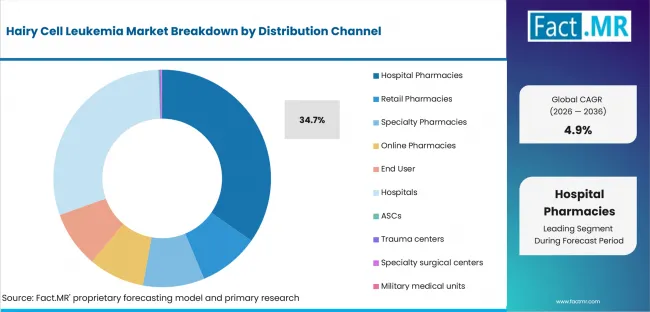
Hairy Cell Leukemia Market Analysis By Distribution Channel | Source: Fact.MR
Hospital Pharmacies lead the distribution channel segment because controlled oncology-drug access and reimbursement handling often run through hospital pharmacies.
Why does Purine Analogues lead Drug Class?
Purine Analogues is expected to account for 34.7% share in 2026.
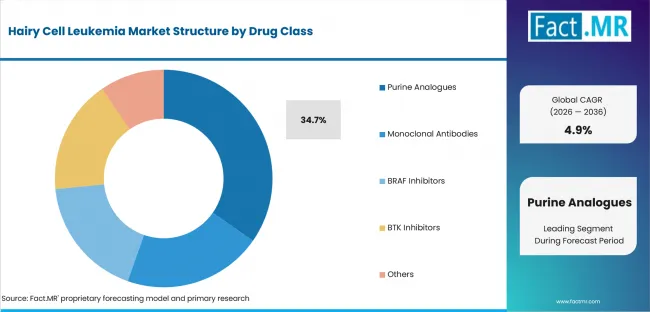
Hairy Cell Leukemia Market Analysis By Drug Class | Source: Fact.MR
Purine Analogues lead the drug class segment because purine analogues remain central to first-line and follow-up treatment planning.
What is accelerating Hairy Cell Leukemia Market adoption, and what is holding it back?
Demand is supported by established purine analogue therapy, specialist diagnosis and relapse follow-up. Growth is held back by rare-disease volume, infection-risk management and reimbursement pressure.
| DRIVER | QUALITATIVE RELEVANCE | GEOGRAPHIC RELEVANCE | IMPACT TIMELINE |
|---|---|---|---|
| Purine analog therapy | High | South Korea | Short term (<=2 years) |
| Classic HCL | High | USA | Short term (<=2 years) |
| Hospital care | Moderate | Canada | Medium term (2-4 years) |
| Hospital pharmacies | Selective | UK | Medium term (2-4 years) |
Source: Fact.MR analysis. Updated Jul 29, 2026
- Purine analog therapy: Established use of cladribine and pentostatin keeps this treatment class central to demand.
- Classic HCL: Most diagnosed patients fall into the classic disease pathway, which anchors treatment planning.
- Hospital care: Diagnosis, treatment initiation and adverse-event management are concentrated in hematology centers.
- Hospital pharmacies: Controlled oncology-drug access and reimbursement work make hospital channels important.
Opportunity Impact Analysis
| OPPORTUNITY | QUALITATIVE RELEVANCE | GEOGRAPHIC RELEVANCE | IMPACT TIMELINE |
|---|---|---|---|
| Relapse monitoring pathways | High | South Korea | Medium term (2-4 years) |
| Targeted therapy development | Moderate | USA | Medium term (2-4 years) |
| Referral support | Selective | Canada | Medium term (2-4 years) |
Source: Fact.MR analysis. Updated Jul 29, 2026
- Relapse monitoring pathways can improve follow-up and support timely treatment decisions.
- Targeted therapy development can address patients who relapse or do not fit standard purine analogue use.
- Referral support can help community providers move rare suspected cases into specialist hematology care.
Restraints Impact Analysis
| RESTRAINT | QUALITATIVE RELEVANCE | GEOGRAPHIC RELEVANCE | IMPACT TIMELINE |
|---|---|---|---|
| Small patient populations | High | South Korea | Short term (<=2 years) |
| Infection-risk management | Moderate | USA | Medium term (2-4 years) |
| Reimbursement and access hurdles | Selective | Canada | Medium term (2-4 years) |
Source: Fact.MR analysis. Updated Jul 29, 2026
- Small patient populations limit commercial scale.
- Infection-risk management and treatment-related toxicity require specialist oversight.
- Reimbursement and access hurdles can delay therapy in some health systems.
Which countries are scaling Hairy Cell Leukemia Market fastest?
The global CAGR is 4.9%. Country rates show how specialist hematology access, reimbursement systems and rare-disease referral pathways change the adoption route by market.
- South Korea records the highest listed CAGR at 5.4% from 2026 to 2036.
- USA and Canada also sit close to the upper end of the comparison where local demand conditions are stronger.
- UK, Australia, Germany, and Japan grow more steadily as buyers weigh cost, availability and adoption risk.
The full regional view covers North America, Latin America, Europe, East Asia, South Asia and Oceania, and the Middle East and Africa.
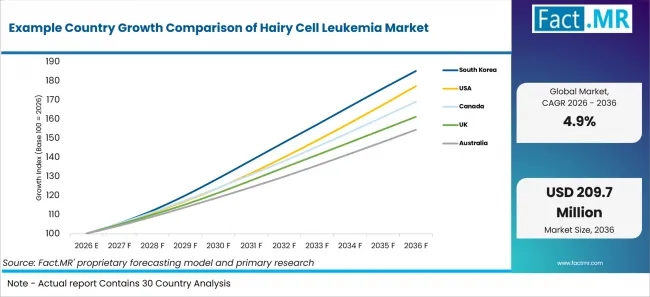
Example Country Growth Comparison Of Hairy Cell Leukemia Market | Source: Fact.MR
| COUNTRY | CAGR, 2026 to 2036 |
|---|---|
| South Korea | 5.4% |
| USA | 5.1% |
| Canada | 4.8% |
| UK | 4.7% |
| Australia | 4.6% |
| Germany | 4.3% |
| Japan | 4.2% |
Source: Fact.MR analysis. Updated Jul 29, 2026
What is shaping South Korea's outlook through 2036?
South Korea is projected at 5.4% CAGR during 2026 to 2036, above the global 4.9% trajectory. coordinated specialist care and treatment access support faster growth from a small base.
What is shaping USA's outlook through 2036?
USA is projected at 5.1% CAGR during 2026 to 2036, above the global 4.9% trajectory. hematology networks, drug access and relapse management support above-market growth.
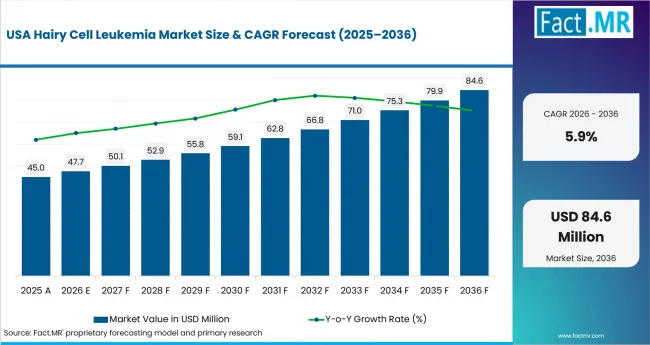
Hairy Cell Leukemia Market Country Value Analysis | Source: Fact.MR
What is shaping Canada's outlook through 2036?
Canada is projected at 4.8% CAGR during 2026 to 2036, below the global 4.9% trajectory. distributed care makes referral pathways and oncology pharmacy access important.
What is shaping UK's outlook through 2036?
UK is projected at 4.7% CAGR during 2026 to 2036, below the global 4.9% trajectory. evidence review and NHS pathway discipline shape treatment access.
What is shaping Australia's outlook through 2036?
Australia is projected at 4.6% CAGR during 2026 to 2036, below the global 4.9% trajectory. distance from specialist centers makes referral and follow-up capacity central.
What is shaping Germany's outlook through 2036?
Germany is projected at 4.3% CAGR during 2026 to 2036, below the global 4.9% trajectory. oncology buyers scrutinize durability, toxicity management and reimbursement evidence.
What is shaping Japan's outlook through 2036?
Japan is projected at 4.2% CAGR during 2026 to 2036, below the global 4.9% trajectory. diagnostic confidence and specialist follow-up support measured growth.
Who leads the Hairy Cell Leukemia Market?
AstraZeneca PLC and Roche Holding AG are among the visible providers in the hairy cell leukemia market. Pfizer Inc and Novartis AG also compete in the named provider set.
AstraZeneca PLC is estimated to hold 16.8% share in 2026. Competition is shaped by treatment access, clinical evidence, oncology pharmacy coordination, relapse support and rare-disease positioning.
Through 2036, competitive gains are expected to come from clearer positioning around Purine Analog Therapy and stronger execution in the highest-growth country markets.
Which companies are the key providers?
Key companies include AstraZeneca PLC; Roche Holding AG; Pfizer Inc.; Novartis AG; Johnson & Johnson; AbbVie Inc.; Sanofi; Amgen Inc..
- AstraZeneca PLC
- Roche Holding AG
- Pfizer Inc.
- Novartis AG
- Johnson & Johnson
- AbbVie Inc.
- Sanofi
- Amgen Inc.
Bibliography
- National Cancer Institute: Hairy Cell Leukemia Treatment - Health Professional Version.
- National Cancer Institute: Hairy Cell Leukemia Treatment - Patient Version.
- ClinicalTrials.gov: Hairy Cell Leukemia Studies.
This Report Addresses
- The report evaluates the Hairy Cell Leukemia Market through Treatment Type and Disease Type choices that define the 2026 market structure.
- Segment analysis covers Purine Analog Therapy and Classic Hairy Cell Leukemia as the leading 2026 positions.
- Country outlook compares the listed markets by CAGR and explains how specialist hematology access, reimbursement systems and rare-disease referral pathways shape local demand.
- Competitive analysis profiles the named providers and evaluates competition around treatment access, clinical evidence, oncology pharmacy coordination, relapse support and rare-disease positioning.
What does the Hairy Cell Leukemia Market cover?
The Hairy Cell Leukemia Market covers therapies, drug classes and care channels used in the treatment and follow-up of hairy cell leukemia, including classic disease and relapsed or variant cases.
The market boundary is tied to paid products, services and channels that directly support this use case. Adjacent spending is included only when it is part of the same purchase or operating decision.
What is included in the scope?
The scope includes treatment type, disease type, end user, distribution channel, drug class and regional demand for HCL therapies.
Coverage also includes adjacent segment options when they are purchased for the same defined market use.
What is excluded from the scope?
The scope excludes general leukemia markets, diagnostics-only revenue and unrelated oncology treatments not used in hairy cell leukemia care.
How Was the Analysis Built?
The analysis combines primary research with desk research focused on the hairy cell leukemia market, its segment structure and country-level demand.
- Primary Research: Interviews and validation discussions test buyer priorities, adoption barriers, pricing logic and operating requirements.
- Desk Research: The assessment reviews company disclosures, public datasets, regulatory material, technical literature and industry records relevant to the market.
- Market Sizing and Forecasting: Estimates combine top-down and bottom-up checks across demand signals, segment shares, country activity, company participation and adoption constraints.
Segmentation
What is the report's scope and coverage?
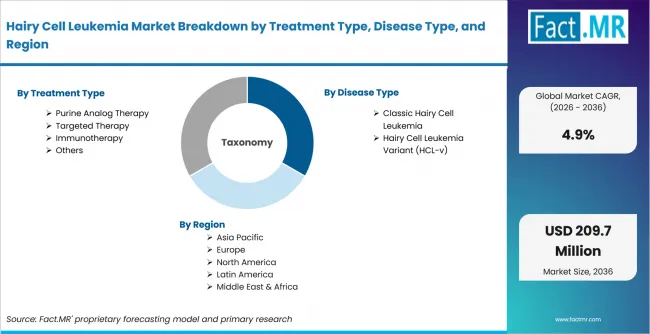
Hairy Cell Leukemia Market Breakdown By Treatment Type, Disease Type, And Region | Source: Fact.MR
| Attribute | Details |
|---|---|
| Quantitative Units | USD million in 2026 to USD million by 2036 at a CAGR |
| Market Definition | Hairy Cell Leukemia covers commercial buying, supply and use of Purine Analog Therapy offerings, with Disease Type choices and South Korea demand used to frame how the category serves diagnosis, treatment initiation, oncology pharmacy access, relapse monitoring and specialist follow-up. |
| Treatment Type | Purine Analog Therapy; Cladribine; Pentostatin; Targeted Therapy; BRAF Inhibitors; BTK Inhibitors; Immunotherapy; Monoclonal Antibodies; Combination Immunotherapy; Others; Splenectomy; Interferon Therapy |
| Disease Type | Classic Hairy Cell Leukemia; Newly Diagnosed HCL; Relapsed HCL; Hairy Cell Leukemia Variant (HCL-v); Treatment-Naive HCL-v; Refractory HCL-v |
| End User | Hospitals; Tertiary Care Hospitals; Cancer Centers; Specialty Clinics; Hematology Clinics; Oncology Clinics; Academic & Research Institutes; Clinical Research Centers; University Hospitals; Others; Ambulatory Care Centers; Community Healthcare Facilities |
| Distribution Channel | Hospital Pharmacies; Inpatient Pharmacies; Oncology Pharmacies; Retail Pharmacies; Chain Pharmacies; Independent Pharmacies; Specialty Pharmacies; Oncology Specialty Pharmacies; Home Delivery Services; Online Pharmacies; E-commerce Pharmacies; Digital Prescription Services |
| Drug Class | Purine Analogues; Cladribine; Pentostatin; Monoclonal Antibodies; Rituximab; Anti-CD20 Antibodies; BRAF Inhibitors; Vemurafenib; Dabrafenib; BTK Inhibitors; Ibrutinib; Acalabrutinib; Others; Interferons; Investigational Therapies |
| Regions Covered | North America; Latin America; Europe; East Asia; South Asia and Oceania; Middle East and Africa |
| Countries Covered | South Korea; USA; Canada; UK; Australia; Germany; Japan |
| Key Companies Profiled | AstraZeneca PLC; Roche Holding AG; Pfizer Inc.; Novartis AG; Johnson & Johnson; AbbVie Inc.; Sanofi; Amgen Inc. |
| Forecast Period | 2026 to 2036 |
| Approach | Hybrid top-down and bottom-up assessment using demand indicators, segment mix, country growth, company participation and public evidence relevant to the category. |
Source: Fact.MR analysis. Updated Jul 29, 2026
How is the market segmented?
-
By Treatment Type:
- Purine Analog Therapy
- Cladribine
- Pentostatin
- Targeted Therapy
- BRAF Inhibitors
- BTK Inhibitors
- Immunotherapy
- Monoclonal Antibodies
- Combination Immunotherapy
- Others
- Splenectomy
- Interferon Therapy
-
By Disease Type:
- Classic Hairy Cell Leukemia
- Newly Diagnosed HCL
- Relapsed HCL
- Hairy Cell Leukemia Variant (HCL-v)
- Treatment-Naive HCL-v
- Refractory HCL-v
-
By End User:
- Hospitals
- Tertiary Care Hospitals
- Cancer Centers
- Specialty Clinics
- Hematology Clinics
- Oncology Clinics
- Academic & Research Institutes
- Clinical Research Centers
- University Hospitals
- Others
- Ambulatory Care Centers
- Community Healthcare Facilities
-
By Distribution Channel:
- Hospital Pharmacies
- Inpatient Pharmacies
- Oncology Pharmacies
- Retail Pharmacies
- Chain Pharmacies
- Independent Pharmacies
- Specialty Pharmacies
- Oncology Specialty Pharmacies
- Home Delivery Services
- Online Pharmacies
- E-commerce Pharmacies
- Digital Prescription Services
-
By Drug Class:
- Purine Analogues
- Cladribine
- Pentostatin
- Monoclonal Antibodies
- Rituximab
- Anti-CD20 Antibodies
- BRAF Inhibitors
- Vemurafenib
- Dabrafenib
- BTK Inhibitors
- Ibrutinib
- Acalabrutinib
- Others
- Interferons
- Investigational Therapies
-
By Region:
- North America
- Latin America
- Europe
- East Asia
- South Asia and Oceania
- Middle East and Africa
Frequently Asked Questions
Which Treatment Type leads the Hairy Cell Leukemia Market?
Which Disease Type leads the Hairy Cell Leukemia Market?
Which End User leads the Hairy Cell Leukemia Market?
Which Distribution Channel leads the Hairy Cell Leukemia Market?
Which Drug Class leads the Hairy Cell Leukemia Market?
How does South Korea perform in the Hairy Cell Leukemia Market?
How does USA perform in the Hairy Cell Leukemia Market?
How does Canada perform in the Hairy Cell Leukemia Market?
What is the primary driver in the Hairy Cell Leukemia Market?
What is the main restraint in the Hairy Cell Leukemia Market?
Who worked on this report


Preview the report firsthand - request a free sample
Free SampleGet the brochure for pricing and purchase details
Download PDF