- Market Value (2025): USD 633.9 Mn
- Estimated Value (2026): USD 710.0 Mn
- Forecast Value (2036): USD 2,205.0 Mn
- CAGR (2026-2036): 12.0%
What is the Halogen-Free Polymer Aids Market forecast to be worth by 2036?
USD 710.0 million in 2026 to USD 2,205.0 million by 2036 at a 12.0% CAGR.
- The Halogen-Free Polymer Aids Market reached USD 633.9 million in 2025.
- Demand is projected to increase from USD 710.0 million in 2026 to USD 2,205.0 million by 2036.
- The market is forecast to record a 12.0% CAGR from 2026 to 2036 as cable compounders and automotive material teams tighten halogen-free specifications.
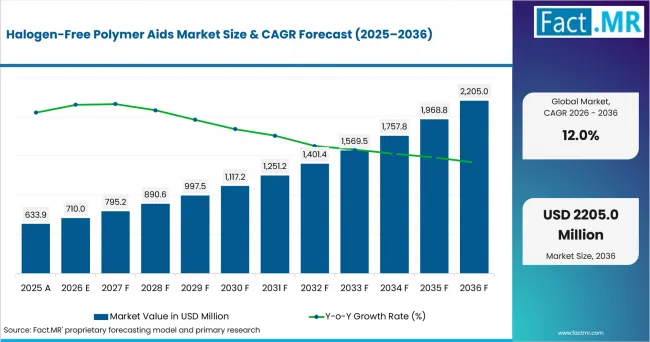
Halogen Free Polymer Aids Market Value Analysis | Source: Fact.MR
What are the defining numbers behind Halogen-Free Polymer Aids Market growth?
USD 1,495.0 million absolute opportunity by 2036, led by processing aids and polyolefins in wire and cable use.
- Demand Drivers in the Market
- Cable compounders need low-smoke systems that pass fire tests and maintain extrusion quality.
- Automotive material teams specify non-halogenated flame-retardant grades for connectors and terminal blocks. EIA reported in July 2026 that hybrid, battery-electric and plug-in hybrid vehicles made up 24% of U.S. light-duty sales in 2Q26.
- Packaging converters need processing aids that protect melt fracture control and seal behavior in polyolefin films. Clariant AG launched AddWorks PPA in June 2025 as PFAS-free polymer processing aids for polyolefin extrusion.
- Industrial goods manufacturers value additive packages that combine processing support with flame and thermal performance.
- Key Segments Analyzed
- By Product: Processing aids are expected to hold 36.0% share in 2026, supported by their role in reducing die build-up and preserving surface finish in filled compounds.
- By Polymer: Polyolefins are projected to account for 38.0% share in 2026 owing to their use in cable jackets, molded goods and flexible compounds.
- By Function: Flow improvement is anticipated to capture 35.0% share in 2026 since halogen-free additive loading can raise melt resistance during extrusion.
- By Application: Wire and cable is estimated to represent 37.0% share in 2026, led by low-smoke fire requirements in building, energy and transport wiring.
- Analyst Opinion at Fact.MR
- Shambhu Nath Jha. Principal Consultant at Fact.MR states, "Halogen-free polymer aids are moving from a compliance choice to a processing decision. Compounders are expected to ask for additives that reduce fire risk while protecting line speed and scrap control. Suppliers that pair formulation support with test data for PBT and elastomers are better placed in cable and e-mobility programs."
- Strategic Implications
- Additive suppliers should document fire testing, smoke behavior and processing windows for each polymer family before scaling customer trials.
- Cable compounders should qualify processing aids with the full filler system, since small changes in mineral loading can alter surface quality.
- Automotive material teams should test hydrolysis resistance and comparative tracking behavior in PBT parts before locking high-voltage connector specifications.
- Distribution partners should carry REACH, RoHS and customer restricted-substance documentation so regional compounders can complete qualification files faster.
The USA is expected to record 13.2% CAGR through 2036, supported by plastics investment and e-mobility wiring demand. Germany is projected to post 12.6% CAGR as electrical equipment orders and engineering-plastic qualification remain active. Japan is anticipated to advance at 11.8% CAGR, shaped by domestic production planning and automotive material discipline. France is estimated to record 11.3% CAGR as electric-vehicle registrations support specialty compounds. Brazil is forecast to reach 10.8% CAGR, supported by rubber and plastic production recovery with price-sensitive industrial channels.
How does the Halogen-Free Polymer Aids Market break down by segment?
Processing aids lead Product at 36.0%; polyolefins lead Polymer at 38.0%.
Which Product leads demand?
Processing aids hold 36.0% share in 2026.
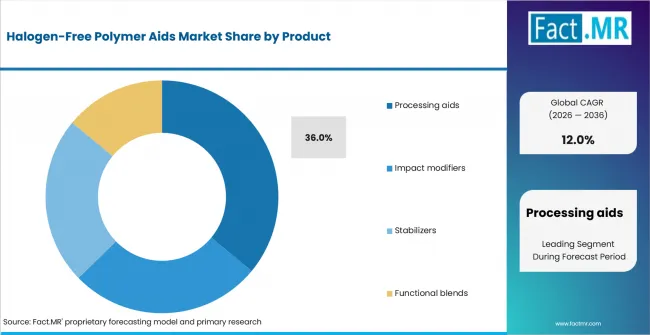
Halogen Free Polymer Aids Market Analysis By Product | Source: Fact.MR
Processing aids lead the product view since filled halogen-free compounds often place more stress on extrusion. Clariant AG launched its AddWorks PPA product line in June 2025 for PFAS-free polyolefin extrusion, with melt-fracture and die build-up control positioned as core functions. That development aligns closely with processing-aid demand in films and cable-related polyolefin compounds.
What leads the Polymer segment?
Polyolefins account for 38.0% share in 2026.
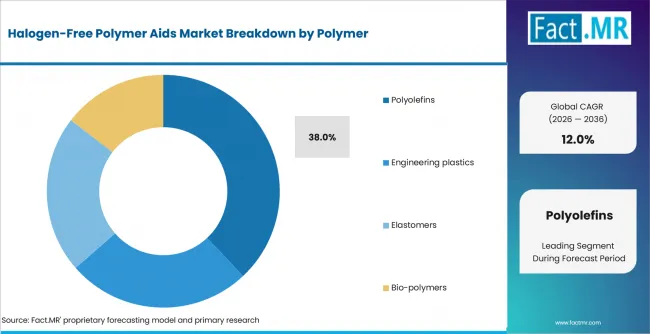
Halogen Free Polymer Aids Market Analysis By Polymer | Source: Fact.MR
Polyolefins hold the polymer lead since polyethylene and polypropylene compounds are common in cable jackets and flexible industrial goods. Mineral fillers and phosphorus chemistries can alter melt flow in these resins. Polymer aids help compounders hold line speed while the formulation moves toward low-smoke performance.
How does Function shape demand?
Flow improvement captures 35.0% share in 2026.
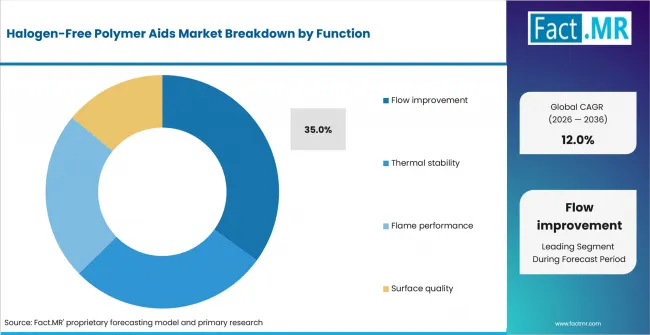
Halogen Free Polymer Aids Market Analysis By Function | Source: Fact.MR
Flow improvement leads the function view where processability is the main operating risk in filled halogen-free compounds. When additives raise friction in the melt, processors face lower line speed and poorer finish. Avient Corporation introduced Cesa MAX flame-retardant additives in September 2025 for polyethylene applications, with non-halogen formulations developed for stricter product-safety standards.
What supports Wire and cable within Application?
Wire and cable represents 37.0% share in 2026.
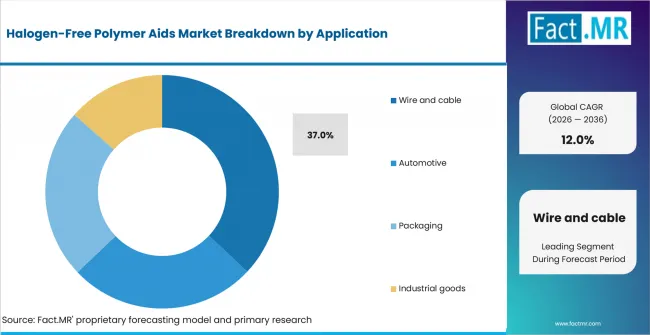
Halogen Free Polymer Aids Market Analysis By Application | Source: Fact.MR
Wire and cable leads application demand where low-smoke and halogen-free requirements directly influence insulation and jacket formulations. Defects can affect long production runs and field installation behavior. Polymer aids are therefore linked to fire performance and line reliability in the same qualification cycle.
Engineering plastics, elastomers and bio-polymers form the next polymer groups. engineering thermoplastics use halogen-free aids in high-heat connectors and housings. Elastomers need flexibility with low smoke, while bio-polymers create formulation work where stabilizers must protect thermal behavior during conversion.
What is accelerating Halogen-Free Polymer Aids Market adoption, and what is holding it back?
Demand is expected to rise through low-smoke fire specifications, e-mobility materials and antimony volatility; expansion is constrained by processing cost and qualification complexity.
Drivers Impact Analysis
| DRIVER | (~) % IMPACT ON CAGR | GEOGRAPHIC RELEVANCE | IMPACT TIMELINE |
|---|---|---|---|
| Wire and cable low-smoke specifications | +1.8% | North America, Europe, East Asia | Short term (<= 2 years) |
| E-mobility connector and terminal-block needs | +1.4% | USA, Germany, Japan, France | Medium term (2-4 years) |
| Antimony-free flame-retardant shift | +1.1% | Europe, North America, East Asia | Medium term (2-4 years) |
Source: Fact.MR analysis. Updated Aug 31, 2026
- Wire and cable low-smoke specifications: Cable producers need halogen-free additive packages that reduce smoke and corrosive gas risk while maintaining jacket extrusion quality and electrical performance.
- E-mobility connector and terminal-block needs: E-mobility applications are expected to support demand for non-halogenated flame-retardant materials in connectors, terminal blocks, inverter systems and motor components where thermal and electrical safety are important.
- Antimony-free flame-retardant shift: Manufacturers are expected to evaluate antimony-free flame-retardant systems where supply volatility, formulation flexibility and evolving material preferences influence additive selection.
Opportunity Impact Analysis
| OPPORTUNITY | (~) % IMPACT ON CAGR | GEOGRAPHIC RELEVANCE | IMPACT TIMELINE |
|---|---|---|---|
| PFAS-free processing aid substitution | +1.2% | Europe, North America, Asia | Short term (<= 2 years) |
| Localized engineering-plastic compounding | +0.9% | Asia, Latin America | Long term (>= 4 years) |
| Halogen-free TPEs for electrical goods | +0.7% | Europe, North America, Japan | Medium term (2-4 years) |
Source: Fact.MR analysis. Updated Aug 31, 2026
- PFAS-free processing aid substitution: Compounders are expected to shift toward fluoropolymer-free processing aids that support smoother polyolefin extrusion, reduce processing defects and align with evolving material requirements.
- Localized engineering-plastic compounding: Regional production of specialty engineering plastics is expected to improve supply responsiveness for automotive and electronics manufacturers seeking flame-retardant grades with consistent processing performance.
- Halogen-free TPEs for electrical goods: Halogen-free flame-retardant thermoplastic elastomers are expected to gain use across automotive, electronics, construction and consumer goods where electrical safety, flexibility and material compliance guide formulation choices.
Restraints Impact Analysis
| RESTRAINT | (~) % IMPACT ON CAGR | GEOGRAPHIC RELEVANCE | IMPACT TIMELINE |
|---|---|---|---|
| Higher additive loading in mineral-filled systems | -0.8% | Global | Short term (<= 2 years) |
| Long customer qualification cycles | -0.6% | USA, Europe, Japan | Medium term (2-4 years) |
| Raw-material price and supply exposure | -0.4% | Global | Medium term (2-4 years) |
Source: Fact.MR analysis. Updated Aug 31, 2026
- Higher additive loading in mineral-filled systems: Halogen-free systems can require higher filler or synergist loading, increasing compound viscosity and placing greater emphasis on processing efficiency and formulation balance.
- Long customer qualification cycles: Wire, cable and e-mobility applications require fire, aging and electrical testing before new polymer-aid packages are approved, extending formulation and validation timelines.
- Raw-material price and supply exposure: Polymer-aid suppliers and compounders remain sensitive to input-cost and supply changes, increasing the importance of formulation flexibility, sourcing resilience and cost control during product qualification.
Which countries are scaling the Halogen-Free Polymer Aids Market through 2036?
- The country comparison spans 2.4 percentage points across the listed markets.
- The USA remains 0.6 percentage point above Germany through plastics investment and e-mobility material qualification.
- Germany remains 0.8 percentage point above Japan, reflecting electrical equipment orders and engineering-plastic approval work.
- Japan stays 0.5 percentage point above France, supported by production discipline in automotive and electronics materials.
- France remains 0.5 percentage point above Brazil as electric-vehicle registrations raise demand for lower-smoke specialty compounds.
Comparable CAGRs create different entry conditions due to resin mix, cable standards and local compounder capabilities. Full report coverage includes North America; Latin America; Western Europe; Eastern Europe; East Asia; South Asia & Pacific; Middle East & Africa.
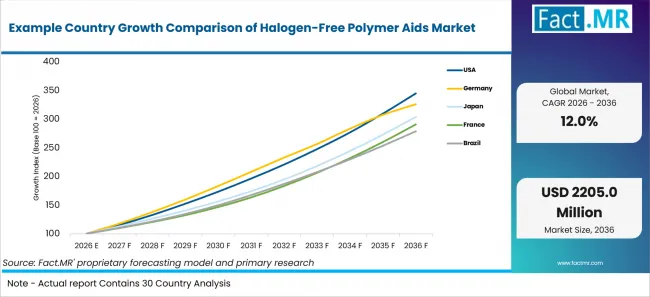
Example Country Growth Comparison Of Halogen Free Polymer Aids Market | Source: Fact.MR
| Country | CAGR |
|---|---|
| United States | 13.2% |
| Germany | 12.6% |
| Japan | 11.8% |
| France | 11.3% |
| Brazil | 10.8% |
Source: Fact.MR analysis. Updated Aug 31, 2026
What supports USA adoption?
13.2% CAGR, supported by plastics investment and e-mobility wiring demand.
U.S. compounders are expected to adopt halogen-free polymer aids where cable, electronics and EV material programs need low-smoke performance with stable extrusion. BEA reported in June 2026 that new direct investment in U.S. plastics and rubber products manufacturing reached USD 19.0 billion in 2025.
What supports Germany adoption?
12.6% CAGR, shaped by electrical-equipment orders and engineering-plastic qualification.
Germany is expected to scale through electrical equipment, automotive connectors and engineered plastic components that require tight substance documentation. Destatis reported in February 2026 that German electrical equipment orders rose 9.8% month over month in December 2025.
How does Japan perform?
11.8% CAGR, led by production planning and automotive material discipline.
Japan is projected to advance through disciplined material approval in automotive, electrical and precision industrial parts. METI reported in February 2026 that Japan industrial production rose 2.2% month over month in January 2026, with plastics products among the sectors that contributed to the rise.
What supports France growth?
11.3% CAGR, backed by electric-vehicle registrations and low-smoke materials demand.
France is estimated to grow through electric-vehicle wiring, charging hardware and transport-equipment components that need safer polymer packages. SDES reported in August 2026 that electric cars accounted for 35.1% of French new-car sales in July 2026.
How is Brazil scaling demand?
10.8% CAGR, supported by industrial recovery with price-sensitive compounders.
Brazil is forecast to expand from a smaller base as wire, cable, packaging and industrial goods producers align local compounds with export customer expectations. IBGE reported in August 2025 that Brazilian rubber and plastic products output increased 1.4% month over month in June 2025.
Who leads the Halogen-Free Polymer Aids Market?
BASF SE participates through flame-retardant engineering plastics used in electrical and e-mobility components. Its January 2025 Ultramid® T6000 development demonstrates the use of non-halogenated flame-retardant PPA in EV terminal blocks, combining electrical isolation with reduced metal-corrosion risk. Clariant AG participates through non-halogenated Exolit® OP flame retardants and PFAS-free AddWorks™ PPA polymer-processing aids.
Evonik Industries AG contributes polymer-processing additive technologies, while ADEKA CORPORATION supplies ADK STAB™ halogen-free flame retardants, including its FP Series highlighted for PLASTINDIA 2026. SONGWON INDUSTRIAL CO., LTD. participates through its polymer-stabilizer and specialty-chemicals portfolio showcased at K 2025. Avient Corporation adds flame-retardant material capabilities through Cesa™ additives, including non-halogenated Cesa™ MAX solutions, and OnFlex™ NHFR non-halogen flame-retardant TPEs.
Which companies are the key providers?
Key companies include BASF SE; Clariant AG; Evonik Industries AG; ADEKA CORPORATION; SONGWON Industrial Co., Ltd.; and Avient Corporation.
- BASF SE
- Clariant AG
- Evonik Industries AG
- ADEKA CORPORATION
- SONGWON Industrial Co., Ltd.
- Avient Corporation
Bibliography
- U.S. Bureau of Economic Analysis. (2026, June 10). New foreign direct investment in the United States, 2025.
- U.S. Energy Information Administration. (2026, July 27). Hybrid sales rise while battery electric sales remain lower after tax credit expiration.
- Federal Statistical Office (Destatis). (2026, February 5). New orders in manufacturing in December 2025: +7.8% on the previous month.
- Federal Statistical Office (Destatis). (2026, August 20). Producer prices in July 2026: +3.0% on July 2025.
- Service des données et études statistiques. (2026, August 5). Motorisations des véhicules légers neufs - Émissions de CO₂ et bonus écologique - Juillet 2026.
- Brazilian Institute of Geography and Statistics. (2025, August 1). After two drops in a row, industry changes 0.1% in June. IBGE News Agency.
- Clariant. (2025, June 5). Clariant launches innovative PFAS-free polymer processing aids for more sustainable polyolefin extrusion.
- Clariant. (2026, June 5). Clariant increases capacity in Daya Bay facility and expands Exolit™ OP portfolio for e-mobility.
- Avient Corporation. (2025, September 16). New Cesa™ MAX flame retardant additives developed by Avient for strict industry standards.
- Avient Corporation. (2026, February 3). Avient expands non-halogen flame-retardant TPE portfolio with OnFlex™ NHFR 7001 Series.
- BASF SE. (2025, January 13). BASF launches innovative Ultramid® T6000 grade for electric vehicle applications.
- BASF SE. (2025, November 13). BASF scales up in India with Ultradur® PBT to meet rising market demand.
- Evonik Industries AG. (2025, October 1). Evonik to showcase latest innovations and sustainability initiatives in polymer chemistry at K 2025.
- ADEKA Corporation. (2026, January 22). To Join PLASTINDIA 2026.
- SONGWON Industrial Group. (2025, October 1). SONGWON presents its sustainability-driven progress at K 2025.
This Report Answers
- The report explains where halogen-free polymer aids are used across product, polymer, function and application segments.
- Segment analysis identifies the leading subsegments and the operating reasons processors prioritize them.
- Country analysis examines the listed markets and the manufacturing mechanisms supporting adoption.
- Competitive analysis reviews current providers across flame-retardant additives, stabilizers, process aids and compound solutions.
- Application analysis assesses how fire performance, processability and qualification needs influence supplier selection.
What does the Halogen-Free Polymer Aids Market cover?
The Halogen-Free Polymer Aids Market covers additive systems that help polymers meet fire and processing requirements using non-halogenated packages. It includes processing aids and impact modifiers. Stabilizers and functional blends are covered when used in compound development for cable or automotive goods. Adjacent material coverage includes plastic antioxidants where thermal and oxidative protection influence compound performance.
The assessment covers polyolefins and engineering plastics. Elastomers and bio-polymers are reviewed where processability and flame performance stay within the same material package. Adjacent category checks include formulation additives where additive selection changes converter economics.
What is included in the scope?
The scope includes commercial additives used to improve flow and thermal stability in halogen-free polymer compounds. Flame performance and surface quality functions are covered when sold as polymer aids. Related upstream and downstream categories include compatibilizer additives where blend performance affects resin acceptance.
The scope includes products used in low-smoke cable jackets and flame-retardant engineering plastics. Flexible elastomer parts and industrial goods are included when the additive supports halogen-free formulation. Electrical safety overlap appears in EV control unit flame retardant compounds where connector housings and control units both depend on flame-rated polymers.
Application overlap is visible in automotive additives where lighter components and electrical safety standards raise the value of additive packages.
What is excluded from the scope?
The scope excludes finished cables, molded automotive parts, base resins sold separately and commodity mineral fillers sold purely by weight. Flame-retardant compounds are treated outside scope when the aid is neither sold nor valued separately.
Standalone halogenated flame retardants are outside the boundary. General PVC additives and heat stabilizers are reviewed only where the chemistry overlaps with halogen-free polymer-aid functionality.
How Was the Analysis Built?
The analysis draws on 120+ sources, 35+ company portfolios, 25+ countries, and more than 20 industry interviews.
- Primary Research: Primary research includes discussions with manufacturers, service providers, technology developers, distributors, end users, and subject-matter experts. These conversations examine purchasing priorities, product adoption, operational challenges, approval requirements, competitive positioning, and the factors that influence wider market acceptance.
- Desk Research: Desk research covers government statistics, regulatory publications, company filings, trade data, technical studies, industry associations, standards, public policy, and other authoritative sources. Every source used in the analysis is documented in the bibliography.
- Market Sizing and Forecasting: Market estimates combine historical performance, demand indicators, pricing and volume trends, segment shares, company participation, country-level growth, adoption patterns, investment activity, and barriers to market expansion.
- Data Validation and Update Cycle: Findings are validated by comparing primary interviews with public data, company activity, regulatory changes, trade patterns, and industry developments. Regular updates review new product launches, capacity changes, partnerships, approvals, and shifts in commercial adoption.
Segmentation
What is the report's scope and coverage?
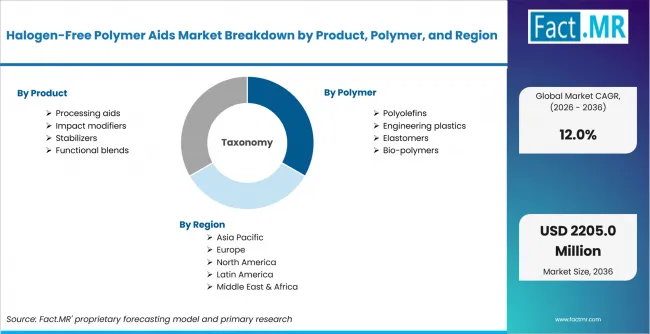
Halogen Free Polymer Aids Market Breakdown By Product, Polymer, And Region | Source: Fact.MR
| Attribute | Details |
|---|---|
| Quantitative Units | USD million |
| Market Definition | Polymer aids and additive systems used to improve processing, stability, flame performance and surface quality in halogen-free polymer compounds. |
| Product | Processing aids; Impact modifiers; Stabilizers; Functional blends |
| Polymer | Polyolefins; Engineering plastics; Elastomers; Bio-polymers |
| Function | Flow improvement; Thermal stability; Flame performance; Surface quality |
| Application | Wire and cable; Automotive; Packaging; Industrial goods |
| Regions Covered | North America; Latin America; Western Europe; Eastern Europe; East Asia; South Asia & Pacific; Middle East & Africa |
| Countries Covered | United States; Germany; Japan; France; Brazil |
| Key Companies Profiled | BASF SE; Clariant AG; Evonik Industries AG; ADEKA CORPORATION; SONGWON Industrial Co., Ltd.; Avient Corporation |
| Forecast Period | 2026 to 2036 |
| Approach | Hybrid top-down and bottom-up approach using additive demand by product, polymer mix, application exposure, country adoption and company portfolio review. |
Source: Fact.MR analysis. Updated Aug 31, 2026
How is the market segmented?
-
By Product:
- Processing aids
- Impact modifiers
- Stabilizers
- Functional blends
-
By Polymer:
- Polyolefins
- Engineering plastics
- Elastomers
- Bio-polymers
-
By Function:
- Flow improvement
- Thermal stability
- Flame performance
- Surface quality
-
By Application:
- Wire and cable
- Automotive
- Packaging
- Industrial goods
-
By Region:
- North America
- Latin America
- Western Europe
- Eastern Europe
- East Asia
- South Asia & Pacific
- Middle East & Africa
Frequently Asked Questions
How big is the halogen-free polymer aids market in 2026?
What is the CAGR of the halogen-free polymer aids market from 2026 to 2036?
Which product leads the halogen-free polymer aids market?
Which polymer leads the halogen-free polymer aids market?
Who are the leading companies in the halogen-free polymer aids market?
Who worked on this report


Preview the report firsthand - request a free sample
Free SampleGet the brochure for pricing and purchase details
Download PDF