- Market Value (2025): USD 2.5 Bn
- Estimated Value (2026): USD 2.7 Bn
- Forecast Value (2036): USD 5.9 Bn
- CAGR (2026-2036): 8.3%
What is the Halogen-Free PBT Grades Market forecast to be worth by 2036?
USD 2.7 billion in 2026 to USD 5.9 billion by 2036 at an 8.3% CAGR.
- The Halogen-Free PBT Grades Market reached approximately USD 2.5 billion in 2025.
- Demand is projected to increase from USD 2.7 billion in 2026 to USD 5.9 billion by 2036.
- The 2026 to 2036 outlook is supported by higher electrical content in vehicles, tighter fire-performance requirements and material specifications that increasingly avoid intentionally added brominated or chlorinated flame retardants.
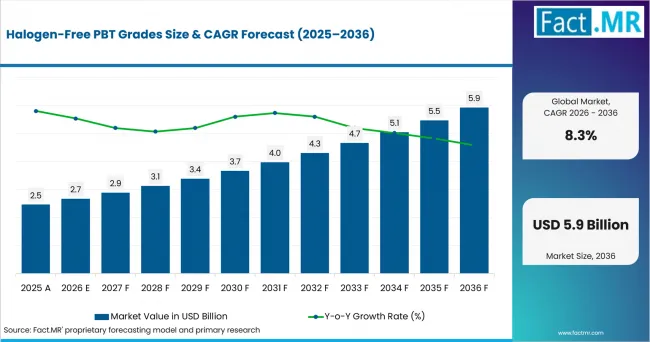
Halogen Free Pbt Grades Value Analysis | Source: Fact.MR
What are the defining numbers behind Halogen-Free PBT Grades Market growth?
The market is expected to create an absolute opportunity of approximately USD 3.3 billion between 2026 and 2036.
- Demand Drivers in the Market
- Halogen-free has become a material-selection requirement in parts of the electronics supply chain, even where regulation does not ban every halogenated flame retardant. IEC 61249-2-21 defines non-halogenated materials using bromine and chlorine limits, and Renesas states that customer requests have driven wider use of halogen-free semiconductor packaging materials. This pushes component makers to qualify engineering plastics that meet similar low-halogen expectations.
- Higher-voltage electrical systems raise the value of tracking resistance and thin-wall flame performance. Clariant lists phosphinate systems for PBT that can reach UL 94 V-0 with CTI values up to 600 V, including formulations for high-voltage e-vehicle connectors. This creates a direct materials requirement inside high-power connectors where the polymer has to insulate closely spaced live parts.
- EV electronics expose PBT to heat, moisture and repeated electrical loading. LANXESS offers hydrolysis-stabilized halogen-free flame-retardant Pocan grades, while Celanese markets Crastin PBT for sensors and electronic components used in e-mobility. The same design pressure is visible across EV components as more connectors, sensors and power-control parts are added per vehicle.
- Miniaturization keeps the fire test difficult. BASF's halogen-free Ultradur B4441 G5 reaches UL 94 V-0 at 0.4 mm and passes a 775 °C GWIT test, showing why compounders compete on flame performance at thin section rather than on halogen content alone.
- Key Segments Analyzed
- By Grade: Flame-retardant halogen-free PBT accounts for 44.0% share in 2026 because electrical parts need the resin to meet both ignition resistance and low-halogen material specifications.
- By FR Chemistry: Phosphorus-based systems hold 39.0% share in 2026, supported by phosphinate chemistry that can deliver V-0 performance while retaining strong electrical tracking resistance.
- By Application: Electrical connectors represent 31.0% share in 2026 because connector housings require insulation, dimensional stability and reliable flame performance in compact geometries.
- By Reinforcement: 30% glass fiber accounts for 34.0% share in 2026 as higher reinforcement improves stiffness and dimensional control in connectors, housings and other load-bearing electrical parts.
- Analyst Opinion at Fact.MR
- Shambhu Nath Jha, Senior Consultant, Fact.MR, states, "The design problem is harder than replacing one flame retardant with another. A halogen-free PBT grade still has to mold cleanly, hold connector dimensions and maintain insulation after heat or moisture exposure. Grades that combine V-0 performance with high CTI and hydrolysis resistance are better positioned for electrical and mobility programs."
- Strategic Implications
- Compounders should design halogen-free grades around the end part rather than treat flame retardancy as a standalone additive problem. Connector pitch, wall thickness and operating voltage change the required CTI and flame performance.
- Automotive material suppliers need hydrolysis data alongside UL 94 results because connectors and sensor housings can sit in hot, humid locations for long service periods.
- Phosphorus-based systems create room to move away from bromine and antimony, but formulation loading affects density and mechanical balance. Suppliers that can retain flow and stiffness at lower loading have an advantage within halogen-free systems.
- Electrical buyers also compare PBT with other engineering thermoplastics. PBT keeps its position where rapid molding, low moisture uptake and dimensional stability matter more than the temperature ceiling offered by higher-cost polymers.
How does the Halogen-Free PBT Grades Market break down by segment?
The market is segmented by Grade, FR Chemistry, Application and Reinforcement.
Why does Flame-retardant halogen-free PBT lead Grade?
Flame-retardant halogen-free PBT accounts for 44.0% of Grade in 2026.
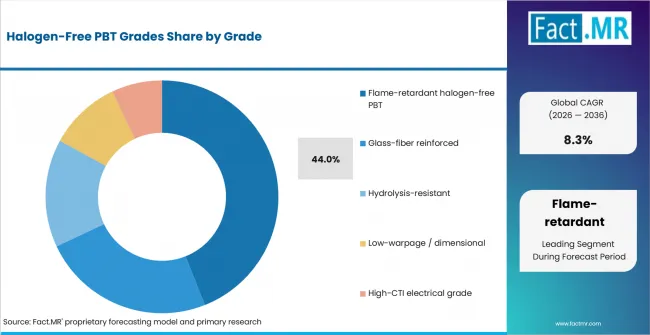
Halogen Free Pbt Grades Analysis By Grade | Source: Fact.MR
The category addresses the core qualification requirement for many electrical parts: the polymer has to resist ignition without an intentionally added brominated or chlorinated flame-retardant package. BASF offers halogen-free Ultradur grades for plug connectors, switches and appliance components, and Polyplastics lists DURANEX 201NF as a halogen-free V-0 PBT grade with higher comparative tracking index.
That combination makes the segment more valuable than a simple 'green' resin label. Buyers still need electrical and mechanical performance that fits automated molding. The broader PBT market therefore remains the base from which halogen-free grades are selected for higher-specification applications.
Why does Phosphorus-based lead FR Chemistry?
Phosphorus-based systems account for 39.0% of FR Chemistry in 2026.
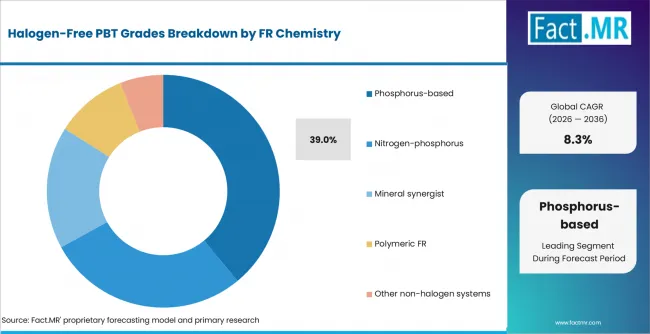
Halogen Free Pbt Grades Analysis By Fr Chemistry | Source: Fact.MR
Phosphinates are effective in PBT because they can work in both gas and condensed phases while avoiding a brominated flame-retardant package. Clariant's Exolit OP 1240 and OP 1248 are designed for polyester injection molding, and current PBT formulations can reach UL 94 V-0 at thin section with CTI values suited to electrical applications.
The buyer benefit is electrical performance after flame retardant is added. High CTI helps prevent surface tracking between conductive paths, which is important when connector spacing falls or operating voltage rises. Nitrogen-phosphorus blends and mineral synergists remain important because they can improve efficiency or processing, but phosphorus provides the main flame-retardant backbone in the leading chemistry set.
Why do Electrical connectors lead Application?
Electrical connectors account for 31.0% of Application in 2026.
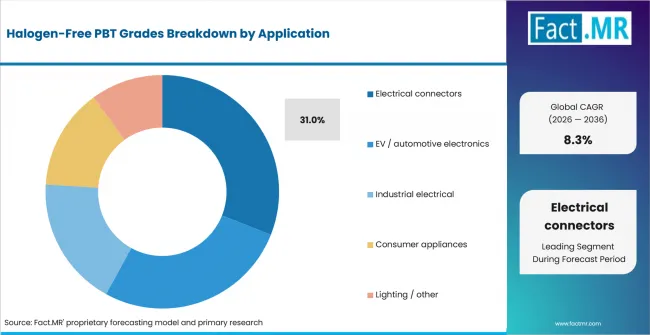
Halogen Free Pbt Grades Analysis By Application | Source: Fact.MR
PBT is well matched to connector housings because it absorbs little moisture, holds molded dimensions and provides electrical insulation. BASF identifies plug connectors as a target application for halogen-free Ultradur, while Mitsubishi Chemical's NOVADURAN portfolio includes halogen-free high-CTI grades with 15% and 30% glass reinforcement.
Connector programs also create repeat volume. A vehicle, appliance or industrial control system can contain many separate connector bodies, each requiring stable terminal position after molding and during thermal cycling. Halogen-free PBT gains specification when the same grade can meet V-0 requirements without sacrificing that dimensional control.
Why does 30% glass fiber lead Reinforcement?
30% glass fiber accounts for 34.0% of Reinforcement in 2026.
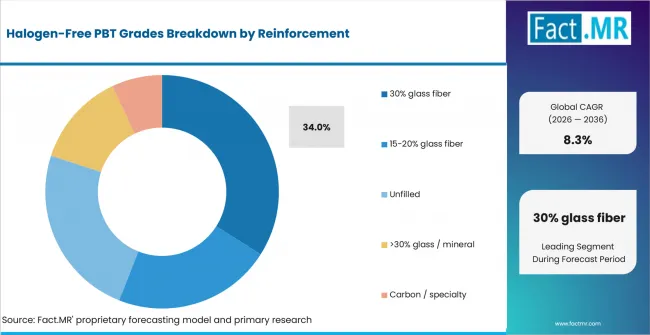
Halogen Free Pbt Grades Analysis By Reinforcement | Source: Fact.MR
Thirty-percent glass reinforcement gives PBT the stiffness needed for housings and connector bodies that must maintain terminal geometry under heat and mechanical load. Mitsubishi Chemical's current NOVADURAN range includes SEF-530, a halogen-free GF30 PBT grade with higher tracking resistance and a V-0 rating at 0.75 mm.
The trade-off is processing and toughness. Lower glass levels can improve flow or impact response, while unfilled grades suit parts with lighter structural demand. The 30% range remains important where molded precision and rigidity carry more weight than flexibility.
What is accelerating Halogen-Free PBT Grades Market adoption, and what is holding it back?
Adoption is being accelerated by the combination of low-halogen material policies and higher electrical stress in compact components. Electronics makers want plastics that can pass flame tests while automotive and charging applications add requirements for CTI, hydrolysis resistance and dimensional stability.
The main restraint is formulation compromise. Halogen-free flame-retardant packages can increase compound cost and may reduce flow or mechanical performance if loading is too high. Qualification also takes time because buyers test flame rating, tracking resistance and long-term ageing on the actual molded geometry rather than accepting a chemistry claim by itself.
Drivers Impact Analysis
| DRIVER | (~) % IMPACT ON CAGR | GEOGRAPHIC RELEVANCE | IMPACT TIMELINE |
|---|---|---|---|
| Low-halogen material specifications in electronics | +1.5% | Europe, Japan, South Korea, USA | Short term (<= 2 years) |
| Higher-voltage connector and EV electrical architectures | +1.3% | Germany, USA, Japan, South Korea, UK | Medium term (2-4 years) |
| Thin-wall UL 94 and glow-wire performance requirements | +1.0% | Global electrical and appliance manufacturing | Medium term (2-4 years) |
| Hydrolysis-resistant PBT demand around mobility electronics | +0.8% | Germany, Japan, USA, South Korea | Long term (>= 4 years) |
Source: Fact.MR analysis. Updated Sep 9, 2026
Opportunity Impact Analysis
| OPPORTUNITY | (~) % IMPACT ON CAGR | GEOGRAPHIC RELEVANCE | IMPACT TIMELINE |
|---|---|---|---|
| High-CTI halogen-free grades for EV charging connectors | +0.9% | USA, Germany, UK | Short term (<= 2 years) |
| Hydrolysis-stable grades for sensors and underhood electronics | +0.7% | Japan, Germany, South Korea | Medium term (2-4 years) |
| Low-warpage halogen-free PBT for compact electrical housings | +0.6% | East Asia, Europe | Medium term (2-4 years) |
Source: Fact.MR analysis. Updated Sep 9, 2026
Restraints Impact Analysis
| RESTRAINT | (~) % IMPACT ON CAGR | GEOGRAPHIC RELEVANCE | IMPACT TIMELINE |
|---|---|---|---|
| Cost premium versus established halogenated FR compounds | -0.5% | Global | Short term (<= 2 years) |
| Mechanical and flow trade-offs at higher FR loading | -0.4% | Connector and thin-wall applications | Medium term (2-4 years) |
| Long qualification cycles for flame, CTI and ageing performance | -0.3% | Automotive and regulated electrical programs | Medium term (2-4 years) |
Source: Fact.MR analysis. Updated Sep 9, 2026
Which countries are scaling the Halogen-Free PBT Grades Market through 2036?
- Germany: Electric vehicles represented 40% of German passenger-car production in 2025, increasing the number of high-voltage connectors, sensors and power-electronic housings that require stable insulating materials.
- Japan: METI is supporting domestic supply capacity for advanced electronic components, including 2026 plans involving TDK and Alps Alpine. This sustains local demand for qualified insulating polymers used around compact electrical parts.
- USA: The U.S. Alternative Fuels Data Center lists more than 190,000 public charging ports and several connector formats. Charging hardware expands the installed base of power connectors that need flame-resistant insulating materials.
- South Korea: Semiconductor and advanced-electronics investment continues around the Yongin cluster, where power and water infrastructure is being built for new production capacity. Equipment and facility buildout adds demand for electrical insulation and connector materials.
- UK: Battery-electric vehicles accounted for 25.6% of UK new-car registrations through August 2026, while plug-in hybrids accounted for 13.3%. A broader electrified vehicle mix increases connector and control-electronics content.
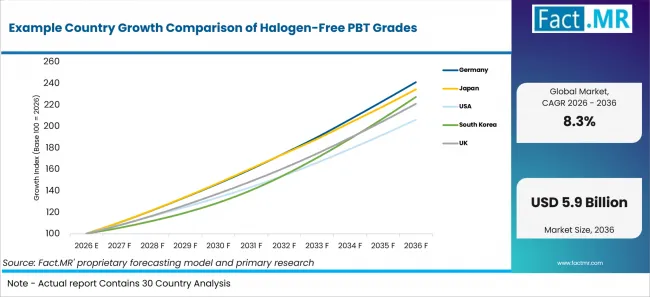
Example Country Growth Comparison Of Halogen Free Pbt Grades | Source: Fact.MR
Country CAGR (2026-2036)
| Country | CAGR (2026-2036) |
|---|---|
| Germany | 9.2% |
| Japan | 8.9% |
| USA | 7.5% |
| South Korea | 8.6% |
| UK | 8.3% |
Source: Fact.MR analysis. Updated Sep 9, 2026
What is driving Germany's growth through 2036?
Germany is projected to record a 9.2% CAGR from 2026 to 2036.
VDA reported 1.67 million electric passenger cars produced in Germany in 2025. By August 2026, electric registrations had reached 735,364 units for the year to date. That keeps vehicle electrical architecture under active redesign as OEMs add high-voltage charging, battery and power-distribution functions.
Halogen-free PBT is used where those systems need molded connector bodies with V-0 flame performance, high tracking resistance and dimensional stability. Germany also hosts polymer and electrical-component suppliers that can support material qualification close to OEM engineering teams.
What is driving Japan's growth through 2036?
Japan is projected to record an 8.9% CAGR from 2026 to 2036.
Japan combines an established automotive manufacturing base with domestic electronic-component production. METI's 2026 supply-assurance plans for advanced electronic components include TDK and Alps Alpine, reflecting continued investment in components used across power, sensing and control systems.
Material availability supports that ecosystem. Mitsubishi Chemical's current NOVADURAN PBT portfolio includes halogen-free high-CTI grades such as SEF-530 and SEF-515T for reinforced electrical parts. This gives Japanese component makers access to locally supported compounds for connector and housing qualification.
What is driving USA growth through 2036?
USA is projected to record a 7.5% CAGR from 2026 to 2036.
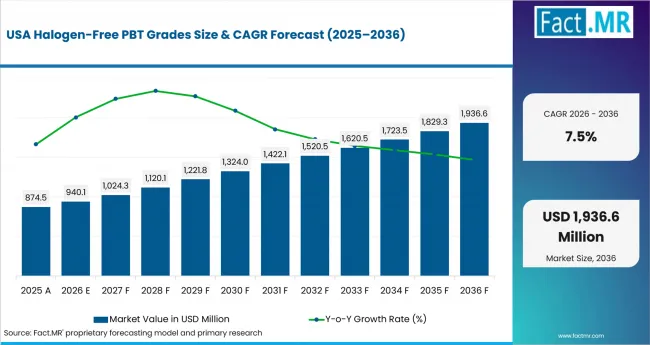
Halogen Free Pbt Grades Country Value Analysis | Source: Fact.MR
The U.S. charging network creates a direct connection between electrification and connector materials. The Alternative Fuels Data Center reports more than 190,000 public charging ports and identifies J1772, CCS and NACS among the connector formats used across charging levels.
Charging and vehicle electronics require insulation materials that tolerate heat and electrical stress around power contacts. Halogen-free PBT grades gain demand when connector suppliers need V-0 performance while maintaining tracking resistance and molded dimensional control.
What is driving South Korea's growth through 2036?
South Korea is projected to record an 8.6% CAGR from 2026 to 2036.
South Korea is expanding semiconductor and electronics production infrastructure. The Ministry of Trade, Industry and Energy has described the Yongin semiconductor cluster as a major new production base, with power and water infrastructure being developed ahead of commercial operation.
The material opportunity extends beyond chip packaging. New fabs, test equipment and factory automation require connectors, switches and control components that use flame-retardant engineering plastics. Automotive electrification adds another demand path through sensor and power-distribution components.
What is driving UK's growth through 2036?
UK is projected to record an 8.3% CAGR from 2026 to 2036.
SMMT data show that battery-electric registrations reached 355,746 units through August 2026, while plug-in hybrids reached 185,198 units. Electrified models therefore represent a growing share of the vehicle mix entering UK use and service.
That shift increases the number of high-voltage connectors, charging interfaces and control modules that require flame-resistant insulation. The UK market also benefits from domestic vehicle production programs that continue to add electrified models, creating qualification work for connector and electronics suppliers.
Who Leads the Halogen-Free PBT Grades Market?
Key players in the Halogen-Free PBT Grades Market include BASF, Celanese, LANXESS, SABIC, Mitsubishi Chemical and Polyplastics. Competition is shaped by thin-wall flame rating, CTI, hydrolysis stability and the ability to supply reinforced grades in electrical-industry colours.
BASF offers halogen-free Ultradur grades for connectors and appliance components. Celanese brings Crastin PBT grades for e-mobility sensors and electrical parts, while LANXESS combines halogen-free flame retardancy with hydrolysis-resistant Pocan formulations. Polyplastics lists halogen-free high-CTI DURANEX grades, and SABIC maintains a broad VALOX flame-retardant PBT portfolio.
Mitsubishi Chemical acquired the NOVADURAN PBT business from Mitsubishi Engineering-Plastics in 2023. NOVADURAN PBT is now marketed by Mitsubishi Chemical, including halogen-free 15% and 30% glass-reinforced high-CTI grades.
Which companies are the key providers?
BASF, Celanese, LANXESS, SABIC, Mitsubishi Chemical and Polyplastics are the key providers included in the market analysis.
- BASF
- Celanese
- LANXESS
- SABIC
- Mitsubishi Chemical
- Polyplastics
Bibliography
- International Electrotechnical Commission. (2003). IEC 61249-2-21: Materials for printed boards and other interconnecting structures, Part 2-21. IEC.
- International Electrotechnical Commission. (2021). IEC 60695-2-13: Glow-wire ignition temperature test method for materials. IEC.
- International Electrotechnical Commission. (2026). IEC 60695-2-10: Glow-wire apparatus and common test procedure. IEC.
- European Commission. (n.d.). RoHS Directive. European Commission.
- Renesas Electronics. (n.d.). Statement on Halogen-free Products. Renesas Electronics.
- BASF. (n.d.). Engineering Plastics for the E&E Industry: Ultradur PBT. BASF.
- BASF. (n.d.). Ultradur Product Brochure. BASF.
- Celanese. (n.d.). Crastin and Celanex Polybutylene Terephthalate. Celanese.
- Celanese. (n.d.). Crastin PBT Hydrolysis-Resistant Portfolio Advances Sensors and Electronic Components for E-Mobility. Celanese.
- LANXESS. (2022). Pocan E: New PBT product range with outstanding tracking resistance. LANXESS.
- Clariant. (2026). Exolit OP flame retardants for engineering plastics. Clariant.
- Clariant. (2026). Exolit OP 1248. Clariant.
- Clariant. (2026). Exolit OP 1260. Clariant.
- Polyplastics. (n.d.). DURANEX PBT Grade Catalogue. Polyplastics.
- Mitsubishi Chemical Group Corporation. (2023, April 3). Completion of Transfer of 25% of Shares of Mitsubishi Engineering-Plastics Corporation and Reinforcement of Engineering Plastic Business in the MCG Group. Mitsubishi Chemical Group Corporation.
- Mitsubishi Chemical Corporation. (n.d.). NOVADURAN Polybutylene Terephthalate Resin. Mitsubishi Chemical Corporation.
- SABIC. (n.d.). VALOX FR Resins. SABIC.
- Verband der Automobilindustrie. (2026, February 3). New record: 40% electric share of passenger car production in 2025. VDA.
- Verband der Automobilindustrie. (2026). Monthly figures: August 2026. VDA.
- U.S. Department of Energy, Alternative Fuels Data Center. (n.d.). Electric Vehicles for Consumers. U.S. Department of Energy.
- U.S. Department of Energy, Alternative Fuels Data Center. (n.d.). Electric Vehicle Charging Networks. U.S. Department of Energy.
- Ministry of Economy, Trade and Industry, Japan. (2026). Advanced Electronic Components Supply Assurance Plans. Government of Japan.
- Ministry of Trade, Industry and Energy, Republic of Korea. (2024). Public and Private Sectors Join Hands in Establishing the Yongin Semiconductor Cluster. Government of the Republic of Korea.
- Society of Motor Manufacturers and Traders. (2026). Electric Vehicle Data. SMMT.
- Society of Motor Manufacturers and Traders. (2026, August 27). UK vehicle production down as pressures persist. SMMT.
This Report Answers
- The report explains why halogen-free PBT is being specified in electrical and mobility components.
- It examines how flame rating, tracking resistance and hydrolysis stability affect grade selection.
- Segment analysis covers Grade, FR Chemistry, Application and Reinforcement.
- Country analysis separates demand mechanisms in Germany, Japan, USA, South Korea and UK.
- Competitive analysis reviews current supplier capability and the transfer of NOVADURAN PBT to Mitsubishi Chemical.
What does the Halogen-Free PBT Grades Market cover?
The market covers PBT compounds sold for applications that require flame retardancy or electrical performance without an intentionally added brominated or chlorinated flame-retardant system. Revenue is counted when the PBT grade is sold as an unfilled or reinforced molding compound for electrical connectors, automotive electronics, industrial electrical equipment, appliances and lighting or other electrical uses.
The analysis follows grade function, flame-retardant chemistry, application and reinforcement level. Both standard halogen-free grades and higher-performance variants such as hydrolysis-resistant, low-warpage or high-CTI grades are included when they meet the market definition.
What is included in the scope?
Included grades are flame-retardant halogen-free PBT, glass-fiber reinforced PBT, hydrolysis-resistant grades, low-warpage or dimensional grades and high-CTI electrical grades.
Included flame-retardant chemistries are phosphorus-based, nitrogen-phosphorus systems, mineral synergists, polymeric flame retardants and other non-halogen systems. Applications include electrical connectors, EV or automotive electronics, industrial electrical equipment, consumer appliances, lighting and other electrical uses.
What is excluded from the scope?
Standard PBT grades with no halogen-free requirement are outside the market, as are polyamide, polycarbonate, PPS and other engineering polymers even when they use non-halogenated flame retardants.
Standalone flame-retardant additives are excluded unless they are sold as part of the finished PBT compound. PBT film, fiber and packaging applications are also outside the scope when the material is not sold as a halogen-free engineering grade for the applications defined here.
How Was the Analysis Built?
- Primary Research: Discussions focus on PBT compounders, electrical connector manufacturers, automotive Tier suppliers, appliance component makers, polymer distributors and material engineers responsible for flame-retardant qualification.
- Desk Research: The analysis uses IEC fire-test standards, substance-restriction guidance, company technical literature, vehicle and charging data, electronics-industry investment records and current product portfolios.
- Market Sizing and Forecasting: Sizing uses PBT compound revenue, halogen-free penetration, application mix, reinforcement level and grade price. Forecasting considers connector demand, vehicle electrification, electronics production, material substitution, qualification cycles and the shift from halogenated to non-halogen flame-retardant systems.
- Data Validation and Update Cycle: Findings are checked against new PBT grades, UL and glow-wire performance, high-CTI requirements, EV and charging activity, electronics manufacturing investment and changes in company product ownership.
Segmentation
What is the report's scope and coverage?
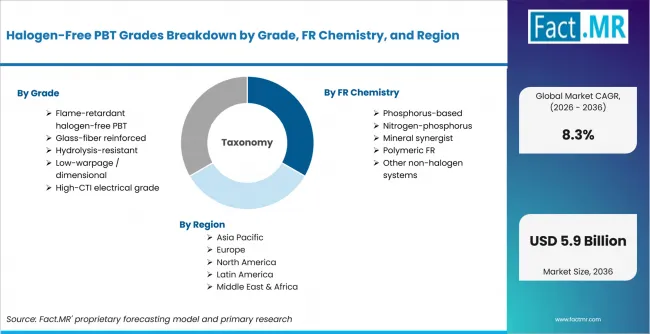
Halogen Free Pbt Grades Breakdown By Grade, Fr Chemistry, And Region | Source: Fact.MR
| Attribute | Details |
|---|---|
| Quantitative Units | USD Billion |
| Market Definition | PBT compounds engineered for electrical and mobility applications requiring halogen-free flame retardancy or related high-specification electrical performance. |
| Grade | Flame-retardant halogen-free PBT; Glass-fiber reinforced; Hydrolysis-resistant; Low-warpage / dimensional; High-CTI electrical grade |
| FR Chemistry | Phosphorus-based; Nitrogen-phosphorus; Mineral synergist; Polymeric FR; Other non-halogen systems |
| Application | Electrical connectors; EV / automotive electronics; Industrial electrical; Consumer appliances; Lighting / other |
| Reinforcement | 30% glass fiber; 15-20% glass fiber; Unfilled; >30% glass / mineral; Carbon / specialty |
| Countries Covered | Germany; Japan; USA; South Korea; UK |
| Key Companies | BASF; Celanese; LANXESS; SABIC; Mitsubishi Chemical; Polyplastics |
| Forecast Period | 2026-2036 |
| Base Year | 2026 |
| Market Value, 2026 | USD 2.7 billion |
| Market Value, 2036 | USD 5.9 billion |
| CAGR, 2026-2036 | 8.3% |
| Absolute Opportunity | Approximately USD 3.3 billion |
| Approach | Demand-side and supplier-side triangulation using PBT consumption, halogen-free penetration, reinforcement mix, application qualification and grade price. |
Source: Fact.MR analysis. Updated Sep 9, 2026
How is the market segmented?
-
By Grade
- Flame-retardant halogen-free PBT
- Glass-fiber reinforced
- Hydrolysis-resistant
- Low-warpage / dimensional
- High-CTI electrical grade
-
By FR Chemistry
- Phosphorus-based
- Nitrogen-phosphorus
- Mineral synergist
- Polymeric FR
- Other non-halogen systems
-
By Application
- Electrical connectors
- EV / automotive electronics
- Industrial electrical
- Consumer appliances
- Lighting / other
-
By Reinforcement
- 30% glass fiber
- 15-20% glass fiber
- Unfilled
- >30% glass / mineral
- Carbon / specialty
-
By Region
- North America
- Latin America
- Western Europe
- Eastern Europe
- East Asia
- South Asia and Pacific
- Middle East & Africa
Frequently Asked Questions
What is the Halogen-Free PBT Grades Market value in 2026?
At what CAGR is the market projected to grow?
What is the projected market value by 2036?
Which Grade leads the market?
Which FR Chemistry leads the market?
Which Application leads the market?
Which Reinforcement level leads the market?
Which country CAGRs are covered in the report?
What is a main demand driver for halogen-free PBT grades?
What is a main restraint on adoption?
Which companies are included in the competitive analysis?
Who worked on this report


Preview the report firsthand - request a free sample
Free SampleGet the brochure for pricing and purchase details
Download PDF