- Base Value(2025): 5.1 Bn
- Estimated Value(2026): 5.4 Bn
- Forecast Value (2036): 9.9 Bn
- CAGR (2026 - 2036): 6.2%
Heat Stabilizers Market Forecast By Fact.MR
In 2025, the heat stabilizers market was valued at USD 5.1 billion. Based on Fact MR analysis, demand for heat stabilizers is estimated to grow to USD 5.4 billion in 2026 and USD 9.9 billion by 2036. FMR projects a CAGR of 6.2% during the forecast period.
The absolute dollar growth from 2026 to 2036 is USD 4.5 billion. This expansion reflects steady development in polymer additives rather than a structural shift in the global plastics industry. Heat stabilizers are widely used in polyvinyl chloride processing to maintain polymer stability during high temperature manufacturing operations. Demand continues to grow across construction materials, wire and cable insulation, pipes, and packaging applications where thermal protection is required during extrusion and molding. Growth remains influenced by fluctuations in petrochemical feedstock costs, regulatory restrictions on certain stabilizer chemistries, and substitution pressure from alternative polymer formulations.
India records the fastest expansion with a projected CAGR of 6.9%, supported by expanding PVC consumption in construction materials and infrastructure applications. The United States follows with a CAGR of 5.9%, driven by steady demand from building materials, electrical cable insulation, and packaging production. Germany shows a CAGR of 5.1%, reflecting continued use of stabilizers in industrial polymer processing. France records a CAGR of 4.9%, supported by stable demand across packaging and building material sectors. Japan shows the slowest growth at 4.7%, reflecting a mature polymer additives market where stabilizer demand is increasingly linked to replacement cycles and product reformulation.
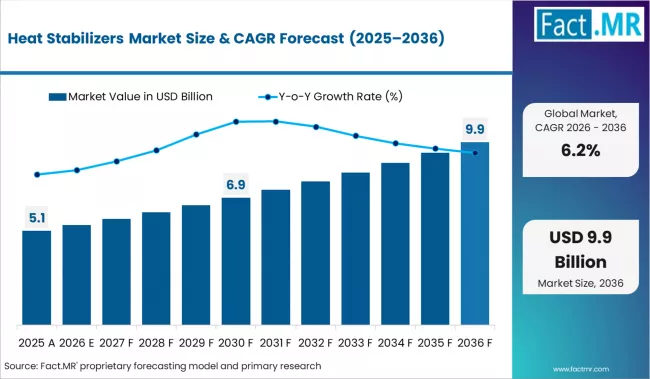
Heat Stabilizers Market Market Value Analysis | Source: Fact.MR
| Metric | Details |
|---|---|
| Industry Size (2026E) | USD 5.4 billion |
| Industry Value (2036F) | USD 9.9 billion |
| CAGR (2026 to 2036) | 6.2% |
Source: Fact.MR analysis. Updated Mar 23, 2026
Heat Stabilizers Market Definition
The Heat Stabilizers Market includes chemical additives used to protect polymers from degradation caused by heat during processing and long term use. These stabilizers prevent discoloration, loss of mechanical strength, and chemical breakdown that occur when plastics are exposed to elevated temperatures. Heat stabilizers are commonly used in the production of polyvinyl chloride and other heat sensitive polymers during extrusion, molding, and compounding processes. They are widely applied in construction materials, electrical components, packaging products, and automotive parts. The primary function of heat stabilizers is to maintain polymer stability and performance during manufacturing and product life cycles.
Heat Stabilizers Market Inclusions
This report covers global and regional market sizes for heat stabilizers with forecast analysis for the study period. The market is segmented by product type including calcium zinc stabilizers, organotin stabilizers, lead stabilizers, and mixed metal stabilizers. Application segments include pipes and fittings, wires and cables, profiles and tubing, films and sheets, and coated fabrics. End users include construction material manufacturers, packaging producers, electrical component manufacturers, and automotive parts suppliers. The report also evaluates pricing patterns, production trends, and selected trade flow analysis across major polymer processing regions.
Heat Stabilizers Market Exclusions
The report excludes general plastic additives such as plasticizers, antioxidants, and flame retardants that perform different polymer stabilization functions. Polymer resins such as polyvinyl chloride, polyethylene, and polypropylene are not included. The scope also excludes finished plastic products manufactured using stabilized polymers. Chemical stabilizers used in coatings, fuels, or food products are outside the defined market scope, as the analysis focuses strictly on heat stabilizers used in polymer processing and plastic manufacturing.
Heat Stabilizers Market Research Methodology
- Primary Research: Interviews were conducted with polymer additive manufacturers, plastic processors, chemical distributors, and materials engineering specialists.
- Desk Research: Public information was collected from chemical industry publications, company reports, regulatory filings, and international trade statistics.
- Market-Sizing and Forecasting: A hybrid model combining bottom up production analysis with top down demand assessment across polymer processing industries was applied.
- Data Validation and Update Cycle: Findings were cross verified using multiple chemical industry sources and expert inputs, with periodic updates conducted as new market information becomes available.
Summary of the Heat Stabilizers Market
- Market Definition
- The market comprises chemical additives used to protect polymers from thermal degradation during manufacturing and long term use. Heat stabilizers prevent discoloration, loss of mechanical strength, and chemical breakdown that occur when polymers are exposed to elevated temperatures during extrusion, molding, and compounding processes. These additives are widely used in polyvinyl chloride processing and other temperature sensitive polymer applications across construction materials, electrical components, packaging products, and automotive parts.
- Demand Drivers
- Increasing production of polyvinyl chloride materials used in pipes, window profiles, cables, and construction products.
- Rising demand for polymer additives that maintain thermal stability during high temperature plastic processing operations.
- Expansion of electrical wiring, cable insulation, and packaging applications that require heat resistant polymer formulations.
- Growing use of stabilizers in automotive components and industrial plastic products requiring long term durability.
- Key Segments Analyzed
- Type: Metallic heat stabilizers account for about 65% share due to effectiveness in preventing polymer degradation during processing.
- Application: Polyvinyl chloride products represent roughly 55% share supported by extensive stabilizer use in PVC processing operations.
- End Use Industry: Construction, electrical and electronics, packaging, and automotive industries represent major users of heat stabilizer additives.
- Geography: India records the fastest expansion supported by increasing PVC consumption across construction and infrastructure projects.
- Analyst Opinion at Fact MR
- Shambhu Nath Jha, Principal Consultant, Fact MR, opines, "In this updated edition of the Heat Stabilizers Market report, industry participants will observe that polymer additives remain essential for maintaining thermal stability during plastic manufacturing processes. Heat stabilizers protect polymer chains from degradation when exposed to elevated processing temperatures. Companies developing stabilizer formulations that meet evolving regulatory requirements and polymer processing standards will maintain stable positions within the global polymer additives market."
- Strategic Implications or Executive Takeaways
- Expand development of stabilizer formulations compatible with evolving environmental and chemical safety regulations.
- Strengthen research capabilities in polymer additive technologies that improve thermal stability in PVC and engineering plastics.
- Invest in production systems capable of supplying stabilizers used across construction materials, electrical insulation, and packaging products.
- Maintain long term supply relationships with polymer manufacturers and plastic processors operating within construction and industrial sectors.
- Methodology
- Primary interviews conducted with polymer additive manufacturers, plastic processors, chemical distributors, and materials engineering specialists.
- Desk research based on chemical industry publications, company financial reports, regulatory documentation, and international trade statistics.
- Market sizing developed through a hybrid approach combining bottom up production analysis and top down demand assessment across polymer processing industries.
- Findings validated through multiple chemical industry sources and expert consultations following Fact MR internal modeling standards.
Segmental Analysis
Heat Stabilizers Market Analysis by Type
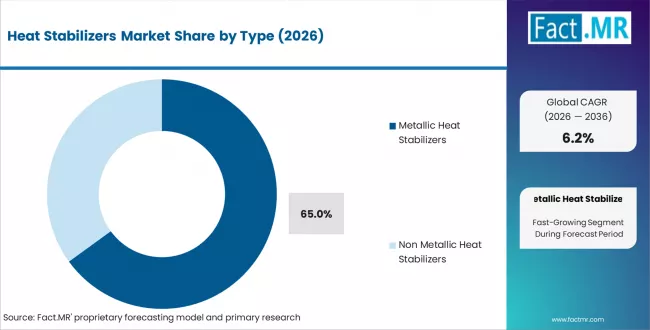
Heat Stabilizers Market Analysis By Type | Source: Fact.MR
- Market Overview: Metallic heat stabilizers are projected to account for around 65% share of the heat stabilizers market by 2026. These stabilizers are widely used during polymer processing to prevent thermal degradation that occurs when plastics are exposed to high processing temperatures. Metallic heat stabilizers, including calcium based and zinc based formulations, help maintain polymer stability by neutralizing hydrogen chloride released during thermal decomposition. Plastic manufacturers incorporate these stabilizers in the processing of polyvinyl chloride and other temperature sensitive polymers. Their effectiveness in maintaining polymer structure and processing stability supports their widespread use in industrial plastic production.
- Demand Drivers:
- Polymer Processing Stability: Metallic heat stabilizers prevent degradation of polymer chains during high temperature processing operations.
- Compatibility with PVC Formulations: Plastic manufacturers widely use metallic stabilizers in PVC production to maintain product durability and structural integrity.
- Industrial Plastic Manufacturing: Growth in plastic manufacturing across construction, automotive, and packaging industries supports demand for heat stabilizer additives.
Heat Stabilizers Market Analysis by Application
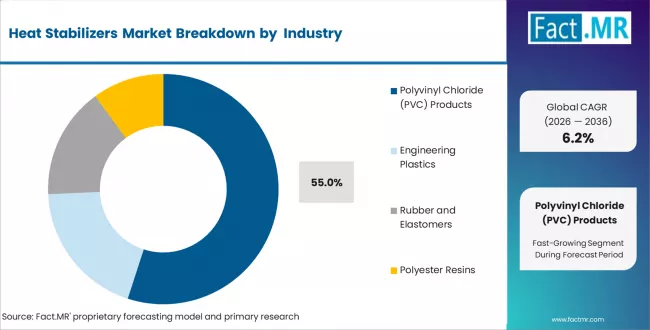
Heat Stabilizers Market Analysis By Application | Source: Fact.MR
- Market Overview: Polyvinyl chloride products are expected to represent approximately 55% share of the heat stabilizers market in 2026. Heat stabilizers are essential additives used in PVC processing to protect the polymer from thermal degradation during extrusion, molding, and compounding processes. PVC products such as pipes, window profiles, cables, flooring materials, and packaging films require stabilizers to maintain mechanical strength and durability. Manufacturers incorporate heat stabilizers into PVC formulations to ensure consistent product performance throughout production and product usage cycles.
- Demand Drivers:
- PVC Processing Requirements: Heat stabilizers protect PVC polymers from decomposition during high temperature manufacturing processes.
- Construction Material Production: PVC pipes, window profiles, and building materials require stabilizers to maintain durability during production and long term use.
- Electrical and Cable Applications: PVC insulation materials used in electrical wiring and cables rely on stabilizers to maintain structural stability under heat exposure.
Heat Stabilizers Market Drivers, Restraints, and Opportunities
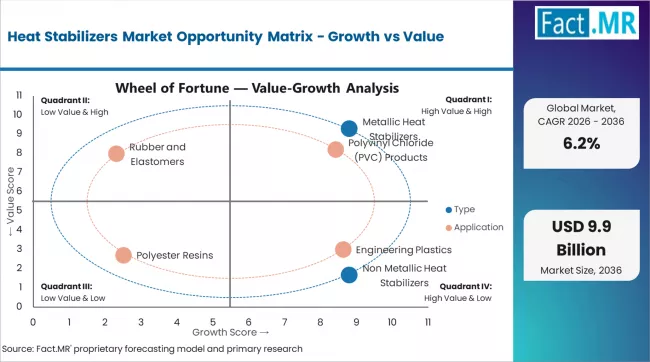
Heat Stabilizers Market Opportunity Matrix Growth Vs Value | Source: Fact.MR
Fact MR analysis indicates that the heat stabilizers market developed alongside the global expansion of polyvinyl chloride processing where thermal degradation posed a major challenge during polymer manufacturing. PVC materials require stabilizing additives to prevent decomposition and discoloration when exposed to high processing temperatures. The current market valuation reflects the widespread use of heat stabilizers across construction materials, electrical cables, packaging films, and consumer products manufactured with PVC compounds. Demand persists because stabilizers maintain polymer integrity during extrusion, molding, and long-term product use.
A structural shift is occurring as traditional heavy metal stabilizers gradually decline due to environmental and regulatory restrictions in polymer manufacturing. Lead-based stabilizers were historically used in large volumes because they offered strong thermal protection and cost efficiency in rigid PVC applications. Manufacturers increasingly adopt calcium-zinc and organic stabilizer systems designed to meet environmental compliance standards. These alternative stabilizer systems often carry higher formulation costs due to specialized chemical compositions and performance requirements. Even when total stabilizer volumes remain linked to PVC production levels, the higher pricing of environmentally compliant additives supports steady market value growth.
- PVC Processing Demand: Construction materials, electrical insulation, and packaging films rely on heat stabilizers to protect PVC compounds during high-temperature processing.
- Chemical Safety Regulation: Regulatory frameworks such as the European Union Restriction of Hazardous Substances (RoHS) Directive and REACH chemical regulations restrict the use of heavy metal stabilizers in polymer products.
- Asia PVC Manufacturing: China and India maintain large PVC production industries that consume heat stabilizers in pipe manufacturing, cable insulation, and construction material production.
Regional Analysis
The market analysis covers key global regions, including North America, Europe, East Asia, and South Asia. It is segmented geographically, with specific market dynamics for each region. The full report provides a detailed market attractiveness analysis.
.webp "Top Country Growth Comparison Heat Stabilizers Market Cagr (2026 2036)")
Top Country Growth Comparison Heat Stabilizers Market Cagr (2026 2036) | Source: Fact.MR
| Country | CAGR (2026-2036) |
|---|---|
| USA | 5.9% |
| Germany | 5.1% |
| France | 4.9% |
| India | 6.9% |
| Japan | 4.7% |
Source: Fact.MR analysis. Updated Mar 23, 2026
Source: Fact MR (FMR) analysis, based on proprietary forecasting model and primary research
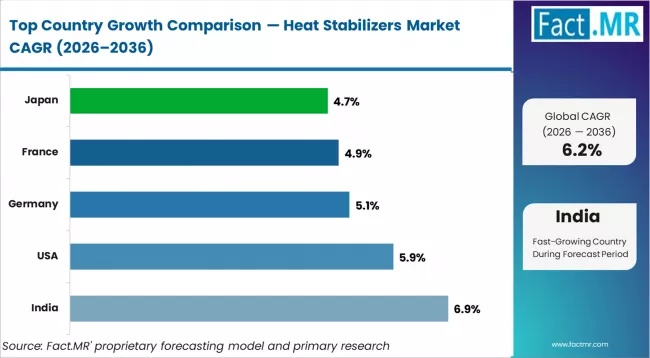
Heat Stabilizers Market Cagr Analysis By Country | Source: Fact.MR
North America
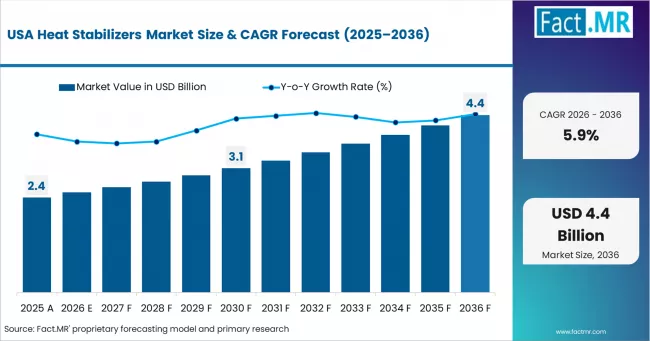
Heat Stabilizers Market Country Value Analysis | Source: Fact.MR
The USA represents a major market supported by demand from polymer processing, construction materials manufacturing, and plastic product production. Key companies include BASF SE, Songwon Industrial Group, and Clariant AG.
- USA: Demand for heat stabilizers in the U.S. is projected to rise at 5.9% CAGR through 2036. Growth is supported by polymer manufacturing expansion programs promoted by the Department of Energy (04-2025) and additive product development initiatives by Songwon Industrial Group (08-2025).
Europe
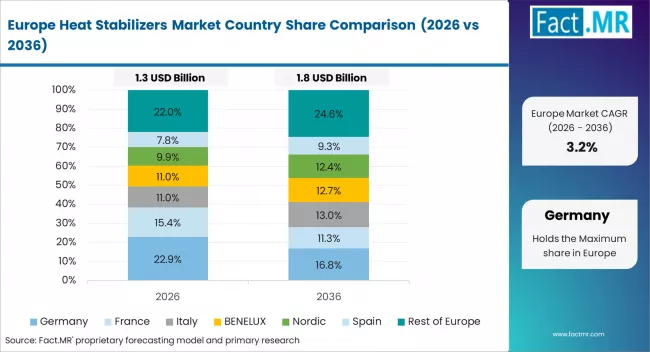
Heat Stabilizers Market Europe Country Market Share Analysis, 2026 & 2036 | Source: Fact.MR
Germany and France represent key markets supported by plastics manufacturing, automotive components production, and industrial polymer processing.
- Germany: Demand for heat stabilizers in Germany is projected to rise at 5.1% CAGR through 2036. Growth is supported by industrial polymer processing initiatives promoted by the Federal Ministry for Economic Affairs (03-2025) and additive technology development by BASF SE (07-2025).
- France: Demand for heat stabilizers in France is projected to rise at 4.9% CAGR through 2036. Growth is supported by polymer innovation programs promoted by the Ministry of Economy and Finance (04-2025) and specialty additive development by Clariant AG (08-2025).
East Asia
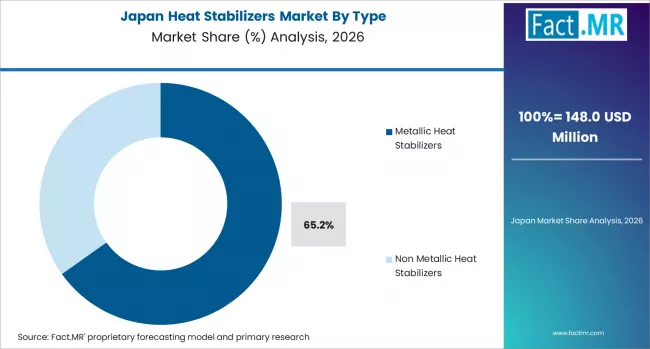
Heat Stabilizers Market Japan Market Share Analysis By Type | Source: Fact.MR
Japan represents an important market supported by advanced materials manufacturing, automotive plastics production, and industrial polymer technologies.
- Japan: Demand for heat stabilizers in Japan is projected to rise at 4.7% CAGR through 2036. Growth is supported by materials technology initiatives promoted by the Ministry of Economy, Trade and Industry (03-2025) and additive formulation development by Songwon Industrial Group (07-2025).
South Asia
India represents a growing market supported by expansion of plastic processing industries, construction materials demand, and polymer manufacturing.
- India: Demand for heat stabilizers in India is projected to rise at 6.9% CAGR through 2036. Growth is supported by polymer manufacturing initiatives promoted by the Ministry of Chemicals and Fertilizers (05-2025) and additive production expansion by BASF SE (09-2025).
Fact MR's analysis of the heat stabilizers market in North America, Europe, East Asia, and South Asia consists of country-wise assessments that include the USA, Germany, France, India, and Japan. Readers can find detailed trends, regulatory updates, and company-specific investments shaping market growth in these countries.
Competitive Structure and Buyer Dynamics in the Heat Stabilizers Market
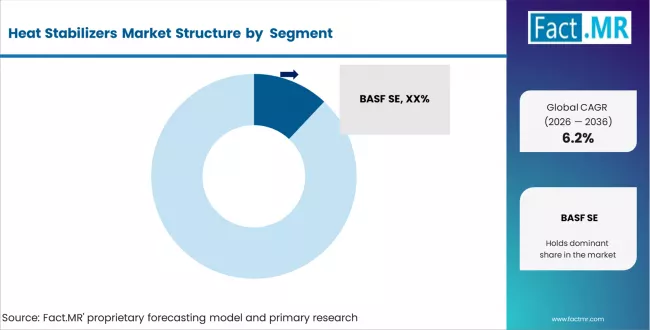
Heat Stabilizers Market Analysis By Company | Source: Fact.MR
The competitive structure of the Heat Stabilizers Market is moderately concentrated, with several global chemical manufacturers controlling a significant share of additive production for polymer processing. BASF SE, Clariant AG, Akzo Nobel N.V., Arkema S.A., and Songwon Industrial Co., Ltd. maintain strong positions through established chemical manufacturing infrastructure and global distribution networks. These companies supply stabilizers used to protect polymers such as PVC and engineering plastics from thermal degradation during processing and long term use. Additional participants including Baerlocher GmbH, Galata Chemicals Holding B.V., ADEKA Corporation, Chemson Polymer-Additive AG, and Valtris Specialty Chemicals operate in specialized polymer additive segments and provide application specific stabilizer formulations. Competition in the market is primarily determined by product performance, compatibility with polymer systems, and compliance with environmental and regulatory standards.
Several companies maintain structural advantages through integrated chemical production systems and long established relationships with polymer manufacturers. Firms such as BASF SE, Clariant AG, Arkema S.A., and ADEKA Corporation benefit from extensive research capabilities and broad polymer additive portfolios. Baerlocher GmbH, Galata Chemicals Holding B.V., and Valtris Specialty Chemicals maintain specialized expertise in PVC stabilization technologies and custom additive formulations. Polymer producers and compounders often adopt multi supplier procurement strategies to reduce dependence on a single additive manufacturer. Procurement teams evaluate suppliers based on formulation consistency, regulatory compliance, and long term supply reliability. This purchasing behavior moderates supplier pricing leverage across the market. Producers with strong technical support capabilities and specialized stabilizer technologies retain moderate negotiating influence in long term polymer additive supply agreements.
Key Players of the Heat Stabilizers Market
- BASF SE
- Clariant AG
- Akzo Nobel N.V.
- Arkema S.A.
- Baerlocher GmbH
- Galata Chemicals Holding B.V.
- ADEKA Corporation
- Songwon Industrial Co., Ltd.
- Chemson Polymer-Additive AG
- Valtris Specialty Chemicals
Report Scope
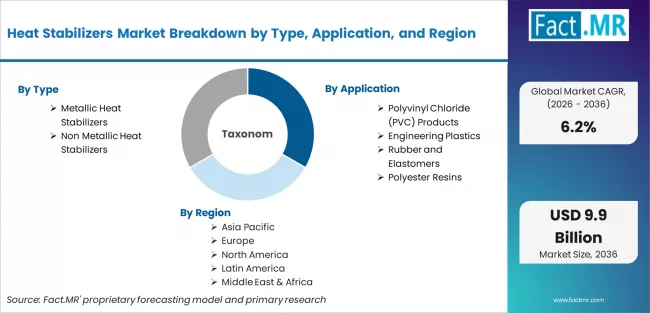
Heat Stabilizers Market Breakdown By Type, Application, And Region | Source: Fact.MR
| Metric | Value |
|---|---|
| Quantitative Units | USD 5.4 billion (2026) to USD 9.9 billion (2036), at a CAGR of 6.2% |
| Market Definition | The heat stabilizers market includes production and application of chemical additives used to prevent thermal degradation of polymers during processing and end-use, particularly in plastic materials exposed to high temperatures. |
| Type Segmentation | Metallic Heat Stabilizers, Non-Metallic Heat Stabilizers |
| Application Coverage | Polyvinyl Chloride (PVC) Products, Engineering Plastics, Rubber and Elastomers, Polyester Resins |
| End-Use Industry | Construction, Electrical and Electronics, Automotive, Packaging, Consumer Goods, Agriculture |
| Key Companies Profiled | BASF SE, Clariant AG, Akzo Nobel N.V., Arkema S.A., Baerlocher GmbH, Galata Chemicals Holding B.V., ADEKA Corporation, Songwon Industrial Co., Ltd., Chemson Polymer-Additive AG, Valtris Specialty Chemicals |
| Forecast Period | 2026 to 2036 |
| Approach | Hybrid top-down and bottom-up market modeling validated through interviews with polymer additive manufacturers and plastic processors, supported by production benchmarking, polymer demand analysis, and trade data evaluation. |
Source: Fact.MR analysis. Updated Mar 23, 2026
Bibliographies
- [1] Department of Energy, USA. (2025). Polymer manufacturing expansion programs.
- [2] Federal Ministry for Economic Affairs, Germany. (2025). Industrial polymer processing initiatives.
- [3] Ministry of Economy and Finance, France. (2025). Polymer innovation programs.
- [4] Ministry of Chemicals and Fertilizers, India. (2025). Polymer manufacturing initiatives.
- [5] Ministry of Economy, Trade and Industry, Japan. (2025). Materials technology initiatives.
- [6] BASF SE. (2025). Additive product development initiatives.
- [7] Songwon Industrial Group. (2025). Additive product development initiatives.
- [8] Clariant AG. (2025). Specialty additive development.
- [9] European Chemicals Agency. (2023). REACH regulations for polymer additives.
This Report Addresses
- Market size estimation and revenue forecasts for the Heat Stabilizers Market from 2026 to 2036, supported by polymer processing demand indicators and PVC production benchmarks across major manufacturing regions.
- Growth opportunity analysis across metallic and non-metallic heat stabilizer formulations, including calcium zinc, organotin, and mixed metal stabilizers used in polymer stabilization processes.
- Segment and regional revenue forecasts covering polyvinyl chloride products, engineering plastics, rubber and elastomers, and polyester resins used across construction, electrical components, automotive parts, packaging materials, and consumer goods manufacturing.
- Competitive strategy assessment including polymer additive formulation capability, chemical manufacturing scale, and distribution network benchmarking among global specialty chemical producers.
- Regulatory and compliance evaluation covering frameworks such as the European Union Restriction of Hazardous Substances Directive and REACH chemical regulations affecting the use of heavy metal stabilizers in polymer formulations.
- Market report delivery in PDF, Excel, PPT, and interactive dashboard formats designed for polymer additive procurement planning, plastics manufacturing analysis, and specialty chemical market evaluation.
- Supply chain and operational risk analysis identifying petrochemical feedstock cost exposure, regulatory restrictions on stabilizer chemistries, and regional polymer production dependencies affecting heat stabilizer demand and supply stability.
Segmentation
Heat Stabilizers Market Key Segments
-
Type
- Metallic Heat Stabilizers
- Non Metallic Heat Stabilizers
-
Application
- Polyvinyl Chloride (PVC) Products
- Engineering Plastics
- Rubber and Elastomers
- Polyester Resins
-
End Use Industry
- Construction
- Electrical and Electronics
- Automotive
- Packaging
- Consumer Goods
- Agriculture
-
Region
- North America
- USA
- Canada
- Mexico
- Europe
- Germany
- UK
- France
- Italy
- Spain
- Nordic Countries
- BENELUX
- Rest of Europe
- Asia Pacific
- China
- Japan
- South Korea
- India
- Australia
- Rest of Asia Pacific
- Latin America
- Brazil
- Argentina
- Rest of Latin America
- Middle East and Africa
- Kingdom of Saudi Arabia
- United Arab Emirates
- South Africa
- Rest of Middle East and Africa
- Other Regions
- Oceania
- Central Asia
- Other Markets
- North America
Frequently Asked Questions
How large is the demand for Heat Stabilizers in the global market in 2026?
What will be the market size of Heat Stabilizers in the global market by 2036?
What is the expected demand growth for Heat Stabilizers in the global market between 2026 and 2036?
Which Type Segment is poised to lead global demand by 2026?
Which Company is Identified as a Leading Participant in the Heat Stabilizers Market?
What is Driving Heat Stabilizers Demand in the United States?
What is the United States Growth Outlook in this Report?
Why is Germany an Important Market for Heat Stabilizers?
What is the Germany Growth Outlook in this Report?
Why is France Considered an Important Market for Heat Stabilizers in Europe?
What is the France Growth Outlook in this Report?
What Factors Support Heat Stabilizers Demand in India?
What is the India Growth Outlook in this Report?
Why is Japan an Important Market for Heat Stabilizers?
What is the Japan Growth Outlook in this Report?
What are Heat Stabilizers and What are They Mainly Used For?
What does Heat Stabilizers Market Mean in this Report?
What is Included in the Scope of this Heat Stabilizers Market Report?
What is Excluded from the Scope of this Report?
What does Market Forecast Mean on this Page?
How is the Heat Stabilizers Market Forecast Developed in this Report?
Who worked on this report


Preview the report firsthand - request a free sample
Free SampleGet the brochure for pricing and purchase details
Download PDF