Heat-Stress Mitigation Foliar Protectant Market

Heat-Stress Mitigation Foliar Protectant Market Size and Share Forecast Outlook 2026 to 2036

Heat-stress mitigation foliar protectant market is projected to grow from USD 321.0 million in 2026 to USD 719.1 million by 2036, at a CAGR of 8.4%. Anti-transpirants (film-forming&stomatal regulation) will dominate with a 26.0% market share, while fruits & vegetables will lead the crop type segment with a 30.0% share.

Heat-Stress Mitigation Foliar Protectant Market Forecast and Outlook 2026 to 2036

The global heat-stress mitigation foliar protectant market is projected to reach USD 719.11 million by 2036. The market is valued at USD 321.00 million in 2026 and is set to rise at a CAGR of 8.4% during the assessment period.

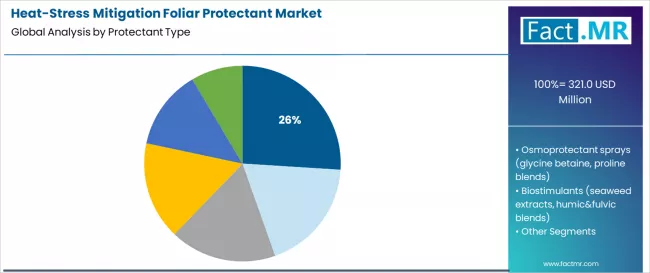
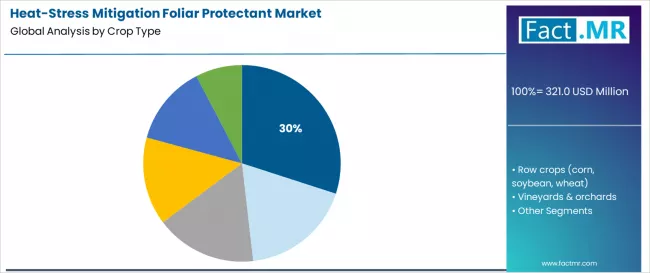
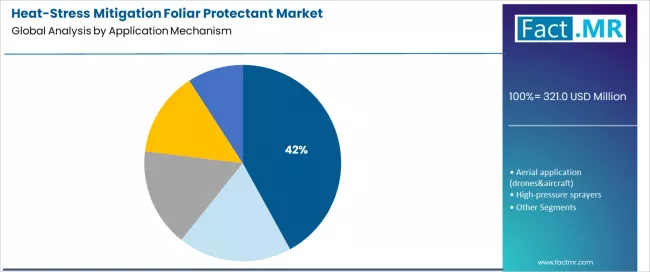
By protectant type, anti-transpirants (film-forming & stomatal regulation) hold a leading 26% share. Fruits & vegetables represent the dominant crop type at 30%, while foliar spray (tractor-mounted) is the primary application mechanism at 42.0%. Commercial farms (large-scale) are the leading end user at 38.0%.

Key Takeaways from the Heat-Stress Mitigation Foliar Protectant Market

  • Market Value for 2026: USD 321.00 Million
  • Market Value for 2036: USD 719.11 Million
  • Forecast CAGR (2026-2036): 8.4%
  • Leading Protectant Type Share (2026): Anti-transpirants (film-forming & stomatal regulation) (26%)
  • Leading Crop Type Share (2026): Fruits & vegetables (30%)
  • Leading Application Mechanism Share (2026): Foliar spray (tractor-mounted) (42.0%)
  • Leading End User Share (2026): Commercial farms (large-scale) (38.0%)
  • Key Players in the Market: BASF SE, Corteva Agriscience, Syngenta, UPL, Valent BioSciences, Rovensa Group
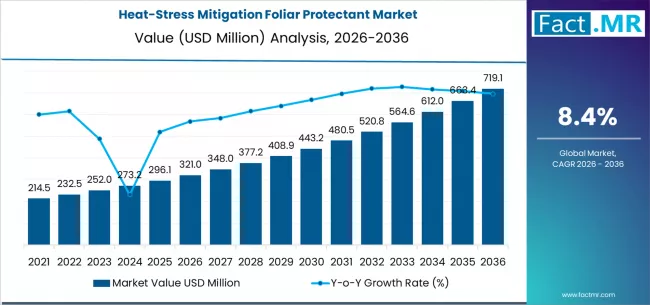
Heat Stress Mitigation Foliar Protectant Market Market Value Analysis

Defining trends involve the development of multi-functional formulations that combine heat-stress protection with nutrient delivery and biostimulant action. Innovation is focused on enhancing plant resilience by leveraging osmoprotectants and biologicals that help maintain critical physiological functions under high temperatures. Integration of these protectants into precision agriculture systems, including drone-assisted spraying and data-driven application advisories, is becoming a key competitive strategy.

The primary driver of market growth is the undeniable impact of climate change, which is leading to more frequent and intense heatwaves that directly threaten crop yield and quality. This global pressure is compelling agricultural producers across all scales to seek effective solutions to protect their crops and ensure productivity, creating sustained demand for reliable foliar protectant technologies.

Heat-Stress Mitigation Foliar Protectant Market

Metric Value
Market Value (2026) USD 321.00 Million
Market Forecast Value (2036) USD 719.11 Million
Forecast CAGR (2026-2036) 8.4%

Category

Category Segments
Protectant Type Anti-transpirants (film-forming & stomatal regulation), Osmoprotectant sprays (glycine betaine, proline blends), Biostimulants (seaweed extracts, humic & fulvic blends), Reflective kaolin & mineral particle films, Amino-acid foliar protectants, Microbial & biological foliar stress reducers
Crop Type Fruits & vegetables, Row crops (corn, soybean, wheat), Vineyards & orchards, Plantation crops (tea, coffee, cocoa), Horticulture & greenhouse crops, Specialty & niche crops
Application Mechanism Foliar spray (tractor-mounted), Aerial application (drones & aircraft), High-pressure sprayers, Low-volume precision sprayers, Hand-held & greenhouse systems
End User Commercial farms (large-scale), Smallholder farmers, Horticulture & greenhouse operators, Fruit & vegetable producers’ cooperatives, Research & extension & demo farms
Region North America, Latin America, Western Europe, Eastern Europe, East Asia, South Asia & Pacific, MEA

Segmental Analysis

By Protectant Type, Which Technology is Fundamental for Reducing Water Loss Under Heat?
Heat Stress Mitigation Foliar Protectant Market Analysis By Protectant Type

Anti-transpirants lead the segment with a 26% share. Their dominance is due to their direct and effective mechanism of action, which involves forming a protective film or regulating stomata to reduce water loss through transpiration. This helps plants conserve vital moisture during periods of extreme heat and drought, making them a foundational and widely adopted tool for managing heat stress across diverse crops and geographies.

By Crop Type, Which High-Value Segment Drives Premium Solutions?
Heat Stress Mitigation Foliar Protectant Market Analysis By Crop Type

Fruits & vegetables command the largest crop type share at 30%. This segment's leadership is attributed to the high economic value and extreme sensitivity of these crops to heat stress, which can cause sunscald, blossom drop, and reduced quality, leading to significant financial losses. The potential for high returns justifies investment in protective technologies, making fruit and vegetable growers early and consistent adopters of advanced foliar protectants.

By Application Mechanism, Which Method is Synonymous with Large-Scale Efficiency?
Heat Stress Mitigation Foliar Protectant Market Analysis By Application Mechanism

Foliar spray using tractor-mounted equipment represents the leading application mechanism at 42.0%. This method's dominance is rooted in its operational practicality and efficiency for covering extensive agricultural areas quickly and uniformly. It integrates seamlessly into existing large-scale farm routines, offering a cost-effective and logistically straightforward way to apply protectants, ensuring it remains the primary choice for major commercial farming operations.

By End User, Which Group has the Scale and Economics to Drive Volume Demand?
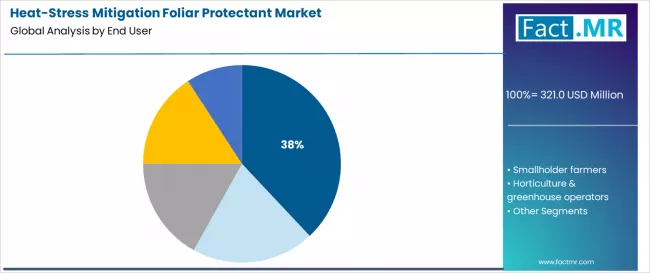
Heat Stress Mitigation Foliar Protectant Market Analysis By End User

Commercial farms (large-scale) are the leading end user at 38.0%. These operations manage significant acreage where the financial impact of heat-induced yield loss is substantial. Their scale justifies the investment in protective inputs and the use of efficient application equipment like tractor-mounted sprayers. The focus on maximizing productivity and protecting high-value crops under climatic pressure makes this group the core volume driver for the market.

What are the Drivers, Restraints, and Key Trends of the Heat-Stress Mitigation Foliar Protectant Market?

The escalating frequency and intensity of heatwaves due to climate change is the principal driver, creating an urgent and global need for crop protection solutions. The expansion of high-value, heat-sensitive horticulture worldwide provides a ready market. Furthermore, growing awareness among farmers about the tangible benefits of these products in preserving yield and quality is bolstering adoption.

A significant restraint is the variable performance of products under diverse and extreme field conditions, which can create uncertainty about return on investment for some growers. Cost sensitivity, particularly among smallholder farmers and in bulk crop segments, can also limit uptake. Additionally, gaps in farmer education regarding optimal product selection, application timing, and dosage may hinder maximum effectiveness and market growth.

Key trends include the development of bio-based and low-toxicity formulations that align with sustainable agriculture goals and stringent regulatory environments. There is a strong movement towards multi-functional products that offer combined benefits, such as heat protection paired with nutrient delivery or biostimulant action. The market is also advancing through precision application technologies, like drone spraying and sensor-based systems, which optimize timing and placement for better results and resource efficiency.

Analysis of the Heat-Stress Mitigation Foliar Protectant Market by Key Countries

Heat Stress Mitigation Foliar Protectant Market Cagr Analysis By Country

Country CAGR (2026-2036)
India 10.30%
Brazil 9.10%
China 8.80%
USA 7.40%

How does India's Expansive Agriculture and Climate Vulnerability Drive Exceptional Growth?

India leads with a 10.30% CAGR, driven by its vast agricultural sector's acute vulnerability to rising temperatures and irregular rainfall. With climate change posing a direct risk to food security and farmer livelihoods, there is a surge in demand for solutions that enhance crop resilience. Government support for agricultural innovation and increasing farmer awareness are accelerating the adoption of protective technologies across the country.

Why is Brazil's Major Crop Production and Export Focus a Key Driver?

Brazil’s 9.10% growth is supported by its status as a global agricultural powerhouse for commodities like soybeans and coffee. Protecting these high-volume crops from heat-related damage is crucial for both domestic supply and export revenues. The tech-savvy, export-oriented nature of its agricultural sector makes Brazilian growers proactive adopters of solutions that ensure yield stability and quality consistency.

What Role does China's Large Agricultural Industry and Food Security Goals Play?

Expected to advance at an 8.8% CAGR, China’s growth is fueled by its massive farming industry and the government's focus on enhancing agricultural productivity and resilience in the face of climate change. The need to safeguard food security for its large population, combined with a growing emphasis on eco-friendly farming practices, is driving substantial investment and demand for advanced foliar protectant solutions.

How does the USA's Demand for Agricultural Innovation Underpin Steady Growth?
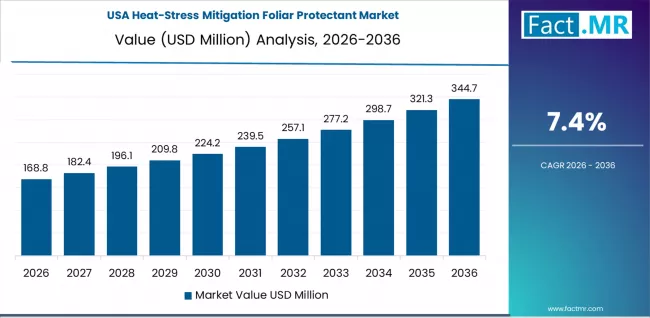
Heat Stress Mitigation Foliar Protectant Market Country Value Analysis

The USA's 7.40% growth is driven by the ongoing need for innovative solutions to mitigate heat stress in key farming regions. High-value specialty crop producers in states like California are particularly motivated to adopt protective technologies to preserve yield and quality. The mature and technologically advanced agricultural input sector facilitates easy access and integration of these products into existing farm management programs.

Competitive Landscape of the Heat-Stress Mitigation Foliar Protectant Market
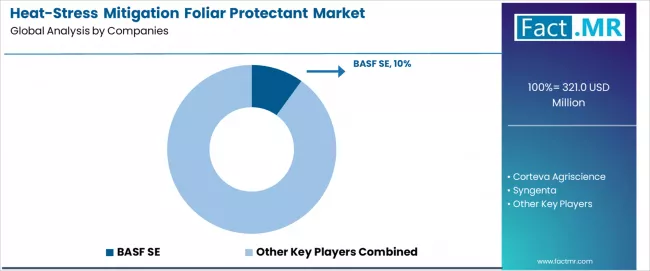
Heat Stress Mitigation Foliar Protectant Market Analysis By Company

The competitive landscape features global agrochemical leaders and specialized plant health companies. Major players like BASF SE, Corteva Agriscience, and Syngenta compete on the strength of their extensive R&D capabilities, broad portfolios spanning traditional chemistry and biologicals, and global distribution networks. They leverage their deep agronomic expertise to develop integrated stress management programs for growers.

Specialist firms like Valent BioSciences and Rovensa Group compete through targeted innovation in biostimulants and biorational solutions. Competition centers on technological leadership in formulation science, the ability to generate robust field trial data demonstrating clear yield benefits, and providing strong technical support and education to growers on effective product use.

Key Players in the Heat-Stress Mitigation Foliar Protectant Market

  • BASF SE
  • Corteva Agriscience
  • Syngenta
  • UPL
  • Valent BioSciences
  • Rovensa Group

Scope of Report

Items Values
Quantitative Units USD Million
Protectant Type Anti-transpirants (film-forming & stomatal regulation), Osmoprotectant sprays (glycine betaine, proline blends), Biostimulants (seaweed extracts, humic & fulvic blends), Reflective kaolin & mineral particle films, Amino-acid foliar protectants, Microbial & biological foliar stress reducers
Crop Type Fruits & vegetables, Row crops (corn, soybean, wheat), Vineyards & orchards, Plantation crops (tea, coffee, cocoa), Horticulture & greenhouse crops, Specialty & niche crops
Application Mechanism Foliar spray (tractor-mounted), Aerial application (drones & aircraft), High-pressure sprayers, Low-volume precision sprayers, Hand-held & greenhouse systems
End User Commercial farms (large-scale), Smallholder farmers, Horticulture & greenhouse operators, Fruit & vegetable producers’ cooperatives, Research & extension & demo farms
Key Countries India, Brazil, China, USA
Key Companies BASF SE, Corteva Agriscience, Syngenta, UPL, Valent BioSciences, Rovensa Group
Additional Analysis Analysis of plant physiological mechanisms targeted by different protectants, cost-benefit analysis and return on investment for key crops, regulatory landscape for novel biological and chemical actives, competitive assessment with alternative stress management practices, and impact of precision farming technologies on adoption rates.

Heat-Stress Mitigation Foliar Protectant Market by Segments

  • Protectant Type :

    • Anti-transpirants (film-forming & stomatal regulation)
    • Osmoprotectant sprays (glycine betaine, proline blends)
    • Biostimulants (seaweed extracts, humic & fulvic blends)
    • Reflective kaolin & mineral particle films
    • Amino-acid foliar protectants
    • Microbial & biological foliar stress reducers
  • Crop Type :

    • Fruits & vegetables
    • Row crops (corn, soybean, wheat)
    • Vineyards & orchards
    • Plantation crops (tea, coffee, cocoa)
    • Horticulture & greenhouse crops
    • Specialty & niche crops
  • Application Mechanism :

    • Foliar spray (tractor-mounted)
    • Aerial application (drones & aircraft)
    • High-pressure sprayers
    • Low-volume precision sprayers
    • Hand-held & greenhouse systems
  • End User :

    • Commercial farms (large-scale)
    • Smallholder farmers
    • Horticulture & greenhouse operators
    • Fruit & vegetable producers’ cooperatives
    • Research & extension & demo farms
  • Region :

    • North America

      • USA
      • Canada
    • Latin America

      • Brazil
      • Mexico
      • Argentina
      • Rest of Latin America
    • Western Europe

      • Germany
      • UK
      • France
      • Spain
      • Italy
      • BENELUX
      • Rest of Western Europe
    • Eastern Europe

      • Russia
      • Poland
      • Czech Republic
      • Rest of Eastern Europe
    • East Asia

      • China
      • Japan
      • South Korea
      • Rest of East Asia
    • South Asia & Pacific

      • India
      • ASEAN
      • Australia
      • Rest of South Asia & Pacific
    • MEA

      • Saudi Arabia
      • UAE
      • Turkiye
      • Rest of MEA

Table of Content

  1. Executive Summary
    • Global Market Outlook
    • Demand to side Trends
    • Supply to side Trends
    • Technology Roadmap Analysis
    • Analysis and Recommendations
  2. Market Overview
    • Market Coverage / Taxonomy
    • Market Definition / Scope / Limitations
  3. Market Background
    • Market Dynamics
      • Drivers
      • Restraints
      • Opportunity
      • Trends
    • Scenario Forecast
      • Demand in Optimistic Scenario
      • Demand in Likely Scenario
      • Demand in Conservative Scenario
    • Opportunity Map Analysis
    • Product Life Cycle Analysis
    • Supply Chain Analysis
    • Investment Feasibility Matrix
    • Value Chain Analysis
    • PESTLE and Porter’s Analysis
    • Regulatory Landscape
    • Regional Parent Market Outlook
    • Production and Consumption Statistics
    • Import and Export Statistics
  4. Global Market Analysis 2021 to 2025 and Forecast, 2026 to 2036
    • Historical Market Size Value (USD Million) Analysis, 2021 to 2025
    • Current and Future Market Size Value (USD Million) Projections, 2026 to 2036
      • Y to o to Y Growth Trend Analysis
      • Absolute $ Opportunity Analysis
  5. Global Market Pricing Analysis 2021 to 2025 and Forecast 2026 to 2036
  6. Global Market Analysis 2021 to 2025 and Forecast 2026 to 2036, By Protectant Type
    • Introduction / Key Findings
    • Historical Market Size Value (USD Million) Analysis By Protectant Type, 2021 to 2025
    • Current and Future Market Size Value (USD Million) Analysis and Forecast By Protectant Type, 2026 to 2036
      • Anti-transpirants (film-forming&stomatal regulation)
      • Osmoprotectant sprays (glycine betaine, proline blends)
      • Biostimulants (seaweed extracts, humic&fulvic blends)
      • Reflective kaolin & mineral particle films
      • Amino-acid foliar protectants
      • Microbial&biological foliar stress reducers
    • Y to o to Y Growth Trend Analysis By Protectant Type, 2021 to 2025
    • Absolute $ Opportunity Analysis By Protectant Type, 2026 to 2036
  7. Global Market Analysis 2021 to 2025 and Forecast 2026 to 2036, By Crop Type
    • Introduction / Key Findings
    • Historical Market Size Value (USD Million) Analysis By Crop Type, 2021 to 2025
    • Current and Future Market Size Value (USD Million) Analysis and Forecast By Crop Type, 2026 to 2036
      • Fruits & vegetables
      • Row crops (corn, soybean, wheat)
      • Vineyards & orchards
      • Plantation crops (tea, coffee, cocoa)
      • Horticulture&greenhouse crops
      • Specialty&niche crops
    • Y to o to Y Growth Trend Analysis By Crop Type, 2021 to 2025
    • Absolute $ Opportunity Analysis By Crop Type, 2026 to 2036
  8. Global Market Analysis 2021 to 2025 and Forecast 2026 to 2036, By Application Mechanism
    • Introduction / Key Findings
    • Historical Market Size Value (USD Million) Analysis By Application Mechanism, 2021 to 2025
    • Current and Future Market Size Value (USD Million) Analysis and Forecast By Application Mechanism, 2026 to 2036
      • Foliar spray (tractor-mounted)
      • Aerial application (drones&aircraft)
      • High-pressure sprayers
      • Low-volume precision sprayers
      • Hand-held&greenhouse systems
    • Y to o to Y Growth Trend Analysis By Application Mechanism, 2021 to 2025
    • Absolute $ Opportunity Analysis By Application Mechanism, 2026 to 2036
  9. Global Market Analysis 2021 to 2025 and Forecast 2026 to 2036, By End User
    • Introduction / Key Findings
    • Historical Market Size Value (USD Million) Analysis By End User, 2021 to 2025
    • Current and Future Market Size Value (USD Million) Analysis and Forecast By End User, 2026 to 2036
      • Commercial farms (large-scale)
      • Smallholder farmers
      • Horticulture & greenhouse operators
      • Fruit&vegetable producers’ cooperatives
      • Research&extension & demo farms
    • Y to o to Y Growth Trend Analysis By End User, 2021 to 2025
    • Absolute $ Opportunity Analysis By End User, 2026 to 2036
  10. Global Market Analysis 2021 to 2025 and Forecast 2026 to 2036, By Region
    • Introduction
    • Historical Market Size Value (USD Million) Analysis By Region, 2021 to 2025
    • Current Market Size Value (USD Million) Analysis and Forecast By Region, 2026 to 2036
      • North America
      • Latin America
      • Western Europe
      • Eastern Europe
      • East Asia
      • South Asia and Pacific
      • Middle East & Africa
    • Market Attractiveness Analysis By Region
  11. North America Market Analysis 2021 to 2025 and Forecast 2026 to 2036, By Country
    • Historical Market Size Value (USD Million) Trend Analysis By Market Taxonomy, 2021 to 2025
    • Market Size Value (USD Million) Forecast By Market Taxonomy, 2026 to 2036
      • By Country
        • USA
        • Canada
        • Mexico
      • By Protectant Type
      • By Crop Type
      • By Application Mechanism
      • By End User
    • Market Attractiveness Analysis
      • By Country
      • By Protectant Type
      • By Crop Type
      • By Application Mechanism
      • By End User
    • Key Takeaways
  12. Latin America Market Analysis 2021 to 2025 and Forecast 2026 to 2036, By Country
    • Historical Market Size Value (USD Million) Trend Analysis By Market Taxonomy, 2021 to 2025
    • Market Size Value (USD Million) Forecast By Market Taxonomy, 2026 to 2036
      • By Country
        • Brazil
        • Chile
        • Rest of Latin America
      • By Protectant Type
      • By Crop Type
      • By Application Mechanism
      • By End User
    • Market Attractiveness Analysis
      • By Country
      • By Protectant Type
      • By Crop Type
      • By Application Mechanism
      • By End User
    • Key Takeaways
  13. Western Europe Market Analysis 2021 to 2025 and Forecast 2026 to 2036, By Country
    • Historical Market Size Value (USD Million) Trend Analysis By Market Taxonomy, 2021 to 2025
    • Market Size Value (USD Million) Forecast By Market Taxonomy, 2026 to 2036
      • By Country
        • Germany
        • UK
        • Italy
        • Spain
        • France
        • Nordic
        • BENELUX
        • Rest of Western Europe
      • By Protectant Type
      • By Crop Type
      • By Application Mechanism
      • By End User
    • Market Attractiveness Analysis
      • By Country
      • By Protectant Type
      • By Crop Type
      • By Application Mechanism
      • By End User
    • Key Takeaways
  14. Eastern Europe Market Analysis 2021 to 2025 and Forecast 2026 to 2036, By Country
    • Historical Market Size Value (USD Million) Trend Analysis By Market Taxonomy, 2021 to 2025
    • Market Size Value (USD Million) Forecast By Market Taxonomy, 2026 to 2036
      • By Country
        • Russia
        • Poland
        • Hungary
        • Balkan & Baltic
        • Rest of Eastern Europe
      • By Protectant Type
      • By Crop Type
      • By Application Mechanism
      • By End User
    • Market Attractiveness Analysis
      • By Country
      • By Protectant Type
      • By Crop Type
      • By Application Mechanism
      • By End User
    • Key Takeaways
  15. East Asia Market Analysis 2021 to 2025 and Forecast 2026 to 2036, By Country
    • Historical Market Size Value (USD Million) Trend Analysis By Market Taxonomy, 2021 to 2025
    • Market Size Value (USD Million) Forecast By Market Taxonomy, 2026 to 2036
      • By Country
        • China
        • Japan
        • South Korea
      • By Protectant Type
      • By Crop Type
      • By Application Mechanism
      • By End User
    • Market Attractiveness Analysis
      • By Country
      • By Protectant Type
      • By Crop Type
      • By Application Mechanism
      • By End User
    • Key Takeaways
  16. South Asia and Pacific Market Analysis 2021 to 2025 and Forecast 2026 to 2036, By Country
    • Historical Market Size Value (USD Million) Trend Analysis By Market Taxonomy, 2021 to 2025
    • Market Size Value (USD Million) Forecast By Market Taxonomy, 2026 to 2036
      • By Country
        • India
        • ASEAN
        • Australia & New Zealand
        • Rest of South Asia and Pacific
      • By Protectant Type
      • By Crop Type
      • By Application Mechanism
      • By End User
    • Market Attractiveness Analysis
      • By Country
      • By Protectant Type
      • By Crop Type
      • By Application Mechanism
      • By End User
    • Key Takeaways
  17. Middle East & Africa Market Analysis 2021 to 2025 and Forecast 2026 to 2036, By Country
    • Historical Market Size Value (USD Million) Trend Analysis By Market Taxonomy, 2021 to 2025
    • Market Size Value (USD Million) Forecast By Market Taxonomy, 2026 to 2036
      • By Country
        • Kingdom of Saudi Arabia
        • Other GCC Countries
        • Turkiye
        • South Africa
        • Other African Union
        • Rest of Middle East & Africa
      • By Protectant Type
      • By Crop Type
      • By Application Mechanism
      • By End User
    • Market Attractiveness Analysis
      • By Country
      • By Protectant Type
      • By Crop Type
      • By Application Mechanism
      • By End User
    • Key Takeaways
  18. Key Countries Market Analysis
    • USA
      • Pricing Analysis
      • Market Share Analysis, 2025
        • By Protectant Type
        • By Crop Type
        • By Application Mechanism
        • By End User
    • Canada
      • Pricing Analysis
      • Market Share Analysis, 2025
        • By Protectant Type
        • By Crop Type
        • By Application Mechanism
        • By End User
    • Mexico
      • Pricing Analysis
      • Market Share Analysis, 2025
        • By Protectant Type
        • By Crop Type
        • By Application Mechanism
        • By End User
    • Brazil
      • Pricing Analysis
      • Market Share Analysis, 2025
        • By Protectant Type
        • By Crop Type
        • By Application Mechanism
        • By End User
    • Chile
      • Pricing Analysis
      • Market Share Analysis, 2025
        • By Protectant Type
        • By Crop Type
        • By Application Mechanism
        • By End User
    • Germany
      • Pricing Analysis
      • Market Share Analysis, 2025
        • By Protectant Type
        • By Crop Type
        • By Application Mechanism
        • By End User
    • UK
      • Pricing Analysis
      • Market Share Analysis, 2025
        • By Protectant Type
        • By Crop Type
        • By Application Mechanism
        • By End User
    • Italy
      • Pricing Analysis
      • Market Share Analysis, 2025
        • By Protectant Type
        • By Crop Type
        • By Application Mechanism
        • By End User
    • Spain
      • Pricing Analysis
      • Market Share Analysis, 2025
        • By Protectant Type
        • By Crop Type
        • By Application Mechanism
        • By End User
    • France
      • Pricing Analysis
      • Market Share Analysis, 2025
        • By Protectant Type
        • By Crop Type
        • By Application Mechanism
        • By End User
    • India
      • Pricing Analysis
      • Market Share Analysis, 2025
        • By Protectant Type
        • By Crop Type
        • By Application Mechanism
        • By End User
    • ASEAN
      • Pricing Analysis
      • Market Share Analysis, 2025
        • By Protectant Type
        • By Crop Type
        • By Application Mechanism
        • By End User
    • Australia & New Zealand
      • Pricing Analysis
      • Market Share Analysis, 2025
        • By Protectant Type
        • By Crop Type
        • By Application Mechanism
        • By End User
    • China
      • Pricing Analysis
      • Market Share Analysis, 2025
        • By Protectant Type
        • By Crop Type
        • By Application Mechanism
        • By End User
    • Japan
      • Pricing Analysis
      • Market Share Analysis, 2025
        • By Protectant Type
        • By Crop Type
        • By Application Mechanism
        • By End User
    • South Korea
      • Pricing Analysis
      • Market Share Analysis, 2025
        • By Protectant Type
        • By Crop Type
        • By Application Mechanism
        • By End User
    • Russia
      • Pricing Analysis
      • Market Share Analysis, 2025
        • By Protectant Type
        • By Crop Type
        • By Application Mechanism
        • By End User
    • Poland
      • Pricing Analysis
      • Market Share Analysis, 2025
        • By Protectant Type
        • By Crop Type
        • By Application Mechanism
        • By End User
    • Hungary
      • Pricing Analysis
      • Market Share Analysis, 2025
        • By Protectant Type
        • By Crop Type
        • By Application Mechanism
        • By End User
    • Kingdom of Saudi Arabia
      • Pricing Analysis
      • Market Share Analysis, 2025
        • By Protectant Type
        • By Crop Type
        • By Application Mechanism
        • By End User
    • Turkiye
      • Pricing Analysis
      • Market Share Analysis, 2025
        • By Protectant Type
        • By Crop Type
        • By Application Mechanism
        • By End User
    • South Africa
      • Pricing Analysis
      • Market Share Analysis, 2025
        • By Protectant Type
        • By Crop Type
        • By Application Mechanism
        • By End User
  19. Market Structure Analysis
    • Competition Dashboard
    • Competition Benchmarking
    • Market Share Analysis of Top Players
      • By Regional
      • By Protectant Type
      • By Crop Type
      • By Application Mechanism
      • By End User
  20. Competition Analysis
    • Competition Deep Dive
      • BASF SE
        • Overview
        • Product Portfolio
        • Profitability by Market Segments (Product/Age /Sales Channel/Region)
        • Sales Footprint
        • Strategy Overview
          • Marketing Strategy
          • Product Strategy
          • Channel Strategy
      • Corteva Agriscience
      • Syngenta
      • UPL
      • Valent BioSciences
      • Rovensa Group
  21. Assumptions & Acronyms Used
  22. Research Methodology

List Of Table

  • Table 1: Global Market Value (USD Million) Forecast by Region, 2021 to 2036
  • Table 2: Global Market Value (USD Million) Forecast by Protectant Type, 2021 to 2036
  • Table 3: Global Market Value (USD Million) Forecast by Crop Type, 2021 to 2036
  • Table 4: Global Market Value (USD Million) Forecast by Application Mechanism, 2021 to 2036
  • Table 5: Global Market Value (USD Million) Forecast by End User, 2021 to 2036
  • Table 6: North America Market Value (USD Million) Forecast by Country, 2021 to 2036
  • Table 7: North America Market Value (USD Million) Forecast by Protectant Type, 2021 to 2036
  • Table 8: North America Market Value (USD Million) Forecast by Crop Type, 2021 to 2036
  • Table 9: North America Market Value (USD Million) Forecast by Application Mechanism, 2021 to 2036
  • Table 10: North America Market Value (USD Million) Forecast by End User, 2021 to 2036
  • Table 11: Latin America Market Value (USD Million) Forecast by Country, 2021 to 2036
  • Table 12: Latin America Market Value (USD Million) Forecast by Protectant Type, 2021 to 2036
  • Table 13: Latin America Market Value (USD Million) Forecast by Crop Type, 2021 to 2036
  • Table 14: Latin America Market Value (USD Million) Forecast by Application Mechanism, 2021 to 2036
  • Table 15: Latin America Market Value (USD Million) Forecast by End User, 2021 to 2036
  • Table 16: Western Europe Market Value (USD Million) Forecast by Country, 2021 to 2036
  • Table 17: Western Europe Market Value (USD Million) Forecast by Protectant Type, 2021 to 2036
  • Table 18: Western Europe Market Value (USD Million) Forecast by Crop Type, 2021 to 2036
  • Table 19: Western Europe Market Value (USD Million) Forecast by Application Mechanism, 2021 to 2036
  • Table 20: Western Europe Market Value (USD Million) Forecast by End User, 2021 to 2036
  • Table 21: Eastern Europe Market Value (USD Million) Forecast by Country, 2021 to 2036
  • Table 22: Eastern Europe Market Value (USD Million) Forecast by Protectant Type, 2021 to 2036
  • Table 23: Eastern Europe Market Value (USD Million) Forecast by Crop Type, 2021 to 2036
  • Table 24: Eastern Europe Market Value (USD Million) Forecast by Application Mechanism, 2021 to 2036
  • Table 25: Eastern Europe Market Value (USD Million) Forecast by End User, 2021 to 2036
  • Table 26: East Asia Market Value (USD Million) Forecast by Country, 2021 to 2036
  • Table 27: East Asia Market Value (USD Million) Forecast by Protectant Type, 2021 to 2036
  • Table 28: East Asia Market Value (USD Million) Forecast by Crop Type, 2021 to 2036
  • Table 29: East Asia Market Value (USD Million) Forecast by Application Mechanism, 2021 to 2036
  • Table 30: East Asia Market Value (USD Million) Forecast by End User, 2021 to 2036
  • Table 31: South Asia and Pacific Market Value (USD Million) Forecast by Country, 2021 to 2036
  • Table 32: South Asia and Pacific Market Value (USD Million) Forecast by Protectant Type, 2021 to 2036
  • Table 33: South Asia and Pacific Market Value (USD Million) Forecast by Crop Type, 2021 to 2036
  • Table 34: South Asia and Pacific Market Value (USD Million) Forecast by Application Mechanism, 2021 to 2036
  • Table 35: South Asia and Pacific Market Value (USD Million) Forecast by End User, 2021 to 2036
  • Table 36: Middle East & Africa Market Value (USD Million) Forecast by Country, 2021 to 2036
  • Table 37: Middle East & Africa Market Value (USD Million) Forecast by Protectant Type, 2021 to 2036
  • Table 38: Middle East & Africa Market Value (USD Million) Forecast by Crop Type, 2021 to 2036
  • Table 39: Middle East & Africa Market Value (USD Million) Forecast by Application Mechanism, 2021 to 2036
  • Table 40: Middle East & Africa Market Value (USD Million) Forecast by End User, 2021 to 2036

List Of Figures

  • Figure 1: Global Market Pricing Analysis
  • Figure 2: Global Market Value (USD Million) Forecast 2021 to 2036
  • Figure 3: Global Market Value Share and BPS Analysis by Protectant Type, 2026 and 2036
  • Figure 4: Global Market Y to o to Y Growth Comparison by Protectant Type, 2026 to 2036
  • Figure 5: Global Market Attractiveness Analysis by Protectant Type
  • Figure 6: Global Market Value Share and BPS Analysis by Crop Type, 2026 and 2036
  • Figure 7: Global Market Y to o to Y Growth Comparison by Crop Type, 2026 to 2036
  • Figure 8: Global Market Attractiveness Analysis by Crop Type
  • Figure 9: Global Market Value Share and BPS Analysis by Application Mechanism, 2026 and 2036
  • Figure 10: Global Market Y to o to Y Growth Comparison by Application Mechanism, 2026 to 2036
  • Figure 11: Global Market Attractiveness Analysis by Application Mechanism
  • Figure 12: Global Market Value Share and BPS Analysis by End User, 2026 and 2036
  • Figure 13: Global Market Y to o to Y Growth Comparison by End User, 2026 to 2036
  • Figure 14: Global Market Attractiveness Analysis by End User
  • Figure 15: Global Market Value (USD Million) Share and BPS Analysis by Region, 2026 and 2036
  • Figure 16: Global Market Y to o to Y Growth Comparison by Region, 2026 to 2036
  • Figure 17: Global Market Attractiveness Analysis by Region
  • Figure 18: North America Market Incremental Dollar Opportunity, 2026 to 2036
  • Figure 19: Latin America Market Incremental Dollar Opportunity, 2026 to 2036
  • Figure 20: Western Europe Market Incremental Dollar Opportunity, 2026 to 2036
  • Figure 21: Eastern Europe Market Incremental Dollar Opportunity, 2026 to 2036
  • Figure 22: East Asia Market Incremental Dollar Opportunity, 2026 to 2036
  • Figure 23: South Asia and Pacific Market Incremental Dollar Opportunity, 2026 to 2036
  • Figure 24: Middle East & Africa Market Incremental Dollar Opportunity, 2026 to 2036
  • Figure 25: North America Market Value Share and BPS Analysis by Country, 2026 and 2036
  • Figure 26: North America Market Value Share and BPS Analysis by Protectant Type, 2026 and 2036
  • Figure 27: North America Market Y to o to Y Growth Comparison by Protectant Type, 2026 to 2036
  • Figure 28: North America Market Attractiveness Analysis by Protectant Type
  • Figure 29: North America Market Value Share and BPS Analysis by Crop Type, 2026 and 2036
  • Figure 30: North America Market Y to o to Y Growth Comparison by Crop Type, 2026 to 2036
  • Figure 31: North America Market Attractiveness Analysis by Crop Type
  • Figure 32: North America Market Value Share and BPS Analysis by Application Mechanism, 2026 and 2036
  • Figure 33: North America Market Y to o to Y Growth Comparison by Application Mechanism, 2026 to 2036
  • Figure 34: North America Market Attractiveness Analysis by Application Mechanism
  • Figure 35: North America Market Value Share and BPS Analysis by End User, 2026 and 2036
  • Figure 36: North America Market Y to o to Y Growth Comparison by End User, 2026 to 2036
  • Figure 37: North America Market Attractiveness Analysis by End User
  • Figure 38: Latin America Market Value Share and BPS Analysis by Country, 2026 and 2036
  • Figure 39: Latin America Market Value Share and BPS Analysis by Protectant Type, 2026 and 2036
  • Figure 40: Latin America Market Y to o to Y Growth Comparison by Protectant Type, 2026 to 2036
  • Figure 41: Latin America Market Attractiveness Analysis by Protectant Type
  • Figure 42: Latin America Market Value Share and BPS Analysis by Crop Type, 2026 and 2036
  • Figure 43: Latin America Market Y to o to Y Growth Comparison by Crop Type, 2026 to 2036
  • Figure 44: Latin America Market Attractiveness Analysis by Crop Type
  • Figure 45: Latin America Market Value Share and BPS Analysis by Application Mechanism, 2026 and 2036
  • Figure 46: Latin America Market Y to o to Y Growth Comparison by Application Mechanism, 2026 to 2036
  • Figure 47: Latin America Market Attractiveness Analysis by Application Mechanism
  • Figure 48: Latin America Market Value Share and BPS Analysis by End User, 2026 and 2036
  • Figure 49: Latin America Market Y to o to Y Growth Comparison by End User, 2026 to 2036
  • Figure 50: Latin America Market Attractiveness Analysis by End User
  • Figure 51: Western Europe Market Value Share and BPS Analysis by Country, 2026 and 2036
  • Figure 52: Western Europe Market Value Share and BPS Analysis by Protectant Type, 2026 and 2036
  • Figure 53: Western Europe Market Y to o to Y Growth Comparison by Protectant Type, 2026 to 2036
  • Figure 54: Western Europe Market Attractiveness Analysis by Protectant Type
  • Figure 55: Western Europe Market Value Share and BPS Analysis by Crop Type, 2026 and 2036
  • Figure 56: Western Europe Market Y to o to Y Growth Comparison by Crop Type, 2026 to 2036
  • Figure 57: Western Europe Market Attractiveness Analysis by Crop Type
  • Figure 58: Western Europe Market Value Share and BPS Analysis by Application Mechanism, 2026 and 2036
  • Figure 59: Western Europe Market Y to o to Y Growth Comparison by Application Mechanism, 2026 to 2036
  • Figure 60: Western Europe Market Attractiveness Analysis by Application Mechanism
  • Figure 61: Western Europe Market Value Share and BPS Analysis by End User, 2026 and 2036
  • Figure 62: Western Europe Market Y to o to Y Growth Comparison by End User, 2026 to 2036
  • Figure 63: Western Europe Market Attractiveness Analysis by End User
  • Figure 64: Eastern Europe Market Value Share and BPS Analysis by Country, 2026 and 2036
  • Figure 65: Eastern Europe Market Value Share and BPS Analysis by Protectant Type, 2026 and 2036
  • Figure 66: Eastern Europe Market Y to o to Y Growth Comparison by Protectant Type, 2026 to 2036
  • Figure 67: Eastern Europe Market Attractiveness Analysis by Protectant Type
  • Figure 68: Eastern Europe Market Value Share and BPS Analysis by Crop Type, 2026 and 2036
  • Figure 69: Eastern Europe Market Y to o to Y Growth Comparison by Crop Type, 2026 to 2036
  • Figure 70: Eastern Europe Market Attractiveness Analysis by Crop Type
  • Figure 71: Eastern Europe Market Value Share and BPS Analysis by Application Mechanism, 2026 and 2036
  • Figure 72: Eastern Europe Market Y to o to Y Growth Comparison by Application Mechanism, 2026 to 2036
  • Figure 73: Eastern Europe Market Attractiveness Analysis by Application Mechanism
  • Figure 74: Eastern Europe Market Value Share and BPS Analysis by End User, 2026 and 2036
  • Figure 75: Eastern Europe Market Y to o to Y Growth Comparison by End User, 2026 to 2036
  • Figure 76: Eastern Europe Market Attractiveness Analysis by End User
  • Figure 77: East Asia Market Value Share and BPS Analysis by Country, 2026 and 2036
  • Figure 78: East Asia Market Value Share and BPS Analysis by Protectant Type, 2026 and 2036
  • Figure 79: East Asia Market Y to o to Y Growth Comparison by Protectant Type, 2026 to 2036
  • Figure 80: East Asia Market Attractiveness Analysis by Protectant Type
  • Figure 81: East Asia Market Value Share and BPS Analysis by Crop Type, 2026 and 2036
  • Figure 82: East Asia Market Y to o to Y Growth Comparison by Crop Type, 2026 to 2036
  • Figure 83: East Asia Market Attractiveness Analysis by Crop Type
  • Figure 84: East Asia Market Value Share and BPS Analysis by Application Mechanism, 2026 and 2036
  • Figure 85: East Asia Market Y to o to Y Growth Comparison by Application Mechanism, 2026 to 2036
  • Figure 86: East Asia Market Attractiveness Analysis by Application Mechanism
  • Figure 87: East Asia Market Value Share and BPS Analysis by End User, 2026 and 2036
  • Figure 88: East Asia Market Y to o to Y Growth Comparison by End User, 2026 to 2036
  • Figure 89: East Asia Market Attractiveness Analysis by End User
  • Figure 90: South Asia and Pacific Market Value Share and BPS Analysis by Country, 2026 and 2036
  • Figure 91: South Asia and Pacific Market Value Share and BPS Analysis by Protectant Type, 2026 and 2036
  • Figure 92: South Asia and Pacific Market Y to o to Y Growth Comparison by Protectant Type, 2026 to 2036
  • Figure 93: South Asia and Pacific Market Attractiveness Analysis by Protectant Type
  • Figure 94: South Asia and Pacific Market Value Share and BPS Analysis by Crop Type, 2026 and 2036
  • Figure 95: South Asia and Pacific Market Y to o to Y Growth Comparison by Crop Type, 2026 to 2036
  • Figure 96: South Asia and Pacific Market Attractiveness Analysis by Crop Type
  • Figure 97: South Asia and Pacific Market Value Share and BPS Analysis by Application Mechanism, 2026 and 2036
  • Figure 98: South Asia and Pacific Market Y to o to Y Growth Comparison by Application Mechanism, 2026 to 2036
  • Figure 99: South Asia and Pacific Market Attractiveness Analysis by Application Mechanism
  • Figure 100: South Asia and Pacific Market Value Share and BPS Analysis by End User, 2026 and 2036
  • Figure 101: South Asia and Pacific Market Y to o to Y Growth Comparison by End User, 2026 to 2036
  • Figure 102: South Asia and Pacific Market Attractiveness Analysis by End User
  • Figure 103: Middle East & Africa Market Value Share and BPS Analysis by Country, 2026 and 2036
  • Figure 104: Middle East & Africa Market Value Share and BPS Analysis by Protectant Type, 2026 and 2036
  • Figure 105: Middle East & Africa Market Y to o to Y Growth Comparison by Protectant Type, 2026 to 2036
  • Figure 106: Middle East & Africa Market Attractiveness Analysis by Protectant Type
  • Figure 107: Middle East & Africa Market Value Share and BPS Analysis by Crop Type, 2026 and 2036
  • Figure 108: Middle East & Africa Market Y to o to Y Growth Comparison by Crop Type, 2026 to 2036
  • Figure 109: Middle East & Africa Market Attractiveness Analysis by Crop Type
  • Figure 110: Middle East & Africa Market Value Share and BPS Analysis by Application Mechanism, 2026 and 2036
  • Figure 111: Middle East & Africa Market Y to o to Y Growth Comparison by Application Mechanism, 2026 to 2036
  • Figure 112: Middle East & Africa Market Attractiveness Analysis by Application Mechanism
  • Figure 113: Middle East & Africa Market Value Share and BPS Analysis by End User, 2026 and 2036
  • Figure 114: Middle East & Africa Market Y to o to Y Growth Comparison by End User, 2026 to 2036
  • Figure 115: Middle East & Africa Market Attractiveness Analysis by End User
  • Figure 116: Global Market - Tier Structure Analysis
  • Figure 117: Global Market - Company Share Analysis

- FAQs -

How big is the heat-stress mitigation foliar protectant market in 2026?

The global pfas-free ev battery fire-protection coatings market is estimated to be valued at USD 141.4 million in 2026.

What will be the size of heat-stress mitigation foliar protectant market in 2036?

The market size for the pfas-free ev battery fire-protection coatings market is projected to reach USD 449.0 million by 2036.

How much will be the heat-stress mitigation foliar protectant market growth between 2026 and 2036?

The pfas-free ev battery fire-protection coatings market is expected to grow at a 12.2% CAGR between 2026 and 2036.

What are the key product types in the heat-stress mitigation foliar protectant market?

The key product types in pfas-free ev battery fire-protection coatings market are battery pack enclosures, covers & lids , cell or module-level barriers & sidewalls , battery trays & underbody structures , high-voltage busbars, cables & connectors and other structural components .

Which crop type segment to contribute significant share in the heat-stress mitigation foliar protectant market in 2026?

In terms of coating type , intumescent coatings segment to command 45.0% share in the pfas-free ev battery fire-protection coatings market in 2026.

Heat-Stress Mitigation Foliar Protectant Market