- Base Value(2025): 3.5 Bn
- Estimated Value(2026): 3.8 Bn
- Forecast Value (2036): 7.7 Bn
- CAGR (2026 - 2036): 7.3%
Heavy-Duty Truck Load and Axle Weight Sensor Systems Market Forecast and Outlook by Fact.MR
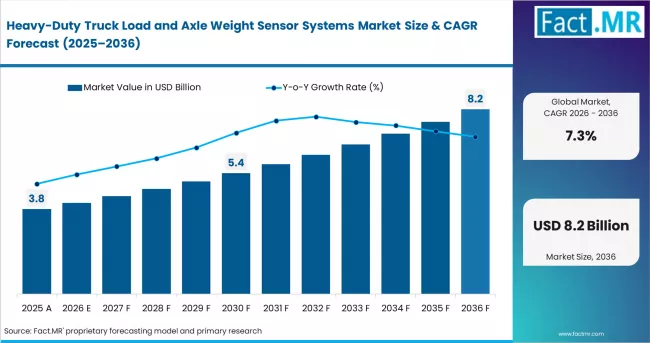
The market was valued at USD 3.5 billion in 2025 and is estimated to reach USD 3.8 billion in 2026. It is projected to expand to USD 7.7 billion by 2036, registering a CAGR of 7.3% over the forecast period. Growth reflects steady adoption of load monitoring systems across transport and logistics operations, where compliance and efficiency remain key priorities. The market is set to generate USD 3.9 billion in incremental opportunity between 2026 and 2036, supported by regulatory enforcement and infrastructure investment.
Heavy Duty Truck Load And Axle Weight Sensor Systems Market Value Analysis | Source: Fact.MR
Summary of Heavy-Duty Truck Load and Axle Weight Sensor Systems Market
- Market Definition
- Load and axle weight sensor systems measure truck weight and axle distribution to ensure compliance and optimize freight operations.
- Demand Drivers
- Governments are enforcing axle load regulations to reduce road damage.
- Logistics operators are adopting onboard systems to optimize payload and reduce penalties.
- Infrastructure investments are increasing deployment of weigh-in-motion systems.
- Key Segments Analyzed
- By Installation: In-road systems are expected to account for 46.3% share in 2026, supported by regulatory enforcement infrastructure.
- By Sensor Type: Piezoelectric sensors are projected to hold 41.7% share in 2026, due to high sensitivity and durability.
- By Geography: China leads growth at 9.9% CAGR, driven by logistics expansion and highway monitoring systems.
- Analyst Opinion at FACT.MR
- Shambhu Nath Jha, Senior Analyst at Fact.MR, states that axle weight monitoring is moving beyond enforcement infrastructure and becoming part of operational intelligence for fleet management. Monitoring systems now support better load distribution, route planning, and compliance tracking. Fleets are using these solutions to reduce penalties, improve fuel efficiency, and extend vehicle life. As data integration improves, axle weight monitoring is expected to play a stronger role in day-to-day logistics decisions.
- Strategic Implications
- Invest in weigh-in-motion infrastructure aligned with regulatory enforcement.
- Expand onboard sensor solutions for fleet operators.
- Develop cost-efficient systems for emerging markets.
- Methodology
- Market sizing integrates freight volumes and infrastructure deployment data.
- Analysis includes regulatory frameworks and procurement patterns.
Forecasts reflect logistics growth and compliance requirements.
| Metric | Value |
|---|---|
| Estimated Value in 2026 | USD 3.8 billion |
| Forecast Value in 2036 | USD 7.7 billion |
| Forecast CAGR (2026 to 2036) | 7.3% |
Source: Fact.MR analysis. Updated Apr 30, 2026
Stricter axle load regulations are a primary driver, as authorities increase monitoring to reduce road damage and improve safety. Expansion of freight transport networks is also increasing the need for accurate load measurement and compliance systems. Governments are investing in weigh-in-motion infrastructure to enable real-time monitoring, while fleet operators are adopting onboard sensors to optimize payload, reduce overloading penalties, and improve operational efficiency. Integration with intelligent transportation systems is further strengthening demand, as data-driven fleet management becomes more common.
China is projected to grow at 9.9% CAGR through 2036, supported by large-scale logistics expansion and regulatory enforcement. India is expected to expand at 9.1%, driven by infrastructure development and freight demand growth. Germany is forecast to grow at 8.4%, followed by France at 7.7% and the United Kingdom at 6.9%, where modernization of transport systems and compliance requirements support steady adoption.
Segmental Analysis
Heavy-Duty Truck Load and Axle Weight Sensor Systems Market Analysis by Installation
Heavy Duty Truck Load And Axle Weight Sensor Systems Market Analysis By Installation | Source: Fact.MR
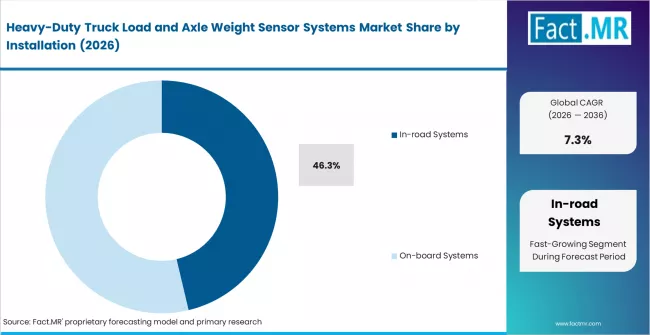
In-road systems are projected to account for 46.3% share of the heavy-duty truck load and axle weight sensor systems market in 2026, supported by their ability to enable continuous weight monitoring across highway networks. These systems are embedded within road infrastructure and allow authorities to measure axle loads and total vehicle weight without interrupting traffic flow. Their deployment supports stricter enforcement of load regulations, reduces congestion at static checkpoints, and improves overall transport efficiency. As freight volumes increase and highway networks expand, in-road systems are becoming an essential part of intelligent transportation infrastructure. Integration with digital traffic management systems also allows real-time data collection and analysis, helping authorities track compliance patterns and optimize enforcement strategies.
- Kistler deployment: Kistler Group deployed advanced weigh-in-motion systems for highway monitoring in 2024, improving real-time enforcement and data accuracy [1]. These systems allow authorities to track axle loads without stopping vehicles, reducing congestion and improving compliance visibility across transport corridors. Integration with digital monitoring platforms also enables better data analytics and long-term infrastructure planning based on traffic and load patterns.
- Infrastructure trend: Governments are increasing investment in weigh-in-motion systems to strengthen enforcement and reduce reliance on static checkpoints. These investments support broader intelligent transportation systems, where real-time monitoring improves regulatory efficiency. Expanding freight volumes and road usage are further encouraging deployment, as authorities aim to manage infrastructure wear and improve traffic flow without interrupting vehicle movement.
- Operational advantage: Continuous monitoring improves enforcement efficiency by reducing manual checks and minimizing delays in freight movement. This supports faster logistics operations while ensuring compliance with axle load regulations. Improved flow reduces fuel consumption, lowers operational costs for fleet operators, and enhances overall transport network performance across high-traffic routes.
Heavy-Duty Truck Load and Axle Weight Sensor Systems Market Analysis by Sensor Type
Heavy Duty Truck Load And Axle Weight Sensor Systems Market Analysis By Sensor Type | Source: Fact.MR
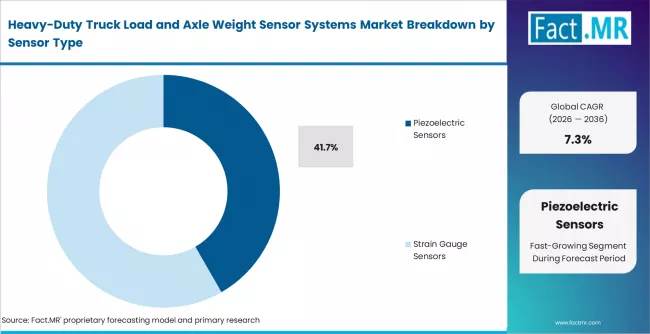
Piezoelectric sensors are expected to represent 41.7% share of the market in 2026, driven by their ability to deliver accurate measurements under dynamic load conditions. These sensors convert mechanical stress into electrical signals, allowing precise detection of axle weight and load distribution even at high vehicle speeds. Their durability and performance under heavy loads make them suitable for both highway applications and industrial environments. As demand for real-time monitoring increases, piezoelectric sensors are being integrated into advanced weigh-in-motion systems and smart traffic infrastructure. Their ability to operate reliably in varying environmental conditions further supports widespread adoption across regions.
- Siemens Mobility development: Siemens Mobility expanded intelligent traffic systems integrating weight sensing technologies in 2024, supporting advanced monitoring capabilities [2]. These systems enhance real-time data collection and enable better traffic and load management across highway infrastructure, improving both compliance tracking and operational planning.
- Technology trend: Piezoelectric sensors provide real-time measurement with high accuracy under continuous and dynamic load conditions. Their ability to convert mechanical stress into electrical signals allows precise detection even at high speeds. This makes them suitable for both highway monitoring and industrial applications where consistent performance and durability are required.
- Adoption trend: Increasing integration into weigh-in-motion systems is supporting segment growth across regions. Their durability under heavy loads and varying environmental conditions makes them a preferred choice for long-term deployment. As monitoring requirements become more complex, these sensors support reliable data collection and system efficiency across transportation and industrial networks.
Drivers, Restraints, and Opportunities
Heavy Duty Truck Load And Axle Weight Sensor Systems Market Opportunity Matrix Growth Vs Value | Source: Fact.MR
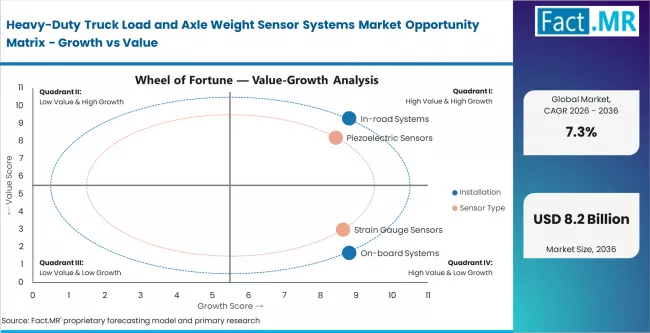
Market demand is driven by regulatory enforcement and the need to improve logistics efficiency across freight networks. Governments are strengthening road safety rules and axle load limits to reduce infrastructure damage, which supports steady adoption of weight monitoring systems. The current market size reflects increasing integration of these systems within transportation networks, including highways, logistics hubs, and fleet operations. Monitoring is becoming part of routine transport management as compliance requirements tighten and data-driven decision-making expands.
Fleet operators are shifting toward onboard monitoring systems that provide real-time load visibility during transit. Static weighing systems continue to operate at checkpoints, though they are being supplemented by dynamic weigh-in-motion technologies that allow continuous monitoring without interrupting vehicle movement. Advanced systems involve higher upfront costs, yet they improve operational efficiency, reduce penalty exposure, and support better fleet utilization. Adoption remains balanced across segments, with high-volume operators investing in more advanced solutions while smaller fleets focus on cost-controlled systems.
- Regulatory enforcement: Policies such as weigh-in-motion mandates and axle load limits are increasing system deployment across highway infrastructure and transport corridors.
- Logistics optimization: Onboard monitoring helps improve payload efficiency, reduce overloading risks, and support better route planning and fleet performance.
- Emerging market growth: Expansion of freight transport in Asia is increasing demand for monitoring systems across developing logistics networks.
Regional Analysis
The heavy-duty truck load and axle weight sensor systems market is assessed across North America, Europe, Asia Pacific, Latin America, and Middle East & Africa. Demand varies by regulatory enforcement, logistics activity, and infrastructure investment. The full report provides market attractiveness analysis.
.webp "Top Country Growth Comparison Heavy Duty Truck Load And Axle Weight Sensor Systems Market Cagr (2026 2036)")
Top Country Growth Comparison Heavy Duty Truck Load And Axle Weight Sensor Systems Market Cagr (2026 2036) | Source: Fact.MR
| Country | CAGR (2026 to 2036) |
|---|---|
| China | 9.9% |
| India | 9.1% |
| Germany | 8.4% |
| France | 7.7% |
| United Kingdom | 6.9% |
Source: Fact.MR analysis. Updated Apr 30, 2026
Source: Fact.MR (FACTMR) analysis, based on proprietary forecasting model and primary research
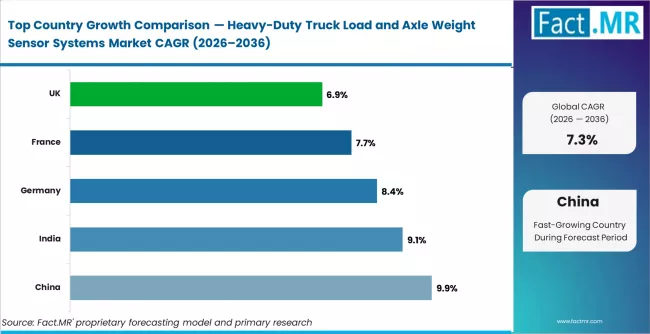
Heavy Duty Truck Load And Axle Weight Sensor Systems Market Cagr Analysis By Country | Source: Fact.MR
Asia Pacific Heavy-Duty Truck Load and Axle Weight Sensor Systems Market Analysis
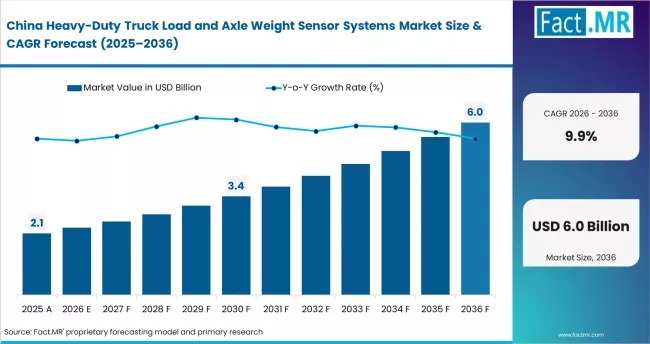
Heavy Duty Truck Load And Axle Weight Sensor Systems Market Country Value Analysis | Source: Fact.MR
Asia Pacific functions as the primary growth engine for this market, supported by rapid infrastructure development and expanding logistics networks. Countries in the region are investing heavily in highway modernization, freight corridor expansion, and digital transport monitoring systems. This creates a strong foundation for the deployment of axle weight and load monitoring technologies, particularly as governments tighten enforcement against overloading and road damage.
- China: China stands out as the largest and fastest-scaling market within the region. Nationwide highway upgrades and stricter enforcement policies have accelerated the deployment of weigh-in-motion systems across key freight corridors. Regulatory authorities strengthened overloading checks in 2024, making automated monitoring systems a necessity rather than an optional upgrade. Freight volumes continue to rise alongside industrial output and e-commerce expansion, further reinforcing demand. The market is expected to grow at a 9.9% CAGR, reflecting infrastructure-led adoption and large-scale logistics activity. Suppliers that align with government programs and deliver scalable, high-accuracy systems are better positioned to capture long-term contracts in this environment. [3]
- India: India follows with strong momentum driven by infrastructure expansion and regulatory tightening. Highway modernization programs and increasing deployment of weigh-in-motion systems are reshaping how freight compliance is managed. Government initiatives led by the Ministry of Road Transport and Highways have strengthened enforcement mechanisms, particularly on national highways and high-traffic routes. Growth in construction, mining, and logistics sectors continues to push freight volumes upward, creating a clear need for reliable load monitoring systems. The market is projected to expand at a 9.1% CAGR, supported by both regulatory push and commercial demand. Suppliers that offer cost-effective, durable solutions suited to diverse road conditions can scale more effectively, while limited localization may restrict adoption in price-sensitive segments. [4]
Regional demand across Asia Pacific continues to benefit from a combination of regulatory enforcement and economic growth. Unlike mature markets, adoption here is still expanding alongside infrastructure development, allowing both public and private stakeholders to integrate advanced sensor systems at scale. This creates long-term opportunities for technology providers that can balance performance, cost, and adaptability.
Europe Heavy-Duty Truck Load and Axle Weight Sensor Systems Market Analysis
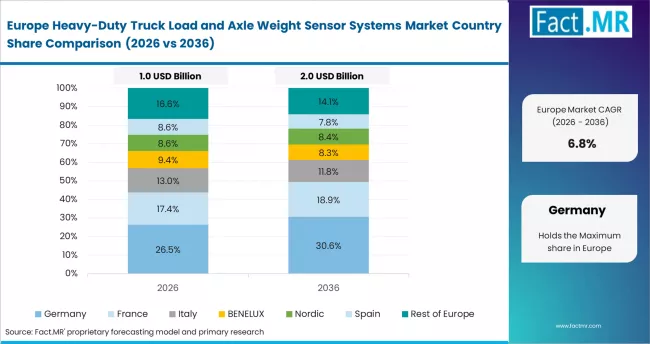
Heavy Duty Truck Load And Axle Weight Sensor Systems Market Europe Country Market Share Analysis, 2026 & 2036 | Source: Fact.MR
Europe represents a compliance-driven market where regulatory enforcement plays a central role in shaping demand. Governments across the region maintain strict axle load limits and actively invest in enforcement technologies to ensure road safety and infrastructure longevity. Unlike Asia Pacific, where growth is driven by expansion, Europe’s trajectory is defined by modernization and optimization of existing systems.
- Germany: Germany leads regional demand with a strong focus on regulatory compliance and logistics efficiency. Advanced transport infrastructure and well-established freight networks create a structured environment for sensor deployment. Federal authorities increased the use of weigh-in-motion systems in 2024 to enhance enforcement efficiency and reduce manual inspection requirements. The market is expected to expand at an 8.4% CAGR, reflecting stable demand supported by both regulatory frameworks and ongoing investments in transport technology. Suppliers that meet strict technical standards and integrate seamlessly with existing systems can secure long-term partnerships in this market. [5]
- France: France continues to expand its smart road infrastructure, with government-backed programs driving adoption of dynamic weighing systems. Investments in intelligent transport systems have increased the use of automated monitoring technologies across highways and urban freight routes. The market is projected to grow at a 7.7% CAGR, supported by infrastructure modernization and a strong focus on compliance. Demand is also influenced by efforts to reduce road damage and improve freight efficiency. Companies that provide reliable, scalable solutions aligned with public infrastructure projects are likely to benefit from sustained demand.
- U.K.: The United Kingdom reflects a more measured growth trajectory, with emphasis on logistics efficiency and road safety rather than rapid expansion. Adoption of intelligent transport systems has increased steadily, supported by policy initiatives and infrastructure upgrades introduced in recent years. The market is expected to grow at a 6.9% CAGR, indicating gradual but consistent demand. Buyers prioritize systems that enhance operational efficiency and integrate with existing logistics networks. Suppliers that deliver clear value in terms of performance and cost-effectiveness can maintain relevance in this competitive environment.
Across Europe, demand remains closely tied to regulatory enforcement and infrastructure management rather than new market creation. This creates a stable but disciplined growth environment where technology providers must meet high standards of accuracy, reliability, and compliance.
Competitive Aligners for Market Players
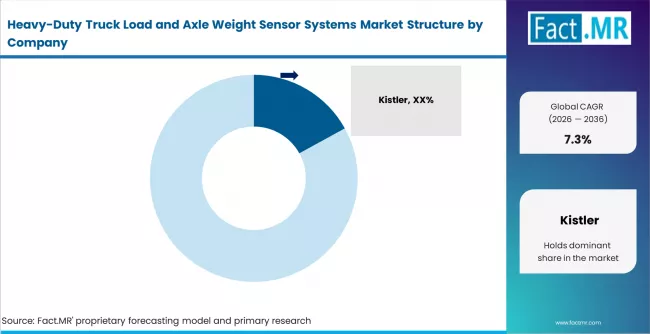
Heavy Duty Truck Load And Axle Weight Sensor Systems Market Analysis By Company | Source: Fact.MR
The market remains moderately concentrated, with key players operating across infrastructure systems and sensor technologies. Competition is defined by measurement accuracy, durability under heavy traffic conditions, and the ability to integrate seamlessly with broader traffic management and enforcement platforms. Suppliers must meet strict technical specifications and performance standards, particularly for highway and logistics applications where reliability directly affects regulatory compliance and operational efficiency. Entry barriers remain high due to long validation cycles and the need for proven field performance.
Companies with strong infrastructure partnerships and regulatory alignment hold clear advantages in securing large-scale projects. Kistler Group, Siemens Mobility, and Kapsch TrafficCom benefit from established relationships with government agencies and transport authorities. Their ability to deliver end-to-end solutions, including sensors, software integration, and data analytics, strengthens their position in long-term infrastructure programs. Experience in handling complex deployments and compliance requirements further supports their competitive standing.
Fleet operators and transport authorities retain strong bargaining power through project-based procurement models and multi-vendor evaluation processes. This reduces dependency on single suppliers and limits pricing flexibility. Suppliers must align with strict performance criteria, provide ongoing technical support, and ensure system reliability over extended operational periods. Competitive advantage increasingly depends on integration capability, service support, and consistent system performance rather than pricing alone.
Key Players
- Kistler
- Econolite
- Intercomp
- International Road Dynamics
- Kapsch TrafficCom
- Q-Free ASA
- Siemens Mobility
- SWARCO AG
Bibliography
- [1] Kistler Group, Weigh-in-Motion Systems Update, 2024
- [2] Siemens Mobility, Intelligent Traffic Systems Report, 2024
- [3] Ministry of Transport China, Highway Monitoring Program, 2024
- [4] Ministry of Road Transport and Highways India, Infrastructure Report, 2024
- [5] European Commission, Transport Infrastructure Monitoring Report, 2024
This Report Addresses
- Provides market intelligence on axle weight monitoring systems, covering infrastructure deployment, onboard sensing technologies, and integration across freight and transport networks.
- Covers forecast from USD 3.8 billion in 2026 to USD 7.7 billion by 2036, reflecting growth linked to regulatory enforcement and logistics optimization.
- Identifies growth opportunities across logistics and infrastructure sectors, including highways, freight corridors, and fleet-level monitoring systems.
- Offers segment and regional demand analysis with clear insights into adoption patterns across key countries and transport networks.
- Evaluates competitive strategies of key players, focusing on system integration, infrastructure partnerships, and compliance capabilities.
- Tracks product development and compliance trends related to weigh-in-motion systems and onboard load monitoring technologies.
- Analyzes regulatory impact, including axle load limits and enforcement policies shaping system adoption.
- Delivered in PDF and dataset formats, enabling structured access for operational, technical, and strategic use.
Heavy-Duty Truck Load and Axle Weight Sensor Systems Market Definition
Heavy-duty truck load and axle weight sensor systems measure the weight carried by trucks and the load distribution across axles. These systems help ensure that vehicles operate within legal weight limits, preventing road damage and improving safety. They are installed either on the road (weigh-in-motion systems) or directly on vehicles (onboard sensors). Their main function is to support regulatory compliance, optimize payload management, and reduce overloading risks in freight transport, construction, and mining operations.
Heavy-Duty Truck Load and Axle Weight Sensor Systems Market Inclusions
The report covers global and regional market size, forecasts from 2026 to 2036, and segment analysis by installation type, sensor type, and application. It includes demand across freight transport, construction, and mining sectors. The study evaluates pricing trends, infrastructure deployment, and integration of weight monitoring systems within transportation networks.
Heavy-Duty Truck Load and Axle Weight Sensor Systems Market Exclusions
The scope excludes full traffic management systems, toll collection infrastructure, and fleet telematics platforms unless directly linked to weight sensing. It does not include light vehicle weighing systems or standalone industrial weighing equipment. The focus remains on heavy-duty truck load and axle weight sensing systems.
Heavy-Duty Truck Load and Axle Weight Sensor Systems Market Research Methodology
- Primary Research
- Interviews with transport authorities, fleet operators, and sensor manufacturers to assess adoption patterns and operational requirements.
- Desk Research
- Uses transportation policy reports, infrastructure data, and company disclosures to support market assessment.
- Market-Sizing and Forecasting
- Applies a hybrid model based on freight volumes, infrastructure deployment, and sensor integration rates.
- Data Validation and Update Cycle
- Validated through procurement trends, infrastructure projects, and supplier shipment data to ensure accuracy.
Segmentation
Scope of Report
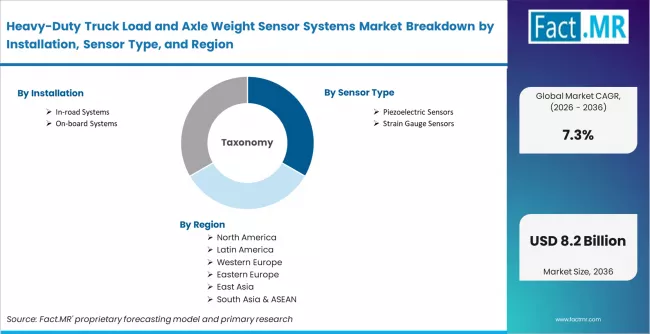
Heavy Duty Truck Load And Axle Weight Sensor Systems Market Breakdown By Installation Sensor Type And Region | Source: Fact.MR
|
Attribute |
Details |
|---|---|
| Quantitative Units | USD 3.8 billion (2026) to USD 7.7 billion (2036), at a CAGR of 7.3% |
| Market Definition | Heavy-duty truck load and axle weight sensor systems used to measure vehicle load and axle weight distribution, enabling compliance with regulatory limits, improving road safety, and optimizing payload management across freight transport, construction, and mining operations globally. |
| Installation Segmentation | In-road Systems, On-board Systems |
| Sensor Type Segmentation | Piezoelectric Sensors, Strain Gauge Sensors, Bending Plate Sensors, Others |
| Application Segmentation | Freight Transport, Construction, Mining, Others |
| Application Coverage | Weigh-in-motion highway monitoring, onboard load measurement, overload detection, regulatory enforcement systems, freight optimization, infrastructure protection, and compliance management across logistics and industrial transport operations |
| Regions Covered | North America, Europe, Asia Pacific, Latin America, Middle East & Africa |
| Countries Covered | USA, Canada, Germany, United Kingdom, France, Italy, Spain, China, India, Japan, Brazil, Mexico, GCC Countries, South Africa |
| Key Companies Profiled | Kistler, Econolite, Intercomp, International Road Dynamics, Kapsch TrafficCom, Q-Free ASA, Siemens Mobility, SWARCO AG |
| Forecast Period | 2026 to 2036 |
| Approach | Hybrid top-down and bottom-up model using freight transport volumes, highway infrastructure deployment, weigh-in-motion system installations, onboard sensor integration rates per vehicle, average selling prices, and primary interviews with transport authorities, fleet operators, and system providers |
Source: Fact.MR analysis. Updated Apr 30, 2026
Heavy-Duty Truck Load and Axle Weight Sensor Systems Market by Segments
-
By Installation:
- In-road Systems
- On-board Systems
-
By Sensor Type:
- Piezoelectric Sensors
- Strain Gauge Sensors
- Bending Plate Sensors
- Others
-
By Application:
- Freight Transport
- Construction
- Mining
- Others
-
By Region:
- North America
- United States
- Canada
- Europe
- Germany
- United Kingdom
- France
- Italy
- Spain
- Asia Pacific
- China
- India
- Japan
- Latin America
- Brazil
- Mexico
- Middle East & Africa
- GCC Countries
- South Africa
- North America
Frequently Asked Questions
How large is the heavy-duty truck load and axle weight sensor systems market in 2025?
What is the estimated market size in 2026?
What will the market size be by 2036?
What is the expected CAGR for this market?
What are load and axle weight sensor systems?
Where are these systems used?
Why are these systems important?
Which installation type is expected to lead the market?
Which sensor type dominates the market?
Which region is growing the fastest?
What is driving demand for these systems?
How do weigh-in-motion systems work?
What are the main challenges in this market?
How are fleet operators benefiting from onboard systems?
What opportunities exist in this market?
Who worked on this report


Preview the report firsthand - request a free sample
Free SampleGet the brochure for pricing and purchase details
Download PDF