Heavy-Lift Military Logistics Drones Market Size, Share, Growth and Forecast (2026 - 2036)

The Heavy-Lift Military Logistics Drones Market is segmented by Drone Type, by Payload Capacity, by Propulsion Type, by Flight Range, by Level of Autonomy, by Mission Type, by Deployment Environment, and Region. Forecast for 2026 to 2036.

Heavy-Lift Military Logistics Drones Market Forecast and Outlook by Fact.MR

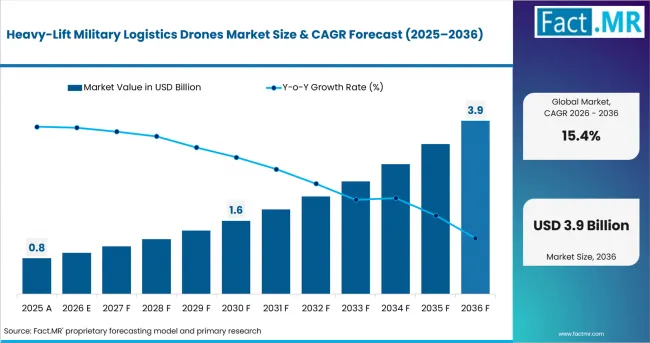
  • In 2025, the Heavy-Lift Military Logistics Drones Market was valued at USD 0.8 billion.
  • Based on Fact.MR's analysis, demand for heavy-lift military logistics drones is estimated to grow to USD 0.9 billion in 2026 and USD 3.9 billion by 2036.
  • Fact.MR projects a CAGR of 15.8% during the forecast period.
Heavy Lift Military Logistics Drones Market Value Analysis

Summary of the Heavy-Lift Military Logistics Drones Market

  • Market Snapshot
    • Global heavy-lift military logistics drones market was valued at USD 0.8 billion in 2025 and is estimated to reach USD 0.9 billion in 2026, further expanding to USD 3.9 billion by 2036.
    • At a 15.8% CAGR from 2026 to 2036, the market is set to expand ~4.3x in value, creating an absolute dollar opportunity of USD 3.0 billion.
    • Growth is being driven by increasing military modernization programs, rising demand for autonomous battlefield logistics, and the need to deliver supplies in high-risk and inaccessible combat environments.
    • Heavy-lift military logistics drones are increasingly adopted to support cargo transport, medical evacuation, ammunition delivery, and mission-critical resupply operations while reducing risks to personnel.
    • Rising investments in AI-enabled autonomy, advanced battery technologies, and next-generation unmanned aerial systems (UAS) are reinforcing market expansion globally.
  • Demand and Growth Drivers
    • Increasing adoption of unmanned systems for military logistics and battlefield support
    • Rising defense expenditure and investment in autonomous drone programs
    • Growing requirement for rapid last-mile resupply in contested environments
    • Increasing use of drones for reducing soldier exposure during dangerous logistics missions
    • Need for solutions that provide:
      o Enhanced payload carrying capability and operational range
      o Faster and safer delivery of ammunition, food, fuel, and medical supplies
      o Improved mission flexibility in remote or hostile terrains
      o Reduced dependence on conventional manned logistics platforms
  • Product and Segment View
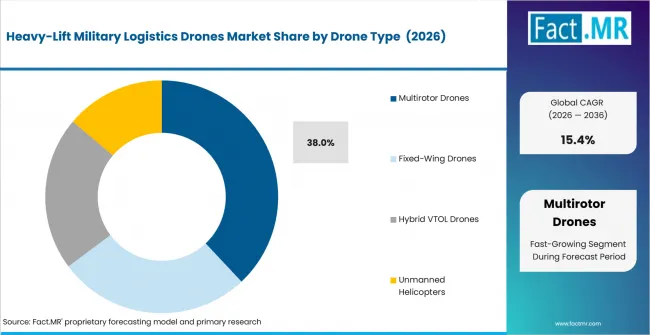
    • Multirotor drones represent the leading drone type segment with a 38% market share in 2026, driven by their vertical take-off and landing (VTOL) capability, precision hovering, and suitability for tactical missions.
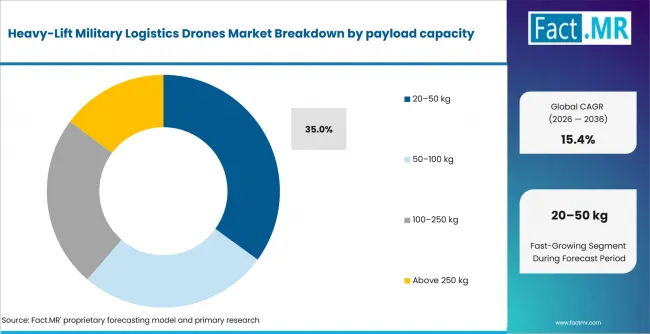
    • 20–50 kg payload capacity drones account for 35% of the market in 2026, supported by their balance between payload capability, maneuverability, and operational efficiency.
    • Battery-electric propulsion systems hold 42% of the market share in 2026 due to lower acoustic signatures, reduced maintenance requirements, and improved advancements in high-density battery technologies.
    • Tactical resupply represents the leading mission application segment with a 34% market share in 2026, owing to increasing demand for rapid delivery of ammunition, medical supplies, food, and essential equipment to frontline troops.
  • Geography and Competitive Outlook
    • The market is geographically segmented into North America, Latin America, Western Europe, Eastern Europe, East Asia, South Asia & Pacific, and the Middle East & Africa.
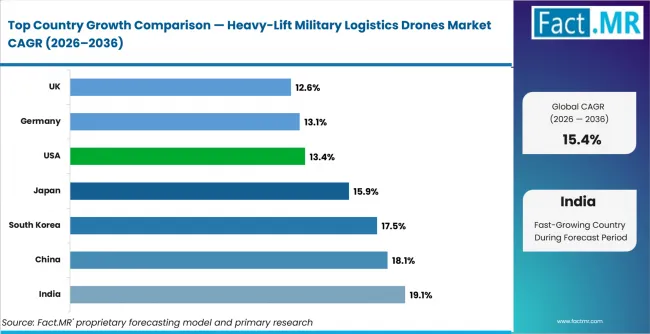
    • Key growth markets and CAGR: India 19.1%, China 18.1%, South Korea 17.5%, Japan 15.9%, U.S. 13.4%, Germany 13.1%, and U.K. 12.6%.
    • Market expansion is closely tied to:
      o Rising government initiatives for indigenous drone development
      o Increasing procurement of autonomous logistics platforms by defense agencies
      o Growing integration of AI, autonomous navigation, and secure communication systems in military drones
    • Key companies active in this market include Elroy Air, Piasecki Aircraft / KARGO UAV, Schiebel Corporation, BAE Systems / Malloy Aeronautics, UAVOS Inc., DZYNE Technologies, Skyways Autonomous Systems, Volatus Aerospace / Drone Delivery Canada, Sierra Nevada Corporation / Volansi assets, Lockheed Martin Corporation, and EHang Holdings.
  • Analyst Opinion
    • Shambhu Nath Jha, Principal Consultant at Fact.MR, opines, "Leaders at the CXO level would realize that in the future, competitive advantage within the heavy-lift military logistics drones market will be defined not merely by payload capacity, but by the ability to deliver highly autonomous, resilient, and mission-ready logistics solutions capable of operating in contested and high-risk environments."

Heavy-Lift Military Logistics Drones Market - At a Glance

Attribute Details
Market Value 2025 USD 0.8 billion
Market Value 2026 USD 0.9 billion
Market Value 2036 USD 3.9 billion
Absolute Dollar Opportunity (2026–2036) USD 3.0 billion
Total Growth (2026–2036) 333.3%
CAGR (2026–2036) 15.8%
Growth Multiple ~4.3x
Key Demand Theme Growing adoption of autonomous aerial logistics systems for military resupply and battlefield operations
Leading Drone Type (2026) Multirotor Drones
Drone Type Share (2026) 38%
Leading Payload Capacity (2026) 20–50 kg
Payload Capacity Share (2026) 35%
Leading Propulsion System (2026) Battery-Electric
Propulsion Share (2026) 42%
Leading Mission Application (2026) Tactical Resupply
Mission Application Share (2026) 34%
Key Growth Regions North America, Latin America, Western Europe, Eastern Europe, East Asia, South Asia & Pacific, Middle East & Africa
Country CAGRs India 19.1%, China 18.1%, South Korea 17.5%, Japan 15.9%, U.S. 13.4%, Germany 13.1%, U.K. 12.6%
Top Companies Elroy Air, Piasecki Aircraft / KARGO UAV, Schiebel Corporation, BAE Systems / Malloy Aeronautics, UAVOS Inc., DZYNE Technologies, Skyways Autonomous Systems, Volatus Aerospace / Drone Delivery Canada, Sierra Nevada Corporation / Volansi assets, Lockheed Martin Corporation, EHang Holdings
Segmentation by Drone Type Multirotor Drones, Fixed-Wing Drones, Hybrid VTOL Drones, Other
Segmentation by Payload Capacity Below 20 kg, 20–50 kg, Above 50 kg, Other
Segmentation by Propulsion Battery-Electric, Hybrid-Electric, Fuel-Based Systems, Other
Segmentation by Mission Application Tactical Resupply, Medical Evacuation & Supply Delivery, Ammunition Transport, Equipment & Cargo Delivery, Other
Segmentation by Region North America, Latin America, Western Europe, Eastern Europe, East Asia, South Asia & Pacific, Middle East & Africa

Market growth for the period of 2026 to 2036 will amount to USD 3.0 billion on an absolute basis. This represents a phase marked by transformative growth instead of steady progress, given that autonomous heavy lift drones will see growing adoption within the armed forces in their role as enablers within logistics and last mile resupplies, especially in difficult-to-reach areas. Defense budget allocations toward modernization, improved AI-based automation, hybrid propulsion technologies, and increased payload carrying capacity will drive market growth, albeit constrained by costly acquisition, rigorous certifications, and cyber security threats.

Drivers, Restraints, and Opportunities
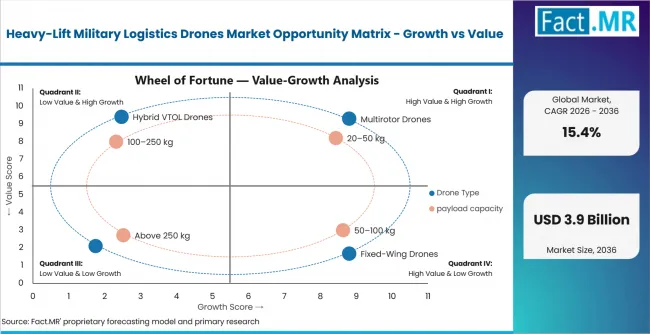
Heavy Lift Military Logistics Drones Market Opportunity Matrix Growth Vs Value

The Fact.MR team notes that the market is currently transitioning into a period of high growth. This comes about as a result of a change from experimental defensive projects to military uses of drones in response to the demand for autonomous solutions to ensure adequate resupply in battlefields. This market thrives because of increasing budgetary allocations by governments in defense modernizations, the desire to minimize the risk posed to humans during dangerous logistical operations, and the increasing number of military autonomous/AI projects.

As per Fact.MR insights, the transition is observed in the market dynamics where there is a move away from legacy battlefield logistics based on manual operations and human control toward unmanned cargo logistics that rely on autonomous, long-endurance, and AI-driven capabilities. There is a gradual reduction in the use of traditional logistics due to the presence of danger in high-risk battle zones, whereas there is a surge in the use of heavy lift drones for autonomous last mile delivery.

Higher costs associated with the production of heavy lift drones have resulted from increased integration of advanced navigational features, secure communications technology, AI technology, and sophisticated propulsion technology. Nevertheless, production volumes will not be large since the number of heavy lift drone procurement programs will remain relatively small. The focus will thus shift towards high-value procurement programs within the military sector. As soldiers' welfare continues to take precedence, autonomous logistic drones will continue to capture a greater percentage of military UAV investments.

  • Autonomous Battlefield Logistics: Modern militaries are increasingly integrating heavy-lift drones into last-mile resupply operations to reduce dependence on manned convoys and helicopters in high-threat areas. Growth is being driven by advances in AI-based navigation, autonomous mission planning, and resilient communication systems that enable operations in contested environments.
  • Defense Modernization Policies: Government initiatives such as the U.S. Department of Defense Replicator Initiative are accelerating the adoption of autonomous military systems by promoting rapid deployment of scalable unmanned platforms. [1] These programs are encouraging defense contractors to develop cost-effective, mission-ready logistics drones with improved payload, endurance, and operational flexibility.
  • Regional Procurement Shift: North America remains the largest market due to substantial U.S. defense spending and established UAV development capabilities, while East Asia and South Asia & Pacific are emerging as high-growth regions due to increasing geopolitical tensions, border security requirements, and indigenous drone manufacturing programs in countries such as China, India, and Australia.

Heavy-Lift Military Logistics Drones Market Segmentation Analysis

Which Drone Type is the most popular across the industry?
Heavy Lift Military Logistics Drones Market Analysis By Drone Type

Based on Fact.MR's Heavy-Lift Military Logistics Drones Market report, consumption of Multirotor Drones is estimated to hold 38% share in 2026. Their dominance is attributed to their vertical take-off and landing capability, operational simplicity, and ability to perform precise last-mile cargo delivery in confined or contested environments without requiring runways. These platforms address a critical military requirement of safely transporting supplies to forward operating bases and remote locations where conventional logistics assets face accessibility and survivability challenges.

Which payload capacity is most used in missions?
Heavy Lift Military Logistics Drones Market Analysis By Payload Capacity

According to the study, consumption of 20–50 kg payload capacity drones is estimated to hold 35% share in 2026. This segment dominates due to its optimal balance between payload capability, operational range, platform cost, and deployment flexibility for tactical battlefield logistics. These drones effectively address the military requirement for frequent last-mile delivery of ammunition, medical supplies, food, and critical equipment to forward operating units while maintaining relatively lower acquisition and operational complexity compared to larger heavy-payload platforms.

Why are battery-driven drones most demanding than others?

As per many analysts, consumption of Battery-Electric propulsion systems is estimated to hold 42% share in 2026. The segment leads due to its mechanical simplicity, lower maintenance requirements, reduced acoustic signature, and suitability for short-range tactical resupply missions. Battery-electric heavy-lift drones address military demand for quiet, rapidly deployable logistics platforms capable of operating in contested environments where stealth and operational flexibility are critical.

What is Tactical Resupply and why these drones’ matter in these types of missions?

The consumption of Tactical Resupply is estimated to hold 34% share in 2026. The segment dominates because heavy-lift drones are primarily deployed to address the critical challenge of delivering essential supplies to frontline units without exposing soldiers and manned vehicles to enemy threats. Their ability to execute autonomous last-mile deliveries in remote, contested, and infrastructure-limited environments provides a significant operational advantage for modern armed forces.

On which deployment environment these drones are widely popular?
Heavy Lift Military Logistics Drones Market Analysis By Deployment Environment

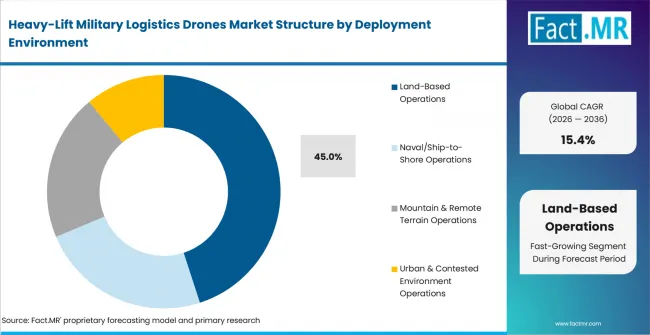
Based on Fact.MR's Heavy-Lift Military Logistics Drones Market report, consumption of Land-Based Operations is estimated to hold 45% share in 2026. This segment dominates due to the extensive use of heavy-lift drones for battlefield resupply, forward operating base support, and transport of essential cargo across land-based military missions. These platforms solve the challenge of delivering supplies across dangerous, inaccessible, or infrastructure-deficient terrains while reducing dependence on vulnerable manned convoys.

Regional Analysis

The market is geographically segmented into North America, Latin America, Western Europe, Eastern Europe, East Asia, South Asia & Pacific, and the Middle East & Africa. The report evaluates regional market sizes, growth prospects, defense procurement trends, and adoption patterns across these key regions. The full report also provides a detailed market attractiveness analysis to identify high-growth opportunities across regional markets.

Heavy Lift Military Logistics Drones Market Value Analysis

Country CAGR
U.S. 13.4%
China 18.1%
Germany 13.1%
U.K. 12.6%
Japan 15.9%
S. Korea 17.5%
India 19.1%

Source: Fact.MR analysis, based on proprietary forecasting model and primary research
Heavy Lift Military Logistics Drones Market Cagr Analysis By Country

North America Heavy-Lift Military Logistics Drones Market
Heavy Lift Military Logistics Drones Market Country Value Analysis

North America serves as the global innovation and defense procurement hub for heavy-lift military logistics drones, supported by substantial military modernization investments, advanced UAV ecosystems, and strong collaboration between defense agencies and private manufacturers. Key regional players include Elroy Air, which specializes in autonomous long-range cargo drones; Piasecki Aircraft / KARGO UAV, known for its proven K-MAX unmanned heavy-lift helicopter platform; and AeroVironment, which leverages its extensive defense UAV expertise to expand capabilities in autonomous military logistics solutions.

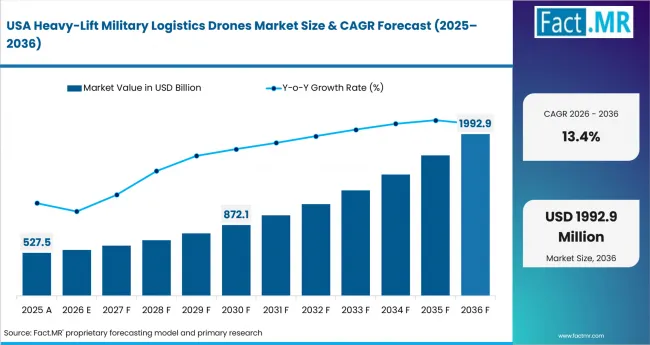
  • United States: Demand for heavy-lift military logistics drones in the United States is projected to rise at 13.4% CAGR through 2036. Growth is driven by continued investments by the U.S. Department of Defense in autonomous battlefield logistics, AI-enabled unmanned systems, and resilient supply chain capabilities under its evolving modernization priorities during 2025 onward. The presence of leading drone developers, extensive defense procurement budgets, and increasing field evaluations of autonomous cargo platforms are expected to support adoption, although stringent military qualification requirements and cybersecurity standards may influence deployment timelines.
  • Canada: Market growth is supported by the Canadian Armed Forces’ increasing emphasis on autonomous technologies, particularly for logistics operations across remote, Arctic, and infrastructure-limited environments. Ongoing defense modernization efforts, investments in domestic innovation, and the need to improve operational reach in challenging terrains are expected to drive adoption, while a relatively smaller defense procurement base may moderate large-scale deployment.

Europe Heavy-Lift Military Logistics Drones Market
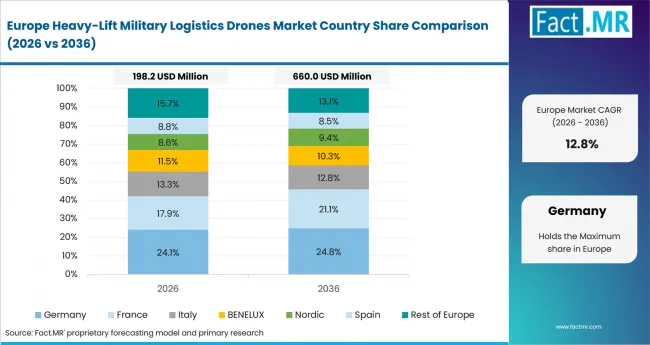
Heavy Lift Military Logistics Drones Market Europe Country Market Share Analysis, 2026 & 2036

Europe serves as the global defense innovation and collaborative development hub for heavy-lift military logistics drones, supported by strong indigenous aerospace capabilities, increasing defense modernization efforts, and cross-border military technology programs. Key regional players include Airbus Defence and Space, which leverages its extensive aerospace expertise and defense relationships to advance autonomous military aviation systems; Schiebel Corporation, recognized for its mature rotary-wing UAV platforms and strong presence in maritime and defense applications; and BAE Systems / Malloy Aeronautics, which specializes in heavy-lift cargo drones designed for tactical resupply and next-generation battlefield logistics missions.

  • Germany: Demand for heavy-lift military logistics drones in Germany is projected to rise at 13.1% CAGR through 2036. Growth is supported by Germany’s accelerated defense modernization under the Bundeswehr’s increased special defense fund allocations and capability enhancement programs continuing through 2025, which prioritize unmanned and autonomous technologies. Furthermore, German defense companies and research institutions are expanding development of next-generation UAV technologies, while the country’s focus on NATO readiness and resilient military logistics is expected to drive procurement of advanced cargo drone platforms.
  • United Kingdom: Demand for heavy-lift military logistics drones in the United Kingdom is projected to rise at 12.6% CAGR through 2036. Market expansion is driven by the UK Ministry of Defence’s continued Defence Drone Strategy implementation (2024 onward, with ongoing deployments and investments through 2025) aimed at integrating autonomous systems across military operations. Additionally, companies such as BAE Systems / Malloy Aeronautics have continued advancing heavy-lift logistics drone capabilities for UK defense applications, strengthening the country’s position in autonomous battlefield resupply and next-generation military mobility.
  • France: Demand for heavy-lift military logistics drones in France is projected to rise at 14.2% CAGR through 2036. Growth is supported by the French Ministry of Armed Forces’ ongoing implementation of the Military Programming Law 2024–2030, with continued investments in autonomous systems and drone capabilities through 2025. The presence of major defense players such as Airbus Defence and Space and Thales and France’s emphasis on sovereign defense technologies are expected to encourage further adoption of advanced logistics UAV platforms.
  • Russia: Growth is influenced by the country’s increased investment in domestic unmanned systems and military technology development following supply chain restrictions and import limitations. Russia’s continued emphasis on indigenous UAV manufacturing and expansion of military drone production capabilities through state-supported defense programs is expected to support demand for logistics-oriented unmanned aerial platforms.

Asia-Pacific Heavy-Lift Military Logistics Drones Market

Asia-Pacific serves as the global defense drone manufacturing and autonomous aviation innovation hub for the market, driven by large-scale UAV production capabilities, increasing military modernization initiatives, and strong government support for indigenous unmanned technologies. Key regional players include Aviation Industry Corporation of China (AVIC), which has a strong position in military UAV development and integrated aerospace manufacturing. China Aerospace Science and Technology Corporation (CASC) maintains a competitive advantage through its expertise in advanced unmanned systems and high-end defense technologies.

  • China: Demand for heavy-lift military logistics drones in China is projected to rise at 18.1% CAGR through 2036. Growth is driven by the country’s focus on military advancement and expansion of autonomous combat support capabilities under the People’s Liberation Army modernization roadmap continuing through 2025 and beyond. In addition, major state-owned defense companies such as Aviation Industry Corporation of China (AVIC) have continued investments in advanced unmanned aerial systems and heavy-payload drone technologies, strengthening domestic manufacturing capabilities and accelerating the deployment of logistics UAVs for remote and high-risk operations.
  • Japan: Demand for heavy-lift military logistics drones in Japan is projected to rise at 15.9% CAGR through 2036. Market growth is supported by the Japan Ministry of Defense’s Defense Buildup Program implementation and increased investments in unmanned defense technologies, aimed at improving operational readiness across remote island territories.
  • South Korea: Demand for heavy-lift military logistics drones in South Korea is projected to rise at 17.5% CAGR through 2036. Growth is supported by the Defense Acquisition Program Administration (DAPA) initiatives during 2025 to strengthen AI-based and unmanned military systems under its defense innovation programs. Additionally, domestic defense manufacturers such as Korea Aerospace Industries (KAI) have expanded investments in advanced UAV and autonomous aerial platform development in recent years, enhancing South Korea’s ability to develop indigenous logistics drones for future military operations.
  • India: Demand for heavy-lift military logistics drones in India is projected to rise at 19.1% CAGR through 2036. Growth is driven by the country’s increasing focus on indigenous unmanned systems under the Ministry of Defence’s Aatmanirbhar Bharat defense manufacturing initiatives and continued procurement preference for domestically developed military technologies during 2025. Additionally, the Indian Army’s ongoing deployment and evaluation of logistics drones for high-altitude supply missions along border regions, including programs supported by domestic manufacturers such as ideaForge and NewSpace Research & Technologies during 2025, is accelerating the adoption of heavy-lift UAVs. Rising requirements for autonomous resupply in mountainous terrains, combined with expanding investments by Indian drone startups and defense manufacturers, are expected to support sustained market growth.

Fact.MR's analysis of the Heavy-Lift Military Logistics Drones Market consists of a comprehensive regional and country-wise assessment across North America, Latin America, Western Europe, Eastern Europe, East Asia, South Asia & Pacific, and the Middle East & Africa. The study includes detailed evaluations of key countries such as the United States, Canada, Germany, the United Kingdom, France, Russia, Ukraine, China, Japan, South Korea, India, Australia, and other emerging markets. Readers can find in-depth insights on regional market share, defense modernization programs, military procurement activities, autonomous logistics adoption trends, competitive landscape, and future growth opportunities across the global market.

Competitive Benchmarking and Company Positioning
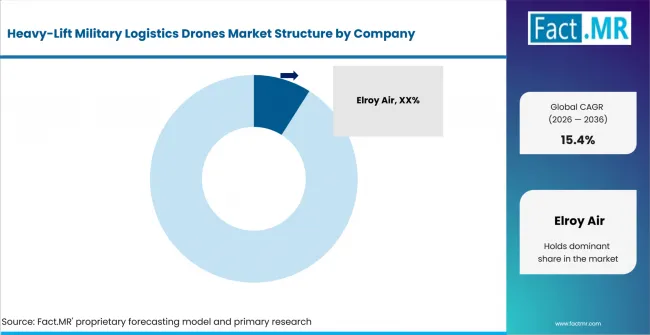
Heavy Lift Military Logistics Drones Market Analysis By Company

The heavy-lift military logistics drones market exhibits a moderately concentrated competitive structure, with the top 10 to 15 players accounting for approximately 55% to 65% of the global market share. Competition is primarily driven by technological capability, including payload capacity, flight endurance, autonomous navigation, secure communication systems, and operational reliability in contested environments. Established defense contractors compete alongside specialized UAV manufacturers, creating a market where proven military performance and procurement relationships are key differentiators.

Companies such as Lockheed Martin, Airbus Defence and Space, AVIC, and BAE Systems possess significant structural advantages due to their established defense ecosystems, strong research and development capabilities, long-standing relationships with military agencies, and ability to integrate drones with broader defense networks. Specialized players such as BAE Systems / Malloy Aeronautics, Elroy Air, Schiebel, and UAVOS maintain competitive positions through focused expertise in heavy-lift cargo platforms, rapid innovation cycles, and customized solutions for tactical resupply applications.

Buyer power remains moderate to high, as the primary customers are government defense agencies and military organizations with extensive procurement oversight and stringent qualification requirements. Large buyers typically reduce supplier dependency through multi-vendor procurement strategies, domestic manufacturing preferences, long-term development partnerships, and rigorous competitive tender processes. This limits manufacturers' pricing power despite the high technological complexity of heavy-lift logistics drones, requiring suppliers to continuously demonstrate performance improvements, reliability, and lifecycle cost advantages to secure contracts.

Leading Companies Shaping the Market

  • Elroy Air
  • Piasecki Aircraft / KARGO UAV
  • Schiebel Corporation
  • BAE Systems / Malloy Aeronautics
  • UAVOS Inc.
  • DZYNE Technologies
  • Skyways Autonomous Systems
  • Volatus Aerospace / Drone Delivery Canada
  • Sierra Nevada Corporation / Volansi assets
  • Lockheed Martin Corporation
  • EHang Holdings

Recent Developments

  • In September 2025, Elroy Air selected Kratos Defense & Security Solutions as the exclusive U.S. manufacturing partner for the Chaparral hybrid-electric VTOL cargo drone. The five-year manufacturing agreement supports high-volume production for a cargo platform designed to move 300 pounds over 300 miles across military resupply, disaster relief, and commercial logistics missions.
  • In August 2025, Elroy Air completed autonomous transition flights of the Chaparral VTOL cargo drone. The aircraft moved from vertical takeoff to forward wing-borne flight during July and August tests, which validated a critical flight capability for longer-range autonomous cargo movement.
  • In July 2025, Schiebel demonstrated CAMCOPTER S-100 cross-domain logistics capability during the European Defence Agency’s OPEX campaign. The unmanned aircraft conducted daily logistics missions with an underslung cargo net and transported suspended loads above 50 kg under simulated battlefield conditions.

Sources and Research Reference

  • Elroy Air. (2025, August 14). Elroy Air achieves major milestone with transition of Chaparral aircraft from vertical takeoff to wingborne flight. Elroy Air.
  • Elroy Air. (2025, September 23). Kratos to be exclusive U.S. manufacturer for the Elroy Air Chaparral VTOL cargo drone. Elroy Air.
  • Government of Canada. (2025, August 5). Royal Canadian Navy to enhance maritime operations with new uncrewed aircraft systems. National Defence.
  • Schiebel. (2025, July 24). Schiebel CAMCOPTER® S-100 demonstrates cross-domain logistics capabilities during EDA’s inaugural OPEX campaign. Schiebel.
  • Schiebel. (2025, September 10). Schiebel CAMCOPTER® S-100 included in MDA Space solution for RCN ISTAR programme. Schiebel.

Heavy-Lift Military Logistics Drones Market Definition

The Market for Heavy Lift Military Logistics Drones includes drones that are used to move cargo like ammunition, medicine, fuel, food, replacement parts, and military hardware without any pilots on board. The drones consist of heavy lift multi-rotor drones, unmanned helicopters, and hybrid UAVs. These drones operate in challenging terrain and combat zones. They play an important role in providing autonomous or remote logistics service in areas where normal vehicles may pose threats. The main customers for these drones are defense forces that include army, navy, air force, and special forces that need efficient battlefield logistics support.

Heavy-Lift Military Logistics Drones Market Inclusion

The report provides a comprehensive analysis of the global market, including historical analysis and forecasts for the period 2026–2036. This study provides comprehensive insights into estimates for market size in various regions, segmenting the market based on Drone Type, payload, power sources, mission type, and end-user. It further highlights technology innovation, trends in military procurement, supply chain dynamics, competitive scenario, price trends, and adoption across various regions for the future prospects of the market.

Heavy-Lift Military Logistics Drones Market Exclusion

The boundaries do not include small tactical UAVs that are only utilized for ISR purposes, loitering munitions, combat strike UAVs, and delivery drones intended for commercial use. In addition to this, the research does not cover autonomous logistics vehicles that operate on the ground, manned cargo helicopters, and other military UAVs that are not specially designed for carrying heavy payloads.

Heavy-Lift Military Logistics Drones Market Research Methodology

  • Primary Research
    • Primary interviews were conducted with defense procurement officials, UAV manufacturers, component suppliers, military technology experts, and industry executives to understand adoption trends, technological developments, and procurement strategies.
  • Desk Research
    • Secondary research included analysis of defense budgets, government procurement records, military modernization programs, company annual reports, investor presentations, technical publications, and credible defense industry databases.
  • Market-Sizing and Forecasting
    • The market size was estimated using a hybrid approach combining bottom-up analysis of drone manufacturers and defense contracts with top-down assessment of military UAV spending, followed by forecast modeling based on technology adoption and procurement trends.
  • Data Validation and Update Cycle
    • All market estimates were validated through triangulation of primary insights, secondary sources, company developments, and historical procurement patterns. The data is continuously reviewed and updated to reflect changes in defense spending, new contracts, and emerging technological advancements

Report Scope

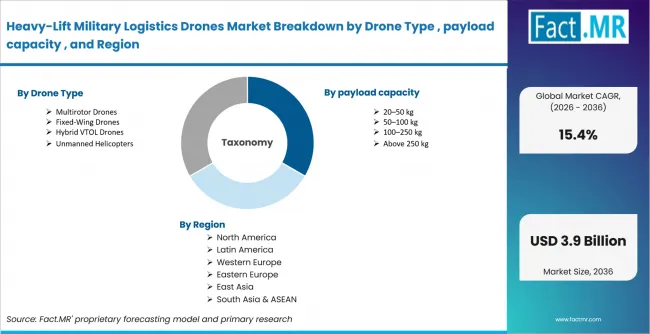
Heavy Lift Military Logistics Drones Market Breakdown By Drone Type , Payload Capacity , And Region

Parameter Details
Quantitative Units USD 0.8 billion in 2025 to USD 3.9 billion in 2036, at a CAGR of 15.8%
Market Definition The Heavy-Lift Military Logistics Drones Market comprises unmanned aerial systems designed for autonomous transportation of military supplies, equipment, and cargo.
Segments Covered Drone Type, Payload Capacity, Propulsion Type, Flight Range, Level of Autonomy, Mission Type, and Deployment Environment
Regions Covered North America, Latin America, Western Europe, Eastern Europe, East Asia, South Asia & Pacific, Middle East & Africa
Countries Covered U.S., China, Germany, Japan, India, U.K., France, Brazil, and 30 others
Key Companies Elroy Air, Piasecki Aircraft / KARGO UAV, Schiebel Corporation, BAE Systems / Malloy Aeronautics, UAVOS Inc., DZYNE Technologies, Skyways Autonomous Systems, Volatus Aerospace / Drone Delivery Canada, Sierra Nevada Corporation / Volansi assets, Lockheed Martin Corporation, and others
Forecast Period 2026 – 2036
Approach Hybrid market approach combining bottom-up analysis of UAV manufacturer revenues, military procurement contracts, and deployment trends, with top-down assessment of defense modernization spending, autonomous systems investments, and battlefield logistics adoption patterns.

Heavy-Lift Military Logistics Drones Market Taxonomy

  • Heavy-Lift Military Logistics Drones Market Segment by Drone Type

    • Multirotor Drones
    • Fixed-Wing Drones
    • Hybrid VTOL Drones
    • Unmanned Helicopters
  • Heavy-Lift Military Logistics Drones Market Segment by Payload Capacity

    • 20–50 kg
    • 50–100 kg
    • 100–250 kg
    • Above 250 kg
  • Heavy-Lift Military Logistics Drones Market Segment by Propulsion Type

    • Battery-Electric
    • Hybrid-Electric
    • Internal Combustion Engine (ICE) Powered
    • Hydrogen Fuel Cell Powered
  • Heavy-Lift Military Logistics Drones Market Segment by Flight Range

    • Short Range (<50 km)
    • Medium Range (50–200 km)
    • Long Range (>200 km)
  • Heavy-Lift Military Logistics Drones Market Segment by Level of Autonomy

    • Remotely Piloted
    • Semi-Autonomous
    • Fully Autonomous
  • Heavy-Lift Military Logistics Drones Market Segment by Mission Type

    • Tactical Resupply
    • Strategic Logistics Support
    • Ammunition & Weapon Supply
    • Medical Supply & Casualty Evacuation (CASEVAC)
    • Spare Parts & Equipment Transport
    • Communication & Sensor Deployment
    • Humanitarian & Disaster Relief
  • Heavy-Lift Military Logistics Drones Market Segment by Deployment Environment

    • Land-Based Operations
    • Naval/Ship-to-Shore Operations
    • Mountain & Remote Terrain Operations
    • Urban & Contested Environment Operations
  • Heavy-Lift Military Logistics Drones Market Segment by Region

    • North America
      • USA
      • Canada
      • Mexico
    • Latin America
      • Brazil
      • Chile
      • Rest of LATAM
    • East Asia
      • China
      • Japan
      • South Korea
    • South Asia-Pacific
      • India
      • ASEAN Countries
      • ANZ
      • Rest of SAP
    • Western Europe
      • Germany
      • Italy
      • France
      • U.K.
      • Spain
      • BENELUX
      • Nordic
      • Rest of W. Europe
    • Eastern Europe
      • Russia
      • Hungary
      • Poland
      • Balkan & Baltics
      • Rest of E. Europe
    • Middle East and Africa
      • Kingdom of Saudi Arabia
      • United Arab Emirates
      • South Africa
      • Turkiye
      • Rest of Middle East and Africa

- Frequently Asked Questions -

How large is the Heavy-Lift Military Logistics Drones market in 2026?

The global Heavy-Lift Military Logistics Drones market is estimated to be valued at USD 0.9 billion in 2026.

What will be the market size by 2036?

The market is projected to reach USD 3.9 billion by 2036.

What is the expected growth rate between 2026 and 2036?

The market is expected to grow at a CAGR of 15.8%, driven by increasing military modernization programs, demand for autonomous resupply missions, and the need to reduce risks to personnel in contested environments.

Which Drone Type is expected to dominate the market?

Multirotor heavy-lift drones are expected to lead the market, accounting for 38% of total market share in 2026, owing to their vertical take-off and landing (VTOL) capability, precise hovering, and suitability for tactical logistics operations.

Which payload capacity segment leads the market?

20–50 kg payload capacity drones are projected to dominate, accounting for 35% of market share in 2026, as they offer an optimal balance between payload capability, endurance, and operational flexibility for frontline supply missions.

Which country is expected to show the highest growth rate?

India is projected to register the highest CAGR at 19.1%, supported by increasing defense budgets, indigenous drone development programs, and rising demand for border surveillance and logistics support.

How does the United States perform in the market?

The United States is projected to grow at a CAGR of 13.4%, driven by investments in next-generation military drones, autonomous cargo platforms, and battlefield logistics modernization.

What are Heavy-Lift Military Logistics Drones used for?

Heavy-lift military logistics drones are unmanned aerial systems designed to transport ammunition, medical supplies, equipment, and essential cargo to frontline units, remote bases, and high-risk operational zones.

What does the Heavy-Lift Military Logistics Drones market include?

The market includes multirotor, fixed-wing, and hybrid heavy-lift UAV platforms, along with related payload handling systems, autonomous navigation technologies, and military logistics applications for defense forces worldwide.

Table of Content

  1. Heavy-Lift Military Logistics Drones Market – Executive Summary
  2. Market Overview
    • Market Definition & Introduction
    • Market Taxonomy & Research Scope
  3. Global Heavy-Lift Military Logistics Drones Market Demand Analysis 2021-2025 and Forecast, 2026–2036
    • Historical Market Volume (Units) Analysis, 2021-2025
    • Current and Future Market Volume (Units) Projections, 2026–2036
    • Y-o-Y Growth Trend Analysis
  4. Global Heavy-Lift Military Logistics Drones Market - Pricing Analysis
    • Product Category and Country-Level Pricing Analysis
    • Region Average Pricing Analysis Benchmark
    • Price Trends and Forecasts
      • Historical price trends
      • Future price forecasts
    • Factors Influencing Pricing
    • Competitive Pricing Strategies
    • Cost Structure Analysis
  5. Global Heavy-Lift Military Logistics Drones Market Demand (in Value or Size in US$ Mn) Analysis 2021-2025 and Forecast, 2026–2036
    • Historical Market Value (US$ Mn) Analysis, 2021-2025
    • Current and Future Market Value (US$ Mn) Projections, 2026–2036
      • Y-o-Y Growth Trend Analysis
      • Absolute $ Opportunity Analysis
  6. Market Background and Foundational Data Points
    • Technology & Innovation Trends
      • Autonomous Navigation & AI-Based Mission Planning
      • Advancements in Heavy Payload & Endurance Capabilities
      • Hybrid-Electric and Alternative Propulsion Development
    • Military Procurement & Deployment Analysis
      • Defense Spending and UAV Modernization Programs
      • Adoption Trends Across Army, Navy, and Air Force Applications
      • Key Military Contracts and Procurement Roadmap
    • Supply Chain & Ecosystem Analysis
      • Drone Manufacturing & Component Supply Chain
      • Critical Components (Sensors, Batteries, Propulsion & Communication Systems)
    • Regulatory & Operational Framework
      • Military UAV Standards and Certification Requirements
      • Airspace Integration and Operational Challenges
    • Future Battlefield Logistics Outlook
      • Autonomous Last-Mile Resupply Trends
      • Swarm Logistics and Human-Machine Teaming Developments
    • Trade Scenario, 2025
      • Imports and Export Analysis
        • By Region
        • By Country
    • Investment in Heavy-Lift Military Logistics Drones, By Region
    • Heavy-Lift Military Logistics Drones Market Opportunity Assessment
      • Total Available Market (US$ Mn)
      • Serviceable Addressable Market (US$ Mn)
      • Serviceable Obtainable Market (US$ Mn)
    • Porter’s Five Forces and PESTEL Analysis
    • Investment Feasibility Analysis
    • Macro-Economic Factors & Forecast Factors - Relevance & Impact
    • Industry Value and Supply Chain Analysis
      • List of Key Channel Partners
      • Profit Margin & Operating Margin at Each Node of Supply Chain.
      • Notes on Value Added at Each Node in the Value Chain
      • Factors Influencing Value Chain
    • Market Dynamics
      • Drivers
      • Restraints
      • Opportunity
      • Trends Analysis
    • Key Regulations & Certifications
  7. Heavy-Lift Military Logistics Drones Market Analysis 2021-2025 and Forecast 2026–2036, By Drone Type
    • Introduction / Key Findings
    • Historical Market Size (US$ Mn) & Volume (Units) Trend Analysis by Drone Type, 2021-2025
    • Current and Future Market Size (US$ Mn) & Volume (Units) Analysis and Forecast by Drone Type, 2026-2036
      • Multirotor Drones
      • Fixed-Wing Drones
      • Hybrid VTOL Drones
      • Unmanned Helicopters
    • Market Attractiveness Analysis by Drone Type
  8. Heavy-Lift Military Logistics Drones Market Analysis 2021-2025 and Forecast 2026–2036, By Payload Capacity
    • Introduction / Key Findings
    • Historical Market Size (US$ Mn) & Volume (Units) Trend Analysis by Payload Capacity, 2021-2025
    • Current and Future Market Size (US$ Mn) & Volume (Units) Analysis and Forecast by Payload Capacity, 2026-2036
      • 20–50 kg
      • 50–100 kg
      • 100–250 kg
      • Above 250 kg
    • Market Attractiveness Analysis by Payload Capacity
  9. Heavy-Lift Military Logistics Drones Market Analysis 2021-2025 and Forecast 2026–2036, By Propulsion Type
    • Introduction / Key Findings
    • Historical Market Size (US$ Mn) & Volume (Units) Trend Analysis by Propulsion Type, 2021-2025
    • Current and Future Market Size (US$ Mn) & Volume (Units) Analysis and Forecast by Propulsion Type, 2026-2036
      • Battery-Electric
      • Hybrid-Electric
      • Internal Combustion Engine (ICE) Powered
      • Hydrogen Fuel Cell Powered
    • Market Attractiveness Analysis by Propulsion Type
  10. Heavy-Lift Military Logistics Drones Market Analysis 2021-2025 and Forecast 2026–2036, By Flight Range
    • Introduction / Key Findings
    • Historical Market Size (US$ Mn) & Volume (Units) Trend Analysis by Flight Range, 2021-2025
    • Current and Future Market Size (US$ Mn) & Volume (Units) Analysis and Forecast by Flight Range, 2026-2036
      • Short Range (<50 km)
      • Medium Range (50–200 km)
      • Long Range (>200 km)
    • Market Attractiveness Analysis by Flight Range
  11. Heavy-Lift Military Logistics Drones Market Analysis 2021-2025 and Forecast 2026–2036, By Level of Autonomy
    • Introduction / Key Findings
    • Historical Market Size (US$ Mn) & Volume (Units) Trend Analysis by Level of Autonomy, 2021-2025
    • Current and Future Market Size (US$ Mn) & Volume (Units) Analysis and Forecast by Level of Autonomy, 2026-2036
      • Remotely Piloted
      • Semi-Autonomous
      • Fully Autonomous
    • Market Attractiveness Analysis by Level of Autonomy
  12. Heavy-Lift Military Logistics Drones Market Analysis 2021-2025 and Forecast 2026–2036, By Mission Type
    • Introduction / Key Findings
    • Historical Market Size (US$ Mn) & Volume (Units) Trend Analysis by Mission Type, 2021-2025
    • Current and Future Market Size (US$ Mn) & Volume (Units) Analysis and Forecast by Mission Type, 2026-2036
      • Tactical Resupply
      • Strategic Logistics Support
      • Ammunition & Weapon Supply
      • Medical Supply & Casualty Evacuation (CASEVAC)
      • Spare Parts & Equipment Transport
      • Communication & Sensor Deployment
      • Humanitarian & Disaster Relief
    • Market Attractiveness Analysis by Mission Type
  13. Heavy-Lift Military Logistics Drones Market Analysis 2021-2025 and Forecast 2026–2036, By Deployment Environment
    • Introduction / Key Findings
    • Historical Market Size (US$ Mn) & Volume (Units) Trend Analysis by Deployment Environment, 2021-2025
    • Current and Future Market Size (US$ Mn) & Volume (Units) Analysis and Forecast by Deployment Environment, 2026-2036
      • Land-Based Operations
      • Naval/Ship-to-Shore Operations
      • Mountain & Remote Terrain Operations
      • Urban & Contested Environment Operations
    • Market Attractiveness Analysis by Deployment Environment
  14. Global Heavy-Lift Military Logistics Drones Market Analysis and Forecast, by Region
    • Introduction / Key Findings
    • Historical Market Size (US$ Mn) & Volume (Units) Trend Analysis by Region, 2021-2025
    • Current and Future Market Size (US$ Mn) & Volume (Units) Analysis and Forecast by Region, 2026-2036
      • North America
      • Latin America
      • Western Europe
      • Eastern Europe
      • East Asia
      • South Asia & Pacific
      • Middle East & Africa
    • Market Attractiveness Analysis by Region
  15. North America Heavy-Lift Military Logistics Drones Market Analysis and Forecast
    • Introduction / Key Findings
    • Pricing Analysis
    • Historical Market Size (US$ Mn) & Volume (Units) Trend Analysis by Market Taxonomy, 2021-2025
    • Current and Future Market Size (US$ Mn) and Volume (Units) Analysis & Forecast by Market Taxonomy, 2026-2036
    • By Country
      • United States
      • Canada
      • Mexico
    • By Taxonomy
    • Market Attractiveness Analysis By Country & Taxonomy
    • Market Trends
    • Key Market Participants – Intensity Mapping
    • Drivers and Restraints - Impact Analysis
  16. Latin America Heavy-Lift Military Logistics Drones Market Analysis and Forecast
    • Introduction / Key Findings
    • Pricing Analysis
    • Historical Market Size (US$ Mn) & Volume (Units) Trend Analysis by Market Taxonomy, 2021-2025
    • Current and Future Market Size (US$ Mn) and Volume (Units) Analysis & Forecast by Market Taxonomy, 2026-2036
    • By Country
      • Brazil
      • Chile
      • Rest of LATAM
    • By Taxonomy
    • Market Attractiveness Analysis By Country & Taxonomy
    • Market Trends
    • Key Market Participants – Intensity Mapping
    • Drivers and Restraints - Impact Analysis
  17. Western Europe Heavy-Lift Military Logistics Drones Market Analysis and Forecast
    • Introduction / Key Findings
    • Pricing Analysis
    • Historical Market Size (US$ Mn) & Volume (Units) Trend Analysis by Market Taxonomy, 2021-2025
    • Current and Future Market Size (US$ Mn) and Volume (Units) Analysis & Forecast by Market Taxonomy, 2026-2036
    • By Country
      • Germany
      • Italy
      • France
      • United Kingdom
      • Spain
      • BENELUX
      • Nordics
      • Rest of Western Europe
    • By Taxonomy
    • Market Attractiveness Analysis By Country & Taxonomy
    • Market Trends
    • Key Market Participants – Intensity Mapping
    • Drivers and Restraints - Impact Analysis
  18. Eastern Europe Heavy-Lift Military Logistics Drones Market Analysis and Forecast
    • Introduction / Key Findings
    • Pricing Analysis
    • Historical Market Size (US$ Mn) & Volume (Units) Trend Analysis by Market Taxonomy, 2021-2025
    • Current and Future Market Size (US$ Mn) and Volume (Units) Analysis & Forecast by Market Taxonomy, 2026-2036
    • By Country
      • Russia
      • Hungary
      • Poland
      • Balkan & Baltics
      • Rest of Eastern Europe
    • By Taxonomy
    • Market Attractiveness Analysis By Country & Taxonomy
    • Market Trends
    • Key Market Participants – Intensity Mapping
    • Drivers and Restraints - Impact Analysis
  19. East Asia Heavy-Lift Military Logistics Drones Market Analysis and Forecast
    • Introduction / Key Findings
    • Pricing Analysis
    • Historical Market Size (US$ Mn) & Volume (Units) Trend Analysis by Market Taxonomy, 2021-2025
    • Current and Future Market Size (US$ Mn) and Volume (Units) Analysis & Forecast by Market Taxonomy, 2026-2036
    • By Country
      • China
      • Japan
      • South Korea
    • By Taxonomy
    • Market Attractiveness Analysis By Country & Taxonomy
    • Market Trends
    • Key Market Participants – Intensity Mapping
    • Drivers and Restraints - Impact Analysis
  20. South Asia & Pacific Heavy-Lift Military Logistics Drones Market Analysis and Forecast
    • Introduction / Key Findings
    • Pricing Analysis
    • Historical Market Size (US$ Mn) & Volume (Units) Trend Analysis by Market Taxonomy, 2021-2025
    • Current and Future Market Size (US$ Mn) and Volume (Units) Analysis & Forecast by Market Taxonomy, 2026-2036
    • By Country
      • India
      • ASEAN
      • Australia & New Zealand
      • Rest of South Asia & Pacific
    • By Taxonomy
    • Market Attractiveness Analysis By Country & Taxonomy
    • Market Trends
    • Key Market Participants – Intensity Mapping
    • Drivers and Restraints - Impact Analysis
  21. Middle East & Africa Heavy-Lift Military Logistics Drones Market Analysis and Forecast
    • Introduction / Key Findings
    • Pricing Analysis
    • Historical Market Size (US$ Mn) & Volume (Units) Trend Analysis by Market Taxonomy, 2021-2025
    • Current and Future Market Size (US$ Mn) and Volume (Units) Analysis & Forecast by Market Taxonomy, 2026-2036
    • By Country
      • Kingdom of Saudi Arabia
      • Other GCC Countries
      • Turkiye
      • South Africa
      • Other African Union
    • By Taxonomy
    • Market Attractiveness Analysis By Country & Taxonomy
    • Market Trends
    • Key Market Participants – Intensity Mapping
    • Drivers and Restraints - Impact Analysis
  22. Country-level Heavy-Lift Military Logistics Drones Market Analysis and Forecast
    • Introduction
    • Market Value Proportion Analysis, By Key Countries
    • Global Vs. Country Growth Comparison
      • United States Heavy-Lift Military Logistics Drones Market Analysis
        • Market Size (US$ Mn) & Volume (Units) Analysis by Market Taxonomy, 2021–2036
        • By Drone Type
        • By Payload Capacity
        • By Propulsion Type
        • By Flight Range
        • By Level of Autonomy
        • By Mission Type
        • By Deployment Environment
        • Canada Heavy-Lift Military Logistics Drones Market Analysis
        • Mexico Heavy-Lift Military Logistics Drones Market Analysis
        • Brazil Heavy-Lift Military Logistics Drones Market Analysis
        • Chile Heavy-Lift Military Logistics Drones Market Analysis
        • Germany Heavy-Lift Military Logistics Drones Market Analysis
        • France Heavy-Lift Military Logistics Drones Market Analysis
        • Italy Heavy-Lift Military Logistics Drones Market Analysis
        • Spain Heavy-Lift Military Logistics Drones Market Analysis
        • United Kingdom Heavy-Lift Military Logistics Drones Market Analysis
        • BENELUX Heavy-Lift Military Logistics Drones Market Analysis
        • Nordics Heavy-Lift Military Logistics Drones Market Analysis
        • Poland Heavy-Lift Military Logistics Drones Market Analysis
        • Russia Heavy-Lift Military Logistics Drones Market Analysis
        • Hungary Heavy-Lift Military Logistics Drones Market Analysis
        • Balkan & Baltics Heavy-Lift Military Logistics Drones Market Analysis
        • China Heavy-Lift Military Logistics Drones Market Analysis
        • Japan Heavy-Lift Military Logistics Drones Market Analysis
        • South Korea Heavy-Lift Military Logistics Drones Market Analysis
        • India Heavy-Lift Military Logistics Drones Market Analysis
        • ASEAN Heavy-Lift Military Logistics Drones Market Analysis
        • ANZ Heavy-Lift Military Logistics Drones Market Analysis
        • KSA Heavy-Lift Military Logistics Drones Market Analysis
        • Other GCC Countries Heavy-Lift Military Logistics Drones Market Analysis
        • South Africa Heavy-Lift Military Logistics Drones Market Analysis
        • Turkiye Heavy-Lift Military Logistics Drones Market Analysis
    • Heavy-Lift Military Logistics Drones Market Structure Analysis
      • Market Analysis by Tier of Companies
      • Market Concentration
      • Market Share Analysis of Top Players
      • Market Space for New Brands and Dollar Opportunity
      • Market Presence Analysis
        • Regional Footprint of Players
        • Product Footprint by Players
    • Heavy-Lift Military Logistics Drones Competition Analysis
      • Competition Dashboard
      • Pricing Analysis by Competition
      • Competition Benchmarking
      • Competition Deep Dive
        • Elroy Air
          • Overview
          • Product Portfolio
          • Sales Footprint
          • Key Developments
          • SWOT Analysis
          • Strategy Overview
          • Key Financials
        • Piasecki Aircraft / KARGO UAV
        • Schiebel Corporation
        • BAE Systems / Malloy Aeronautics
        • UAVOS Inc.
        • DZYNE Technologies
        • Skyways Autonomous Systems
        • Volatus Aerospace / Drone Delivery Canada
        • Sierra Nevada Corporation / Volansi assets
        • Lockheed Martin Corporation
        • EHang Holdings
        • Other Prominent Players
    • Primary insights
    • Assumptions & Acronyms Used
    • Research Methodology & Data Sources

List Of Table

  • Table 1: GlobalMarket Value (US$ Mn) Forecast by Region, 2021 to 2036
  • Table 2: GlobalMarket Volume (Units) Forecast by Region, 2021 to 2036
  • Table 3: GlobalMarket Value (US$ Mn) Forecast by Drone Type, 2021 to 2036
  • Table 4: GlobalMarket Volume (Units) Forecast by Drone Type, 2021 to 2036
  • Table 5: GlobalMarket Value (US$ Mn) Forecast by Payload Capacity, 2021 to 2036
  • Table 6: GlobalMarket Volume (Units) Forecast by Payload Capacity, 2021 to 2036
  • Table 7: GlobalMarket Value (US$ Mn) Forecast by Propulsion Type, 2021 to 2036
  • Table 8: GlobalMarket Volume (Units) Forecast by Propulsion Type, 2021 to 2036
  • Table 9: GlobalMarket Value (US$ Mn) Forecast by Flight Range, 2021 to 2036
  • Table 10: GlobalMarket Volume (Units) Forecast by Flight Range, 2021 to 2036
  • Table 11: GlobalMarket Value (US$ Mn) Forecast by Level of Autonomy, 2021 to 2036
  • Table 12: GlobalMarket Volume (Units) Forecast by Level of Autonomy, 2021 to 2036
  • Table 13: GlobalMarket Value (US$ Mn) Forecast by Mission Type, 2021 to 2036
  • Table 14: GlobalMarket Volume (Units) Forecast by Mission Type, 2021 to 2036
  • Table 15: GlobalMarket Value (US$ Mn) Forecast by Deployment Environment, 2021 to 2036
  • Table 16: GlobalMarket Volume (Units) Forecast by Deployment Environment, 2021 to 2036
  • Table 17: North AmericaMarket Value (US$ Mn) Forecast by Country, 2021 to 2036
  • Table 18: North AmericaMarket Volume (Units) Forecast by Country, 2021 to 2036
  • Table 19: North AmericaMarket Value (US$ Mn) Forecast by Drone Type, 2021 to 2036
  • Table 20: North AmericaMarket Volume (Units) Forecast by Drone Type, 2021 to 2036
  • Table 21: North AmericaMarket Value (US$ Mn) Forecast by Payload Capacity, 2021 to 2036
  • Table 22: North AmericaMarket Volume (Units) Forecast by Payload Capacity, 2021 to 2036
  • Table 23: North AmericaMarket Value (US$ Mn) Forecast by Propulsion Type, 2021 to 2036
  • Table 24: North AmericaMarket Volume (Units) Forecast by Propulsion Type, 2021 to 2036
  • Table 25: North AmericaMarket Value (US$ Mn) Forecast by Flight Range, 2021 to 2036
  • Table 26: North AmericaMarket Volume (Units) Forecast by Flight Range, 2021 to 2036
  • Table 27: North AmericaMarket Value (US$ Mn) Forecast by Level of Autonomy, 2021 to 2036
  • Table 28: North AmericaMarket Volume (Units) Forecast by Level of Autonomy, 2021 to 2036
  • Table 29: North AmericaMarket Value (US$ Mn) Forecast by Mission Type, 2021 to 2036
  • Table 30: North AmericaMarket Volume (Units) Forecast by Mission Type, 2021 to 2036
  • Table 31: North AmericaMarket Value (US$ Mn) Forecast by Deployment Environment, 2021 to 2036
  • Table 32: North AmericaMarket Volume (Units) Forecast by Deployment Environment, 2021 to 2036
  • Table 33: Latin AmericaMarket Value (US$ Mn) Forecast by Country, 2021 to 2036
  • Table 34: Latin AmericaMarket Volume (Units) Forecast by Country, 2021 to 2036
  • Table 35: Latin AmericaMarket Value (US$ Mn) Forecast by Drone Type, 2021 to 2036
  • Table 36: Latin AmericaMarket Volume (Units) Forecast by Drone Type, 2021 to 2036
  • Table 37: Latin AmericaMarket Value (US$ Mn) Forecast by Payload Capacity, 2021 to 2036
  • Table 38: Latin AmericaMarket Volume (Units) Forecast by Payload Capacity, 2021 to 2036
  • Table 39: Latin AmericaMarket Value (US$ Mn) Forecast by Propulsion Type, 2021 to 2036
  • Table 40: Latin AmericaMarket Volume (Units) Forecast by Propulsion Type, 2021 to 2036
  • Table 41: Latin AmericaMarket Value (US$ Mn) Forecast by Flight Range, 2021 to 2036
  • Table 42: Latin AmericaMarket Volume (Units) Forecast by Flight Range, 2021 to 2036
  • Table 43: Latin AmericaMarket Value (US$ Mn) Forecast by Level of Autonomy, 2021 to 2036
  • Table 44: Latin AmericaMarket Volume (Units) Forecast by Level of Autonomy, 2021 to 2036
  • Table 45: Latin AmericaMarket Value (US$ Mn) Forecast by Mission Type, 2021 to 2036
  • Table 46: Latin AmericaMarket Volume (Units) Forecast by Mission Type, 2021 to 2036
  • Table 47: Latin AmericaMarket Value (US$ Mn) Forecast by Deployment Environment, 2021 to 2036
  • Table 48: Latin AmericaMarket Volume (Units) Forecast by Deployment Environment, 2021 to 2036
  • Table 49: Western EuropeMarket Value (US$ Mn) Forecast by Country, 2021 to 2036
  • Table 50: Western EuropeMarket Volume (Units) Forecast by Country, 2021 to 2036
  • Table 51: Western EuropeMarket Value (US$ Mn) Forecast by Drone Type, 2021 to 2036
  • Table 52: Western EuropeMarket Volume (Units) Forecast by Drone Type, 2021 to 2036
  • Table 53: Western EuropeMarket Value (US$ Mn) Forecast by Payload Capacity, 2021 to 2036
  • Table 54: Western EuropeMarket Volume (Units) Forecast by Payload Capacity, 2021 to 2036
  • Table 55: Western EuropeMarket Value (US$ Mn) Forecast by Propulsion Type, 2021 to 2036
  • Table 56: Western EuropeMarket Volume (Units) Forecast by Propulsion Type, 2021 to 2036
  • Table 57: Western EuropeMarket Value (US$ Mn) Forecast by Flight Range, 2021 to 2036
  • Table 58: Western EuropeMarket Volume (Units) Forecast by Flight Range, 2021 to 2036
  • Table 59: Western EuropeMarket Value (US$ Mn) Forecast by Level of Autonomy, 2021 to 2036
  • Table 60: Western EuropeMarket Volume (Units) Forecast by Level of Autonomy, 2021 to 2036
  • Table 61: Western EuropeMarket Value (US$ Mn) Forecast by Mission Type, 2021 to 2036
  • Table 62: Western EuropeMarket Volume (Units) Forecast by Mission Type, 2021 to 2036
  • Table 63: Western EuropeMarket Value (US$ Mn) Forecast by Deployment Environment, 2021 to 2036
  • Table 64: Western EuropeMarket Volume (Units) Forecast by Deployment Environment, 2021 to 2036
  • Table 65: Eastern EuropeMarket Value (US$ Mn) Forecast by Country, 2021 to 2036
  • Table 66: Eastern EuropeMarket Volume (Units) Forecast by Country, 2021 to 2036
  • Table 67: Eastern EuropeMarket Value (US$ Mn) Forecast by Drone Type, 2021 to 2036
  • Table 68: Eastern EuropeMarket Volume (Units) Forecast by Drone Type, 2021 to 2036
  • Table 69: Eastern EuropeMarket Value (US$ Mn) Forecast by Payload Capacity, 2021 to 2036
  • Table 70: Eastern EuropeMarket Volume (Units) Forecast by Payload Capacity, 2021 to 2036
  • Table 71: Eastern EuropeMarket Value (US$ Mn) Forecast by Propulsion Type, 2021 to 2036
  • Table 72: Eastern EuropeMarket Volume (Units) Forecast by Propulsion Type, 2021 to 2036
  • Table 73: Eastern EuropeMarket Value (US$ Mn) Forecast by Flight Range, 2021 to 2036
  • Table 74: Eastern EuropeMarket Volume (Units) Forecast by Flight Range, 2021 to 2036
  • Table 75: Eastern EuropeMarket Value (US$ Mn) Forecast by Level of Autonomy, 2021 to 2036
  • Table 76: Eastern EuropeMarket Volume (Units) Forecast by Level of Autonomy, 2021 to 2036
  • Table 77: Eastern EuropeMarket Value (US$ Mn) Forecast by Mission Type, 2021 to 2036
  • Table 78: Eastern EuropeMarket Volume (Units) Forecast by Mission Type, 2021 to 2036
  • Table 79: Eastern EuropeMarket Value (US$ Mn) Forecast by Deployment Environment, 2021 to 2036
  • Table 80: Eastern EuropeMarket Volume (Units) Forecast by Deployment Environment, 2021 to 2036
  • Table 81: East AsiaMarket Value (US$ Mn) Forecast by Country, 2021 to 2036
  • Table 82: East AsiaMarket Volume (Units) Forecast by Country, 2021 to 2036
  • Table 83: East AsiaMarket Value (US$ Mn) Forecast by Drone Type, 2021 to 2036
  • Table 84: East AsiaMarket Volume (Units) Forecast by Drone Type, 2021 to 2036
  • Table 85: East AsiaMarket Value (US$ Mn) Forecast by Payload Capacity, 2021 to 2036
  • Table 86: East AsiaMarket Volume (Units) Forecast by Payload Capacity, 2021 to 2036
  • Table 87: East AsiaMarket Value (US$ Mn) Forecast by Propulsion Type, 2021 to 2036
  • Table 88: East AsiaMarket Volume (Units) Forecast by Propulsion Type, 2021 to 2036
  • Table 89: East AsiaMarket Value (US$ Mn) Forecast by Flight Range, 2021 to 2036
  • Table 90: East AsiaMarket Volume (Units) Forecast by Flight Range, 2021 to 2036
  • Table 91: East AsiaMarket Value (US$ Mn) Forecast by Level of Autonomy, 2021 to 2036
  • Table 92: East AsiaMarket Volume (Units) Forecast by Level of Autonomy, 2021 to 2036
  • Table 93: East AsiaMarket Value (US$ Mn) Forecast by Mission Type, 2021 to 2036
  • Table 94: East AsiaMarket Volume (Units) Forecast by Mission Type, 2021 to 2036
  • Table 95: East AsiaMarket Value (US$ Mn) Forecast by Deployment Environment, 2021 to 2036
  • Table 96: East AsiaMarket Volume (Units) Forecast by Deployment Environment, 2021 to 2036
  • Table 97: South Asia-PacificMarket Value (US$ Mn) Forecast by Country, 2021 to 2036
  • Table 98: South Asia-PacificMarket Volume (Units) Forecast by Country, 2021 to 2036
  • Table 99: South Asia-PacificMarket Value (US$ Mn) Forecast by Drone Type, 2021 to 2036
  • Table 100: South Asia-PacificMarket Volume (Units) Forecast by Drone Type, 2021 to 2036
  • Table 101: South Asia-PacificMarket Value (US$ Mn) Forecast by Payload Capacity, 2021 to 2036
  • Table 102: South Asia-PacificMarket Volume (Units) Forecast by Payload Capacity, 2021 to 2036
  • Table 103: South Asia-PacificMarket Value (US$ Mn) Forecast by Propulsion Type, 2021 to 2036
  • Table 104: South Asia-PacificMarket Volume (Units) Forecast by Propulsion Type, 2021 to 2036
  • Table 105: South Asia-PacificMarket Value (US$ Mn) Forecast by Flight Range, 2021 to 2036
  • Table 106: South Asia-PacificMarket Volume (Units) Forecast by Flight Range, 2021 to 2036
  • Table 107: South Asia-PacificMarket Value (US$ Mn) Forecast by Level of Autonomy, 2021 to 2036
  • Table 108: South Asia-PacificMarket Volume (Units) Forecast by Level of Autonomy, 2021 to 2036
  • Table 109: South Asia-PacificMarket Value (US$ Mn) Forecast by Mission Type, 2021 to 2036
  • Table 110: South Asia-PacificMarket Volume (Units) Forecast by Mission Type, 2021 to 2036
  • Table 111: South Asia-PacificMarket Value (US$ Mn) Forecast by Deployment Environment, 2021 to 2036
  • Table 112: South Asia-PacificMarket Volume (Units) Forecast by Deployment Environment, 2021 to 2036
  • Table 113: Middle East & AfricaMarket Value (US$ Mn) Forecast by Country, 2021 to 2036
  • Table 114: Middle East & AfricaMarket Volume (Units) Forecast by Country, 2021 to 2036
  • Table 115: Middle East & AfricaMarket Value (US$ Mn) Forecast by Drone Type, 2021 to 2036
  • Table 116: Middle East & AfricaMarket Volume (Units) Forecast by Drone Type, 2021 to 2036
  • Table 117: Middle East & AfricaMarket Value (US$ Mn) Forecast by Payload Capacity, 2021 to 2036
  • Table 118: Middle East & AfricaMarket Volume (Units) Forecast by Payload Capacity, 2021 to 2036
  • Table 119: Middle East & AfricaMarket Value (US$ Mn) Forecast by Propulsion Type, 2021 to 2036
  • Table 120: Middle East & AfricaMarket Volume (Units) Forecast by Propulsion Type, 2021 to 2036
  • Table 121: Middle East & AfricaMarket Value (US$ Mn) Forecast by Flight Range, 2021 to 2036
  • Table 122: Middle East & AfricaMarket Volume (Units) Forecast by Flight Range, 2021 to 2036
  • Table 123: Middle East & AfricaMarket Value (US$ Mn) Forecast by Level of Autonomy, 2021 to 2036
  • Table 124: Middle East & AfricaMarket Volume (Units) Forecast by Level of Autonomy, 2021 to 2036
  • Table 125: Middle East & AfricaMarket Value (US$ Mn) Forecast by Mission Type, 2021 to 2036
  • Table 126: Middle East & AfricaMarket Volume (Units) Forecast by Mission Type, 2021 to 2036
  • Table 127: Middle East & AfricaMarket Value (US$ Mn) Forecast by Deployment Environment, 2021 to 2036
  • Table 128: Middle East & AfricaMarket Volume (Units) Forecast by Deployment Environment, 2021 to 2036

List Of Figures

  • Figure 1: Global Market Volume (Units) Forecast 2021–2036
  • Figure 2: Global Market Pricing Analysis
  • Figure 3: Global Market Value (US$ Mn) Forecast 2021–2036
  • Figure 4: Global Market Value Share and BPS Analysis by Drone Type, 2026 and 2036
  • Figure 5: Global Market Y-o-Y Growth Comparison by Drone Type, 2026 to 2036
  • Figure 6: Global Market Attractiveness Analysis by Drone Type
  • Figure 7: Global Market Value Share and BPS Analysis by Payload Capacity, 2026 and 2036
  • Figure 8: Global Market Y-o-Y Growth Comparison by Payload Capacity, 2026 to 2036
  • Figure 9: Global Market Attractiveness Analysis by Payload Capacity
  • Figure 10: Global Market Value Share and BPS Analysis by Propulsion Type, 2026 and 2036
  • Figure 11: Global Market Y-o-Y Growth Comparison by Propulsion Type, 2026 to 2036
  • Figure 12: Global Market Attractiveness Analysis by Propulsion Type
  • Figure 13: Global Market Value Share and BPS Analysis by Flight Range, 2026 and 2036
  • Figure 14: Global Market Y-o-Y Growth Comparison by Flight Range, 2026 to 2036
  • Figure 15: Global Market Attractiveness Analysis by Flight Range
  • Figure 16: Global Market Value Share and BPS Analysis by Level of Autonomy, 2026 and 2036
  • Figure 17: Global Market Y-o-Y Growth Comparison by Level of Autonomy, 2026 to 2036
  • Figure 18: Global Market Attractiveness Analysis by Level of Autonomy
  • Figure 19: Global Market Value Share and BPS Analysis by Mission Type, 2026 and 2036
  • Figure 20: Global Market Y-o-Y Growth Comparison by Mission Type, 2026 to 2036
  • Figure 21: Global Market Attractiveness Analysis by Mission Type
  • Figure 22: Global Market Value Share and BPS Analysis by Deployment Environment, 2026 and 2036
  • Figure 23: Global Market Y-o-Y Growth Comparison by Deployment Environment, 2026 to 2036
  • Figure 24: Global Market Attractiveness Analysis by Deployment Environment
  • Figure 25: Global Market Value (US$ Mn) Share and BPS Analysis by Region, 2026 and 2036
  • Figure 26: Global Market Y-o-Y Growth Comparison by Region, 2026 to 2036
  • Figure 27: Global Market Attractiveness Analysis by Region
  • Figure 28: North America Market Incremental $ Opportunity, 2026 to 2036
  • Figure 29: Latin America Market Incremental $ Opportunity, 2026 to 2036
  • Figure 30: Western Europe Market Incremental $ Opportunity, 2026 to 2036
  • Figure 31: Eastern Europe Market Incremental $ Opportunity, 2026 to 2036
  • Figure 32: East Asia Market Incremental $ Opportunity, 2026 to 2036
  • Figure 33: South Asia-Pacific Market Incremental $ Opportunity, 2026 to 2036
  • Figure 34: Middle East & Africa Market Incremental $ Opportunity, 2026 to 2036
  • Figure 35: North America Market Value Share and BPS Analysis by Country, 2026 and 2036
  • Figure 36: North America Market Value Share and BPS Analysis by Drone Type, 2026 and 2036
  • Figure 37: North America Market Y-o-Y Growth Comparison by Drone Type, 2026 to 2036
  • Figure 38: North America Market Attractiveness Analysis by Drone Type
  • Figure 39: North America Market Value Share and BPS Analysis by Payload Capacity, 2026 and 2036
  • Figure 40: North America Market Y-o-Y Growth Comparison by Payload Capacity, 2026 to 2036
  • Figure 41: North America Market Attractiveness Analysis by Payload Capacity
  • Figure 42: North America Market Value Share and BPS Analysis by Propulsion Type, 2026 and 2036
  • Figure 43: North America Market Y-o-Y Growth Comparison by Propulsion Type, 2026 to 2036
  • Figure 44: North America Market Attractiveness Analysis by Propulsion Type
  • Figure 45: North America Market Value Share and BPS Analysis by Flight Range, 2026 and 2036
  • Figure 46: North America Market Y-o-Y Growth Comparison by Flight Range, 2026 to 2036
  • Figure 47: North America Market Attractiveness Analysis by Flight Range
  • Figure 48: North America Market Value Share and BPS Analysis by Level of Autonomy, 2026 and 2036
  • Figure 49: North America Market Y-o-Y Growth Comparison by Level of Autonomy, 2026 to 2036
  • Figure 50: North America Market Attractiveness Analysis by Level of Autonomy
  • Figure 51: North America Market Value Share and BPS Analysis by Mission Type, 2026 and 2036
  • Figure 52: North America Market Y-o-Y Growth Comparison by Mission Type, 2026 to 2036
  • Figure 53: North America Market Attractiveness Analysis by Mission Type
  • Figure 54: North America Market Value Share and BPS Analysis by Deployment Environment, 2026 and 2036
  • Figure 55: North America Market Y-o-Y Growth Comparison by Deployment Environment, 2026 to 2036
  • Figure 56: North America Market Attractiveness Analysis by Deployment Environment
  • Figure 57: Latin America Market Value Share and BPS Analysis by Country, 2026 and 2036
  • Figure 58: Latin America Market Value Share and BPS Analysis by Drone Type, 2026 and 2036
  • Figure 59: Latin America Market Y-o-Y Growth Comparison by Drone Type, 2026 to 2036
  • Figure 60: Latin America Market Attractiveness Analysis by Drone Type
  • Figure 61: Latin America Market Value Share and BPS Analysis by Payload Capacity, 2026 and 2036
  • Figure 62: Latin America Market Y-o-Y Growth Comparison by Payload Capacity, 2026 to 2036
  • Figure 63: Latin America Market Attractiveness Analysis by Payload Capacity
  • Figure 64: Latin America Market Value Share and BPS Analysis by Propulsion Type, 2026 and 2036
  • Figure 65: Latin America Market Y-o-Y Growth Comparison by Propulsion Type, 2026 to 2036
  • Figure 66: Latin America Market Attractiveness Analysis by Propulsion Type
  • Figure 67: Latin America Market Value Share and BPS Analysis by Flight Range, 2026 and 2036
  • Figure 68: Latin America Market Y-o-Y Growth Comparison by Flight Range, 2026 to 2036
  • Figure 69: Latin America Market Attractiveness Analysis by Flight Range
  • Figure 70: Latin America Market Value Share and BPS Analysis by Level of Autonomy, 2026 and 2036
  • Figure 71: Latin America Market Y-o-Y Growth Comparison by Level of Autonomy, 2026 to 2036
  • Figure 72: Latin America Market Attractiveness Analysis by Level of Autonomy
  • Figure 73: Latin America Market Value Share and BPS Analysis by Mission Type, 2026 and 2036
  • Figure 74: Latin America Market Y-o-Y Growth Comparison by Mission Type, 2026 to 2036
  • Figure 75: Latin America Market Attractiveness Analysis by Mission Type
  • Figure 76: Latin America Market Value Share and BPS Analysis by Deployment Environment, 2026 and 2036
  • Figure 77: Latin America Market Y-o-Y Growth Comparison by Deployment Environment, 2026 to 2036
  • Figure 78: Latin America Market Attractiveness Analysis by Deployment Environment
  • Figure 79: Western Europe Market Value Share and BPS Analysis by Country, 2026 and 2036
  • Figure 80: Western Europe Market Value Share and BPS Analysis by Drone Type, 2026 and 2036
  • Figure 81: Western Europe Market Y-o-Y Growth Comparison by Drone Type, 2026 to 2036
  • Figure 82: Western Europe Market Attractiveness Analysis by Drone Type
  • Figure 83: Western Europe Market Value Share and BPS Analysis by Payload Capacity, 2026 and 2036
  • Figure 84: Western Europe Market Y-o-Y Growth Comparison by Payload Capacity, 2026 to 2036
  • Figure 85: Western Europe Market Attractiveness Analysis by Payload Capacity
  • Figure 86: Western Europe Market Value Share and BPS Analysis by Propulsion Type, 2026 and 2036
  • Figure 87: Western Europe Market Y-o-Y Growth Comparison by Propulsion Type, 2026 to 2036
  • Figure 88: Western Europe Market Attractiveness Analysis by Propulsion Type
  • Figure 89: Western Europe Market Value Share and BPS Analysis by Flight Range, 2026 and 2036
  • Figure 90: Western Europe Market Y-o-Y Growth Comparison by Flight Range, 2026 to 2036
  • Figure 91: Western Europe Market Attractiveness Analysis by Flight Range
  • Figure 92: Western Europe Market Value Share and BPS Analysis by Level of Autonomy, 2026 and 2036
  • Figure 93: Western Europe Market Y-o-Y Growth Comparison by Level of Autonomy, 2026 to 2036
  • Figure 94: Western Europe Market Attractiveness Analysis by Level of Autonomy
  • Figure 95: Western Europe Market Value Share and BPS Analysis by Mission Type, 2026 and 2036
  • Figure 96: Western Europe Market Y-o-Y Growth Comparison by Mission Type, 2026 to 2036
  • Figure 97: Western Europe Market Attractiveness Analysis by Mission Type
  • Figure 98: Western Europe Market Value Share and BPS Analysis by Deployment Environment, 2026 and 2036
  • Figure 99: Western Europe Market Y-o-Y Growth Comparison by Deployment Environment, 2026 to 2036
  • Figure 100: Western Europe Market Attractiveness Analysis by Deployment Environment
  • Figure 101: Eastern Europe Market Value Share and BPS Analysis by Country, 2026 and 2036
  • Figure 102: Eastern Europe Market Value Share and BPS Analysis by Drone Type, 2026 and 2036
  • Figure 103: Eastern Europe Market Y-o-Y Growth Comparison by Drone Type, 2026 to 2036
  • Figure 104: Eastern Europe Market Attractiveness Analysis by Drone Type
  • Figure 105: Eastern Europe Market Value Share and BPS Analysis by Payload Capacity, 2026 and 2036
  • Figure 106: Eastern Europe Market Y-o-Y Growth Comparison by Payload Capacity, 2026 to 2036
  • Figure 107: Eastern Europe Market Attractiveness Analysis by Payload Capacity
  • Figure 108: Eastern Europe Market Value Share and BPS Analysis by Propulsion Type, 2026 and 2036
  • Figure 109: Eastern Europe Market Y-o-Y Growth Comparison by Propulsion Type, 2026 to 2036
  • Figure 110: Eastern Europe Market Attractiveness Analysis by Propulsion Type
  • Figure 111: Eastern Europe Market Value Share and BPS Analysis by Flight Range, 2026 and 2036
  • Figure 112: Eastern Europe Market Y-o-Y Growth Comparison by Flight Range, 2026 to 2036
  • Figure 113: Eastern Europe Market Attractiveness Analysis by Flight Range
  • Figure 114: Eastern Europe Market Value Share and BPS Analysis by Level of Autonomy, 2026 and 2036
  • Figure 115: Eastern Europe Market Y-o-Y Growth Comparison by Level of Autonomy, 2026 to 2036
  • Figure 116: Eastern Europe Market Attractiveness Analysis by Level of Autonomy
  • Figure 117: Eastern Europe Market Value Share and BPS Analysis by Mission Type, 2026 and 2036
  • Figure 118: Eastern Europe Market Y-o-Y Growth Comparison by Mission Type, 2026 to 2036
  • Figure 119: Eastern Europe Market Attractiveness Analysis by Mission Type
  • Figure 120: Eastern Europe Market Value Share and BPS Analysis by Deployment Environment, 2026 and 2036
  • Figure 121: Eastern Europe Market Y-o-Y Growth Comparison by Deployment Environment, 2026 to 2036
  • Figure 122: Eastern Europe Market Attractiveness Analysis by Deployment Environment
  • Figure 123: East Asia Market Value Share and BPS Analysis by Country, 2026 and 2036
  • Figure 124: East Asia Market Value Share and BPS Analysis by Drone Type, 2026 and 2036
  • Figure 125: East Asia Market Y-o-Y Growth Comparison by Drone Type, 2026 to 2036
  • Figure 126: East Asia Market Attractiveness Analysis by Drone Type
  • Figure 127: East Asia Market Value Share and BPS Analysis by Payload Capacity, 2026 and 2036
  • Figure 128: East Asia Market Y-o-Y Growth Comparison by Payload Capacity, 2026 to 2036
  • Figure 129: East Asia Market Attractiveness Analysis by Payload Capacity
  • Figure 130: East Asia Market Value Share and BPS Analysis by Propulsion Type, 2026 and 2036
  • Figure 131: East Asia Market Y-o-Y Growth Comparison by Propulsion Type, 2026 to 2036
  • Figure 132: East Asia Market Attractiveness Analysis by Propulsion Type
  • Figure 133: East Asia Market Value Share and BPS Analysis by Flight Range, 2026 and 2036
  • Figure 134: East Asia Market Y-o-Y Growth Comparison by Flight Range, 2026 to 2036
  • Figure 135: East Asia Market Attractiveness Analysis by Flight Range
  • Figure 136: East Asia Market Value Share and BPS Analysis by Level of Autonomy, 2026 and 2036
  • Figure 137: East Asia Market Y-o-Y Growth Comparison by Level of Autonomy, 2026 to 2036
  • Figure 138: East Asia Market Attractiveness Analysis by Level of Autonomy
  • Figure 139: East Asia Market Value Share and BPS Analysis by Mission Type, 2026 and 2036
  • Figure 140: East Asia Market Y-o-Y Growth Comparison by Mission Type, 2026 to 2036
  • Figure 141: East Asia Market Attractiveness Analysis by Mission Type
  • Figure 142: East Asia Market Value Share and BPS Analysis by Deployment Environment, 2026 and 2036
  • Figure 143: East Asia Market Y-o-Y Growth Comparison by Deployment Environment, 2026 to 2036
  • Figure 144: East Asia Market Attractiveness Analysis by Deployment Environment
  • Figure 145: South Asia-Pacific Market Value Share and BPS Analysis by Country, 2026 and 2036
  • Figure 146: South Asia-Pacific Market Value Share and BPS Analysis by Drone Type, 2026 and 2036
  • Figure 147: South Asia-Pacific Market Y-o-Y Growth Comparison by Drone Type, 2026 to 2036
  • Figure 148: South Asia-Pacific Market Attractiveness Analysis by Drone Type
  • Figure 149: South Asia-Pacific Market Value Share and BPS Analysis by Payload Capacity, 2026 and 2036
  • Figure 150: South Asia-Pacific Market Y-o-Y Growth Comparison by Payload Capacity, 2026 to 2036
  • Figure 151: South Asia-Pacific Market Attractiveness Analysis by Payload Capacity
  • Figure 152: South Asia-Pacific Market Value Share and BPS Analysis by Propulsion Type, 2026 and 2036
  • Figure 153: South Asia-Pacific Market Y-o-Y Growth Comparison by Propulsion Type, 2026 to 2036
  • Figure 154: South Asia-Pacific Market Attractiveness Analysis by Propulsion Type
  • Figure 155: South Asia-Pacific Market Value Share and BPS Analysis by Flight Range, 2026 and 2036
  • Figure 156: South Asia-Pacific Market Y-o-Y Growth Comparison by Flight Range, 2026 to 2036
  • Figure 157: South Asia-Pacific Market Attractiveness Analysis by Flight Range
  • Figure 158: South Asia-Pacific Market Value Share and BPS Analysis by Level of Autonomy, 2026 and 2036
  • Figure 159: South Asia-Pacific Market Y-o-Y Growth Comparison by Level of Autonomy, 2026 to 2036
  • Figure 160: South Asia-Pacific Market Attractiveness Analysis by Level of Autonomy
  • Figure 161: South Asia-Pacific Market Value Share and BPS Analysis by Mission Type, 2026 and 2036
  • Figure 162: South Asia-Pacific Market Y-o-Y Growth Comparison by Mission Type, 2026 to 2036
  • Figure 163: South Asia-Pacific Market Attractiveness Analysis by Mission Type
  • Figure 164: South Asia-Pacific Market Value Share and BPS Analysis by Deployment Environment, 2026 and 2036
  • Figure 165: South Asia-Pacific Market Y-o-Y Growth Comparison by Deployment Environment, 2026 to 2036
  • Figure 166: South Asia-Pacific Market Attractiveness Analysis by Deployment Environment
  • Figure 167: Middle East & Africa Market Value Share and BPS Analysis by Country, 2026 and 2036
  • Figure 168: Middle East & Africa Market Value Share and BPS Analysis by Drone Type, 2026 and 2036
  • Figure 169: Middle East & Africa Market Y-o-Y Growth Comparison by Drone Type, 2026 to 2036
  • Figure 170: Middle East & Africa Market Attractiveness Analysis by Drone Type
  • Figure 171: Middle East & Africa Market Value Share and BPS Analysis by Payload Capacity, 2026 and 2036
  • Figure 172: Middle East & Africa Market Y-o-Y Growth Comparison by Payload Capacity, 2026 to 2036
  • Figure 173: Middle East & Africa Market Attractiveness Analysis by Payload Capacity
  • Figure 174: Middle East & Africa Market Value Share and BPS Analysis by Propulsion Type, 2026 and 2036
  • Figure 175: Middle East & Africa Market Y-o-Y Growth Comparison by Propulsion Type, 2026 to 2036
  • Figure 176: Middle East & Africa Market Attractiveness Analysis by Propulsion Type
  • Figure 177: Middle East & Africa Market Value Share and BPS Analysis by Flight Range, 2026 and 2036
  • Figure 178: Middle East & Africa Market Y-o-Y Growth Comparison by Flight Range, 2026 to 2036
  • Figure 179: Middle East & Africa Market Attractiveness Analysis by Flight Range
  • Figure 180: Middle East & Africa Market Value Share and BPS Analysis by Level of Autonomy, 2026 and 2036
  • Figure 181: Middle East & Africa Market Y-o-Y Growth Comparison by Level of Autonomy, 2026 to 2036
  • Figure 182: Middle East & Africa Market Attractiveness Analysis by Level of Autonomy
  • Figure 183: Middle East & Africa Market Value Share and BPS Analysis by Mission Type, 2026 and 2036
  • Figure 184: Middle East & Africa Market Y-o-Y Growth Comparison by Mission Type, 2026 to 2036
  • Figure 185: Middle East & Africa Market Attractiveness Analysis by Mission Type
  • Figure 186: Middle East & Africa Market Value Share and BPS Analysis by Deployment Environment, 2026 and 2036
  • Figure 187: Middle East & Africa Market Y-o-Y Growth Comparison by Deployment Environment, 2026 to 2036
  • Figure 188: Middle East & Africa Market Attractiveness Analysis by Deployment Environment
  • Figure 189: Global Market – Tier Structure Analysis
  • Figure 190: Global Market – Company Share Analysis

Heavy-Lift Military Logistics Drones Market

Buy Report Now