Heavy Metal Chelation Chemicals Market
Heavy Metal Chelation Chemicals Market Size and Share Forecast Outlook 2026 to 2036
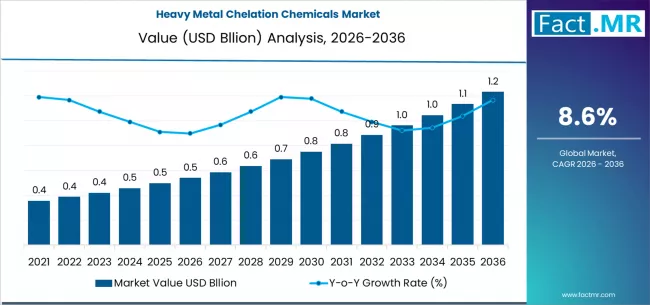
Heavy metal chelation chemicals market is projected to grow from USD 0.5 bllion in 2026 to USD 1.2 bllion by 2036, at a CAGR of 8.6%. EDTA & EDTA Derivatives will dominate with a 32.0% market share, while industrial wastewater & effluent treatment will lead the end-use industry segment with a 38.0% share.
Heavy Metal Chelation Chemicals Market Forecast and Outlook 2026 to 2036
The global market for heavy metal chelation chemicals is projected to reach USD 1.23 billion by 2036. The market is valued at USD 0.54 billion in 2026 and is set to rise at a CAGR of 8.6% during the assessment period. By chelating agent type, EDTA and its derivatives hold a leading 32% share.
Key Takeaways from the Heavy Metal Chelation Chemicals Market
- Market Value for 2026: USD 0.54 Billion
- Market Value for 2036: USD 1.23 Billion
- Forecast CAGR (2026-2036): 8.6%
- Leading Chelating Agent Type Share (2026): EDTA & EDTA Derivatives (32%)
- Leading End-Use Industry Share (2026): Industrial Wastewater & Effluent Treatment (38%)
- Leading Metal Target Group Share (2026): Lead Removal Chemicals (26%)
- Key Players in the Market: BASF SE, Nouryon, Dow Inc., Mitsubishi Chemical Group, Arkema Group
The end-use industry for industrial wastewater and effluent treatment represents the dominant application at 38%. The metal target group for lead removal chemicals is foremost, accounting for a 26% share.
This growth is driven by escalating global environmental regulations limiting heavy metal discharges and increasing remediation activities for contaminated soil and water. Effective chelation is critical for immobilizing, removing, and recovering toxic metals from various streams to protect human health and ecosystems.
Chelation chemicals form stable, soluble complexes with metal ions, preventing their precipitation or undesired reactivity and facilitating their extraction. Their use is essential for achieving regulatory compliance in industrial processes, treating contaminated groundwater, and managing hazardous waste in a safer, more controlled manner.
Heavy Metal Chelation Chemicals Market
| Metric | Value |
|---|---|
| Market Value (2026) | USD 0.54 Billion |
| Market Forecast Value (2036) | USD 1.23 Billion |
| Forecast CAGR (2026-2036) | 8.6% |
Category
| Category | Segments |
|---|---|
| Chelating Agent Type | EDTA & EDTA Derivatives, DTPA, NTA & Other Aminopolycarboxylic Acids, Biodegradable Chelators (GLDA, MGDA, IDS), Specialized Metal-Specific Chelators, Other Organic & Inorganic Chelation Chemicals |
| End-Use Industry | Industrial Wastewater & Effluent Treatment, Municipal Water & Sewage Treatment, Mining & Metallurgy, Soil & Groundwater Remediation, Other Industrial & Environmental Uses |
| Metal Target Group | Lead Removal Chemicals, Mercury Removal Chemicals, Cadmium, Chromium & Nickel, Arsenic Removal Agents, Multi-Metal Chelation Chemicals |
| Region | North America, Latin America, Western Europe, Eastern Europe, East Asia, South Asia & Pacific, MEA |
Segmental Analysis
By Chelating Agent Type, Which Segment Commands the Largest Market Share?
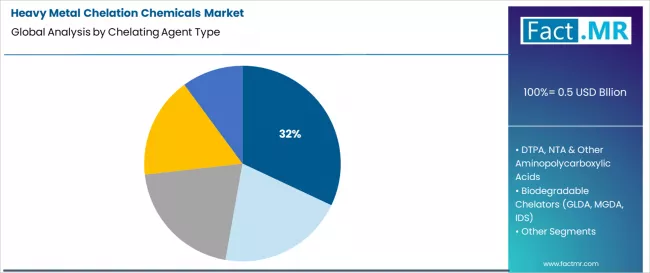
EDTA and its derivatives lead the segment with a 32% share. Their continued dominance is attributed to their versatility, high stability constants with a broad range of metal ions, and well-understood performance across diverse applications.
While facing scrutiny over environmental persistence, EDTA remains a cost-effective and highly effective workhorse for complexometric titration, industrial process control, and remediation projects where complete biodegradability is not the primary regulatory driver.
By End-Use Industry, Which Sector Generates the Most Significant Demand?
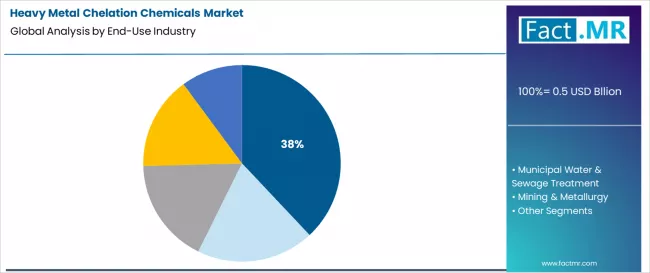
Industrial wastewater and effluent treatment represents the largest end-use industry with a 38% share. Industries such as electroplating, metal finishing, battery manufacturing, and chemicals generate streams with high, variable concentrations of toxic metals.
Chelating agents are crucial for pre-treating these effluents to meet strict discharge limits, often used in precipitation processes to enhance metal removal or in membrane systems to prevent scaling. The direct link to regulatory compliance and operational permits creates consistent, high-stakes demand.
By Metal Target Group, Which Contaminant is the Primary Focus for Removal?
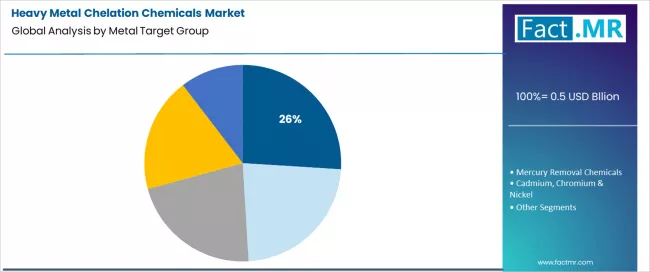
Chemicals targeted at lead removal lead this segment with a 26% share. Lead contamination is a pervasive public health concern, stemming from legacy paints, industrial sites, and aging infrastructure. Its severe neurological toxicity drives stringent regulations in drinking water and soil.
The well-established chemistry for sequestering lead ions, combined with ongoing global remediation efforts for lead-contaminated sites and water sources, sustains its position as the most prominent single-metal target for chelation technology.
What are the Drivers, Restraints, and Key Trends of the Heavy Metal Chelation Chemicals Market?
The primary market driver is the global tightening of environmental regulations governing heavy metal concentrations in industrial discharges, drinking water, and soil. Laws like the EU's Water Framework Directive and various national hazardous waste rules compel industries and governments to invest in effective treatment and remediation technologies, where chelation plays a key role. Growing awareness of the health impacts of metal exposure and increasing brownfield redevelopment projects further propel demand.
A significant market restraint is the environmental persistence of conventional chelants like EDTA and NTA, which can remobilize metals in the environment if not managed correctly. This has led to regulatory pressure and a shift toward biodegradable alternatives, which often come at a higher cost. The specificity and efficiency of chelators can also be highly dependent on pH and the presence of competing ions, requiring skilled application and process control to avoid inefficiencies or treatment failures.
Key trends include the strong shift toward readily biodegradable chelating agents like GLDA and MGDA, driven by green chemistry principles and regulatory preferences. There is growing development of highly selective, next-generation chelators designed for specific problematic metals like arsenic or mercury, offering improved efficiency. The market is also integrating chelants into advanced treatment processes such as membrane filtration and ion exchange to enhance system performance and metal recovery rates.
Analysis of the Heavy Metal Chelation Chemicals Market by Key Countries
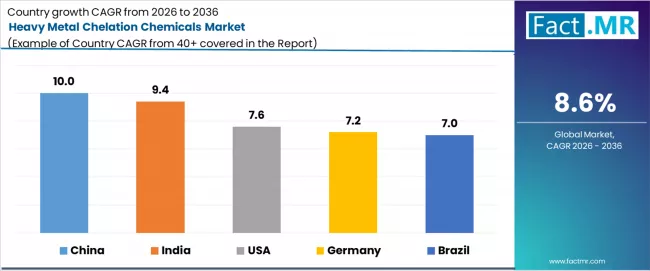
| Country | CAGR (2026-2036) |
|---|---|
| China | 10.00% |
| India | 9.40% |
| USA | 7.60% |
| Germany | 7.20% |
| Brazil | 7.00% |
How do China's Industrial Environmental Regulations Drive Demand for Chelation Chemicals?
China's leading CAGR of 10.00% is fueled by its ongoing, stringent enforcement of environmental protection laws and its "clear waters and blue skies" campaign. The mandate for industries to pre-treat wastewater to stringent new standards before discharge, coupled with massive soil remediation initiatives, creates immense and sustained demand for effective metal removal technologies, including both conventional and advanced chelation chemicals.
What is the Impact of India's Rapid Industrialization and Remediation Efforts on the Market?
India's 9.40% growth is underpinned by the expansion of its manufacturing base and stricter enforcement of wastewater norms by bodies like the CPCB. Simultaneously, national programs addressing legacy industrial contamination and providing safe drinking water are generating significant demand for chelating agents used in both industrial treatment and portable water purification systems.
How is the USA's Focus on Legacy Site Cleanup and Water Infrastructure Influencing the Market?
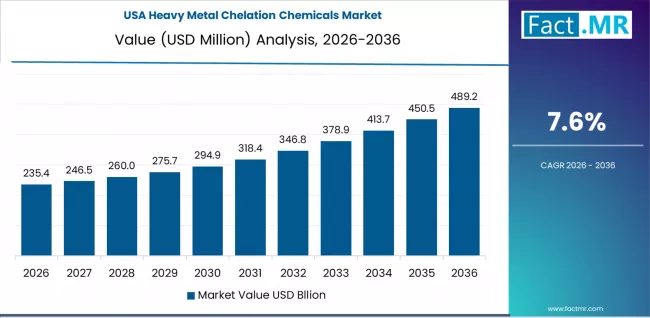
Ongoing Superfund site remediation, lead pipe replacement programs, and stringent EPA regulations on metal discharges support the USA’s 7.60% growth. The need for proven, effective technologies to handle complex metal contamination in soil and groundwater at these sites sustains a sophisticated market for a wide array of chelation products, including newer biodegradable formulations.
Why is Germany a Key Market for High-Performance and Sustainable Chelants?
Germany's 7.20% CAGR reflects its rigorous implementation of EU chemical (REACH) and water directives. The German market emphasizes environmental safety, favoring biodegradable chelators and highly efficient products with validated performance data. This focus on cutting-edge, sustainable solutions for industrial and municipal applications makes it a key market for innovation.
What Role does Brazil's Mining and Agricultural Sector Play in Driving Demand?
Brazil's 7.00% growth is anchored in its large mining and metallurgy sector, which requires effective tailings and process water treatment. Additionally, the need to address trace metal contamination in agricultural soils and water sources contributes to demand for chelation-based remediation strategies, supporting market development.
Competitive Landscape of the Heavy Metal Chelation Chemicals Market
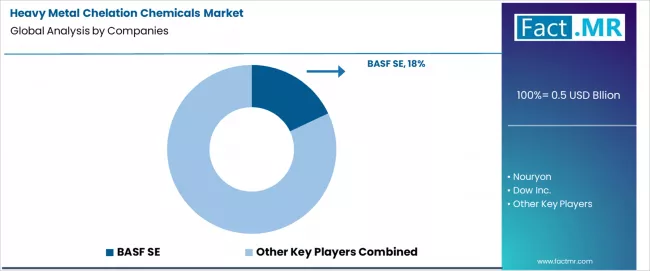
Large, diversified chemical companies with strong portfolios in functional and specialty chemicals characterize the competitive landscape. Leaders like BASF, Dow, and Nouryon compete on their global production scale, broad product ranges (from classic to biodegradable agents), and deep technical expertise in formulation and application. Competition centers on providing tailored solutions for specific industrial challenges, supplying products with verified environmental profiles, and offering comprehensive technical support for regulatory compliance and process optimization.
Key Players in the Heavy Metal Chelation Chemicals Market
- BASF SE
- Nouryon
- Dow Inc.
- Mitsubishi Chemical Group
- Arkema Group
Scope of Report
| Items | Values |
|---|---|
| Quantitative Units | USD Billion |
| Chelating Agent Type | EDTA/Derivatives, Other APCs, Biodegradable (GLDA, MGDA), Metal-Specific, Others |
| End-Use Industry | Industrial Wastewater, Municipal Water, Mining & Metallurgy, Soil/Groundwater Remediation, Other |
| Metal Target Group | Lead, Mercury, Cadmium/Chromium/Nickel, Arsenic, Multi-Metal |
| Key Countries | China, India, USA, Germany, Brazil |
| Key Companies | BASF SE, Nouryon, Dow Inc., Mitsubishi Chemical Group, Arkema Group |
| Additional Analysis | Analysis of stability constants and selectivity; environmental fate and biodegradability testing; application in metal recovery and recycling processes; regulatory landscape for persistent versus biodegradable chelants; supply chain for key feedstocks (e.g., iminodisuccinic acid, glutamic acid). |
Market by Segments
-
Chelating Agent Type :
- EDTA & EDTA Derivatives
- DTPA, NTA & Other Aminopolycarboxylic Acids
- Biodegradable Chelators (GLDA, MGDA, IDS)
- Specialized Metal-Specific Chelators (Mercury, Lead, Arsenic)
- Other Organic & Inorganic Chelation Chemicals
-
End-Use Industry :
- Industrial Wastewater & Effluent Treatment
- Municipal Water & Sewage Treatment
- Mining & Metallurgy
- Soil & Groundwater Remediation
- Other Industrial & Environmental Uses
-
Metal Target Group :
- Lead Removal Chemicals
- Mercury Removal Chemicals
- Cadmium, Chromium & Nickel
- Arsenic Removal Agents
- Multi-Metal Chelation Chemicals
-
Region :
-
North America
- USA
- Canada
-
Latin America
- Brazil
- Mexico
- Argentina
- Rest of Latin America
-
Western Europe
- Germany
- UK
- France
- Spain
- Italy
- BENELUX
- Rest of Western Europe
-
Eastern Europe
- Russia
- Poland
- Czech Republic
- Rest of Eastern Europe
-
East Asia
- China
- Japan
- South Korea
- Rest of East Asia
-
South Asia & Pacific
- India
- ASEAN
- Australia
- Rest of South Asia & Pacific
-
MEA
- Saudi Arabia
- UAE
- Turkiye
- Rest of MEA
-
Table of Content
- Executive Summary
- Global Market Outlook
- Demand to side Trends
- Supply to side Trends
- Technology Roadmap Analysis
- Analysis and Recommendations
- Market Overview
- Market Coverage / Taxonomy
- Market Definition / Scope / Limitations
- Market Background
- Market Dynamics
- Drivers
- Restraints
- Opportunity
- Trends
- Scenario Forecast
- Demand in Optimistic Scenario
- Demand in Likely Scenario
- Demand in Conservative Scenario
- Opportunity Map Analysis
- Product Life Cycle Analysis
- Supply Chain Analysis
- Investment Feasibility Matrix
- Value Chain Analysis
- PESTLE and Porter’s Analysis
- Regulatory Landscape
- Regional Parent Market Outlook
- Production and Consumption Statistics
- Import and Export Statistics
- Market Dynamics
- Global Market Analysis 2021 to 2025 and Forecast, 2026 to 2036
- Historical Market Size Value (USD Million) Analysis, 2021 to 2025
- Current and Future Market Size Value (USD Million) Projections, 2026 to 2036
- Y to o to Y Growth Trend Analysis
- Absolute $ Opportunity Analysis
- Global Market Pricing Analysis 2021 to 2025 and Forecast 2026 to 2036
- Global Market Analysis 2021 to 2025 and Forecast 2026 to 2036, By Chelating Agent Type
- Introduction / Key Findings
- Historical Market Size Value (USD Million) Analysis By Chelating Agent Type, 2021 to 2025
- Current and Future Market Size Value (USD Million) Analysis and Forecast By Chelating Agent Type, 2026 to 2036
- EDTA & EDTA Derivatives
- DTPA, NTA & Other Aminopolycarboxylic Acids
- Biodegradable Chelators (GLDA, MGDA, IDS)
- Specialized Metal-Specific Chelators (Mercury, Lead, Arsenic)
- Other Organic & Inorganic Chelation Chemicals
- EDTA & EDTA Derivatives
- Y to o to Y Growth Trend Analysis By Chelating Agent Type, 2021 to 2025
- Absolute $ Opportunity Analysis By Chelating Agent Type, 2026 to 2036
- Global Market Analysis 2021 to 2025 and Forecast 2026 to 2036, By End-Use Industry
- Introduction / Key Findings
- Historical Market Size Value (USD Million) Analysis By End-Use Industry, 2021 to 2025
- Current and Future Market Size Value (USD Million) Analysis and Forecast By End-Use Industry, 2026 to 2036
- Industrial Wastewater & Effluent Treatment
- Municipal Water & Sewage Treatment
- Mining & Metallurgy
- Soil & Groundwater Remediation
- Other Industrial & Environmental Uses
- Industrial Wastewater & Effluent Treatment
- Y to o to Y Growth Trend Analysis By End-Use Industry, 2021 to 2025
- Absolute $ Opportunity Analysis By End-Use Industry, 2026 to 2036
- Global Market Analysis 2021 to 2025 and Forecast 2026 to 2036, By Metal Target Group
- Introduction / Key Findings
- Historical Market Size Value (USD Million) Analysis By Metal Target Group, 2021 to 2025
- Current and Future Market Size Value (USD Million) Analysis and Forecast By Metal Target Group, 2026 to 2036
- Lead Removal Chemicals
- Mercury Removal Chemicals
- Cadmium, Chromium & Nickel
- Arsenic Removal Agents
- Multi-Metal Chelation Chemicals
- Lead Removal Chemicals
- Y to o to Y Growth Trend Analysis By Metal Target Group, 2021 to 2025
- Absolute $ Opportunity Analysis By Metal Target Group, 2026 to 2036
- Global Market Analysis 2021 to 2025 and Forecast 2026 to 2036, By Region
- Introduction
- Historical Market Size Value (USD Million) Analysis By Region, 2021 to 2025
- Current Market Size Value (USD Million) Analysis and Forecast By Region, 2026 to 2036
- North America
- Latin America
- Western Europe
- Eastern Europe
- East Asia
- South Asia and Pacific
- Middle East & Africa
- Market Attractiveness Analysis By Region
- North America Market Analysis 2021 to 2025 and Forecast 2026 to 2036, By Country
- Historical Market Size Value (USD Million) Trend Analysis By Market Taxonomy, 2021 to 2025
- Market Size Value (USD Million) Forecast By Market Taxonomy, 2026 to 2036
- By Country
- USA
- Canada
- Mexico
- By Chelating Agent Type
- By End-Use Industry
- By Metal Target Group
- By Country
- Market Attractiveness Analysis
- By Country
- By Chelating Agent Type
- By End-Use Industry
- By Metal Target Group
- Key Takeaways
- Latin America Market Analysis 2021 to 2025 and Forecast 2026 to 2036, By Country
- Historical Market Size Value (USD Million) Trend Analysis By Market Taxonomy, 2021 to 2025
- Market Size Value (USD Million) Forecast By Market Taxonomy, 2026 to 2036
- By Country
- Brazil
- Chile
- Rest of Latin America
- By Chelating Agent Type
- By End-Use Industry
- By Metal Target Group
- By Country
- Market Attractiveness Analysis
- By Country
- By Chelating Agent Type
- By End-Use Industry
- By Metal Target Group
- Key Takeaways
- Western Europe Market Analysis 2021 to 2025 and Forecast 2026 to 2036, By Country
- Historical Market Size Value (USD Million) Trend Analysis By Market Taxonomy, 2021 to 2025
- Market Size Value (USD Million) Forecast By Market Taxonomy, 2026 to 2036
- By Country
- Germany
- UK
- Italy
- Spain
- France
- Nordic
- BENELUX
- Rest of Western Europe
- By Chelating Agent Type
- By End-Use Industry
- By Metal Target Group
- By Country
- Market Attractiveness Analysis
- By Country
- By Chelating Agent Type
- By End-Use Industry
- By Metal Target Group
- Key Takeaways
- Eastern Europe Market Analysis 2021 to 2025 and Forecast 2026 to 2036, By Country
- Historical Market Size Value (USD Million) Trend Analysis By Market Taxonomy, 2021 to 2025
- Market Size Value (USD Million) Forecast By Market Taxonomy, 2026 to 2036
- By Country
- Russia
- Poland
- Hungary
- Balkan & Baltic
- Rest of Eastern Europe
- By Chelating Agent Type
- By End-Use Industry
- By Metal Target Group
- By Country
- Market Attractiveness Analysis
- By Country
- By Chelating Agent Type
- By End-Use Industry
- By Metal Target Group
- Key Takeaways
- East Asia Market Analysis 2021 to 2025 and Forecast 2026 to 2036, By Country
- Historical Market Size Value (USD Million) Trend Analysis By Market Taxonomy, 2021 to 2025
- Market Size Value (USD Million) Forecast By Market Taxonomy, 2026 to 2036
- By Country
- China
- Japan
- South Korea
- By Chelating Agent Type
- By End-Use Industry
- By Metal Target Group
- By Country
- Market Attractiveness Analysis
- By Country
- By Chelating Agent Type
- By End-Use Industry
- By Metal Target Group
- Key Takeaways
- South Asia and Pacific Market Analysis 2021 to 2025 and Forecast 2026 to 2036, By Country
- Historical Market Size Value (USD Million) Trend Analysis By Market Taxonomy, 2021 to 2025
- Market Size Value (USD Million) Forecast By Market Taxonomy, 2026 to 2036
- By Country
- India
- ASEAN
- Australia & New Zealand
- Rest of South Asia and Pacific
- By Chelating Agent Type
- By End-Use Industry
- By Metal Target Group
- By Country
- Market Attractiveness Analysis
- By Country
- By Chelating Agent Type
- By End-Use Industry
- By Metal Target Group
- Key Takeaways
- Middle East & Africa Market Analysis 2021 to 2025 and Forecast 2026 to 2036, By Country
- Historical Market Size Value (USD Million) Trend Analysis By Market Taxonomy, 2021 to 2025
- Market Size Value (USD Million) Forecast By Market Taxonomy, 2026 to 2036
- By Country
- Kingdom of Saudi Arabia
- Other GCC Countries
- Turkiye
- South Africa
- Other African Union
- Rest of Middle East & Africa
- By Chelating Agent Type
- By End-Use Industry
- By Metal Target Group
- By Country
- Market Attractiveness Analysis
- By Country
- By Chelating Agent Type
- By End-Use Industry
- By Metal Target Group
- Key Takeaways
- Key Countries Market Analysis
- USA
- Pricing Analysis
- Market Share Analysis, 2025
- By Chelating Agent Type
- By End-Use Industry
- By Metal Target Group
- Canada
- Pricing Analysis
- Market Share Analysis, 2025
- By Chelating Agent Type
- By End-Use Industry
- By Metal Target Group
- Mexico
- Pricing Analysis
- Market Share Analysis, 2025
- By Chelating Agent Type
- By End-Use Industry
- By Metal Target Group
- Brazil
- Pricing Analysis
- Market Share Analysis, 2025
- By Chelating Agent Type
- By End-Use Industry
- By Metal Target Group
- Chile
- Pricing Analysis
- Market Share Analysis, 2025
- By Chelating Agent Type
- By End-Use Industry
- By Metal Target Group
- Germany
- Pricing Analysis
- Market Share Analysis, 2025
- By Chelating Agent Type
- By End-Use Industry
- By Metal Target Group
- UK
- Pricing Analysis
- Market Share Analysis, 2025
- By Chelating Agent Type
- By End-Use Industry
- By Metal Target Group
- Italy
- Pricing Analysis
- Market Share Analysis, 2025
- By Chelating Agent Type
- By End-Use Industry
- By Metal Target Group
- Spain
- Pricing Analysis
- Market Share Analysis, 2025
- By Chelating Agent Type
- By End-Use Industry
- By Metal Target Group
- France
- Pricing Analysis
- Market Share Analysis, 2025
- By Chelating Agent Type
- By End-Use Industry
- By Metal Target Group
- India
- Pricing Analysis
- Market Share Analysis, 2025
- By Chelating Agent Type
- By End-Use Industry
- By Metal Target Group
- ASEAN
- Pricing Analysis
- Market Share Analysis, 2025
- By Chelating Agent Type
- By End-Use Industry
- By Metal Target Group
- Australia & New Zealand
- Pricing Analysis
- Market Share Analysis, 2025
- By Chelating Agent Type
- By End-Use Industry
- By Metal Target Group
- China
- Pricing Analysis
- Market Share Analysis, 2025
- By Chelating Agent Type
- By End-Use Industry
- By Metal Target Group
- Japan
- Pricing Analysis
- Market Share Analysis, 2025
- By Chelating Agent Type
- By End-Use Industry
- By Metal Target Group
- South Korea
- Pricing Analysis
- Market Share Analysis, 2025
- By Chelating Agent Type
- By End-Use Industry
- By Metal Target Group
- Russia
- Pricing Analysis
- Market Share Analysis, 2025
- By Chelating Agent Type
- By End-Use Industry
- By Metal Target Group
- Poland
- Pricing Analysis
- Market Share Analysis, 2025
- By Chelating Agent Type
- By End-Use Industry
- By Metal Target Group
- Hungary
- Pricing Analysis
- Market Share Analysis, 2025
- By Chelating Agent Type
- By End-Use Industry
- By Metal Target Group
- Kingdom of Saudi Arabia
- Pricing Analysis
- Market Share Analysis, 2025
- By Chelating Agent Type
- By End-Use Industry
- By Metal Target Group
- Turkiye
- Pricing Analysis
- Market Share Analysis, 2025
- By Chelating Agent Type
- By End-Use Industry
- By Metal Target Group
- South Africa
- Pricing Analysis
- Market Share Analysis, 2025
- By Chelating Agent Type
- By End-Use Industry
- By Metal Target Group
- USA
- Market Structure Analysis
- Competition Dashboard
- Competition Benchmarking
- Market Share Analysis of Top Players
- By Regional
- By Chelating Agent Type
- By End-Use Industry
- By Metal Target Group
- Competition Analysis
- Competition Deep Dive
- BASF SE
- Overview
- Product Portfolio
- Profitability by Market Segments (Product/Age /Sales Channel/Region)
- Sales Footprint
- Strategy Overview
- Marketing Strategy
- Product Strategy
- Channel Strategy
- Nouryon
- Dow Inc.
- Mitsubishi Chemical Group
- Arkema Group
- BASF SE
- Competition Deep Dive
- Assumptions & Acronyms Used
- Research Methodology
List Of Table
- Table 1: Global Market Value (USD Million) Forecast by Region, 2021 to 2036
- Table 2: Global Market Value (USD Million) Forecast by Chelating Agent Type, 2021 to 2036
- Table 3: Global Market Value (USD Million) Forecast by End-Use Industry, 2021 to 2036
- Table 4: Global Market Value (USD Million) Forecast by Metal Target Group, 2021 to 2036
- Table 5: North America Market Value (USD Million) Forecast by Country, 2021 to 2036
- Table 6: North America Market Value (USD Million) Forecast by Chelating Agent Type, 2021 to 2036
- Table 7: North America Market Value (USD Million) Forecast by End-Use Industry, 2021 to 2036
- Table 8: North America Market Value (USD Million) Forecast by Metal Target Group, 2021 to 2036
- Table 9: Latin America Market Value (USD Million) Forecast by Country, 2021 to 2036
- Table 10: Latin America Market Value (USD Million) Forecast by Chelating Agent Type, 2021 to 2036
- Table 11: Latin America Market Value (USD Million) Forecast by End-Use Industry, 2021 to 2036
- Table 12: Latin America Market Value (USD Million) Forecast by Metal Target Group, 2021 to 2036
- Table 13: Western Europe Market Value (USD Million) Forecast by Country, 2021 to 2036
- Table 14: Western Europe Market Value (USD Million) Forecast by Chelating Agent Type, 2021 to 2036
- Table 15: Western Europe Market Value (USD Million) Forecast by End-Use Industry, 2021 to 2036
- Table 16: Western Europe Market Value (USD Million) Forecast by Metal Target Group, 2021 to 2036
- Table 17: Eastern Europe Market Value (USD Million) Forecast by Country, 2021 to 2036
- Table 18: Eastern Europe Market Value (USD Million) Forecast by Chelating Agent Type, 2021 to 2036
- Table 19: Eastern Europe Market Value (USD Million) Forecast by End-Use Industry, 2021 to 2036
- Table 20: Eastern Europe Market Value (USD Million) Forecast by Metal Target Group, 2021 to 2036
- Table 21: East Asia Market Value (USD Million) Forecast by Country, 2021 to 2036
- Table 22: East Asia Market Value (USD Million) Forecast by Chelating Agent Type, 2021 to 2036
- Table 23: East Asia Market Value (USD Million) Forecast by End-Use Industry, 2021 to 2036
- Table 24: East Asia Market Value (USD Million) Forecast by Metal Target Group, 2021 to 2036
- Table 25: South Asia and Pacific Market Value (USD Million) Forecast by Country, 2021 to 2036
- Table 26: South Asia and Pacific Market Value (USD Million) Forecast by Chelating Agent Type, 2021 to 2036
- Table 27: South Asia and Pacific Market Value (USD Million) Forecast by End-Use Industry, 2021 to 2036
- Table 28: South Asia and Pacific Market Value (USD Million) Forecast by Metal Target Group, 2021 to 2036
- Table 29: Middle East & Africa Market Value (USD Million) Forecast by Country, 2021 to 2036
- Table 30: Middle East & Africa Market Value (USD Million) Forecast by Chelating Agent Type, 2021 to 2036
- Table 31: Middle East & Africa Market Value (USD Million) Forecast by End-Use Industry, 2021 to 2036
- Table 32: Middle East & Africa Market Value (USD Million) Forecast by Metal Target Group, 2021 to 2036
List Of Figures
- Figure 1: Global Market Pricing Analysis
- Figure 2: Global Market Value (USD Million) Forecast 2021 to 2036
- Figure 3: Global Market Value Share and BPS Analysis by Chelating Agent Type, 2026 and 2036
- Figure 4: Global Market Y to o to Y Growth Comparison by Chelating Agent Type, 2026 to 2036
- Figure 5: Global Market Attractiveness Analysis by Chelating Agent Type
- Figure 6: Global Market Value Share and BPS Analysis by End-Use Industry, 2026 and 2036
- Figure 7: Global Market Y to o to Y Growth Comparison by End-Use Industry, 2026 to 2036
- Figure 8: Global Market Attractiveness Analysis by End-Use Industry
- Figure 9: Global Market Value Share and BPS Analysis by Metal Target Group, 2026 and 2036
- Figure 10: Global Market Y to o to Y Growth Comparison by Metal Target Group, 2026 to 2036
- Figure 11: Global Market Attractiveness Analysis by Metal Target Group
- Figure 12: Global Market Value (USD Million) Share and BPS Analysis by Region, 2026 and 2036
- Figure 13: Global Market Y to o to Y Growth Comparison by Region, 2026 to 2036
- Figure 14: Global Market Attractiveness Analysis by Region
- Figure 15: North America Market Incremental Dollar Opportunity, 2026 to 2036
- Figure 16: Latin America Market Incremental Dollar Opportunity, 2026 to 2036
- Figure 17: Western Europe Market Incremental Dollar Opportunity, 2026 to 2036
- Figure 18: Eastern Europe Market Incremental Dollar Opportunity, 2026 to 2036
- Figure 19: East Asia Market Incremental Dollar Opportunity, 2026 to 2036
- Figure 20: South Asia and Pacific Market Incremental Dollar Opportunity, 2026 to 2036
- Figure 21: Middle East & Africa Market Incremental Dollar Opportunity, 2026 to 2036
- Figure 22: North America Market Value Share and BPS Analysis by Country, 2026 and 2036
- Figure 23: North America Market Value Share and BPS Analysis by Chelating Agent Type, 2026 and 2036
- Figure 24: North America Market Y to o to Y Growth Comparison by Chelating Agent Type, 2026 to 2036
- Figure 25: North America Market Attractiveness Analysis by Chelating Agent Type
- Figure 26: North America Market Value Share and BPS Analysis by End-Use Industry, 2026 and 2036
- Figure 27: North America Market Y to o to Y Growth Comparison by End-Use Industry, 2026 to 2036
- Figure 28: North America Market Attractiveness Analysis by End-Use Industry
- Figure 29: North America Market Value Share and BPS Analysis by Metal Target Group, 2026 and 2036
- Figure 30: North America Market Y to o to Y Growth Comparison by Metal Target Group, 2026 to 2036
- Figure 31: North America Market Attractiveness Analysis by Metal Target Group
- Figure 32: Latin America Market Value Share and BPS Analysis by Country, 2026 and 2036
- Figure 33: Latin America Market Value Share and BPS Analysis by Chelating Agent Type, 2026 and 2036
- Figure 34: Latin America Market Y to o to Y Growth Comparison by Chelating Agent Type, 2026 to 2036
- Figure 35: Latin America Market Attractiveness Analysis by Chelating Agent Type
- Figure 36: Latin America Market Value Share and BPS Analysis by End-Use Industry, 2026 and 2036
- Figure 37: Latin America Market Y to o to Y Growth Comparison by End-Use Industry, 2026 to 2036
- Figure 38: Latin America Market Attractiveness Analysis by End-Use Industry
- Figure 39: Latin America Market Value Share and BPS Analysis by Metal Target Group, 2026 and 2036
- Figure 40: Latin America Market Y to o to Y Growth Comparison by Metal Target Group, 2026 to 2036
- Figure 41: Latin America Market Attractiveness Analysis by Metal Target Group
- Figure 42: Western Europe Market Value Share and BPS Analysis by Country, 2026 and 2036
- Figure 43: Western Europe Market Value Share and BPS Analysis by Chelating Agent Type, 2026 and 2036
- Figure 44: Western Europe Market Y to o to Y Growth Comparison by Chelating Agent Type, 2026 to 2036
- Figure 45: Western Europe Market Attractiveness Analysis by Chelating Agent Type
- Figure 46: Western Europe Market Value Share and BPS Analysis by End-Use Industry, 2026 and 2036
- Figure 47: Western Europe Market Y to o to Y Growth Comparison by End-Use Industry, 2026 to 2036
- Figure 48: Western Europe Market Attractiveness Analysis by End-Use Industry
- Figure 49: Western Europe Market Value Share and BPS Analysis by Metal Target Group, 2026 and 2036
- Figure 50: Western Europe Market Y to o to Y Growth Comparison by Metal Target Group, 2026 to 2036
- Figure 51: Western Europe Market Attractiveness Analysis by Metal Target Group
- Figure 52: Eastern Europe Market Value Share and BPS Analysis by Country, 2026 and 2036
- Figure 53: Eastern Europe Market Value Share and BPS Analysis by Chelating Agent Type, 2026 and 2036
- Figure 54: Eastern Europe Market Y to o to Y Growth Comparison by Chelating Agent Type, 2026 to 2036
- Figure 55: Eastern Europe Market Attractiveness Analysis by Chelating Agent Type
- Figure 56: Eastern Europe Market Value Share and BPS Analysis by End-Use Industry, 2026 and 2036
- Figure 57: Eastern Europe Market Y to o to Y Growth Comparison by End-Use Industry, 2026 to 2036
- Figure 58: Eastern Europe Market Attractiveness Analysis by End-Use Industry
- Figure 59: Eastern Europe Market Value Share and BPS Analysis by Metal Target Group, 2026 and 2036
- Figure 60: Eastern Europe Market Y to o to Y Growth Comparison by Metal Target Group, 2026 to 2036
- Figure 61: Eastern Europe Market Attractiveness Analysis by Metal Target Group
- Figure 62: East Asia Market Value Share and BPS Analysis by Country, 2026 and 2036
- Figure 63: East Asia Market Value Share and BPS Analysis by Chelating Agent Type, 2026 and 2036
- Figure 64: East Asia Market Y to o to Y Growth Comparison by Chelating Agent Type, 2026 to 2036
- Figure 65: East Asia Market Attractiveness Analysis by Chelating Agent Type
- Figure 66: East Asia Market Value Share and BPS Analysis by End-Use Industry, 2026 and 2036
- Figure 67: East Asia Market Y to o to Y Growth Comparison by End-Use Industry, 2026 to 2036
- Figure 68: East Asia Market Attractiveness Analysis by End-Use Industry
- Figure 69: East Asia Market Value Share and BPS Analysis by Metal Target Group, 2026 and 2036
- Figure 70: East Asia Market Y to o to Y Growth Comparison by Metal Target Group, 2026 to 2036
- Figure 71: East Asia Market Attractiveness Analysis by Metal Target Group
- Figure 72: South Asia and Pacific Market Value Share and BPS Analysis by Country, 2026 and 2036
- Figure 73: South Asia and Pacific Market Value Share and BPS Analysis by Chelating Agent Type, 2026 and 2036
- Figure 74: South Asia and Pacific Market Y to o to Y Growth Comparison by Chelating Agent Type, 2026 to 2036
- Figure 75: South Asia and Pacific Market Attractiveness Analysis by Chelating Agent Type
- Figure 76: South Asia and Pacific Market Value Share and BPS Analysis by End-Use Industry, 2026 and 2036
- Figure 77: South Asia and Pacific Market Y to o to Y Growth Comparison by End-Use Industry, 2026 to 2036
- Figure 78: South Asia and Pacific Market Attractiveness Analysis by End-Use Industry
- Figure 79: South Asia and Pacific Market Value Share and BPS Analysis by Metal Target Group, 2026 and 2036
- Figure 80: South Asia and Pacific Market Y to o to Y Growth Comparison by Metal Target Group, 2026 to 2036
- Figure 81: South Asia and Pacific Market Attractiveness Analysis by Metal Target Group
- Figure 82: Middle East & Africa Market Value Share and BPS Analysis by Country, 2026 and 2036
- Figure 83: Middle East & Africa Market Value Share and BPS Analysis by Chelating Agent Type, 2026 and 2036
- Figure 84: Middle East & Africa Market Y to o to Y Growth Comparison by Chelating Agent Type, 2026 to 2036
- Figure 85: Middle East & Africa Market Attractiveness Analysis by Chelating Agent Type
- Figure 86: Middle East & Africa Market Value Share and BPS Analysis by End-Use Industry, 2026 and 2036
- Figure 87: Middle East & Africa Market Y to o to Y Growth Comparison by End-Use Industry, 2026 to 2036
- Figure 88: Middle East & Africa Market Attractiveness Analysis by End-Use Industry
- Figure 89: Middle East & Africa Market Value Share and BPS Analysis by Metal Target Group, 2026 and 2036
- Figure 90: Middle East & Africa Market Y to o to Y Growth Comparison by Metal Target Group, 2026 to 2036
- Figure 91: Middle East & Africa Market Attractiveness Analysis by Metal Target Group
- Figure 92: Global Market - Tier Structure Analysis
- Figure 93: Global Market - Company Share Analysis
- FAQs -
How big is the heavy metal chelation chemicals market in 2026?
The global heavy metal chelation chemicals market is estimated to be valued at USD 0.5 bllion in 2026.
What will be the size of heavy metal chelation chemicals market in 2036?
The market size for the heavy metal chelation chemicals market is projected to reach USD 1.2 bllion by 2036.
How much will be the heavy metal chelation chemicals market growth between 2026 and 2036?
The heavy metal chelation chemicals market is expected to grow at a 8.6% CAGR between 2026 and 2036.
What are the key product types in the heavy metal chelation chemicals market?
The key product types in heavy metal chelation chemicals market are edta & edta derivatives, dtpa, nta & other aminopolycarboxylic acids, biodegradable chelators (glda, mgda, ids), specialized metal-specific chelators (mercury, lead, arsenic) and other organic & inorganic chelation chemicals.
Which end-use industry segment to contribute significant share in the heavy metal chelation chemicals market in 2026?
In terms of end-use industry, industrial wastewater & effluent treatment segment to command 38.0% share in the heavy metal chelation chemicals market in 2026.