- Market Value (2025): USD 2.3 Bn
- Estimated Value (2026): USD 2.6 Bn
- Forecast Value (2036): USD 8.2 Bn
- CAGR (2026-2036): 12.3%
What is the High-Opacity Conductive Coating Additives Market forecast to be worth by 2036?
USD 2.6 billion in 2026 to USD 8.2 billion by 2036 at a 12.3% CAGR.
- The High-Opacity Conductive Coating Additives Market was valued at USD 2.3 billion in 2025.
- Demand is projected to rise from USD 2.6 billion in 2026 to USD 8.2 billion by 2036.
- The market is forecast to grow at a 12.3% CAGR from 2026 to 2036 as tech plants add more ESD-sensitive work areas.
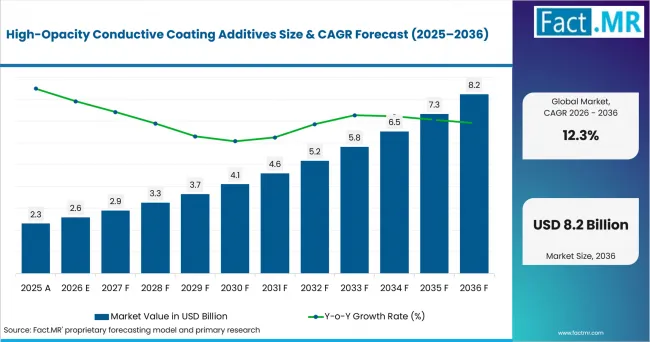
High Opacity Conductive Coating Additives Value Analysis | Source: Fact.MR
What are the defining numbers behind High-Opacity Conductive Coating Additives Market growth?
The market is set to add USD 5.6 billion in absolute opportunity between 2026 and 2036.
- Demand Drivers in the Market
- Chip-fab teams need coatings that move static charge away from work zones and stay easy to clean.
- Battery plants need tough floor systems that control static near automated handling and pack assembly.
- Data centers need static-control surfaces near racks and service rooms where a discharge can harm devices.
- Device plants need even additive mixing. Poor mixing can cause resistance to change across a coated area.
- Key Segments Analyzed
- By Conductive Additive: Carbon black is expected to hold 34.0% share in 2026. It has well-known mixing routes for static-control coatings.
- By Conductivity Target: Antistatic is expected to hold 31.0% share in 2026. Many site surfaces need charge control at practical resistance levels.
- By End-use Facility: Semiconductor fabs are expected to hold 36.0% share in 2026. These sites use strict ESD control around wafer and pack areas.
- By Coating System: Epoxy is estimated to hold 29.0% share in 2026. It is common in tough static-control floor systems.
- Analyst Opinion at Fact.MR
- Shambhu Nath Jha, Principal Consultant at Fact.MR, states, “A coating must do more than conduct charge. It must keep its hiding power and film strength after cure. The market is expected to favor systems that give steady resistance across large areas and fit current coating steps.”
- Strategic Implications
- Additive makers should give clear mixing guidance. It should link loading with surface resistance and hiding power.
- Coating makers should test charge control after wear and cleaning. This helps site teams judge service life.
- Coating suppliers should match each system to the ESD risk in chip and battery work areas.
- Installers should record grounding and film thickness. Install quality affects floor results.
China is forecast to post a 13.7% CAGR through 2036. Japan is projected at 12.6%. The USA and France are each expected to post 12.2%. Germany is estimated at 12.0%.
How does the High-Opacity Conductive Coating Additives Market break down by segment?
Semiconductor fabs are projected to lead End-use Facility at 36.0% share in 2026. Carbon black leads Conductive Additive at 34.0% share.
Which Conductive Additive dominates?
Carbon black is set to hold 34.0% share in 2026.
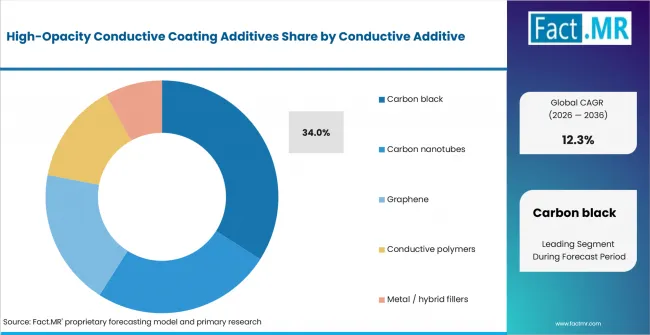
High Opacity Conductive Coating Additives Analysis By Conductive Additive | Source: Fact.MR
Carbon black is widely used because it forms charge paths and gives strong opacity. Many coating makers know how to mix it. Carbon nanotubes can reach target conductivity at lower loading. Graphene can form thin charge paths and add strength. Conductive polymers suit flexible systems. Metal and hybrid fillers can support higher conductivity.
What leads the Conductivity Target segment?
Antistatic is set to account for 31.0% share in 2026.
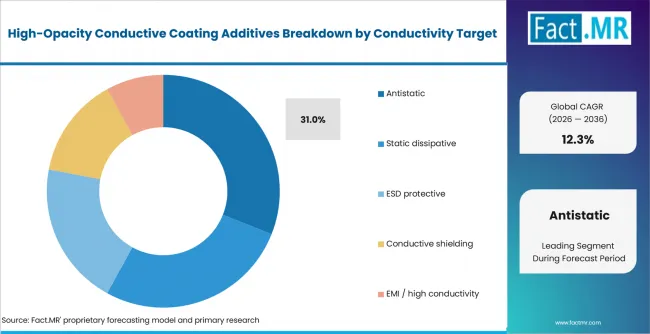
High Opacity Conductive Coating Additives Analysis By Conductivity Target | Source: Fact.MR
Antistatic coatings control charge before a harmful discharge. Static-dissipative systems serve tighter resistance ranges. ESD-protective surfaces also use grounding. Site teams match resistance bands to work-zone risk. Shielding systems use stronger charge paths when EMI control is needed.
How does End-use Facility shape demand?
Semiconductor fabs are expected to capture 36.0% share in 2026.
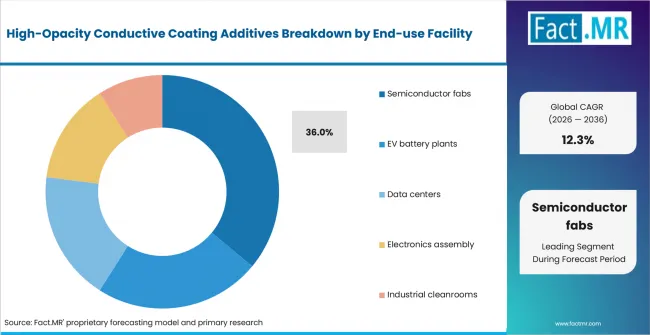
High Opacity Conductive Coating Additives Analysis By End Use Facility | Source: Fact.MR
Chip fabs combine clean production with strict ESD control. Floors and walls must stay easy to clean while they manage charge. EV battery plants add demand near automated assembly. Data centers need static-control surfaces near racks and server rooms. Device plants also need ESD control. Cleanrooms extend this need into precision work.
What supports Epoxy within Coating System?
Epoxy is set to represent 29.0% share in 2026.
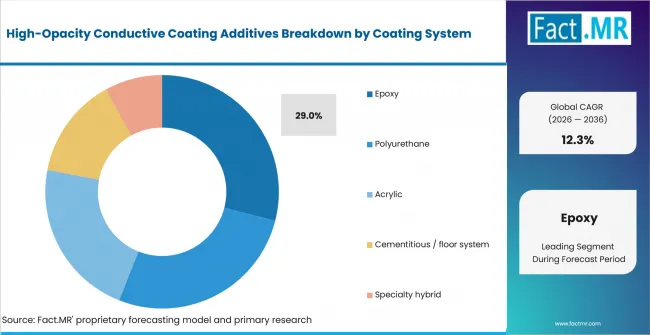
High Opacity Conductive Coating Additives Analysis By Coating System | Source: Fact.MR
Epoxy offers strong adhesion, chemical resistance, and tough films. This suits plant floors that face traffic and cleaning. Polyurethane can add flexibility. Acrylics can support faster handling. Cementitious systems give thicker builds.
What is accelerating High-Opacity Conductive Coating Additives Market adoption, and what is holding it back?
Chip growth and ESD-control needs support use. Mixing complexity and site checks can slow adoption.
Drivers Impact Analysis
| DRIVER | (~) % IMPACT ON CAGR | GEOGRAPHIC RELEVANCE | IMPACT TIMELINE |
|---|---|---|---|
| Semiconductor fab construction and expansion | +1.8% | North America, East Asia, Europe | Medium term (2-4 years) |
| ESD-control requirements in electronics facilities | +1.5% | Global | Short term (<= 2 years) |
| EV battery plant investment | +1.2% | North America, Europe, East Asia | Medium term (2-4 years) |
| Data center facility expansion | +0.9% | North America, East Asia, Europe | Long term (>= 4 years) |
Source: Fact.MR analysis. Updated Sep 23, 2026
Opportunity Impact Analysis
| OPPORTUNITY | (~) % IMPACT ON CAGR | GEOGRAPHIC RELEVANCE | IMPACT TIMELINE |
|---|---|---|---|
| Low-loading CNT and graphene additive systems | +1.1% | Global | Medium term (2-4 years) |
| High-opacity waterborne conductive coatings | +0.8% | Europe, North America | Medium term (2-4 years) |
| Hybrid conductive filler systems for shielding | +0.7% | East Asia, North America | Long term (>= 4 years) |
Source: Fact.MR analysis. Updated Sep 23, 2026
Restraints Impact Analysis
| RESTRAINT | (~) % IMPACT ON CAGR | GEOGRAPHIC RELEVANCE | IMPACT TIMELINE |
|---|---|---|---|
| Dispersion sensitivity at high conductive-filler loadings | -0.7% | Global | Short term (<= 2 years) |
| Qualification time for ESD-sensitive facilities | -0.5% | Global | Medium term (2-4 years) |
| Cost premium for nanotube, graphene and metal fillers | -0.4% | Global | Medium term (2-4 years) |
Source: Fact.MR analysis. Updated Sep 23, 2026
Which countries are scaling the High-Opacity Conductive Coating Additives Market through 2036?
- The country comparison spans 1.7 percentage points and forms three practical growth bands across the forecast period.
- China remains 1.1 percentage points above Japan as large electronics output and semiconductor production support wider use of antistatic and conductive coating systems.
- Japan remains 0.4 percentage point above the USA as domestic chip investment and advanced manufacturing expand ESD-sensitive production areas.
- The USA and France both record 12.2% CAGR, with the USA supported by semiconductor fabrication expansion and France supported by electronics output and precision-industry activity.
- France remains 0.2 percentage point above Germany as electronics and precision-manufacturing activity supports controlled coating applications across assembly and test environments.
- Germany closes the displayed range through continued semiconductor investment, power-electronics capacity and demand for durable static-control surfaces.
Comparable CAGRs can create different entry conditions due to semiconductor investment, electronics production, ESD-control requirements, facility expansion and advanced-manufacturing activity. Full report coverage includes North America, Latin America, Western Europe, Eastern Europe, East Asia, South Asia & Pacific, Middle East & Africa.
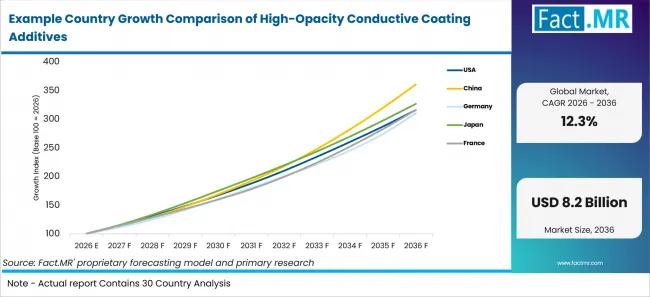
Example Country Growth Comparison Of High Opacity Conductive Coating Additives | Source: Fact.MR
| Country | CAGR (2026-2036) |
|---|---|
| China | 13.7% |
| Japan | 12.6% |
| United States | 12.2% |
| France | 12.2% |
| Germany | 12.0% |
Source: Fact.MR analysis. Updated Sep 23, 2026
What supports China adoption?
13.7% CAGR, supported by electronics output and chip production.
China has a large electronics base that uses static-control materials in chip and component plants. The Ministry of Industry and Information Technology reported in January 2026 that China produced 484.3 billion integrated circuits in 2025. This scale supports antistatic and dissipative surfaces. Carbon black can suit uses where opacity and cost matter. Suppliers also need clear resistance data for large floor areas.
How is Japan developing demand?
12.6% CAGR, driven by chip investment and advanced manufacturing.
Japan is adding domestic chip capacity. In February 2026, Rapidus announced that it had secured JPY 267.6 billion in funding from the Japanese government and private-sector companies, including JPY 100 billion from the Information-Technology Promotion Agency under METI. New fabs add more ESD-sensitive spaces. Suppliers need steady electrical results and a good fit with current floor systems. Clear cure guidance can also help in clean sites.
What supports USA adoption?
12.2% CAGR, led by chip fabrication and dense electronics sites.
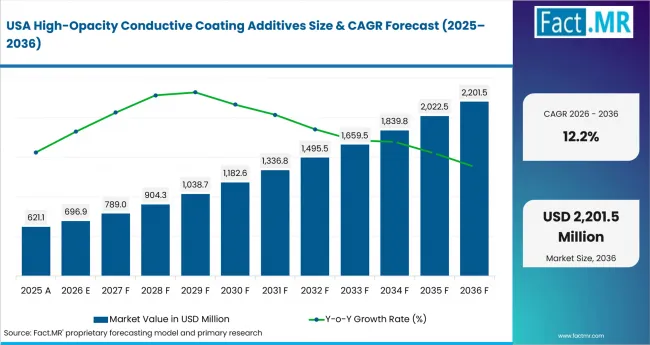
High Opacity Conductive Coating Additives Country Value Analysis | Source: Fact.MR
The United States is expanding advanced chip manufacturing. The U.S. Department of Commerce announced in June 2025 that Micron planned USD 200 billion in domestic semiconductor manufacturing and R&D investment. More fab space creates more zones where static control is part of site design. Epoxy and hybrid systems can fit areas that need both wear life and electrical control.
How does France perform?
12.2% CAGR, backed by electronics output and precision industry.
France combines electronics output with aerospace and other precision industries. INSEE reported in September 2026 that output of computer, electronic and optical products was 3.7% higher year on year in July 2026. This activity supports controlled surfaces in assembly and test areas. Suppliers can compete on stable resistance after wear, cure speed, and flexibility.
What is supporting Germany adoption?
12.0% CAGR, shaped by chip investment and electrified manufacturing.
Germany continues to add chip and power-electronics capacity. Germany’s Federal Ministry for Economic Affairs and Climate Action reported in February 2025 that Infineon planned to invest around EUR 3.4 billion at its Dresden site to expand semiconductor production capacity. New chip space raises demand for static-control floors and coated surfaces. Suppliers need tough systems and stable resistance after cleaning and wear.
Who leads the High-Opacity Conductive Coating Additives Market?
Cabot Corporation, Orion S.A., Birla Carbon, Denka, and Mitsubishi Chemical are the profiled providers in the High-Opacity Conductive Coating Additives Market. The supplier set is positioned around conductive additives used in antistatic, static-dissipative, ESD-protective, and shielding coating systems.
Competition centers on additive systems that provide reliable electrical conductivity while maintaining opacity and film strength. Carbon black, carbon nanotubes, graphene, conductive polymers, and metal or hybrid fillers create different routes to resistance control across coating formulations.
Suppliers also compete on dispersion quality, compatibility with epoxy and polyurethane systems, and suitability for acrylic, cementitious, and specialty hybrid coatings. Semiconductor fabs, EV battery plants, data centers, electronics assembly sites, and industrial cleanrooms create the main controlled-environment application base.
Competitive differentiation therefore centers on stable resistance, hiding power, dispersion control, coating-system compatibility, wear performance, and reliable results after cleaning and service exposure. Material choice must also align with the required antistatic, ESD-protective, or shielding performance level.
Which companies are the key providers?
Companies profiled across conductive coatings, EMI materials, and related electronics technologies include Cabot Corporation; Orion S.A.; Birla Carbon; Denka; Mitsubishi Chemical.
- Cabot Corporation
- Orion S.A.
- Birla Carbon
- Denka
- Mitsubishi Chemical
Bibliography
- International Energy Agency. (2025, April 10). Energy and AI.
- Ministry of Economy, Trade and Industry. (2026, February 27). Press conference by Minister Akazawa (excerpt).
- U.S. Department of Commerce. (2025, June 12). President Trump secures $200B investment from Micron Technology for memory chip manufacturing in the United States.
- Institut national de la statistique et des études économiques. (2026, September 9). In July 2026, manufacturing output fell again sharply (-0.8% after -1.0%): Industrial production index—July 2026.
- Federal Ministry for Economic Affairs and Climate Action. (2025, February 20). Europäische Kommission genehmigt weiteres deutsches Chips-Act-Projekt: Infineon baut seine Chip-Produktion in Dresden aus.
This Report Answers
- The report explains how additive choice changes across antistatic and ESD-protective coating needs.
- Segment analysis identifies the leading subsegments and the main reasons for material choice.
- Country analysis compares the listed CAGRs and the manufacturing factors that shape demand.
- Competitive analysis reviews the supplied companies across conductive coatings and electronics materials.
- Application analysis reviews how hiding power and resistance affect material and install choices.
What does the High-Opacity Conductive Coating Additives Market cover?
The market covers additives used in coatings to control electrical conductivity while keeping hiding power and film strength. It includes carbon black, carbon nanotubes, graphene, conductive polymers, and metal or hybrid fillers. Related products include graphene-based coating additives.
The assessment covers chip fabs, EV battery plants, data centers, device assembly sites, and cleanrooms. It also uses resinous flooring as context for epoxy and polyurethane floor systems.
What is included in the scope?
The scope includes conductive additives used in epoxy and polyurethane coatings. It also covers acrylic, cementitious, and specialty hybrid floor systems. Antistatic and ESD-protective uses are included. Related materials include electronic conformal coatings.
Material context includes specialty carbon systems and graphene grades used for electrical control. It also includes conductive shielding where a coating provides a working surface. Upstream context includes specialty carbon black.
What is excluded from the scope?
The scope excludes pigments used only for color. It also excludes conductive plastics and printed-circuit inks sold without a coating-additive role. Metallic shielding enclosures, grounding hardware, and finished electronic parts are outside the market when no conductive coating additive is used.
General architectural coatings are outside the scope when they have no measurable static-control role. Finished floor-installation revenue is also outside the market, except where it reflects demand for conductive coatings. Molded or extruded polymer compounds remain adjacent.
How Was the Analysis Built?
The analysis draws on 120+ sources, 35+ company portfolios, 25+ countries, and more than 20 industry interviews.
- Primary Research: Primary research includes discussions with manufacturers, service providers, technology developers, distributors, end users, and subject-matter experts. These conversations examine purchasing priorities, product adoption, operational challenges, approval requirements, competitive positioning, and the factors that influence wider market acceptance.
- Desk Research: Desk research covers government statistics, regulatory publications, company filings, trade data, technical studies, industry associations, standards, public policy, and other authoritative sources. Every source used in the analysis is documented in the bibliography.
- Market Sizing and Forecasting: Market estimates combine historical performance, demand indicators, pricing and volume trends, segment shares, company participation, country-level growth, adoption patterns, investment activity, and barriers to market expansion.
- Data Validation and Update Cycle: Findings are validated by comparing primary interviews with public data, company activity, regulatory changes, trade patterns, and industry developments. Regular updates review new product launches, capacity changes, partnerships, approvals, and shifts in commercial adoption.
Segmentation
What is the report’s scope and coverage?
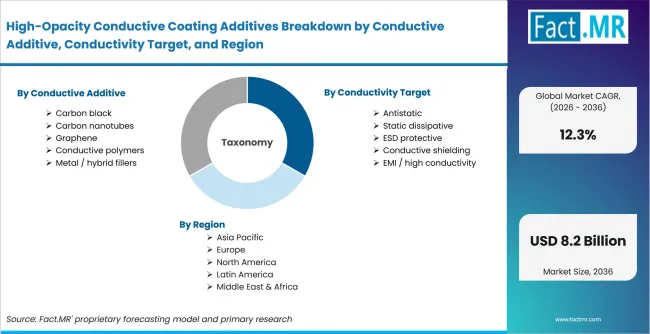
High Opacity Conductive Coating Additives Breakdown By Conductive Additive, Conductivity Target, And Region | Source: Fact.MR
| Attribute | Details |
|---|---|
| Quantitative Units | USD billion |
| Market Definition | Conductive coating additives used to create high-opacity antistatic, static-dissipative, ESD-protective or shielding coating systems for controlled industrial and electronics facilities. |
| Conductive Additive | Carbon black; Carbon nanotubes; Graphene; Conductive polymers; Metal / hybrid fillers |
| Conductivity Target | Antistatic; Static dissipative; ESD protective; Conductive shielding; EMI / high conductivity |
| End-use Facility | Semiconductor fabs; EV battery plants; Data centers; Electronics assembly; Industrial cleanrooms |
| Coating System | Epoxy; Polyurethane; Acrylic; Cementitious / floor system; Specialty hybrid |
| Regions Covered | North America; Latin America; Western Europe; Eastern Europe; East Asia; South Asia & Pacific; Middle East & Africa |
| Countries Covered | United States; China; Germany; Japan; France |
| Key Companies Profiled | Cabot Corporation; Orion S.A.; Birla Carbon; Denka; Mitsubishi Chemical |
| Forecast Period | 2026 to 2036 |
| Approach | Hybrid top-down and bottom-up approach using coating demand; facility expansion; segment shares; country growth; and provider portfolio review. |
Source: Fact.MR analysis. Updated Sep 23, 2026
How is the market segmented?
-
By Conductive Additive:
- Carbon black
- Carbon nanotubes
- Graphene
- Conductive polymers
- Metal / hybrid fillers
-
By Conductivity Target:
- Antistatic
- Static dissipative
- ESD protective
- Conductive shielding
- EMI / high conductivity
-
By End-use Facility:
- Semiconductor fabs
- EV battery plants
- Data centers
- Electronics assembly
- Industrial cleanrooms
-
By Coating System:
- Epoxy
- Polyurethane
- Acrylic
- Cementitious / floor system
- Specialty hybrid
-
By Region:
- North America
- Latin America
- Western Europe
- Eastern Europe
- East Asia
- South Asia & Pacific
- Middle East & Africa
Frequently Asked Questions
How big is the high-opacity conductive coating additives market in 2026?
What is the CAGR of the high-opacity conductive coating additives market from 2026 to 2036?
Which conductive additive leads the high-opacity conductive coating additives market?
Which end-use facility leads the high-opacity conductive coating additives market?
Who are the leading companies in the high-opacity conductive coating additives market?
Who worked on this report


Preview the report firsthand - request a free sample
Free SampleGet the brochure for pricing and purchase details
Download PDF