- Market Value (2025): USD 9.0 Bn
- Estimated Value (2026): USD 9.6 Bn
- Forecast Value (2036): USD 17.9 Bn
- CAGR (2026-2036): 6.4%
What is the High Pressure Protective Packaging Film Market forecast to be worth by 2036?
USD 9.6 billion in 2026 to USD 17.9 billion by 2036 at 6.4% CAGR.
- The High Pressure Protective Packaging Film market reached USD 9.0 billion in 2025 as buyers placed more weight on pressure resistance and transit loss control.
- Demand is projected to increase from USD 9.6 billion in 2026 to USD 17.9 billion by 2036.
- The market is forecast to record 6.4% CAGR from 2026 to 2036 owing to e-commerce handling needs and recyclable film redesign.
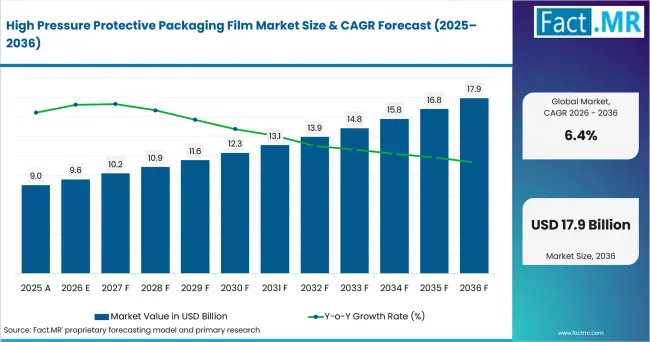
High Pressure Protective Packaging Film Market Value Analysis | Source: Fact.MR
What are the defining numbers behind High Pressure Protective Packaging Film Market growth?
USD 8.2 billion absolute opportunity is expected between 2026 and 2036.
- Demand Drivers in the Market
- Fulfillment growth is expected to raise the need for pressure resistant film because parcels move through several handling points before delivery.
- Food and beverage brands are expected to use stronger barrier films when product loss or leakage risk affects shelf availability.
- Industrial shippers are expected to prefer puncture and abrasion resistance when parts need clean arrival without heavier rigid packaging.
- Key Segments Analyzed
- By Product Type: High Pressure Barrier Films is expected to hold 47.0% share in 2026 because these films protect products under handling stress.
- By Application: Food & Beverage Packaging is projected to account for 38.0% share in 2026 as pack integrity remains central to shelf life.
- By End User: Food Processing Companies is anticipated to capture 43.0% share in 2026 since line performance and packaging waste affect operating cost.
- By Distribution Channel: Direct Sales is estimated to represent 49.0% share in 2026 due to the need for specification support and trial validation.
- By Material Type: Polyethylene is forecast to hold 36.0% share in 2026 as converters use it across flexible and protective film formats.
- Analyst Opinion at Fact.MR
- Shambhu Nath Jha, Principal Consultant at Fact.MR, states, “High pressure protective packaging film demand is expected to depend on damage reduction and material efficiency. Buyers are likely to approve films that pass line trials and protect goods in transit.”
- Strategic Implications
- Film suppliers should prove puncture resistance, seal strength, and recyclable performance before buyers approve broader packaging conversion.
- Converters can strengthen adoption by showing that thinner film structures maintain protection during filling, storage, and transit.
- Procurement teams should compare film cost with product-damage, return, and packaging-waste costs before selecting lower-gauge or recyclable alternatives.
China leads at 7.2% CAGR through online retail scale. The USA follows at 6.9% through parcel channels. Germany reaches 6.7% through packaging rules. Japan records 6.5%. India posts 6.2%. South Korea reaches 6.0%. France records 5.8%.
How does the High Pressure Protective Packaging Film Market break down by segment?
High Pressure Barrier Films are expected to lead Product Type at 47.0% share in 2026. Food & Beverage Packaging is projected to lead Application at 38.0% share in 2026.
Which Product Type dominates?
High Pressure Barrier Films are projected to account for 47.0% share in 2026.
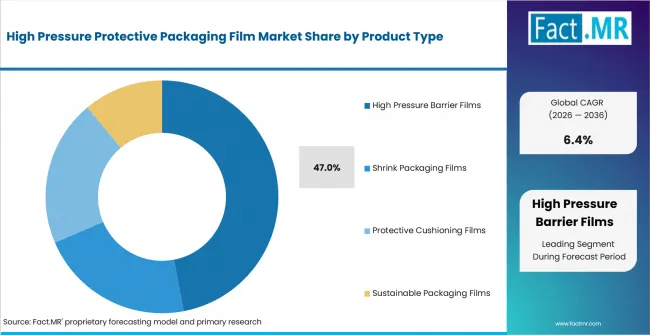
High Pressure Protective Packaging Film Market Analysis By Product Type | Source: Fact.MR
Barrier films lead product type demand because they solve two buyer problems in one structure. They protect goods from pressure and moisture without forcing a heavier pack. This makes the film useful for food packs and industrial parts where damage claims can erase savings from cheaper materials.
What leads the Application segment?
Food & Beverage Packaging is expected to hold 38.0% share in 2026.
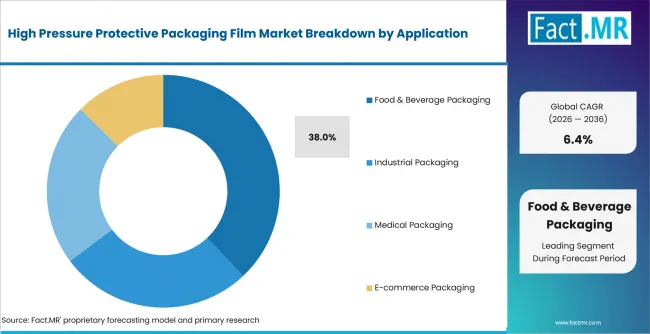
High Pressure Protective Packaging Film Market Analysis By Application | Source: Fact.MR
Food and beverage use leads application demand where seal quality directly affects freshness and waste. Buyers select films that hold pressure through filling and chilled movement. The need is commercial and not decorative. Suppliers must prove pack integrity before large brands shift specifications.
How does End User demand take shape?
Food Processing Companies are anticipated to lead with 43.0% share in 2026.
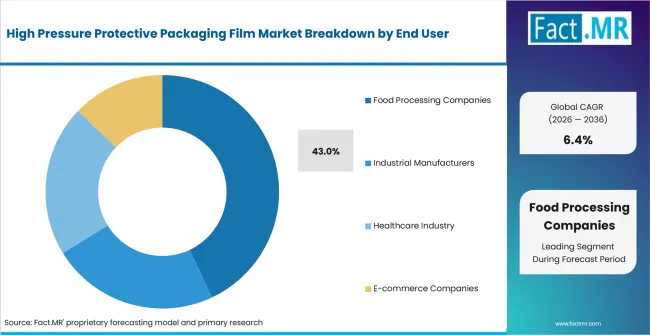
High Pressure Protective Packaging Film Market Analysis By End User | Source: Fact.MR
Food processors lead end user demand because packaging affects throughput as much as shelf life. A film that tears or fails at seals can slow lines and create rejects. Buyers therefore test materials against filling speed and storage conditions before repeat purchases.
What supports Direct Sales within Distribution Channel?
Direct Sales is estimated to represent 49.0% share in 2026.
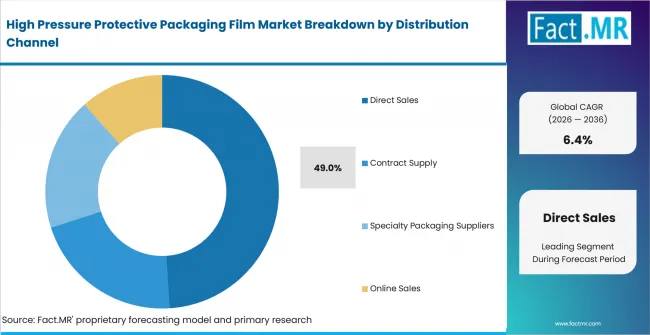
High Pressure Protective Packaging Film Market Analysis By Distribution Channel | Source: Fact.MR
Direct sales leads distribution because film selection often needs trial runs with the buyer’s product and machine settings. Converters can answer seal failure and gauge reduction questions during qualification. That technical contact makes direct purchasing more practical than catalog-style buying.
Why does Polyethylene lead Material Type?
Polyethylene is forecast to hold 36.0% share in 2026.
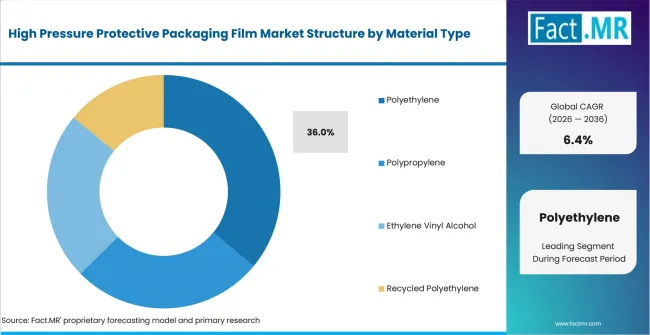
High Pressure Protective Packaging Film Market Analysis By Material Type | Source: Fact.MR
Polyethylene leads material use through converter familiarity and broad performance range. The material can provide flexibility and puncture resistance across everyday protection uses. It is easier for buyers to source and test than newer alternatives, which keeps approval risk lower in high-volume packaging lines.
What is accelerating High Pressure Protective Packaging Film Market adoption, and what is holding it back?
Demand is expected to rise through parcel handling and food protection. Recyclable film redesign is expected to add another route.
Drivers Impact Analysis
| DRIVER | (~) % IMPACT ON CAGR | GEOGRAPHIC RELEVANCE | IMPACT TIMELINE |
|---|---|---|---|
| E-commerce handling pressure | +1.7% | China; USA; South Korea | Short term |
| Food shelf-life protection | +1.4% | USA; Japan; India | Short term |
| Recyclable film redesign | +1.2% | Europe and North America | Medium term |
| Direct technical selling | +0.9% | Global | Medium term |
| Material thinning and strength | +0.7% | Global | Long term |
Source: Fact.MR analysis. Updated Aug 11, 2026
- E-commerce handling pressure: Parcels are expected to face more drops and compression points as online order volumes rise.
- Food shelf-life protection: Food processors are expected to value films that prevent leakage and reduce rejected packs during filling.
- Recyclable film redesign: EU Regulation 2025/40 is expected to push buyers toward packaging that can meet recyclability and recycled-content planning rules.
Opportunity Impact Analysis
| OPPORTUNITY | (~) % IMPACT ON CAGR | GEOGRAPHIC RELEVANCE | IMPACT TIMELINE |
|---|---|---|---|
| Recycle-ready barrier structures | +1.3% | Europe; North America | Medium term |
| Gauge reduction trials | +1.1% | Global brand owners | Short term |
| Food processor line support | +0.9% | USA; India; Japan | Medium term |
| Custom film specifications | +0.7% | Industrial buyers | Long term |
Source: Fact.MR analysis. Updated Aug 11, 2026
- Recycle-ready barrier structures: Amcor commercialized AmPrima Plus recycle-ready packaging for Agropur’s Grand Cheddar product in February 2026. Amcor reported that this specific packaging redesign reduced packaging weight by 82%.recycle-ready packaging
- Gauge reduction trials: Film suppliers can win accounts when thinner structures protect products without increasing returns or warehouse damage.
- Custom film specifications: Buyers are expected to request pressure films designed around product shape and pack movement.
Restraints Impact Analysis
| RESTRAINT | (~) % IMPACT ON CAGR | GEOGRAPHIC RELEVANCE | IMPACT TIMELINE |
|---|---|---|---|
| Resin and recycled-content cost | -1.1% | Global | Short term |
| Qualification and line compatibility | -0.9% | Food and industrial buyers | Medium term |
| Recycling infrastructure gaps | -0.7% | Developing markets | Long term |
| Seal and puncture trade-off | -0.5% | High-speed packaging lines | Medium term |
Source: Fact.MR analysis. Updated Aug 11, 2026
- Resin and recycled-content cost: Premium structures can face slower adoption when buyers focus on near-term pack cost.
- Qualification and line compatibility: New films must run on existing equipment before procurement teams approve broader conversion.
- Recycling infrastructure gaps: Mono-material design is easier to justify where collection and sorting systems can handle flexible films.
Which countries are scaling High Pressure Protective Packaging Film Market fastest?
- The country comparison spans 1.4 percentage points across the forecast period.
- China remains 0.3 percentage points above the USA through online retail scale.
- The USA remains 0.2 percentage points above Germany through e-commerce scale.
- Germany remains 0.2 percentage points above Japan through packaging rules.
- Japan remains 0.3 percentage points above India through premium packaging expectations.
- India remains 0.2 percentage points above South Korea as food processing investment expands the buyer base.
- South Korea remains 0.2 percentage points above France through mobile commerce.
Comparable CAGRs create different entry conditions due to retail scale and recycling readiness. Full report coverage includes North America; Latin America; Europe; East Asia; South Asia and Pacific; Middle East and Africa.
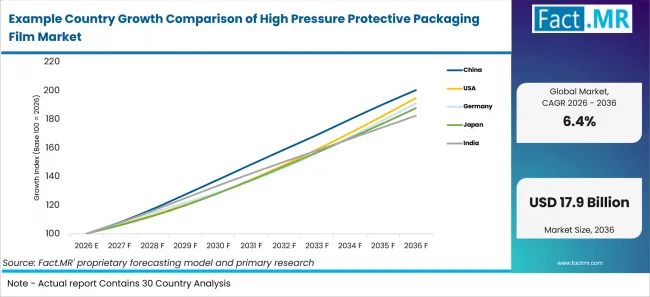
Example Country Growth Comparison Of High Pressure Protective Packaging Film Market | Source: Fact.MR
| COUNTRY | CAGR (%) |
|---|---|
| USA | 6.9% |
| Germany | 6.7% |
| Japan | 6.5% |
| India | 6.2% |
| South Korea | 6.0% |
| France | 5.8% |
Source: Fact.MR analysis. Updated Aug 11, 2026
What supports USA adoption?
6.9% CAGR, driven by large consumer channels and e-commerce growth.
USA demand benefits from USD 326.7 billion in Q1 2026 e-commerce sales, which represented 16.9% of total retail sales. Large retailers and food-delivery channels support pressure-resistant films. Higher recycled-content costs, varying state requirements, and line trials can delay wider adoption of new film structures.
How is Germany scaling demand?
6.7% CAGR, supported by advanced packaging technology and sustainability leadership.
Germany’s growth is supported by retail and mail-order activity, with Destatis reporting 2.7% real retail growth in 2025. Circular packaging rules favor recyclable film development, while machinery exports support durable formats. Strict recycling requirements, energy costs, and certification needs can extend testing and approval cycles.
How does Japan perform?
6.5% CAGR, backed by high-quality packaging and material innovation.
Japan’s demand benefits from a sizable e-commerce market, with METI reporting 26.1 trillion yen in B-to-C e-commerce in 2024, up 5.1% from the previous year. Premium packaging standards and converter expertise support thinner films, although testing requirements and imported resin costs remain constraints.
What supports India growth?
6.2% CAGR, supported by expanding consumer demand and manufacturing.
India’s growth is supported by food-processing investment. Local converters support faster supply, while price sensitivity, uneven recycling systems, and cold-chain gaps may restrict premium-film adoption.
How is South Korea developing demand?
6.0% CAGR, led by mobile commerce and dense logistics networks.
South Korea’s demand is supported by 24.16 trillion won in online shopping value in November 2025, including 18.59 trillion won through mobile shopping. Electronics shipments and advanced converters strengthen protective-film use, although high testing standards, recycled-material constraints, and market maturity can moderate expansion.
What supports France demand?
5.8% CAGR, supported by online buying and circular packaging pressure.
France’s growth reflects strong digital purchasing, with INSEE reporting that 63% of people aged 15 or older bought online in 2024 and 42% purchased clothing or footwear accessories. These channels support lightweight protective films, while circular compliance, collection limitations, and premium costs can slow adoption.
Who leads the High Pressure Protective Packaging Film Market?
Amcor plc, including the former Berry Global portfolio, and Sealed Air Corporation show broad relevance through flexible films and protective packaging. Mondi plc and Coveris GmbH strengthen the European field.
Amcor commercialized AmPrima Plus recycle-ready packaging for Agropur’s Grand Cheddar product in February 2026 and reported that the specific redesign reduced packaging weight by 82%. Before its combination with Amcor, Berry Global unveiled Bontite Sustane stretch film with 30% certified post-consumer recycled content in February 2025.
Which companies are the key providers?
Key companies profiled in the High Pressure Protective Packaging Film market include Amcor plc; Sealed Air Corporation; Mondi plc; Coveris GmbH; Winpak Ltd.; Pregis LLC; ProAmpac LLC; Constantia Flexibles Group GmbH.
- Amcor plc
- Sealed Air Corporation
- Mondi plc
- Coveris GmbH
- Winpak Ltd.
- Pregis LLC
- ProAmpac LLC
- Constantia Flexibles Group GmbH
Bibliography
- Amcor plc. (2026, February 5). Amcor enables commercialization of recycle-ready packaging for largest dairy cooperative in Canada.
- Berry Global Group, Inc. (2025, February 17). Berry Global unveils next-generation Bontite Sustane stretch film with 30% PCR.
- Amcor plc. (2025, April 30). Amcor completes combination with Berry Global; positioned to significantly enhance value for customers and shareholders.
- Official Journal of the European Union (2025, January 22) Regulation (EU) 2025/40 of the European Parliament and of the Council of 19 December 2024 on packaging and packaging waste, amending Regulation (EU) 2019/1020 and Directive (EU) 2019/904, and repealing Directive 94/62/EC.
- Ministry of Data and Statistics. (2026, January 2). Online shopping in November 2025.
- Ministry of Economy, Trade and Industry. (2025, August 26). Results of FY2024 e-commerce market survey compiled.
- National Bureau of Statistics of China. (2026, July 16). Total retail sales of consumer goods in the first half of 2026.
- Press Information Bureau. (2026, March 26). India’s resilient production systems in agriculture: “From fields to market.”
- U.S. Census Bureau. (2026, May 18). Quarterly retail e-commerce sales.
This Report Answers
- The report provides strategic intelligence on the High Pressure Protective Packaging Film Market across Product Type and Application choices that shape pressure-resistant packaging demand.
- Segment analysis covers High Pressure Barrier Films and Food & Beverage Packaging as the leading categories within the 2026 market.
- Country outlook evaluates China and the USA alongside Germany and Japan. India, South Korea and France complete the growth comparison across the profiled markets.
- Competitive analysis profiles Amcor plc and Sealed Air Corporation alongside Mondi plc and Coveris GmbH. Winpak, Pregis, ProAmpac and Constantia Flexibles complete the provider set.
- Material assessment covers Polyethylene alongside Polypropylene, Polyamide and PET. Bio-based and Recyclable Materials complete the film-material view across pressure-resistant packaging applications.
What does the High Pressure Protective Packaging Film Market cover?
High pressure protective packaging films protect products that face compression during movement.
The market covers protective films used in food packs and e-commerce parcels. Industrial and healthcare packs are included when pressure resistance protects the product.
What is included in the scope?
High pressure protective packaging films are used by food processors and e-commerce retailers. Industrial buyers are included where pressure damage affects approval.
The scope includes Product Type and Application. End User and Distribution Channel remain included. Coverage spans High Pressure Barrier Films and Vacuum Skin Films. Stretch and Shrink Films complete the product view with Cushioning Films and Specialty Laminate Films. Direct Sales and distributor channels are included where buyers purchase films for protective packaging use.
What is excluded from the scope?
General packaging materials without a pressure protection role remain outside the scope of this market.
The scope excludes rigid containers and labels. Tapes and paperboard cartons are excluded unless the film provides pressure protection. General resin sales are excluded unless they are converted into protective packaging film. Unrelated company revenue is excluded from the scope.
How Was the Analysis Built?
The analysis draws on 120+ sources and 35+ company portfolios. It reviews 25+ countries and more than 20 industry interviews.
- Primary Research: Primary research includes discussions with manufacturers and converters. Buyer and procurement input is used to examine purchasing priorities and approvals.
- Desk Research: Desk research covers government statistics and regulatory publications. Company filings and trade data are reviewed. Every source used is documented in the bibliography.
- Market Sizing and Forecasting: Market estimates combine historical performance and demand indicators. Pricing trends and segment shares are reviewed with country growth and adoption barriers.
- Data Validation and Update Cycle: Findings are validated against public data and company activity. Updates review launches and capacity changes. Procurement trends and adoption shifts are checked.
Segmentation
What is the report’s scope and coverage?
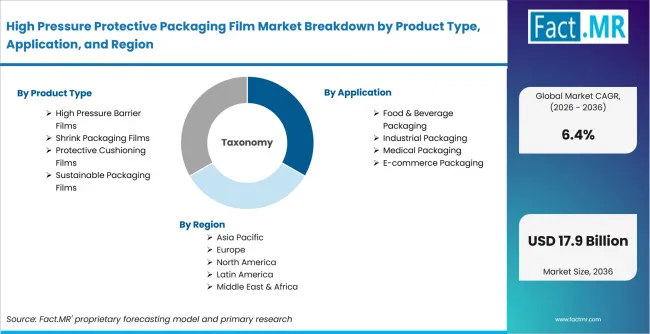
High Pressure Protective Packaging Film Market Breakdown By Product Type, Application, And Region | Source: Fact.MR
| Attribute | Details |
|---|---|
| Quantitative Units | USD million |
| Market Definition | Pressure-resistant films used to reduce puncture, compression, moisture, and handling damage |
| Product Type | High Pressure Barrier Films; Vacuum Skin Films; Stretch and Shrink Films; Cushioning Films; Specialty Laminate Films |
| Application | Food & Beverage Packaging; E-commerce Packaging; Industrial Goods Packaging; Healthcare Packaging; Consumer Goods Packaging |
| End User | Food Processing Companies; E-commerce Retailers; Industrial Manufacturers; Healthcare Companies; Consumer Goods Brands |
| Distribution Channel | Direct Sales; Distributors; Online Channels; Integrators; Contract Packaging Partners |
| Material Type | Polyethylene; Polypropylene; Polyamide; PET; Recyclable Materials |
| Regions Covered | North America; Latin America; Europe; East Asia; South Asia and Pacific; MEA |
| Countries Covered | China; USA; Germany; Japan; India; South Korea; France |
| Key Companies Profiled | Amcor plc, Sealed Air Corporation, Mondi plc, Coveris GmbH, Winpak Ltd., Pregis LLC, ProAmpac LLC, and Constantia Flexibles Group GmbH |
| Forecast Period | 2026 to 2036 |
| Approach | Hybrid approach using packaging demand; shipment activity; film qualification; regulation; buyer approvals; country patterns; and company portfolios |
Source: Fact.MR analysis. Updated Aug 11, 2026
How is the market segmented?
-
By Product Type
- High Pressure Barrier Films
- Multilayer Barrier Films
- Co-extruded Barrier Films
- Shrink Packaging Films
- Cross-linked Shrink Films
- Heat Shrink Films
- Protective Cushioning Films
- Air Cushion Films
- Bubble Cushion Films
- Sustainable Packaging Films
- Recyclable Protective Films
- Bio-based Protective Films
- High Pressure Barrier Films
-
By Application
- Food & Beverage Packaging
- Modified Atmosphere Packaging
- Vacuum Packaging
- Industrial Packaging
- Heavy Equipment Packaging
- Chemical Packaging
- Medical Packaging
- Medical Device Packaging
- Pharmaceutical Packaging
- E-commerce Packaging
- Consumer Electronics Packaging
- Consumer Goods Packaging
- Food & Beverage Packaging
-
By End User
- Food Processing Companies
- Packaging Manufacturers
- Meat & Seafood Processors
- Industrial Manufacturers
- Electronics Manufacturers
- Chemical Companies
- Healthcare Industry
- Medical Device Manufacturers
- Pharmaceutical Companies
- E-commerce Companies
- Logistics & Fulfillment Providers
- Retail Packaging Companies
- Y-o-Y Growth Trend Analysis By End User, 2021 to 2025
- Absolute $ Opportunity Analysis By End User, 2026 to 2036
- Food Processing Companies
-
By Distribution Channel
- Direct Sales
- OEM Supply
- Industrial Distributors
- Contract Supply
- Regional Distributors
- Export Sales
- Specialty Packaging Suppliers
- Medical Supply Distributors
- Healthcare Procurement
- Online Sales
- E-commerce Platforms
- Direct Retail Partnerships
- Direct Sales
-
By Material Type
- Polyethylene
- Linear Low-density Polyethylene
- High-density Polyethylene
- Polypropylene
- Biaxially Oriented Polypropylene
- Polyamide
- Ethylene Vinyl Alcohol
- Ethylene Vinyl Acetate
- Polyethylene Terephthalate
- Recycled Polyethylene
- Bio-based Polyethylene
- Compostable Polymer Blends
- Polyethylene
-
By Region
- North America
- Latin America
- Europe
- East Asia
- South Asia and Oceania
- Middle East and Africa
Frequently Asked Questions
How big is the high pressure protective packaging film market in 2026?
What is the CAGR of the high pressure protective packaging film market from 2026 to 2036?
Which product type leads the high pressure protective packaging film market?
Which application leads the high pressure protective packaging film market?
Who are the leading companies in the high pressure protective packaging film market?
Who worked on this report


Preview the report firsthand - request a free sample
Free SampleGet the brochure for pricing and purchase details
Download PDF