- Market Value (2025): USD 1.9 Bn
- Estimated Value (2026): USD 2.1 Bn
- Forecast Value (2036): USD 4.5 Bn
- CAGR (2026-2036): 7.9%
What is the High-Protein Spreads Market forecast to be worth by 2036?
USD 2.1 billion in 2026 to USD 4.5 billion by 2036 at 7.9% CAGR.
- The high-protein spreads market reached USD 1.9 billion in 2025 as protein-positioned snacks moved into breakfast and pantry occasions.
- Demand is projected to increase from USD 2.1 billion in 2026 to USD 4.5 billion by 2036.
- The market is forecast to record 7.9% CAGR from 2026 to 2036 owing to macro-led shopping and wider DTC sampling.
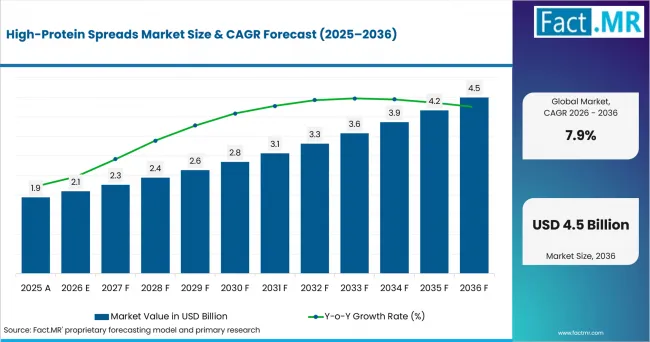
High Protein Spreads Market Value Analysis | Source: Fact.MR
What are the defining numbers behind High-Protein Spreads Market growth?
USD 2.4 billion absolute opportunity by 2036, led by Nut & seed spreads and Dairy protein alongside High-protein claims and Grocery & mass distribution.
- Demand Drivers in the Market
- Grocery retailers need familiar high-protein formats because spreads fit breakfast, lunchbox and snack routines without new preparation steps.
- Online nutrition retailers benefit from repeat bundles where protein spread jars sit beside powders, bars and portioned snacks.
- Food brands need texture control since protein fortification is expected to make spreads gritty or dry.
- Sports-nutrition shoppers compare protein per serving and sugar load before paying a premium for chocolate or nut formats.
- Key Segments Analyzed
- By Type: Nut & seed spreads are expected to hold 33.0% share in 2026 owing to peanut, almond and seed-butter familiarity.
- By Protein Source: Dairy protein is projected to account for 37.0% share in 2026 because whey and casein support taste and texture.
- By Claim: High-protein is anticipated to capture 36.0% share in 2026 since clear protein numbers help shoppers compare products quickly.
- By Distribution: Grocery & mass is estimated to represent 44.0% share in 2026 due to routine shelf placement beside spreads and breakfast foods.
- By Region: The United States is forecast to hold 30% share in 2026 as peanut-butter familiarity supports protein-positioned variants.
- Analyst Opinion at Fact.MR
- Shambhu Nath Jha, Principal Consultant at Fact.MR, states, “High-protein spreads turn a pantry item into a measurable nutrition choice. Supplier acceptance is expected to depend on taste, spreadability and credible protein numbers. Brands should keep ingredient lists clear and serving claims easy to compare.”
- Strategic Implications
- Brand teams should keep protein claims close to flavor cues so products do not read like supplements.
- Retail buyers should test high-protein spreads beside breakfast staples and sports-nutrition shelves before permanent ranging.
- Manufacturers should validate spreadability after adding whey, casein, pea or blended protein systems.
- Investors should separate mainstream pantry brands from specialist sports-nutrition labels with narrower repeat bases.
Australia is expected to post 10.0% CAGR through 2036 as sports-nutrition retail supports trial. Canada is projected to record 9.7% CAGR due to packaged protein foods and e-commerce. The United States is anticipated to reach 9.3% CAGR owing to peanut-butter familiarity. The United Kingdom is forecast to advance at 8.8% CAGR where active adults support protein snacking. Germany records 7.9% CAGR through dairy-protein habits. France posts 7.0% CAGR as clean-label review slows proof cycles.
How does the High-Protein Spreads Market break down by segment?
Nut & seed spreads lead Type at 33.0%; Dairy protein leads Protein Source at 37.0%.
Which type dominates?
Nut & seed spreads are projected to account for 33.0% share in 2026.
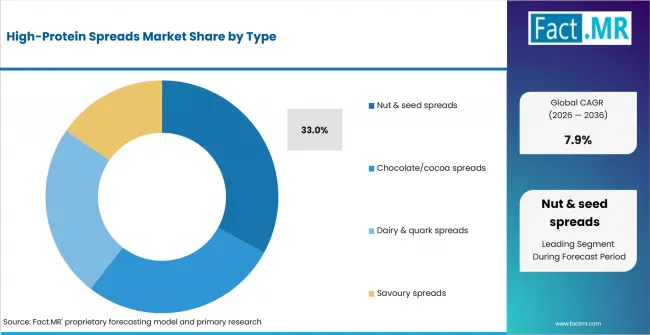
High Protein Spreads Market Analysis By Type | Source: Fact.MR
Nut & seed spreads are expected to lead Type with 33.0% share in 2026 because peanut, almond and seed formats already fit breakfast routines. Their familiar taste profiles, broad household use and compatibility with protein enrichment support repeat purchase while allowing brands to position products across mainstream and wellness-focused occasions.
What leads the Protein Source segment?
Dairy protein is expected to hold 37.0% share in 2026.
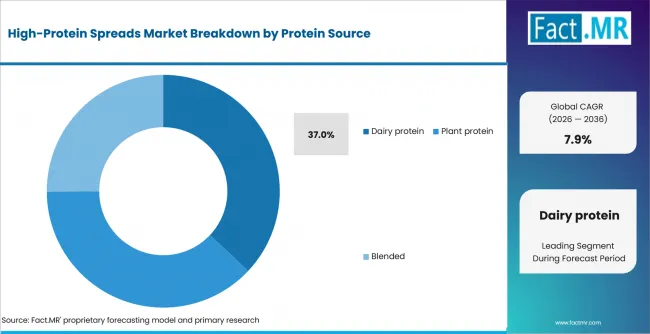
High Protein Spreads Market Analysis By Protein Source | Source: Fact.MR
Dairy protein is projected to lead Protein Source with 37.0% share in 2026, supported by the functionality of whey and casein in spread formulations. Agriculture and Agri-Food Canada reported that demand for animal-derived protein ingredients was highest in the dairy products packaged-food category, which accounted for 49.0% of volume sales in Canada in 2025.
How does Claim shape demand?
High-protein is anticipated to lead with 36.0% share in 2026.
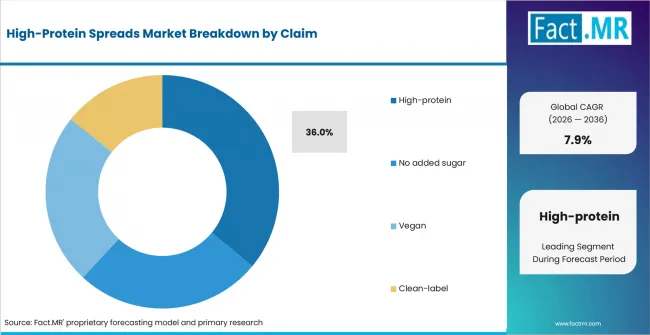
High Protein Spreads Market Analysis By Claim | Source: Fact.MR
High-protein is forecast to lead Claim with 36.0% share in 2026 as shoppers compare serving nutrition before purchasing premium spreads. The Food Standards Agency reported in May 2026 that 77% of respondents in England, Wales and Northern Ireland were concerned about ultra-processed food in March 2026, indicating strong consumer attention to food processing and ingredient information.
What supports Grocery & mass within Distribution?
Grocery & mass is estimated to represent 44.0% share in 2026.
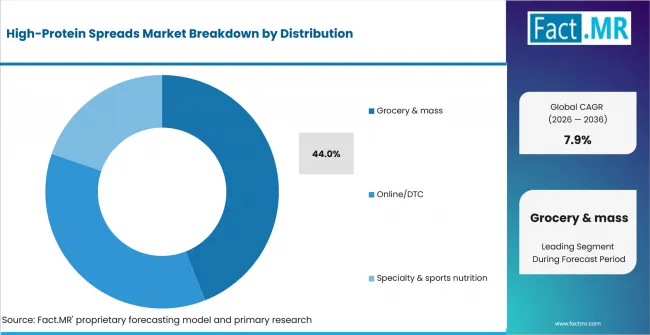
High Protein Spreads Market Analysis By Distribution | Source: Fact.MR
Grocery & mass is estimated to lead Distribution with 44.0% share in 2026 because spreads are commonly purchased during routine food shopping trips. The U.S. Census Bureau reported in May 2026 that e-commerce accounted for 16.9% of total U.S. retail sales in Q1 2026, underscoring the importance of digital purchasing channels alongside physical retail.
What is accelerating High-Protein Spreads Market adoption, and what is holding it back?
Protein snacking drives it; price and texture restrain it.
| DRIVER | (~) % IMPACT ON CAGR | GEOGRAPHIC RELEVANCE | IMPACT TIMELINE |
|---|---|---|---|
| Protein-led snacking | +2.1% | USA, UK, Australia | Short term (<= 2 years) |
| Nut and seed spread familiarity | +1.8% | USA, Canada, Australia | Short term (<= 2 years) |
| Grocery shelf testing | +1.5% | USA, Germany, UK | Medium term (2-4 years) |
| Online nutrition bundles | +1.2% | Canada, UK, Australia | Medium term (2-4 years) |
| Clean-label formulation | +0.9% | France, Germany | Long term (>= 4 years) |
Source: Fact.MR analysis. Updated Aug 19, 2026
- Nut and seed spread familiarity: Familiar use cases reduce adoption risk. The USDA Economic Research Service reported in June 2026 that food-at-home expenditures reached USD 1.10 trillion in 2025. Grocery routines are expected to support premium spread tests when flavor remains familiar.
- Online nutrition bundles: Online retail is anticipated to improve repeat buying through bundles with powders and bars. Myprotein directly markets a Chocolate Protein Spread made with whey protein concentrate, with its product page stating that the spreads deliver 21 g of protein per 100 g, providing direct evidence of the company’s participation in protein-positioned spreads.
Opportunity Impact Analysis
| OPPORTUNITY | (~) % IMPACT ON CAGR | GEOGRAPHIC RELEVANCE | IMPACT TIMELINE |
|---|---|---|---|
| Lower-sugar cocoa formats | +1.0% | USA, UK, Germany | Short term (<= 2 years) |
| Blended protein systems | +0.8% | Canada, France, Germany | Medium term (2-4 years) |
| Chilled quark spreads | +0.7% | Germany, France, UK | Medium term (2-4 years) |
| School and travel portions | +0.5% | USA, Canada, Australia | Long term (>= 4 years) |
Source: Fact.MR analysis. Updated Aug 19, 2026
- Lower-sugar cocoa formats: Cocoa spreads are expected to gain when brands keep indulgent flavor but reduce sugar exposure. Protein and sugar claims need to be visible on the same pack panel.
- Blended protein systems: Blends are projected to improve spreadability when one source creates dryness or bitterness. Danone announced in July 2026 that Silk expanded its Silk Protein lineup with plant-based high-protein yogurt and ready-to-drink protein shakes.
- Chilled quark spreads: Chilled dairy spreads are anticipated to create a bridge between high-protein yogurts and spreadable snacks. Germany and France are suited to this route because dairy protein is already familiar. Brands still need cold-chain discipline and short ingredient lists.
Restraints Impact Analysis
| RESTRAINT | (~) % IMPACT ON CAGR | GEOGRAPHIC RELEVANCE | IMPACT TIMELINE |
|---|---|---|---|
| Premium price friction | -1.3% | Global | Short term (<= 2 years) |
| Texture and aftertaste risk | -1.0% | USA, UK, Germany | Short term (<= 2 years) |
| Nut and sesame allergen limits | -0.8% | USA, Canada, Australia | Medium term (2-4 years) |
| Retail margin pressure | -0.6% | Australia, France, Germany | Long term (>= 4 years) |
Source: Fact.MR analysis. Updated Aug 19, 2026
- Premium price friction: Premium spreads face resistance when households compare price per serving with standard peanut butter. The Food Standards Agency reported in May 2026 that 91% of respondents in England, Wales and Northern Ireland were concerned about food prices in March 2026.
- Texture and aftertaste risk: Protein addition is expected to make spreads less smooth when formulation work is weak. Dryness and bitterness reduce repeat purchase before grocery scale. Flavor masking and fat balance therefore shape acceptance.
Which countries are scaling High-Protein Spreads Market fastest?
- The country comparison spans 3.00 percentage points across the forecast period.
- Australia remains 0.24 point above Canada through sports-nutrition retail.
- Canada remains 0.41 point above the United States through packaged protein foods.
- The United States remains 0.47 point above the United Kingdom through peanut-butter familiarity.
- The United Kingdom remains 0.94 point above Germany through gym-linked snacking.
- Germany remains 0.94 point above France through protein dairy familiarity.
- France closes the displayed range through clean-label review and slower grocery proof cycles.
Comparable CAGRs create different entry conditions because protein claims and retail pricing vary by country. Full coverage includes North America, Latin America, Europe, East Asia, South Asia and Pacific, Middle East and Africa.
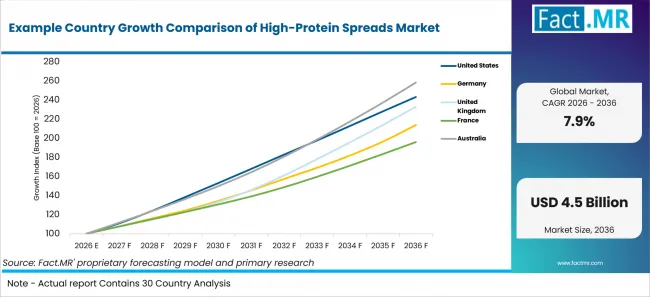
Example Country Growth Comparison Of High Protein Spreads Market | Source: Fact.MR
| Country | CAGR (2026-2036) |
|---|---|
| Australia | 10.0% |
| Canada | 9.7% |
| United States | 9.3% |
| United Kingdom | 8.8% |
| Germany | 7.9% |
| France | 7.0% |
Source: Fact.MR analysis. Updated Aug 19, 2026
What is powering Australia adoption?
10.0% CAGR, supported by sports-nutrition retail and online food buying.
Australia’s growth is supported by rising food spending and a large fitness population. ABS reported that food spending increased 1.1% month over month in May 2026, while AIHW reported, citing Australian Sports Commission AusPlay data, that 7.0 million Australians aged 15 and over participated in fitness and gym activities in 2024–25. Sports-nutrition retail supports product trials, although grocery price scrutiny, allergen requirements and texture challenges may restrict adoption.
How is Canada scaling High-Protein Spreads demand?
9.7% CAGR, driven by packaged protein foods and e-commerce reach.
Canada’s growth is supported by established protein-food consumption and expanding digital retail. Statistics Canada reported seasonally adjusted retail e-commerce sales of CAD 5.0 billion in May 2026, while Agriculture and Agri-Food Canada reported that animal-derived protein ingredients used in packaged foods totaled 13.1 thousand tonnes in Canada in 2025. Allergen concerns, labeling requirements and DTC logistics may constrain growth.
What supports the United States outlook?
9.3% CAGR, backed by peanut-butter familiarity and protein snacking.
United States growth benefits from familiar peanut-butter consumption and strong food spending. USDA ERS reported U.S. food expenditures reached USD 2.51 trillion in 2025, while Census Bureau data showed USD 326.7 billion in Q1 2026 retail e-commerce sales. Premium pricing, peanut restrictions and competition from protein bars may temper repeat purchases.
What underpins United Kingdom growth?
8.8% CAGR, shaped by active adults and sports-nutrition retail.
United Kingdom growth is supported by active consumers and established protein-nutrition channels. Sport England reported 30.9 million adults met physical-activity guidelines during November 2024-November 2025, while ONS recorded a 0.6% quarterly retail-sales-volume increase in Q2 2026. Food affordability concerns, HFSS expectations and imported-product costs may limit broader adoption.
How is Germany developing demand?
7.9% CAGR, led by discount retail and protein dairy familiarity.
Germany’s growth reflects familiar protein-dairy consumption and strong discount retail channels. Destatis reported that German retail turnover increased 1.1% in real terms month over month in May 2026, while the European Commission’s Youth Wiki noted that Germany has about 86,000 gymnastics and sports clubs. Inflation, nut and cocoa price volatility, and consumer expectations for clear ingredient lists may restrain premium spread adoption.
What supports France adoption?
7.0% CAGR, supported by protein policy and clean-label review.
France’s growth is supported by recovering food consumption and policy backing for domestic protein production. INSEE reported household food consumption rose 0.6% in June 2026, while the agriculture ministry announced EUR 11.7 million for protein-sovereignty projects. Strict origin controls, taste expectations and confectionery-like positioning may restrict broader high-protein spread adoption.
Who leads the High-Protein Spreads Market?
Grenade and Myprotein have directly evidenced high-protein spreads. J.M. Smucker/Jif and Hormel/SKIPPY are conventional spread comparators; Danone and Unilever provide adjacent nutrition or branded-food context.
Jif and SKIPPY are conventional spread comparators. SKIPPY highlighted 7 g of protein per serving in October 2025. Grenade and Myprotein provide direct protein-spread evidence; Danone and Unilever are adjacent. Competition is expected to depend on taste, serving-level protein, spreadability and channel proof.
Which companies are the key providers?
Key companies include Nuts ‘N More; Once Again Nut Butter; Hormel Foods Corporation — SKIPPY; American Dream Nut Butter; Grenade; and Myprotein.
- Nuts ‘N More
- Once Again Nut Butter
- Hormel Foods Corporation — SKIPPY
- American Dream Nut Butter
- Grenade
- Myprotein
Bibliography
- Australian Bureau of Statistics. (2026, August 4). Monthly Household Spending Indicator, June 2026.
- Australian Institute of Health and Welfare. (2026, June 24). Sports injury in Australia: Sports participation and injury rates.
- Australian Competition and Consumer Commission. (2025, March 21). ACCC recommends supermarket reforms to provide better outcomes for consumers and suppliers.
- Statistics Canada. (2026, July 23). Retail trade, May 2026.
- Canadian Food Inspection Agency. (2025, December 2). Canadian Food Inspection Agency takes further action to protect Canadians from Salmonella linked to pistachios from Iran.
- Public Health Agency of Canada. (2026, July 21). Public health notice: Outbreak of Salmonella infections linked to various brands of pistachios and pistachio-containing products.
- U.S. Census Bureau. (2026, May 18). Quarterly retail e-commerce sales: 1st quarter 2026.
- U.S. Bureau of Labor Statistics. (2026, August 12). Table 2. Consumer Price Index for All Urban Consumers (CPI-U): U.S. city average, by detailed expenditure category, July 2026 [Data table].
- Office for National Statistics. (2026, July 24). Retail sales, Great Britain: June 2026.
- Food Standards Agency, & YouGov. (2026, May 19). Consumer Insights Tracker (January 2026–March 2026).
- Statistisches Bundesamt (Destatis). (2026, June 30). Einzelhandelsumsatz im Mai 2026 real um 1,1 % höher als im Vormonat [Retail turnover in May 2026 up 1.1% in real terms on the previous month].
- European Commission. (2026, March 10). Germany: 7.3 Sport, youth fitness and physical activity. Youth Wiki.
- Institut national de la statistique et des études économiques. (2026, July 30). Household consumption of goods increased again in June 2026.
- Ministère de l’Agriculture et de la Souveraineté alimentaire. (2025, July 2). Planification écologique : 11,7 millions d’euros d’aides en faveur de la souveraineté protéique en France.
- Hormel Foods Corporation. (2025, October 31). SKIPPY® Peanut Butter spreads joy in every jar.
This Report Answers
- The report provides intelligence on Type and Protein Source choices that shape formulation and pricing.
- Segment analysis covers Nut & seed spreads and Dairy protein as 2026 share leaders.
- Country outlook evaluates Australia, Canada, the United States, the United Kingdom, Germany and France.
- Competitive analysis profiles Nuts ‘N More, Hormel Foods Corporation — SKIPPY, Once Again Nut Butter, American Dream Nut Butter, Grenade and Myprotein.
- Distribution assessment covers Grocery & mass, Online/DTC and Specialty & sports nutrition.
What does the High-Protein Spreads Market cover?
High-protein spreads cover foods where spreadability and nutrition claims meet. The scope connects protein ingredients with sweet and savory spreads when brands lift pantry products into better-for-you snacking.
The market includes protein-positioned peanut, almond, seed, cocoa and dairy spreads. It aligns with functional foods and functional snacks where everyday foods carry a clear nutrition job.
What is included in the scope?
The scope includes dairy, plant and blended protein systems used in retail spreads. It covers plant protein ingredients when plant sources support vegan and clean-label positioning.
Nut and seed formats are included when the protein claim guides choice. Coverage includes adjacent seed butter and almond butter categories used on toast, fruit or snacks.
What is excluded from the scope?
Conventional spreads without a protein-positioned claim remain outside the scope. The report excludes reduced fat peanut butter unless higher protein is part of commercial positioning.
Standalone powders, bars and supplements are excluded unless sold as spreadable foods. Protein flavor masking agents are included only when they affect spread formulation. Wider health and wellness foods activity remains outside scope unless the product is a spread.
How Was the Analysis Built?
The analysis draws on 120+ sources, 35+ company portfolios, 25+ countries, and more than 20 industry interviews.
- Primary Research: Primary research includes discussions with manufacturers, service providers, technology developers, distributors, end users, procurement teams, and subject-matter experts. These conversations examine purchasing priorities, product adoption, operational challenges, approval requirements, competitive positioning, and the factors that influence wider market acceptance.
- Desk Research: Desk research covers government statistics, regulatory publications, company filings, trade data, technical studies, industry associations, standards, public policy, and other authoritative sources. Every source used in the analysis is documented in the bibliography.
- Market Sizing and Forecasting: Market estimates combine historical performance, demand indicators, pricing and volume trends, segment shares, company participation, country-level growth, adoption patterns, investment activity, and barriers to market expansion.
- Data Validation and Update Cycle: Findings are validated by comparing primary interviews with public data, company activity, regulatory changes, trade patterns, and industry developments. Regular updates review new product launches, capacity changes, partnerships, approvals, procurement trends, and shifts in commercial adoption.
Segmentation
What is the report’s scope and coverage?
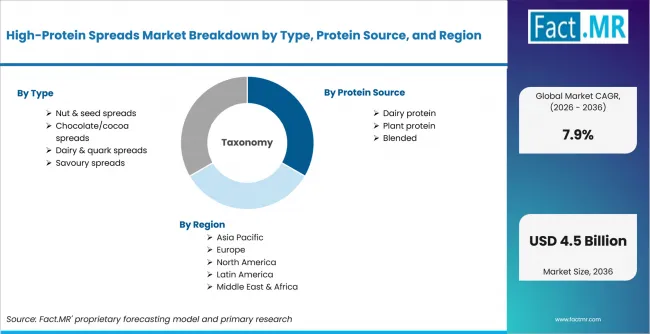
High Protein Spreads Market Breakdown By Type, Protein Source, And Region | Source: Fact.MR
| Attribute | Details |
|---|---|
| Quantitative Units | USD billion |
| Market Definition | Retail and direct-to-consumer spreads formulated or positioned around higher protein content, including nut and seed, chocolate or cocoa, dairy and quark, and savoury formats |
| Type | Nut & seed spreads; Chocolate/cocoa spreads; Dairy & quark spreads; Savoury spreads |
| Protein Source | Dairy protein; Plant protein; Blended |
| Claim | High-protein; No added sugar; Vegan; Clean-label |
| Distribution | Grocery & mass; Online/DTC; Specialty & sports nutrition |
| Regions Covered | North America; Latin America; Europe; East Asia; South Asia and Pacific; Middle East and Africa |
| Countries Covered | Australia; Canada; United States; United Kingdom; Germany; France |
| Key Companies Profiled | Nuts ‘N More; Once Again Nut Butter; Hormel Foods Corporation — SKIPPY; American Dream Nut Butter; Grenade; Myprotein |
| Forecast Period | 2026 to 2036 |
| Approach | Hybrid approach using food spending, retail data, protein claims, segment shares, country growth, company portfolios and verified evidence |
Source: Fact.MR analysis. Updated Aug 19, 2026
How is the market segmented?
-
By Type:
- Nut & seed spreads
- Chocolate/cocoa spreads
- Dairy & quark spreads
- Savoury spreads
-
By Protein Source:
- Dairy protein
- Plant protein
- Blended
-
By Claim:
- High-protein
- No added sugar
- Vegan
- Clean-label
-
By Distribution:
- Grocery & mass
- Online/DTC
- Specialty & sports nutrition
-
By Region:
- North America
- Latin America
- Europe
- East Asia
- South Asia and Oceania
- Middle East and Africa
Frequently Asked Questions
How big is the high-protein spreads market in 2026?
What is the CAGR of the high-protein spreads market from 2026 to 2036?
Which type leads the high-protein spreads market?
Which protein source leads the high-protein spreads market?
Who are the leading companies in the high-protein spreads market?
Who worked on this report


Preview the report firsthand - request a free sample
Free SampleGet the brochure for pricing and purchase details
Download PDF