- Market Value (2025): USD 417.8 Mn
- Estimated Value (2026): USD 912.4 Mn
- Forecast Value (2036): USD 1933.6 Mn
- CAGR (2026-2036): 7.8%
What is the High Speed Camera Market forecast to be worth by 2036?
USD 912.4 million in 2026 to USD 1,933.6 million by 2036 at 7.8% CAGR.
- The high speed camera market reached USD 846.4 million in 2025 as industrial users kept funding motion analysis and process troubleshooting.
- Demand is projected to increase from USD 912.4 million in 2026 to USD 1,933.6 million by 2036.
- The market is forecast to record 7.8% CAGR from 2026 to 2036. Growth is expected to depend on frame-rate proof, lighting setup and service support.
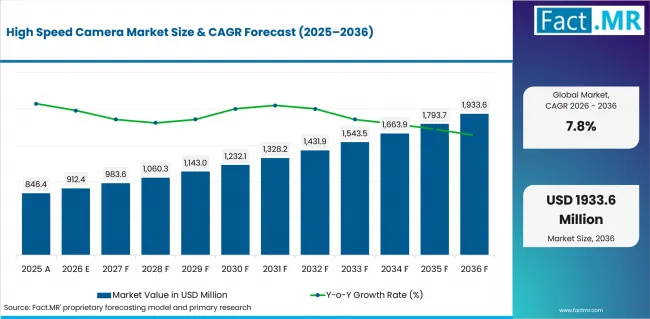
High Speed Camera Market Value Analysis | Source: Fact.MR
What are the defining numbers behind High Speed Camera Market growth?
USD 1,021.2 million absolute opportunity is expected by 2036.
- Demand Drivers in the Market
- Portable high-speed cameras are expected to draw demand where users move between test locations without complex setup.
- Industrial inspection programs are expected to use high-speed imaging when operators need to see fast mechanical movement.
- CMOS sensor adoption is anticipated to support uptake since users need speed and readout control in one platform.
- Key Segments Analyzed
- By Product: Portable High-speed Cameras are projected to hold 40.2% share in 2026 since they support testing across several locations.
- By Frame Rate: 10,000-100,000 FPS is anticipated to account for 38.1% share in 2026. This range fits many industrial and research events while keeping data handling manageable.
- By Application: Industrial Manufacturing is estimated to hold 35.1% share in 2026. Operators use high-speed footage when visual proof is needed before changing a line setting or maintenance plan.
- By Sensor Technology: CMOS Sensors are forecast to represent 50.4% share in 2026 due to fast readout and broader camera availability.
- By End User: Manufacturing Industries are expected to hold 35.2% share in 2026 as factories use high-speed footage to examine motion and quality issues.
- Analyst Opinion at Fact.MR
- Shambhu Nath Jha, Sr. Consultant at Fact.MR, opines, “High speed camera purchases are expected to depend on whether the system turns fast movement into reliable operating evidence. Users are less likely to approve equipment on frame rate alone unless lighting and memory support the test setting. Software and service support need to match the same workflow.”
- Strategic Implications
- Manufacturers need to connect camera selection with the event being measured before quotation review begins.
- Equipment providers are expected to strengthen proposals by explaining the fit between sensor choice and workflow software.
- Investors need to separate industrial testing demand from media production and automotive validation.
Canada is expected to record 6.3% CAGR from 2026 to 2036 due to portable equipment needs. France is projected to record 7.0% CAGR as professional imaging and manufacturing customers compare product proof more closely. South Korea is anticipated to grow at 5.5% CAGR through electronics and advanced manufacturing applications. Japan is estimated to post 7.8% CAGR through precision engineering and research use. The USA is forecast at 10.1% CAGR. Germany is projected at 9.4% CAGR and the UK at 8.6% CAGR.
How does the High Speed Camera Market break down by segment?
Portable High-speed Cameras are expected to lead Product at 40.2% share in 2026. The 10,000-100,000 FPS class is projected to lead Frame Rate at 38.1% share in 2026.
Which product type dominates?
Portable High-speed Cameras are projected to account for 40.2% share in 2026.
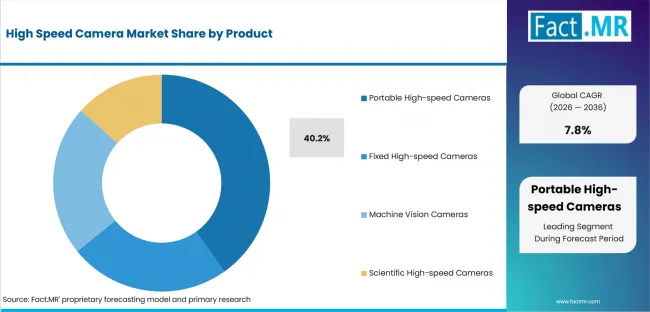
High Speed Camera Market Analysis By Product | Source: Fact.MR
Portable systems lead when users need to capture short test events in different locations. They are useful for troubleshooting on production floors and in field testing areas. Fixed High-speed Cameras remain valuable when a facility needs repeatable capture from a stable test position.
What leads the Frame Rate segment?
10,000-100,000 FPS is expected to hold 38.1% share in 2026.
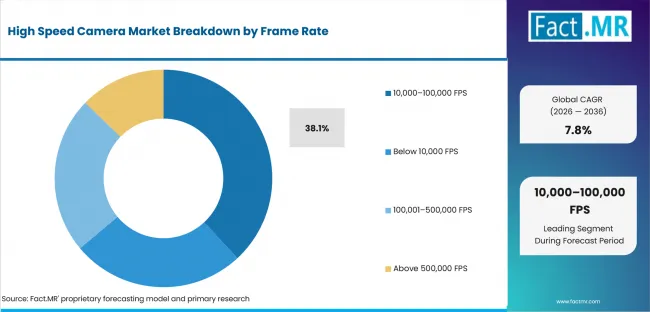
High Speed Camera Market Analysis By Frame Rate | Source: Fact.MR
A practical speed window gives this class its commercial position. It captures fast motion without creating the file burden seen in ultra-high-speed work. Lower frame-rate classes support routine analysis. Higher frame-rate classes serve ballistics and specialized research where exact timing matters more.
How does Application shape demand?
Industrial Manufacturing is anticipated to lead with 35.1% share in 2026.
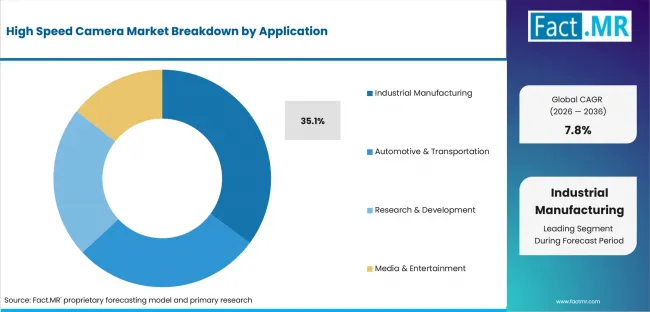
High Speed Camera Market Analysis By Application | Source: Fact.MR
Factory users rely on high-speed cameras when a fault happens too quickly for normal video. Production Line Inspection and Quality Control remain important for root-cause review.
What supports CMOS Sensors within Sensor Technology?
CMOS Sensors are estimated to represent 50.4% share in 2026.
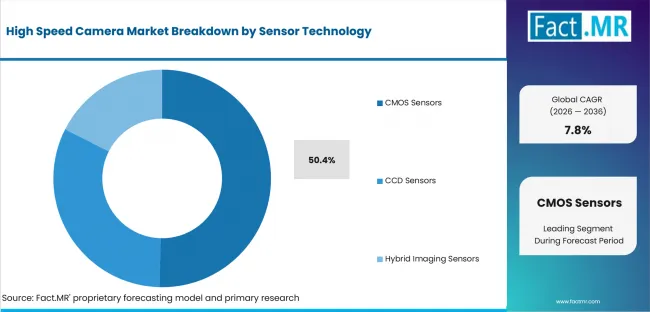
High Speed Camera Market Analysis By Sensor Technology | Source: Fact.MR
CMOS technology supports high-speed capture through fast readout and broader integration options. Backside Illuminated CMOS and Global Shutter CMOS remain important for low-light performance and motion control.
What supports Manufacturing Industries within End User?
Manufacturing Industries are forecast to hold 35.2% share in 2026.
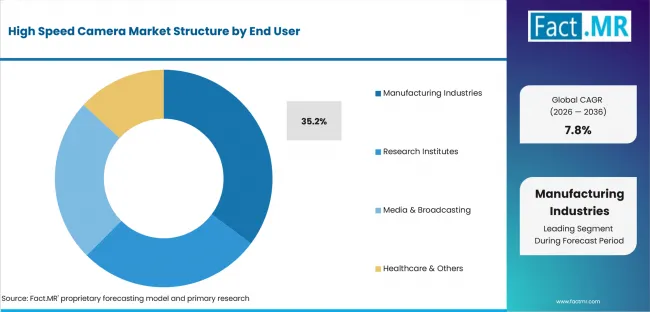
High Speed Camera Market Analysis By End User | Source: Fact.MR
Manufacturing users lead demand when equipment failures and quality deviations happen in short time windows. Automotive Manufacturers use high-speed footage in crash testing and component testing.
What is accelerating High Speed Camera Market adoption, and what is holding it back?
Demand is expected to grow through portable testing and suitable frame-rate options. Adoption may be limited by high costs, large data files and lighting requirements.
Drivers Impact Analysis
| DRIVER | QUALITATIVE RELEVANCE | GEOGRAPHIC RELEVANCE | IMPACT TIMELINE |
|---|---|---|---|
| Portable high-speed camera mobility | High | Canada, USA, Japan | Short term (<= 2 years) |
| 10,000-100,000 FPS practical frame-rate band | High | France, Germany, UK | Short term (<= 2 years) |
| Industrial process troubleshooting | High | Canada, South Korea, Germany | Medium term (2-4 years) |
| CMOS sensor readout and sensitivity | Moderate | Japan, South Korea, USA | Medium term (2-4 years) |
| Software, lighting and storage integration | Moderate | Manufacturing and research users | Long term (>= 4 years) |
Source: Fact.MR analysis. Updated Jul 29, 2026
- Portable high-speed camera mobility: Portable systems are expected to support demand when users need one camera across test cells and production areas.
- 10,000-100,000 FPS practical frame-rate band: This frame-rate range is expected to match many industrial events without excessive data load.
- Industrial process troubleshooting: High-speed footage is expected to support root-cause analysis in factories and test labs.
Opportunity Impact Analysis
| OPPORTUNITY | QUALITATIVE RELEVANCE | GEOGRAPHIC RELEVANCE | IMPACT TIMELINE |
|---|---|---|---|
| Rental and trial-led qualification | Moderate | Canada and USA | Medium term (2-4 years) |
| Factory troubleshooting packages | Moderate | France and Germany | Medium term (2-4 years) |
| Automotive crash and component testing | Moderate | South Korea and Japan | Long term (>= 4 years) |
| High-speed camera training and support | Selective | UK and Europe | Long term (>= 4 years) |
Source: Fact.MR analysis. Updated Jul 29, 2026
- Rental and trial-led qualification: Rental access is expected to lower purchase risk when users need to prove fit before approval.
- Factory troubleshooting packages: Providers are expected to gain opportunity when they sell camera, lens and software guidance together.
- Automotive crash and component testing: Automotive users are expected to keep demand active where impact and vibration tests need detailed review.
Restraints Impact Analysis
| RESTRAINT | QUALITATIVE RELEVANCE | GEOGRAPHIC RELEVANCE | IMPACT TIMELINE |
|---|---|---|---|
| High system and lighting cost | High | Global | Short term (<= 2 years) |
| Data storage and workflow burden | Moderate | Industrial and research users | Short term (<= 2 years) |
| Low-light setup complexity | Moderate | Portable applications | Medium term (2-4 years) |
| Service access and calibration delays | Selective | Canada, France, UK | Medium term (2-4 years) |
Source: Fact.MR analysis. Updated Jul 29, 2026
- High system and lighting cost: High-speed cameras often need lenses and software before the customer gets useful output.
- Data storage and workflow burden: Higher frame rates create large files that need disciplined transfer and review processes.
- Low-light setup complexity: Short exposures make lighting a practical barrier in many test environments.
Which countries are scaling High Speed Camera Market fastest?
- The USA records the highest listed country CAGR at 10.1%, followed by Germany at 9.4% and the UK at 8.6%.
- Japan records 7.8%, France 7.0%, Canada 6.3%, and South Korea 5.5% from 2026 to 2036.
- Country-level demand differs by testing application, available technical support, and buyer workflow requirements.
Comparable CAGRs can therefore produce different sales conditions across the seven countries. Deployment timing depends on local service depth and the ability to package cameras with lighting and workflow support.
The full report provides country-level CAGR analysis across North America and Latin America. It also covers Europe and East Asia. South Asia and Pacific and the Middle East and Africa complete the regional view.
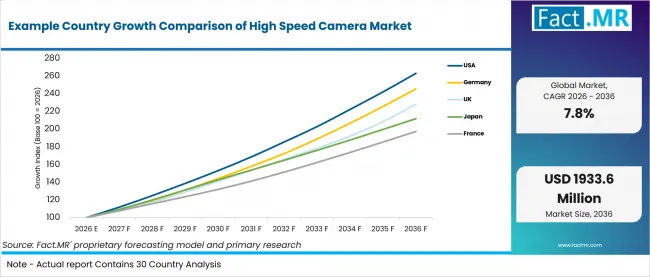
Example Country Growth Comparison Of High Speed Camera Market | Source: Fact.MR
| Country | CAGR (2026-2036) |
|---|---|
| Canada | 6.3% |
| France | 7.0% |
| South Korea | 5.5% |
| Japan | 7.8% |
| USA | 10.1% |
| Germany | 9.4% |
| UK | 8.6% |
Source: Fact.MR analysis. Updated Jul 29, 2026
What supports Canada adoption?
6.3% CAGR, supported by portable equipment needs and service coverage across dispersed industrial users.
Canada’s growth reflects a market where test locations can be far apart. Portable High-speed Cameras are expected to fit this pattern because they reduce setup work. Service availability and training support are expected to influence whether smaller industrial customers move from trial use to purchase.
How is France scaling demand?
7.0% CAGR, driven by professional imaging use and specification-led industrial testing.
French customers often compare image quality and software support before approval. The 10,000-100,000 FPS range is expected to fit many test and creative-production needs. Demand is likely to strengthen where distributors explain workflow fit and after-sales support clearly.
What is driving South Korea’s growth from 2026 to 2036?
5.5% CAGR, backed by electronics manufacturing and component test requirements.
South Korea’s growth is shaped by manufacturing environments where fast failures need frame-by-frame review. Industrial Manufacturing applications are expected to benefit from electronics and production-line testing. Equipment choices are likely to favor systems that fit existing engineering review processes.
How is Japan developing demand?
7.8% CAGR, led by precision engineering and research use.
Japan’s growth reflects customers that place high value on repeatable image quality and controlled measurement. CMOS Sensors support this demand because they help balance speed and imaging consistency. Local technical support and product reliability are expected to remain important purchase conditions.
How does the USA perform?
10.1% CAGR, supported by established automotive and manufacturing testing channels.
The USA’s growth is steadier because many large users already have testing infrastructure and provider relationships. Manufacturing Industries are expected to replace or upgrade systems when data handling improves. Automotive testing remains important where high-speed video supports crash and component analysis.
What supports Germany’s growth?
9.4% CAGR, driven by manufacturing quality control and engineering validation.
Germany’s growth reflects demand from users that require documented performance before changing equipment. Portable High-speed Cameras are expected to advance when providers show repeatability across line checks and laboratory testing. Local service support is expected to influence order timing in smaller industrial accounts.
What supports UK adoption?
8.6% CAGR, backed by selective research and media demand.
The UK’s growth is expected to depend on customers that need high-speed capture for defined projects. Research and media users are likely to value setup flexibility and workflow support. Industrial purchases are expected to progress when the system clearly reduces troubleshooting time.
Who leads the High Speed Camera Market?
Vision Research Inc. and Photron Limited show the strongest direct relevance, while NAC Image Technology strengthens the wider industrial and research imaging landscape.
Vision Research and Photron support high-speed imaging across engineering, automotive testing and research. NAC Image Technology adds crash-testing expertise, while AOS Technologies, Fastec Imaging, Weisscam and iX Cameras broaden the specialized camera field. Competition will depend on frame rate, image quality, software integration and service support. Providers offering reliable performance may gain stronger industrial and laboratory demand.
Which companies are the key providers?
Key companies include Vision Research Inc.; Photron Limited; NAC Image Technology; AOS Technologies AG; Fastec Imaging Corporation; iX Cameras.
- Vision Research Inc.
- Photron Limited
- NAC Image Technology
- AOS Technologies AG
- Fastec Imaging Corporation
Bibliography
- Nottingham Trent University. (2025, March 11). High speed camera. UK Contracts Finder.
- Fastec Imaging Corporation. (2024, July 19). HS high-speed camera system.
This Report Answers
- The report provides strategic intelligence on the High Speed Camera Market across Product and Frame Rate choices that shape industrial testing and motion-analysis programs.
- Segment analysis covers Portable High-speed Cameras and the 10,000-100,000 FPS class as the share leaders within the 2026 market.
- Country outlook evaluates Canada and France alongside South Korea and Japan. The USA, Germany and the UK complete the growth comparison across the profiled markets.
- Competitive analysis profiles Vision Research Inc. and Photron Limited alongside NAC Image Technology and AOS Technologies AG. Fastec Imaging Corporation and iX Cameras complete the provider set.
- Application assessment covers Industrial Manufacturing and Production Line Inspection. Quality Control and Process Monitoring complete the use-case view alongside industrial vision applications.
What does the High Speed Camera Market cover?
High speed camera systems are used to capture fast motion where normal video cannot provide enough frame-by-frame evidence for review.
The High Speed Camera Market covers portable and handheld camera systems. Fixed industrial systems and laboratory cameras are included when they record fast motion for analysis. Studio and machine vision systems are included when high-speed capture is part of the product use. Coverage extends to frame-rate classes from below 10,000 FPS to above 500,000 FPS.
What is included in the scope?
High speed camera systems are used across manufacturing industries and automotive manufacturers. Electronics manufacturers and aerospace manufacturers are included. Research institutes and media users are included. Healthcare users and defense organizations are also included.
The scope includes Product and Frame Rate alongside Application, Sensor Technology and End User. Coverage spans Portable High-speed Cameras and 10,000-100,000 FPS systems. Industrial Manufacturing applications are included as the leading application reference.
What is excluded from the scope?
General camera systems and unrelated video equipment remain outside the scope of this market.
The scope excludes standard photography cameras, mobile-phone cameras and basic surveillance hardware used only for normal-speed recording. It excludes lighting, lenses and storage systems sold without a direct high-speed camera use case. Company revenue without a clear connection to high-speed imaging, motion analysis or test evidence is outside the market boundary.
How Was the Analysis Built?
The analysis draws on 120+ sources, 35+ company portfolios, 25+ countries, and more than 20 industry interviews.
- Primary Research: Primary research includes discussions with manufacturers, service providers, technology developers, distributors, end users, procurement teams, and subject-matter experts. These conversations examine purchasing priorities, product adoption, operational challenges, approval requirements, competitive positioning, and the factors that influence wider market acceptance.
- Desk Research: Desk research covers government statistics, regulatory publications, company filings, trade data, technical studies, industry associations, standards, public policy, and other authoritative sources. Every source used in the analysis is documented in the bibliography.
- Market Sizing and Forecasting: Market estimates combine historical performance, demand indicators, pricing and volume trends, segment shares, company participation, country-level growth, adoption patterns, investment activity, and barriers to market expansion.
- Data Validation and Update Cycle: Findings are validated by comparing primary interviews with public data, company activity, regulatory changes, trade patterns, and industry developments. Regular updates review new product launches, capacity changes, partnerships, approvals, procurement trends, and shifts in commercial adoption.
Segmentation
What is the report’s scope and coverage?
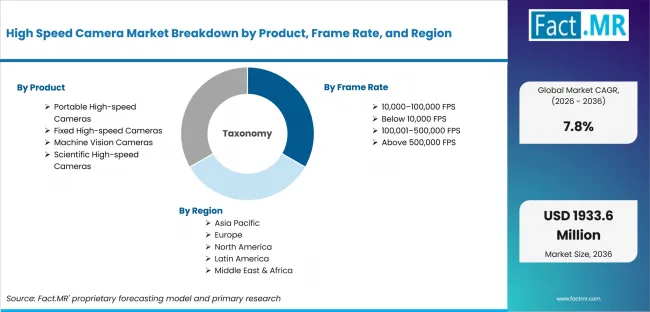
High Speed Camera Market Breakdown By Product, Frame Rate, And Region | Source: Fact.MR
| Metric | Value |
|---|---|
| Quantitative Units | USD million in 2026 to USD million by 2036 at CAGR |
| Market Definition | High Speed Camera covers high-frame-rate imaging systems used to capture fast motion for industrial testing, research, automotive validation, media production and scientific measurement. |
| Product | Portable High-speed Cameras; Handheld High-speed Cameras; Battery-powered Cameras; Compact High-speed Cameras; Fixed High-speed Cameras; Industrial Cameras; Laboratory Cameras; Studio Cameras; Machine Vision Cameras; Line Scan Cameras; Area Scan Cameras; Smart Vision Cameras; Scientific High-speed Cameras; CMOS Scientific Cameras; Intensified Cameras; Ultra High-frame-rate Cameras |
| Frame Rate | 10,000-100,000 FPS; 10,000-25,000 FPS; 25,001-50,000 FPS; 50,001-100,000 FPS; Below 10,000 FPS; 1,000-5,000 FPS; 5,001-10,000 FPS; Entry-level High-speed Cameras; 100,001-500,000 FPS; 100,001-250,000 FPS; 250,001-500,000 FPS; High-performance Cameras; Above 500,000 FPS; Research-grade Cameras; Ballistics Cameras; Specialized Scientific Cameras |
| Application | Industrial Manufacturing; Production Line Inspection; Quality Control; Process Monitoring; Automotive & Transportation; Crash Testing; Component Testing; Engine Analysis; Research & Development; Fluid Dynamics; Material Testing; Ballistics Research; Media & Entertainment; Sports Broadcasting; Film Production; Commercial Production |
| Sensor Technology | CMOS Sensors; Backside Illuminated CMOS; Global Shutter CMOS; Stacked CMOS; CCD Sensors; Progressive Scan CCD; Interline CCD; High-sensitivity CCD; Hybrid Imaging Sensors; CMOS-CCD Hybrid; Custom Imaging Sensors; HDR Sensors |
| End User | Manufacturing Industries; Automotive Manufacturers; Electronics Manufacturers; Aerospace Manufacturers; Research Institutes; Universities; Government Laboratories; Private Research Centers; Media & Broadcasting; Film Studios; Sports Broadcasters; Content Production Companies; Healthcare & Others; Medical Research; Defense Organizations; Forensic Laboratories |
| Regions Covered | North America; Latin America; Europe; East Asia; South Asia and Pacific; Middle East and Africa |
| Countries Covered | Canada; France; South Korea; Japan; USA; Germany; UK |
| Key Companies Profiled | Vision Research Inc.; Photron Limited; NAC Image Technology; AOS Technologies AG; Fastec Imaging Corporation; iX Cameras |
| Forecast Period | 2026 to 2036 |
| Approach | Hybrid top-down and bottom-up approach using high-speed camera demand; frame-rate requirements; sensor mix; country growth; application use; company participation; service coverage; workflow needs and public evidence relevant to the category |
Source: Fact.MR analysis. Updated Jul 29, 2026
How is the market segmented?
-
By Product:
- Portable High-speed Cameras
- Handheld High-speed Cameras
- Battery-powered Cameras
- Compact High-speed Cameras
- Fixed High-speed Cameras
- Industrial Cameras
- Laboratory Cameras
- Studio Cameras
- Machine Vision Cameras
- Line Scan Cameras
- Area Scan Cameras
- Smart Vision Cameras
- Scientific High-speed Cameras
- CMOS Scientific Cameras
- Intensified Cameras
- Ultra High-frame-rate Cameras
-
By Frame Rate:
- 10,000-100,000 FPS
- 10,000-25,000 FPS
- 25,001-50,000 FPS
- 50,001-100,000 FPS
- Below 10,000 FPS
- 1,000-5,000 FPS
- 5,001-10,000 FPS
- Entry-level High-speed Cameras
- 100,001-500,000 FPS
- 100,001-250,000 FPS
- 250,001-500,000 FPS
- High-performance Cameras
- Above 500,000 FPS
- Research-grade Cameras
- Ballistics Cameras
- Specialized Scientific Cameras
-
By Application:
- Industrial Manufacturing
- Production Line Inspection
- Quality Control
- Process Monitoring
- Automotive & Transportation
- Crash Testing
- Component Testing
- Engine Analysis
- Research & Development
- Fluid Dynamics
- Material Testing
- Ballistics Research
- Media & Entertainment
- Sports Broadcasting
- Film Production
- Commercial Production
- By Sensor Technology
- CMOS Sensors
- Backside Illuminated CMOS
- Global Shutter CMOS
- Stacked CMOS
- CCD Sensors
- Progressive Scan CCD
- Interline CCD
- High-sensitivity CCD
- Hybrid Imaging Sensors
- CMOS-CCD Hybrid
- Custom Imaging Sensors
- HDR Sensors
-
By End User:
- Manufacturing Industries
- Automotive Manufacturers
- Electronics Manufacturers
- Aerospace Manufacturers
- Research Institutes
- Universities
- Government Laboratories
- Private Research Centers
- Media & Broadcasting
- Film Studios
- Sports Broadcasters
- Content Production Companies
- Healthcare & Others
- Medical Research
- Defense Organizations
- Forensic Laboratories
-
By Region:
- North America
- Latin America
- Europe
- East Asia
- South Asia and Pacific
- Middle East and Africa
Frequently Asked Questions
Which Product leads the market?
Which Frame Rate leads the market?
Which Application leads the market?
Which Sensor Technology leads the market?
Which End User leads the market?
Which country records the highest listed CAGR?
What is the primary driver in this market?
What is the main restraint?
Why do Manufacturing Industries lead demand?
Who worked on this report


Preview the report firsthand - request a free sample
Free SampleGet the brochure for pricing and purchase details
Download PDF