- Market Value (2025): USD 2.4 Bn
- Estimated Value (2026): USD 2.8 Bn
- Forecast Value (2036): USD 10.9 Bn
- CAGR (2026-2036): 14.7%
What is the Home-Compostable High-Barrier Laminates Market forecast to be worth by 2036?
USD 2.8 Billion in 2026 to USD 10.9 Billion by 2036 at a 14.7% CAGR.
- The Home-Compostable High-Barrier Laminates Market reached USD 2.4 Billion in 2025.
- Demand is expected to increase from USD 2.8 Billion in 2026 to USD 10.9 Billion by 2036.
- The market is expected to grow at 14.7% CAGR from 2026 to 2036. Food brands and film pack makers are testing higher-barrier packs for sachets, pouches and flow wraps.
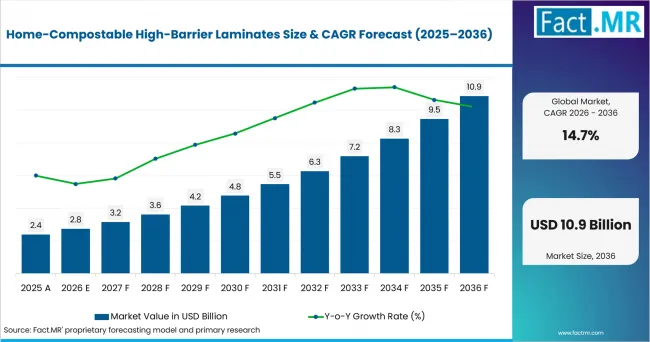
Home Compostable High Barrier Laminates Value Analysis | Source: Fact.MR
What are the defining numbers behind Home-Compostable High-Barrier Laminates Market growth?
An absolute opportunity of USD 8.1 Billion is expected between 2026 and 2036.
- Demand Drivers in the Market
- Food and snack brands need strong oxygen and moisture control across filling and storage. This need links the market with high-barrier compostable laminates used for sensitive food packs.
- pack makers need materials that run on existing lines. On April 29, 2026 BASF said its certified home-compostable ecovio grades support extrusion coating plus film extrusion and lamination. The grades can give adjustable oxygen and moisture barriers.
- Single-serve packs raise the need for dependable seals and low material use. Related biopolymer films serve wraps, bags and laminate layers where thin structures must still protect the product.
- Packaging rules are giving end-of-life design more weight. CalRecycle announced on May 1, 2026, that California’s SB 54 packaging regulations require a 25% reduction in single-use plastic covered material by 2032, compared with the 2023 baseline. Covered packaging and plastic food-service ware must also meet recyclable or compostable needs.
- Key Segments Analyzed
- By Laminate Platform: PLA-based laminates are expected to hold 36.0% share in 2026. Their fit with film, coating and lamination routes supports use in flexible packs and links this segment with the wider bioplastics market.
- By Barrier Level: High oxygen barrier is expected to account for 31.0% share in 2026. Food packs for oxidation-sensitive products need stronger gas control than a basic compostable film.
- By Pack Format: Single-serve sachets are expected to capture 29.0% share in 2026. Small packs need steady seals, thin structures and steady product protection.
- By End-of-Life: Industrial compostable is estimated to represent 33.0% share in 2026. Controlled composting conditions support established certification routes across some biodegradable packaging materials.
- Analyst Opinion at Fact.MR
- Shambhu Nath Jha is Principal Consultant at Fact.MR. He states, “The commercial test is simple: the finished pack must keep its barrier and seal performance during use. Brand owners are expected to ask for clear proof on oxygen control and moisture resistance. They also need clear composting claims. Firms that pair material know-how with pack maker support can shorten testing work.”
- Strategic Implications
- Film and laminate makers should test the finished pack after printing, sealing and storage. Final pack performance carries more weight than resin identity alone.
- Brand owners should match composting claims to local collection and disposal routes. Related home-compostable PHA polymers show how certification can shape material choice.
- pack makers should test coating weight and seal windows on commercial lines. Good line performance helps protect package strength when less material is used.
China is expected to grow at 15.3% CAGR through 2036. The USA and Japan are each projected at 14.8%. Germany is anticipated at 14.6%. France is expected to post 14.1%.
How does the Home-Compostable High-Barrier Laminates Market break down by segment?
PLA-based laminates lead Laminate Platform at 36.0%. High oxygen barrier leads Barrier Level at 31.0%.
Which Laminate Platform leads?
PLA-based laminates are expected to hold 36.0% share in 2026.
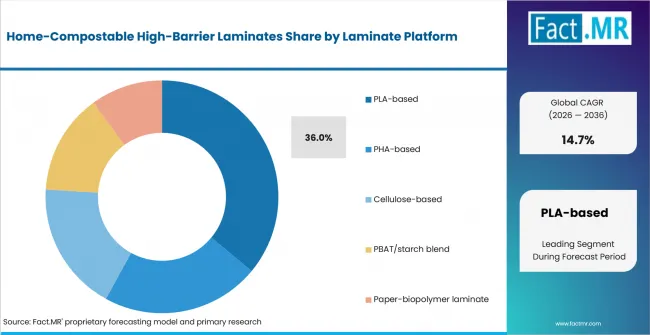
Home Compostable High Barrier Laminates Analysis By Laminate Platform | Source: Fact.MR
PLA-based structures lead because pack makers can use established film and coating routes. PHA and cellulose serve other compostable structures. PBAT/starch blends and paper-biopolymer laminates widen the design choices.
The adjacent material set includes compostable PHA film packaging materials and other compostable film platforms. Each route needs a fit between film strength, sealing and the intended disposal claim.
What leads the Barrier Level segment?
High oxygen barrier is expected to account for 31.0% share in 2026.
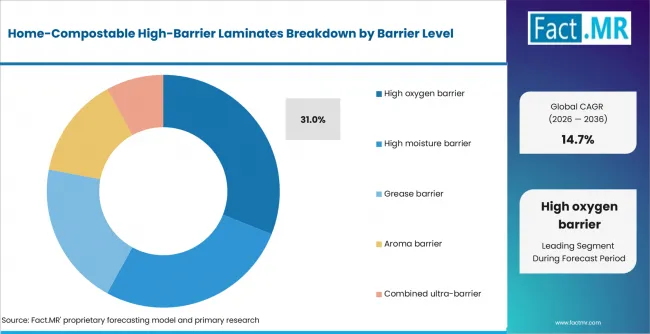
Home Compostable High Barrier Laminates Analysis By Barrier Level | Source: Fact.MR
High oxygen barrier leads where oxidation can harm food quality. Moisture, grease and aroma barriers address other pack needs. Combined ultra-barrier structures manage more than one transfer path in the same web.
BASF’s April 2026 ecovio range lists home-compostable grades for flexible packs. The company describes grease and liquid barriers. It also covers oxygen and moisture control.
How does Pack Format shape demand?
Single-serve sachets are expected to capture 29.0% share in 2026.
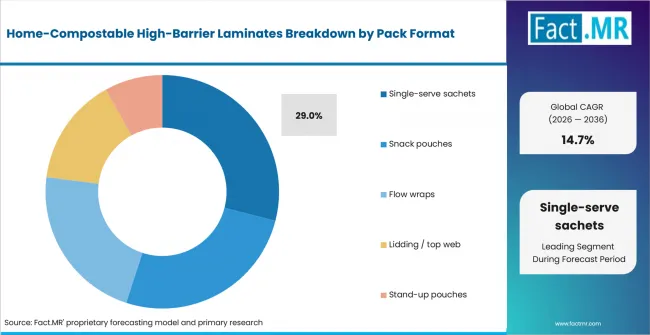
Home Compostable High Barrier Laminates Analysis By Pack Format | Source: Fact.MR
Single-serve sachets lead because small packs need tight seals and strong protection with little material. Snack pouches and flow wraps place different demands on the film. Lidding webs and stand-up pouches add other seal needs.
The same design issue appears across sustainable plastic packaging. Flexible packs need low material use while preserving seal and barrier performance.
What supports Industrial compostable within End-of-Life?
Industrial compostable is expected to hold 33.0% share in 2026.
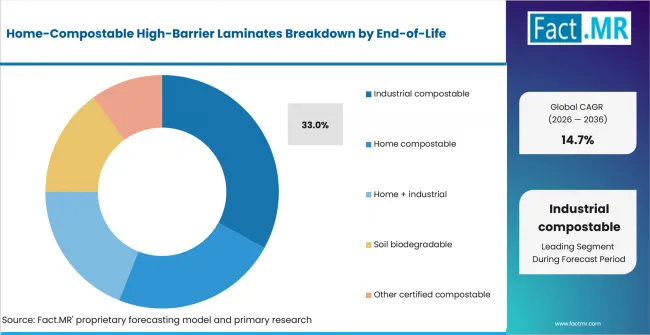
Home Compostable High Barrier Laminates Analysis By End Of Life | Source: Fact.MR
Industrial compostable leads because controlled facilities give stable composting settings. Home-compostable claims need a route that works at lower temperatures. Other certified routes remain tied to the pack design and local waste system.
End-of-life choice connects with Europe biodegradable packaging and broader compostable formats. EU packaging rules separate composting routes from wider recycling needs.
What is accelerating Home-Compostable High-Barrier Laminates Market adoption, and what is holding it back?
Barrier performance and clear end-of-life rules support adoption. Certification limits and local waste routes slow it.
Drivers Impact Analysis
| DRIVER | (~) % IMPACT ON CAGR | GEOGRAPHIC RELEVANCE | IMPACT TIMELINE |
|---|---|---|---|
| High-barrier replacement of conventional flexible laminates | +1.7% | North America, Europe, East Asia | Short term (<= 2 years) |
| Food and single-serve packaging intensity | +1.4% | Global | Medium term (2-4 years) |
| Compostability and packaging design rules | +1.1% | Europe, North America | Medium term (2-4 years) |
| New biopolymer and coating capacity | +0.8% | East Asia, North America, Europe | Long term (>= 4 years) |
Opportunity Impact Analysis
| OPPORTUNITY | (~) % IMPACT ON CAGR | GEOGRAPHIC RELEVANCE | IMPACT TIMELINE |
|---|---|---|---|
| Paper-biopolymer high-barrier structures | +1.2% | Europe, North America | Medium term (2-4 years) |
| Sachets and snack pouches with home-compostable claims | +0.9% | Global | Short term (<= 2 years) |
| Regional conversion and certification support | +0.6% | East Asia, Europe | Long term (>= 4 years) |
Restraints Impact Analysis
| RESTRAINT | (~) % IMPACT ON CAGR | GEOGRAPHIC RELEVANCE | IMPACT TIMELINE |
|---|---|---|---|
| Mismatch between compostability claim and local collection route | -0.8% | Global | Short term (<= 2 years) |
| Barrier and seal qualification across full laminate structure | -0.6% | Global | Medium term (2-4 years) |
| Cost and process changes during converter qualification | -0.4% | North America, Europe, East Asia | Long term (>= 4 years) |
Which countries are scaling Home-Compostable High-Barrier Laminates Market through 2036?
- China is expected to grow at 15.3%. This is 0.5 percentage point above the USA and Japan over the forecast period.
- The USA and Japan are each projected at 14.8%. Their demand settings differ across retail packaging and processed-food uses.
- Germany is anticipated at 14.6% as ready-meal production and packaging rules shape barrier and end-of-life needs.
- France is expected to post 14.1%, supported by a large food-factory base and active packaging-waste policy.
Similar CAGRs can create different entry settings. Food-packaging intensity, collection systems and composting claims vary by country. Full report coverage includes North America, Latin America, Western Europe, Eastern Europe, East Asia, South Asia & Pacific, Middle East & Africa.
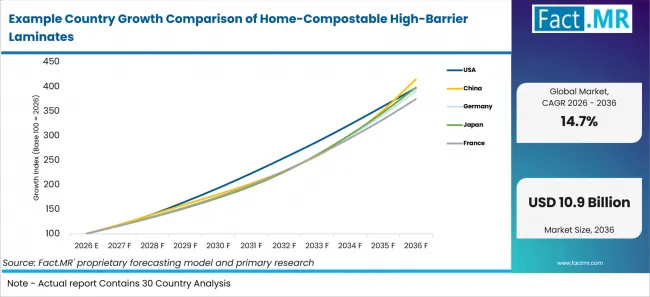
Example Country Growth Comparison Of Home Compostable High Barrier Laminates | Source: Fact.MR
| Country | CAGR (2026-2036) |
|---|---|
| China | 15.3% |
| United States | 14.8% |
| Japan | 14.8% |
| Germany | 14.6% |
| France | 14.1% |
What supports United States adoption?
14.8% CAGR, supported by food-pack demand and state packaging rules.
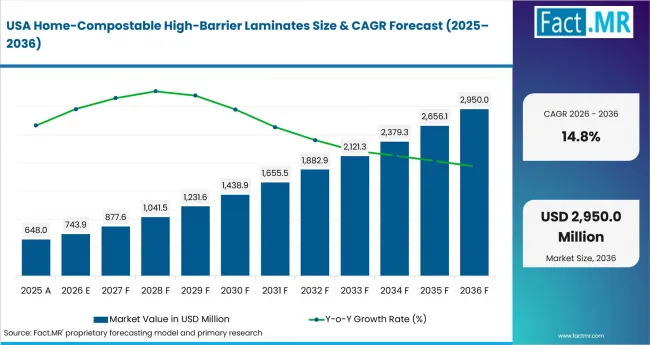
Home Compostable High Barrier Laminates Country Value Analysis | Source: Fact.MR
Food spending gives the United States a large base for barrier packs. The USDA Economic Research Service said on June 11, 2026 that U.S. Food spending reached USD 2.51 trillion in 2025. Food brands need packs that protect shelf life and keep disposal claims clear. State packaging rules are expected to make those claims more important during material trials. Flexible formats such as sachets and pouches remain a practical test area for home-compostable barrier webs. Large food runs also give pack makers room to test seal speed and film use at scale. Brands can then compare pack life, line fit and end-of-life claims before a wider switch.
What supports China adoption?
15.3% CAGR, led by online food sales and flexible-pack use.
China combines high online food activity with a broad pack-converting base. The National Bureau of Statistics said on January 20, 2026 that online retail sales of food rose 14.5% in 2025. Small parcel formats increase use of sachets and pouches. Film firms are expected to compete on seal quality and barrier stability. Local processing scale gives PLA-based and other compostable structures a route into higher-volume trials. Fast pack lines place more weight on film strength and clean seals. Local resin supply can help cut lead times when brands move from test runs to larger orders.
What supports Germany adoption?
14.6% CAGR, backed by ready-meal output and packaging rules.
Germany has a large ready-meal base that uses sealed packs with clear shelf-life needs. Destatis said on January 14, 2026 that German makers made 1.7 million tonnes of ready meals in 2024. High oxygen and moisture control can support food-pack trials where composting claims are suitable. EU packaging rules are expected to keep end-of-life design visible. Firms still need strong proof on sealing and barrier life for the finished web. Pack makers can gain from films that run on known lines and keep food fresh.
What supports Japan adoption?
14.8% CAGR, shaped by processed food and compact pack formats.
Japan has a large food-processing base and strong use of small retail packs. USDA Foreign Agricultural Service said on April 1, 2026 that the sector contracted by 3% in 2025. Its value was USD 174 billion. This setting supports demand for wraps and sachets that protect food during storage. Home-compostable barrier films are expected to gain attention where thin packs need clear disposal guidance. Pack maker support remains important because heat and humidity can change film performance. Small pack sizes make waste and seal loss easy to spot.
What supports France adoption?
14.1% CAGR, driven by food production and pack-waste policy.
France combines a large food-factory base with active pack-waste policy. Food brands use pouches and sachets that need grease or aroma control. Lidding webs often need moisture control. Compostable barrier webs are expected to be assessed beside other lower-waste routes. Clear labels and stable seals are central when a pack is designed for a home-composting claim. Food firms can use small trial runs to test print and seal quality. Strong test results can help a new web move from trial work to a wider pack plan.
Who leads the Home-Compostable High-Barrier Laminates Market?
Novamont supplies MATER-BI® biodegradable and compostable polymers for film, coating and lamination applications. TIPA specializes in compostable flexible packaging, while Futamura Chemical supplies NatureFlex™ cellulose-based compostable films. Across these suppliers, barrier performance, sealing behavior, compostability certification, printability and processing compatibility are important product-performance considerations.
Futamura’s NatureFlex™ range includes home- and industrial-compostable cellulose films with high oxygen and gas barrier properties, moisture-barrier options, printability and heat-seal grades. This provides packaging converters with an additional compostable barrier-film platform alongside other biopolymer-based systems.
Which companies are the key providers?
Companies profiled include BASF, Novamont, TIPA, and Futamura Chemical.
- BASF
- Novamont
- TIPA
- Futamura Chemical
Bibliography
- Zeballos, E., & Sinclair, W. (2026, June 11). Total U.S. food spending reached $2.51 trillion in 2025. U.S. Department of Agriculture, Economic Research Service.
- National Bureau of Statistics of China. (2026, January 20). Total retail sales of consumer goods in December 2025.
- Statistisches Bundesamt (Destatis). (2026, January 14). Produktion von Fertiggerichten binnen fünf Jahren mengenmäßig um 25,6 % gestiegen.
- U.S. Department of Agriculture, Foreign Agricultural Service. (2026, April 1). Food processing ingredients annual (Report No. JA2026-0012).
- Institut national de la statistique et des études économiques. (2026, July 21). Indicateurs macroéconomiques de l’industrie manufacturière: Données annuelles de 2010 à 2025.
- California Department of Resources Recycling and Recovery. (2026, May 1). California approves new plastic and packaging rules that put consumers first.
- BASF. (2026, April 29). New ecovio® portfolio for flexible packaging: Multiple barrier options combined with organic or paper recycling.
This Report Answers
- The report explains demand by laminate platform, barrier level, pack format and end-of-life route. Related flushable bio packaging films show how disposal route can define the film specification.
- Segment analysis explains why converters focus on oxygen control, sachet performance and material fit. The analysis also considers links with bioplastics for packaging.
- Country analysis compares the five listed markets using packaging demand, food activity, waste policy and disposal constraints.
- Competitive analysis reviews current givers across PLA, compostable biopolymers, cellulose films and finished flexible structures.
What does the Home-Compostable High-Barrier Laminates Market cover?
The market covers coated or multilayer flexible webs that combine high barrier performance with a composting route. It includes PLA, PHA, cellulose, PBAT/starch and paper-biopolymer platforms used in the listed formats.
The market boundary follows the finished laminate. Compostable polymers enter the scope when they form part of a covered high-barrier pack.
What is included in the scope?
The scope includes films, coatings and laminated webs for the listed flexible formats. The pack must control oxygen, moisture, grease or aroma and carry a defined end-of-life route.
Commercial analysis covers pack maker trials, sealing, lamination fit and end-of-life labeling.
What is excluded from the scope?
The core scope focuses on compostable high-barrier flexible packs. Standard flexible laminates, rigid serviceware and basic films sit outside the covered product set.
Recyclable mono-material films fall outside the core scope when composting is absent. Agricultural mulch films and unrelated soil-biodegradable products are treated as separate uses.
How Was the Analysis Built?
The analysis draws on 120+ sources, 35+ company portfolios, 25+ countries, and more than 20 industry interviews.
- Primary Research: Primary research includes discussions with manufacturers, service providers, technology developers, distributors, end users, and subject-matter experts. These conversations examine purchasing priorities, product adoption, operational challenges, approval requirements, competitive positioning, and the factors that influence wider market acceptance.
- Desk Research: Desk research covers government statistics, regulatory publications, company filings, trade data, technical studies, industry associations, standards, public policy, and other authoritative sources. Every source used in the analysis is documented in the bibliography.
- Market Sizing and Forecasting: Market estimates combine historical performance, demand indicators, pricing and volume trends, segment shares, company participation, country-level growth, adoption patterns, investment activity, and barriers to market expansion.
- Data Validation and Update Cycle: Findings are validated by comparing primary interviews with public data, company activity, regulatory changes, trade patterns, and industry developments. Regular updates review new product launches, capacity changes, partnerships, approvals, and shifts in commercial adoption.
What is the report’s scope and coverage?
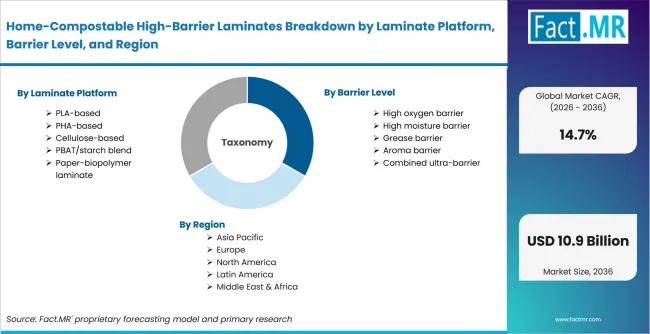
Home Compostable High Barrier Laminates Breakdown By Laminate Platform, Barrier Level, And Region | Source: Fact.MR
| Attribute | Details |
|---|---|
| Quantitative Units | USD Billion in 2026 to USD Billion by 2036 at a CAGR |
| Market Definition | Flexible laminate structures designed to combine high oxygen, moisture, grease or aroma barrier performance with a compostability route that includes home-compostable positioning within the market boundary. |
| Laminate Platform | PLA-based; PHA-based; Cellulose-based; PBAT/starch blend; Paper-biopolymer laminate |
| Barrier Level | High oxygen barrier; High moisture barrier; Grease barrier; Aroma barrier; Combined ultra-barrier |
| Pack Format | Single-serve sachets; Snack pouches; Flow wraps; Lidding / top web; Stand-up pouches |
| End-of-Life | Industrial compostable; Home compostable; Home + industrial; Soil biodegradable; Other certified compostable |
| Regions Covered | North America; Latin America; Western Europe; Eastern Europe; East Asia; South Asia & Pacific; Middle East & Africa |
| Countries Covered | United States; China; Germany; Japan; France |
| Key Companies Profiled | BASF; Novamont; TIPA; Futamura Chemical |
| Forecast Period | 2026 to 2036 |
| Approach | Hybrid top-down and bottom-up approach using flexible-packaging applications, laminate platform mix, barrier requirements, end-of-life claims, country adoption and provider portfolio review. |
How is the market segmented?
-
By Laminate Platform
- PLA-based
- PHA-based
- Cellulose-based
- PBAT/starch blend
- Paper-biopolymer laminate
-
By Barrier Level
- High oxygen barrier
- High moisture barrier
- Grease barrier
- Aroma barrier
- Combined ultra-barrier
-
By Pack Format
- Single-serve sachets
- Snack pouches
- Flow wraps
- Lidding / top web
- Stand-up pouches
-
By End-of-Life
- Industrial compostable
- Home compostable
- Home + industrial
- Soil biodegradable
- Other certified compostable
-
By Region
- North America
- Latin America
- Western Europe
- Eastern Europe
- East Asia
- South Asia & Pacific
- Middle East & Africa