- Market Value (2025): USD 3.5 Bn
- Estimated Value (2026): USD 3.8 Bn
- Forecast Value (2036): USD 10.4 Bn
- CAGR (2026-2036): 10.5%
What is the Hot-Hold Fiber Packaging Market forecast to be worth by 2036?
USD 3.8 billion in 2026 to USD 10.4 billion by 2036 at a 10.5% CAGR.
- The Hot-Hold Fiber Packaging Market was valued at USD 3.5 billion in 2025.
- Demand is projected to increase from USD 3.8 billion in 2026 to USD 10.4 billion by 2036.
- The market is forecast to record 10.5% CAGR from 2026 to 2036 as foodservice operators shift hot-meal formats toward fiber-based structures with grease and moisture control.
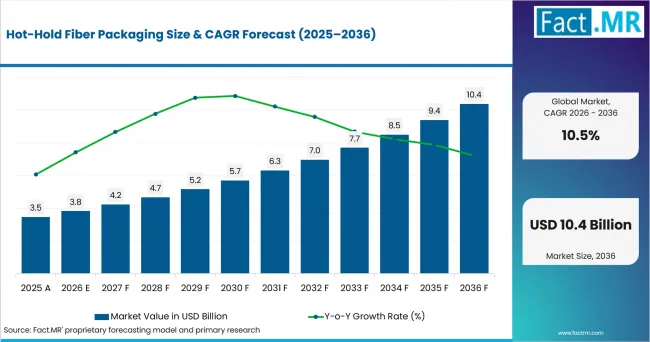
Hot Hold Fiber Packaging Value Analysis | Source: Fact.MR
What are the defining numbers behind Hot-Hold Fiber Packaging Market growth?
An absolute opportunity of USD 6.6 billion is expected between 2026 and 2036.
- Demand Drivers in the Market
- Quick-service restaurants need containers that stay rigid during holding and transport. USDA Economic Research Service reported on June 11, 2026 that inflation-adjusted U.S. food-away-from-home spending reached USD 1.41 trillion in 2025, expressed in 2025 dollars. That service-channel scale supports repeated use of foodservice packaging designed for hot meals.
- Prepared-food retailers need grease control that protects fiber strength during contact with sauces and hot oils. Development of paper barrier coatings is expected to widen coating choices for trays and bowls while keeping food-contact performance central to approval.
- Converters are expected to use stronger forming methods as meal weight and holding time increase. The wider high-performance molded fiber category shows how fiber geometry and forming consistency are becoming more important in rigid food containers.
- Packaging policy changes are expected to increase scrutiny of material recovery and food-contact chemistry. That pressure supports next-gen paper-based and fiber-based packaging where converters can document both container performance and the intended recovery route.
- Delivery formats place greater pressure on closures and sidewalls than immediate dine-in service. Designs related to home-compostable food serviceware show how disposal claims increasingly sit alongside heat retention and leak control during format selection.
- Key Segments Analyzed
- By Fiber Feedstock: Bagasse is expected to hold 33.0% share in 2026 owing to established use in molded foodservice containers.
- By Performance Treatment: Grease resistant is projected to account for 34.0% share in 2026 since hot meals place oils directly against the fiber surface.
- By Format: Trays are anticipated to capture 37.0% share in 2026 as prepared meals need a broad base that supports portioning and stable handling.
- By Application: Hot meals are estimated to represent 29.0% share in 2026 due to direct heat exposure during service and transport. Grease and moisture control remain central.
- Analyst Opinion at Fact.MR
- Shambhu Nath Jha, Principal Consultant at Fact.MR, states, “Hot-hold fiber packaging is judged first on food performance. Operators need rigidity and grease control through service. Suppliers that combine forming consistency with verified barrier performance are expected to gain wider qualification.”
- Strategic Implications
- Molded-fiber converters should benchmark wall strength and seal behavior against the meal types that create the highest heat and oil exposure. Comparable paper trays provide a useful format reference for portion stability and handling.
- Foodservice brands should separate recyclability and compostability claims so disposal instructions match the local recovery route. Adjacent biodegradable packaging material analysis reinforces the need to connect material claims with available collection systems.
- Barrier suppliers should document food-contact compliance and recovery performance for each chemistry. On January 3, 2025, the U.S. Food and Drug Administration said 35 PFAS-related food-contact notifications for grease-proofing uses were no longer effective because manufacturers or suppliers had ceased those uses. The phase-out increases the commercial relevance of non-PFAS grease-barrier formulations for paper and fiber food packaging.
- Tray and clamshell producers should test lid fit after hot filling and during transport. Work on compostable food service coatings shows why coating performance needs to be assessed together with forming strength and final container geometry.
How does the Hot-Hold Fiber Packaging Market break down by segment?
Trays lead Format at 37.0% share in 2026; Grease resistant leads Performance Treatment at 34.0% share.
Which Fiber Feedstock leads?
Bagasse is expected to hold 33.0% share in 2026.
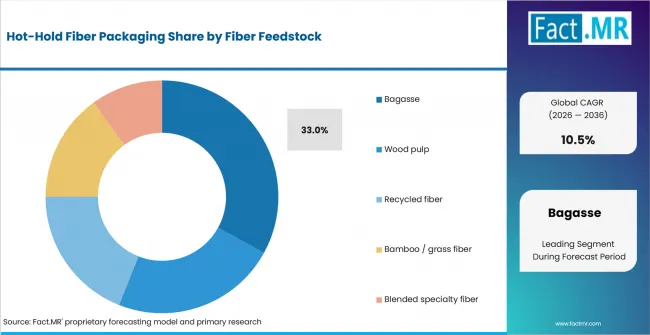
Hot Hold Fiber Packaging Analysis By Fiber Feedstock | Source: Fact.MR
Bagasse fits molded food containers because its fiber structure can be formed into rigid trays and bowls at commercial scale. The sugarcane bagasse fiber value chain provides a feedstock route tied to agricultural residues. Wood pulp supports smooth surfaces and printing. Recycled fiber serves selected structures where food-contact design permits its use. Bamboo and grass fiber broaden options for specialized forming programs.
What leads the Performance Treatment segment?
Grease resistant is projected to account for 34.0% share in 2026.
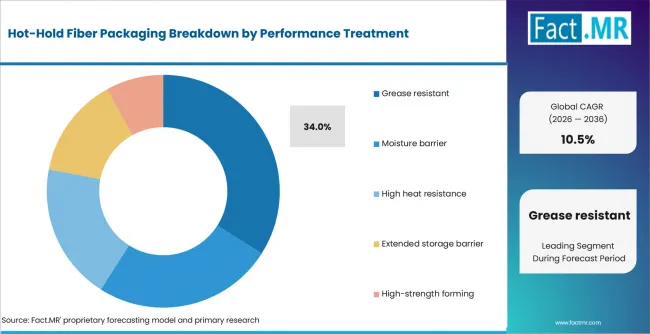
Hot Hold Fiber Packaging Analysis By Performance Treatment | Source: Fact.MR
Grease resistance is central to hot-hold packaging because oil transfer can stain the pack and reduce wall strength. Moisture barriers serve meals with sauces or condensate. High-heat treatments focus on shape retention during hot filling and reheating. Extended-storage barriers support chilled or frozen formats. High-strength forming targets heavier portions and stacked handling.
How does Format shape demand?
Trays are anticipated to capture 37.0% share in 2026.
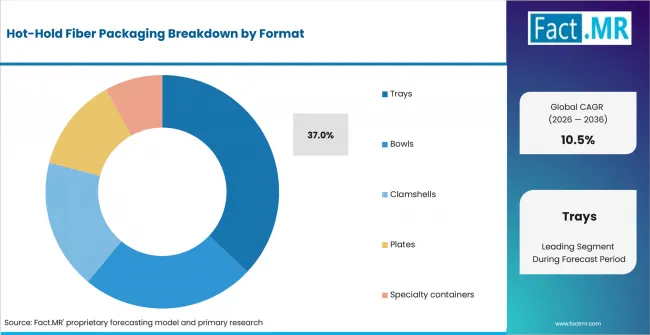
Hot Hold Fiber Packaging Analysis By Format | Source: Fact.MR
Trays suit ready meals because a broad base supports portioning and stable handling. Sabert announced in June 2025 that its food-packaging portfolio included Pulp Ultra® and Pulp Plus® molded-fiber formats made in Greenville, Texas. Bowls suit liquid-heavy meals. Clamshells combine a base and lid in one formed unit. Plates and specialty containers address immediate-service and compartmented meals.
What supports Hot meals within Application?
Hot meals are estimated to represent 29.0% share in 2026.
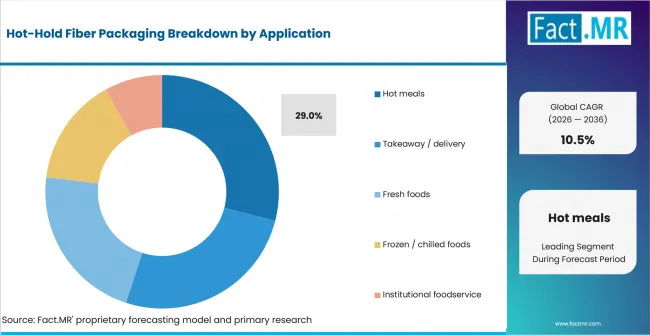
Hot Hold Fiber Packaging Analysis By Application | Source: Fact.MR
Hot meals place direct stress on fiber packs because steam and grease act on the container during service. Takeaway and delivery extend holding time. Fresh foods emphasize moisture control and presentation. Frozen and chilled foods need stability through temperature changes. Institutional foodservice values predictable handling across repeated meal programs.
What is accelerating Hot-Hold Fiber Packaging Market adoption, and what is holding it back?
Foodservice conversion and barrier improvements support adoption; coating cost and recovery complexity restrain it.
Drivers Impact Analysis
| DRIVER | (~) % IMPACT ON CAGR | GEOGRAPHIC RELEVANCE | IMPACT TIMELINE |
|---|---|---|---|
| Hot-meal takeaway and delivery volumes | +1.5% | North America, East Asia | Short term (<= 2 years) |
| Plastic-to-fiber conversion under packaging rules | +1.3% | Europe, North America | Medium term (2-4 years) |
| PFAS-free grease barrier qualification | +1.0% | USA, Europe | Short term (<= 2 years) |
| Prepared-food expansion in retail channels | +0.8% | Global | Medium term (2-4 years) |
| Higher molded-fiber forming performance | +0.6% | Global | Long term (>= 4 years) |
Source: Fact.MR analysis. Updated Sep 21, 2026
Opportunity Impact Analysis
| OPPORTUNITY | (~) % IMPACT ON CAGR | GEOGRAPHIC RELEVANCE | IMPACT TIMELINE |
|---|---|---|---|
| PFAS-free high-grease barriers | +1.1% | USA, Europe | Short term (<= 2 years) |
| Ovenable and rapid-reheat fiber formats | +0.9% | North America, Japan | Medium term (2-4 years) |
| Local bagasse and agricultural-fiber conversion | +0.7% | China, Asia | Medium term (2-4 years) |
| Institutional meal systems | +0.5% | Global | Long term (>= 4 years) |
Source: Fact.MR analysis. Updated Sep 21, 2026
Restraints Impact Analysis
| RESTRAINT | (~) % IMPACT ON CAGR | GEOGRAPHIC RELEVANCE | IMPACT TIMELINE |
|---|---|---|---|
| Barrier and coating cost | -0.8% | Global | Short term (<= 2 years) |
| Fiber softening under steam and sauce | -0.6% | Global | Short term (<= 2 years) |
| Uneven composting and recycling acceptance | -0.5% | North America, Europe, Asia | Medium term (2-4 years) |
| Food-contact qualification burden | -0.4% | USA, Europe, Japan | Medium term (2-4 years) |
Source: Fact.MR analysis. Updated Sep 21, 2026
Which countries are scaling the Hot-Hold Fiber Packaging Market through 2036?
- The country comparison spans 1.4 percentage points across the forecast period.
- France remains 0.7 percentage point above China as fiber recovery expectations meet prepared-food packaging demand.
- China remains 0.5 percentage point above the USA and Japan as catering scale supports repeated use of molded-fiber containers.
- The USA and Japan each record 10.1% CAGR with different demand mechanisms across foodservice and recovery planning.
- Germany closes the displayed range at 9.9% CAGR as foodservice activity aligns with established paper-recovery systems.
Hot-Hold Fiber Packaging Market is assessed across North America, Latin America, Western Europe, Eastern Europe, East Asia, South Asia & Pacific, and Middle East & Africa.
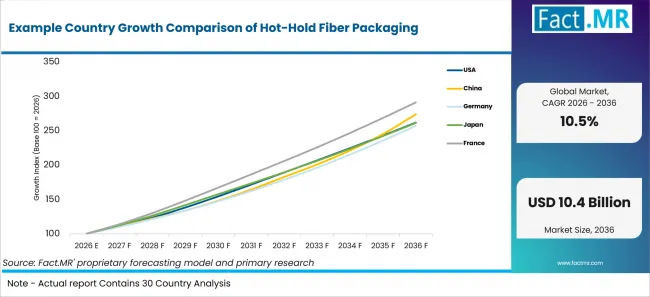
Example Country Growth Comparison Of Hot Hold Fiber Packaging | Source: Fact.MR
| Country | CAGR (2026-2036) |
|---|---|
| France | 11.3% |
| China | 10.6% |
| USA | 10.1% |
| Japan | 10.1% |
| Germany | 9.9% |
Source: Fact.MR analysis. Updated Sep 21, 2026
What supports France adoption?
11.3% CAGR, with France's broader household-packaging and paper-recovery framework providing country context.
ADEME reported in April 2026 that 6,345 kt of household packaging and graphic papers were placed on the French market in 2024; around 4,893 kt were sorted for recycling. France is forecast to record 11.3% CAGR through 2036 as hot-food formats are assessed alongside established fiber-recovery expectations. Converters that pair grease control with clear recovery instructions are expected to find stronger alignment with restaurant and takeaway use.
How is China scaling demand?
10.6% CAGR, supported by catering scale and molded-fiber conversion.
The National Bureau of Statistics of China reported in February 2026 that catering revenue reached CNY 5,798.2 billion in 2025, up 3.2% year on year. China is projected to post 10.6% CAGR by 2036 as foodservice volume supports repeated use of trays and clamshells. Bagasse-based forming is expected to benefit where converters can maintain heat tolerance and consistent shape at scale.
What supports the USA outlook?
10.1% CAGR, backed by foodservice activity and grease-barrier reformulation.
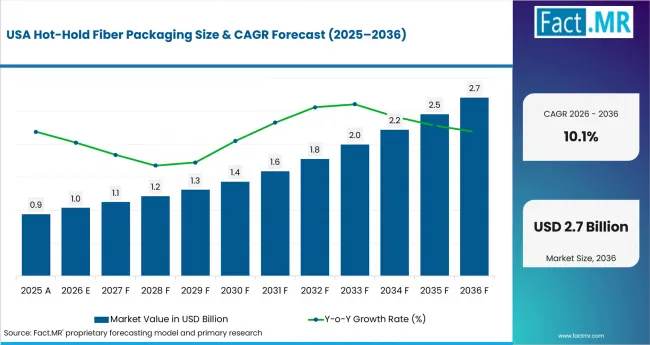
Hot Hold Fiber Packaging Country Value Analysis | Source: Fact.MR
On November 25, 2025, the U.S. Census Bureau reported that sales at food service and drinking places were up 6.7% (±1.8%) in September 2025 from September 2024. The USA is anticipated to advance at 10.1% CAGR from 2026 to 2036 as operators evaluate fiber packs for hot meals and delivery. Supplier selection is expected to focus on leak control and repeatable performance during high-volume service.
How does Japan perform?
10.1% CAGR, led by paper-container recovery planning and reheating needs.
Japan’s Ministry of the Environment reported in March 2026 that municipalities expected to separately collect 97,000 tonnes of paper containers and packaging in FY2026. Japan is estimated to record 10.1% CAGR by 2036 as fiber formats are aligned with organized collection planning. Trays and bowls that retain shape during reheating are expected to fit prepared-meal use more effectively.
What is supporting Germany adoption?
9.9% CAGR, backed by foodservice packaging recovery planning and barrier-performance needs.
Destatis reported on February 19, 2026 that German hospitality turnover in 2025 was 1.4% higher in nominal terms but 2.1% lower in real terms than in 2024; within food and beverage service, turnover rose 1.8% nominally and fell 2.2% in real terms. Germany is forecast to post 9.9% CAGR through 2036 as foodservice packaging decisions increasingly consider material recovery and barrier performance together. Fiber containers with documented grease resistance are expected to suit takeaway meals where paper-based recovery routes are familiar.
Who leads the Hot-Hold Fiber Packaging Market?
Huhtamaki participates through paperboard and molded-fiber foodservice packaging, including containers, bowls, lids, cups and other food-to-go formats. Novolex completed its combination with Pactiv Evergreen on April 1, 2025, bringing the former Pactiv Evergreen business into Novolex. Sabert supplies molded-fiber food packaging through Pulp Ultra® and Pulp Plus® formulations, while Genpak offers Harvest® Fiber molded-fiber containers and tableware suitable for hot and cold food applications.
Stora Enso supplies food-grade paperboard for cups, trays, containers and other foodservice applications and continues to support formed-fiber packaging development through its partnership with Matrix Pack.
Supplier comparison in fiber-based foodservice packaging includes heat and moisture resistance, grease-barrier performance, dimensional consistency, nesting and handling efficiency, and compatibility with relevant recovery systems. For multi-site foodservice operations, consistent dimensions, lid fit and barrier performance support repeatable handling, storage and serving requirements across locations.
Which companies are the key providers?
Profiled providers include Huhtamaki, Novolex, Sabert, Genpak, and Stora Enso.
- Huhtamaki
- Novolex (including the former Pactiv Evergreen business)
- Sabert
- Genpak
- Stora Enso
Bibliography
- Zeballos, E., & Sinclair, W. (2026, June 11). Total U.S. food spending reached $2.51 trillion in 2025. U.S. Department of Agriculture, Economic Research Service.
- U.S. Food and Drug Administration. (2025, January 3). FDA determines authorization for 35 food contact notifications related to PFAS are no longer effective.
- Sabert Corporation. (2025, June 2). Sabert invests in the future of food packaging with innovative, domestically produced solutions featured at the 2025 IDDBA Show.
- Van de Voorde, J., & Parisot, F. (2026, March). Emballages ménagers et papiers graphiques : données 2024. ADEME.
- National Bureau of Statistics of China. (2026, February 28). Statistical communiqué of the People’s Republic of China on the 2025 national economic and social development.
- U.S. Census Bureau. (2025, November 25). Advance monthly sales for retail and food services, September 2025 (Release No. CB25-158).
- Statistisches Bundesamt (Destatis). (2026, February 19). Gastgewerbeumsatz 2025 real 2,1 % niedriger als im Vorjahr [Hospitality industry turnover in 2025 decreased by 2.1% in real terms year on year].
- Novolex. (2025, April 1). Novolex and Pactiv Evergreen Inc. complete combination, creating a leading manufacturer in food, beverage and specialty packaging.
This Report Addresses
- The report assesses hot-hold fiber packaging by feedstock and performance treatment. Format and application analysis complete the product view.
- Country analysis covers France and China along with the USA and Japan. Germany completes the country comparison using the stated 2026-2036 CAGRs.
- Competitive analysis profiles Huhtamaki and Novolex alongside Sabert and Genpak. Stora Enso completes the company set.
What does the Hot-Hold Fiber Packaging Market cover?
Molded and paper-based fiber containers used to hold hot food during transport and service.
The assessment covers trays and bowls as well as clamshells and plates. Specialty containers are included when the fiber body is designed to retain function during hot-food service. Feedstocks include bagasse and wood pulp along with recycled fiber and specialty plant fibers.
What is included in the scope?
Fiber-based hot-food containers used across foodservice and retail prepared meals. Delivery and institutional dining are included.
Included products use a fiber body designed for direct food contact during hot or reheated meal service. Coverage includes molded-fiber trays and clamshells. Coated paper or board formats are included when the fiber structure remains central to the pack.
What is excluded from the scope?
Plastic and foam packaging are outside the scope. Aluminum formats and general paper packaging fall outside the defined hot-hold fiber boundary.
The scope excludes plastic clamshells and EPS food boxes. Aluminum trays and flexible pouches fall outside the defined fiber-container boundary. Ordinary paper cartons enter scope only when converted for hot prepared food. Raw pulp enters scope after forming into a foodservice packaging application.
How Was the Analysis Built?
The analysis draws on 120+ sources, 35+ company portfolios, 25+ countries, and more than 20 industry interviews.
- Primary Research: Primary research includes discussions with manufacturers, service providers, technology developers, distributors, end users, and subject-matter experts. These conversations examine purchasing priorities, product adoption, operational challenges, approval requirements, competitive positioning, and the factors that influence wider market acceptance.
- Desk Research: Desk research covers government statistics, regulatory publications, company filings, trade data, technical studies, industry associations, standards, public policy, and other authoritative sources. Every source used in the analysis is documented in the bibliography.
- Market Sizing and Forecasting: Market estimates combine historical performance, demand indicators, pricing and volume trends, segment shares, company participation, country-level growth, adoption patterns, investment activity, and barriers to market expansion.
- Data Validation and Update Cycle: Findings are validated by comparing primary interviews with public data, company activity, regulatory changes, trade patterns, and industry developments. Regular updates review new product launches, capacity changes, partnerships, approvals, and shifts in commercial adoption.
Segmentation
What is the report’s scope and coverage?
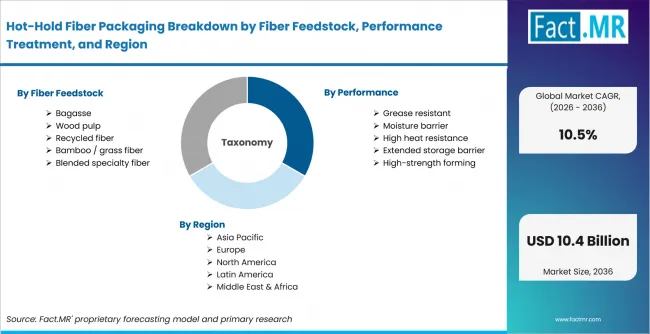
Hot Hold Fiber Packaging Breakdown By Fiber Feedstock, Performance Treatment, And Region | Source: Fact.MR
| Attribute | Details |
|---|---|
| Quantitative Units | USD billion |
| Market Definition | Fiber-based food packaging designed to retain shape and barrier performance when holding hot meals, including molded and formed-fiber trays, bowls, clamshells, plates, and specialty containers. |
| Fiber Feedstock | Bagasse; Wood pulp; Recycled fiber; Bamboo / grass fiber; Blended specialty fiber |
| Performance Treatment | Grease resistant; Moisture barrier; High heat resistance; Extended storage barrier; High-strength forming |
| Format | Trays; Bowls; Clamshells; Plates; Specialty containers |
| Application | Hot meals; Takeaway / delivery; Fresh foods; Frozen / chilled foods; Institutional foodservice |
| Regions Covered | North America; Latin America; Western Europe; Eastern Europe; East Asia; South Asia & Pacific; Middle East & Africa |
| Countries Covered | USA; China; Germany; Japan; France |
| Key Companies Profiled | Huhtamaki; Novolex; Sabert; Genpak; Stora Enso |
| Forecast Period | 2026 to 2036 |
| Approach | Hybrid top-down and bottom-up approach using foodservice activity, format mix, barrier qualification, feedstock suitability, country growth, and provider portfolio review. |
Source: Fact.MR analysis. Updated Sep 21, 2026
How is the market segmented?
-
By Fiber Feedstock
- Bagasse
- Wood pulp
- Recycled fiber
- Bamboo / grass fiber
- Blended specialty fiber
-
By Performance Treatment
- Grease resistant
- Moisture barrier
- High heat resistance
- Extended storage barrier
- High-strength forming
-
By Format
- Trays
- Bowls
- Clamshells
- Plates
- Specialty containers
-
By Application
- Hot meals
- Takeaway / delivery
- Fresh foods
- Frozen / chilled foods
- Institutional foodservice
-
By Region
- North America
- Latin America
- Western Europe
- Eastern Europe
- East Asia
- South Asia & Pacific
- Middle East & Africa
Frequently Asked Questions
How big is the Hot-Hold Fiber Packaging Market in 2026?
What is the CAGR of the Hot-Hold Fiber Packaging Market from 2026 to 2036?
Which fiber feedstock leads the Hot-Hold Fiber Packaging Market?
Which format leads the Hot-Hold Fiber Packaging Market?
Who are the leading companies in the Hot-Hold Fiber Packaging Market?
Who worked on this report


Preview the report firsthand - request a free sample
Free SampleGet the brochure for pricing and purchase details
Download PDF