- Market Value (2025): USD 2.2 Bn
- Estimated Value (2026): USD 2.4 Bn
- Forecast Value (2036): USD 6.4 Bn
- CAGR (2026-2036): 10.3%
What is the Human Liver Model Market forecast to be worth by 2036?
USD 2.4 billion in 2026 to USD 6.4 billion by 2036 at 10.3% CAGR.
- The human liver model market crossed USD 2.2 billion in 2025 as research teams kept funding liver-relevant preclinical models.
- Demand is projected to increase from USD 2.4 billion in 2026 to USD 6.4 billion by 2036.
- The market is forecast to record 10.3% CAGR from 2026 to 2036.
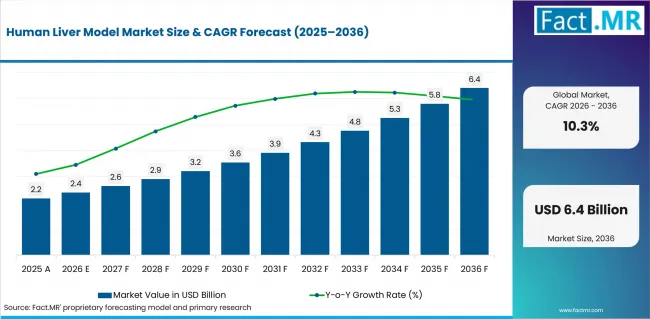
Human Liver Model Market Value Analysis | Source: Fact.MR
What are the defining numbers behind Human Liver Model Market growth?
USD 4.0 billion absolute opportunity by 2036.
- Demand Drivers in the Market
- 3D liver models are expected to gain specification priority when research teams need clearer liver behavior than flat cultures can provide.
- Drug discovery and development workflows are likely to use liver models before later studies absorb more time and budget.
- Pharmaceutical and biotechnology companies are expected to prefer suppliers that provide handling guidance and repeatable assay support.
- Organoid technology is anticipated to support adoption where buyers want structured liver-like systems for defined research questions.
- Key Segments Analyzed
- By Model Type: 3D Liver Models are expected to hold 38.1% share in 2026 since they give buyers a practical route between simple culture and complex organoid work.
- By Application: Drug Discovery & Development is projected to hold 34.4% share in 2026 with sponsors using liver models to review metabolism and toxicity earlier.
- By End User: Pharmaceutical & Biotechnology Companies are anticipated to hold 34.7% share in 2026 where internal pipelines require repeatable preclinical evidence.
- By Technology: Organoid Technology is estimated to hold 52.5% share in 2026. Structured culture systems improve relevance for selected liver studies.
- By Cell Source: Primary Human Hepatocytes are forecast to hold 42.9% share in 2026 due to their direct role in liver-relevant testing behavior.
- Analyst Opinion at Fact.MR
- Shambhu Nath Jha, Sr. Consultant at Fact.MR, opines, “Human liver model suppliers need to prove that the model reduces study risk for the buyer. Adoption is expected to depend on repeatable biology and clear handling requirements. The stronger offer explains exactly where the model changes a drug discovery decision.”
- Strategic Implications
- Pharmaceutical teams should define when 3D liver models replace simpler screening tools and when they support confirmation work.
- Suppliers can strengthen proposals by showing how model handling and assay readouts fit drug discovery routines.
- Investors should separate broad cell-culture exposure from liver-relevant systems that solve a defined testing problem.
The USA is projected to record 13.4% CAGR from 2026 to 2036, followed by Germany at 12.4% and the UK at 11.3%. Japan is forecast at 10.3%, France at 9.3%, Canada at 8.3%, and South Korea at 7.2%.
How does the Human Liver Model Market break down by segment?
3D Liver Models are expected to lead Model Type at 38.1% share in 2026. Drug Discovery & Development is projected to lead Application at 34.4% share in 2026.
Which model type dominates?
3D Liver Models are projected to account for 38.1% share in 2026.
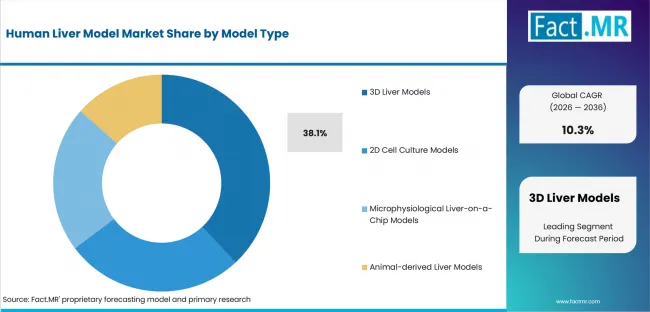
Human Liver Model Market Analysis By Model Type | Source: Fact.MR
3D liver models lead model type by giving buyers a workable step beyond flat cultures. Liver Organoids and Spheroid Models remain useful where teams need more biological depth. Bioprinted Liver Models serve studies that require shaped tissue structures.
What leads the Application segment?
Drug Discovery & Development is expected to hold 34.4% share in 2026.
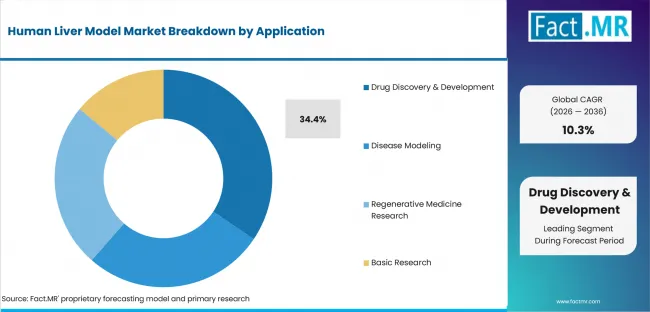
Human Liver Model Market Analysis By Application | Source: Fact.MR
Drug discovery & development leads application where sponsors need liver-relevant evidence before later testing becomes expensive. Hepatotoxicity Testing supports safety review. ADME Studies and Lead Optimization matter when model output changes candidate selection.
How does End User shape demand?
Pharmaceutical & Biotechnology Companies are anticipated to lead with 34.7% share in 2026.
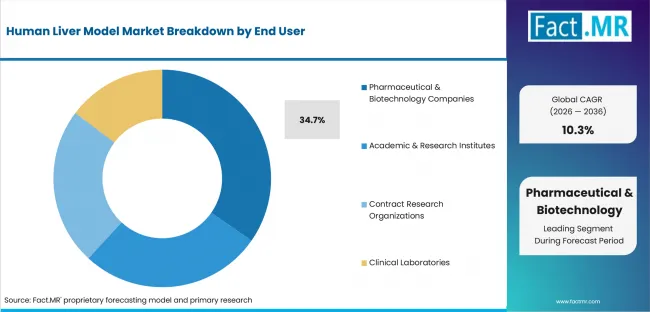
Human Liver Model Market Analysis By End User | Source: Fact.MR
Pharmaceutical & biotechnology companies form the largest buyer group since repeated preclinical decisions need clear liver evidence. Academic institutes use models for research depth. CROs and clinical laboratories matter when clients outsource study work.
What supports Organoid Technology?
Organoid Technology is estimated to lead Technology with 52.5% share in 2026.
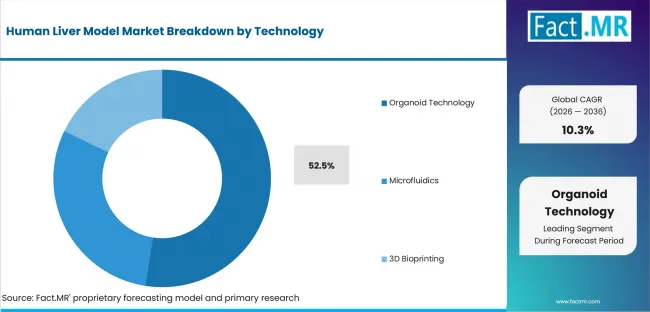
Human Liver Model Market Analysis By Technology | Source: Fact.MR
Organoid technology gains preference when buyers want structured cell systems that reflect liver behavior more closely. Microfluidics helps where flow conditions affect results. 3D Bioprinting remains selective where tissue structure is central to the study.
What supports Primary Human Hepatocytes?
Primary Human Hepatocytes are forecast to represent 42.9% share in 2026.
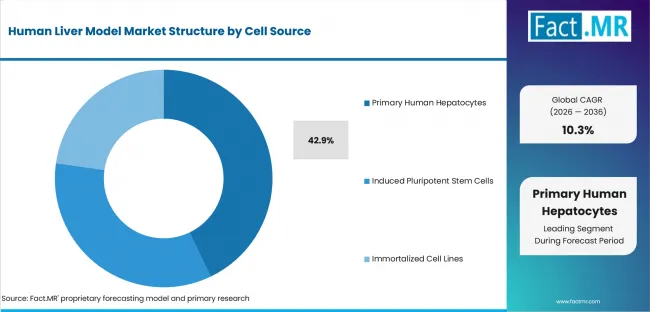
Human Liver Model Market Analysis By Cell Source | Source: Fact.MR
Primary human hepatocytes lead cell source through their close connection with liver-relevant function. Induced Pluripotent Stem Cells matter where disease modeling is needed. Immortalized Cell Lines remain useful when cost and routine handling guide the study.
What is accelerating Human Liver Model Market adoption, and what is holding it back?
Demand is expected to grow through wider use of 3D liver models in drug discovery. Adoption may be limited by inconsistent results and strict buyer validation needs.
Drivers Impact Analysis
| DRIVER | QUALITATIVE RELEVANCE | GEOGRAPHIC RELEVANCE | IMPACT TIMELINE |
|---|---|---|---|
| 3D liver model specification pull | High | Canada; France; USA | Short term (<= 2 years) |
| Drug discovery workflow use | High | France; USA; UK | Short term (<= 2 years) |
| Pharmaceutical buyer validation needs | High | Canada; Germany; Japan | Medium term (2-4 years) |
| Organoid technology uptake | High | South Korea; Japan; Germany | Medium term (2-4 years) |
| Primary hepatocyte assay familiarity | Moderate | North America and Europe | Long term (>= 4 years) |
Source: Fact.MR analysis. Updated Jul 29, 2026
- 3D liver model specification pull: Buyers are expected to prioritize models that can be written clearly into protocols. Repeatable setup reduces the risk of inconsistent study output.
- Drug discovery workflow use: Earlier liver-relevant testing is likely to improve candidate review when metabolism questions appear before later development stages. This gives sponsors a clearer study filter.
- Pharmaceutical buyer validation needs: Model providers gain preference when qualification support lowers the work needed before a study can start. Clear documentation helps procurement teams defend adoption.
Opportunity Impact Analysis
| OPPORTUNITY | QUALITATIVE RELEVANCE | GEOGRAPHIC RELEVANCE | IMPACT TIMELINE |
|---|---|---|---|
| Drug discovery workflow packages | Moderate | Canada and France | Medium term (2-4 years) |
| Organoid validation support | Moderate | South Korea and Japan | Medium term (2-4 years) |
| Liver-toxicity testing services | Moderate | USA and UK | Long term (>= 4 years) |
| Cell-source supply programs | Selective | Germany and Canada | Long term (>= 4 years) |
Source: Fact.MR analysis. Updated Jul 29, 2026
- Drug discovery workflow packages: Suppliers can bundle model access with protocol support so research teams face fewer adoption steps. This turns the model into a study-ready service.
- Organoid validation support: Buyers are expected to value documentation that explains where organoid systems improve study relevance. Clear limits make the claim easier to approve.
- Liver-toxicity testing services: Service providers can convert demand when hepatotoxicity readouts are packaged with interpretation support. The buyer receives a clearer answer instead of raw data alone.
Restraints Impact Analysis
| RESTRAINT | QUALITATIVE RELEVANCE | GEOGRAPHIC RELEVANCE | IMPACT TIMELINE |
|---|---|---|---|
| Model variability and validation burden | Moderate | Global | Short term (<= 2 years) |
| High study setup cost | Moderate | Academic and smaller labs | Short term (<= 2 years) |
| Cell-source reliability concerns | Selective | North America; Europe; East Asia | Medium term (2-4 years) |
| Slow conversion from legacy assays | Selective | Established research centers | Long term (>= 4 years) |
Source: Fact.MR analysis. Updated Jul 29, 2026
- Model variability and validation burden: Adoption slows when buyers cannot compare biological performance across suppliers or study batches. Weak proof extends review time.
- High study setup cost: Smaller teams may delay purchases when equipment and assay optimization raise the first-study cost. Training needs can make the trial harder to approve.
- Cell-source reliability concerns: Donor variation and supply timing can raise planning risk for repeat studies. Buyers may postpone wider use when continuity is unclear.
Which countries are scaling Human Liver Model Market fastest?
The country comparison is led by the USA at 13.4% CAGR, followed by Germany at 12.4% and the UK at 11.3%. Japan records 10.3%, France 9.3%, Canada 8.3%, and South Korea 7.2% from 2026 to 2036.
- The USA, Germany, and the UK record the three highest listed country CAGRs.
- Japan matches the 10.3% global market CAGR.
- France, Canada, and South Korea record 9.3%, 8.3%, and 7.2%, respectively.
The full report provides country-level CAGR analysis across North America; Latin America; Europe; East Asia; South Asia and Oceania; and the Middle East and Africa.
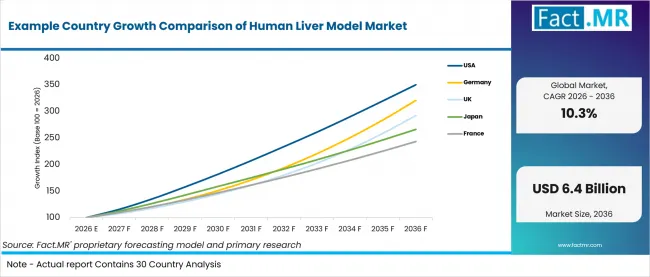
Example Country Growth Comparison Of Human Liver Model Market | Source: Fact.MR
| Country | CAGR (2026-2036) |
|---|---|
| Canada | 8.3% |
| France | 9.3% |
| South Korea | 7.2% |
| USA | 13.4% |
| UK | 11.3% |
| Germany | 12.4% |
| Japan | 10.3% |
Source: Fact.MR analysis. Updated Jul 29, 2026
What supports Canada adoption?
8.3% CAGR, supported by service coverage and distributed research demand.
Canada is projected to record 8.3% CAGR from 2026 to 2036. Buyers continue to assess suppliers on study support across dispersed research and clinical hubs. 3D Liver Models remain the clearest entry point when teams compare reliability and repeat-study support.
How is France building demand?
9.3% CAGR, driven by compliance-aware research procurement.
France is projected to record 9.3% CAGR from 2026 to 2036. Buyers continue to assess defined product positioning and compliance-ready documentation. Drug Discovery & Development leads the demand route where liver model outputs must support structured study decisions.
How is South Korea developing demand?
7.2% CAGR, backed by technology-led research programs.
South Korea is projected to record 7.2% CAGR from 2026 to 2036. Research buyers continue to assess advanced platforms and documented supplier support. Pharmaceutical & Biotechnology Companies remain central where model selection has to fit internal testing programs.
How does USA demand develop?
13.4% CAGR, supported by documentation-led purchasing.
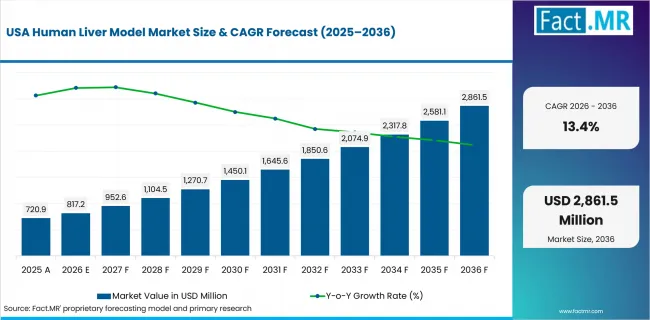
Human Liver Model Market Country Value Analysis | Source: Fact.MR
The USA is projected to record 13.4% CAGR from 2026 to 2036 as buyers assess liver models against evidence and workflow fit. Organoid Technology gains relevance where buyers need stronger disease or toxicity context.
What supports UK adoption?
11.3% CAGR, led by supplier support and research-service fit.
UK demand is expected to reflect careful supplier review and value-based procurement. Primary Human Hepatocytes remain useful where buyers want recognized liver behavior before adopting more complex systems.
How is Germany converting demand?
12.4% CAGR, shaped by validation discipline and institutional purchasing.
Germany is projected to record 12.4% CAGR from 2026 to 2036, with institutional buyers continuing to scrutinize reproducibility and supplier evidence. 3D Liver Models are expected to gain demand when performance proof fits strict internal review routines.
What shapes Japan’s uptake?
10.3% CAGR, supported by quality-led procurement and reliable handling needs.
Japan is forecast to remain close to Germany as buyers place weight on quality and fit with compact research workflows. Drug Discovery & Development is expected to remain the main use case for careful early-stage review.
Who leads the Human Liver Model Market?
Emulate, Inc. and MIMETAS show the clearest direct relevance. CN Bio Innovations and InSphero AG widen the provider set through liver model and microtissue capabilities.
Emulate supports organ-on-chip research, while MIMETAS adds microfluidic tissue models. CN Bio Innovations provides liver-on-a-chip systems, and InSphero offers liver microtissues. Competition will depend on reproducibility, validation support and reliable cell sources. Providers offering clear application guidance may gain stronger demand from pharmaceutical companies and preclinical CROs.
Which companies are the key providers?
Key companies include Emulate, Inc.; MIMETAS; CN Bio Innovations; InSphero AG; VivoSim Labs, Inc.; CELLINK; and Lonza Group.
- Emulate, Inc.
- MIMETAS
- CN Bio Innovations
- InSphero AG
- VivoSim Labs, Inc.
- CELLINK
- Lonza Group
Bibliography
- U.S. Food and Drug Administration. (2024). Microphysiological systems for the evaluation of drug-induced liver injury.
- National Institutes of Health. (2024). Comparison of iPSC-derived liver organoids and other liver cell models using proteomic analysis and CYP450 assays.
- CN Bio Innovations Limited. (2024, January 23). CN Bio and Altis Biosystems partner to develop next-generation human gut/liver in vitro model for advanced ADME studies.
- InSphero AG. (2024, October 14). InSphero and FDA’s NCTR publish the largest benchmarking study demonstrating early detection of liver toxicity using 3D liver microtissues.
This Report Answers
- The report provides strategic intelligence on the Human Liver Model Market across Model Type and Application choices that shape drug discovery model use.
- Segment analysis covers 3D Liver Models and Drug Discovery & Development as the share leaders within the 2026 market.
- Country outlook evaluates Canada and France alongside South Korea. The USA; UK; Germany; and Japan complete the growth comparison.
- Competitive analysis profiles Emulate, Inc. alongside MIMETAS and CN Bio Innovations. InSphero AG; VivoSim Labs, Inc.; CELLINK; and Lonza Group complete the provider set.
- Technology assessment covers Organoid Technology and Microfluidics. Liver-on-a-chip and Perfusion Systems complete the technology view alongside 3D Bioprinting.
What does the Human Liver Model Market cover?
Human liver models are used to support liver-relevant testing where model behavior affects drug discovery and toxicology review. Disease research decisions are included when liver-model output guides the study.
The Human Liver Model Market covers commercial systems and services used for 3D liver models; liver organoids; spheroid models; and liver-on-a-chip formats. Coverage extends to hepatotoxicity testing and ADME studies. Regenerative medicine research is included when the model supports liver-relevant study output.
What is included in the scope?
Human liver model systems are used across pharmaceutical and biotechnology companies. Academic institutes, contract research organizations and research hospitals are included.
The scope includes Model Type and Application alongside End User, Technology and Cell Source. Coverage spans 3D Liver Models; Liver Organoids; Spheroid Models; and Bioprinted Liver Models. It includes Drug Discovery & Development and Hepatotoxicity Testing where human liver model output changes the study decision.
What is excluded from the scope?
General laboratory tools and unrelated clinical products remain outside the scope of this market.
The scope excludes products that do not address liver-relevant model use. Broad research equipment is excluded unless demand depends on a human liver model workflow. Company revenue without a clear connection to liver model use is excluded.
How Was the Analysis Built?
The analysis draws on 120+ sources and 35+ company portfolios. It also covers 25+ countries and more than 20 industry interviews.
- Primary Research: Primary research includes discussions with manufacturers and service providers. It also includes technology developers; distributors; end users; procurement teams; and subject-matter experts. These conversations examine purchasing priorities and product adoption. They also cover operational challenges; approval requirements; competitive positioning; and factors that influence wider market acceptance.
- Desk Research: Desk research covers government statistics and regulatory publications. It also covers company filings; trade data; technical studies; industry associations; standards; public policy; and other authoritative sources. Every source used in the analysis is documented in the bibliography.
- Market Sizing and Forecasting: Market estimates combine historical performance and demand indicators. They also review pricing and volume trends; segment shares; company participation; country-level growth; adoption patterns; investment activity; and barriers to market expansion.
- Data Validation and Update Cycle: Findings are validated by comparing primary interviews with public data. The review also checks company activity; regulatory changes; trade patterns; and industry developments. Regular updates review new product launches and capacity changes. They also cover partnerships; approvals; procurement trends; and shifts in commercial adoption.
Segmentation
What is the report’s scope and coverage?
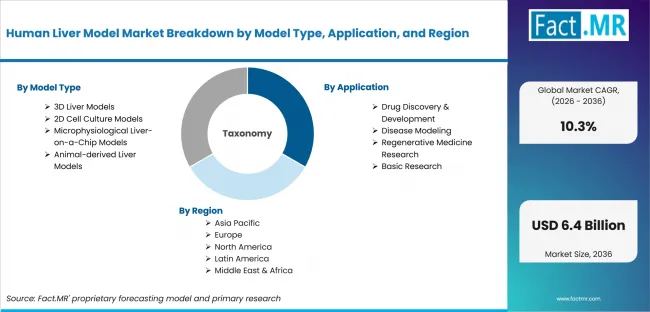
Human Liver Model Market Breakdown By Model Type, Application, And Region | Source: Fact.MR
| Attribute | Details |
|---|---|
| Quantitative Units | USD billion in 2026 to USD billion by 2036 at CAGR |
| Market Definition | Commercial human liver model systems and related services used for drug discovery; hepatotoxicity testing; ADME studies; disease modeling; and liver-relevant research workflows |
| Model Type | 3D Liver Models; Liver Organoids; Spheroid Models; Bioprinted Liver Models; 2D Cell Culture Models; Primary Hepatocyte Models; Immortalized Cell Line Models; Co-culture Models; Microphysiological Liver-on-a-Chip Models; Single-organ Chip Models; Multi-organ Chip Models; Microfluidic Liver Systems; Animal-derived Liver Models; Mouse Liver Models; Rat Liver Models; Humanized Animal Models |
| Application | Drug Discovery & Development; Hepatotoxicity Testing; ADME Studies; Lead Optimization; Disease Modeling; Fatty Liver Disease Models; Hepatitis Models; Liver Fibrosis Models; Regenerative Medicine Research; Cell Therapy Research; Tissue Engineering; Stem Cell Research; Basic Research; Liver Biology Studies; Gene Function Analysis; Metabolic Research |
| End User | Pharmaceutical & Biotechnology Companies; Pharmaceutical Companies; Biotechnology Companies; Cell Therapy Developers; Academic & Research Institutes; Universities; Government Research Institutes; Non-profit Research Centers; Contract Research Organizations; Preclinical CROs; Drug Discovery CROs; Toxicology Testing CROs; Clinical Laboratories; Reference Laboratories; Research Hospitals; Translational Research Centers |
| Technology | Organoid Technology; Stem Cell-derived Organoids; Patient-derived Organoids; Gene-edited Organoids; Microfluidics; Liver-on-a-chip; Perfusion Systems; Multi-organ Chips; 3D Bioprinting; Extrusion Bioprinting; Inkjet Bioprinting; Laser-assisted Bioprinting |
| Cell Source | Primary Human Hepatocytes; Fresh Hepatocytes; Cryopreserved Hepatocytes; Donor-derived Hepatocytes; Induced Pluripotent Stem Cells; Human iPSCs; Disease-specific iPSCs; Gene-edited iPSCs; Immortalized Cell Lines; HepG2 Cells; HepaRG Cells; Other Hepatic Cell Lines |
| Regions Covered | North America; Latin America; Europe; East Asia; South Asia and Oceania; Middle East and Africa |
| Countries Covered | Canada; France; South Korea; USA; UK; Germany; Japan |
| Key Companies Profiled | Emulate, Inc.; MIMETAS; CN Bio Innovations; InSphero AG; VivoSim Labs, Inc.; CELLINK; Lonza Group |
| Forecast Period | 2026 to 2036 |
| Approach | Hybrid top-down and bottom-up approach using demand indicators; segment mix; country growth; company participation; drug discovery use; hepatotoxicity testing needs; organoid technology adoption; primary hepatocyte workflows; service coverage; validation burden; and supplier portfolio review |
Source: Fact.MR analysis. Updated Jul 29, 2026
How is the market segmented?
-
By Model Type:
- 3D Liver Models
- Liver Organoids
- Spheroid Models
- Bioprinted Liver Models
- 2D Cell Culture Models
- Primary Hepatocyte Models
- Immortalized Cell Line Models
- Co-culture Models
- Microphysiological Liver-on-a-Chip Models
- Single-organ Chip Models
- Multi-organ Chip Models
- Microfluidic Liver Systems
- Animal-derived Liver Models
- Mouse Liver Models
- Rat Liver Models
- Humanized Animal Models
-
By Application:
- Drug Discovery & Development
- Hepatotoxicity Testing
- ADME Studies
- Lead Optimization
- Disease Modeling
- Fatty Liver Disease Models
- Hepatitis Models
- Liver Fibrosis Models
- Regenerative Medicine Research
- Cell Therapy Research
- Tissue Engineering
- Stem Cell Research
- Basic Research
- Liver Biology Studies
- Gene Function Analysis
- Metabolic Research
-
By End User:
- Pharmaceutical & Biotechnology Companies
- Pharmaceutical Companies
- Biotechnology Companies
- Cell Therapy Developers
- Academic & Research Institutes
- Universities
- Government Research Institutes
- Non-profit Research Centers
- Contract Research Organizations
- Preclinical CROs
- Drug Discovery CROs
- Toxicology Testing CROs
- Clinical Laboratories
- Reference Laboratories
- Research Hospitals
- Translational Research Centers
-
By Technology:
- Organoid Technology
- Stem Cell-derived Organoids
- Patient-derived Organoids
- Gene-edited Organoids
- Microfluidics
- Liver-on-a-chip
- Perfusion Systems
- Multi-organ Chips
- 3D Bioprinting
- Extrusion Bioprinting
- Inkjet Bioprinting
- Laser-assisted Bioprinting
-
By Cell Source:
- Primary Human Hepatocytes
- Fresh Hepatocytes
- Cryopreserved Hepatocytes
- Donor-derived Hepatocytes
- Induced Pluripotent Stem Cells
- Human iPSCs
- Disease-specific iPSCs
- Gene-edited iPSCs
- Immortalized Cell Lines
- HepG2 Cells
- HepaRG Cells
- Other Hepatic Cell Lines
-
By Region:
- North America
- Latin America
- Europe
- East Asia
- South Asia and Oceania
- Middle East and Africa
Frequently Asked Questions
Which Model Type leads the market?
Which Application leads the market?
Which End User category leads the market?
Which Technology leads the market?
Which Cell Source leads the market?
Which country records the highest listed CAGR?
What is the primary driver in this market?
What is the main restraint?
Why do pharmaceutical and biotechnology companies lead demand?
Who worked on this report


Preview the report firsthand - request a free sample
Free SampleGet the brochure for pricing and purchase details
Download PDF