- Market Value (2025): USD 38.5 Mn
- Estimated Value (2026): USD 45.0 Mn
- Forecast Value (2036): USD 215.0 Mn
- CAGR (2026-2036): 16.9%
What is the Hydrogen-Oxygen Infusion Skid Market forecast to be worth by 2036?
USD 45.0 million in 2026 to USD 215.0 million by 2036, at 16.9% CAGR from 2026 to 2036.
- The market reached approximately USD 38.5 million in 2025, with early demand concentrated in pilot units and ozone-oxygen treatment packages.
- Revenue is projected to increase from USD 45.0 million in 2026 to USD 215.0 million by 2036 as packaged contacting systems replace site-assembled gas-transfer loops.
- The market is forecast to record a 16.9% CAGR from 2026 to 2036. Pilot-to-commercial conversion and tighter oxygen control are expected to support this pace.
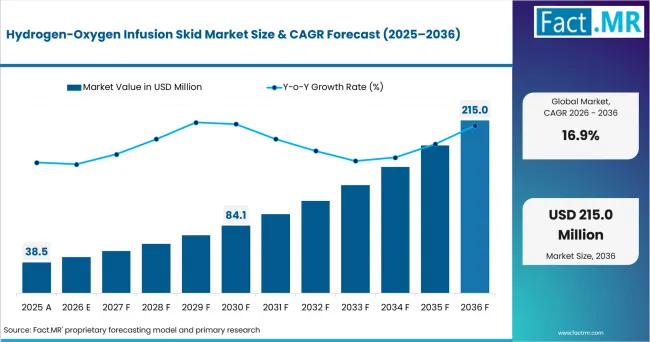
Hydrogen Oxygen Infusion Skid Market Value Analysis | Source: Fact.MR
What are the defining numbers behind Hydrogen-Oxygen Infusion Skid Market growth?
USD 170.0 million absolute opportunity by 2036, led by Oxygen infusion and Venturi injector within their respective segments.
- Demand Drivers in the Market
- Industrial wastewater plants often use compact systems that combine oxygen or ozone supply with pumps and testing equipment on one frame.
- In aquaculture, oxygen levels must adjust as fish volume and water temperature change, without constant manual control.
- Process-water plants rely on steady gas mixing when treatment limits are part of normal plant procedures.
- Engineering companies benefit from fewer separate site connections because gas supply, alarms, and controls become harder to coordinate after installation starts.
- Key Segments Analyzed
- By Gas Infusion Route: Oxygen infusion is expected to hold 31.0% share in 2026 because dissolved oxygen is a direct operating variable in biological treatment and aquaculture.
- By Contacting Technology: Venturi injector is projected to account for 29.0% share in 2026 owing to compact suction and gas contact without moving parts at the injector.
- By Skid Configuration: Frame-mounted skid is anticipated to capture 36.0% share in 2026 as it gives plant staff shop assembly while keeping service points accessible.
- By Application: Industrial wastewater is estimated to represent 31.0% share in 2026 attributable to variable loads that need controlled oxygenation and contact dosing.
- By Automation Level: PLC controlled is forecast to account for 42.0% share in 2026 because gas dosing requires interlocks and repeatable startup logic.
- Analyst Opinion at Fact.MR
- Shambhu Nath Jha states as Senior Analyst at Fact.MR: “Hydrogen-oxygen infusion skid projects are expected to be judged by how safely and steadily the gas is transferred into the water. Gas generation capacity alone is not enough. Skid manufacturers are expected to show clear sensor placement, safe operating controls, and strong protection for plant staff in one complete system.”
- Strategic Implications
- Industrial users need to define the dissolved-gas target and water chemistry range before choosing an injector or contactor.
- Skid builders reduce sales risk when pilot packages use the same control sequence as the full installation, so field data translates into scale-up sizing.
- Injector and mixer manufacturers gain credibility by publishing performance maps across pressure and liquid flow to support accurate recirculation design.
- EPC firms need early decisions on gas detection and ventilation because those items change skid layout and cost.
Spartan environmental technologies describes skid-mounted ozone water-treatment systems that use oxygen supply and ozone generation. Its skid page also describes booster pumps and venturi injection. The configuration places gas generation and oxygen supply inside one package. It also keeps pumping and contacting inside the treatment skid.
Germany is expected to register a 20.0% CAGR from 2026 to 2036 with support from engineered water-treatment skids and strict process control. The United States is projected to grow at an 18.3% CAGR through 2036. The Netherlands is anticipated to post an 18.0% CAGR by 2036 on water-technology integration and horticultural treatment systems. Denmark is estimated to advance at a 17.2% CAGR from 2026 to 2036 as recirculating aquaculture increases oxygen-control needs. Japan is forecast to record a 16.6% CAGR through 2036 because compact automation favors controlled contacting.
How does the Hydrogen-Oxygen Infusion Skid Market break down by segment?
The leading shares are oxygen infusion at 31.0% by Gas Infusion Route and Venturi injector at 29.0% by Contacting Technology.
Which infusion route dominates?
Oxygen infusion holds 31.0% share in 2026.
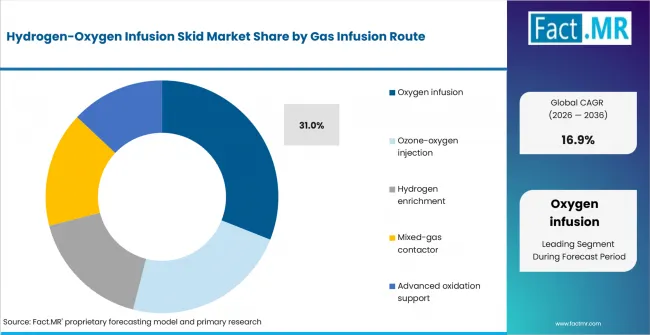
Hydrogen Oxygen Infusion Skid Market Analysis By Gas Infusion Route | Source: Fact.MR
Treatment tanks and aquaculture basins depend on steady oxygen levels, which keeps oxygen infusion at the front of this segment. The system helps plant operators respond when water quality, flow, or fish volume changes. Its wide use across daily treatment work also supports repeat demand for complete skid systems.
What leads the Contacting Technology segment?
Venturi Injector captures 29.0% share in 2026.
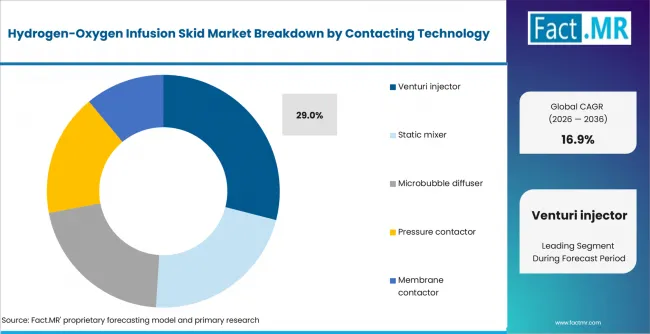
Hydrogen Oxygen Infusion Skid Market Analysis By Contacting Technology | Source: Fact.MR
A Venturi Injector draws gas into flowing water and starts bubble formation without requiring several separate units. This makes the setup easier to install and manage. Its compact size also suits plants where space is limited and gas must be mixed directly inside an existing pipe system.
How does Configuration shape demand?
Frame-Mounted Skid holds 36.0% share in 2026.
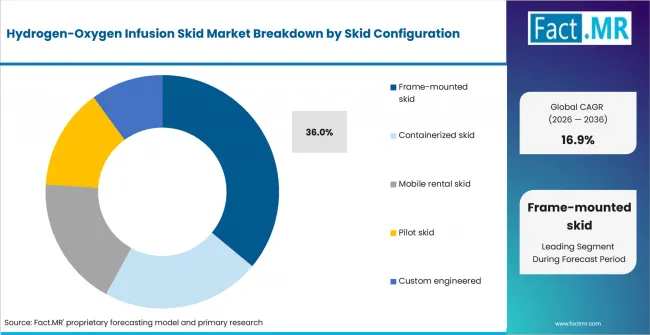
Hydrogen Oxygen Infusion Skid Market Analysis By Skid Configuration | Source: Fact.MR
Many plants prefer a Frame-Mounted Skid because the main parts arrive together on one open frame. Staff can reach pumps, valves, and controls without removing panels or entering a container. This layout reduces installation work while keeping routine checks, cleaning, and repairs simple at the operating site.
What supports Industrial Wastewater within Application?
Industrial Wastewater accounts for 31.0% share in 2026.
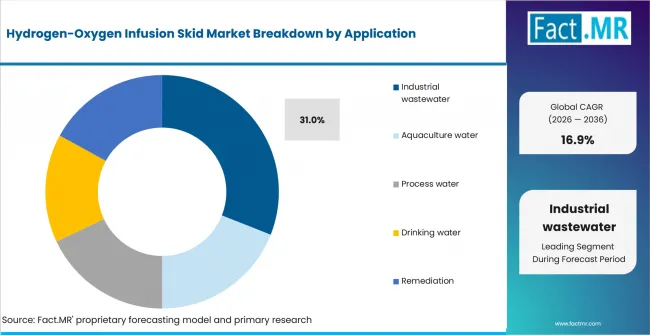
Hydrogen Oxygen Infusion Skid Market Analysis By Application | Source: Fact.MR
Wastewater conditions can change by plant, shift, and production process, so gas delivery must be adjusted with care. Skid systems give operators closer control over oxygen or ozone treatment. They also help plants respond to changing flow and contamination levels without rebuilding the full treatment setup each time.
Which Control System leads?
PLC-Controlled Skids lead with 42.0% share in 2026.
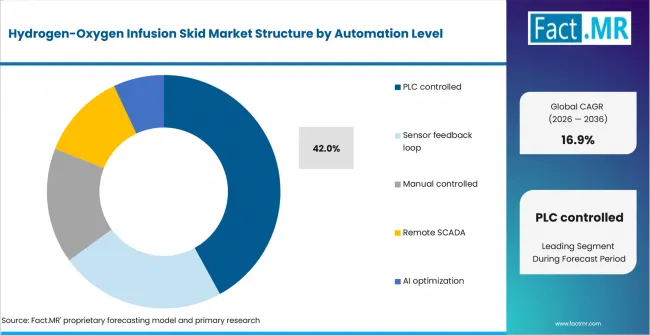
Hydrogen Oxygen Infusion Skid Market Analysis By Automation Level | Source: Fact.MR
PLC-Controlled Skids bring pump operation, gas flow, alarms, and shutdown steps into one control system. This reduces repeated manual checks and keeps the operating process more consistent. The system can also stop or adjust equipment when readings move outside the set limits, which supports safer daily operation.
What is accelerating Hydrogen-Oxygen Infusion Skid Market adoption, and what is holding it back?
Factory-integrated skids are expected to accelerate adoption because they reduce project interfaces and make pilot results easier to scale. Uptake is anticipated to be restrained by mass-transfer uncertainty and gas safety scope. Energy cost is expected to remain a separate check during system sizing.
Drivers Impact Analysis
| DRIVER | (~) % IMPACT ON CAGR | GEOGRAPHIC RELEVANCE | IMPACT TIMELINE |
|---|---|---|---|
| Industrial oxidation demand | +2.5% | Germany, the Netherlands, and United States | Short term (<= 2 years) |
| Aquaculture oxygen control | +2.2% | Asia-Pacific | Medium term (2-4 years) |
| Pilot-led procurement | +1.9% | Global | Short term (<= 2 years) |
| Automation upgrades | +1.5% | Europe and North America | Medium term (2-4 years) |
| Advanced oxidation support | +1.2% | Water-stressed regions | Long term (>= 4 years) |
Source: Fact.MR analysis. Updated Jul 17, 2026
- Industrial oxidation demand: Industrial water operators are expected to use oxygen and ozone packages when treatment guarantees cover generation and control logic together.
- Aquaculture oxygen control: Recirculating systems are projected to require tighter dissolved-oxygen response as biomass and temperature move through each day.
- Pilot-led procurement: Pilot skids are anticipated to support purchase decisions because operators measure transfer rate and energy use on actual water.
Opportunity Impact Analysis
| OPPORTUNITY | (~) % IMPACT ON CAGR | GEOGRAPHIC RELEVANCE | IMPACT TIMELINE |
|---|---|---|---|
| Containerized rapid deployment | +1.4% | Middle East and Asia-Pacific | Short term (<= 2 years) |
| Transfer-efficiency guarantees | +1.2% | Global | Medium term (2-4 years) |
| Remote operating services | +1.0% | North America and Europe | Long term (>= 4 years) |
| Hydrogen facility oxygen use | +0.8% | Germany, Japan, and United States | Long term (>= 4 years) |
Source: Fact.MR analysis. Updated Jul 17, 2026
- Containerized rapid deployment: Containerized skids are expected to fit fast-track sites where weather protection and controlled access are needed together.
- Transfer-efficiency guarantees: Skid manufacturers are projected to differentiate when they define the water envelope and guarantee a measurable dissolved-gas result inside that boundary.
- Remote operating services: Remote review of gas rate and alarms is anticipated to improve uptime when plant control authority remains clear.
Restraints Impact Analysis
| RESTRAINT | (~) % IMPACT ON CAGR | GEOGRAPHIC RELEVANCE | IMPACT TIMELINE |
|---|---|---|---|
| Mass-transfer variability | -1.2% | Global | Short term (<= 2 years) |
| Gas safety requirements | -0.9% | Global | Short term (<= 2 years) |
| Energy consumption | -0.8% | High-cost power markets | Medium term (2-4 years) |
| Sensor maintenance | -0.6% | Industrial and aquaculture sites | Long term (>= 4 years) |
Source: Fact.MR analysis. Updated Jul 17, 2026
- Mass-transfer variability: Transfer efficiency is expected to differ by pressure and chemistry, so clean-water testing needs careful translation.
- Gas safety requirements: Hydrogen and ozone systems are anticipated to need detection and ventilation that raise engineering time.
- Energy consumption: Gas generation and water recirculation are expected to affect operating cost if hydraulic design is not matched to the target transfer rate.
Where are hydrogen-oxygen infusion skids gaining ground?
Germany 20.0%; United States 18.3%; Netherlands 18.0%; Denmark 17.2%; Japan 16.6%.
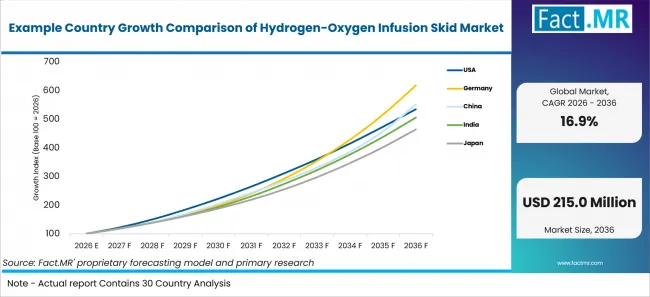
Example Country Growth Comparison Of Hydrogen Oxygen Infusion Skid Market | Source: Fact.MR
| COUNTRY | CAGR (2026 to 2036) |
|---|---|
| Germany | 20.0% |
| United States | 18.3% |
| Netherlands | 18.0% |
| Denmark | 17.2% |
| Japan | 16.6% |
Source: Fact.MR analysis. Updated Jul 17, 2026
What is driving Germany’s growth through 2036?
20.0% CAGR, supported by skid manufacturing and industrial water treatment.
Germany has a strong base of equipment makers and process plants that use advanced water-treatment systems. Buyers place close attention on safe gas handling, clear control steps, and reliable transfer rates before approving new equipment. The market is expected to record a 20.0% CAGR from 2026 to 2036 as plants seek complete systems that reduce installation and start-up problems.
How is the United States market expected to develop through 2036?
18.3% CAGR, driven by wastewater treatment and clean-up projects.
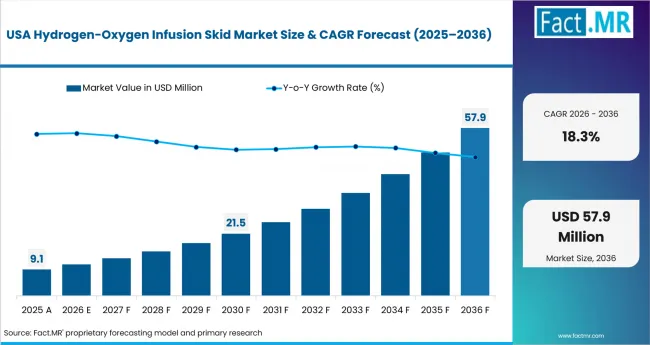
Hydrogen Oxygen Infusion Skid Market Country Value Analysis | Source: Fact.MR
The United States is seeing greater use of gas-infusion skids in industrial wastewater plants and site clean-up work. Rental and pilot units allow operators to test performance before buying a permanent system. Demand is projected to rise at an 18.3% CAGR from 2026 to 2036 as remote support and ready-to-install units fit existing plant operations.
What supports the Netherlands market?
18.0% CAGR, backed by water-technology companies and greenhouse farming.
The Netherlands has an established network of companies that design and install water-treatment equipment for several industries. Greenhouse farms also use controlled water systems where steady gas levels support crop production. The market is anticipated to grow at an 18.0% CAGR through 2036 as specialist engineering companies bring complete infusion systems to different customers.
Why is Denmark showing interest in gas-infusion skids?
17.2% CAGR, supported by fish farming and lower-energy water treatment.
Denmark’s fish farms depend on steady oxygen levels to protect fish health in recirculating water systems. Operators also look for equipment that limits pumping energy and fits within smaller sites. Demand is estimated to expand at a 17.2% CAGR from 2026 to 2036 as compact skids offer better control without adding large treatment units.
What supports hydrogen-oxygen infusion skid demand in Japan?
16.6% CAGR, driven by compact equipment and dependable controls.
Japanese water-treatment sites often have limited space and place strong importance on reliable daily operation. Compact skid systems suit these conditions by bringing gas handling, pumps, sensors, and controls into one unit. The market is forecast to record a 16.6% CAGR from 2026 to 2036 where better gas use and smaller equipment size support the higher purchase cost.
Who leads the Hydrogen-Oxygen Infusion Skid Market?
Spartan E
nvironmental Technologies and Herco Wassertechnik compete across integrated skid packages. Mazzei Injector Company adds venturi depth while Xylem add water-treatment system reach.
Competition includes companies that build complete skid systems and companies that supply key parts. Spartan Environmental Technologies and Herco Wassertechnik offer ready-built water-treatment units. Mazzei Injector Company supplies venturi injectors used to mix gas into water. Xylem add ozone systems and wider service support for water-treatment projects.
Spartan Environmental Technologies fits this market because its SPARTOX and custom ozone units combine ozone generation with venturi injection on one skid. This brings gas production and gas mixing into a single system.
Herco Wassertechnik offers modular water-treatment units that arrive pre-assembled. The company also supplies equipment for green hydrogen projects, which links its work to gas-based treatment systems.
Mazzei Injector Company makes venturi injectors that use pressure differences to draw gas into water. The injectors have no moving parts and include internal mixing sections. These products are widely used in venturi-based and side-stream gas mixing systems
Which companies are the key providers?
The company set includes Spartan Environmental Technologies and Herco Wassertechnik. It also includes Mazzei Injector Company and Xylem.
- Spartan Environmental Technologies
- Herco Wassertechnik
- Mazzei Injector Company
- Xylem
Bibliography
- European Environment Agency. (2025, June 4). Water savings for a water-resilient Europe.
- Department for Environment, Food & Rural Affairs. (2026, January). A new vision for water (CP 1490). UK Government.
- European Commission, Directorate-General for Environment. (2025, June 3). European Water Resilience Strategy.
- U.S. Environmental Protection Agency. (2026, April 16). Water Reuse Action Plan 2.0.
This Report Addresses
- The report quantifies the 2025 and the global revenue forecast from 2026 to 2036.
- It compares Germany and the United States through country-level growth assumptions. The Netherlands and Denmark are covered with Japan in the same country set.
- It assesses Spartan Environmental Technologies and Herco Wassertechnik. Mazzei Injector Company and Xylem are evaluated by direct product relevance.
- It evaluates venturi and static-mixer choices across closed-pipe contact routes. Microbubble diffuser and pressure-contactor demand are separated from membrane-contactor demand.
- It examines industrial wastewater and aquaculture applications across different operating conditions. Process water and drinking water are handled as distinct use cases. Remediation completes the application view where projects need defined contact dosing.
- It tests the forecast against pilot conversion and automation adoption. Gas-transfer economics and gas safety requirements are included in the same forecast review.
What does the Hydrogen-Oxygen Infusion Skid Market cover?
The study follows integrated water-gas infusion systems from pilot and rental deployment through permanent automated skid installation.
Revenue includes the functional skid and mounted process components. Integrated instruments and gas-handling equipment are counted when sold as part of the system. Pilot and mobile units are valued separately from permanent frame and container packages.
The analysis segments demand by gas route and contacting technology. Configuration and application are reviewed as separate demand views. Automation level is tracked through control architecture and commissioning needs. Country estimates reflect project activity and industrial water investment. Aquaculture oxygen needs and engineering access are included.
What is included in the scope?
Included systems must provide a packaged and controllable route for transferring a specified gas into a water stream.
Oxygen and ozone-oxygen skids fall within scope. Hydrogen and mixed-gas skids are included when they meet the packaged-system boundary. Advanced-oxidation-support skids are included under the same boundary. Venturi injectors and membrane contactors are counted when integrated into a covered skid.
PLC and sensor-feedback configurations are included according to the primary operating architecture. Manual and remote-SCADA configurations are also covered. AI-optimization configurations complete the automation view where data quality supports higher control authority. Commissioning value is included when it is bundled into the same system package.
What is excluded from the scope?
Gas production and water-treatment assets outside the packaged infusion boundary are not counted.
Merchant gas and stand-alone oxygen concentrators are excluded. Electrolyzers sold for hydrogen production alone are also excluded. Bulk ozone generators without contacting equipment are outside scope. General-purpose pumps are excluded when they are sold outside the packaged infusion boundary. Site piping and buildings are outside the market total. Tanks and downstream biological processes are also outside the market total.
How was the analysis built?
120+ sources, 40+ company portfolios, 25+ countries, 20+ interviews.
- Primary Research: Primary interviews covered industrial water engineers, aquaculture operators, EPC firms, skid builders, injector manufacturers, and automation specialists. Safety reviewers examined gas-handling assumptions against practical skid layouts. Discussions addressed transfer targets, water chemistry, control logic, energy use, commissioning risk, and final system sizing.
- Desk Research: Desk research reviewed official company literature, injector performance information, ozone-system documentation, and aquaculture oxygen references. Public project documents were included only when their technical details aligned with official source material.
- Market-Sizing and Forecasting: Market sizing combined annual skid placements with realized value by configuration. Automation content, rental revenue equivalents, component integration, and expected pilot-to-commercial conversion were assessed as separate inputs before the forecast was finalized.
- Data Validation and Update Cycle: Validation tests market growth against project pipelines, starting-market conditions, company capacity, and application diversity. Updates track verified skid launches, industrial water-reuse projects, aquaculture investment, ozone regulation, sensor adoption, and service-network expansion.
Segmentation
What is the report's scope and coverage?
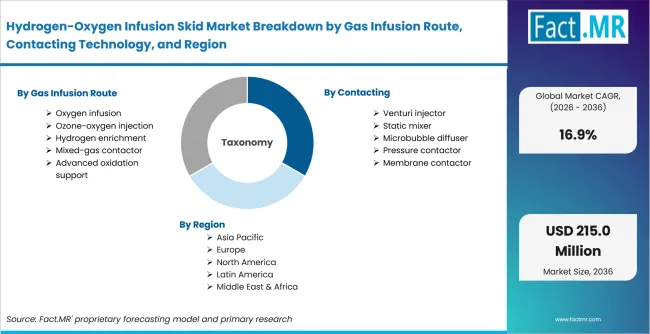
Hydrogen Oxygen Infusion Skid Market Breakdown By Gas Infusion Route, Contacting Technology, And Region | Source: Fact.MR
| ATTRIBUTE | DETAILS |
|---|---|
| Quantitative Units | USD million to USD million by 2036 at a CAGR |
| Market Definition | The market covers frame-mounted, containerized, mobile, pilot, and custom skids that generate, meter, contact, or dissolve hydrogen, oxygen, ozone-oxygen, or mixed gases into water and wastewater. |
| Gas Infusion Route | Oxygen infusion; Ozone-oxygen injection; Hydrogen enrichment; Mixed-gas contactor; Advanced oxidation support |
| Contacting Technology | Venturi injector; Static mixer; Microbubble diffuser; Pressure contactor; Membrane contactor |
| Skid Configuration | Frame-mounted skid; Containerized skid; Mobile rental skid; Pilot skid; Custom engineered |
| Application | Industrial wastewater; Aquaculture water; Process water; Drinking water; Remediation |
| Automation Level | PLC controlled; Sensor feedback loop; Manual controlled; Remote SCADA; AI optimization |
| Regions Covered | North America; Europe; Asia Pacific; Latin America; Middle East and Africa |
| Countries Covered | Germany; United States; Netherlands; Denmark; Japan, and 30+ countries |
| Key Companies Profiled | Spartan Environmental Technologies; Herco Wassertechnik; Mazzei Injector Company; Xylem |
| Forecast Period | 2026 to 2036 |
| Approach | Sizing combines skid shipments, realized values by gas route and automation level, pilot and rental equivalents, component integration, and validated project conversion rates. |
Source: Fact.MR analysis. Updated Jul 17, 2026
How is the market segmented?
-
By Gas Infusion Route
- Oxygen infusion
- Ozone-oxygen injection
- Hydrogen enrichment
- Mixed-gas contactor
- Advanced oxidation support
-
By Contacting Technology
- Venturi injector
- Static mixer
- Microbubble diffuser
- Pressure contactor
- Membrane contactor
-
By Skid Configuration
- Frame-mounted skid
- Containerized skid
- Mobile rental skid
- Pilot skid
- Custom engineered
-
By Application
- Industrial wastewater
- Aquaculture water
- Process water
- Drinking water
- Remediation
-
By Automation Level
- PLC controlled
- Sensor feedback loop
- Manual controlled
- Remote SCADA
- AI optimization
-
By Region
- North America
- United States
- Europe
- Germany
- Netherlands
- Denmark
- Asia Pacific
- Japan
Frequently Asked Questions
Which Gas Infusion Route leads the Hydrogen-Oxygen Infusion Skid Market?
Which Contacting Technology leads the Hydrogen-Oxygen Infusion Skid Market?
Which Skid Configuration leads the Hydrogen-Oxygen Infusion Skid Market?
Which Application leads the Hydrogen-Oxygen Infusion Skid Market?
Which Automation Level leads the Hydrogen-Oxygen Infusion Skid Market?
Which country records the highest CAGR in the Hydrogen-Oxygen Infusion Skid Market?
How does the United States perform in the Hydrogen-Oxygen Infusion Skid Market?
How does the Netherlands perform in the Hydrogen-Oxygen Infusion Skid Market?
How does Denmark perform in the Hydrogen-Oxygen Infusion Skid Market?
How does Japan perform in the Hydrogen-Oxygen Infusion Skid Market?
What is the primary driver in the Hydrogen-Oxygen Infusion Skid Market?
What is the main restraint in the Hydrogen-Oxygen Infusion Skid Market?
Why is Oxygen Infusion important?
Why do industrial wastewater plants dominate demand?
Who worked on this report


Preview the report firsthand - request a free sample
Free SampleGet the brochure for pricing and purchase details
Download PDF