- Market Value (2025): USD 21.7 Bn
- Estimated Value (2026): USD 24.7 Bn
- Forecast Value (2036): USD 90.0 Bn
- CAGR (2026-2036): 13.8%
What is the IoT Cloud Platform Market forecast to be worth by 2036?
USD 24.7 billion in 2026 to USD 90.0 billion by 2036 at 13.8% CAGR.
- The IoT cloud platform market reached USD 21.7 billion in 2025 as enterprises expanded connected-device control and remote monitoring programs.
- Demand is projected to increase from USD 24.7 billion in 2026 to USD 90.0 billion by 2036.
- The market is forecast to record 13.8% CAGR from 2026 to 2036 owing to device lifecycle management and cloud-based operating control.
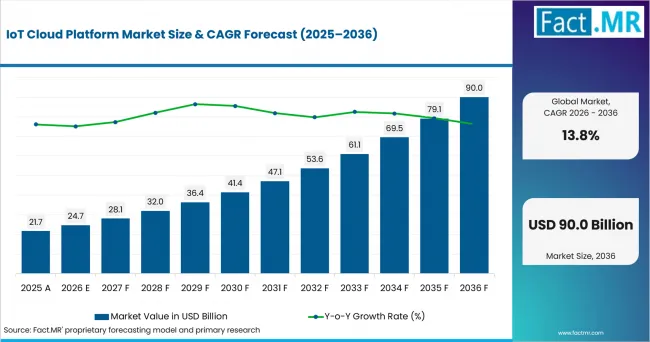
Iot Cloud Platform Market Value Analysis | Source: Fact.MR
What are the defining numbers behind IoT Cloud Platform Market growth?
USD 65.3 billion absolute opportunity is expected by 2036.
- Demand Drivers in the Market
- Device Management Platforms are expected to lead buyer attention. Connected assets need onboarding and identity control before they can be used safely at scale.
- Industrial IoT workloads are anticipated to raise demand in factories that need machine data for maintenance and operating review.
- Large enterprises are likely to approve platforms that reduce downtime and make device ownership clear for IT teams.
- Public cloud deployment is expected to gain preference when buyers need wider access without building a dedicated platform stack for every site.
- Key Segments Analyzed
- By Product Type: Device Management Platforms are expected to hold 36.3% share in 2026. Buyers treat onboarding and lifecycle control as early approval tests.
- By Application: Industrial IoT is projected to account for 30.8% share in 2026. Plants need device data that can move into maintenance workflows.
- By End User: Large Enterprises are anticipated to capture 31.6% share in 2026. Larger buyers need platform governance across several sites.
- By Distribution Channel: Direct Sales are estimated to represent 32.4% share in 2026. Technical scoping makes direct vendor engagement useful.
- By Deployment Model: Public Cloud is forecast to hold 44.2% share in 2026. Buyers seek elastic capacity and managed platform access.
- Analyst Opinion at Fact.MR
- Shambhu Nath Jha, Principal Consultant at Fact.MR, states, “IoT cloud platform buyers are asking vendors to prove the operating step after deployment. Device data has value only when the platform can manage identity and security. Updates must not add avoidable integration work.”
- Strategic Implications
- Enterprise teams should define device-control requirements before comparing platform brands. The review needs to cover identity and update paths. It must explain failure response.
- Suppliers can strengthen proposals by showing how the platform fits smart manufacturing workflows. This helps buyers connect device management with maintenance planning.
- Investors should separate broad cloud exposure from direct IoT platform demand. Value is stronger where recurring device operations create measurable service need.
Germany is expected to record a 18.0% CAGR from 2026 to 2036 through industrial digitization and platform review. Brazil is projected to post 16.5% CAGR as channel access shapes Industrial IoT adoption. Australia is anticipated to grow at 9.6% through compliance-led platform selection. The USA is estimated at 15.2% CAGR through direct enterprise procurement. Canada is forecast at 11.1%. The UK is projected to reach 13.8%. Japan is expected to post 12.4% CAGR through quality-led platform approval and compact operating needs.
How does the IoT Cloud Platform Market break down by segment?
Device Management Platforms are expected to lead Product Type at 36.3% share in 2026. Industrial IoT is projected to lead Application at 30.8% share in 2026.
Why does Device Management Platforms lead Product Type?
Device Management Platforms are projected to account for 36.3% share in 2026.
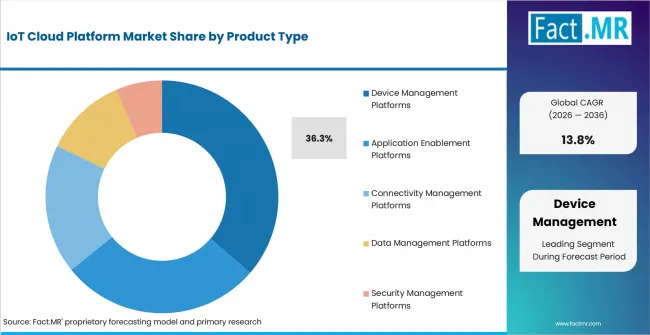
Iot Cloud Platform Market Analysis By Product Type | Source: Fact.MR
Device Management Platforms lead Product Type when buyers need one layer for onboarding and configuration. Patch management becomes part of the same approval route. Device Provisioning and Remote Device Monitoring remain useful where fleets are still being organized.
Why does Industrial IoT lead Application?
Industrial IoT is projected to account for 30.8% share in 2026.
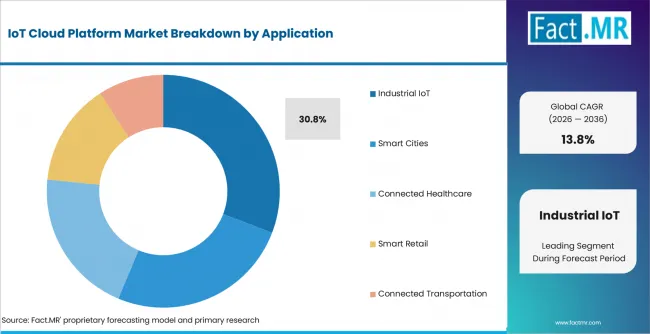
Iot Cloud Platform Market Analysis By Application | Source: Fact.MR
Industrial IoT leads Application where factories need device data that supports service action. Predictive maintenance use cases become stronger when uptime planning depends on sensor records. Connected Healthcare remains relevant where operators need secure remote monitoring.
Why does Large Enterprises lead End User?
Large Enterprises are anticipated to account for 31.6% share in 2026.
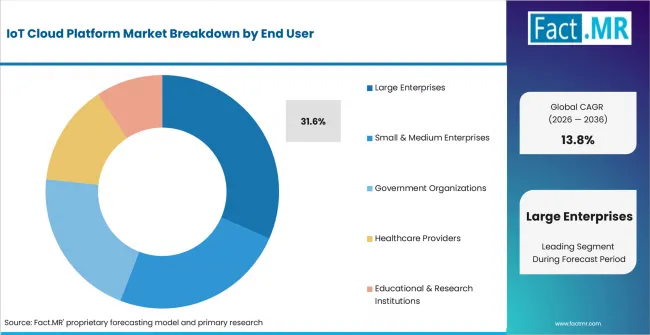
Iot Cloud Platform Market Analysis By End User | Source: Fact.MR
Large Enterprises lead End User because device fleets often span several facilities and security teams. Manufacturing Enterprises need clear integration support before expanding orders. Smaller buyers tend to move more slowly when platform cost limits adoption.
Why does Direct Sales lead Distribution Channel?
Direct Sales are estimated to account for 32.4% share in 2026.
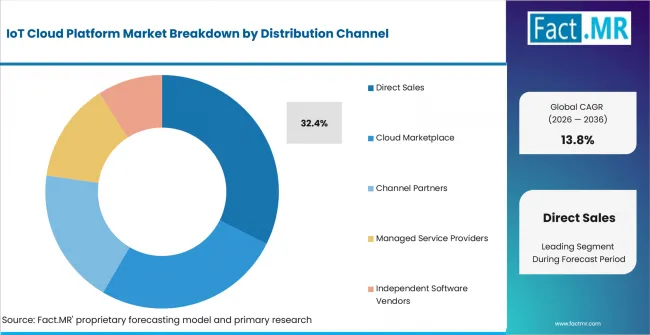
Iot Cloud Platform Market Analysis By Distribution Channel | Source: Fact.MR
Direct Sales lead Distribution Channel when enterprise buyers need proof of integration before committing to a platform. Data-handling controls become part of the sales process. System Integrators help when deployment crosses legacy systems.
Why does Public Cloud lead Deployment Model?
Public Cloud is forecast to account for 44.2% share in 2026.
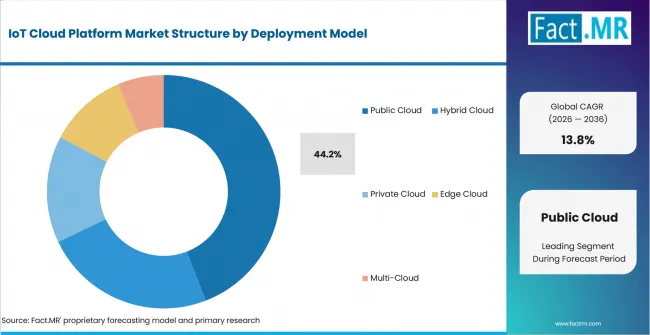
Iot Cloud Platform Market Analysis By Deployment Model | Source: Fact.MR
Public Cloud leads Deployment Model because it gives buyers scalable platform access without dedicated infrastructure at each site. Hybrid Cloud remains useful where data policies require local control. Edge computing platforms matter when latency is central to the use case.
What is accelerating IoT Cloud Platform Market adoption, and what is holding it back?
Demand is expected to rise through better device management and wider Industrial IoT use. High integration costs, switching risks and unclear responsibility after setup may slow adoption.
Drivers Impact Analysis
| DRIVER | (~) % IMPACT ON CAGR | GEOGRAPHIC RELEVANCE | IMPACT TIMELINE |
|---|---|---|---|
| Device management platform specification | +3.0% | Germany, USA, Japan | Short term (<= 2 years) |
| Industrial IoT integration workload | +2.6% | Germany, Brazil, Australia | Short term (<= 2 years) |
| Enterprise security and lifecycle control | +2.2% | USA, UK, Canada | Medium term (2-4 years) |
| Public cloud scalability | +1.5% | Global enterprise markets | Medium term (2-4 years) |
Source: Fact.MR analysis. Updated Jul 31, 2026
- Device management platform specification: Buyers are expected to prioritize tools that keep onboarding and authentication records under one operating model. Update records then remain easier to review.
- Industrial IoT integration workload: Connected plants need platforms that move machine data into maintenance systems. The platform becomes more useful when records trigger a real service action.
- Enterprise security and lifecycle control: Approval is expected to improve when vendors show how identity and patching responsibilities are handled after deployment.
Opportunity Impact Analysis
| OPPORTUNITY | (~) % IMPACT ON CAGR | GEOGRAPHIC RELEVANCE | IMPACT TIMELINE |
|---|---|---|---|
| Managed device operations | +1.4% | Germany and USA | Medium term (2-4 years) |
| Security-led platform upgrades | +1.1% | UK, Canada, Japan | Medium term (2-4 years) |
| Vertical IoT templates | +0.8% | Brazil and Australia | Long term (>= 4 years) |
| Edge-to-cloud workflow expansion | +0.6% | Industrial and utility sites | Long term (>= 4 years) |
Source: Fact.MR analysis. Updated Jul 31, 2026
- Managed device operations: Vendors that convert platform deployment into repeat service work are expected to improve retention across enterprise accounts.
- Cloud security requirements create openings for platforms that can document access control and incident response. The buyer case improves when proof is easy to check.
- Vertical IoT templates: Preconfigured workflows can shorten evaluation time for manufacturing and utility buyers. The template must still fit the buyer’s operating routine.
Restraints Impact Analysis
| RESTRAINT | (~) % IMPACT ON CAGR | GEOGRAPHIC RELEVANCE | IMPACT TIMELINE |
|---|---|---|---|
| Integration complexity and switching cost | -1.3% | Global enterprise markets | Short term (<= 2 years) |
| Unclear device ownership after deployment | -1.0% | Large enterprises | Short term (<= 2 years) |
| Price sensitivity around Industrial IoT | -0.8% | Brazil and smaller buyer groups | Medium term (2-4 years) |
| Data governance and residency review | -0.6% | UK, Canada, Japan | Long term (>= 4 years) |
Source: Fact.MR analysis. Updated Jul 31, 2026
- Integration complexity and switching cost: Existing device data and legacy systems can extend approval work before platform migration begins.
- Unclear device ownership after deployment: Adoption slows when IT and operations teams do not agree on update responsibilities.
- Price sensitivity around Industrial IoT: Smaller buyers may delay orders when service support raises the total project cost.
Which countries are scaling IoT Cloud Platform Market fastest?
- Germany leads as industrial buyers seek strong device management and lifecycle control. Brazil follows through distributor support that reduces Industrial IoT implementation risk.
- Australia holds the middle position as compliance and supplier reliability guide adoption. The USA and Canada remain close due to large enterprise purchasing and the need for clear integration proof.
- The UK and Japan grow more carefully as buyers focus on platform governance, service quality and long-term operational reliability.
- Comparable CAGRs can still produce different entry conditions. Deployment timing depends on channel access and service accountability.
The full report provides country-level CAGR analysis.
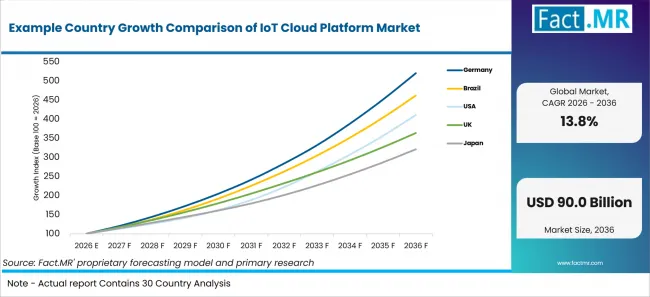
Example Country Growth Comparison Of Iot Cloud Platform Market | Source: Fact.MR
| Country | CAGR (2026-2036) |
|---|---|
| Germany | 18.0% |
| Brazil | 16.5% |
| Australia | 9.6% |
| USA | 15.2% |
| Canada | 11.1% |
| UK | 13.8% |
| Japan | 12.4% |
Source: Fact.MR analysis. Updated Jul 31, 2026
What supports Germany adoption?
15.9% CAGR, supported by industrial digitization and platform qualification.
Germany’s industrial buyers place device visibility close to production control. Platform demand is expected to build where factories need identity management for connected assets. Suppliers gain attention when onboarding fits plant IT rules.
How is Brazil scaling demand?
14.5% CAGR, driven by Industrial IoT channels and service reach.
In Brazil, the buying route depends on partners that support deployment after the first sale. Industrial IoT buyers are expected to value training and local service access. Channel depth can reduce hesitation after pilot projects.
What shapes Australia growth?
13.4% CAGR, backed by compliance review and supplier dependability.
Australia’s outlook reflects buyers that manage long service distances and careful compliance review. Large Enterprises are expected to compare support depth before expanding device programs.
How does USA demand develop?
13.1% CAGR, led by direct sales and enterprise procurement discipline.
The USA is expected to move through direct enterprise engagement. Buyers examine integration proof and data-handling controls before approval. Technical account support remains central during expansion.
What supports Canada adoption?
12.9% CAGR, supported by public cloud access and service coverage needs.
Across Canada, dispersed operating sites make service coverage a practical purchase factor. Public Cloud remains useful when teams need one control layer across locations.
How is UK demand positioned?
11.7% CAGR, shaped by governance review and life-cycle value checks.
UK demand is expected to build through governance-led review. Buyers compare supplier support and long-term operating value before expanding orders.
What supports Japan growth?
10.3% CAGR, backed by reliability needs and compact operating conditions.
Japan’s growth reflects a quality-focused route where platform stability matters more than broad feature claims. Industrial IoT buyers are expected to value precise support and reliable workflows.
Who leads the IoT Cloud Platform Market?
Amazon Web Services (AWS), Microsoft and Google LLC show direct relevance through cloud infrastructure and IoT platform services. IBM adds enterprise software depth. Oracle Corporation and Cisco Systems broaden the provider field. Velotic, through ThingWorx strengthens the industrial IoT side.
From 2026 to 2036, competition is expected to depend on integration proof and device security. Buyers are likely to compare governance and update controls before expanding use. Providers that explain the operating burden clearly are expected to gain stronger demand.
Which companies are the key providers?
Key companies include Amazon Web Services (AWS); Microsoft; Google LLC; IBM; Oracle Corporation; Cisco Systems; Velotic, through ThingWorx
- Amazon Web Services (AWS)
- Microsoft
- Google LLC
- IBM
- Oracle Corporation
- Cisco Systems
- Velotic, through ThingWorx
Bibliography
- Office for Product Safety and Standards, & Department for Science, Innovation and Technology. (2024, January 8). Regulations: Consumer connectable product security. GOV.UK.
- National Institute of Standards and Technology. (2024, April 3). Product development cybersecurity handbook: Concepts and considerations for IoT product manufacturers (NIST CSWP 33, Initial Public Draft).
- European Commission. (2024, December 10). Cyber Resilience Act enters into force to make Europe’s cyberspace safer and more secure.
- Google LLC. (2024, May). Enabling modern manufacturing outcomes with AI, edge, and modern infrastructure.
This Report Answers
- The report provides strategic intelligence on Product Type and Application choices that shape platform approval.
- Segment analysis covers Device Management Platforms and Industrial IoT as 2026 share leaders.
- Country outlook evaluates Germany and Brazil alongside Australia and the USA. Canada, the UK and Japan complete the comparison.
- Competitive analysis profiles Amazon Web Services (AWS), Microsoft and Google LLC. IBM and Oracle Corporation follow. Cisco Systems and Velotic, through ThingWorx complete the provider set.
- Deployment assessment covers Public Cloud and Hybrid Cloud alongside Private Cloud, Edge Cloud and Multi-Cloud.
What does the IoT Cloud Platform Market cover?
IoT cloud platforms connect and govern device fleets where identity control determines operating value.
The IoT Cloud Platform Market covers commercial platforms used for device management and application enablement. It includes connectivity management and data management. Security management is included when the platform helps control device access. Coverage includes Industrial IoT and Smart Cities. Connected Healthcare is included where cloud control supports recurring device operations.
What is included in the scope?
IoT cloud platforms are used by large enterprises and manufacturing enterprises. Utility companies and government organizations are included when their fleets require cloud-based management.
The scope includes Product Type and Application alongside End User and Distribution Channel. Deployment Model is included because buyers compare Public Cloud and Hybrid Cloud differently. Coverage spans device management and application enablement.
What is excluded from the scope?
General cloud services and unrelated software spending remain outside the scope of this market.
The scope excludes platforms that do not manage connected-device operations. Hardware-only devices are excluded. Telecom connectivity without cloud platform functions remains outside the boundary.
How Was the Analysis Built?
The analysis draws on 120+ sources, 35+ company portfolios, 25+ countries, and more than 20 industry interviews.
- Primary Research: Primary research includes discussions with manufacturers, service providers, technology developers, distributors, end users, procurement teams, and subject-matter experts. These conversations examine purchasing priorities, product adoption, operational challenges, approval requirements, competitive positioning, and the factors that influence wider market acceptance.
- Desk Research: Desk research covers government statistics, regulatory publications, company filings, trade data, technical studies, industry associations, standards, public policy, and other authoritative sources. Every source used in the analysis is documented in the bibliography.
- Market Sizing and Forecasting: Market estimates combine historical performance, demand indicators, pricing and volume trends, segment shares, company participation, country-level growth, adoption patterns, investment activity, and barriers to market expansion.
- Data Validation and Update Cycle: Findings are validated by comparing primary interviews with public data, company activity, regulatory changes, trade patterns, and industry developments. Regular updates review new product launches, capacity changes, partnerships, approvals, procurement trends, and shifts in commercial adoption.
Segmentation
What is the report's scope and coverage?
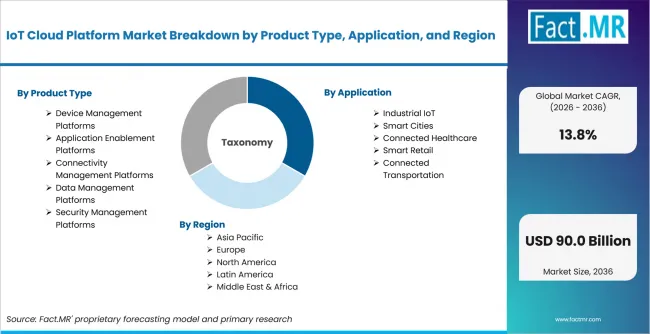
Iot Cloud Platform Market Breakdown By Product Type, Application, And Region | Source: Fact.MR
| Attribute | Details |
|---|---|
| Quantitative Units | USD billion in 2026 to USD billion by 2036 at CAGR |
| Market Definition | Commercial platforms used to connect and govern connected devices through cloud infrastructure where device identity, lifecycle control, data flow and secure operations shape purchasing decisions |
| Product Type | Device Management Platforms; Application Enablement Platforms; Connectivity Management Platforms; Data Management Platforms; Security Management Platforms |
| Application | Industrial IoT; Smart Manufacturing; Predictive Maintenance; Smart Cities; Connected Healthcare; Smart Retail; Connected Transportation |
| End User | Large Enterprises; Manufacturing Enterprises; Utility Companies; Small & Medium Enterprises; Government Organizations; Healthcare Providers; Educational & Research Institutions |
| Distribution Channel | Direct Sales; Cloud Marketplace; Channel Partners; System Integrators; Managed Service Providers; Independent Software Vendors |
| Deployment Model | Public Cloud; Hybrid Cloud; Private Cloud; Edge Cloud; Multi-Cloud |
| Regions Covered | North America; Latin America; Europe; East Asia; South Asia and Oceania; Middle East and Africa |
| Countries Covered | Germany; Brazil; Australia; USA; Canada; UK; Japan |
| Key Companies Profiled | Amazon Web Services (AWS); Microsoft; Google LLC; IBM; Oracle Corporation; Cisco Systems; Velotic, through ThingWorx |
| Forecast Period | 2026 to 2036 |
| Approach | Hybrid top-down and bottom-up assessment using platform demand indicators, segment mix, country growth and company participation. |
Source: Fact.MR analysis. Updated Jul 31, 2026
How is the market segmented?
-
By Product Type:
- Device Management Platforms
- Application Enablement Platforms
- Connectivity Management Platforms
- Data Management Platforms
- Security Management Platforms
-
By Application:
- Industrial IoT
- Smart Manufacturing
- Predictive Maintenance
- Smart Cities
- Connected Healthcare
- Smart Retail
- Connected Transportation
-
By End User:
- Large Enterprises
- Manufacturing Enterprises
- Utility Companies
- Small & Medium Enterprises
- Government Organizations
- Healthcare Providers
- Educational & Research Institutions
-
By Distribution Channel:
- Direct Sales
- Cloud Marketplace
- Channel Partners
- System Integrators
- Managed Service Providers
- Independent Software Vendors
-
By Deployment Model:
- Public Cloud
- Hybrid Cloud
- Private Cloud
- Edge Cloud
- Multi-Cloud
-
By Region:
- North America
- Latin America
- Europe
- East Asia
- South Asia and Oceania
- Middle East and Africa
Frequently Asked Questions
Which Product Type leads the market?
Which Application leads the market?
Which End User leads the market?
Which Distribution Channel leads the market?
Which Deployment Model leads the market?
Which country records the highest listed CAGR?
What is the primary driver in this market?
What is the main restraint?
Why do Large Enterprises lead demand?
Who worked on this report


Preview the report firsthand - request a free sample
Free SampleGet the brochure for pricing and purchase details
Download PDF