- Market Value (2025): USD 18.7 Bn
- Estimated Value (2026): USD 20.5 Bn
- Forecast Value (2036): USD 51.7 Bn
- CAGR (2026-2036): 9.7%
What is the IoT Wearable Device Market forecast to be worth by 2036?
USD 20.5 billion in 2026 to USD 51.7 billion by 2036 at 9.7% CAGR.
- The IoT wearable device market reached USD 18.7 billion in 2025 as smartwatch replacement and health review use expanded across consumer channels.
- Demand is projected to increase from USD 20.5 billion in 2026 to USD 51.7 billion by 2036.
- The market is forecast to record 9.7% CAGR from 2026 to 2036 owing to daily wearable use and app-based support.
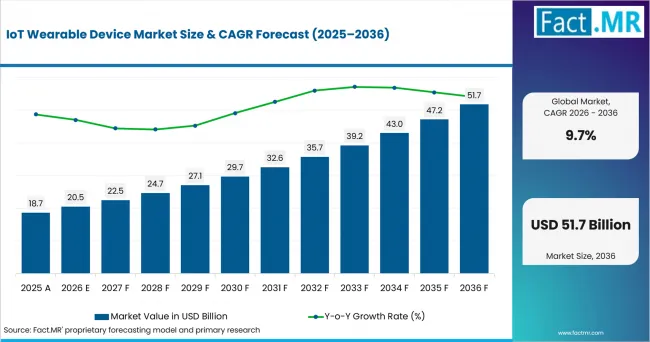
Iot Wearable Device Market Value Analysis | Source: Fact.MR
What are the defining numbers behind IoT Wearable Device Market growth?
USD 31.2 billion absolute opportunity by 2036.
- Demand Drivers in the Market
- Smartwatch replacement cycles are expected to support repeat buying when users want better sensors and smoother phone pairing.
- Healthcare and medical monitoring use is anticipated to widen the buyer base when daily readings become easier to review.
- Online retail is expected to shape product discovery since buyers compare features and return terms before choosing a device.
- Bluetooth pairing is projected to reduce setup friction for users who already connect phones with audio devices.
- Key Segments Analyzed
- By Product Type: Smartwatches are expected to hold 36.8% share in 2026 since buyers understand the format and use it every day.
- By Application: Healthcare and Medical Monitoring is projected to account for 31.9% share in 2026 where readings support daily health review.
- By End User: Individual Consumers are anticipated to capture 29.4% share in 2026 with personal purchases remaining the main volume path.
- By Distribution Channel: Online Retail is estimated to represent 30.3% share in 2026 through comparison-based buying and brand store access.
- By Connectivity: Bluetooth is forecast to hold 40.9% share in 2026 since phone pairing remains the easiest connection route.
- Analyst Opinion at Fact.MR
- Shambhu Nath Jha, Senior Consultant at Fact.MR, states, "IoT wearable suppliers need to prove that the device and app work together without buyer friction. Purchase decisions are expected to depend on battery life and sensor clarity. Privacy controls and service support shape the next step."
- Strategic Implications
- Consumer technology teams should build smartwatch offers around daily use cases.
- Healthcare suppliers can improve approval chances by showing how wearable readings move into review.
- Retail partners should compare returns and app compatibility before expanding listings.
South Korea leads at 7.8% CAGR, supported by retail reach and smartphone brand familiarity. The USA follows as health monitoring and replacements drive demand. Canada benefits from online comparison, while Germany emphasizes privacy and durability. Australia depends on delivery and after-sales support. The UK grows through value checks and subscription visibility, while Japan advances through compact design and trusted service.
How does the IoT Wearable Device Market break down by segment?
Smartwatches are expected to lead Product Type at 36.8% share in 2026. Healthcare and Medical Monitoring is projected to lead Application at 31.9% share in 2026.
Why does Smartwatches lead Product Type?
Smartwatches are projected to account for 36.8% share in 2026.
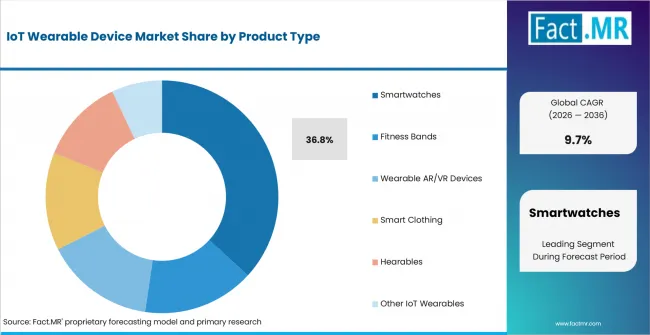
Iot Wearable Device Market Analysis By Product Type | Source: Fact.MR
Smartwatches lead Product Type because the smartwatch gives buyers health review and phone controls in one product. Advanced Health Monitoring Smartwatches serve users who want deeper readings. Fitness and Lifestyle Smartwatches remain useful for daily activity use.
Why does Healthcare and Medical Monitoring lead Application?
Healthcare and Medical Monitoring is expected to account for 31.9% share in 2026.
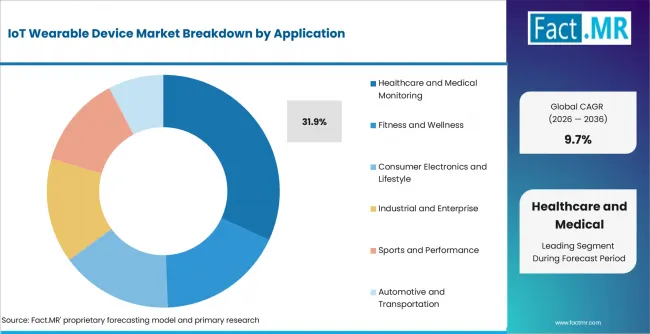
Iot Wearable Device Market Analysis By Application | Source: Fact.MR
Healthcare and Medical Monitoring leads Application when sensor readings help users watch health changes between appointments. Remote patient monitoring devices gain value when readings move into care review. Chronic Disease Management needs steady data transfer and simple alerts.
What supports Individual Consumers within End User?
Individual Consumers are anticipated to represent 29.4% share in 2026.
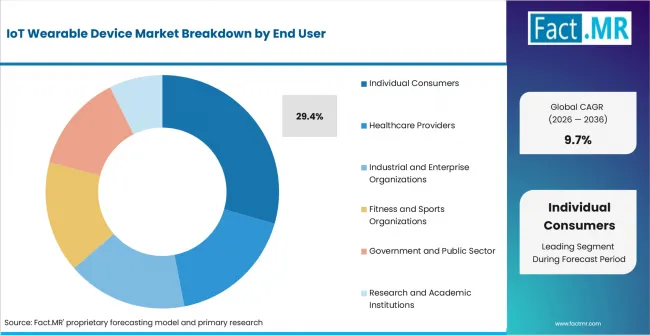
Iot Wearable Device Market Analysis By End User | Source: Fact.MR
Individual Consumers lead End User when the purchase starts with personal health goals and phone use. Mass-Market Consumers give the category broad volume. Premium and Tech-Savvy Consumers raise spending when sensors and design work with useful apps.
Why does Online Retail lead Distribution Channel?
Online Retail is estimated to hold 30.3% share in 2026.Online Retail leads Distribution Channel because the e-commerce market lets buyers compare features and warranty terms
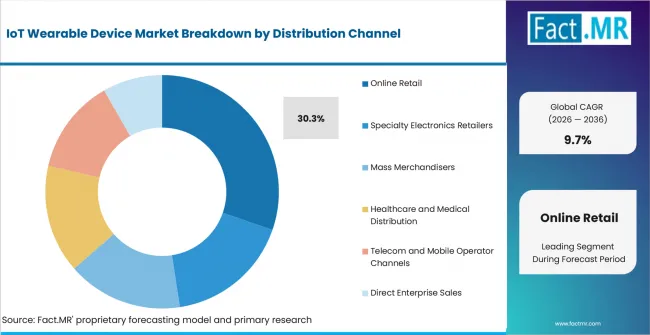
Iot Wearable Device Market Analysis By Distribution Channel | Source: Fact.MR
before purchase. E-Commerce Marketplaces help discovery. Brand-Owned Online Stores strengthen premium buying through setup support and replacement terms.
What supports Bluetooth within Connectivity?
Bluetooth is forecast to account for 40.9% share in 2026.
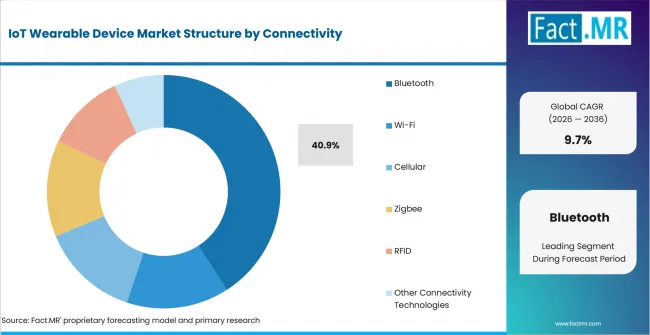
Iot Wearable Device Market Analysis By Connectivity | Source: Fact.MR
Bluetooth leads Connectivity when users need simple phone pairing before data transfer starts. Bluetooth Low Energy helps battery life in daily use. Wi-Fi and cellular formats gain relevance when devices need independent operation.
What is accelerating IoT Wearable Device Market adoption, and what is holding it back?
Demand is expected to rise through smartwatch replacement and growing health-monitoring use. Privacy concerns and limited battery life may slow adoption.
Drivers Impact Analysis
| DRIVER | (~) % IMPACT ON CAGR | GEOGRAPHIC RELEVANCE | IMPACT TIMELINE |
|---|---|---|---|
| Smartwatch replacement cycles | +2.6% | South Korea; USA | Short term (<= 2 years) |
| Healthcare monitoring use | +2.3% | USA; Canada | Short term (<= 2 years) |
| Online retail comparison | +1.8% | South Korea; UK | Medium term (2-4 years) |
| Bluetooth pairing familiarity | +1.5% | Germany; Australia | Medium term (2-4 years) |
| App ecosystem depth | +1.1% | Japan; premium markets | Long term (>= 4 years) |
Source: Fact.MR analysis. Updated Jul 31, 2026
- Smartwatch replacement cycles: Better sensors and smoother phone pairing are expected to support repeat purchases when older devices lose appeal.
- Healthcare monitoring use: Daily readings are expected to carry more value when consumers can review them without difficult transfer steps.
- Online retail comparison: Clear product pages are expected to shorten buyer research by showing features and service terms together.
Opportunity Impact Analysis
| OPPORTUNITY | (~) % IMPACT ON CAGR | GEOGRAPHIC RELEVANCE | IMPACT TIMELINE |
|---|---|---|---|
| Care-review device support | +1.4% | USA; Canada | Medium term (2-4 years) |
| Premium sensor upgrades | +1.1% | South Korea; Japan | Medium term (2-4 years) |
| Brand-owned online bundles | +0.9% | UK; Germany | Medium term (2-4 years) |
| Worker-safety use cases | +0.6% | Australia; enterprise buyers | Long term (>= 4 years) |
Source: Fact.MR analysis. Updated Jul 31, 2026
- Care-review device support: Providers that make wearable readings easier to review are expected to earn trust in care-related use cases.
- Premium sensor upgrades: Buyers are expected to pay more when they can see a clear gain from richer readings.
- Brand-owned online bundles: Direct online stores are expected to improve replacement when warranty and setup guidance appear together.
Restraints Impact Analysis
| RESTRAINT | (~) % IMPACT ON CAGR | GEOGRAPHIC RELEVANCE | IMPACT TIMELINE |
|---|---|---|---|
| Device-data privacy review | -1.2% | Global | Short term (<= 2 years) |
| Battery life and replacement cost | -0.9% | Consumer markets | Short term (<= 2 years) |
| Platform lock-in | -0.7% | USA; Germany; UK | Medium term (2-4 years) |
| Medical validation burden | -0.5% | Healthcare channels | Long term (>= 4 years) |
Source: Fact.MR analysis. Updated Jul 31, 2026
- Device-data privacy review: Buyers are expected to delay purchases when app permissions and account controls are unclear.
- Battery life and replacement cost: Short battery life is expected to frustrate users who need daily charging.
- Platform lock-in: App fragmentation is expected to slow switching when users risk losing history and phone features.
Which countries are scaling IoT Wearable Device Market fastest?
The country comparison is defined by South Korea’s clear lead and a compact group across the USA and Canada. Germany and Australia form a measured middle pair. UK and Japan follow a slower path. The 3.3-point spread reflects channel readiness and buyer trust in connected health features.
- South Korea records the highest listed CAGR when smartwatch adoption benefits from retail access and local electronics strength. USA remains above the global figure where healthcare monitoring and premium device replacement support wider wearable use.
- Canada stays close to the global rate since buyers need reliable service coverage across a wide geography. Germany follows an evidence-based route when buyers review privacy terms and product durability before switching devices.
- Australia depends on online access and dependable service outside major cities. UK demand moves through value comparison when consumers weigh device price and app usefulness before replacing wearables.
- Japan records the lowest listed CAGR as buyers favor compact design and trusted service over frequent switching.
Comparable CAGRs can produce different market entry conditions. Faster markets need app ecosystems and retail execution. Slower markets create demand when suppliers reduce setup friction and make service terms visible.
The full report provides country-level CAGR analysis across North America; Latin America; Europe; East Asia; South Asia and Oceania; and the Middle East and Africa.
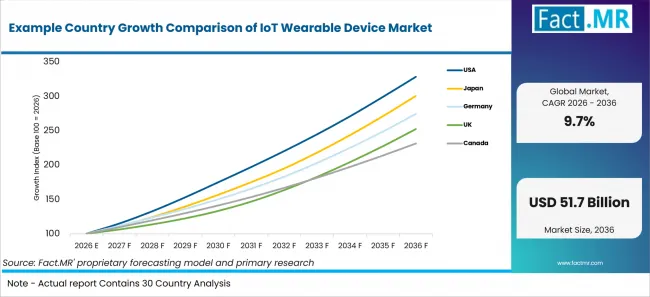
Example Country Growth Comparison Of Iot Wearable Device Market | Source: Fact.MR
| Country | CAGR (2026-2036) |
|---|---|
| South Korea | 7.8% |
| USA | 12.6% |
| Canada | 8.8% |
| Germany | 10.6% |
| Australia | 6.8% |
| UK | 9.7% |
| Japan | 11.6% |
Source: Fact.MR analysis. Updated Jul 31, 2026
What supports South Korea adoption?
11.1% CAGR, supported by smartwatch replacement and mobile-first retail behavior.
South Korea’s growth reflects comfort with connected electronics and frequent upgrades. Smartwatches benefit from brand visibility and carrier support. Suppliers perform better when they explain battery life and phone compatibility before sale.
What supports USA adoption?
10.2% CAGR, driven by healthcare monitoring and premium device demand.
USA growth is shaped by buyers who compare wearable features against health goals. Healthcare and Medical Monitoring creates value when readings support follow-up. Direct
online stores compete on warranty clarity and setup support.
How is Canada developing demand?
9.6% CAGR, backed by online retail reach and service coverage needs.
Canada’s growth reflects a market where distance can make support as necessary as features. Individual Consumers favor brands that make returns and repairs easy to understand. Online retail pages need clear replacement timelines.
What shapes Germany’s route to adoption?
9.2% CAGR, led by privacy review and documentation-based purchasing.
Germany’s growth is expected to move through buyers who examine data handling and durability before purchase. Online Retail remains useful when pages provide clear privacy and warranty information. Documentation can turn cautious users into repeat buyers.
How does Australia perform?
8.9% CAGR, supported by online access and dependable after-sales service.
Australia’s growth reflects a buying environment where delivery reach influences selection. Bluetooth-enabled devices fit mainstream phone pairing needs. Suppliers gain preference when replacement processes are visible across urban and regional buyers.
What supports UK growth?
8.5% CAGR, shaped by value comparison and replacement discipline.
UK growth is expected to depend on consumers who compare price and app usefulness before replacing devices. Smartwatches remain the reference category. Online listings need clear health features and subscription costs.
How is Japan positioned?
7.8% CAGR, supported by quality-focused replacement and compact product needs.
Japan’s growth reflects a market where buyers value reliable design and clear device purpose. Healthcare and Medical Monitoring supports demand when readings are simple to review. Suppliers need comfort and battery life with trusted service support.
Who leads the IoT Wearable Device Market?
Apple Inc. and Garmin Ltd. show direct relevance through smartwatch and fitness wearable ecosystems. Samsung Electronics Co., Ltd. adds Android smartwatch depth through Galaxy wearables.
Google LLC through Fitbit contributes activity tracking experience. Huawei Technologies Co., Ltd. and Xiaomi Corporation broaden the provider set through consumer electronics reach. Zepp Health Corporation and Ōura Health Oy add smart ring exposure through health analytics.
From 2026 to 2036, competition is expected to depend on battery life and sensor usefulness. App reliability and privacy controls are expected to guide replacement decisions. Buyers are likely to compare setup and support before replacing older wearables.
Which companies are the key providers?
Key companies includes Apple Inc., Samsung Electronics Co., Ltd., Google LLC (Fitbit), Garmin Ltd., Huawei Technologies Co., Ltd., Xiaomi Corporation, Zepp Health Corporation, Ōura Health Oy.
- Apple Inc.
- Samsung Electronics Co., Ltd.
- Google LLC (Fitbit)
- Garmin Ltd.
- Huawei Technologies Co., Ltd.
- Xiaomi Corporation
- Zepp Health Corporation
- Ōura Health Oy
Bibliography
- U.S. Food and Drug Administration. (2024, February 21). Do not use smartwatches or smart rings to measure blood glucose levels: FDA safety communication.
- World Health Organization. (2024, July 8). MeDevIS platform announced to boost access to medical technologies and devices.
- International Telecommunication Union. (2024, November 27). Global Internet use continues to rise but disparities remain, especially in low-income regions.
- Garmin Ltd. (2024, January 8). Garmin brings big updates to its small, stylish Lily 2 smartwatch series.
This Report Answers
- The report provides strategic intelligence on the IoT Wearable Device Market across Product Type and Application choices.
- Segment analysis covers Smartwatches and Healthcare and Medical Monitoring as the share leaders within the 2026 market.
- Country outlook evaluates South Korea and USA alongside Canada and Germany. Australia with UK and Japan completes the comparison.
- Competitive analysis profiles Apple Inc. and Samsung Electronics Co., Ltd. alongside Google LLC under Fitbit and Garmin Ltd.
- Channel assessment covers Online Retail and Specialty Electronics Retailers. Healthcare distribution and direct enterprise sales complete the route-to-market view.
What does the IoT Wearable Device Market cover?
IoT wearable devices are connected products worn on the body for health data and activity data.
The IoT Wearable Device Market covers smartwatches and bands. It covers hearables and smart clothing. Coverage extends to devices that support monitoring and personal data review. General sensors are excluded when the wearable device is not the purchase focus.
What is included in the scope?
The scope includes Product Type and Application. It covers End User and Distribution Channel. Connectivity and regional demand complete the scope.
It includes consumer purchases through online and offline channels. Healthcare and enterprise purchases are included when wearables support monitoring or safety review. The scope covers Bluetooth and Wi-Fi. Cellular and Zigbee formats are included. RFID formats are included when they support wearable use.
What is excluded from the scope?
Unrelated infrastructure and general corporate IT spending remain outside the scope of this market.
The scope excludes smartphones and tablets. Cloud software is excluded when it is sold without wearable hardware. Hospital equipment is excluded when it does not rely on a wearable device. Revenue outside direct device support is not counted.
How Was the Analysis Built?
The analysis draws on 120+ sources and 35+ company portfolios. It reviews 25+ countries and more than 20 industry interviews.
- Primary Research: Primary research includes discussions with manufacturers and end users. These conversations examine purchasing priorities and approval requirements.
- Desk Research: Desk research covers public records and company disclosures. Industry records and technical literature are reviewed when they explain adoption conditions.
- Market Sizing and Forecasting: Market estimates combine historical performance with demand indicators. Segment shares and country growth patterns are cross-checked before publication.
- Data Validation and Update Cycle: Findings are validated by comparing interviews with public data. Regular updates review product launches and shifts in commercial adoption.
Segmentation
What is the report’s scope and coverage?
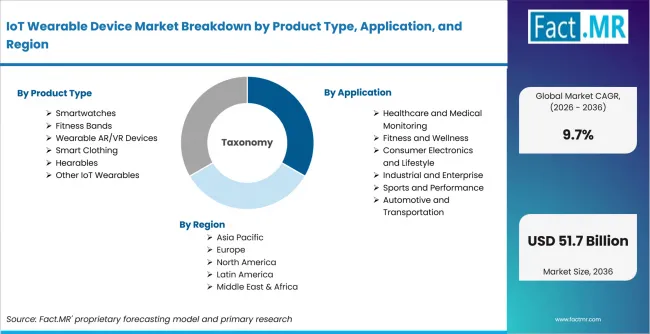
Iot Wearable Device Market Breakdown By Product Type, Application, And Region | Source: Fact.MR
| Attribute | Details |
|---|---|
| Quantitative Units | USD billion in 2026 to USD billion by 2036 at CAGR |
| Market Definition | Connected wearables worn on the body to collect health data and activity data |
| Product Type | Smartwatches; Advanced Health Monitoring Smartwatches; Fitness Bands; Wearable AR/VR Devices; Smart Clothing; Hearables |
| Application | Healthcare and Medical Monitoring; Remote Patient Monitoring; Fitness and Wellness; Industrial and Enterprise; Sports and Performance |
| End User | Individual Consumers; Healthcare Providers; Industrial and Enterprise Organizations; Fitness and Sports Organizations; Government and Public Sector |
| Distribution Channel | Online Retail; Specialty Electronics Retailers; Mass Merchandisers; Healthcare and Medical Distribution; Direct Enterprise Sales |
| Connectivity | Bluetooth; Bluetooth Low Energy; Wi-Fi; Cellular; Zigbee; RFID |
| Regions Covered | North America; Latin America; Europe; East Asia; South Asia and Oceania; Middle East and Africa |
| Countries Covered | South Korea; USA; Canada; Germany; Australia; UK; Japan |
| Key Companies Profiled | Apple Inc.; Samsung Electronics Co., Ltd.; Google LLC (Fitbit); Garmin Ltd.; Huawei Technologies Co., Ltd.; Xiaomi Corporation; Zepp Health Corporation; Ōura Health Oy |
| Forecast Period | 2026 to 2036 |
| Approach | Hybrid top-down and bottom-up approach using connected wearable demand; smartwatch replacement cycles; country adoption indicators; and company portfolio review |
Source: Fact.MR analysis. Updated Jul 31, 2026
How is the market segmented?
-
By Product Type:
- Smartwatches
- Advanced Health Monitoring Smartwatches
- Fitness and Lifestyle Smartwatches
- Fitness Bands
- Activity Tracking Bands
- Health Monitoring Bands
- Wearable AR/VR Devices
- Augmented Reality Smart Glasses
- Virtual Reality Headsets
- Smart Clothing
- Smart Shirts
- Smart Jackets and Sportswear
- Hearables
- Smart Earbuds
- Connected Hearing Devices
- Other IoT Wearables
- Smart Rings
- Smart Shoes and Footwear
- Smartwatches
-
By Application:
- Healthcare and Medical Monitoring
- Remote Patient Monitoring
- Chronic Disease Management
- Fitness and Wellness
- Activity and Exercise Tracking
- Sleep and Recovery Monitoring
- Consumer Electronics and Lifestyle
- Communication and Entertainment
- Personal Safety and Convenience
- Industrial and Enterprise
- Worker Safety Monitoring
- Asset and Workforce Tracking
- Sports and Performance
- Athlete Performance Monitoring
- Professional Sports Analytics
- Automotive and Transportation
- Driver Health and Fatigue Monitoring
- Connected Mobility Applications
- Healthcare and Medical Monitoring
-
By End User:
- Individual Consumers
- Mass-Market Consumers
- Premium and Tech-Savvy Consumers
- Healthcare Providers
- Hospitals and Clinics
- Diagnostic and Telehealth Providers
- Industrial and Enterprise Organizations
- Manufacturing Companies
- Logistics and Construction Companies
- Fitness and Sports Organizations
- Fitness Centers and Gyms
- Professional Sports Teams and Training Centers
- Government and Public Sector
- Public Safety Agencies
- Defense and Emergency Services
- Research and Academic Institutions
- Universities and Research Centers
- Clinical Research Organizations
- Individual Consumers
-
By Distribution Channel:
- Online Retail
- E-Commerce Marketplaces
- Brand-Owned Online Stores
- Specialty Electronics Retailers
- Consumer Electronics Chains
- Computer and Technology Stores
- Mass Merchandisers
- Hypermarkets and Supermarkets
- Department Stores
- Healthcare and Medical Distribution
- Medical Equipment Distributors
- Hospital and Institutional Procurement
- Telecom and Mobile Operator Channels
- Mobile Network Operators
- Telecom Retail Stores
- Direct Enterprise Sales
- Direct Corporate Sales
- Enterprise Technology Partnerships
- Online Retail
-
By Connectivity:
- Bluetooth
- Bluetooth Low Energy
- Classic Bluetooth
- Wi-Fi
- 2.4 GHz Wi-Fi
- Dual-Band Wi-Fi
- Cellular
- 4G LTE
- 5G Connectivity
- Zigbee
- Zigbee Mesh Networks
- Low-Power Zigbee Devices
- RFID
- Passive RFID
- Active RFID
- Other Connectivity Technologies
- NFC
- LPWAN and Other IoT Protocols
- Bluetooth
-
By Region:
- North America
- Latin America
- Europe
- East Asia
- South Asia and Oceania
- Middle East and Africa
Frequently Asked Questions
Which Product Type leads the market?
Which Application leads the market?
Which End User leads the market?
Which Distribution Channel leads the market?
Which Connectivity leads the market?
Which country records the highest listed CAGR?
What is the primary driver in this market?
What is the main restraint?
Who worked on this report


Preview the report firsthand - request a free sample
Free SampleGet the brochure for pricing and purchase details
Download PDF