Wireless Charging Market (2026 - 2036)
Wireless Charging Market is segmented by Technology Type (Inductive Charging, Magnetic Resonance, Radio Frequency, and Others), Application (Consumer Electronics, Automotive, Industrial, Healthcare, and Others), Power Range (Low Power (0-5W), Medium Power (5-50W), High Power (50W+)), and Region. Forecast for 2026 to 2036.
Core Findings
Wireless Charging Market Forecast By Fact.MR
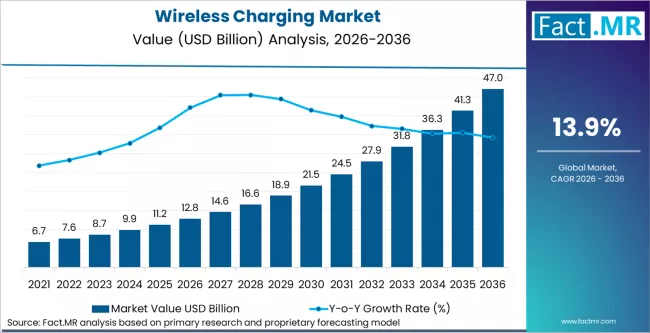
In 2025, the wireless charging market was valued at USD 11.3 billion. Based on FMR analysis, demand for wireless charging solutions is estimated to grow to USD 12.8 billion in 2026 and USD 47.2 billion by 2036. Fact MR projects a CAGR of 13.9% during the forecast period.
The absolute dollar growth from 2026 to 2036 is USD 34.4 billion. This growth is driven by increasing adoption of electric vehicles, smartphones, wearable devices, and IoT applications that support wireless charging. The convenience of cable-free energy transfer, coupled with advancements in charging efficiency and safety, is further supporting market expansion. However, high initial costs and interoperability issues between devices may limit growth in some regions.
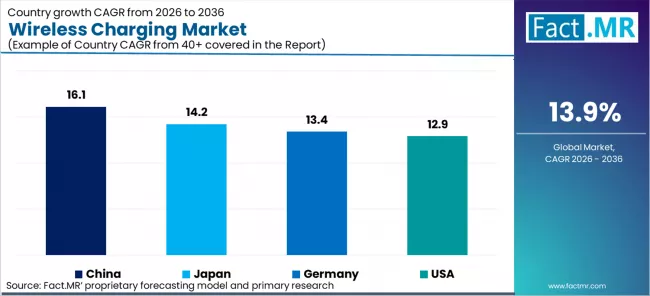
China leads with a CAGR of 16.1%, driven by strong adoption of EVs, smartphones, and consumer electronics. Japan follows with 14.2%, supported by high demand for automotive and consumer device wireless charging solutions. Germany grows at 13.4%, reflecting steady adoption in the automotive sector and industrial applications. The USA grows at 12.9%, fueled by increasing use of wireless charging in consumer electronics, EVs, and smart devices.
Wireless Charging Market
| Metric | Value |
|---|---|
| Estimated Value in (2026E) | USD 12.8 billion |
| Forecast Value in (2036F) | USD 47.2 billion |
| Forecast CAGR (2026 to 2036) | 13.9% |
Wireless Charging Market Definition
The Wireless Charging Market involves the development, manufacture, and sale of systems that transmit electrical power without physical connectors to charge electronic devices, vehicles, and other equipment via inductive, resonant, or radio frequency technologies.
Market Inclusions
This report covers global and regional market sizes for wireless charging over a defined forecast period, including technology types (inductive, resonant, RF), application segments (consumer electronics, electric vehicles, industrial devices), and sales channels (OEM integration, aftermarket accessories).
Market Exclusions
The scope excludes wired charging solutions, power adapters and cables not designed for wireless energy transfer, and unrelated power electronics outside wireless charging technologies.
Research Methodology
Primary Research: Interviews were conducted with product developers, component suppliers, and industry analysts.
- Desk Research: Data was sourced from industry reports, technology publications, and trade association statistics.
- Market‑Sizing and Forecasting: A hybrid model combining top‑down technology adoption forecasts with bottom‑up shipment and revenue data was used.
- Data Validation and Update Cycle: Findings were validated through expert review and aligned with recent production, adoption, and trade figures.
Summary of the Wireless Charging Market
- Market Definition
- The Wireless Charging Market includes technologies, systems, and devices that enable the transfer of electrical power without physical connectors, using methods such as inductive charging, magnetic resonance, or radio frequency. It covers applications across consumer electronics, electric vehicles, industrial equipment, and healthcare devices.
- Demand Drivers
- Increasing adoption of electric vehicles, smartphones, wearable devices, and IoT applications.
- Growing preference for cable-free, convenient charging solutions.
- Advancements in charging efficiency, safety, and interoperability.
- Rising integration of wireless charging in industrial automation and smart factories.
- Expansion of connected device ecosystems in Asia Pacific, North America, and Europe.
- Key Segments Analyzed
- Technology Type: Inductive Charging (62.3% share in 2026), Magnetic Resonance, Radio Frequency, Others.
- Application: Consumer Electronics, Automotive, Industrial (29% share in 2026), Healthcare, Others.
- Power Range: Low Power (0-5W), Medium Power (5-50W), High Power (50W+).
- Geography: East Asia, Europe, North America; China leads at 16.1% CAGR, Japan 14.2%, Germany 13.4%, USA 12.9%.
- Analyst Opinion at Fact MR
- Shambhu Nath Jha, Principal Consultant, Fact MR, opines, 'In this updated edition of the Wireless Charging Market report, industry participants will observe that value creation is shifting from basic wired power delivery toward integrated, inductive, and resonant wireless solutions. Wireless charging technologies are no longer optional accessories but core enablers of mobility, convenience, and industrial efficiency. Providers that invest in high-efficiency inductive systems, cross-device compatibility, and automotive-grade solutions will capture margin expansion beyond consumer electronics. The convergence of interoperability, power performance, and safety defines the competitive landscape through 2036.'
- Strategic Implications/Executive Takeaways
- Focus on inductive charging solutions for consumer electronics, wearables, and EVs.
- Expand industrial wireless charging applications for AGVs, robots, and smart factory operations.
- Target high-growth regions such as China, Japan, and North America with localized deployment strategies.
- Ensure interoperability, Qi certification, and standards compliance across devices and platforms.
- Develop scalable, high-power solutions for automotive and industrial applications.
- Leverage partnerships with OEMs and consumer electronics brands to drive adoption.
- Methodology
- Primary Research: Interviews with product developers, component suppliers, and industry analysts.
- Desk Research: Data sourced from industry reports, technology publications, and trade association statistics.
- Market Sizing & Forecasting: Hybrid model combining top-down technology adoption forecasts with bottom-up shipment and revenue data.
- Data Validation: Findings validated through expert review and aligned with recent production, adoption, and deployment figures using proprietary Fact MR forecasting models.
Segmental Analysis
Wireless Charging Market Analysis by Technology Type
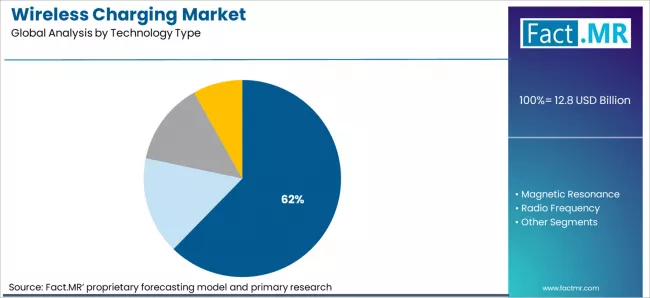
Market Overview: Inductive charging is expected to capture 62.3% of the market share by 2026. Inductive wireless charging, based on electromagnetic induction, is widely used due to its efficiency, safety, and compatibility with smartphones, wearables, and consumer electronics. Its proven reliability and ease of integration make it the dominant technology in the market.
Demand Drivers:
- Rapid Adoption in Consumer Electronics: Smartphones, tablets, and wearables increasingly support inductive charging, driving its widespread market adoption.
- Ease of Use and Convenience: Inductive charging allows users to charge devices without cables, enhancing convenience and user experience.
- Safety and Compatibility: Inductive charging is safe, reliable, and compatible with multiple devices, making it a preferred technology across consumer and industrial applications.
Wireless Charging Market Analysis by Application
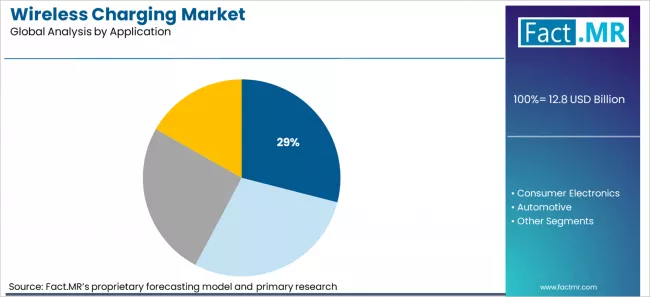
Market Overview: Industrial applications are projected to hold 29% of the market share by 2026. Wireless charging is used in industrial environments to power autonomous robots, AGVs, sensors, and equipment, enabling uninterrupted operations without frequent manual charging.
Demand Drivers:
- Automation and Robotics Growth: Industrial adoption of automated guided vehicles (AGVs) and robots increases the need for wireless charging solutions that reduce downtime.
- Efficiency and Safety: Wireless charging eliminates manual handling of power cables in industrial environments, improving operational safety and efficiency.
- Integration in Smart Factories: The rise of smart manufacturing and Industry 4.0 encourages adoption of wireless charging systems to support continuous, connected industrial operations.
Wireless Charging Market Drivers, Restraints, and Opportunities
FMR analysts observe that the wireless charging market is a growth‑aligned, technology‑driven segment propelled by increasing adoption of smartphones, wearables, and electric vehicles (EVs). Historically, wired charging dominated due to cost and efficiency; as consumer desire for convenience and OEM integration grew, structural demand emerged for inductive and resonant wireless solutions that eliminate cables and enhance user experience. The 2026 valuation reflects this shift, with uptake tied to broader device ecosystems and mobility electrification rather than isolated product upgrades.
While traditional wired chargers remain significant in cost‑sensitive segments, advanced wireless systems-Qi‑certified consumer pads and EV wireless power transfer-are gaining share because they deliver hands‑free convenience and integration with smart environments. These higher‑value solutions often command premium pricing, contributing to net market value growth even as unit volumes scale with device penetration and infrastructure build‑out. The market exists because users increasingly prefer seamless power delivery and industries seek differentiating features in competitive product portfolios.
- Convenience and UX Demand: Consumers adopt wireless charging to replace cables with seamless, contactless power delivery across phones, wearables, and accessories.
- Standards and Interoperability: Certification frameworks like the Qi standard push adoption of interoperable wireless chargers that meet performance and safety criteria.
- Regional Tech Adoption: In Asia‑Pacific and North America, strong smartphone use and EV growth drive higher wireless charging uptake compared with regions with slower tech adoption.
Regional Analysis
The market analysis covers key global regions, including East Asia, North America, and Europe. It is segmented geographically, with specific market dynamics for each region. The full report provides a detailed market attractiveness analysis.
| Country | CAGR (2026-2036) |
|---|---|
| China | 16.1% |
| Japan | 14.2% |
| Germany | 13.4% |
| USA | 12.9% |
Source: Fact MR (FMR) analysis, based on proprietary forecasting model and primary research
East Asia
China and Japan are leading markets, driven by smartphone adoption, electric vehicle growth, and increasing integration of wireless charging in consumer electronics. Key players include Xiaomi, Samsung Electronics, and Panasonic.
- China: Demand for wireless charging solutions in China is projected to rise at 16.1% CAGR through 2036. Growth is supported by expansion of smartphone manufacturing (03-2025) and Xiaomi’s regional production and distribution increase (08-2025).
- Japan: Demand for wireless charging solutions in Japan is projected to rise at 14.2% CAGR through 2036. Growth is influenced by adoption in consumer electronics and EV sectors (02-2025) and Panasonic’s facility expansions (07-2025).
Europe
Germany is a key market, supported by automotive applications, consumer electronics adoption, and industrial wireless charging initiatives.
- Germany: Demand for wireless charging solutions in Germany is projected to rise at 13.4% CAGR through 2036. Growth is supported by automotive industry integration projects (04-2025) and Bosch’s regional product development expansions (09-2025).
North America
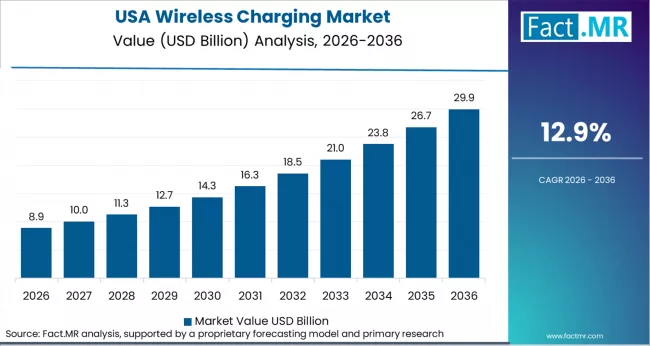
The USA is a major market, driven by consumer electronics adoption, EV charging infrastructure, and enterprise wireless solutions.
- USA: Demand for wireless charging solutions in the U.S. is projected to rise at 12.9% CAGR through 2036. Growth is supported by federal EV charging programs (05-2025) and Apple and Tesla’s regional deployment of wireless charging technologies (08-2025).
Fact MR's analysis of the wireless charging market in East Asia, Europe, and North America consists of country-wise assessments that include China, Japan, Germany, and the USA. Readers can find detailed trends, regulatory updates, and company-specific investments shaping market growth in these countries.
What is the Competitive Structure and Buyer Behavior in the Wireless Charging Market?
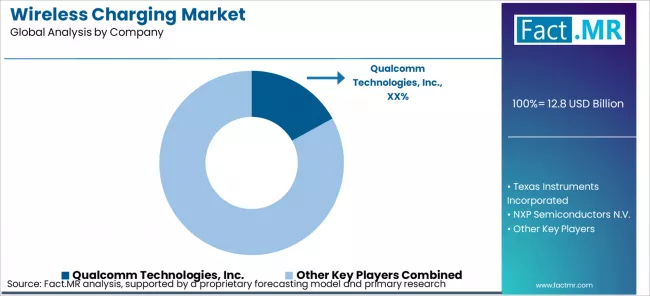
The wireless charging market is moderately concentrated, with major technology and semiconductor firms such as Qualcomm Technologies, Inc., Texas Instruments Incorporated, NXP Semiconductors N.V., STMicroelectronics N.V., Infineon Technologies AG, Renesas Electronics Corporation, Samsung Electronics Co., Ltd., and Apple Inc. holding significant share alongside specialised innovators like WiTricity Corporation and Powermat Technologies Ltd. The primary competitive variables are power transfer efficiency, interoperability with global standards (e.g., Qi), integration ease with consumer and automotive platforms, and design scalability. Companies with extensive R&D capabilities, broad patent portfolios, and strong ecosystem partnerships hold structural advantages because they can drive standard adoption, deliver optimized system‑level solutions, and support cross‑device compatibility that appeals to OEMs and end users.
Large original equipment manufacturers, consumer electronics brands, and automotive OEMs exert notable buyer leverage by qualifying multiple module and chipset suppliers, negotiating long‑term supply agreements, and specifying performance and interoperability criteria tied to product roadmaps. To manage supplier dependency, these buyers often adopt multi‑source strategies, require adherence to open standards, and emphasize platform flexibility. This buyer behavior limits individual suppliers’ pricing power and shifts competition toward delivering high performance, robust integration, and broad ecosystem support rather than on price alone.
Key Players of the Wireless Charging Market
- Qualcomm Technologies, Inc.
- Texas Instruments Incorporated
- NXP Semiconductors N.V.
- STMicroelectronics N.V.
- Infineon Technologies AG
- Renesas Electronics Corporation
- Samsung Electronics Co., Ltd.
- Apple Inc.
- WiTricity Corporation
- Powermat Technologies Ltd.
Report Scope
| Metric | Value |
|---|---|
| Quantitative Units | USD 12.8 billion (2026) to USD 47.2 billion (2036), at a CAGR of 13.9% |
| Market Definition | The Wireless Charging Market includes technologies, systems, and devices that enable the transfer of electrical power without physical connectors, using methods such as inductive charging, magnetic resonance, or radio frequency. |
| Technology Type | Inductive Charging, Magnetic Resonance, Radio Frequency, Others |
| Application | Consumer Electronics, Automotive, Industrial, Healthcare, Other applications |
| Power Range | Low Power (0-5 W), Medium Power (5-50 W), High Power (50 W+) |
| Regions Covered | North America, Latin America, Europe, East Asia, South Asia & Pacific, Middle East & Africa |
| Countries Covered | United States, Canada, Mexico, Brazil, Germany, France, United Kingdom, Italy, Spain, China, India, Japan, South Korea, Australia & New Zealand, GCC Countries, South Africa |
| Key Companies Profiled | Qualcomm Technologies, Inc., Texas Instruments Incorporated, NXP Semiconductors N.V., STMicroelectronics N.V., Infineon Technologies AG, Renesas Electronics Corporation, Samsung Electronics Co., Ltd., Apple Inc., WiTricity Corporation, Powermat Technologies Ltd. |
| Forecast Period | 2026 to 2036 |
| Approach | Market sizing based on historical adoption of wireless charging, device penetration, power range distribution, and vendor revenue, validated through interviews and industry reports. |
Wireless Charging Market Key Segments
-
Technology Type
- Inductive Charging
- Magnetic Resonance
- Radio Frequency
- Others
-
Application
- Consumer Electronics
- Automotive
- Industrial
- Healthcare
- Others
-
Power Range
- Low Power (0-5W)
- Medium Power (5-50W)
- High Power (50W+)
-
Region
- North America
- USA
- Canada
- Mexico
- Europe
- Germany
- UK
- France
- Italy
- Spain
- Nordic Countries
- BENELUX
- Rest of Europe
- Asia Pacific
- China
- Japan
- South Korea
- India
- Australia
- Rest of Asia Pacific
- Latin America
- Brazil
- Argentina
- Rest of Latin America
- Middle East and Africa
- Kingdom of Saudi Arabia
- United Arab Emirates
- South Africa
- Rest of Middle East and Africa
- Other Regions
- Oceania
- Central Asia
- Other Markets
- North America
Bibliographies
- International Electrotechnical Commission. (2023). IEC standards for wireless power transfer systems and inductive charging technologies. International Electrotechnical Commission.
- Institute of Electrical and Electronics Engineers. (2023). Wireless power transfer and inductive charging systems for consumer electronics and electric vehicles. IEEE.
- International Energy Agency. (2024). Electric vehicle charging infrastructure and emerging wireless charging technologies. International Energy Agency.
- National Renewable Energy Laboratory. (2023). Wireless charging systems for electric vehicles and smart mobility applications. National Renewable Energy Laboratory.
- Qualcomm Incorporated. (2024). Qualcomm annual report: Wireless connectivity, charging technologies, and semiconductor innovation. Qualcomm Incorporated.
- NXP Semiconductors N.V. (2024). NXP annual report: Automotive electronics and wireless power solutions. NXP Semiconductors N.V.
- Apple Inc. (2024). Apple annual report: Consumer electronics ecosystem and wireless charging technologies. Apple Inc.
This report addresses
- Market intelligence enabling a detailed assessment of leading countries, technology types, application segments, and power ranges in the Wireless Charging Market globally.
- Market volume (revenue) estimates and 10-year revenue forecasts from 2026 to 2036, validated through device shipment data, power range distribution, and adoption trends across consumer electronics, EVs, and industrial systems.
- Growth opportunity mapping across technology types (Inductive Charging, Magnetic Resonance, Radio Frequency, Others), applications (Consumer Electronics, Automotive, Industrial, Healthcare, Others), power ranges (Low Power 0-5W, Medium Power 5-50W, High Power 50W+), and regions.
- Segment and regional revenue forecasts by technology, application, power range, and geography, covering 40+ countries.
- Competition strategy analysis focusing on power transfer efficiency, Qi standard interoperability, integration with device ecosystems, R&D portfolios, and cross-platform deployment, including major players Qualcomm Technologies, Inc., Texas Instruments Incorporated, NXP Semiconductors N.V., STMicroelectronics N.V., Infineon Technologies AG, Renesas Electronics Corporation, Samsung Electronics Co., Ltd., Apple Inc., WiTricity Corporation, and Powermat Technologies Ltd.
- Product, technology, and regulatory tracking aligned with wireless power standards, EV charging regulations, and consumer electronics certification frameworks.
- Adoption dynamics emphasizing smartphone and wearable integration, EV wireless infrastructure, industrial automation, and inductive/resonant charging technologies.
- Report delivery in PDF, Excel, PowerPoint, and interactive dashboard formats for executive, operational, and strategic planning use.
Table of Content
- Executive Summary
- Global Market Outlook
- Demand to side Trends
- Supply to side Trends
- Technology Roadmap Analysis
- Analysis and Recommendations
- Market Overview
- Market Coverage / Taxonomy
- Market Definition / Scope / Limitations
- Research Methodology
- Chapter Orientation
- Analytical Lens and Working Hypotheses
- Market Structure, Signals, and Trend Drivers
- Benchmarking and Cross-market Comparability
- Market Sizing, Forecasting, and Opportunity Mapping
- Research Design and Evidence Framework
- Desk Research Programme (Secondary Evidence)
- Company Annual and Sustainability Reports
- Peer-reviewed Journals and Academic Literature
- Corporate Websites, Product Literature, and Technical Notes
- Earnings Decks and Investor Briefings
- Statutory Filings and Regulatory Disclosures
- Technical White Papers and Standards Notes
- Trade Journals, Industry Magazines, and Analyst Briefs
- Conference Proceedings, Webinars, and Seminar Materials
- Government Statistics Portals and Public Data Releases
- Press Releases and Reputable Media Coverage
- Specialist Newsletters and Curated Briefings
- Sector Databases and Reference Repositories
- FMR Internal Proprietary Databases and Historical Market Datasets
- Subscription Datasets and Paid Sources
- Social Channels, Communities, and Digital Listening Inputs
- Additional Desk Sources
- Expert Input and Fieldwork (Primary Evidence)
- Primary Modes
- Qualitative Interviews and Expert Elicitation
- Quantitative Surveys and Structured Data Capture
- Blended Approach
- Why Primary Evidence is Used
- Field Techniques
- Interviews
- Surveys
- Focus Groups
- Observational and In-context Research
- Social and Community Interactions
- Stakeholder Universe Engaged
- C-suite Leaders
- Board Members
- Presidents and Vice Presidents
- R&D and Innovation Heads
- Technical Specialists
- Domain Subject-matter Experts
- Scientists
- Physicians and Other Healthcare Professionals
- Governance, Ethics, and Data Stewardship
- Research Ethics
- Data Integrity and Handling
- Primary Modes
- Tooling, Models, and Reference Databases
- Desk Research Programme (Secondary Evidence)
- Data Engineering and Model Build
- Data Acquisition and Ingestion
- Cleaning, Normalisation, and Verification
- Synthesis, Triangulation, and Analysis
- Quality Assurance and Audit Trail
- Market Background
- Market Dynamics
- Drivers
- Restraints
- Opportunity
- Trends
- Scenario Forecast
- Demand in Optimistic Scenario
- Demand in Likely Scenario
- Demand in Conservative Scenario
- Opportunity Map Analysis
- Product Life Cycle Analysis
- Supply Chain Analysis
- Investment Feasibility Matrix
- Value Chain Analysis
- PESTLE and Porter’s Analysis
- Regulatory Landscape
- Regional Parent Market Outlook
- Production and Consumption Statistics
- Import and Export Statistics
- Market Dynamics
- Global Market Analysis 2021 to 2025 and Forecast, 2026 to 2036
- Historical Market Size Value (USD Million) Analysis, 2021 to 2025
- Current and Future Market Size Value (USD Million) Projections, 2026 to 2036
- Y to o to Y Growth Trend Analysis
- Absolute $ Opportunity Analysis
- Global Market Pricing Analysis 2021 to 2025 and Forecast 2026 to 2036
- Global Market Analysis 2021 to 2025 and Forecast 2026 to 2036, By Technology Type
- Introduction / Key Findings
- Historical Market Size Value (USD Million) Analysis By Technology Type , 2021 to 2025
- Current and Future Market Size Value (USD Million) Analysis and Forecast By Technology Type , 2026 to 2036
- Inductive Charging
- Magnetic Resonance
- Radio Frequency
- Others
- Inductive Charging
- Y to o to Y Growth Trend Analysis By Technology Type , 2021 to 2025
- Absolute $ Opportunity Analysis By Technology Type , 2026 to 2036
- Global Market Analysis 2021 to 2025 and Forecast 2026 to 2036, By Application
- Introduction / Key Findings
- Historical Market Size Value (USD Million) Analysis By Application, 2021 to 2025
- Current and Future Market Size Value (USD Million) Analysis and Forecast By Application, 2026 to 2036
- Industrial
- Consumer Electronics
- Automotive
- Others
- Industrial
- Y to o to Y Growth Trend Analysis By Application, 2021 to 2025
- Absolute $ Opportunity Analysis By Application, 2026 to 2036
- Global Market Analysis 2021 to 2025 and Forecast 2026 to 2036, By Region
- Introduction
- Historical Market Size Value (USD Million) Analysis By Region, 2021 to 2025
- Current Market Size Value (USD Million) Analysis and Forecast By Region, 2026 to 2036
- North America
- Latin America
- Western Europe
- Eastern Europe
- East Asia
- South Asia and Pacific
- Middle East & Africa
- Market Attractiveness Analysis By Region
- North America Market Analysis 2021 to 2025 and Forecast 2026 to 2036, By Country
- Historical Market Size Value (USD Million) Trend Analysis By Market Taxonomy, 2021 to 2025
- Market Size Value (USD Million) Forecast By Market Taxonomy, 2026 to 2036
- By Country
- USA
- Canada
- Mexico
- By Technology Type
- By Application
- By Country
- Market Attractiveness Analysis
- By Country
- By Technology Type
- By Application
- Key Takeaways
- Latin America Market Analysis 2021 to 2025 and Forecast 2026 to 2036, By Country
- Historical Market Size Value (USD Million) Trend Analysis By Market Taxonomy, 2021 to 2025
- Market Size Value (USD Million) Forecast By Market Taxonomy, 2026 to 2036
- By Country
- Brazil
- Chile
- Rest of Latin America
- By Technology Type
- By Application
- By Country
- Market Attractiveness Analysis
- By Country
- By Technology Type
- By Application
- Key Takeaways
- Western Europe Market Analysis 2021 to 2025 and Forecast 2026 to 2036, By Country
- Historical Market Size Value (USD Million) Trend Analysis By Market Taxonomy, 2021 to 2025
- Market Size Value (USD Million) Forecast By Market Taxonomy, 2026 to 2036
- By Country
- Germany
- UK
- Italy
- Spain
- France
- Nordic
- BENELUX
- Rest of Western Europe
- By Technology Type
- By Application
- By Country
- Market Attractiveness Analysis
- By Country
- By Technology Type
- By Application
- Key Takeaways
- Eastern Europe Market Analysis 2021 to 2025 and Forecast 2026 to 2036, By Country
- Historical Market Size Value (USD Million) Trend Analysis By Market Taxonomy, 2021 to 2025
- Market Size Value (USD Million) Forecast By Market Taxonomy, 2026 to 2036
- By Country
- Russia
- Poland
- Hungary
- Balkan & Baltic
- Rest of Eastern Europe
- By Technology Type
- By Application
- By Country
- Market Attractiveness Analysis
- By Country
- By Technology Type
- By Application
- Key Takeaways
- East Asia Market Analysis 2021 to 2025 and Forecast 2026 to 2036, By Country
- Historical Market Size Value (USD Million) Trend Analysis By Market Taxonomy, 2021 to 2025
- Market Size Value (USD Million) Forecast By Market Taxonomy, 2026 to 2036
- By Country
- China
- Japan
- South Korea
- By Technology Type
- By Application
- By Country
- Market Attractiveness Analysis
- By Country
- By Technology Type
- By Application
- Key Takeaways
- South Asia and Pacific Market Analysis 2021 to 2025 and Forecast 2026 to 2036, By Country
- Historical Market Size Value (USD Million) Trend Analysis By Market Taxonomy, 2021 to 2025
- Market Size Value (USD Million) Forecast By Market Taxonomy, 2026 to 2036
- By Country
- India
- ASEAN
- Australia & New Zealand
- Rest of South Asia and Pacific
- By Technology Type
- By Application
- By Country
- Market Attractiveness Analysis
- By Country
- By Technology Type
- By Application
- Key Takeaways
- Middle East & Africa Market Analysis 2021 to 2025 and Forecast 2026 to 2036, By Country
- Historical Market Size Value (USD Million) Trend Analysis By Market Taxonomy, 2021 to 2025
- Market Size Value (USD Million) Forecast By Market Taxonomy, 2026 to 2036
- By Country
- Kingdom of Saudi Arabia
- Other GCC Countries
- Turkiye
- South Africa
- Other African Union
- Rest of Middle East & Africa
- By Technology Type
- By Application
- By Country
- Market Attractiveness Analysis
- By Country
- By Technology Type
- By Application
- Key Takeaways
- Key Countries Market Analysis
- USA
- Pricing Analysis
- Market Share Analysis, 2025
- By Technology Type
- By Application
- Canada
- Pricing Analysis
- Market Share Analysis, 2025
- By Technology Type
- By Application
- Mexico
- Pricing Analysis
- Market Share Analysis, 2025
- By Technology Type
- By Application
- Brazil
- Pricing Analysis
- Market Share Analysis, 2025
- By Technology Type
- By Application
- Chile
- Pricing Analysis
- Market Share Analysis, 2025
- By Technology Type
- By Application
- Germany
- Pricing Analysis
- Market Share Analysis, 2025
- By Technology Type
- By Application
- UK
- Pricing Analysis
- Market Share Analysis, 2025
- By Technology Type
- By Application
- Italy
- Pricing Analysis
- Market Share Analysis, 2025
- By Technology Type
- By Application
- Spain
- Pricing Analysis
- Market Share Analysis, 2025
- By Technology Type
- By Application
- France
- Pricing Analysis
- Market Share Analysis, 2025
- By Technology Type
- By Application
- India
- Pricing Analysis
- Market Share Analysis, 2025
- By Technology Type
- By Application
- ASEAN
- Pricing Analysis
- Market Share Analysis, 2025
- By Technology Type
- By Application
- Australia & New Zealand
- Pricing Analysis
- Market Share Analysis, 2025
- By Technology Type
- By Application
- China
- Pricing Analysis
- Market Share Analysis, 2025
- By Technology Type
- By Application
- Japan
- Pricing Analysis
- Market Share Analysis, 2025
- By Technology Type
- By Application
- South Korea
- Pricing Analysis
- Market Share Analysis, 2025
- By Technology Type
- By Application
- Russia
- Pricing Analysis
- Market Share Analysis, 2025
- By Technology Type
- By Application
- Poland
- Pricing Analysis
- Market Share Analysis, 2025
- By Technology Type
- By Application
- Hungary
- Pricing Analysis
- Market Share Analysis, 2025
- By Technology Type
- By Application
- Kingdom of Saudi Arabia
- Pricing Analysis
- Market Share Analysis, 2025
- By Technology Type
- By Application
- Turkiye
- Pricing Analysis
- Market Share Analysis, 2025
- By Technology Type
- By Application
- South Africa
- Pricing Analysis
- Market Share Analysis, 2025
- By Technology Type
- By Application
- USA
- Market Structure Analysis
- Competition Dashboard
- Competition Benchmarking
- Market Share Analysis of Top Players
- By Regional
- By Technology Type
- By Application
- Competition Analysis
- Competition Deep Dive
- Qualcomm Technologies, Inc.
- Overview
- Product Portfolio
- Profitability by Market Segments (Product/Age /Sales Channel/Region)
- Sales Footprint
- Strategy Overview
- Marketing Strategy
- Product Strategy
- Channel Strategy
- Texas Instruments Incorporated
- NXP Semiconductors N.V.
- STMicroelectronics N.V.
- Infineon Technologies AG
- Renesas Electronics Corporation
- Samsung Electronics Co., Ltd.
- Apple Inc.
- WiTricity Corporation
- Powermat Technologies Ltd.
- Qualcomm Technologies, Inc.
- Competition Deep Dive
- Assumptions & Acronyms Used
List Of Table
- Table 1: Global Market Value (USD Million) Forecast by Region, 2021 to 2036
- Table 2: Global Market Value (USD Million) Forecast by Technology Type, 2021 to 2036
- Table 3: Global Market Value (USD Million) Forecast by Application, 2021 to 2036
- Table 4: North America Market Value (USD Million) Forecast by Country, 2021 to 2036
- Table 5: North America Market Value (USD Million) Forecast by Technology Type, 2021 to 2036
- Table 6: North America Market Value (USD Million) Forecast by Application, 2021 to 2036
- Table 7: Latin America Market Value (USD Million) Forecast by Country, 2021 to 2036
- Table 8: Latin America Market Value (USD Million) Forecast by Technology Type, 2021 to 2036
- Table 9: Latin America Market Value (USD Million) Forecast by Application, 2021 to 2036
- Table 10: Western Europe Market Value (USD Million) Forecast by Country, 2021 to 2036
- Table 11: Western Europe Market Value (USD Million) Forecast by Technology Type, 2021 to 2036
- Table 12: Western Europe Market Value (USD Million) Forecast by Application, 2021 to 2036
- Table 13: Eastern Europe Market Value (USD Million) Forecast by Country, 2021 to 2036
- Table 14: Eastern Europe Market Value (USD Million) Forecast by Technology Type, 2021 to 2036
- Table 15: Eastern Europe Market Value (USD Million) Forecast by Application, 2021 to 2036
- Table 16: East Asia Market Value (USD Million) Forecast by Country, 2021 to 2036
- Table 17: East Asia Market Value (USD Million) Forecast by Technology Type, 2021 to 2036
- Table 18: East Asia Market Value (USD Million) Forecast by Application, 2021 to 2036
- Table 19: South Asia and Pacific Market Value (USD Million) Forecast by Country, 2021 to 2036
- Table 20: South Asia and Pacific Market Value (USD Million) Forecast by Technology Type, 2021 to 2036
- Table 21: South Asia and Pacific Market Value (USD Million) Forecast by Application, 2021 to 2036
- Table 22: Middle East & Africa Market Value (USD Million) Forecast by Country, 2021 to 2036
- Table 23: Middle East & Africa Market Value (USD Million) Forecast by Technology Type, 2021 to 2036
- Table 24: Middle East & Africa Market Value (USD Million) Forecast by Application, 2021 to 2036
List Of Figures
- Figure 1: Global Market Pricing Analysis
- Figure 2: Global Market Value (USD Million) Forecast 2021-2036
- Figure 3: Global Market Value Share and BPS Analysis by Technology Type, 2026 and 2036
- Figure 4: Global Market Y to o to Y Growth Comparison by Technology Type, 2026 to 2036
- Figure 5: Global Market Attractiveness Analysis by Technology Type
- Figure 6: Global Market Value Share and BPS Analysis by Application, 2026 and 2036
- Figure 7: Global Market Y to o to Y Growth Comparison by Application, 2026 to 2036
- Figure 8: Global Market Attractiveness Analysis by Application
- Figure 9: Global Market Value (USD Million) Share and BPS Analysis by Region, 2026 and 2036
- Figure 10: Global Market Y to o to Y Growth Comparison by Region, 2026 to 2036
- Figure 11: Global Market Attractiveness Analysis by Region
- Figure 12: North America Market Incremental Dollar Opportunity, 2026 to 2036
- Figure 13: Latin America Market Incremental Dollar Opportunity, 2026 to 2036
- Figure 14: Western Europe Market Incremental Dollar Opportunity, 2026 to 2036
- Figure 15: Eastern Europe Market Incremental Dollar Opportunity, 2026 to 2036
- Figure 16: East Asia Market Incremental Dollar Opportunity, 2026 to 2036
- Figure 17: South Asia and Pacific Market Incremental Dollar Opportunity, 2026 to 2036
- Figure 18: Middle East & Africa Market Incremental Dollar Opportunity, 2026 to 2036
- Figure 19: North America Market Value Share and BPS Analysis by Country, 2026 and 2036
- Figure 20: North America Market Value Share and BPS Analysis by Technology Type, 2026 and 2036
- Figure 21: North America Market Y to o to Y Growth Comparison by Technology Type, 2026 to 2036
- Figure 22: North America Market Attractiveness Analysis by Technology Type
- Figure 23: North America Market Value Share and BPS Analysis by Application, 2026 and 2036
- Figure 24: North America Market Y to o to Y Growth Comparison by Application, 2026 to 2036
- Figure 25: North America Market Attractiveness Analysis by Application
- Figure 26: Latin America Market Value Share and BPS Analysis by Country, 2026 and 2036
- Figure 27: Latin America Market Value Share and BPS Analysis by Technology Type, 2026 and 2036
- Figure 28: Latin America Market Y to o to Y Growth Comparison by Technology Type, 2026 to 2036
- Figure 29: Latin America Market Attractiveness Analysis by Technology Type
- Figure 30: Latin America Market Value Share and BPS Analysis by Application, 2026 and 2036
- Figure 31: Latin America Market Y to o to Y Growth Comparison by Application, 2026 to 2036
- Figure 32: Latin America Market Attractiveness Analysis by Application
- Figure 33: Western Europe Market Value Share and BPS Analysis by Country, 2026 and 2036
- Figure 34: Western Europe Market Value Share and BPS Analysis by Technology Type, 2026 and 2036
- Figure 35: Western Europe Market Y to o to Y Growth Comparison by Technology Type, 2026 to 2036
- Figure 36: Western Europe Market Attractiveness Analysis by Technology Type
- Figure 37: Western Europe Market Value Share and BPS Analysis by Application, 2026 and 2036
- Figure 38: Western Europe Market Y to o to Y Growth Comparison by Application, 2026 to 2036
- Figure 39: Western Europe Market Attractiveness Analysis by Application
- Figure 40: Eastern Europe Market Value Share and BPS Analysis by Country, 2026 and 2036
- Figure 41: Eastern Europe Market Value Share and BPS Analysis by Technology Type, 2026 and 2036
- Figure 42: Eastern Europe Market Y to o to Y Growth Comparison by Technology Type, 2026 to 2036
- Figure 43: Eastern Europe Market Attractiveness Analysis by Technology Type
- Figure 44: Eastern Europe Market Value Share and BPS Analysis by Application, 2026 and 2036
- Figure 45: Eastern Europe Market Y to o to Y Growth Comparison by Application, 2026 to 2036
- Figure 46: Eastern Europe Market Attractiveness Analysis by Application
- Figure 47: East Asia Market Value Share and BPS Analysis by Country, 2026 and 2036
- Figure 48: East Asia Market Value Share and BPS Analysis by Technology Type, 2026 and 2036
- Figure 49: East Asia Market Y to o to Y Growth Comparison by Technology Type, 2026 to 2036
- Figure 50: East Asia Market Attractiveness Analysis by Technology Type
- Figure 51: East Asia Market Value Share and BPS Analysis by Application, 2026 and 2036
- Figure 52: East Asia Market Y to o to Y Growth Comparison by Application, 2026 to 2036
- Figure 53: East Asia Market Attractiveness Analysis by Application
- Figure 54: South Asia and Pacific Market Value Share and BPS Analysis by Country, 2026 and 2036
- Figure 55: South Asia and Pacific Market Value Share and BPS Analysis by Technology Type, 2026 and 2036
- Figure 56: South Asia and Pacific Market Y to o to Y Growth Comparison by Technology Type, 2026 to 2036
- Figure 57: South Asia and Pacific Market Attractiveness Analysis by Technology Type
- Figure 58: South Asia and Pacific Market Value Share and BPS Analysis by Application, 2026 and 2036
- Figure 59: South Asia and Pacific Market Y to o to Y Growth Comparison by Application, 2026 to 2036
- Figure 60: South Asia and Pacific Market Attractiveness Analysis by Application
- Figure 61: Middle East & Africa Market Value Share and BPS Analysis by Country, 2026 and 2036
- Figure 62: Middle East & Africa Market Value Share and BPS Analysis by Technology Type, 2026 and 2036
- Figure 63: Middle East & Africa Market Y to o to Y Growth Comparison by Technology Type, 2026 to 2036
- Figure 64: Middle East & Africa Market Attractiveness Analysis by Technology Type
- Figure 65: Middle East & Africa Market Value Share and BPS Analysis by Application, 2026 and 2036
- Figure 66: Middle East & Africa Market Y to o to Y Growth Comparison by Application, 2026 to 2036
- Figure 67: Middle East & Africa Market Attractiveness Analysis by Application
- Figure 68: Global Market - Tier Structure Analysis
- Figure 69: Global Market - Company Share Analysis
- FAQs -
How large is the demand for Wireless Charging in the global market in 2026?
Demand for Wireless Charging in the global market is estimated to be valued at USD 12.8 billion in 2026.
What will be the market size of Wireless Charging in the global market by 2036?
The market size for Wireless Charging is projected to reach USD 47.2 billion by 2036.
What is the expected demand growth for Wireless Charging in the global market between 2026 and 2036?
Demand for Wireless Charging in the global market is expected to grow at a CAGR of 13.9% between 2026 and 2036.
Which technology type is expected to dominate the market?
Inductive Charging is expected to dominate the market, accounting for 62.3% of the market share in 2026, due to widespread adoption in smartphones, wearable devices, and automotive applications.
Which region is expected to show the highest growth rate for Wireless Charging?
China is projected to show the highest regional CAGR at 16.1%, driven by the rapid adoption of smartphones, electric vehicles, and consumer electronics that support wireless charging.
How significant is the growth outlook for Japan in this market?
Japan is expected to grow at a CAGR of 14.2%, supported by strong adoption of consumer electronics, electric vehicles, and industrial applications of wireless charging technology.
What is the growth outlook for Germany in the Wireless Charging market?
Germany is expected to grow at a CAGR of 13.4%, reflecting growing electric vehicle adoption, industrial automation, and support for inductive and resonant charging solutions.
What is the growth forecast for the United States in the Wireless Charging market?
The United States is projected to grow at a CAGR of 12.9%, driven by increasing smartphone penetration, expansion of EV infrastructure, and adoption of wireless charging solutions in consumer and industrial segments.
Which company is identified as a leading player in the Wireless Charging market?
Qualcomm Technologies, Inc. is recognized as a leading player in this market, providing wireless charging technologies, ICs, and solutions for smartphones, EVs, and consumer electronics.
What is Wireless Charging used for?
Wireless Charging is used to transfer power without physical connectors, enabling charging of smartphones, wearable devices, electric vehicles, and industrial equipment through inductive or resonant coupling technologies.
What does the Wireless Charging market include in this report?
The market scope includes inductive and resonant wireless charging solutions, covering consumer electronics, automotive applications, and industrial use cases.
How is the market forecast developed in this report?
The forecast is developed using historical adoption data, trends in smartphone and EV markets, consumer electronics penetration, and insights from key providers like Qualcomm Technologies, Inc.
What is meant by the Wireless Charging market in this report?
The market refers to the global production, trade, and consumption of wireless charging technologies, with emphasis on inductive charging for consumer electronics, electric vehicles, and industrial applications.