- Base Value(2025): 1.8 Bn
- Estimated Value(2026): 1.8 Bn
- Forecast Value (2036): 2.4 Bn
- CAGR (2026 - 2036): 2.7%
Laboratory Centrifuge Analysis and Forecast by Fact.MR
- The Laboratory Centrifuge Market is expected to grow from USD 1.8 billion in 2026 to USD 2.4 billion by 2036, at a 2.7% CAGR.
- driven by growing clinical diagnostic volumes sustaining benchtop centrifuge demand, biotech and pharmaceutical R&D investment lifting higher-specification procurement, and automation and IoT integration raising the value of connected instruments, with Benchtop Laboratory Centrifuges accounting.
- 46.8% share and Clinical Diagnostics contributing 58.4% share as providers prioritize earlier detection, treatment-selection accuracy, and resource efficiency across clinical settings.
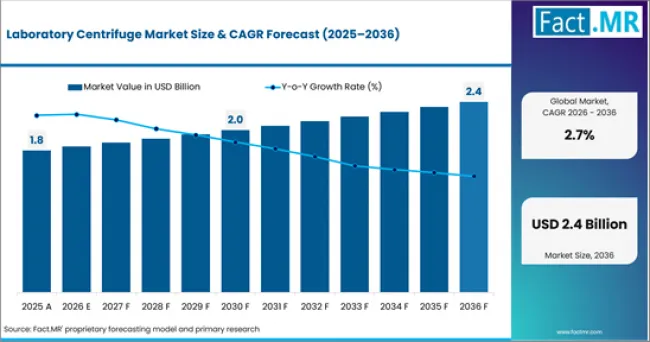
Laboratory Centrifuge Market Value Analysis | Source: Fact.MR
Summary of Laboratory Centrifuge Market
- Market Snapshot
- In 2025, the global Laboratory Centrifuge Market was valued at approximately USD 1.8 billion.
- The market is estimated to reach USD 1.8 billion in 2026 and is projected to attain USD 2.4 billion by 2036.
- The market is likely to expand at a CAGR of 2.7% during the forecast period.
- The market is anticipated to create an absolute dollar opportunity of USD 0.6 billion between 2026 and 2036.
- Benchtop Laboratory Centrifuges accounts for 46.8% of product share in 2026.
- China (3.6%) and India (3.4%) are the key growth markets during the forecast period.
- Demand and Growth Drivers
- Growing clinical diagnostic volumes, driven by infectious-disease testing and chronic-disease management, are sustaining demand for benchtop and high-speed laboratory centrifuges in hospital and laboratory settings.
- Biotech and pharmaceutical R&D investment is lifting procurement of ultracentrifuges and specialty centrifuges for cell separation, protein purification, and drug development workflows.
- Automation and digital integration, including IoT-enabled platforms with LIMS connectivity, are raising the value of connected centrifuges that support workflow efficiency and sample traceability.
- Automated and digitally integrated centrifuge platforms create higher-value, connected instruments supporting lab workflow optimization.
- Growing biotech and cell therapy production pipelines expand demand for high-specification centrifuges.
- Product and Segment View
- Benchtop Laboratory Centrifuges accounts for 46.8% of the product segment in 2026, emerging as the leading category.
- Clinical Diagnostics accounts for 58.4% of the application segment in 2026, making it the dominant use setting.
- Key segmentation includes:
- Product: Benchtop Laboratory Centrifuges, Floor Standing Centrifuges, Ultracentrifuges, Specialty Centrifuges
- Application: Clinical Diagnostics, Biotechnology Research, Pharmaceutical Applications, Academic Research Institutes
- End Use: Hospitals & Diagnostic Centers, Clinical Laboratories, Pharmaceutical & Biotechnology Companies, Academic & Research Institutes
- Technology: High Speed Centrifugation Technology, Refrigeration Control Technology, Automation & Digital Control, Safety & Monitoring Systems
- Formulation: Biological Sample Processing Systems, Chemical Sample Processing Systems, Pharmaceutical Processing Systems, Industrial Processing Systems
- Distribution Channel: Direct Equipment Sales, Laboratory Equipment Distributors, Online Sales Channels, Third Party Service Providers
- These systems enable:
- High-speed biological sample separation
- Automated digital-control centrifugation
- Connected workflow with LIMS integration
- Geography and Competitive Outlook
- North America leads on clinical diagnostic volumes, pharmaceutical and biotech R&D spending, and early adoption of automated and IoT-enabled centrifuge platforms.
- Europe demand reflects strong pharmaceutical and biotech research, EU IVDR diagnostic equipment regulation, and established laboratory distribution.
- Asia Pacific shows moderate growth, as expanding diagnostic laboratory networks in China and India widen the clinical centrifuge base.
- China (3.6%) and India (3.4%) lead country growth, with other major markets showing steady demand.
- Key companies include Thermo Fisher Scientific Inc., Danaher Corporation (Beckman Coulter), Eppendorf SE, KUBOTA Corporation, Andreas Hettich GmbH & Co. KG, Sigma Laborzentrifugen GmbH.
- Analyst Opinion
- Shambhu Nath Jha, Principal Consultant at Fact.MR, says 'Laboratory centrifuge demand rests on two pillars: clinical diagnostic throughput and biotech R&D investment. Benchtop models lead on volume, but the growth direction is automation and digital integration that embed centrifuges into connected laboratory workflows. Long instrument lifetimes moderate replacement cycles, so differentiation turns on IoT platform capability and rotor innovation rather than price. China and India widen the base through diagnostic lab expansion, while mature markets grow through automation upgrades. The suppliers best positioned combine reliable separation performance with digital connectivity and LIMS integration, since laboratory procurement increasingly favors connected instruments over standalone machines.'
Key Growth Drivers, Constraints, and Opportunities
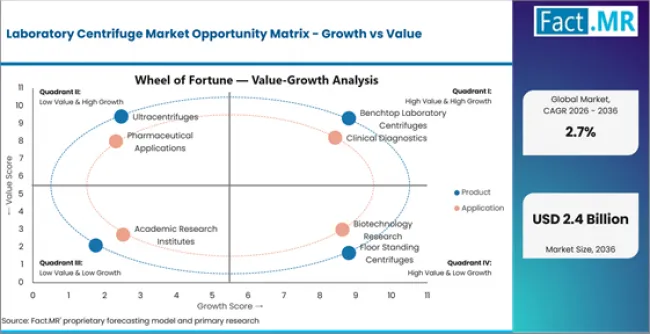
Laboratory Centrifuge Market Opportunity Matrix Growth Vs Value | Source: Fact.MR
Key Factors Driving Growth
- Growing clinical diagnostic volumes, driven by infectious-disease testing and chronic-disease management, are sustaining demand for benchtop and high-speed laboratory centrifuges in hospital and laboratory settings.
- Biotech and pharmaceutical R&D investment is lifting procurement of ultracentrifuges and specialty centrifuges for cell separation, protein purification, and drug development workflows.
- Automation and digital integration, including IoT-enabled platforms with LIMS connectivity, are raising the value of connected centrifuges that support workflow efficiency and sample traceability.
Key Market Constraints
- High instrument cost for advanced ultracentrifuges limits adoption in budget-constrained laboratories.
- Long instrument lifetimes and low failure rates moderate replacement-cycle demand.
- Competition from alternative separation technologies limits centrifuge expansion in some niche applications.
Key Opportunity Areas
- Automated and digitally integrated centrifuge platforms create higher-value, connected instruments supporting lab workflow optimization.
- Growing biotech and cell therapy production pipelines expand demand for high-specification centrifuges.
- Emerging-market diagnostic laboratory expansion widens the clinical centrifuge installed base.
Segment-wise Analysis of the Laboratory Centrifuge
- Benchtop Laboratory Centrifuges holds 46.8% of the product segment in 2026, supported by clinical preference and procurement scale.
- Clinical Diagnostics represents 58.4% of the application segment in 2026, anchored by its dominant care setting.
The Laboratory Centrifuge Market is segmented by product, application, end use, technology, formulation, distribution channel. Demand is shaped by clinical pathway choices, reimbursement exposure, and procurement structure, with leading segments anchored in higher-volume care settings while faster-growing categories capture incremental demand as adoption broadens.
Which Product Segment Dominates the Laboratory Centrifuge?
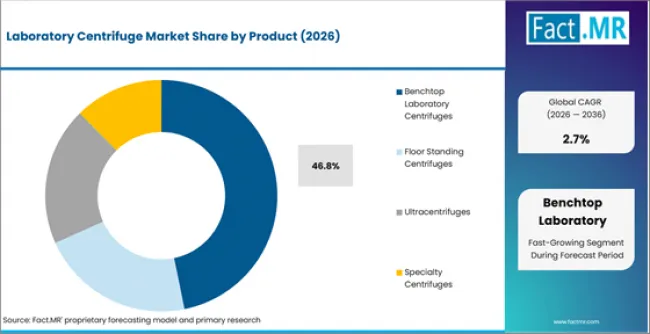
Laboratory Centrifuge Market Analysis By Product | Source: Fact.MR
Benchtop Laboratory Centrifuges lead the product segment with 46.8% share in 2026, reflecting widespread demand for compact, reliable sample-processing instruments across clinical diagnostics, routine research, and pharmaceutical quality-control applications.
The segment is expected to retain leadership as clinical diagnostic volumes sustain high-throughput benchtop demand. Floor-standing, ultracentrifuges, and specialty systems grow through advanced research and precision-medicine applications, but benchtop models hold the largest share through their accessibility and versatility.
Which Application Segment Dominates the Laboratory Centrifuge?
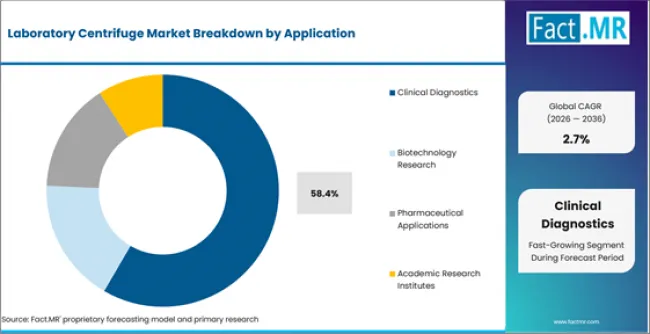
Laboratory Centrifuge Market Analysis By Application | Source: Fact.MR
Clinical Diagnostics leads the application segment with 58.4% share in 2026, driven by high volumes of blood, serum, and biological sample processing required for routine and acute diagnostic testing in hospital and laboratory settings.
The application is likely to hold its lead as diagnostic testing volumes continue to grow. Biotechnology research and pharmaceutical applications expand centrifuge demand for cell separation and drug development, but clinical diagnostics anchors the largest application channel through its daily throughput.
Which Product Trend is Shaping the Next Phase of Growth in the Laboratory Centrifuge?
Benchtop Laboratory Centrifuges lead the product segment at 46.8%, and the defining dynamic is the balance between routine clinical throughput and advanced research specification. High-speed centrifugation technology anchors the largest technology share, with demand concentrated in clinical diagnostics where high volumes of sample processing require reliable, space-efficient benchtop systems.
Automation is the most consequential shift. IoT-enabled centrifuge platforms with digital control and LIMS integration are transforming centrifuges from standalone instruments into connected workflow components. Biological sample processing systems anchor the largest formulation share as clinical and biotech demand sustain the largest application pool.
Regional Outlook Across Key Markets
- North America leads on clinical diagnostic volumes, pharmaceutical and biotech R&D spending, and early adoption of automated and IoT-enabled centrifuge platforms.
- Europe demand reflects strong pharmaceutical and biotech research, EU IVDR diagnostic equipment regulation, and established laboratory distribution.
- Asia Pacific shows moderate growth, as expanding diagnostic laboratory networks in China and India widen the clinical centrifuge base.
- Japan shows steady demand anchored in advanced research infrastructure and preference for domestic instrument suppliers.
.webp "Top Country Growth Comparison Laboratory Centrifuge Market Cagr (2026 2036)")
Top Country Growth Comparison Laboratory Centrifuge Market Cagr (2026 2036) | Source: Fact.MR
CAGR Table
| Country | CAGR (%) |
|---|---|
| China | 3.7% |
| India | 3.4% |
| Germany | 3.1% |
| Brazil | 2.8% |
| USA | 2.6% |
| United Kingdom | 2.3% |
| Japan | 2.0% |
Source: Fact.MR analysis, based on proprietary forecasting model and primary research.
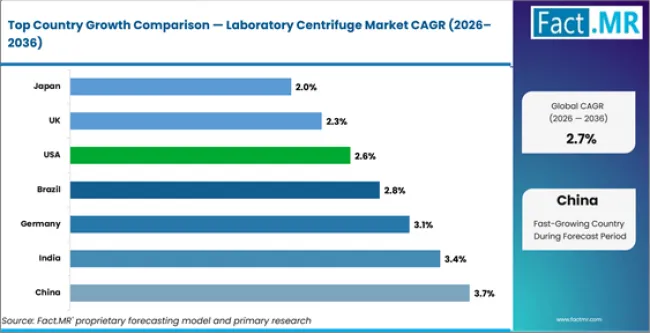
Laboratory Centrifuge Market Cagr Analysis By Country | Source: Fact.MR
Market Outlook for Laboratory Centrifuge in China
The China Laboratory Centrifuge market is projected to grow at a CAGR of 3.6% through 2036. Expanding diagnostic laboratory networks and growing pharmaceutical and biotech R&D investment are widening centrifuge demand. Domestic instrument manufacturing provides cost-competitive benchtop supply, while university and research institute expansion sustains academic procurement.
- Diagnostic laboratory expansion is lifting demand for clinical benchtop centrifuges.
- Pharmaceutical and biotech R&D growth supports higher-specification centrifuge procurement.
India Laboratory Centrifuge Demand Trends
The India Laboratory Centrifuge market is projected to grow at a CAGR of 3.4% through 2036. Demand is shaped by expanding clinical diagnostic infrastructure and growing pharmaceutical manufacturing capacity. Cost-effectiveness favors benchtop centrifuges for routine diagnostics, while private hospital and laboratory investment widens access to higher-speed and refrigerated models.
- Clinical diagnostic infrastructure expansion is widening benchtop centrifuge demand.
- Pharmaceutical manufacturing growth supports specialty centrifuge procurement.
Laboratory Centrifuge Growth Assessment in Germany
The Germany Laboratory Centrifuge market is projected to grow at a CAGR of 3.1% through 2036. EU IVDR diagnostic equipment regulation and pharmaceutical GMP requirements govern centrifuge specification across German laboratories. Strong domestic instrument manufacturing and research funding sustain demand for high-specification ultracentrifuges and automated platforms.
- EU IVDR regulation governs centrifuge specification in diagnostic laboratories.
- Research funding sustains demand for high-specification ultracentrifuges.
United States Laboratory Centrifuge Market Opportunity Outlook
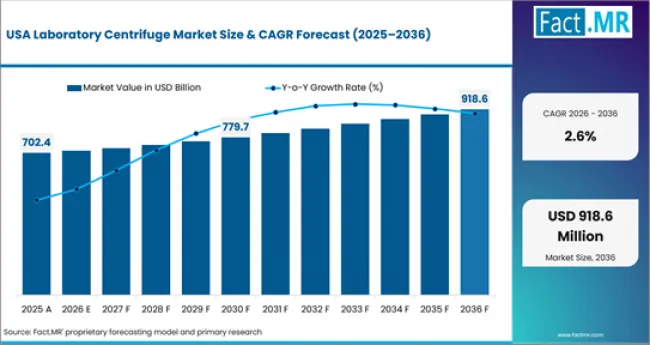
Laboratory Centrifuge Market Country Value Analysis | Source: Fact.MR
The United States Laboratory Centrifuge market is projected to grow at a CAGR of 2.6% through 2036. The laboratory centrifuge installed base is mature, so growth tracks automation upgrades and R&D investment rather than first-time adoption. FDA diagnostic requirements and NIH research funding shape instrument specification, while IoT-enabled platforms with LIMS integration support connected-lab demand.
- Automation and IoT-platform upgrades drive centrifuge replacement demand.
- NIH research funding sustains academic and biotech centrifuge procurement.
Laboratory Centrifuge Demand Analysis in Japan
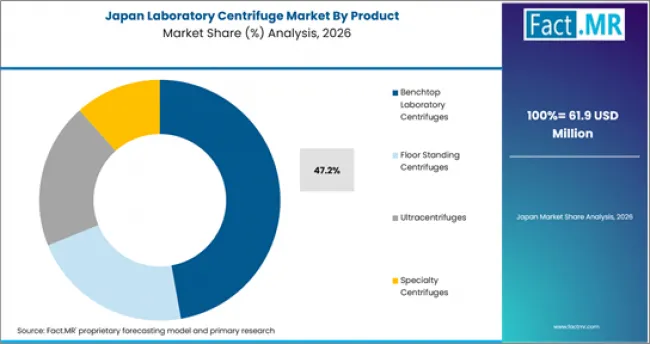
Laboratory Centrifuge Market Japan Market Share Analysis By Product | Source: Fact.MR
The Japan Laboratory Centrifuge market is projected to grow at a CAGR of 2.0% through 2036. Domestic centrifuge manufacturing, including Kubota and Hitachi Koki heritage, and advanced research infrastructure sustain demand for precision instruments. Strict quality standards and preference for domestic suppliers shape procurement, while aging demographic-driven diagnostic volumes sustain clinical demand.
- Domestic manufacturing strength sustains precision centrifuge supply.
- Aging-population diagnostic volumes sustain clinical centrifuge demand.
Competitive Benchmarking and Company Positioning
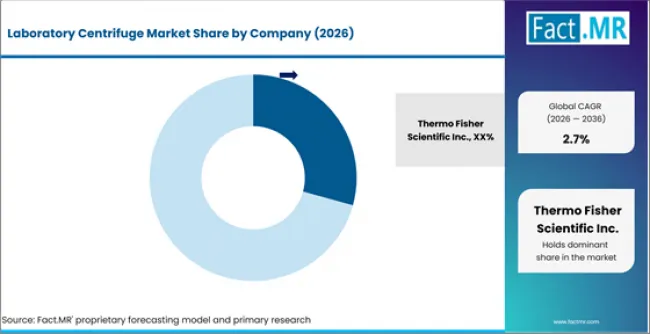
Laboratory Centrifuge Market Analysis By Company | Source: Fact.MR
Laboratory Centrifuge Analysis By Company
- Thermo Fisher, Beckman Coulter (Danaher), and Eppendorf hold leading positions through broad centrifuge portfolios spanning benchtop, floor-standing, and ultracentrifuge systems, supported by global distribution and strong laboratory relationships.
- Kubota, Hettich, and Sigma compete across specific centrifuge formats and geographies, where instrument reliability, rotor design, and service reach shape laboratory preference.
- Automation and digital integration, including IoT-enabled platforms with LIMS connectivity, increasingly differentiate leaders as laboratories prioritize workflow efficiency.
The competitive landscape is concentrated among a few established instrument makers, with differentiation driven by rotor technology, automation capability, and service network breadth. Thermo Fisher, Beckman Coulter, and Eppendorf lead through comprehensive centrifuge ranges, extensive distribution, and strong after-sales support across clinical and research segments.
Below the leaders, Kubota, Hettich, Sigma, NuAire, and Sartorius maintain strong positions through specific instrument strengths, regional manufacturing, and niche research applications. Competition turns on speed performance, refrigeration control, and automation integration rather than price alone.
Automation and digital connectivity are the emerging competitive frontiers. IoT-enabled platforms with LIMS integration and automated rotor systems raise switching costs and create recurring service value. Suppliers that combine reliable separation performance with connected-lab capability are positioned to deepen account retention.
Key Companies in the Laboratory Centrifuge
- Leading companies in the laboratory centrifuge market include Thermo Fisher Scientific Inc., Danaher Corporation (Beckman Coulter), Eppendorf SE, KUBOTA Corporation, which hold strong positions through portfolio breadth, clinical evidence, and broad distribution.
- Andreas Hettich GmbH & Co. KG, Sigma Laborzentrifugen GmbH, NuAire, Inc., Sartorius AG maintain established positions across specific segments and channels, competing on assay or product performance, service, and regional reach.
- Bio-Rad Laboratories, Inc., QIAGEN N.V. and other specialists compete through focused offerings and niche strength, reinforcing relevance in a competitive but evolving market.
Recent Industry Developments
- Danaher Corporation (Beckman Coulter) - OptiMATE Gradient Maker for Ultracentrifuge Preparation (April 2025)
- In April 2025, Beckman Coulter Life Sciences introduced the OptiMATE Gradient Maker, an automated density-gradient instrument that reduces ultracentrifuge preparation time by 75%. The launch targets precision-medicine and research laboratories.
- Thermo Fisher Scientific Inc. - Cryofuge Refrigerated Floor Models Launch (April 2025)
- In April 2025, Thermo Fisher unveiled the Cryofuge refrigerated floor centrifuge models targeting precision-medicine laboratories. The launch supports high-specification centrifuge demand in clinical and research settings.
- Industry Trend - IoT-Enabled Centrifuge and LIMS Integration (2025)
- Through 2025, laboratory centrifuge manufacturers continued advancing IoT-enabled platforms with digital control and LIMS connectivity. The trend supports workflow automation and sample traceability in connected laboratory environments.
Leading Companies Shaping the Laboratory Centrifuge
- Thermo Fisher Scientific Inc.
- Danaher Corporation (Beckman Coulter)
- Eppendorf SE
- KUBOTA Corporation
- Andreas Hettich GmbH & Co. KG
- Sigma Laborzentrifugen GmbH
Sources and Research References
- Beckman Coulter Life Sciences. (2025). Beckman Coulter Life Sciences introduces OptiMATE Gradient Maker to automate density gradient preparation for ultracentrifugation. Beckman Coulter Life Sciences.
- Thermo Fisher Scientific Inc. (2025). Cryofuge refrigerated floor centrifuge systems for clinical and research laboratories. Thermo Fisher Scientific Inc.
- Thermo Fisher Scientific Inc. (2025). Connected laboratory automation and digital workflow solutions. Thermo Fisher Scientific Inc.
This bibliography is provided for reader reference and is not exhaustive. The full report contains the complete reference list and detailed citations.
Key Questions This Report Addresses
- What is the current and future size of the Laboratory Centrifuge Market?
- How fast is the Laboratory Centrifuge Market expected to grow between 2026 and 2036?
- Which product segment is likely to lead the market by 2026?
- Which application segment is expected to account for the highest demand by 2026?
- What factors are driving demand in the laboratory centrifuge market globally?
- Which countries are projected to show the fastest growth through 2036?
- What is driving market expansion in China and India?
- Who are the key companies active in the laboratory centrifuge market?
- How is IoT and LIMS integration changing laboratory centrifuge procurement?
- What role does biotech and cell therapy production play in ultracentrifuge demand?
- How does Fact.MR estimate and validate the laboratory centrifuge market forecast?
Laboratory Centrifuge Market Definition
The laboratory centrifuge market covers benchtop, floor-standing, ultracentrifuges, and specialty centrifuges used in clinical diagnostics, biotechnology research, pharmaceutical applications, and academic research. It spans high-speed centrifugation, refrigeration control, automation and digital control, and safety and monitoring technologies delivered through biological, chemical, pharmaceutical, and industrial sample processing system formats across hospitals, laboratories, pharmaceutical companies, and research institutes.
Laboratory Centrifuge Market Inclusions
- The scope covers global and regional market size and forecasts for 2026 to 2036 across product type, application, end use, technology, formulation, and distribution channel.
- It includes demand tied to clinical diagnostic volumes, biotech R&D investment, pharmaceutical manufacturing, and academic research funding.
- Pricing analysis spans entry-level benchtop models to high-specification ultracentrifuges across direct, distributor, and service channels.
- Coverage includes IoT-enabled centrifuge platforms with LIMS integration and automated rotor systems.
Laboratory Centrifuge Market Exclusions
- The scope excludes industrial-scale continuous centrifuges used in non-laboratory settings.
- It excludes general laboratory consumables without centrifuge hardware content.
- Centrifuge rotors and accessories sold separately without instrument context are excluded where not part of integrated procurement.
- Non-separation laboratory equipment is excluded.
Laboratory Centrifuge Market Research Methodology
- The methodology combines secondary research, primary interviews, and demand-side modeling.
- It draws on 100 plus secondary sources and benchmarks 45 plus instrument portfolios.
- Market sizing covers 30 plus countries through a laboratory-infrastructure and diagnostic-volume model with top-down validation.
- Key inputs include clinical diagnostic testing volumes, biotech and pharmaceutical R&D spending, and academic research funding.
- The model cross-checks demand with instrument placements, rotor pull-through, and service revenue.
- Primary validation includes 20 plus interviews across lab directors, procurement leads, OEMs, and distributors.
- Final estimates pass through installed-base review and sensitivity testing.
Scope of Analysis
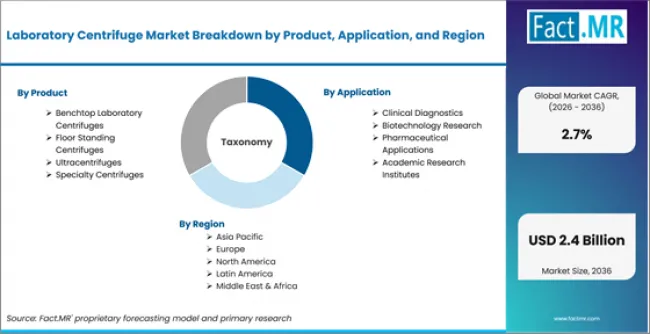
Laboratory Centrifuge Market Breakdown By Product, Application, And Region | Source: Fact.MR
| Parameter | Details |
|---|---|
| Quantitative Units | USD 1.8 billion to USD 2.4 billion, at a CAGR of 2.7% |
| Market Definition | The laboratory centrifuge market covers benchtop, floor-standing, ultracentrifuge, and specialty systems used in clinical diagnostics, biotechnology, pharmaceutical, and academic research applications. |
| Regions Covered | North America, Latin America, Europe, East Asia, South Asia and Pacific, Middle East and Africa |
| Countries Covered | China, India, Germany, Brazil, U.S., UK, Japan, 30 plus countries |
| Key Companies | Thermo Fisher Scientific Inc., Danaher Corporation (Beckman Coulter), Eppendorf SE, KUBOTA Corporation, Andreas Hettich GmbH & Co. KG, Sigma Laborzentrifugen GmbH. |
| Forecast Period | 2026 to 2036 |
| Approach | Hybrid demand-side and top-down methodology built on country-level demand, product and equipment benchmarking, pricing analysis, shipment validation, and primary interviews across providers, laboratories, distributors, and end users |
Laboratory Centrifuge Segmentation
-
Laboratory Centrifuge Market Segmented by Product:
- Benchtop Laboratory Centrifuges
- Microcentrifuges
- High Speed Microcentrifuges
- Refrigerated Microcentrifuges
- Clinical Benchtop Centrifuges
- Routine Diagnostic Centrifuges
- Blood Sample Centrifuges
- Microcentrifuges
- Floor Standing Centrifuges
- High Capacity Centrifuges
- Large Volume Processing Centrifuges
- Industrial Sample Centrifuges
- Refrigerated Floor Centrifuges
- Temperature Controlled Centrifugation Systems
- Biological Sample Preservation Centrifuges
- High Capacity Centrifuges
- Ultracentrifuges
- Analytical Ultracentrifuges
- Protein Analysis Ultracentrifuges
- Molecular Separation Ultracentrifuges
- Preparative Ultracentrifuges
- Virus Isolation Centrifuges
- Cell Fractionation Systems
- Analytical Ultracentrifuges
- Specialty Centrifuges
- Cytology Centrifuges
- Cell Culture Processing Centrifuges
- Diagnostic Cytology Systems
- Hematology Centrifuges
- Plasma Separation Systems
- Serum Processing Centrifuges
- Cytology Centrifuges
- Benchtop Laboratory Centrifuges
-
Laboratory Centrifuge Market Segmented by Application:
- Clinical Diagnostics
- Blood Testing Applications
- Hematology Analysis Applications
- Serology Testing Applications
- Pathology Laboratories
- Histopathology Sample Processing
- Cytology Sample Analysis
- Blood Testing Applications
- Biotechnology Research
- Cell Biology Research
- Cell Separation Studies
- Stem Cell Research Applications
- Molecular Biology Research
- DNA/RNA Isolation Processes
- Protein Purification Studies
- Cell Biology Research
- Pharmaceutical Applications
- Drug Discovery Research
- Compound Separation Studies
- Bioassay Preparation Processes
- Vaccine Development
- Antigen Preparation Systems
- Virus Isolation Studies
- Drug Discovery Research
- Academic Research Institutes
- University Laboratories
- Life Science Research Labs
- Biomedical Engineering Labs
- Government Research Centers
- Public Health Laboratories
- Scientific Testing Institutes
- University Laboratories
- Clinical Diagnostics
-
Laboratory Centrifuge Market Segmented by End Use:
- Hospitals & Diagnostic Centers
- Public Healthcare Hospitals
- Government Diagnostic Labs
- Regional Medical Centers
- Private Healthcare Hospitals
- Multi Specialty Hospitals
- Specialized Diagnostic Hospitals
- Public Healthcare Hospitals
- Clinical Laboratories
- Independent Diagnostic Labs
- Pathology Service Providers
- Reference Testing Labs
- Hospital Based Laboratories
- In House Diagnostic Labs
- Emergency Testing Labs
- Independent Diagnostic Labs
- Pharmaceutical & Biotechnology Companies
- Pharma R&D Facilities
- Drug Development Labs
- Formulation Research Units
- Biotech Research Companies
- Genetic Research Firms
- Cell Therapy Developers
- Pharma R&D Facilities
- Academic & Research Institutes
- Universities
- Life Science Departments
- Medical Research Schools
- Government Research Bodies
- National Science Institutes
- Public Health Research Centers
- Universities
- Hospitals & Diagnostic Centers
-
Laboratory Centrifuge Market Segmented by Technology:
- High Speed Centrifugation Technology
- Fixed Angle Rotor Technology
- High RPM Separation Systems
- Precision Balance Rotor Systems
- Swing Bucket Rotor Technology
- Sample Separation Optimization Systems
- Density Gradient Centrifugation Systems
- Fixed Angle Rotor Technology
- Refrigeration Control Technology
- Temperature Stability Systems
- Low Temperature Sample Preservation
- Cryogenic Centrifugation Systems
- Thermal Regulation Systems
- Heat Dissipation Control Units
- Thermal Balance Optimization Systems
- Temperature Stability Systems
- Automation & Digital Control
- Microprocessor Control Systems
- Programmable Speed Control Units
- Digital Display Interface Systems
- Smart Centrifugation Systems
- AI Assisted Load Balancing
- Automated Cycle Optimization Systems
- Microprocessor Control Systems
- Safety & Monitoring Systems
- Imbalance Detection Systems
- Automatic Shutdown Mechanisms
- Vibration Monitoring Systems
- Door Lock Safety Systems
- Emergency Lock Release Systems
- Over Speed Protection Systems
- Imbalance Detection Systems
- High Speed Centrifugation Technology
-
Laboratory Centrifuge Market Segmented by Formulation:
- Biological Sample Processing Systems
- Cell Separation Systems
- Blood Component Separation Units
- Plasma Isolation Systems
- Cell Fractionation Systems
- Organelle Isolation Systems
- Subcellular Component Separation
- Cell Separation Systems
- Chemical Sample Processing Systems
- Compound Separation Systems
- Chemical Gradient Separation Units
- Analytical Compound Isolation Systems
- Reagent Based Processing Systems
- Buffer Assisted Centrifugation Systems
- Stabilized Chemical Processing Units
- Compound Separation Systems
- Pharmaceutical Processing Systems
- Drug Compound Separation
- Active Ingredient Isolation Systems
- Formulation Purification Units
- Biopharmaceutical Processing
- Protein Purification Systems
- Vaccine Component Separation Units
- Drug Compound Separation
- Industrial Processing Systems
- Bulk Sample Processing
- Large Volume Industrial Centrifugation
- Continuous Flow Separation Systems
- Bulk Sample Processing
- Biological Sample Processing Systems
-
Laboratory Centrifuge Market Segmented by Distribution Channel:
- Direct Equipment Sales
- Manufacturer Direct Supply
- OEM Laboratory Equipment Sales
- Institutional Procurement Contracts
- Enterprise Sales Channels
- Hospital Procurement Systems
- Research Institute Contracts
- Manufacturer Direct Supply
- Laboratory Equipment Distributors
- Regional Distributors
- Medical Equipment Distributors
- Scientific Equipment Suppliers
- Specialized Lab Vendors
- Diagnostic Equipment Suppliers
- Biotech Equipment Dealers
- Regional Distributors
- Online Sales Channels
- B2B Scientific Platforms
- Lab Equipment E Commerce Portals
- Digital Procurement Platforms
- Manufacturer E Portals
- Direct Online Ordering Systems
- Subscription Based Supply Platforms
- B2B Scientific Platforms
- Third Party Service Providers
- Equipment Leasing Companies
- Rental Laboratory Equipment Providers
- Managed Lab Service Providers
- Maintenance Service Providers
- Calibration Service Providers
- Repair & Support Networks
- Equipment Leasing Companies
- Direct Equipment Sales
-
Laboratory Centrifuge Market by Region:
- North America
- USA
- Canada
- Mexico
- Latin America
- Brazil
- Chile
- Rest of Latin America
- Western Europe
- Germany
- UK
- Italy
- Spain
- France
- Nordic
- BENELUX
- Rest of Western Europe
- Eastern Europe
- Russia
- Poland
- Hungary
- Balkan & Baltic
- Rest of Eastern Europe
- East Asia
- China
- Japan
- South Korea
- South Asia and Pacific
- India
- ASEAN
- Australia & New Zealand
- Rest of South Asia and Pacific
- Middle East & Africa
- Kingdom of Saudi Arabia
- Other GCC Countries
- Turkiye
- South Africa
- Other African Union
- Rest of Middle East & Africa
- North America