Laparotomy Sponges Market Size, Share, Growth and Forecast (2026 - 2036)
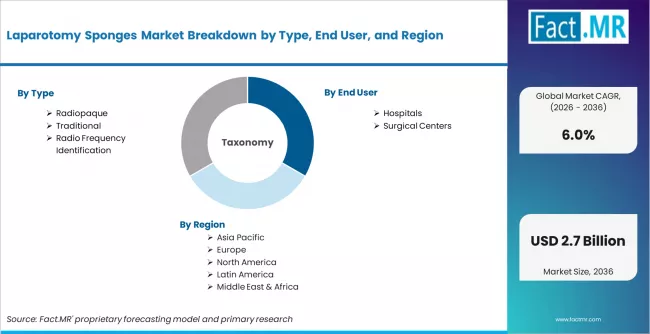
Laparotomy Sponges Market is segmented by Type (Radiopaque, Traditional, Radio Frequency Identification), End User (Hospitals, Surgical Centers), Technology (Manufacturing Process, Non Woven Sponges, Sterilization Technology, Gamma Sterilization), and Region, with forecasts covering the period from 2026 to 2036.
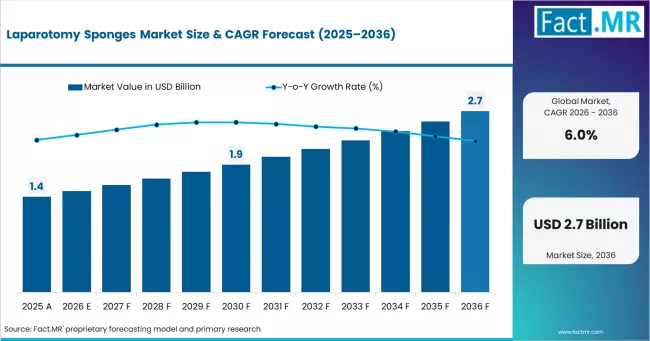
According to Fact.MR estimates, the global laparotomy sponges market market was valued at USD 1.4 billion in 2025. The market is projected to reach USD 1.5 billion in 2026 and is expected to grow to USD 2.7 billion by 2036, expanding at a CAGR of 6.0%. Radiopaque is anticipated to account for 48.7% of the product segment in 2026, while Hospitals is expected to remain the leading application with around 72.3% share.
Laparotomy Sponges Market Analysis and Forecast by Fact.MR
The laparotomy sponges market, valued at USD 1.429 billion in 2025, is expanding at a 6.0% CAGR to reach USD 2.713 billion by 2036. Laparotomy sponges are absorbent surgical textile products used in abdominal, thoracic, and pelvic surgical procedures for blood and fluid absorption, organ retraction, and wound packing. Growth reflects rising global surgical volumes, adoption of radiopaque and RFID-tagged sponges for retained surgical sponge prevention, and hospital patient safety mandates. The USD 1.198 billion incremental opportunity between 2026 and 2036 is concentrated in technology-enhanced sponge formats across Asia, North America, and Europe.
Summary of Laparotomy Sponges Market
- Market Snapshot
- Market value in 2025: USD 1.429 billion
- Projected value in 2026: USD 1.515 billion; forecast to reach USD 2.713 billion by 2036
- CAGR from 2026 to 2036: 6.0%
- Incremental opportunity (2026 to 2036): USD 1.198 billion
- Radiopaque sponges lead type demand with 48.7% share in 2025
- China and India lead country-level growth, followed by Germany and Brazil
- Demand and Growth Drivers
- Global surgical procedure volumes continue to rise across abdominal, gynecological, cardiothoracic, and orthopedic specialties, with each procedure consuming multiple sponges as standard consumable supplies.
- Retained surgical sponge prevention mandates from hospital accreditation bodies and patient safety organizations are driving conversion from traditional to radiopaque and RFID-tagged sponge formats.
- Cesarean delivery rates continue to increase globally, with cesarean sections being high-volume consumers of laparotomy sponges as standard obstetric procedure supplies.
- Hospital risk management programs are investing in technology-enhanced counting and detection systems that use radiopaque markers and RFID tags to eliminate retained sponge incidents, a common source of surgical malpractice claims.
- Product and Segment View
- Radiopaque sponges hold 48.7% of type demand, driven by hospital patient safety mandates requiring X-ray-detectable sponges in abdominal and body-cavity surgical procedures.
- Hospitals account for 72.3% of end-user demand, reflecting the concentration of open abdominal, thoracic, and pelvic surgical procedures in hospital operating theaters.
- Direct sales command 54.2% of distribution channel share, as surgical supply procurement is managed through hospital supply chain departments and GPO contracts.
- Key segmentation includes:
- Type: Radiopaque, Traditional, Radio Frequency Identification
- End User: Hospitals, Surgical Centers
- Technology: Manufacturing Process, Non Woven Sponges, Sterilization Technology, Gamma Sterilization
- Distribution Channel: Direct Sales, Distributors, Online Sales
- Geography and Competitive Outlook
- North America is the largest revenue region, with the USA contributing USD 0.526 billion in 2025 through established retained sponge prevention protocols and high surgical volumes.
- East Asia is the fastest-growing region, with China recording the highest country CAGR driven by surgical volume growth and hospital safety standard adoption.
- Europe maintains steady growth, with Germany leading through surgical safety protocol adherence and technology-enhanced sponge procurement.
- Medtronic Inc. leads the competitive field with a 17.6% market share, followed by Cardinal Health, Medline Industries, Owens and Minor, and B. Braun Melsungen.
- Analyst Opinion
- The laparotomy sponges market is a surgical consumable category where growth is tied to procedure volume and technology migration. The conversion from traditional to radiopaque sponges is largely complete in developed markets, and the next growth vector is RFID-tagged sponge adoption that automates surgical counting and eliminates manual count errors. RFID sponges carry a significant price premium over radiopaque equivalents, making the technology migration the primary revenue growth mechanism in mature markets. Fact.MR expects the fastest volume growth to concentrate in emerging markets where surgical access expansion creates new sponge consumption, while the fastest value growth concentrates in developed markets transitioning to RFID-enabled surgical counting systems.
Key Growth Drivers, Constraints, and Opportunities
Key Factors Driving Growth
- Surgical volume growth: Rising global surgical counts across abdominal, gynecological, and cardiothoracic specialties create proportional laparotomy sponge consumption as a per-procedure standard consumable.
- Retained sponge prevention mandates: The Joint Commission, WHO surgical safety checklist, and national patient safety bodies are mandating technology-enhanced sponge counting, driving conversion to radiopaque and RFID formats.
- Cesarean section volume growth: Rising global cesarean delivery rates, particularly in China, Brazil, and India, create high-volume consumption of laparotomy sponges as standard obstetric surgical supplies.
Key Market Constraints
- Commodity pricing pressure: Traditional laparotomy sponges are commodity products with low differentiation, creating intense price competition that compresses manufacturer margins in the non-technology-enhanced segment.
- RFID adoption cost barriers: RFID-tagged sponges carry 5x to 10x price premiums over standard radiopaque equivalents, creating procurement budget resistance in cost-sensitive hospital systems and emerging markets.
- Waste volume concerns: Surgical sponges contribute to operating theater waste streams, creating sustainability pressure that may favor reduced-count protocols or reusable absorbent alternatives.
Key Opportunity Areas
- RFID surgical counting systems: Hospital adoption of automated RFID-based surgical counting eliminates manual count errors and creates a premium product category with recurring consumable revenue tied to counting system installed base.
- Antimicrobial sponge coatings: Sponges with antimicrobial treatments that reduce surgical site infection risk are emerging as a clinical differentiation opportunity, particularly for prolonged abdominal procedures.
- Emerging market surgical access expansion: Hospital construction and surgical capacity growth in India, China, and Africa are creating new sponge consumption that did not exist in healthcare systems with previously limited surgical access.
Segment-wise Analysis of the Laparotomy Sponges Market
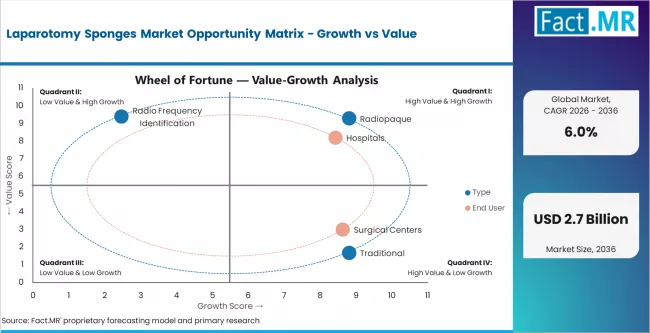
- Radiopaque sponges lead type demand at 48.7%, driven by hospital patient safety mandates for X-ray-detectable surgical sponges.
- Hospitals account for 72.3% of end-user demand, reflecting the concentration of open surgical procedures in hospital operating theaters.
- Direct sales hold 54.2% of distribution channel share, as hospital supply procurement is managed through centralized purchasing departments.
Which type dominates the Laparotomy Sponges Market?
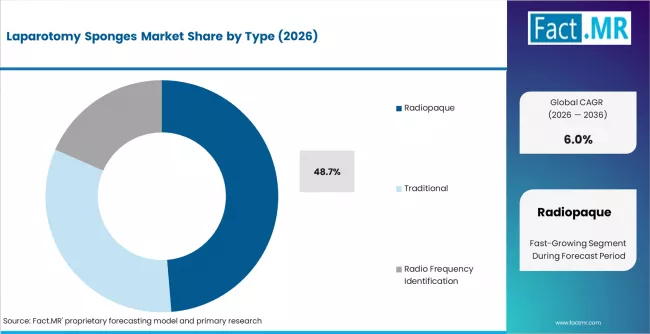
Radiopaque sponges hold a 48.7% share of type demand in 2025, the largest single type category. The share reflects the near-universal adoption of X-ray-detectable sponges in developed market hospitals, where patient safety protocols require that all body-cavity sponges contain radiopaque markers enabling post-operative X-ray identification of retained surgical items. The radiopaque segment is mature in North America and Europe, with growth now driven by emerging market adoption.
RFID-tagged sponges are the fastest-growing type category, carrying electronic identification chips that enable automated counting through radio-frequency detection systems. RFID sponges eliminate the reliance on manual visual counting, addressing the primary failure mode in retained sponge events. Traditional sponges without detection features retain share in cost-sensitive markets and for non-cavity applications where retention risk is lower.
Which end user dominates the Laparotomy Sponges Market?
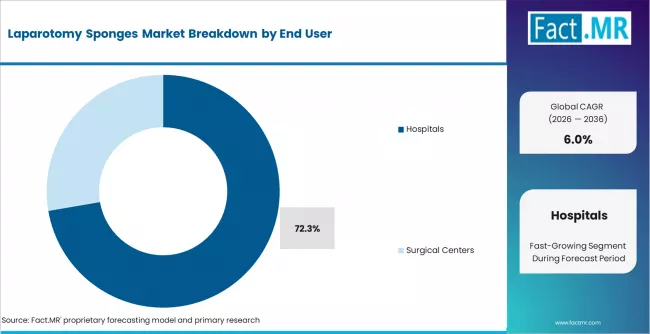
Hospitals account for 72.3% of end-user demand in 2025, the dominant institutional setting. The share reflects the concentration of open abdominal, thoracic, and pelvic surgical procedures in hospital operating theaters, where laparotomy sponges are standard per-procedure consumables. Hospital procurement departments manage sponge supply through GPO-negotiated contracts and direct manufacturer agreements.
Surgical centers represent the remaining end-user demand, concentrated in ambulatory facilities performing gynecological, hernia repair, and other open surgical procedures that consume laparotomy sponges as standard supplies.
Which distribution channel dominates the Laparotomy Sponges Market?
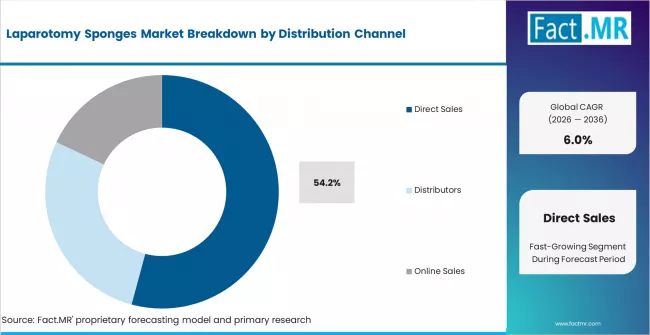
Direct sales command 54.2% of distribution channel share in 2025, reflecting the manufacturer-to-hospital procurement model that dominates surgical consumable supply. Direct sales relationships enable manufacturers to negotiate multi-year supply contracts with hospital systems and GPOs, securing volume commitments and pricing stability.
Distributors serve as the primary channel for smaller hospital systems and surgical centers that lack the procurement volume to attract direct manufacturer contracts. Online sales represent a small but growing channel for reordering commodity surgical supplies.
Which Product Trend is Shaping the Next Phase of Growth in the Laparotomy Sponges Market?
RFID-enabled surgical counting systems are shaping the next growth phase in the laparotomy sponges market. RFID counting technology replaces manual visual counting with automated radio-frequency scanning that detects each tagged sponge in the surgical field, the waste container, and on the instrument table. This automation addresses the primary failure mode in retained sponge events, which is human counting error during complex or emergency procedures. Hospitals that have deployed RFID counting systems report elimination of retained sponge events, reducing patient harm and malpractice liability exposure.
The commercial model for RFID sponge adoption combines hardware (scanning equipment) and consumables (RFID-tagged sponges), creating a razor-and-blade revenue structure. Once a hospital invests in RFID scanning infrastructure, it is locked into purchasing RFID-tagged sponges at premium pricing for all applicable procedures. Fact.MR projects that RFID sponge adoption will expand from current penetration of approximately 10% to 15% of developed-market hospitals to over 40% by 2036, driven by patient safety evidence, accreditation body endorsement, and declining hardware and tag costs that improve the adoption business case.
Regional Outlook Across Key Markets
.webp)
- North America is the largest revenue region, with the USA contributing USD 0.526 billion in 2025 through established retained sponge prevention protocols.
- East Asia is the fastest-growing region, with China recording the highest country CAGR driven by surgical volume expansion.
- Europe maintains steady growth, shaped by WHO surgical safety checklist adherence and technology-enhanced sponge procurement.
- South Asia is an emerging corridor, with India recording strong CAGR driven by hospital construction and cesarean section volume growth.
CAGR Table
| Country | CAGR (%) |
|---|---|
| China | 7.7% |
| India | 7.1% |
| Germany | 6.6% |
| Brazil | 6.0% |
| USA | 5.4% |
| UK | 4.9% |
| Japan | 4.3% |
Source: Fact.MR analysis, based on proprietary forecasting model and primary research.
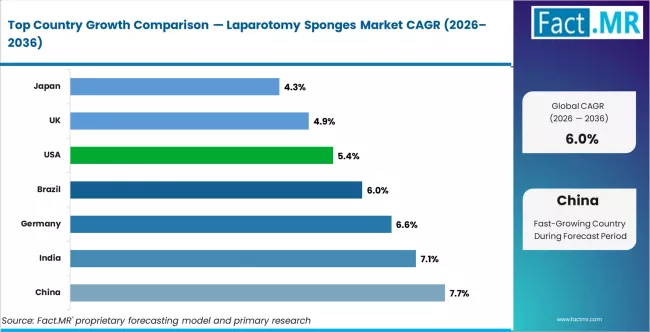
China:Surgical volume growth and safety standard adoption
China records the highest country-level CAGR in the laparotomy sponges market, driven by expanding surgical volumes across public hospitals and the progressive adoption of retained surgical item prevention protocols. The National Health Commission is formalizing surgical safety standards that include radiopaque sponge requirements at designated hospital tiers. The high volume of cesarean deliveries in China, though declining from peak rates, remains a significant consumption driver for laparotomy sponges.
- Growth anchor: Surgical safety standard formalization and sustained surgical volume growth create dual demand for technology-enhanced sponge products.
USA: RFID adoption and liability-driven procurement
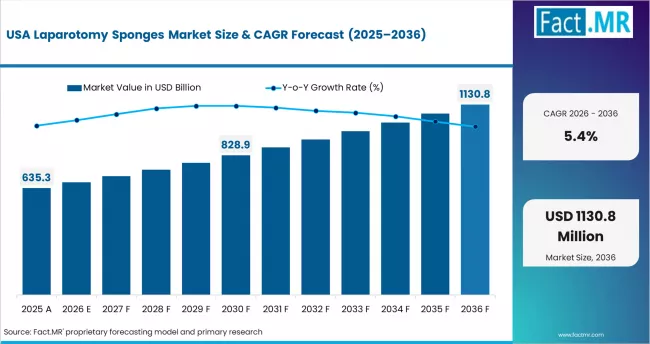
The USA contributes USD 0.526 billion in 2025, with growth driven by RFID surgical counting system adoption and hospital risk management programs seeking to eliminate retained sponge malpractice exposure. The Joint Commission's surgical safety requirements and CMS never-event policies create institutional incentives for technology-enhanced counting. RFID sponge adoption is concentrated in large academic medical centers and multi-hospital health systems with centralized patient safety programs.
- Growth anchor: RFID counting adoption and malpractice liability management are driving premium sponge product procurement in large hospital systems.
India: Cesarean delivery volume and surgical access expansion
India records strong growth driven by rising cesarean delivery rates, hospital surgical capacity expansion, and growing awareness of retained surgical item prevention. Indian hospitals are transitioning from traditional to radiopaque sponges as patient safety protocols formalize. The large number of surgical procedures performed annually in India creates a substantial consumption base for laparotomy sponge manufacturers.
- Growth anchor: Rising cesarean volumes and surgical safety protocol adoption are converting traditional sponge consumption toward radiopaque formats.
Germany: Surgical safety culture and RFID pilot programs
Germany leads European laparotomy sponge growth, supported by strong surgical safety culture and early pilot programs for RFID counting technology at university hospitals. German hospitals demonstrate high adherence to WHO surgical safety checklist protocols, and the country's statutory health insurance system covers the cost of radiopaque sponges as standard surgical supplies. RFID adoption is in early stages but gaining momentum through positive pilot results.
- Growth anchor: Surgical safety protocol adherence and RFID pilot programs create steady demand growth and technology migration opportunity.
Competitive Benchmarking and Company Positioning
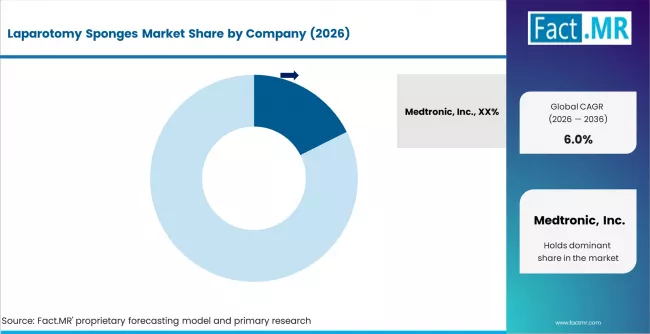
Laparotomy Sponges Market Analysis By Company
- Medtronic Inc. leads with 17.6% market share, leveraging its surgical supply portfolio and hospital distribution relationships to maintain positioning in the laparotomy sponge category.
- Cardinal Health and Medline Industries compete in the broad surgical supply tier, offering laparotomy sponges as part of comprehensive operating room consumable portfolios distributed through GPO contracts.
- Owens and Minor and B. Braun Melsungen maintain positions through distribution network reach and product portfolio breadth in surgical consumables.
The competitive field is moderately fragmented, with the top five players accounting for a combined share above 45%. Competition in traditional and radiopaque sponges is primarily price-driven, as the products are commodity consumables with limited differentiation. Manufacturers compete on pricing, supply reliability, and the ability to bundle sponges with broader surgical supply contracts.
RFID sponge technology is creating a differentiation tier where manufacturers that invest in RFID tag integration and counting system development can command premium pricing. RF Surgical Systems (now part of Stryker) pioneered the RFID counting category, and other manufacturers are developing competing systems.
Regional manufacturers in China and India are gaining share in their domestic markets by offering radiopaque sponges at price points below multinational competitors, targeting the volume segment of hospital procurement.
Key Companies in the Laparotomy Sponges Market
Medtronic Inc., Actimed, Owens and Minor Inc., Cardinal Health Inc., Dukal Corporation, Premier Enterprises, B. Braun Melsungen AG, Derma Sciences Inc., DeRoyal Industries Inc., Medicaux Healthcare, Medline Industries Inc., A Plus International Inc., Suzhou Sunmed Co. Ltd, and VWR International LLC are the principal companies operating in the global laparotomy sponges market.
Recent Industry Developments
- Stryker (RF Surgical): RFID counting system upgrade (2025)
- Stryker released an upgraded RFID surgical counting platform in 2025 with expanded sponge tag detection range, faster scanning speed, and integration with hospital electronic health record systems for automated documentation.
- Cardinal Health: radiopaque sponge line expansion (2025)
- Cardinal Health expanded its radiopaque laparotomy sponge product line in 2025, adding new size configurations and packaging formats designed to reduce operating room setup time and sponge identification during surgical counting.
- Medline Industries: RFID sponge pilot program (2025)
- Medline Industries launched an RFID-tagged laparotomy sponge pilot program with select US hospital systems in 2025, offering bundled RFID counting hardware and tagged sponge consumables as an integrated patient safety solution.
- B. Braun: antimicrobial sponge development (2026)
- B. Braun initiated development of an antimicrobial-coated laparotomy sponge in early 2026, targeting reduction of surgical site infection risk in prolonged abdominal procedures through controlled antimicrobial agent release.
Leading Companies Shaping the Laparotomy Sponges Market
-
Global Players
- Medtronic, Inc.
- Cardinal Health, Inc.
- Medline Industries, Inc.
- Owens and Minor, Inc.
- B. Braun Melsungen AG
- Dukal Corporation
-
Regional Players
- DeRoyal Industries, Inc.
- Premier Enterprises
- Actimed
- A Plus International Inc.
-
Emerging / Start-up Players
- Suzhou Sunmed Co., Ltd
- Medicaux Healthcare
- VWR International LLC
Sources and Research References
- Medtronic Inc. Annual Report 2024 and Surgical Solutions Division Updates
- The Joint Commission Sentinel Event Alert on Retained Surgical Items
- WHO Surgical Safety Checklist Implementation Guidelines
- CMS Never Events Policy Documentation
- Cardinal Health Annual Report 2024 and Surgical Supply Portfolio
- National surgical volume statistics from CMS, NHS England, and NHC China
All numerical data in this report is derived from Fact.MR proprietary research. Source references are provided for contextual and directional validation only.
Key Questions This Report Addresses
- What is the projected size of the laparotomy sponges market by 2036?
- Which type holds the largest share?
- What CAGR is expected from 2026 to 2036?
- Which country is growing fastest?
- Who is the leading company?
- What is the incremental opportunity between 2026 and 2036?
- How is RFID technology affecting the laparotomy sponges market?
- What role do cesarean deliveries play in sponge demand?
Laparotomy Sponges Market Definition
The laparotomy sponges market covers absorbent surgical textile products used in abdominal, thoracic, pelvic, and other body-cavity surgical procedures for fluid absorption, tissue retraction, and wound management. Products include radiopaque sponges with X-ray-detectable markers, traditional woven and non-woven sponges, and RFID-tagged sponges with electronic identification for automated counting systems.
Laparotomy Sponges Market Inclusions
- Radiopaque laparotomy sponges with barium sulfate or other X-ray-detectable markers
- Traditional woven and non-woven surgical sponges without detection features
- RFID-tagged laparotomy sponges for automated surgical counting systems
- Sponges sterilized via gamma irradiation, ethylene oxide, or steam sterilization
Laparotomy Sponges Market Exclusions
- Gauze pads, wound dressings, and other non-laparotomy surgical textiles
- Surgical counting trays, bowls, and instrument management systems
- Hemostatic agents, sealants, and absorbable hemostatic materials
- Wound closure materials including sutures, staples, and adhesive strips
Laparotomy Sponges Market Research Methodology
- Bottom-up revenue modeling using surgical procedure volumes, per-procedure sponge consumption rates, and average unit pricing across 15+ countries
- Primary interviews with hospital operating room managers, surgical supply chain directors, and patient safety officers
- Cross-referencing surgical volume data from national health statistics agencies and hospital discharge databases
- Validation of segment shares through hospital procurement records, manufacturer product catalogues, and distributor sales data
- Forecasting calibrated against surgical volume projections, retained sponge prevention mandate timelines, and RFID adoption rates
- Company-level revenue triangulation using annual reports and product line disclosures from listed medical supply companies
Scope of Analysis

| Parameter | Details |
|---|---|
| Market size (2025) | USD 1.429 billion |
| Forecast period | 2026 to 2036 |
| CAGR | 6.0% |
| Base year | 2025 |
| Units | USD Billion |
| Segments covered | Type (Radiopaque, Traditional, RFID); End User (Hospitals, Surgical Centers); Technology (Manufacturing Process, Non Woven, Sterilization, Gamma Sterilization); Distribution Channel (Direct Sales, Distributors, Online Sales) |
| Regions covered | North America, Latin America, Europe, East Asia, South Asia and Pacific, Middle East and Africa |
| Countries profiled | USA, China, India, Germany, UK, Brazil, Japan |
| Companies profiled | Medtronic Inc., Cardinal Health, Medline Industries, Owens and Minor, B. Braun Melsungen |
| Forecasting approach | Bottom-up revenue modeling validated through primary research, surgical volume analysis, and company-level financial triangulation |
Market Segmentation Analysis
-
Laparotomy Sponges Market Market Segmented by Type:
- Radiopaque
- Barium Sulfate Impregnated
- X Ray Detectable Thread
- Double Detectable Markers
- Traditional
- Non Detectable Sponges
- Cotton Gauze Sponges
- Multi Ply Gauze
- Radio Frequency Identification
- Embedded RFID Tag
- Trackable Surgical Sponges
- Smart Inventory Enabled
- Radiopaque
-
Laparotomy Sponges Market Market Segmented by End User:
- Hospitals
- Public Hospitals
- Private Hospitals
- Multi Specialty Hospitals
- Surgical Centers
- Ambulatory Surgical Centers
- Day Care Centers
- Specialty Clinics
- Hospitals
-
Laparotomy Sponges Market Market Segmented by Technology:
- Manufacturing Process
- Woven Sponges
- Cotton Based
- Blended Fiber
- Non Woven Sponges
- Synthetic Fiber
- Composite Fiber
- Sterilization Technology
- Ethylene Oxide Sterilization
- Low Temperature Sterilization
- Bulk Sterilization
- Gamma Sterilization
- Pre Packaged Sterilization
- High Volume Sterilization
- Manufacturing Process
-
Laparotomy Sponges Market Market Segmented by Distribution Channel:
- Direct Sales
- Hospital Procurement
- Tender Based Contracts
- Long Term Agreements
- Distributors
- Medical Device Distributors
- Regional Distributors
- Specialty Distributors
- Online Sales
- Digital Procurement
- Hospital Portals
- E Commerce Platforms
- Direct Sales
-
Laparotomy Sponges Market Market by Region:
- North America
- USA
- Canada
- Mexico
- Latin America
- Brazil
- Chile
- Rest of Latin America
- Western Europe
- Germany
- UK
- Italy
- Spain
- France
- Nordic
- BENELUX
- Rest of Western Europe
- Eastern Europe
- Russia
- Poland
- Hungary
- Balkan & Baltic
- Rest of Eastern Europe
- East Asia
- China
- Japan
- South Korea
- South Asia and Pacific
- India
- ASEAN
- Australia & New Zealand
- Rest of South Asia and Pacific
- Middle East & Africa
- Kingdom of Saudi Arabia
- Other GCC Countries
- Turkiye
- South Africa
- Other African Union
- Rest of Middle East & Africa
- North America
- Frequently Asked Questions -
What is the current size of the laparotomy sponges market?
The global laparotomy sponges market is valued at USD 1.429 billion in 2025.
What growth rate is expected?
The market is projected to grow at a CAGR of 6.0% from 2026 to 2036.
What will the market be worth by 2036?
The market is forecast to reach USD 2.713 billion by 2036.
Which type leads?
Radiopaque sponges lead with 48.7% of type demand in 2025.
Which country is growing fastest?
China records the highest country-level CAGR among tracked markets.
Who is the market leader?
Medtronic Inc. leads with a 17.6% market share in 2025.
What is the USA market value?
The USA contributes USD 0.526 billion in 2025.
Table of Content
- Executive Summary
- Global Market Outlook
- Demand to side Trends
- Supply to side Trends
- Technology Roadmap Analysis
- Analysis and Recommendations
- Market Overview
- Market Coverage / Taxonomy
- Market Definition / Scope / Limitations
- Research Methodology
- Chapter Orientation
- Analytical Lens and Working Hypotheses
- Market Structure, Signals, and Trend Drivers
- Benchmarking and Cross-market Comparability
- Market Sizing, Forecasting, and Opportunity Mapping
- Research Design and Evidence Framework
- Desk Research Programme (Secondary Evidence)
- Company Annual and Sustainability Reports
- Peer-reviewed Journals and Academic Literature
- Corporate Websites, Product Literature, and Technical Notes
- Earnings Decks and Investor Briefings
- Statutory Filings and Regulatory Disclosures
- Technical White Papers and Standards Notes
- Trade Journals, Industry Magazines, and Analyst Briefs
- Conference Proceedings, Webinars, and Seminar Materials
- Government Statistics Portals and Public Data Releases
- Press Releases and Reputable Media Coverage
- Specialist Newsletters and Curated Briefings
- Sector Databases and Reference Repositories
- Fact.MR Internal Proprietary Databases and Historical Market Datasets
- Subscription Datasets and Paid Sources
- Social Channels, Communities, and Digital Listening Inputs
- Additional Desk Sources
- Expert Input and Fieldwork (Primary Evidence)
- Primary Modes
- Qualitative Interviews and Expert Elicitation
- Quantitative Surveys and Structured Data Capture
- Blended Approach
- Why Primary Evidence is Used
- Field Techniques
- Interviews
- Surveys
- Focus Groups
- Observational and In-context Research
- Social and Community Interactions
- Stakeholder Universe Engaged
- C-suite Leaders
- Board Members
- Presidents and Vice Presidents
- R&D and Innovation Heads
- Technical Specialists
- Domain Subject-matter Experts
- Scientists
- Physicians and Other Healthcare Professionals
- Governance, Ethics, and Data Stewardship
- Research Ethics
- Data Integrity and Handling
- Primary Modes
- Tooling, Models, and Reference Databases
- Desk Research Programme (Secondary Evidence)
- Data Engineering and Model Build
- Data Acquisition and Ingestion
- Cleaning, Normalisation, and Verification
- Synthesis, Triangulation, and Analysis
- Quality Assurance and Audit Trail
- Market Background
- Market Dynamics
- Drivers
- Restraints
- Opportunity
- Trends
- Scenario Forecast
- Demand in Optimistic Scenario
- Demand in Likely Scenario
- Demand in Conservative Scenario
- Opportunity Map Analysis
- Product Life Cycle Analysis
- Supply Chain Analysis
- Investment Feasibility Matrix
- Value Chain Analysis
- PESTLE and Porter’s Analysis
- Regulatory Landscape
- Regional Parent Market Outlook
- Production and Consumption Statistics
- Import and Export Statistics
- Market Dynamics
- Global Market Analysis 2021 to 2025 and Forecast, 2026 to 2036
- Historical Market Size Value (USD Million) Analysis, 2021 to 2025
- Current and Future Market Size Value (USD Million) Projections, 2026 to 2036
- Y to o to Y Growth Trend Analysis
- Absolute $ Opportunity Analysis
- Global Market Pricing Analysis 2021 to 2025 and Forecast 2026 to 2036
- Global Market Analysis 2021 to 2025 and Forecast 2026 to 2036, By Type
- Introduction / Key Findings
- Historical Market Size Value (USD Million) Analysis By Type , 2021 to 2025
- Current and Future Market Size Value (USD Million) Analysis and Forecast By Type , 2026 to 2036
- Radiopaque
- Barium Sulfate Impregnated
- X Ray Detectable Thread
- Double Detectable Markers
- Traditional
- Non Detectable Sponges
- Cotton Gauze Sponges
- Multi Ply Gauze
- Radio Frequency Identification
- Embedded RFID Tag
- Trackable Surgical Sponges
- Smart Inventory Enabled
- Radiopaque
- Y to o to Y Growth Trend Analysis By Type , 2021 to 2025
- Absolute $ Opportunity Analysis By Type , 2026 to 2036
- Global Market Analysis 2021 to 2025 and Forecast 2026 to 2036, By End User
- Introduction / Key Findings
- Historical Market Size Value (USD Million) Analysis By End User, 2021 to 2025
- Current and Future Market Size Value (USD Million) Analysis and Forecast By End User, 2026 to 2036
- Hospitals
- Public Hospitals
- Private Hospitals
- Multi Specialty Hospitals
- Surgical Centers
- Ambulatory Surgical Centers
- Day Care Centers
- Specialty Clinics
- Hospitals
- Y to o to Y Growth Trend Analysis By End User, 2021 to 2025
- Absolute $ Opportunity Analysis By End User, 2026 to 2036
- Global Market Analysis 2021 to 2025 and Forecast 2026 to 2036, By Technology
- Introduction / Key Findings
- Historical Market Size Value (USD Million) Analysis By Technology, 2021 to 2025
- Current and Future Market Size Value (USD Million) Analysis and Forecast By Technology, 2026 to 2036
- Manufacturing Process
- Woven Sponges
- Cotton Based
- Blended Fiber
- Non Woven Sponges
- Synthetic Fiber
- Composite Fiber
- Sterilization Technology
- Ethylene Oxide Sterilization
- Low Temperature Sterilization
- Bulk Sterilization
- Gamma Sterilization
- Pre Packaged Sterilization
- High Volume Sterilization
- Manufacturing Process
- Y to o to Y Growth Trend Analysis By Technology, 2021 to 2025
- Absolute $ Opportunity Analysis By Technology, 2026 to 2036
- Global Market Analysis 2021 to 2025 and Forecast 2026 to 2036, By Distribution Channel
- Introduction / Key Findings
- Historical Market Size Value (USD Million) Analysis By Distribution Channel, 2021 to 2025
- Current and Future Market Size Value (USD Million) Analysis and Forecast By Distribution Channel, 2026 to 2036
- Direct Sales
- Hospital Procurement
- Tender Based Contracts
- Long Term Agreements
- Distributors
- Medical Device Distributors
- Regional Distributors
- Specialty Distributors
- Online Sales
- Digital Procurement
- Hospital Portals
- E Commerce Platforms
- Direct Sales
- Y to o to Y Growth Trend Analysis By Distribution Channel, 2021 to 2025
- Absolute $ Opportunity Analysis By Distribution Channel, 2026 to 2036
- Global Market Analysis 2021 to 2025 and Forecast 2026 to 2036, By Region
- Introduction
- Historical Market Size Value (USD Million) Analysis By Region, 2021 to 2025
- Current Market Size Value (USD Million) Analysis and Forecast By Region, 2026 to 2036
- North America
- Latin America
- Western Europe
- Eastern Europe
- East Asia
- South Asia and Pacific
- Middle East & Africa
- Market Attractiveness Analysis By Region
- North America Market Analysis 2021 to 2025 and Forecast 2026 to 2036, By Country
- Historical Market Size Value (USD Million) Trend Analysis By Market Taxonomy, 2021 to 2025
- Market Size Value (USD Million) Forecast By Market Taxonomy, 2026 to 2036
- By Country
- USA
- Canada
- Mexico
- By Type
- By End User
- By Technology
- By Distribution Channel
- By Country
- Market Attractiveness Analysis
- By Country
- By Type
- By End User
- By Technology
- By Distribution Channel
- Key Takeaways
- Latin America Market Analysis 2021 to 2025 and Forecast 2026 to 2036, By Country
- Historical Market Size Value (USD Million) Trend Analysis By Market Taxonomy, 2021 to 2025
- Market Size Value (USD Million) Forecast By Market Taxonomy, 2026 to 2036
- By Country
- Brazil
- Chile
- Rest of Latin America
- By Type
- By End User
- By Technology
- By Distribution Channel
- By Country
- Market Attractiveness Analysis
- By Country
- By Type
- By End User
- By Technology
- By Distribution Channel
- Key Takeaways
- Western Europe Market Analysis 2021 to 2025 and Forecast 2026 to 2036, By Country
- Historical Market Size Value (USD Million) Trend Analysis By Market Taxonomy, 2021 to 2025
- Market Size Value (USD Million) Forecast By Market Taxonomy, 2026 to 2036
- By Country
- Germany
- UK
- Italy
- Spain
- France
- Nordic
- BENELUX
- Rest of Western Europe
- By Type
- By End User
- By Technology
- By Distribution Channel
- By Country
- Market Attractiveness Analysis
- By Country
- By Type
- By End User
- By Technology
- By Distribution Channel
- Key Takeaways
- Eastern Europe Market Analysis 2021 to 2025 and Forecast 2026 to 2036, By Country
- Historical Market Size Value (USD Million) Trend Analysis By Market Taxonomy, 2021 to 2025
- Market Size Value (USD Million) Forecast By Market Taxonomy, 2026 to 2036
- By Country
- Russia
- Poland
- Hungary
- Balkan & Baltic
- Rest of Eastern Europe
- By Type
- By End User
- By Technology
- By Distribution Channel
- By Country
- Market Attractiveness Analysis
- By Country
- By Type
- By End User
- By Technology
- By Distribution Channel
- Key Takeaways
- East Asia Market Analysis 2021 to 2025 and Forecast 2026 to 2036, By Country
- Historical Market Size Value (USD Million) Trend Analysis By Market Taxonomy, 2021 to 2025
- Market Size Value (USD Million) Forecast By Market Taxonomy, 2026 to 2036
- By Country
- China
- Japan
- South Korea
- By Type
- By End User
- By Technology
- By Distribution Channel
- By Country
- Market Attractiveness Analysis
- By Country
- By Type
- By End User
- By Technology
- By Distribution Channel
- Key Takeaways
- South Asia and Pacific Market Analysis 2021 to 2025 and Forecast 2026 to 2036, By Country
- Historical Market Size Value (USD Million) Trend Analysis By Market Taxonomy, 2021 to 2025
- Market Size Value (USD Million) Forecast By Market Taxonomy, 2026 to 2036
- By Country
- India
- ASEAN
- Australia & New Zealand
- Rest of South Asia and Pacific
- By Type
- By End User
- By Technology
- By Distribution Channel
- By Country
- Market Attractiveness Analysis
- By Country
- By Type
- By End User
- By Technology
- By Distribution Channel
- Key Takeaways
- Middle East & Africa Market Analysis 2021 to 2025 and Forecast 2026 to 2036, By Country
- Historical Market Size Value (USD Million) Trend Analysis By Market Taxonomy, 2021 to 2025
- Market Size Value (USD Million) Forecast By Market Taxonomy, 2026 to 2036
- By Country
- Kingdom of Saudi Arabia
- Other GCC Countries
- Turkiye
- South Africa
- Other African Union
- Rest of Middle East & Africa
- By Type
- By End User
- By Technology
- By Distribution Channel
- By Country
- Market Attractiveness Analysis
- By Country
- By Type
- By End User
- By Technology
- By Distribution Channel
- Key Takeaways
- Key Countries Market Analysis
- USA
- Pricing Analysis
- Market Share Analysis, 2025
- By Type
- By End User
- By Technology
- By Distribution Channel
- Canada
- Pricing Analysis
- Market Share Analysis, 2025
- By Type
- By End User
- By Technology
- By Distribution Channel
- Mexico
- Pricing Analysis
- Market Share Analysis, 2025
- By Type
- By End User
- By Technology
- By Distribution Channel
- Brazil
- Pricing Analysis
- Market Share Analysis, 2025
- By Type
- By End User
- By Technology
- By Distribution Channel
- Chile
- Pricing Analysis
- Market Share Analysis, 2025
- By Type
- By End User
- By Technology
- By Distribution Channel
- Germany
- Pricing Analysis
- Market Share Analysis, 2025
- By Type
- By End User
- By Technology
- By Distribution Channel
- UK
- Pricing Analysis
- Market Share Analysis, 2025
- By Type
- By End User
- By Technology
- By Distribution Channel
- Italy
- Pricing Analysis
- Market Share Analysis, 2025
- By Type
- By End User
- By Technology
- By Distribution Channel
- Spain
- Pricing Analysis
- Market Share Analysis, 2025
- By Type
- By End User
- By Technology
- By Distribution Channel
- France
- Pricing Analysis
- Market Share Analysis, 2025
- By Type
- By End User
- By Technology
- By Distribution Channel
- India
- Pricing Analysis
- Market Share Analysis, 2025
- By Type
- By End User
- By Technology
- By Distribution Channel
- ASEAN
- Pricing Analysis
- Market Share Analysis, 2025
- By Type
- By End User
- By Technology
- By Distribution Channel
- Australia & New Zealand
- Pricing Analysis
- Market Share Analysis, 2025
- By Type
- By End User
- By Technology
- By Distribution Channel
- China
- Pricing Analysis
- Market Share Analysis, 2025
- By Type
- By End User
- By Technology
- By Distribution Channel
- Japan
- Pricing Analysis
- Market Share Analysis, 2025
- By Type
- By End User
- By Technology
- By Distribution Channel
- South Korea
- Pricing Analysis
- Market Share Analysis, 2025
- By Type
- By End User
- By Technology
- By Distribution Channel
- Russia
- Pricing Analysis
- Market Share Analysis, 2025
- By Type
- By End User
- By Technology
- By Distribution Channel
- Poland
- Pricing Analysis
- Market Share Analysis, 2025
- By Type
- By End User
- By Technology
- By Distribution Channel
- Hungary
- Pricing Analysis
- Market Share Analysis, 2025
- By Type
- By End User
- By Technology
- By Distribution Channel
- Kingdom of Saudi Arabia
- Pricing Analysis
- Market Share Analysis, 2025
- By Type
- By End User
- By Technology
- By Distribution Channel
- Turkiye
- Pricing Analysis
- Market Share Analysis, 2025
- By Type
- By End User
- By Technology
- By Distribution Channel
- South Africa
- Pricing Analysis
- Market Share Analysis, 2025
- By Type
- By End User
- By Technology
- By Distribution Channel
- USA
- Market Structure Analysis
- Competition Dashboard
- Competition Benchmarking
- Market Share Analysis of Top Players
- By Regional
- By Type
- By End User
- By Technology
- By Distribution Channel
- Competition Analysis
- Competition Deep Dive
- Medtronic, Inc.
- Overview
- Product Portfolio
- Profitability by Market Segments (Product/Age /Sales Channel/Region)
- Sales Footprint
- Strategy Overview
- Marketing Strategy
- Product Strategy
- Channel Strategy
- Actimed
- Owens & Minor, Inc.
- Cardinal Health, Inc.
- Dukal Corporation
- Premier Enterprises
- B. Braun Melsungen AG
- Derma Sciences, Inc.
- DeRoyal Industries, Inc.
- Medicaux Healthcare
- Medline Industries, Inc.
- A Plus International Inc.
- Suzhou Sunmed Co., Ltd
- VWR International LLC
- Medtronic, Inc.
- Competition Deep Dive
- Assumptions & Acronyms Used
List Of Table
- Table 1: Global Market Value (USD Million) Forecast by Region, 2021 to 2036
- Table 2: Global Market Value (USD Million) Forecast by Type , 2021 to 2036
- Table 3: Global Market Value (USD Million) Forecast by End User, 2021 to 2036
- Table 4: Global Market Value (USD Million) Forecast by Technology, 2021 to 2036
- Table 5: Global Market Value (USD Million) Forecast by Distribution Channel, 2021 to 2036
- Table 6: North America Market Value (USD Million) Forecast by Country, 2021 to 2036
- Table 7: North America Market Value (USD Million) Forecast by Type , 2021 to 2036
- Table 8: North America Market Value (USD Million) Forecast by End User, 2021 to 2036
- Table 9: North America Market Value (USD Million) Forecast by Technology, 2021 to 2036
- Table 10: North America Market Value (USD Million) Forecast by Distribution Channel, 2021 to 2036
- Table 11: Latin America Market Value (USD Million) Forecast by Country, 2021 to 2036
- Table 12: Latin America Market Value (USD Million) Forecast by Type , 2021 to 2036
- Table 13: Latin America Market Value (USD Million) Forecast by End User, 2021 to 2036
- Table 14: Latin America Market Value (USD Million) Forecast by Technology, 2021 to 2036
- Table 15: Latin America Market Value (USD Million) Forecast by Distribution Channel, 2021 to 2036
- Table 16: Western Europe Market Value (USD Million) Forecast by Country, 2021 to 2036
- Table 17: Western Europe Market Value (USD Million) Forecast by Type , 2021 to 2036
- Table 18: Western Europe Market Value (USD Million) Forecast by End User, 2021 to 2036
- Table 19: Western Europe Market Value (USD Million) Forecast by Technology, 2021 to 2036
- Table 20: Western Europe Market Value (USD Million) Forecast by Distribution Channel, 2021 to 2036
- Table 21: Eastern Europe Market Value (USD Million) Forecast by Country, 2021 to 2036
- Table 22: Eastern Europe Market Value (USD Million) Forecast by Type , 2021 to 2036
- Table 23: Eastern Europe Market Value (USD Million) Forecast by End User, 2021 to 2036
- Table 24: Eastern Europe Market Value (USD Million) Forecast by Technology, 2021 to 2036
- Table 25: Eastern Europe Market Value (USD Million) Forecast by Distribution Channel, 2021 to 2036
- Table 26: East Asia Market Value (USD Million) Forecast by Country, 2021 to 2036
- Table 27: East Asia Market Value (USD Million) Forecast by Type , 2021 to 2036
- Table 28: East Asia Market Value (USD Million) Forecast by End User, 2021 to 2036
- Table 29: East Asia Market Value (USD Million) Forecast by Technology, 2021 to 2036
- Table 30: East Asia Market Value (USD Million) Forecast by Distribution Channel, 2021 to 2036
- Table 31: South Asia and Pacific Market Value (USD Million) Forecast by Country, 2021 to 2036
- Table 32: South Asia and Pacific Market Value (USD Million) Forecast by Type , 2021 to 2036
- Table 33: South Asia and Pacific Market Value (USD Million) Forecast by End User, 2021 to 2036
- Table 34: South Asia and Pacific Market Value (USD Million) Forecast by Technology, 2021 to 2036
- Table 35: South Asia and Pacific Market Value (USD Million) Forecast by Distribution Channel, 2021 to 2036
- Table 36: Middle East & Africa Market Value (USD Million) Forecast by Country, 2021 to 2036
- Table 37: Middle East & Africa Market Value (USD Million) Forecast by Type , 2021 to 2036
- Table 38: Middle East & Africa Market Value (USD Million) Forecast by End User, 2021 to 2036
- Table 39: Middle East & Africa Market Value (USD Million) Forecast by Technology, 2021 to 2036
- Table 40: Middle East & Africa Market Value (USD Million) Forecast by Distribution Channel, 2021 to 2036
List Of Figures
- Figure 1: Global Market Pricing Analysis
- Figure 2: Global Market Value (USD Million) Forecast 2021-2036
- Figure 3: Global Market Value Share and BPS Analysis by Type, 2026 and 2036
- Figure 4: Global Market Y-o-Y Growth Comparison by Type,2026 to 2036
- Figure 5: Global Market Attractiveness Analysis by Type
- Figure 6: Global Market Value Share and BPS Analysis by End User, 2026 and 2036
- Figure 7: Global Market Y-o-Y Growth Comparison by End User,2026 to 2036
- Figure 8: Global Market Attractiveness Analysis by End User
- Figure 9: Global Market Value Share and BPS Analysis by Technology, 2026 and 2036
- Figure 10: Global Market Y-o-Y Growth Comparison by Technology,2026 to 2036
- Figure 11: Global Market Attractiveness Analysis by Technology
- Figure 12: Global Market Value Share and BPS Analysis by Distribution Channel, 2026 and 2036
- Figure 13: Global Market Y-o-Y Growth Comparison by Distribution Channel,2026 to 2036
- Figure 14: Global Market Attractiveness Analysis by Distribution Channel
- Figure 15: Global Market Value (USD Million) Share and BPS Analysis by Region, 2026 and 2036
- Figure 16: Global Market Y-o-Y Growth Comparison by Region,2026 to 2036
- Figure 17: Global Market Attractiveness Analysis by Region
- Figure 18: North America Market Incremental Dollar Opportunity,2026 to 2036
- Figure 19: Latin America Market Incremental Dollar Opportunity,2026 to 2036
- Figure 20: Western Europe Market Incremental Dollar Opportunity,2026 to 2036
- Figure 21: Eastern Europe Market Incremental Dollar Opportunity,2026 to 2036
- Figure 22: East Asia Market Incremental Dollar Opportunity,2026 to 2036
- Figure 23: South Asia and Pacific Market Incremental Dollar Opportunity,2026 to 2036
- Figure 24: Middle East & Africa Market Incremental Dollar Opportunity,2026 to 2036
- Figure 25: North America Market Value Share and BPS Analysis by Country, 2026 and 2036
- Figure 26: North America Market Value Share and BPS Analysis by Type, 2026 and 2036
- Figure 27: North America Market Y-o-Y Growth Comparison by Type,2026 to 2036
- Figure 28: North America Market Attractiveness Analysis by Type
- Figure 29: North America Market Value Share and BPS Analysis by End User, 2026 and 2036
- Figure 30: North America Market Y-o-Y Growth Comparison by End User,2026 to 2036
- Figure 31: North America Market Attractiveness Analysis by End User
- Figure 32: North America Market Value Share and BPS Analysis by Technology, 2026 and 2036
- Figure 33: North America Market Y-o-Y Growth Comparison by Technology,2026 to 2036
- Figure 34: North America Market Attractiveness Analysis by Technology
- Figure 35: North America Market Value Share and BPS Analysis by Distribution Channel, 2026 and 2036
- Figure 36: North America Market Y-o-Y Growth Comparison by Distribution Channel,2026 to 2036
- Figure 37: North America Market Attractiveness Analysis by Distribution Channel
- Figure 38: Latin America Market Value Share and BPS Analysis by Country, 2026 and 2036
- Figure 39: Latin America Market Value Share and BPS Analysis by Type, 2026 and 2036
- Figure 40: Latin America Market Y-o-Y Growth Comparison by Type,2026 to 2036
- Figure 41: Latin America Market Attractiveness Analysis by Type
- Figure 42: Latin America Market Value Share and BPS Analysis by End User, 2026 and 2036
- Figure 43: Latin America Market Y-o-Y Growth Comparison by End User,2026 to 2036
- Figure 44: Latin America Market Attractiveness Analysis by End User
- Figure 45: Latin America Market Value Share and BPS Analysis by Technology, 2026 and 2036
- Figure 46: Latin America Market Y-o-Y Growth Comparison by Technology,2026 to 2036
- Figure 47: Latin America Market Attractiveness Analysis by Technology
- Figure 48: Latin America Market Value Share and BPS Analysis by Distribution Channel, 2026 and 2036
- Figure 49: Latin America Market Y-o-Y Growth Comparison by Distribution Channel,2026 to 2036
- Figure 50: Latin America Market Attractiveness Analysis by Distribution Channel
- Figure 51: Western Europe Market Value Share and BPS Analysis by Country, 2026 and 2036
- Figure 52: Western Europe Market Value Share and BPS Analysis by Type, 2026 and 2036
- Figure 53: Western Europe Market Y-o-Y Growth Comparison by Type,2026 to 2036
- Figure 54: Western Europe Market Attractiveness Analysis by Type
- Figure 55: Western Europe Market Value Share and BPS Analysis by End User, 2026 and 2036
- Figure 56: Western Europe Market Y-o-Y Growth Comparison by End User,2026 to 2036
- Figure 57: Western Europe Market Attractiveness Analysis by End User
- Figure 58: Western Europe Market Value Share and BPS Analysis by Technology, 2026 and 2036
- Figure 59: Western Europe Market Y-o-Y Growth Comparison by Technology,2026 to 2036
- Figure 60: Western Europe Market Attractiveness Analysis by Technology
- Figure 61: Western Europe Market Value Share and BPS Analysis by Distribution Channel, 2026 and 2036
- Figure 62: Western Europe Market Y-o-Y Growth Comparison by Distribution Channel,2026 to 2036
- Figure 63: Western Europe Market Attractiveness Analysis by Distribution Channel
- Figure 64: Eastern Europe Market Value Share and BPS Analysis by Country, 2026 and 2036
- Figure 65: Eastern Europe Market Value Share and BPS Analysis by Type, 2026 and 2036
- Figure 66: Eastern Europe Market Y-o-Y Growth Comparison by Type,2026 to 2036
- Figure 67: Eastern Europe Market Attractiveness Analysis by Type
- Figure 68: Eastern Europe Market Value Share and BPS Analysis by End User, 2026 and 2036
- Figure 69: Eastern Europe Market Y-o-Y Growth Comparison by End User,2026 to 2036
- Figure 70: Eastern Europe Market Attractiveness Analysis by End User
- Figure 71: Eastern Europe Market Value Share and BPS Analysis by Technology, 2026 and 2036
- Figure 72: Eastern Europe Market Y-o-Y Growth Comparison by Technology,2026 to 2036
- Figure 73: Eastern Europe Market Attractiveness Analysis by Technology
- Figure 74: Eastern Europe Market Value Share and BPS Analysis by Distribution Channel, 2026 and 2036
- Figure 75: Eastern Europe Market Y-o-Y Growth Comparison by Distribution Channel,2026 to 2036
- Figure 76: Eastern Europe Market Attractiveness Analysis by Distribution Channel
- Figure 77: East Asia Market Value Share and BPS Analysis by Country, 2026 and 2036
- Figure 78: East Asia Market Value Share and BPS Analysis by Type, 2026 and 2036
- Figure 79: East Asia Market Y-o-Y Growth Comparison by Type,2026 to 2036
- Figure 80: East Asia Market Attractiveness Analysis by Type
- Figure 81: East Asia Market Value Share and BPS Analysis by End User, 2026 and 2036
- Figure 82: East Asia Market Y-o-Y Growth Comparison by End User,2026 to 2036
- Figure 83: East Asia Market Attractiveness Analysis by End User
- Figure 84: East Asia Market Value Share and BPS Analysis by Technology, 2026 and 2036
- Figure 85: East Asia Market Y-o-Y Growth Comparison by Technology,2026 to 2036
- Figure 86: East Asia Market Attractiveness Analysis by Technology
- Figure 87: East Asia Market Value Share and BPS Analysis by Distribution Channel, 2026 and 2036
- Figure 88: East Asia Market Y-o-Y Growth Comparison by Distribution Channel,2026 to 2036
- Figure 89: East Asia Market Attractiveness Analysis by Distribution Channel
- Figure 90: South Asia and Pacific Market Value Share and BPS Analysis by Country, 2026 and 2036
- Figure 91: South Asia and Pacific Market Value Share and BPS Analysis by Type, 2026 and 2036
- Figure 92: South Asia and Pacific Market Y-o-Y Growth Comparison by Type,2026 to 2036
- Figure 93: South Asia and Pacific Market Attractiveness Analysis by Type
- Figure 94: South Asia and Pacific Market Value Share and BPS Analysis by End User, 2026 and 2036
- Figure 95: South Asia and Pacific Market Y-o-Y Growth Comparison by End User,2026 to 2036
- Figure 96: South Asia and Pacific Market Attractiveness Analysis by End User
- Figure 97: South Asia and Pacific Market Value Share and BPS Analysis by Technology, 2026 and 2036
- Figure 98: South Asia and Pacific Market Y-o-Y Growth Comparison by Technology,2026 to 2036
- Figure 99: South Asia and Pacific Market Attractiveness Analysis by Technology
- Figure 100: South Asia and Pacific Market Value Share and BPS Analysis by Distribution Channel, 2026 and 2036
- Figure 101: South Asia and Pacific Market Y-o-Y Growth Comparison by Distribution Channel,2026 to 2036
- Figure 102: South Asia and Pacific Market Attractiveness Analysis by Distribution Channel
- Figure 103: Middle East & Africa Market Value Share and BPS Analysis by Country, 2026 and 2036
- Figure 104: Middle East & Africa Market Value Share and BPS Analysis by Type, 2026 and 2036
- Figure 105: Middle East & Africa Market Y-o-Y Growth Comparison by Type,2026 to 2036
- Figure 106: Middle East & Africa Market Attractiveness Analysis by Type
- Figure 107: Middle East & Africa Market Value Share and BPS Analysis by End User, 2026 and 2036
- Figure 108: Middle East & Africa Market Y-o-Y Growth Comparison by End User,2026 to 2036
- Figure 109: Middle East & Africa Market Attractiveness Analysis by End User
- Figure 110: Middle East & Africa Market Value Share and BPS Analysis by Technology, 2026 and 2036
- Figure 111: Middle East & Africa Market Y-o-Y Growth Comparison by Technology,2026 to 2036
- Figure 112: Middle East & Africa Market Attractiveness Analysis by Technology
- Figure 113: Middle East & Africa Market Value Share and BPS Analysis by Distribution Channel, 2026 and 2036
- Figure 114: Middle East & Africa Market Y-o-Y Growth Comparison by Distribution Channel,2026 to 2036
- Figure 115: Middle East & Africa Market Attractiveness Analysis by Distribution Channel
- Figure 116: Global Market - Tier Structure Analysis
- Figure 117: Global Market - Company Share Analysis