- Market Value (2025): USD 474.0 Mn
- Estimated Value (2026): USD 526.0 Mn
- Forecast Value (2036): USD 1490.9 Mn
- CAGR (2026-2036): 11.0%
What is the Licorice Waste Antimicrobials Market forecast to be worth by 2036?
USD 526.0 million in 2026 to USD 1490.9 million by 2036 at an 11.0% CAGR.
- The Licorice Waste Antimicrobials Market crossed a valuation of USD 474.0 million in 2025.
- Demand is projected to increase from USD 526.0 million in 2026 to USD 1490.9 million by 2036.
- The market is forecast to record 11.0% CAGR from 2026 to 2036 as formulators evaluate recovered plant actives for preservation and related functional roles.
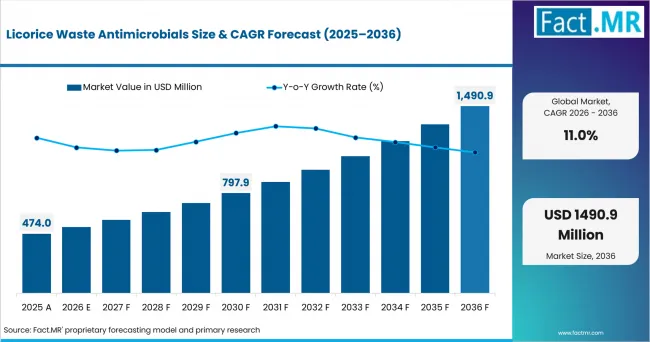
Licorice Waste Antimicrobials Value Analysis | Source: Fact.MR
What are the defining numbers behind Licorice Waste Antimicrobials Market growth?
USD 964.8 million absolute opportunity by 2036 led by plant-waste extract and antimicrobial / preservation applications.
- Demand Drivers in the Market
- Food processors are expected to evaluate recovered licorice actives where natural shelf-life systems fit established natural food preservatives programs and product-specific microbial targets.
- Bakery formulators are anticipated to prioritize measurable mould control because shelf-life performance is visible through routine challenge testing and distribution checks.
- Ingredient processors are expected to seek higher-value routes for licorice residues where extraction can produce standardized fractions with defined marker ranges.
- European food manufacturing provides a broad application base. Eurostat reported in August 2026 that sold production value for EU food products increased 3.8% in constant prices during 2025.
- Key Segments Analyzed
- By Source / Active Platform: Plant-waste extract is expected to hold 36.0% share in 2026 because direct recovery keeps the process close to the licorice residue stream.
- By Primary Function: Antimicrobial / preservation is projected to account for 42.0% share in 2026 owing to microbial control being the central commercial use.
- By Application: Bakery / snacks are anticipated to capture 26.0% share in 2026 reflecting repeated mould-control and freshness requirements in packaged baked products.
- By Form: Dry powder is estimated to represent 38.0% share in 2026 supported by storage stability and compatibility with dry ingredient systems.
- Analyst Opinion at Fact.MR
- Shambhu Nath Jha is Principal Consultant at Fact.MR and states: “Commercial value depends on repeatable potency and food-compatible sensory performance. Adoption is expected to favor suppliers that connect residue selection with standardized extraction. Application testing remains central to customer qualification.”
- Strategic Implications
- Extract processors should define marker compounds and acceptance ranges before scaling multi-site sourcing.
- Food formulators should match antimicrobial testing to the target spoilage organism and the finished-food matrix.
- Bakery teams should use predictive shelf-life tools when comparing preservation systems.
- Ingredient distributors should maintain powder and liquid options so customers can align dosing with plant layout and formulation sequence.
Belgium is anticipated to record 10.9% CAGR through 2036 supported by dairy processing. The USA is projected to post 10.6% CAGR as its food economy sustains broad formulation activity. France is estimated at 9.5% CAGR reflecting food and beverage manufacturing depth. Germany is forecast at 9.0% CAGR as prepared-food production expands. Japan is expected to record 8.6% CAGR with processors emphasizing consistency and formulation fit.
How does the Licorice Waste Antimicrobials Market break down by segment?
Plant-waste extract leads at 36.0%; antimicrobial / preservation leads at 42.0%.
Which Source / Active Platform dominates?
Plant-waste extract is expected to hold 36.0% share in 2026.
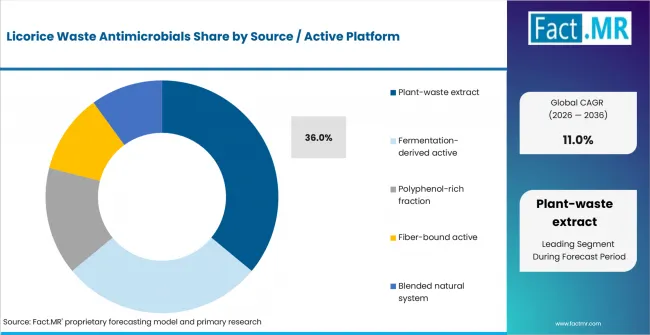
Licorice Waste Antimicrobials Analysis By Source Active Platform | Source: Fact.MR
Plant-waste extract is expected to lead because it converts residual licorice material into a directly testable active fraction. Fermentation-derived actives provide a second route when bioprocessing improves release or consistency. Polyphenol-rich fractions support antioxidant overlap. Fiber-bound actives and blended natural systems address applications that need combined functions. The segment aligns with wider fermented ingredients and recovered plant-input value chains.
What leads the Primary Function segment?
Antimicrobial / preservation is projected to account for 42.0% share in 2026.
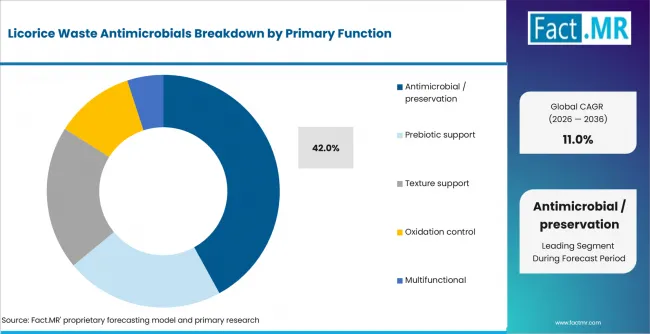
Licorice Waste Antimicrobials Analysis By Primary Function | Source: Fact.MR
Antimicrobial / preservation is projected to lead because microbial control defines the market boundary. Oxidation control extends shelf-life value where recovered phenolics protect sensitive formulations. Prebiotic support and texture functions require separate validation. Multifunctional systems are expected to gain interest when one standardized fraction supports more than one formulation goal. Adjacent natural antioxidant shelf extenders show how plant-derived actives can be positioned around measurable shelf-life performance.
How does Application shape demand?
Bakery / snacks are anticipated to lead with 26.0% share in 2026.
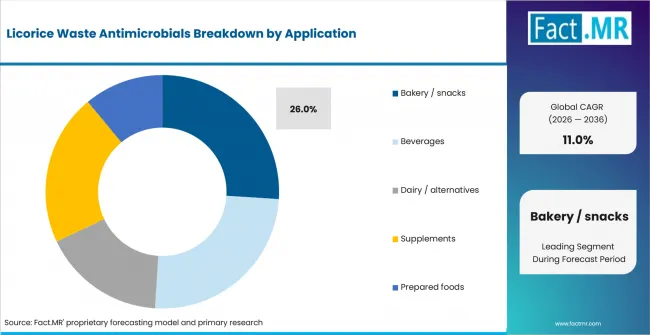
Licorice Waste Antimicrobials Analysis By Application | Source: Fact.MR
Bakery and snacks are anticipated to lead because mould growth gives formulators a clear performance target. Dry systems can enter flour blends and premixes with limited process change. Beverages need tighter color and flavor control. Dairy alternatives require compatibility with refrigerated matrices. Supplements and prepared foods extend demand where standardized botanical fractions support defined functions. This application pattern connects with functional bakery ingredients and wider food additives used for shelf-life and formulation control.
What supports Dry powder within Form?
Dry powder is estimated to represent 38.0% share in 2026.
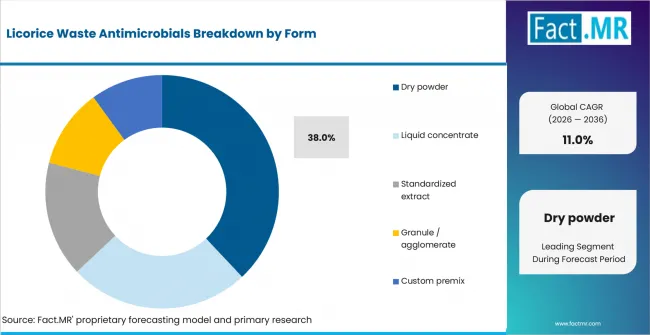
Licorice Waste Antimicrobials Analysis By Form | Source: Fact.MR
Dry powder is estimated to lead because storage and dosing align with premix operations. Liquid concentrate suits beverage and liquid-food lines. Standardized extract emphasizes marker control. Granules support handling where dust reduction is useful. Custom premixes combine the active fraction with compatible carriers. These formats overlap with microencapsulated food ingredients when protection and controlled delivery become part of the formulation requirement.
What is accelerating Licorice Waste Antimicrobials Market adoption, and what is holding it back?
Waste-stream valorization and natural preservation support adoption; active-content variability and qualification cost restrain scale-up.
Drivers Impact Analysis
| DRIVER | (~) % IMPACT ON CAGR | GEOGRAPHIC RELEVANCE | IMPACT TIMELINE |
|---|---|---|---|
| Food-waste valorization and ingredient recovery | +1.7% | Europe, North America | Medium term (2-4 years) |
| Natural preservation reformulation | +1.5% | Global | Short term (<= 2 years) |
| Bakery mould-control and shelf-life needs | +1.2% | North America, Europe | Short term (<= 2 years) |
| Standardized botanical extraction capability | +0.9% | Europe, East Asia | Medium term (2-4 years) |
| Multifunctional polyphenol and fiber fractions | +0.7% | Global | Long term (>= 4 years) |
Source: Fact.MR analysis. Updated Sep 21, 2026
Opportunity Impact Analysis
| OPPORTUNITY | (~) % IMPACT ON CAGR | GEOGRAPHIC RELEVANCE | IMPACT TIMELINE |
|---|---|---|---|
| Bakery-specific antimicrobial systems | +1.2% | USA, Germany, France | Short term (<= 2 years) |
| Beverage-compatible standardized extracts | +1.0% | France, Japan, Belgium | Medium term (2-4 years) |
| Fermentation-assisted recovery | +0.8% | Europe, Japan | Medium term (2-4 years) |
| Custom premixes for prepared foods | +0.6% | Global | Long term (>= 4 years) |
Source: Fact.MR analysis. Updated Sep 21, 2026
Restraints Impact Analysis
| RESTRAINT | (~) % IMPACT ON CAGR | GEOGRAPHIC RELEVANCE | IMPACT TIMELINE |
|---|---|---|---|
| Variable active content in residue streams | -0.7% | Global | Short term (<= 2 years) |
| Taste, color and odor interference | -0.6% | Global | Short term (<= 2 years) |
| Food-ingredient safety and claims qualification | -0.5% | USA, Europe | Medium term (2-4 years) |
| Recovery cost versus established preservatives | -0.4% | Global | Long term (>= 4 years) |
Source: Fact.MR analysis. Updated Sep 21, 2026
Which countries are scaling the Licorice Waste Antimicrobials Market through 2036?
- The country comparison spans 2.3 percentage points and forms three practical growth bands across the forecast period.
- Belgium remains 0.3 percentage point above the USA through dairy-processing activity and ingredient networks that support preservation-system testing.
- The USA remains 1.1 percentage points above France as its broad food economy and formulation base support natural preservation trials across bakery and prepared foods.
- France remains 0.5 percentage point above Germany through food and beverage manufacturing depth and multiple routes for standardized botanical ingredient testing.
- Germany remains 0.4 percentage point above Japan as prepared-food production and shelf-life requirements support preservation trials across varied formulations.
- Japan closes the displayed range through its large food-processing base and emphasis on consistency, sensory control and standardized active specifications.
Comparable CAGRs can create different entry conditions due to food-processing scale, dairy and bakery application depth, formulation requirements, sensory constraints and ingredient-standardization capability. Full report coverage includes North America, Latin America, Western Europe, Eastern Europe, East Asia, South Asia & Pacific, Middle East & Africa.
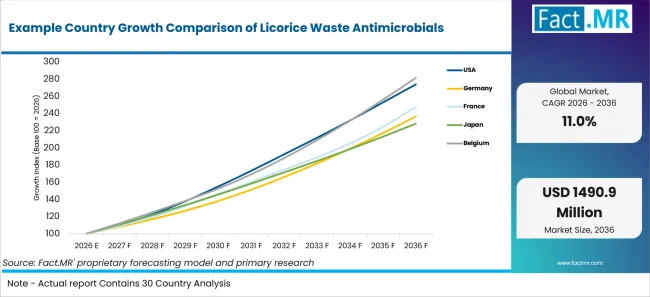
Example Country Growth Comparison Of Licorice Waste Antimicrobials | Source: Fact.MR
| Country | CAGR (2026-2036) |
|---|---|
| Belgium | 10.9% |
| USA | 10.6% |
| France | 9.5% |
| Germany | 9.0% |
| Japan | 8.6% |
Source: Fact.MR analysis. Updated Sep 21, 2026
What is powering Belgium's lead?
10.9% CAGR through 2036 supported by dairy processing and ingredient networks.
Belgium is anticipated to record 10.9% CAGR through 2036 as dairy processors evaluate preservation systems for chilled products and desserts. Statbel reported in May 2026 that Belgian dairies produced 731 million litres of fresh dairy products in 2025. That production base gives ingredient developers a defined set of refrigerated applications for testing standardized licorice-derived fractions. Commercial progress is expected to depend on sensory fit and repeatable active specifications across powder and liquid formats.
How is the USA scaling demand?
10.6% CAGR through 2036 shaped by a broad food economy and formulation base.
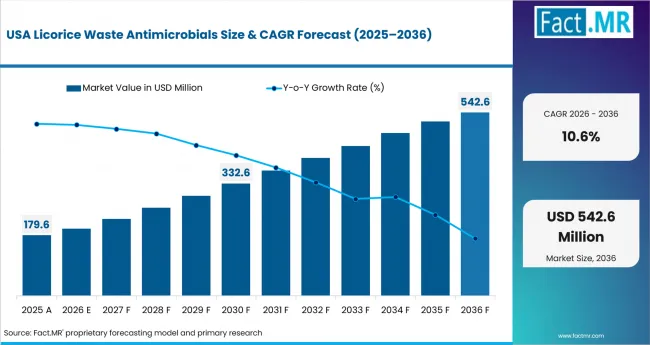
Licorice Waste Antimicrobials Country Value Analysis | Source: Fact.MR
The USA is projected to post 10.6% CAGR from 2026 to 2036 as food manufacturers evaluate natural preservation systems across bakery and prepared foods. USDA Economic Research Service reported on June 11, 2026 that total U.S. food spending reached USD 2.51 trillion in 2025 in inflation-adjusted 2025 dollars. The scale supports a large testing base for ingredient qualification across retail and foodservice products. Adoption is expected to favor systems that pair antimicrobial performance with simple dosing and stable sensory results.
What supports the France outlook?
9.5% CAGR through 2036 reinforced by food and beverage manufacturing depth.
France is estimated to advance at 9.5% CAGR by 2036 with demand spread across bakery and beverage applications. Insee reported in July 2026 that French food and beverage manufacturing plus tobacco reached EUR 207 billion in production value during 2025. That industrial base gives botanical ingredient suppliers multiple routes for application testing. Standardized licorice-waste fractions are expected to compete through active-marker control and formulation support in products where taste and color remain tightly managed.
What underpins Germany's growth?
9.0% CAGR through 2036 supported by prepared-food production and shelf-life requirements.
Germany is forecast to reach 9.0% CAGR through 2036 as prepared-food producers seek consistent shelf-life performance across complex formulations. Destatis reported in January 2026 that Germany produced 1.7 million tonnes of ready meals in 2024. That volume creates a practical application base for preservation trials in products with varied moisture and processing conditions. Suppliers are expected to gain acceptance through defined dose ranges and stable specifications for recovered plant actives.
How does Japan perform?
8.6% CAGR through 2036 influenced by a large food-processing base and strict formulation requirements.
Japan is expected to record 8.6% CAGR from 2026 to 2036 as processors balance ingredient performance with consistency and sensory control. USDA Foreign Agricultural Service reported on April 1, 2026 that Japan’s food-processing sector contracted by 3% in 2025 to USD 174 billion. The sector includes beverages and health foods alongside frozen and shelf-stable products. Licorice-derived systems are expected to gain attention where standardized actives fit established quality requirements and compact powder or concentrate formats.
Who leads the Licorice Waste Antimicrobials Market?
Ruitenberg BasIQs is included among the key companies profiled for the Licorice Waste Antimicrobials Market. Its relevance within the competitive set is assessed against the market’s need for standardized functional ingredients that combine antimicrobial performance with food-compatible sensory characteristics.
DELACON / CARGILL is also included in the profiled company set. Competitive relevance in this market depends on the ability to support natural-preservation formulations while maintaining consistent active specifications, practical dosing and compatibility with finished-food matrices across bakery, beverages and prepared foods.
Kono Chem completes the listed provider set. Commercial qualification across licorice-waste-derived systems is expected to depend on controlled extraction, standardized active content and repeatable application performance, particularly where taste, color and odor must remain within finished-product requirements.
The supplied report identifies Ruitenberg BasIQs, DELACON / CARGILL and Kono Chem as the key profiled companies, but it does not provide company-specific evidence establishing distinct licorice-waste antimicrobial products for each provider. Competition therefore centers on active-content consistency, antimicrobial performance, sensory control, extraction capability, formulation support and scalable residue processing.
Which companies are the key providers?
Key companies include Ruitenberg BasIQs; DELACON / CARGILL; and Kono Chem.
- Ruitenberg BasIQs
- DELACON / CARGILL
- Kono Chem
Bibliography
- Eurostat. (2026, August 24). EU industrial production rebounds in 2025.
- Statbel. (2026, May 29). Belgian cheese and fresh dairy products continue to perform well in 2025.
- Zeballos, E., & Sinclair, W. (2026, June 11). Total U.S. food spending reached $2.51 trillion in 2025. U.S. Department of Agriculture, Economic Research Service.
- Insee. (2026, July 21). Indicateurs macroéconomiques de l’industrie manufacturière.
- Statistisches Bundesamt (Destatis). (2026, January 14). Produktion von Fertiggerichten binnen fünf Jahren mengenmäßig um 25,6 % gestiegen.
- Aoki, S. (2026, April 1). Food processing ingredients annual (Report No. JA2026-0012). U.S. Department of Agriculture, Foreign Agricultural Service.
This Report Addresses
- The report assesses source platform and preservation function across licorice-processing waste streams.
- Segment analysis covers plant-waste extract at 36.0% and antimicrobial / preservation at 42.0% in 2026.
- Country analysis profiles Belgium and the USA alongside France, Germany and Japan.
- Competitive analysis profiles Ruitenberg BasIQs, DELACON/ CARGILL, and Kono Chem.
- Application analysis covers bakery / snacks, beverages, dairy/ alternatives, supplements and prepared foods.
What does the Licorice Waste Antimicrobials Market cover?
Plant-waste extracts and fermentation-derived actives with polyphenol-rich or fiber-bound fractions used for preservation and related food functions.
The market covers functional ingredients recovered from licorice-processing residues when antimicrobial or preservation performance is the central commercial use. It links residue valorization with clean-label preservatives and related natural shelf-life systems.
Primary-root extracts fall outside the market boundary when they enter formulations as conventional licorice ingredients. The scope stays focused on documented waste-stream recovery. Adjacent nisin natural antimicrobial systems provide a comparison point for food-grade shelf-life technologies.
What is included in the scope?
Licorice-waste-derived functional ingredients used in bakery and beverages; dairy alternatives and supplements; prepared foods.
Coverage includes plant-waste extracts and fermentation-derived actives. Polyphenol-rich fractions and fiber-bound actives are included when licorice waste is the material origin. Blended systems qualify when recovered licorice actives remain functional components. The analysis spans powder and liquid formats alongside standardized extracts and custom premixes. These products overlap with food additives and natural antioxidant shelf extenders where preservation and oxidation control share application requirements.
What is excluded from the scope?
Primary-root licorice extracts and unrelated conventional preservation systems are outside the market boundary.
Outside scope are conventional licorice extracts sourced directly from primary root material and finished preservatives based on other active systems. Finished retail foods remain application endpoints. The assessment focuses on ingredient value within the functional system. Broader preservation categories appear only as comparison points for performance and formulation fit.
How Was the Analysis Built?
The analysis draws on 120+ sources, 35+ company portfolios, 25+ countries, and more than 20 industry interviews.
- Primary Research: Primary research includes discussions with manufacturers, service providers, technology developers, distributors, end users, and subject-matter experts. These conversations examine purchasing priorities, product adoption, operational challenges, approval requirements, competitive positioning, and the factors that influence wider market acceptance.
- Desk Research: Desk research covers government statistics, regulatory publications, company filings, trade data, technical studies, industry associations, standards, public policy, and other authoritative sources. Every source used in the analysis is documented in the bibliography.
- Market Sizing and Forecasting: Market estimates combine historical performance, demand indicators, pricing and volume trends, segment shares, company participation, country-level growth, adoption patterns, investment activity, and barriers to market expansion.
- Data Validation and Update Cycle: Findings are validated by comparing primary interviews with public data, company activity, regulatory changes, trade patterns, and industry developments. Regular updates review new product launches, capacity changes, partnerships, approvals, and shifts in commercial adoption.
Segmentation
What is the report's scope and coverage?
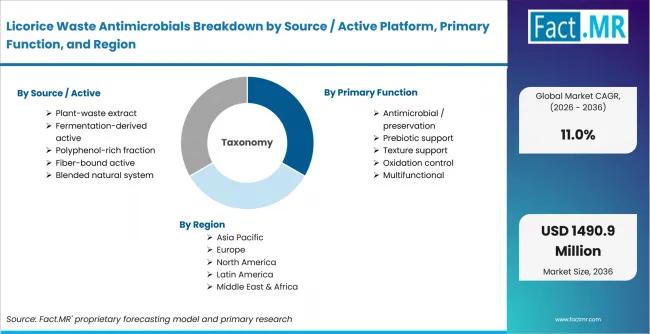
Licorice Waste Antimicrobials Breakdown By Source Active Platform, Primary Function, And Region | Source: Fact.MR
| Attribute | Details |
|---|---|
| Quantitative Units | USD million |
| Market Definition | Functional ingredients recovered from licorice-processing waste streams with antimicrobial or preservation use. |
| Source / Active Platform | Plant-waste extract; Fermentation-derived active; Polyphenol-rich fraction; Fiber-bound active; Blended natural system |
| Primary Function | Antimicrobial / preservation; Prebiotic support; Texture support; Oxidation control; Multifunctional |
| Application | Bakery / snacks; Beverages; Dairy / alternatives; Supplements; Prepared foods |
| Form | Dry powder; Liquid concentrate; Standardized extract; Granule / agglomerate; Custom premix |
| Regions Covered | North America; Latin America; Western Europe; Eastern Europe; East Asia; South Asia & Pacific; Middle East & Africa |
| Countries Covered | Belgium; USA; France; Germany; Japan |
| Key Companies Profiled | Ruitenberg BasIQs; DELACON / CARGILL; Kono Chem |
| Forecast Period | 2026 to 2036 |
| Approach | Official sector evidence; first-party company verification; segment mapping; country analysis |
Source: Fact.MR analysis. Updated Sep 21, 2026
How is the market segmented?
-
By Source / Active Platform
- Plant-waste extract
- Fermentation-derived active
- Polyphenol-rich fraction
- Fiber-bound active
- Blended natural system
-
By Primary Function
- Antimicrobial / preservation
- Prebiotic support
- Texture support
- Oxidation control
- Multifunctional
-
By Application
- Bakery / snacks
- Beverages
- Dairy / alternatives
- Supplements
- Prepared foods
-
By Form
- Dry powder
- Liquid concentrate
- Standardized extract
- Granule / agglomerate
- Custom premix
-
By Region
- North America
- Latin America
- Western Europe
- Eastern Europe
- East Asia
- South Asia & Pacific
- Middle East & Africa
Frequently Asked Questions
How big is the Licorice Waste Antimicrobials Market in 2026?
What is the CAGR of the Licorice Waste Antimicrobials Market from 2026 to 2036?
Which source/active platform leads the Licorice Waste Antimicrobials Market?
Which primary function leads the Licorice Waste Antimicrobials Market?
Who are the leading companies in the Licorice Waste Antimicrobials Market?
Who worked on this report


Preview the report firsthand - request a free sample
Free SampleGet the brochure for pricing and purchase details
Download PDF