- Market Value (2025): USD 1.3 Bn
- Estimated Value (2026): USD 1.4 Bn
- Forecast Value (2036): USD 2.9 Bn
- CAGR (2026-2036): 8.0%
What is the Natural Antioxidant Shelf Extenders Market forecast to be worth by 2036?
USD 1.4 billion in 2026 to USD 2.9 billion by 2036 at an 8.0% CAGR.
- The Natural Antioxidant Shelf Extenders Market crossed a valuation of USD 1.3 billion in 2025.
- Demand is projected to increase from USD 1.4 billion in 2026 to USD 2.9 billion by 2036.
- The market is forecast to record 8.0% CAGR from 2026 to 2036 as food manufacturers replace synthetic antioxidants and document shelf-life performance.
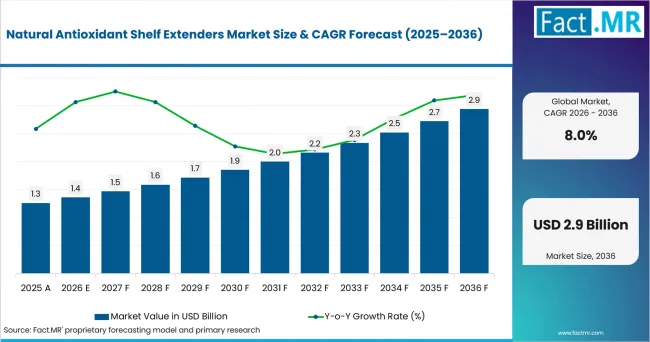
Natural Antioxidant Shelf Extenders Market Value Analysis | Source: Fact.MR
What are the defining numbers behind Natural Antioxidant Shelf Extenders Market growth?
An absolute opportunity of USD 1.58 billion is expected between 2026 and 2036.
- Demand Drivers in the Market
- Meat processors need oxidation control that protects color and flavor during chilled distribution. Agreste and FranceAgriMer reported in July 2026 that overall meat consumption in France increased 1.3% in 2025.
- Oil and snack formulators need fat-stability systems that reduce rancid notes while preserving label language. Rosemary and tocopherol blends fit high-fat applications, and wider food additives rules make documentation part of supplier approval.
- Pet food manufacturers need natural antioxidant systems that protect rendered fats and finished kibble. Mixed tocopherols and rosemary systems help maintain palatability when premium brands reduce reliance on BHA, BHT, and TBHQ.
- Retail and foodservice brands need more shelf-life confidence as waste programs receive public attention.
- Formulation teams are comparing antioxidant systems with nearby clean-label preservatives because launch teams often review shelf life, label fit, and sensory impact together before approving a recipe.
- Key Segments Analyzed
- By Antioxidant System: Rosemary extract is expected to hold 35.00% share in 2026, supported by familiar botanical positioning and its role in lipid oxidation control within rosemary extract applications.
- By Primary Protection: Lipid oxidation is projected to account for 44.00% share in 2026 due to its direct effect on rancidity, color loss, and off-flavor risk across food preservatives planning.
- By Food Application: Meat & poultry is anticipated to capture 29.00% share in 2026 owing to chilled shelf-life needs and rapid quality loss when oxidation is unmanaged.
- By Formulation Format: Oil-soluble formats are forecast to represent 34.00% share in 2026, supported by fat-phase dosing in oils, marinades, and seasonings where tocopherol systems are common.
- Analyst Opinion at Fact.MR
- Shambhu Nath Jha, Principal Consultant at Fact.MR, states, “Natural antioxidant shelf extenders are being selected less as a label claim and more as a formulation-control tool. Demand is expected to move toward blends that prove oxidation control in the actual food matrix. Suppliers that combine botanical sourcing, application testing, dose guidance, and label support should earn stronger positions with meat, snack, oil, and pet food brands.”
- Strategic Implications
- Ingredient suppliers should publish application data by fat level and storage condition so formulators compare real stability gains before scale-up.
- Contract manufacturers should align dry, oil-soluble, and emulsion dosing routes with their existing mixing equipment.
- Distributors should stock region-ready rosemary, tocopherol, acerola, and green tea blends with clear label and compliance documentation.
The USA is projected to post 9.0% CAGR through 2036, supported by packaged food spending and meat-processing scale. Germany is anticipated to advance at 8.6% as plant-based meat and EU additive rules shape formulation choices. The UK is forecast to record 8.2% through retail freshness priorities. France is estimated to reach 7.6% through meat and prepared-food demand. Brazil is projected to post 7.2% as protein and grain-linked food systems support antioxidant use.
How does the Natural Antioxidant Shelf Extenders Market break down by segment?
Rosemary extract leads at 35.00%; lipid oxidation leads at 44.00%.
Which Antioxidant System dominates?
Rosemary extract holds 35.0% share in 2026.
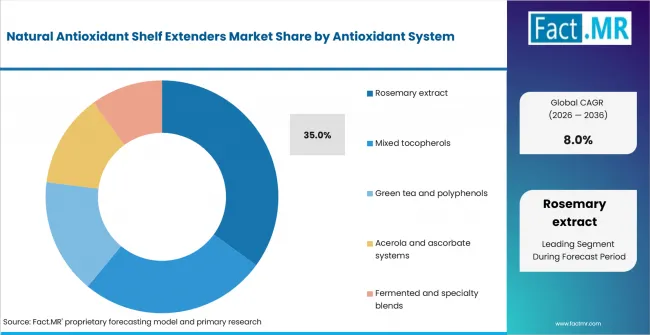
Natural Antioxidant Shelf Extenders Market Analysis By Antioxidant System | Source: Fact.MR
Rosemary extract is expected to lead due to its carnosic acid and carnosol content. Kalsec positions rosemary-based food protection within natural food protection, and Kemin links rosemary programs to standardized botanical supply. Mixed tocopherols remain relevant where formulators need fat-phase stability and mild label language. Green tea and polyphenol systems add value in blends where phenolic activity and taste control must be balanced.
What leads the Primary Protection segment?
Lipid oxidation holds 44.0% share in 2026.
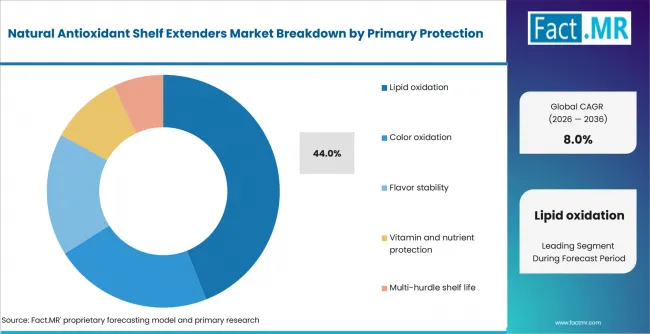
Natural Antioxidant Shelf Extenders Market Analysis By Primary Protection | Source: Fact.MR
Lipid oxidation is projected to lead since rancidity remains a clear shelf-life failure point in high-fat foods. The European Commission stated in February 2026 that antioxidants protect food from oxidation and extend shelf life under EU additive functions. Color oxidation follows in meat and prepared meals. Flavor stability gains attention in sauces and snacks, while nutrient protection supports fortified and pet food formulas.
How does Food Application shape demand?
Meat & poultry captures 29.0% share in 2026.
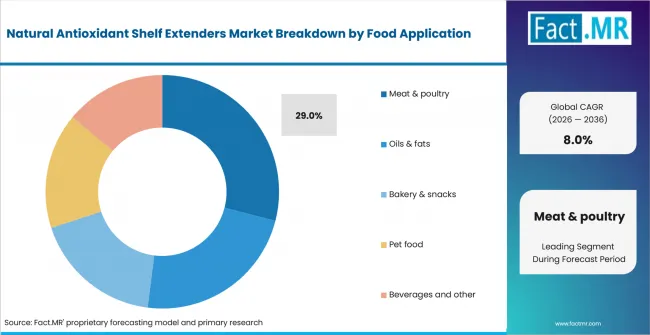
Natural Antioxidant Shelf Extenders Market Analysis By Food Application | Source: Fact.MR
Meat & poultry is anticipated to lead because fresh and processed proteins show color loss and rancid odor quickly when oxidation is unmanaged. DEFRA reported in July 2026 that UK home-fed poultry meat production reached 2.0 million tonnes in 2025. Oils & fats follow because unsaturated oils need stability support. Bakery & snacks use dry systems for seasoning, frying-oil carryover, and ambient storage.
What supports Oil-soluble formats?
Oil-soluble formats account for 34.0% share in 2026.
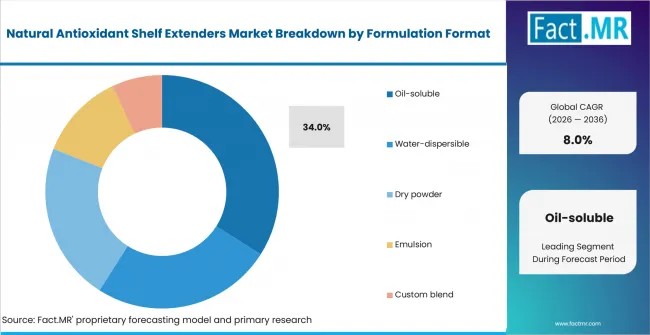
Natural Antioxidant Shelf Extenders Market Analysis By Formulation Format | Source: Fact.MR
Oil-soluble formats are forecast to account for 34.00% share since many oxidation problems begin in fat phases. Camlin Fine Sciences lists NaSure applications across oils, bakery, meat, poultry, and pet food. Water-dispersible formats serve beverages and emulsions. Dry powders support premixes and snack bases, creating overlap with food stabilizers where shelf life and texture are reviewed together.
What is accelerating Natural Antioxidant Shelf Extenders Market adoption, and what is holding it back?
Clean-label reformulation drives it; cost and sensory limits restrain it.
Drivers Impact Analysis
| DRIVER | (~) % IMPACT ON CAGR | GEOGRAPHIC RELEVANCE | IMPACT TIMELINE |
|---|---|---|---|
| Replacement of synthetic antioxidants | +1.9% | North America, Europe | Short term (<= 2 years) |
| Meat and poultry oxidation control | +1.5% | USA, UK, Brazil | Medium term (2-4 years) |
| Oil and snack shelf-life economics | +1.1% | Global | Medium term (2-4 years) |
| Pet food natural preservation | +0.8% | North America, Western Europe | Long term (>= 4 years) |
| Food waste reduction programs | +0.6% | Europe, North America | Long term (>= 4 years) |
Source: Fact.MR analysis. Updated Sep 3, 2026
- Replacement of synthetic antioxidants: Food brands are reformulating away from synthetic antioxidants where natural positioning adds label value. Rosemary, tocopherol, acerola, and green tea systems gain relevance when they can demonstrate reliable oxidation control in the intended food application.
- Meat and poultry oxidation control: Fresh and processed proteins require protection against color deterioration, off-odors, and oxidative quality loss during storage and display. Natural antioxidant systems can support shelf-life management across meat and poultry applications where visual and sensory quality influence product acceptance.
- Oil and snack shelf-life economics: Oil-rich foods can lose value when oxidation creates off-flavors before the expected shelf-life period. Oil-soluble antioxidants help protect frying systems and packaged snacks, allowing manufacturers to balance ingredient cost against longer product stability and improved sensory performance.
- Pet food natural preservation: Premium pet food manufacturers use mixed tocopherols, rosemary extracts, and other botanical antioxidants to stabilize fats and protect product quality. Natural preservation systems are particularly relevant where brands want effective oxidation control alongside cleaner ingredient positioning.
- Food waste reduction programs: Shelf-life extension supports food-waste reduction by helping products maintain acceptable quality for longer periods. Natural antioxidants remain relevant where manufacturers seek cleaner labels together with measurable improvements in oxidation control, storage stability, and product durability.
Opportunity Impact Analysis
| OPPORTUNITY | (~) % IMPACT ON CAGR | GEOGRAPHIC RELEVANCE | IMPACT TIMELINE |
|---|---|---|---|
| Microencapsulated rosemary for dry snacks | +1.0% | North America, Europe | Medium term (2-4 years) |
| Water-dispersible systems for beverages | +0.8% | Europe, USA | Medium term (2-4 years) |
| Multi-hurdle antioxidant blends | +0.7% | Global | Long term (>= 4 years) |
| Country-specific label support | +0.5% | EU, UK, Brazil | Short term (<= 2 years) |
Source: Fact.MR analysis. Updated Sep 3, 2026
- Microencapsulated rosemary: Snack manufacturers need dry antioxidant powders that protect seasonings and fried bases while limiting unwanted herbal odor or flavor. Microencapsulation can improve handling, stability, and controlled release, supporting broader use of rosemary-based systems in dry and oil-rich formulations.
- Water-dispersible systems: Beverage and emulsion formulators require antioxidant systems that disperse consistently while supporting cleaner ingredient positioning. Water-dispersible ascorbates, rosemary extracts, tocopherols, and green tea compounds can help control oxidation and protect color across aqueous and emulsified food systems.
- Multi-hurdle antioxidant blends: Some foods require oxidation control together with flavor stability and broader preservation support. Combined antioxidant and preservation systems can help manufacturers manage several quality risks within one formulation, particularly where fresh food packaging and shelf-life strategies are evaluated together.
- Country-specific label support: Antioxidant permissions and labeling requirements vary across markets and product categories. Suppliers with clear regional documentation, application guidance, and regulatory support can simplify cross-border product development and help manufacturers qualify natural antioxidant systems more efficiently.
Restraints Impact Analysis
| RESTRAINT | (~) % IMPACT ON CAGR | GEOGRAPHIC RELEVANCE | IMPACT TIMELINE |
|---|---|---|---|
| Higher cost of natural extracts | -0.7% | Global | Short term (<= 2 years) |
| Sensory carry-over in mild foods | -0.5% | Europe, USA | Medium term (2-4 years) |
| Botanical active variability | -0.4% | Global | Medium term (2-4 years) |
| Additive approval and label complexity | -0.3% | EU, UK, Brazil | Long term (>= 4 years) |
Source: Fact.MR analysis. Updated Sep 3, 2026
- Higher cost of natural extracts: Natural antioxidant systems often require additional testing, tighter dosage control, and application-specific validation. These requirements can increase reformulation costs, making adoption more selective in price-sensitive food categories where manufacturers closely manage ingredient and development budgets.
- Sensory carry-over in mild foods: Rosemary and green tea extracts can introduce herbal or botanical notes into mild-tasting products such as poultry, sauces, and beverages. Formulators therefore need sensory trials to confirm that oxidation control does not compromise flavor or conflict with clean-label positioning.
- Botanical active variability: Plant-derived antioxidants can vary with crop quality, growing conditions, and extraction methods. Standardized cultivation, assay control, and supplier specifications help reduce batch variation, although qualification can remain more demanding than for conventional commodity additives.
- Additive approval and label complexity: Natural antioxidant systems still require category alignment, dosage checks, and label review before commercial use. Suppliers with clear regulatory documentation and application guidance can help manufacturers move more efficiently from pilot testing into approved retail formulations.
Which countries are scaling the Natural Antioxidant Shelf Extenders Market through 2036?
- The country comparison spans 1.84 percentage points across the forecast period.
- The USA remains 0.48 percentage point above Germany through packaged-food spending and protein processing scale.
- Germany remains 0.39 percentage point above the UK as plant-based meat and EU additive rules shape formulation reviews.
- The UK remains 0.57 percentage point above France through chilled protein, bakery freshness, and retailer shelf-life priorities.
- France remains 0.40 percentage point above Brazil because meat consumption and prepared foods keep antioxidant qualification active.
- Brazil closes the displayed range through poultry scale and grain-linked food systems.
Natural Antioxidant Shelf Extenders Market is segmented into North America, Latin America, Western Europe, Eastern Europe, East Asia, South Asia & Pacific, and Middle East & Africa.
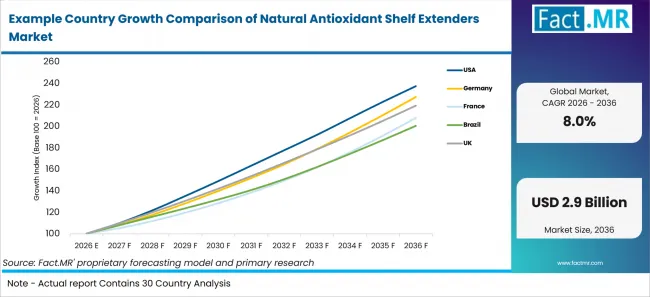
Example Country Growth Comparison Of Natural Antioxidant Shelf Extenders Market | Source: Fact.MR
| Country | CAGR (2026-2036) |
|---|---|
| USA | 9.0% |
| Germany | 8.6% |
| UK | 8.2% |
| France | 7.6% |
| Brazil | 7.2% |
Source: Fact.MR analysis. Updated Sep 3, 2026
What supports USA adoption?
9.0% CAGR through 2036, driven by packaged-food spending and protein formulation needs.
Packaged food value gives USA formulators a broad base for shelf-life work. USDA ERS reported in June 2026 that inflation-adjusted total U.S. food spending reached USD 2.51 trillion in 2025. The USA is projected to post 9.0% CAGR through 2036 as Kalsec and Kemin support rosemary extract, tocopherol, and oxidation-control programs for meat, snacks, and pet food.
How is Germany scaling demand?
8.6% CAGR through 2036, supported by plant-based meat and EU additive discipline.
Germany links clean-label antioxidant use to meat substitutes and EU additive review. Destatis reported in May 2026 that Germany produced 124,900 tonnes of meat substitutes in 2025. Germany is anticipated to advance at 8.6% CAGR through 2036 as formulators use tocopherol, rosemary, and acerola blends in plant-based foods, meat analogues, and snacks.
What supports the UK outlook?
8.2% CAGR through 2036, backed by chilled protein and date-label attention.
UK retailers place shelf-life and use-by confidence at the center of chilled protein decisions. The Food Standards Agency reported in March 2025 that 86% of respondents said they “always” or “most of the time” checked use-by dates when buying food. The UK is forecast to record 8.2% CAGR through 2036 as Kerry and other ingredient suppliers help brands validate freshness in deli meat, bakery, and beverage applications.
What underpins France growth?
7.6% CAGR through 2036, led by meat consumption and prepared-food demand.
France combines meat consumption with prepared-food demand across retail and foodservice channels. INSEE reported on August 28, 2026 that household food consumption increased 0.2% in July 2026 after a revised 0.7% increase in June 2026. France is estimated to reach 7.6% CAGR through 2036 as DSM-Firmenich and regional formulators apply antioxidants in beverages, dairy, processed meat, and prepared foods.
How is Brazil developing demand?
7.2% CAGR through 2036, supported by protein scale and oilseed-linked food systems.
Brazil connects natural antioxidant use to protein processing and oilseed-linked foods. IBGE reported in March 2026 that Brazil slaughtered 6.69 billion chickens in 2025, a record in the series. Brazil is projected to post 7.2% CAGR through 2036 as Camlin Fine Sciences and regional formulators apply natural blends to meat, oils, bakery, and pet food.
Who leads the Natural Antioxidant Shelf Extenders Market?
Kalsec is active through rosemary-centered natural food protection and botanical sourcing. Its April 2026 CSR update reported that it achieved Farm Sustainability Assessment Silver verification across key crops and regions, strengthening its sustainable sourcing credentials for plant-derived antioxidant ingredients.
Kemin Industries competes through FORTIUM™, NATUROX®, and its vertically integrated rosemary program. Its December 2025 update described control from proprietary clonal rosemary lines through cultivation, harvesting, and extraction, supporting consistent quality in natural antioxidant supply. FORTIUM™ R provides rosemary-based antioxidant protection for food applications, while NATUROX® serves natural antioxidant applications in pet food.
Camlin Fine Sciences competes through NaSure™ shelf-life systems. Its 2025 ground-beef technical bulletin tested acerola, rosemary, green tea, and acerola-green tea treatments on 85:15 ground-beef patties over an 18-day refrigerated storage period, evaluating their effects on color retention and lipid oxidation.
Kerry Group adds clean-label preservation through FoodGARD and Nourishield platforms. DSM-Firmenich supports technical antioxidants such as ascorbates, rosemary extract, tocopherols, and green tea EGCG. Vitablend competes through tocopherol, rosemary, vitamin-based, and custom antioxidant systems for food, feed, and personal care.
Which companies are the key providers?
Key companies include Kalsec; Kemin Industries; Camlin Fine Sciences; Kerry Group; DSM-Firmenich; and Vitablend.
- Kalsec
- Kemin Industries
- Camlin Fine Sciences
- Kerry Group
- DSM-Firmenich
- Vitablend
Bibliography
- Service de la statistique et de la prospective, & FranceAgriMer. (2026, July 8). En 2025, une hausse de la consommation de viande en France et une dépendance croissante aux importations.
- U.S. Bureau of Labor Statistics. (2026, August 12). Consumer Price Index—July 2026.
- Companhia Nacional de Abastecimento. (2026, August 13). Estimativa aponta para uma produção de 360,8 milhões de toneladas na safra 2025/26.
- Department for Environment, Food & Rural Affairs. (2026, July 29). Chapter 8: Livestock.
- Statistisches Bundesamt (Destatis). (2026, May 18). Nach jahrelangem Anstieg: Fleischersatz-Produktion sinkt 2025 um 1,2 % gegenüber dem Vorjahr.
- European Commission. (2026, February 5). Food additives in the EU: Safe use and clear labelling [Factsheet].
- Eurostat. (2025, October 16). 130 kg of food wasted per person annually in the EU.
- Moore, A., Heard, H., Murray, L., Shillitoe, R., Clifford, R., Mensah, D., & Jenkins, M. (2025, March 25). Food and You 2: Wave 9. Food Standards Agency.
- Instituto Brasileiro de Geografia e Estatística. (2026, March 18). In 2025, Brazil registers the highest production of milk, leather and eggs in history; slaughter of cattle, chickens and pigs also hits record.
- Institut national de la statistique et des études économiques. (2026, August 28). Household consumption of goods increased again in July 2026 (+0.5% after +0.6%).
- Kalsec. (2026, April 28). Kalsec highlights measurable progress in latest corporate social responsibility report.
- Boettcher, M. (2025, December 16). Kemin’s rosemary program is leading the way in natural antioxidant solutions. Kemin Industries.
- Kerry Group plc. (2025, March). Investor presentation.
- Zeballos, E., & Sinclair, W. (2026, June 11). Total U.S. food spending reached $2.51 trillion in 2025. U.S. Department of Agriculture, Economic Research Service.
- U.S. Department of Agriculture, National Agricultural Statistics Service. (2026, April 30). Poultry - Production and Value 2025 Summary.
This Report Addresses
- The report explains antioxidant use by system, protection need, application, and format. It links shelf-life reasoning to nearby food-grade post-harvest decay control coatings while keeping the analysis focused on oxidation control.
- Segmentation analysis explains why rosemary extract and tocopherol systems remain central in fat-rich and protein-rich foods. Country analysis reviews the listed markets and the food-processing signals supporting color retention agents in practical shelf-life work.
What does the Natural Antioxidant Shelf Extenders Market cover?
The Natural Antioxidant Shelf Extenders Market covers natural-origin antioxidant systems used to delay oxidation in food and pet food. It includes rosemary extract, tocopherols, green tea, acerola, fermented blends, and specialty combinations.
What is included in the scope?
The scope includes ingredient systems for oxidation control, color protection, flavor stability, nutrient protection, and multi-hurdle shelf-life programs. Technical support is included when tied to ingredient sales.
What is excluded from the scope?
The scope excludes synthetic antioxidant systems sold mainly as BHA, BHT, TBHQ, or propyl gallate. Packaging films, cold-chain services, stand-alone testing, and supplement antioxidants are outside scope.
How Was the Analysis Built?
The analysis draws on 120+ sources, 35+ company portfolios, 25+ countries, and more than 20 industry interviews.
- Primary Research: Primary research includes discussions with manufacturers, service providers, technology developers, distributors, end users, and subject-matter experts. These conversations examine purchasing priorities, product adoption, operational challenges, approval requirements, competitive positioning, and the factors that influence wider market acceptance.
- Desk Research: Desk research covers government statistics, regulatory publications, company filings, trade data, technical studies, industry associations, standards, public policy, and other authoritative sources. Every source used in the analysis is documented in the bibliography.
- Market Sizing and Forecasting: Market estimates combine historical performance, demand indicators, pricing and volume trends, segment shares, company participation, country-level growth, adoption patterns, investment activity, and barriers to market expansion.
- Data Validation and Update Cycle: Findings are validated by comparing primary interviews with public data, company activity, regulatory changes, trade patterns, and industry developments. Regular updates review new product launches, capacity changes, partnerships, approvals, and shifts in commercial adoption.
Segmentation
What is the report’s scope and coverage?
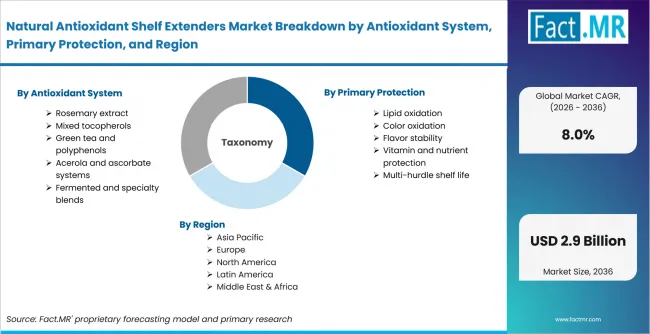
Natural Antioxidant Shelf Extenders Market Breakdown By Antioxidant System, Primary Protection, And Region | Source: Fact.MR
| Attribute | Details |
|---|---|
| Quantitative Units | USD billion |
| Market Definition | Natural antioxidant systems used to slow oxidation and protect shelf life in food and pet food applications. |
| Antioxidant System | Rosemary extract; Mixed tocopherols; Green tea and polyphenols; Acerola and ascorbate systems; Fermented and specialty blends |
| Primary Protection | Lipid oxidation; Color oxidation; Flavor stability; Vitamin and nutrient protection; Multi-hurdle shelf life |
| Food Application | Meat & poultry; Oils & fats; Bakery & snacks; Pet food; Beverages and other |
| Formulation Format | Oil-soluble; Water-dispersible; Dry powder; Emulsion; Custom blend |
| Regions Covered | North America; Latin America; Western Europe; Eastern Europe; East Asia; South Asia & Pacific; Middle East & Africa |
| Countries Covered | USA; Germany; UK; France; Brazil |
| Companies Profiled | Kalsec; Kemin Industries; Camlin Fine Sciences; Kerry Group; DSM-Firmenich; Vitablend |
| Forecast Period | 2026 to 2036 |
| Approach | Hybrid top-down and bottom-up approach using food application intensity; antioxidant system fit; format demand; country indicators; and provider portfolio review. |
Source: Fact.MR analysis. Updated Sep 3, 2026
How is the market segmented?
-
By Antioxidant System:
- Rosemary extract
- Mixed tocopherols
- Green tea and polyphenols
- Acerola and ascorbate systems
- Fermented and specialty blends
-
By Primary Protection:
- Lipid oxidation
- Color oxidation
- Flavor stability
- Vitamin and nutrient protection
- Multi-hurdle shelf life
-
By Food Application:
- Meat & poultry
- Oils & fats
- Bakery & snacks
- Pet food
- Beverages and other
-
By Formulation Format:
- Oil-soluble
- Water-dispersible
- Dry powder
- Emulsion
- Custom blend
-
By Region:
- North America
- Latin America
- Western Europe
- Eastern Europe
- East Asia
- South Asia & Pacific
- Middle East & Africa
Frequently Asked Questions
How big is the Natural Antioxidant Shelf Extenders Market in 2026?
What is the CAGR of the Natural Antioxidant Shelf Extenders Market from 2026 to 2036?
Which antioxidant system leads?
Which application leads the market?
Who are the main companies?
Who worked on this report


Preview the report firsthand - request a free sample
Free SampleGet the brochure for pricing and purchase details
Download PDF