- Base Value(2025): 580 Mn
- Forecast Value (2035): 1152 Mn
- CAGR (2035): 8.2%
Lithium Acetate Market Outlook 2025 to 2035
The global lithium acetate market is expected to reach USD 1,152 million by 2035, up from USD 580 million in 2025. During the forecast period 2025 to 2035, the industry is projected to register at a CAGR of 7.1%.
The market is expanding due to increasing demand from EV batteries and renewable energy storage systems. Its applications in biotechnology and regulated industrial processes also drive growth, supported by recycling innovations and low toxicity.
Quick Stats for Lithium Acetate Market
- Industry Value(2025):USD 580 Million
- Projected Value (2035):USD 1,152 Million
- Forecast CAGR(2025 to 2035):7.1%
- Leading Segment(2025):Powder (48% Market Share)
- Fastest Growing Country (2025-35):China (8.6% CAGR)
- Top Key Players:Albemarle Corporation, Merck KGaA, Honeywell International Inc., Thermo Fisher Scientific, American Elements, Nacalai Tesque, Inc., Santa Cruz Biotechnology, MP Biomedicals, and BOC Sciences.
2025-to-2035.webp "Us Lithium Acetate Market Value(usd Billion)2025 To 2035")
Us Lithium Acetate Market Value(usd Billion)2025 To 2035 | Source: Fact.MR
What are the drivers of lithium acetate market?
Lithium acetate has been emerging as a market of growing interest because of its application in the production of lithium-ion batteries especially as the electric vehicle (EV) market demand and renewable energy storage soar. It is usable as a precursor in the battery manufacturing process due to the compatibility with other lithium salts.
The pharmaceutical and biotech sectors are key contributors with lithium acetate used in DNA extractions and in electrophoresis. The solubility and efficacy of the chemical in the buffer solutions enhance the demand of the chemical in molecular biology laboratories.
In industrial chemistry, the lithium acetate is used in catalysts, coatings and ceramics, aided by increased spending on industrial research and development. Also, its reduced toxicity relative to other lithium salts makes it desirable to use in controlled conditions. Secondary production is also being stabilized globally in response to growing demands of lithium recycling, creating new opportunities for lithium acetate utilization.
What are the regional trends of Lithium Acetate Market?
Asia Pacific is leading in the lithium acetate market due to the high functionality of the lithium extractive abilities of China and its position as a battery manufacturing zone. The region presents significant investment opportunities in lithium compound, aided by government incentives and expanding demand in the EV sector.
Japan and South Korea contribute to the growth in the region by developing electronics and energy storage technologies. North America is also becoming a key area of development, enabled by locally based battery supply chain development and reducing reliance on imported lithium derivatives.
The field of battery production and recycling is the one that Europe is heavily investing in, in order to promote the usage of lithium acetate in the future circular economies. The region also benefits from stringent regulations that encourage low-toxicity materials in the use of chemicals and pharmaceuticals.
Latin America holds substantial lithium reserves, with extraction activities increasing. However, limitations in processing infrastructure have resulted in most lithium acetate production remaining concentrated in Asia and North America.
What are the challenges and restraining factors of Lithium Acetate Market?
One of the main challenges is price volatility in the raw materials used in production, which discourages long-term investments on lithium acetate production. Inconsistent supply distribution and geopolitical instability in the global lithium market evolving environmental regulations contribute to unstable production dynamics.
Also lithium acetate is not as common as lithium carbonate or hydroxide and is not commonly adopted beyond specialized application such as metabolic disease treatment and ceramic work. Such unfamiliarity with the market needs a more definitive R&D and industry promotion in order to broaden its application.
Extraction and processing of lithium are increasingly subjected to environmental scrutiny, which can result in the stricter compliance standards, further hindering the market penetration, particularly in the regions where regulations are not fully established or recycling infrastructure remains underdeveloped.
Country-Wise Outlook
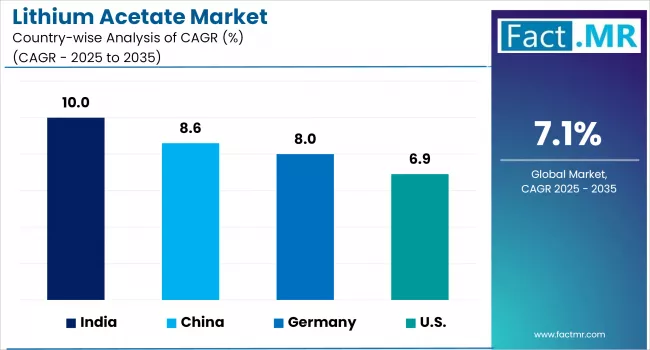
Lithium Acetate Market By Country | Source: Fact.MR
China’s Battery Dominance Powers Lithium Acetate Expansion
China holds a leading position in the lithium acetate market owing to its unmatched control over lithium-ion battery manufacturing with its government incentives, avenues to raw material, and the refinery apparatus. With the proliferation of electric vehicles (EV) due to the policy of the new energy vehicles, the demand of the lithium derivative, such as lithium acetate, has been driven particularly in the high performance cathode precursor compositions.
2025-to-2035.webp "Us Lithium Acetate Country Value(usd Billion)2025 To 2035")
Us Lithium Acetate Country Value(usd Billion)2025 To 2035 | Source: Fact.MR
Rapid R&D efforts by state-supported laboratories and private enterprises in China are focused on improving the thermal stability of lithium acetate for use in electric vehicles and grid storage batteries. Sichuan and Jiangxi have established advanced production centers where low-carbon production technology is used, and increasing dependence on AI-led purity control and digital twin models to improve process stability is emanating.
U.S. Drives Strategic Lithium Acetate Development via Onshoring and Defense Needs
Under both the Inflation Reduction Act and Defense Production Act, the United States is expanding domestic lithium acetate capacity as a central feature of its critical minerals policy. Lithium acetate is gaining attention as a cathode precursor and as a specialist pharmaceutical catalyst. With substantial federal investment in domestic battery manufacturing such as through the DOE Loan Programs Office, pilot initiatives in Nevada and North Carolina are being expanded to incorporate lithium acetate into next-generation LFP and NMC formulations.
Process innovations are focused on sustainability such as microwave assisted crystallization and real-time spectroscopic monitoring. There is also the increasing usage of acetylation reactions in life sciences in the U.S., where demand for pharma-grade lithium derivatives supports broader application. Supply chain limitations are however an obstacle to scaling, unless there is matching of domestic mining with the refining capacity.
Germany Anchors Europe’s Lithium Acetate Push for E-Mobility and Clean Tech
An important aspect of the German market is shaped by its rapid transition to electric vehicles and the implementation of the EU Critical Raw Materials Act. German OEMs and cathode producers are increasingly incorporating the material in electrolyte system optimization and lithium metal battery stabilization. Aligned with green chemistry goals, companies such as BASF and similar chemical enterprises are planning investments in closed-loop acetate recovery systems.
The adoption of Industry 4.0 in the German manufacturing assembly lines like automated process analytics and smart reactors are enhancing the quality of lithium acetate and its energy efficiency. The demand is also increasing between research centers interested in next-gen lithium-sulfur and solid-state cells.
Category-Wise Analysis
Battery Grade Lithium Acetate Powers the Shift to High-Efficiency Energy Storage
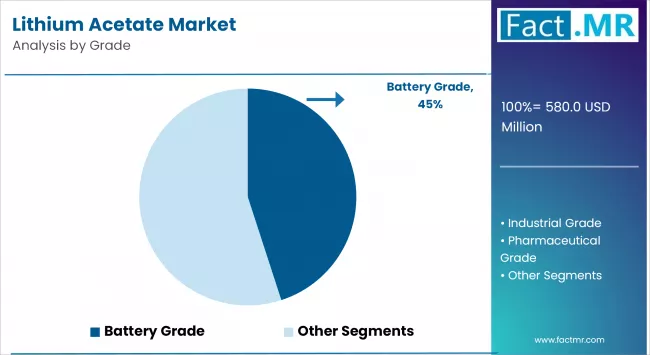
Lithium Acetate Market By Grade | Source: Fact.MR
High purity and low moisture content are the key parameters of battery grade lithium acetate as they are essential for ensuring long-term stability and efficient lithium-ion battery chemistries. This grade is particularly important in applications where impurities introduced during cathode precursor synthesis and electrolyte formulations may have catastrophic effects on battery life, charge and safety.
Irrespective of investments across the global electric vehicle (EV) and energy storage markets, the demand for battery-grade lithium acetate continues to grow. This is driven by the need for stable performance and adherence to stringent quality standards in regions such as Asia, Europe, and North America.
Powder Form Enhances Handling and Reactivity across Lithium Compound Applications
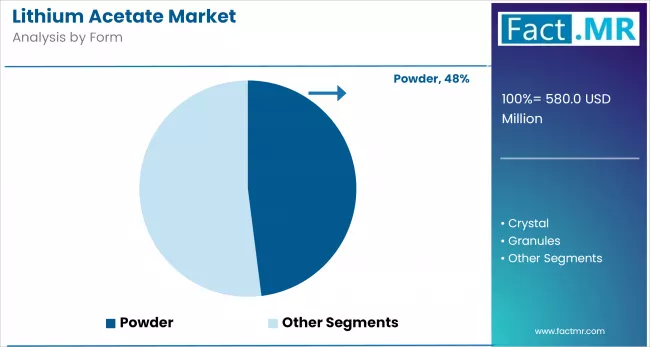
Lithium Acetate Market By Form | Source: Fact.MR
Powder lithium acetate is highly reactive with respect to the surface area that enhances the rate of solution and chemical reaction in catalysts, energy materials, and fine chemical production. The powder form is easier to mix in large-scale production and gives homogeneous distribution in composite materials or in many cases solution-based reactions.
It is also preferred in research labs and in the commercial applications because of its stable shelf life and ease of transportation, particularly where precise dosing and fast reaction kinetics are critical.
Catalyst Applications Drive Industrial Demand for Lithium Acetate
Lithium acetate is used in catalyst production as a precursor or modifier, influencing the selectivity of various reactions. Applications include the polymerization of styrene, oxidation reactions, and esterification reactions where lithium acetate plays the role of precursor or modifier. It possesses a distinct ability to alter reaction pathways and enhance metal-support interactions, particularly in heterogeneous catalysis systems.
Competitive Analysis
Specialization and regional focus are the key characteristics of the lithium acetate market. Several manufacturers emphasize vertical integration and supply chain efficiency in order to stabilize their prices and guarantee the consistency of quality related to pharmaceutical, catalyst and electrolyte-grade applications. This has intensified competition in the purity grades and custom formulations.
Firms distinguish themselves by the use of production scale, technical knowledge and adherence to global safety requirements. New approaches to green synthesis and connections with organizations dealing with battery research have emerged as renewed strategic moves to enhance environment sustainability and a competitive position.
The competitive landscape is also shifting with the emerging regional suppliers offering cost effective options, particularly in the Asia-Pacific region. The quality standards of high purities, as well as access to regulated end-use remains challenging to the newer entrants therefore, providing an added edge of advantage to the established producers in the quality-sensitive markets.
Key players in the market are Albemarle Corporation, Merck KGaA, Honeywell International Inc., Thermo Fisher Scientific, American Elements, Nacalai Tesque, Inc., Santa Cruz Biotechnology, MP Biomedicals, BOC Sciences, and other players.
Recent Development
- In October 2024, A Journal of Power Sources study demonstrates lithium acetate (LiOAc) and sodium acetate (NaOAc) can support one‑step pre‑metalation in battery anodes, improving charging rates and cycle life.
- In September 2024, A new bipolar membrane electrodialysis process enables sustainable, high‑purity lithium acetate (LiAc·2H₂O) at ~$0.32 / kg, with minimal waste and ~0.075 % sulfate impurity ideal as precursor for LiFePO₄/C battery cathodes.
Fact.MR has provided detailed information about the price points of key manufacturers of Lithium Acetate Market positioned across regions, sales growth, production capacity, and speculative technological expansion, in the recently published report.
Methodology and Industry Tracking Approach
Fact.MR examination worldwide and weighing in excess of 1,300 participants of 10 nations uncovers that an expanding level of attention is focused on lithium acetate customized to pharmaceutical production, battery electrolyte mixes, and a high-performance catalyst. Even as of October 2025, 42 interested parties including chemical engineers, electrolyte formulators and specialty lithium compound producers have reported a growing user request in ultra-dry lithium acetate, acetate-buffered solutions, and high-purity lithium acetate dihydrate in niche energy storage formats
In June 2024 and June 2025, lithium acetate market players experienced a significant development in the solvent-free methods of crystallization, closed-loop systems of acetate recovery, and modular systems of lithium conversion leading to the increasing yields of production and minimized reagent wastes in the verticals.
The manufacturers have since 2018, utilized green synthesis of acetate processes, cradle to gate traceability, reach compliant labels, and the use of tracking aids such as block chain to support ethical sourcing, low carbon foot print and aligning hard ESG standards.
Segmentation
Segmentation of Lithium Acetate Market
-
By Grade :
- Battery Grade
- Industrial Grade
- Pharmaceutical Grade
- Reagent Grade
-
By Form :
- Powder
- Crystal
- Granules
- Liquid
-
By Application :
- Catalysts
- Buffering Agents
- Dye Fixation
- Polymer Additives
- Laboratory Reagents
- Others (e.g., corrosion inhibitors)
-
By End-use Industry :
- Automotive
- Chemicals
- Textiles
- Electronics
- Pharmaceuticals
- Research Institutes
-
By Region :
- North America
- Latin America
- Western Europe
- Eastern Europe
- East Asia
- South Asia & Pacific
- Middle East & Africa
Frequently Asked Questions
What was the global Lithium Acetate Market size reported by Fact.MR for 2025?
Who are the major players operating in the Lithium Acetate Market?
What is the Estimated Valuation of the Lithium Acetate Market in 2035?
What value CAGR did the Lithium Acetate Market exhibit over the last five years?
Who worked on this report


Preview the report firsthand - request a free sample
Free SampleGet the brochure for pricing and purchase details
Download PDF