- Forecast Value (2035): 3.29 Bn
- CAGR (2035): 9.9%
Lithium Molybdate Market Outlook 2025 to2035
The global Lithium Molybdate market is expected to reach USD 3.29 billion by 2035, up from USD 1.3 billion in 2024. During the forecast period (2025 to 2035), the industry is projected to expand at a CAGR of 9%. Lithium molybdate market is picking up pace because of its growing applications in high performance electronics, constituent parts of batteries as well as sophisticated corrosion shielding systems. Lithium molybdate is irreplaceable in terms of its specific thermal stability and solubility properties as even more demand emerges regarding efficient energy storage facilities, eco-friendly cooling technology, and special catalysts.
Quick Stats for Lithium Molybdate Market
- Industry Value (2025): USD 1.4 Billion
- Projected Value (2035): USD 3.3 Billion
- Forecast CAGR (2025 to 2035): 9%
- Leading Segment (2025): Standard-grade (64% Market Share)
- Fastest Growing Country (2025-2035): China (10% CAGR)
- Top Key Players: Shanghai China Lithium Industrial, Sigma-Aldrich, Parad Corporation Pvt Ltd, FUJIFILM, Nanjing, and Mody Chemi Pharma
2025-to-2035.webp "Us Lithium Molybdate Market Value(usd Billion)2025 To 2035")
Us Lithium Molybdate Market Value(usd Billion)2025 To 2035 | Source: Fact.MR
The use of it in next-generation materials, precise chemical applications, highlights its increased significance in the energy sectors, automotive, and specialty chemicals industries.
What are the drivers of the Lithium Molybdate market?
The market of lithium molybdate is experiencing a strong growth with their application in sophisticated energy storage systems, corrosion inhibition, as well as thermal regulation being its major zone of strategic integration. With the shift towards high-efficiency and low-emission technologies in industries, lithium molybdate is becoming a vital material because of its high level of solubility, thermal stability, and compatibility with lithium-based systems.
Increasing regulatory and environmental attention at the minimization of conventional corrosion inhibitors and lead-based material is driving its usage in the industrial chiller, catalysts, and electronics. At the same time, the development of interventions in electric vehicles, renewable energy storage, and dedicated catalysts investments are leading to product innovation.
What are the regional trends of the Lithium Molybdate market?
The lithium molybdate market is characterized by regional dynamics that have a nexus of energy innovation, materials research, and industrial modernization. With China, South Korea and Japan leading the pack, the Asia-Pacific commands production and consumption since the region has a strong electronics, battery and chemical industry. A surge in adoption of corrosion inhibition systems and energy storage in North America is made possible with advanced R&D and clean energy policies.
In Europe, the lithium molybdate in catalyst and hybrid system is being used in mass through an eco-friendly material and clean energy storage regulatory direction. At the same time, other regions, such as Latin America, and the Middle East are becoming the potential centre of downstream applications of lithium based industrial technologies.
What are the challenges and restraining factors of the Lithium Molybdate market?
The potential lithium molybdate market has a key weakness related to its prices as well as dependence on both lithium and molybdenum ores, which are prone to price fluctuations dependent on geopolitical, and mining restrictions. Purity of the raw materials used and the processing technique can also be variable hence resulting in variability in the performance of the product in the applications.
There is also standardization in the application protocols particularly in the corrosion inhibitor and catalyst systems which have not been universal in application. A low level of understanding concerning the multifunctional nature of lithium molybdate in emerging economies also hinders penetration of the market.
Further, the excessive environmental constraints on environmental disposal and heavy metal to-content require the manufacturers to be innovative towards the safer compositions which increase compliance and development costs.
Country-Wise Insights
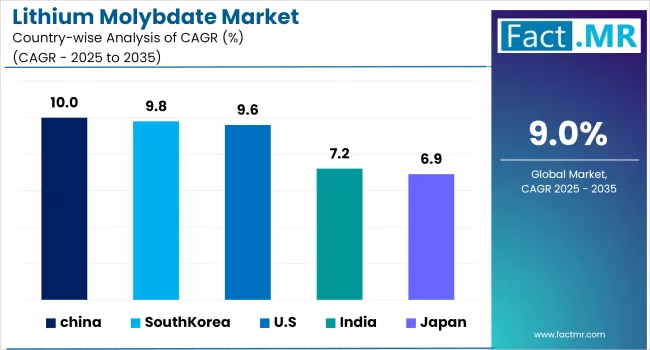
Lithium Molybdate Market Cagr By Country | Source: Fact.MR
U.S. market emphasizes corrosion inhibition, batteries, and clean energy applications
The U.S. lithium molybdate market was marked by the rising use in high-accuracy industrial and energy technologies, specifically, in corrosion inhibition, semiconductor, and electric vehicle systems. Increasing design demand with respect to HVAC and absorptions chiller manufactures, those wishing to be EPA environmentally compliant, are increasing demands with respect to using environmentally friendly lithium-based inhibitors.
2025-to-2035.webp "Us Lithium Molybdate Market Country Value(usd Billion)2025 To 2035")
Us Lithium Molybdate Market Country Value(usd Billion)2025 To 2035 | Source: Fact.MR
Its applicability extends to aerospace and defense applications in high-temperature and radiation resistant parts that strengthen its usage in the same field. Institutional R&D and industrial collaboration is leading to advanced techniques of formulations whereby the solubility and heating rates of lithium molybdate are being refined.
China dominates production, exports, and green-tech-driven lithium molybdate demand
China supply dominates in the global market of lithium molybdate on the basis of vertical integration of control of lithium and molybdenum mining, refining, and manufacture to the end-use. These are phased by the strong local demand and export-type manufacturing, with high usage in the electronics, solar and chemical processing industries.
Lithium molybdate is also part of the refrigeration system, both HVAC and in refrigeration chillers that utilize lithium bromide in commercial infrastructure. Major state-backed manufacturers are increasing the uniformity and purity of the products to downstream uses in batteries and corrosion-resistant alloys. Investment in lithium molybdate derivatives across battery innovation and green material processing clusters is being strengthened by strategic alignment with the dual-carbon objectives and industrial decarbonisation drive in China.
South Korea leverages lithium molybdate for batteries and electronics innovation
The lithium molybdate market in South Korea is supported by the established electronics and energy storage sector of the country, and has a high degree of connection with EV battery production, 5G equipment, and semiconductor parts. It is being combined with the high performance coatings and thermal buffer systems of heat sensitive electronics.
Domestic chemical enterprises are trying to create types of low impurity, high-dispersion lithium molybdate, that can meet the needs of solid-state battery and specialty adhesive actors. As Japan considers the self-sustainability and the strength of its supply chains and reducing their reliance on foreign materials, lithium molybdate is becoming a topic of research and development as a flame-retardant material and a precision catalyst.
Innovation programs sponsored by governments and production with an export orientation are speeding up the commercialization of application-specific lithium molybdate formulations.
Category-Wise Analysis
Lithium molybdate enhances battery stability, conductivity, and thermal resistance
The battery materials market is already in high swing as lithium molybdate is involved in the battery chemistries used in future generation batteries, in terms of thermal resistance and electrolyte stabilizing. It is capable of collaborating with lithium systems, and has low solubility in organic solvents, which an advantage to safer and more stable operation of cells. Due to growing electric mobility and the increasing number of grid-scale storage systems, lithium molybdate is becoming a strategic additive in both liquid and solid-state battery systems.
It is multifunctional and allows the regulation of electrolyte conductivity and stabilization of the cathode temperature. The technology of adoption is being fuelled by OEMs and cell developers optimizing their performance risk to safety ratios, particularly in heavy load cycles. Long term EV and ESS commitments strengthen the future of the segment.
Lithium Molybdate used for thermal buffering and dielectric performance in electronics manufacturing
The electronics and semiconductors industry is also experiencing bright prospects with development of the lithium molybdate which is used in thermal buffering layers, high-dielectric substrates and optical ceramics. Its distinctive thermal and chemical characteristics its high melting point, radiation stability, and many more make it useful in semiconductor packaging and photonic devices.
Granular shape of the compound is compatible with sputtering targets, optical coatings, and ceramic composites with high frequencies. Due to increased demand of heat dissipation and miniaturization of devices, the importance of lithium molybdate in providing structural stability and electronic efficiency becomes increasingly important. The rollout of 5G, development of quantum computing and optoelectronic innovation ecosystems support demand, too.
“High purity grade supports precision electronics, optics, and energy storage”
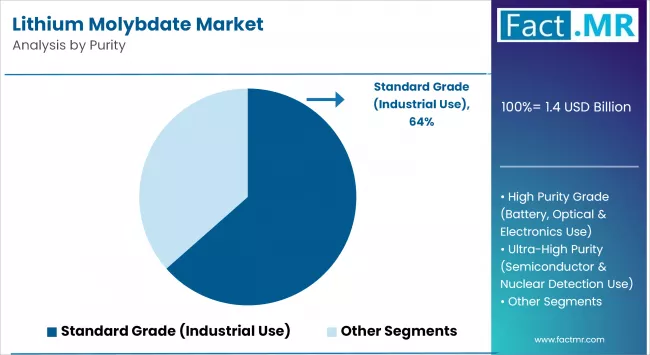
Lithium Molybdate Market By Purity | Source: Fact.MR
The lithium molybdate is high purity and has successful increase in demand in battery, optics, and advanced electronics sectors where the purity of lithium molybdate determines the efficiency of the device significantly. It is most applicable in industries that need ultra-low contamination to have dielectric consistency, heat, and high-voltage resistance.
Manufacturers are making investment on a specific refinement processes of purification and particle to ensure their products conforms to specifications of high performance users. It is also gaining on lithium molybdate being used as material in scintillators in the detection of radiations.
With the move towards the clean and traceable input compounds by material science, high purity lithium molybdate is increasingly becoming a favored material by manufacturers who are aiming to incorporate yield stability and process control.
Competitive Analysis
Key players in the lithium molybdate market include Shanghai China Lithium Industrial, Sigma-Aldrich, Parad Corporation Pvt Ltd, FUJIFILM, Nanjing, Mody Chemi Pharma, American Elements and Sanmenxia Changteng and Axiom Chemicals.
The global market of lithium molybdate is on the increase as the functional materials needed to fulfill the energy, electronics, and corrosion control applications demand are on the rise in terms of purity. The major companies are engaging in the development of hi-tech purification, nano-formulation and product lines of various products. More sustainable, low-toxic or even non-toxic solutions are on the rise especially in cooling systems and batteries. These factors are creating increased competition and consequent consolidation of the global markets at a faster rate due to strategic alliances, supply chains integrated horizontally, and manufacturing centres located regionally.
Recent Development
- In January 2025, LevertonHELM partnered with EnBW to work together on a sustainable domestic supply chain for lithium in the UK. The aim is to combine Altilium’s expertise in the recovery of battery materials from waste batteries with LevertonHELM’s lithium production capacities.
- In September 2024, Thermax has developed hybrid absorption chillers combining vapor compression and absorption technologies to improve energy efficiency in industrial cooling systems. ncrease the demand for effective corrosion inhibitors like lithium molybdate in Solution/Suspension form to ensure system longevity.
Fact.MR has provided detailed information about the price points of key manufacturers of Lithium Molybdate Market positioned across regions, sales growth, production capacity, and speculative technological expansion, in the recently published report.
Methodology and Industry Tracking Approach
The Global Lithium Molybdate Market report issued by Fact.MR uses the input of 9,800 stakeholders across 30 countries including more than 300 respondents in key markets. The respondents consisted of 2/3 end users and manufacturers (e.g. electronic companies, battery makers, industrial cooling systems) and 1/3 of industry experts (e.g. materials scientist, procurement, chemical distributors).
The trends, investment trends, technological changes and risk factors are captured between April 2024 and March 2025 when data was collected. More than 250 information sources such as journals, technical patents, and trade filings have been reviewed. Multivariate regressions, sensitivity models, etc. were applied in advanced statistical methods to make the data reliable and relevant in the region.
With Fact.MR monitoring consumer behavior, product efficacy, industry trends, and market opportunities since 2018, this report is becoming an authoritative source of information that stakeholders can rely on.
Segmentation
Segmentation of Lithium Molybdate Market
-
By Application :
- Corrosion Inhibitors
- Battery Materials (Electrolytes, Cathode Additives)
- Thermal Regulation & Heat Transfer Systems
- Catalysts & Chemical Synthesis
- Flame Retardants
- Glass and Ceramic Manufacturing
- Radiation Detection & Scintillators
- Pigments and Dyes
- Others (Research, Specialty Alloys, etc.)
-
By Form :
- Powder
- Crystals
- Granules
- Solution/Suspension
- Pellets
-
By Purity Level :
- Standard Grade (Industrial Use)
- High Purity Grade (Battery, Optical & Electronics Use)
- Ultra-High Purity (Semiconductor & Nuclear Detection Use)
-
By End-Use Industry :
- Energy & Power
- Electronics & Semiconductors
- Chemical & Petrochemical
- Automotive (EV & Thermal Control)
- Aerospace & Defense
- HVAC (Absorption Chillers)
- Glass & Ceramics
- Healthcare (Radiation Imaging & Detection)
- Research & Academic Institutions
-
By Distribution Channel :
- Direct (Manufacturer to End-User)
- Distributors & Specialty Chemical Suppliers
- Online B2B Platforms
-
By Region :
- North America
- Latin America
- Western Europe
- Eastern Europe
- East Asia
- South Asia & Pacific
- Middle East & Africa
Who worked on this report


Preview the report firsthand - request a free sample
Free SampleGet the brochure for pricing and purchase details
Download PDF