- Base Value(2025): 158.9 Mn
- Forecast Value (2035): 321.5 Mn
- CAGR (2035): 6.3%
Lithium Citrate Market Outlook 2025 to 2035
The global lithium citrate market is expected to reach USD 321.5 million by 2035, up from USD 158.9 million in 2025. During the forecast period 2025 to 2035, the industry is projected to expand at a CAGR of 7.3%.
The lithium citrate market is experiencing strength, owing to the increase in pharmaceutical demand, especially in psychiatric pharmaceutical segments, such as bipolar disorder. Also, its usage in nutraceuticals and electrolyte-based products has indicated the emerging potential role in health-driven product development, which is a trend seen worldwide due to the increasing popularity of personalized medicine and trace mineral supplement markets.
Quick Stats for Lithium Citrate Market
- Industry Value (2025): USD 158.9 Million
- Projected Value (2035): USD 321.5 Million
- Forecast CAGR (2025 to 2035): 7.3%
- Leading Segment (2025): Pharmaceutical Grade (52.8% Market Share)
- Fastest Growing Country (2025-2035): India (10.2% CAGR)
- Top Key Players: Muby Chemicals, Aadhunik Industries, and Anmol Chemicals
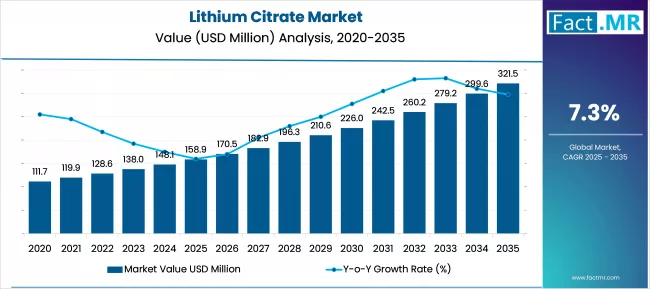
Lithium Citrate Market Market Value Analysis | Source: Fact.MR
What are the drivers of the lithium citrate market?
The increased incidence of mental and neurological conditions and the gradual trend toward the creation of specialized psychiatric care are the key growth factors in the lithium citrate market. Lithium citrate is a common mood stabilizer that is extensively used to treat bipolar disorder, which means that it is necessary in medical products. This healthcare dependency has the backing of growing mental health awareness and therapeutic adoption in the global scenario.
Another major factor is the rising demand of trace mineral supplements in nutraceuticals. Lithium citrate has a high bioavailability and low toxicity, which make it a good choice when formulating mood-enhancing dietary supplements. The need to support cognitive wellness and emotional balance in the consumer has led to the incorporation of lithium citrate in nutraceutical brands, making it have a potential market in its non-prescriptive category.
The expansion of the market has also been triggered by the strategic interest of contract manufacturers and CMOs. Their contribution to an increased output level and the adherence of production to the pharmacopeia standards contributes to wider availability and affordability. Such dynamics coupled with the increased development of lithium citrate in other forms like tablets and solutions are instrumental in the rise of the whole lithium citrate into a multi-industry growth accelerator.
What are the regional trends of the lithium citrate market?
In Asia Pacific, particularly China and India, lithium citrate market is growing at a fast pace of increasing pharmaceutical production capacity and the ambitious mental health awareness campaign. Governmental policy preferences and competitive prices ensure that the region is very appealing when it comes to contract manufacturing as well as domestic distribution.
Europe and especially Germany have developed a tendency of high-purity lithium citrate in strict accordance with the EU pharmacopeia. The region is quite quality and innovation-oriented with the demand including both large international pharmaceutical companies and smaller nutraceutical businesses working in the targeted sections of mental wellness and dietary supplementation.
North America continues to be a mature but innovative market. The U.S. leads in advanced research, therapeutic applications, and prescription-grade lithium citrate. It is also a hub for CMOs that ensure flexible production for both domestic and export markets. Market players in this region are investing in clinical validation and expanding digital healthcare integrations.
What are the challenges and restraining factors of the lithium citrate market?
Having strict regulatory controls surrounding the lithium-related psychiatric medication offers a hindrance to their scale in the market. Strict documentation, dosage regulations, safety standards are enforced within the regulatory agencies that delay clearance and increase compliance cost, most especially to new entrants and small manufacturers.
There is volatility of raw material supply of which lithium carbonate is prominent and this affects production continuity, and price. The production of lithium citrate is susceptible to lithium market dynamics, which are subject to competing demand by battery and EV industries and as a result, the pharmaceutical-grade supply chain is susceptible to external economic fluctuation.
The R&D funding and investment in clinical trials on nutraceutical applications is low, which limits their use. Although there is an increasing number of consumers interested in them, there is still a lack of extensive research to determine the long-term safety and efficacy issues, which explain its limited regulation and widespread commercialization. This restricts the positioning of the product in the over-the-counter and functional range of wellness in key markets.
Country-Wise Insights
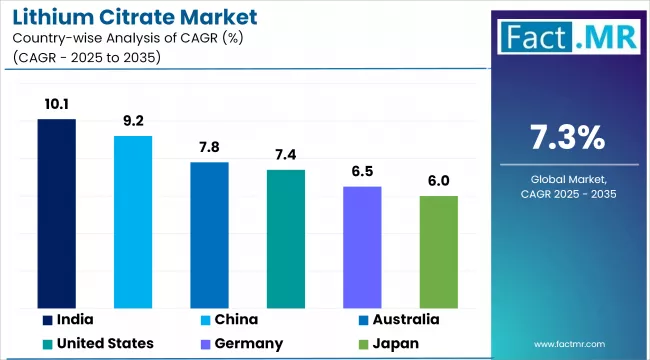
Lithium Citrate Market Cagr Analysis By Country | Source: Fact.MR
China is the Dominant Manufacturing Hub for Cost-Efficient Lithium Citrate
China is the largest producer of lithium citrate using its well-established chemical production capacity and its adjacent access to lithium supply. Its capacity to develop and produce at large scale and at reduced costs enables the Chinese companies to occupy world market especially in the industrial and pharmaceutical grades.
A number of Chinese firms also have vertically integrated value chains, covering the source of lithium extraction, formulation of compounds, which reduces costs and standardisation. The policies put in place by the government to promote pharmaceutical development in the country contribute towards increasing internal demand further establishing a steady dual-use market where both local use and distribution of pharmaceuticals is available.
Innovation is kept at a moderate and practical level, aiming not to exceed requirements set within international pharma companies, but also avoid making truly innovative products, but instead conforming with them. The Chinese strategy is also to increase the cooperation with foreign CMOs and have lithium supply secured by investing in global mines, which makes the supply of raw materials and manufacturing sustainable long-term both.
India is the Strategic Exporter and Contract Manufacturer for Global Brands
India has a pivotal position in the lithium citrate market as a contract manufacturer and exporter to the pharma brands across the globe and nutraceutical brands across the globe. Indian producers can provide competitive prices, the quality of the products meet the USP/BP standards and export logistic are well established making the country an attractive destination to outsource manufacturing.
There is also growth in the domestic market with the growth being supported by mental health awareness activities and higher levels of supplement consumption. The Indian regulators have increasingly revised APIs and trace mineral codes, keeping in tandem with international standards and creating greater possibilities of local use.
The Indian manufacturers focus on scale-up preparation and working partnerships with third parties. The pharma ecosystem in the country facilitates high-scale orders on a continuous basis even when the production run is on the smaller scale. The Indian approach is based on a value-oriented system of manufacture with an extensive array of certifications (WHO-GMP), which makes Indian a reliable point in global networks of lithium citrate supply chains.
Germany is the Innovation Leader in High-Purity Lithium Citrate Manufacturing
Germany focuses on high purity production of lithium citrate as regulated pharmaceutical product, it pays attention to high precision, documentation, and innovation that is based on the R&D. It has high quality control that adheres to pharmacological models in the EU, and is one of the most trusted sources of raw materials in the manufacture of psychiatric medication and mood stabilizers.
It is an innovating market and companies are putting in money on new formulation-delivery as well as green synthesis process. The pull effect of the German pharmaceutical companies who require traceable and compliant ingredients makes internal growth maintainable thus easy to predict the demand.
Export sales target the high-end clients in North America, the EU, and Japan in pharmaceuticals. Germany has been producing specialty chemicals and controlled drug substances for a long time, so it has competence to cover niche markets that have a high regulatory environment. Vertical integration and growths of intellectual property are the sources of strategic growth.
Category-Wise Analysis
Brine-Based Lithium is the Cost-Efficient Backbone of Citrate Production
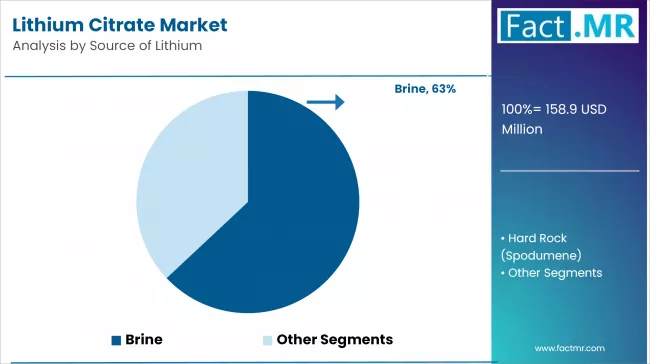
Lithium Citrate Market Analysis By Source Of Lithium | Source: Fact.MR
Most lithium is extracted in the form of brine-based lithium, made by taking the salt flats deposits and collecting them from underground reservoirs. It is a favored source due to its high availability and low cost of extraction, being the most suitable source of bulk manufacturers who are targeted at scalability and affordability. In particular, in China and South America, brine production allows production volumes to be shifted to these mass levels and parts of the economy with sustainable price levels.
Sustainability and lower-emission extraction tendencies also benefit brine operations, which consume less energy in comparison with the hard rock mining. The brine-sourced lithium is likely to remain a staple of global lithium citrate supply chain in view of improving technology and increased, regulatory scrutiny with the companies looking at capturing mass market manufacturing pharma and nutraceutical market.
Pharmaceutical-Grade Lithium Citrate is the Market’s Regulatory Stronghold
The Pharmaceutical grade of lithium citrate is the most valued type as it meets the pharmacopeia requirements and has a therapeutic essence in the process of treating bipolar disorder. This part has stringent safety, purity, and traceability standards and it is the heart of regulatory and clinical assessments.
Pharmaceutical-grade variants have advantages to major drug manufacturers and CMOs since they are consistent and easy to pass regulation in global markets. The demand is quite strong even when there is an interruption in the supply chains where governments tend to ensure that their access remains continuous to very important psychiatric drugs. The investment in clinical trials and the unfading reimbursement opportunities will keep lithium citrate as the pharmaceutical grade of choice in the industry.
Competitive Analysis
Key players in the lithium citrate market Muby Chemicals, Aadhunik Industries, Anmol Chemicals, Leverton (LevertonHELM, UK), Dr. Paul Lohmann GmbH & Co. KG, Axiom Chemicals Private Ltd., Annie Chemie P. Ltd., Satyam Pharma Pvt Ltd, Ennore India Chemicals.
Lithium citrate market is somewhat fragmented and there is a combination of large pharma and regional specialty producers. The rivalry is also taking place on the prices policy, the certification of pharmacopeia and the versatility in formulations. Scaling, Compliance with Purities, and Capabilities by Third-Party manufacturers are utilized as a way of differentiation between players.
Most innovations are based on incremental development of improved solubility, uniformity-granule, and shelf-life. The behavior of the procurement is shifting to the long-term contracts with certified suppliers to reduce the risks of compliance. The latest deal forms are directly selling to pharma clients and exclusive selling to private-label nutraceutical agreements where CMOs have a selective or strategic procurement role.
Recent Development
- In August 2024, Ennore India Chemicals has formed a joint venture with Kamarajar Port Limited to optimize the logistics of chemical supply directly at Ennore Port. This collaboration aims to improve the delivery infrastructure for industrial chemicals, which could enhance the scale and reliability of products such as lithium-based salts. This initiative signifies a strategic move to expand India's capabilities in chemical exports.
Fact.MR has provided detailed information about the price points of key manufacturers of Lithium Citrate Market positioned across regions, sales growth, production capacity, and speculative technological expansion, in the recently published report.
Methodology and Industry Tracking Approach
The 2025 lithium citrate market report by Fact.MR is based on insights collected from 1,050 stakeholders across 10 countries, with a minimum of 60 respondents per country. Among the participants, 62% were end users—including pharmaceutical procurement leads, nutraceutical formulators, academic researchers, and CMOs—while the remaining 38% included regulatory experts, quality auditors, and chemical sourcing heads.
Data collection was conducted between September 2024 and August 2025, evaluating key parameters such as purity benchmarks, lithium sourcing stability, batch traceability, dosage accuracy, and pharmaceutical compliance levels. A regionally balanced calibration model ensured fair representation across Asia, North America, and Europe.
The report synthesized over 90 validated sources, including clinical trials, pharma ingredient databases, safety filings, and CMO partnership disclosures to deliver strategic insights.
Fact.MR applied rigorous analytical tools such as multi-variable regression and scenario modeling to ensure data robustness. With continuous monitoring of the glass adhesives space since 2018, this report offers a comprehensive roadmap for firms seeking competitive advantage, innovation, and sustainable growth within the sector.
Segmentation
Segmentation of Lithium Citrate Market
-
By Source of Lithium :
- Brine
- Hard Rock (Spodumene)
-
By Form :
- Solid (Powder, Granules, Tablets)
- Liquid (Solution, Concentrate)
-
By Grade :
- Pharmaceutical Grade
- Food Grade
- Laboratory / Industrial Grade
-
By End User :
- Pharmaceutical Companies
- Nutraceutical & Supplement Brands
- Academic & Research Institutes
- Contract Manufacturing Organizations (CMOs)
-
By Distribution Channel :
- Direct Sales
- Distributors
-
By Region :
- North America
- Latin America
- Western Europe
- Eastern Europe
- East Asia
- South Asia & Pacific
- Middle East & Africa
Frequently Asked Questions
What was the Global Lithium Citrate Market Size Reported by Fact.MR for 2025?
Who are the Major Players Operating in the Lithium Citrate Market?
What is the Estimated Valuation of the Lithium Citrate Market in 2035?
What Value CAGR did the Lithium Citrate Market Exhibit Over the Last Five Years?
Who worked on this report


Preview the report firsthand - request a free sample
Free SampleGet the brochure for pricing and purchase details
Download PDF