- Base Value(2025): 21.9 Bn
- Estimated Value(2026): 23.6 Bn
- Forecast Value (2036): 51.5 Bn
- CAGR (2026 - 2036): 8.1%
Liver Disease Therapeutics Market Analysis and Forecast by Fact.MR
- The global liver disease therapeutics market is estimated at US$ 21.87 billion in 2025 and is forecast to expand at a CAGR of 8.1% to reach US$ 51.52 billion by 2036.
- The liver disease therapeutics category spans antiviral therapies, nucleoside analogues, nucleotide analogues, and related therapeutic approaches addressing hepatitis b and chronic hepatitis.
- Growth reflects rising disease prevalence, expanding clinical evidence, and increasing healthcare access across both developed and emerging markets.
- Regulatory approvals, payer coverage expansion, and physician familiarity with newer therapeutic mechanisms are contributing to sustained demand across the forecast period.
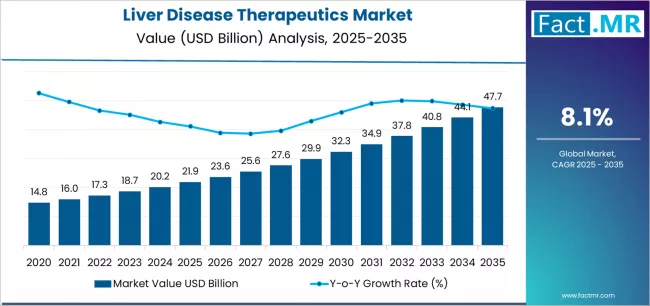
Liver Disease Therapeutics Market Market Value Analysis | Source: Fact.MR
Summary of Liver Disease Therapeutics Market
- Market Snapshot
- In 2025, the global Liver Disease Therapeutics Market was valued at approximately USD 21.87 billion.
- The market is estimated to reach USD 23.64 billion in 2026 and is projected to attain USD 51.52 billion by 2036.
- The liver disease therapeutics market is likely to expand at a CAGR of 8.1% during the forecast period.
- The market is anticipated to create an absolute dollar opportunity of USD 27.87 billion between 2026 and 2036.
- Antiviral Therapies is expected to lead the product segment in 2026.
- China (9.1%) and USA (8.6%) are the key growth markets during the forecast period.
- Demand and Growth Drivers
- Rising disease prevalence and improving diagnosis rates are expanding the addressable patient population across both developed and emerging healthcare systems.
- Growing clinical evidence and real-world data supporting treatment efficacy are strengthening physician confidence and prescribing patterns in specialty care settings.
- Expanding regulatory approvals and payer coverage decisions are improving patient access and reducing out-of-pocket treatment barriers in major markets.
- Increasing investment in specialty pharmacy infrastructure and patient support programs is supporting treatment initiation and long-term adherence.
- Product and Segment View
- Antiviral Therapies is expected to lead the product segment in 2026, supported by established clinical adoption and broad availability.
- Hepatitis B is anticipated to account for the largest share of the disease indication segment, reflecting concentrated treatment demand.
- Antiviral Drugs is projected to lead the drug class segment, supported by clinical preference and treatment protocol alignment.
- Key segmentation includes:
- Product: Antiviral Therapies, Nucleoside Analogues, Nucleotide Analogues, Interferon Based Therapies, Antifibrotic Agents
- Disease Indication: Hepatitis B, Chronic Hepatitis B, Acute Hepatitis B, Hepatitis C, Chronic Hepatitis C
- Drug Class: Antiviral Drugs, Direct Acting Antivirals, Nucleotide Polymerase Inhibitors, Immunomodulators, Interferon Alpha Based Drugs
- Route of Administration: Oral, Tablets, Capsules, Injectable, Intravenous Injection
- Distribution Channel: Hospital Pharmacies, Tertiary Care Hospitals, Specialty Liver Clinics, Retail Pharmacies, Community Pharmacies
- These systems enable:
- Targeted therapeutic intervention in specific disease pathways
- Patient-specific treatment optimization and adherence support
- Clinical outcome monitoring and long-term disease management
- Geography and Competitive Outlook
- North America is a major market, supported by established healthcare infrastructure, strong payer coverage, and high treatment adoption rates.
- Europe is expected to maintain steady growth, supported by structured market access frameworks and specialty treatment networks.
- Asia Pacific is emerging as a growth region, with expanding healthcare investment and rising clinical awareness supporting demand.
- China (9.1%) and USA (8.6%) are the fastest-growing country markets during the forecast period.
- Key companies include Gilead Sciences, Inc., AbbVie Inc., Bristol Myers Squibb Company, F. Hoffmann-La Roche Ltd., Takeda Pharmaceutical Company Limited.
- Analyst Opinion
- Shambhu Nath Jha, Principal Consultant at Fact.MR, says 'The liver disease therapeutics market is entering a phase where growth depends on geographic expansion, payer negotiations, and real-world evidence generation. Markets with structured reimbursement pathways are absorbing demand faster. Companies combining strong clinical evidence with effective distribution are capturing disproportionate share. The next growth layer depends on how manufacturers address access barriers in mid-income markets while defending pricing in established geographies.'
Key Growth Drivers, Constraints, and Opportunities
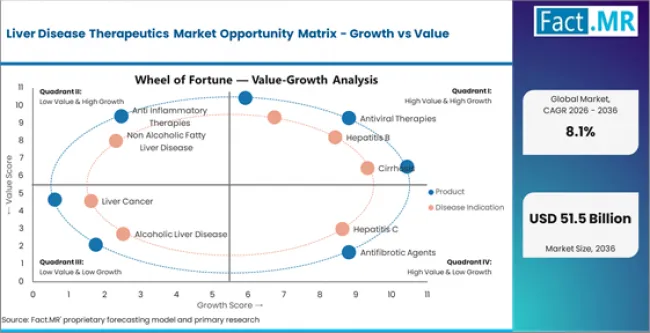
Liver Disease Therapeutics Market Opportunity Matrix Growth Vs Value | Source: Fact.MR
Key Factors Driving Growth
- Rising prevalence of hepatitis b and chronic hepatitis b conditions and improving diagnosis rates are expanding the addressable patient population, driving demand for antiviral therapies, nucleoside analogues, nucleotide analogues across both developed and emerging healthcare systems.
- Growing clinical evidence, expanding real-world outcome data, and physician confidence in liver disease therapeutics therapeutic mechanisms are strengthening prescribing patterns and supporting treatment uptake in specialty care settings.
- Expanding regulatory approvals across major markets and broadening payer coverage for antiviral therapies, nucleoside analogues, nucleotide analogues are reducing access barriers and supporting patient enrolment in long-term treatment programmes.
Key Market Constraints
- High treatment costs for antiviral therapies, nucleoside analogues, nucleotide analogues and reimbursement variability across markets create access barriers, particularly in price-sensitive healthcare systems managing hepatitis b and chronic hepatitis b populations.
- Limited availability of specialised liver disease therapeutics treatment centres and trained clinicians in emerging markets constrains adoption outside major metropolitan and academic medical centres.
- Lengthy regulatory approval timelines and complex market access negotiations for newer antiviral therapies, nucleoside analogues, nucleotide analogues formulations in certain geographies delay commercial availability and patient uptake.
Key Opportunity Areas
- Label expansion of antiviral therapies, nucleoside analogues, nucleotide analogues into adjacent indications and underserved patient subgroups within the hepatitis b and chronic hepatitis b space is creating incremental revenue potential beyond current approved uses.
- Growing healthcare infrastructure investment in emerging markets is expanding the addressable liver disease therapeutics treatment population, particularly in regions with rising clinical awareness and diagnostic capacity.
- Development of combination therapies, next-generation formulations, and optimised treatment protocols for hepatitis b and chronic hepatitis b is supporting deeper market penetration and share capture in established geographies.
Segment-wise Analysis of the Liver Disease Therapeutics Market
- Antiviral Therapies is expected to lead the product segment in 2026, supported by established adoption, broad clinical utility, and availability across major markets.
- Hepatitis B is anticipated to account for the largest share of the disease indication segment, reflecting concentrated treatment demand and clinical prioritization.
- Hospital Pharmacies is projected to lead the distribution channel segment, supported by established treatment infrastructure and prescribing patterns.
The liver disease therapeutics market is segmented by product, disease indication, drug class, route of administration, distribution channel, and region. By product, the market covers antiviral therapies, nucleoside analogues, nucleotide analogues, interferon based therapies. By disease indication, coverage includes hepatitis b, chronic hepatitis b, acute hepatitis b, hepatitis c. Antiviral Therapies leads by value in the near term due to established demand, while emerging segments are expected to gain share over the forecast period.
Which Product Segment Leads the Liver Disease Therapeutics Market?
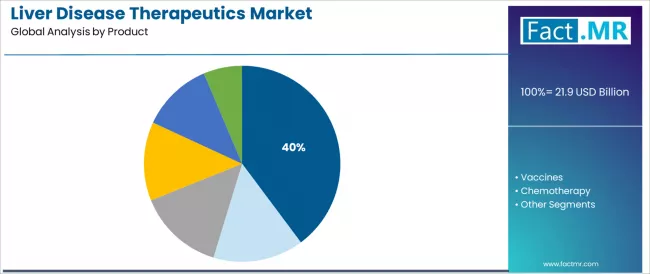
Liver Disease Therapeutics Market Analysis By Product | Source: Fact.MR
Antiviral Therapies is estimated to account for the largest share of the product segment in 2026. Demand is concentrated in established treatment settings where clinical evidence, physician familiarity, and payer coverage support continued adoption. The segment benefits from broad availability across specialty and general healthcare channels.
The nucleoside analogues sub-segment is also gaining traction as clinical protocols evolve and treatment guidelines incorporate newer approaches, reflecting expanding indications and improving evidence bases.
Which Disease Indication Segment Leads the Liver Disease Therapeutics Market?
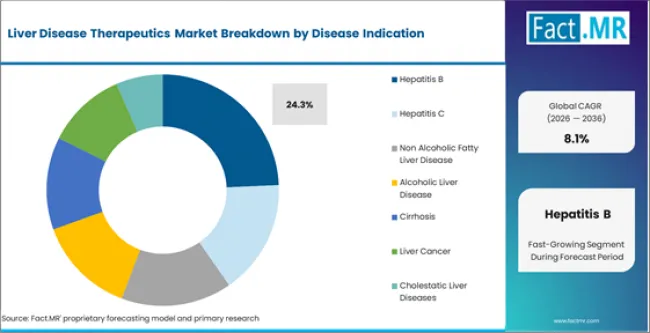
Liver Disease Therapeutics Market Analysis By Disease Indication | Source: Fact.MR
Hepatitis B is expected to lead the disease indication segment in 2026, reflecting the largest patient population and deepest clinical evidence base. Demand is supported by established diagnosis pathways, treatment protocols, and payer coverage across major geographies.
Chronic Hepatitis B represent a growing portion of demand, supported by expanding clinical research and regulatory attention, diversifying the revenue base over the forecast period.
Which Route of Administration Segment Leads the Liver Disease Therapeutics Market?
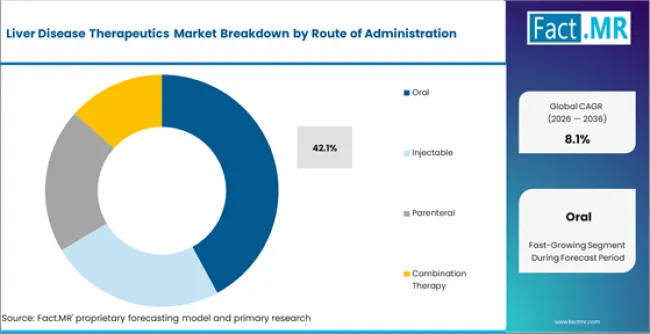
Liver Disease Therapeutics Market Analysis By Route Of Administration | Source: Fact.MR
Oral is anticipated to lead the route of administration segment in 2026, supported by clinical preference and established infrastructure across major healthcare settings.
Alternative route of administration options are gaining share as treatment settings diversify and home-based care options expand, supporting broader access.
Which Product Trend is Shaping the Next Phase of Growth in the Liver Disease Therapeutics Market?
Nucleoside Analogues are not yet the largest segment, but they are emerging as a growth area within the liver disease therapeutics market. Their share is projected to rise as clinical evidence strengthens, regulatory approvals expand, and treatment protocols increasingly incorporate newer mechanisms. This is relevant for patient populations where existing options have not fully addressed treatment goals.
The shift toward newer approaches reflects changing clinical and commercial expectations. Providers and payers are evaluating treatment value based on long-term outcomes, patient convenience, and total cost of care. Products offering differentiated mechanisms or improved adherence profiles are moving from niche positions into more central roles within the treatment pathway.
Regional Outlook Across Key Markets
- China leads growth at 9.1%, supported by expanding healthcare access and rising treatment adoption.
- North America shows stable growth, with established healthcare infrastructure and strong payer coverage supporting continued demand.
- Europe maintains steady adoption, with structured market access frameworks and specialty treatment networks supporting growth.
- Asia Pacific is emerging as a growth region, with healthcare investment and rising clinical awareness creating incremental demand.
.webp "Top Country Growth Comparison Liver Disease Therapeutics Market Cagr (2026 2036)")
Top Country Growth Comparison Liver Disease Therapeutics Market Cagr (2026 2036) | Source: Fact.MR
CAGR Table
| Country | CAGR (%) |
|---|---|
| China | 9.1% |
| USA | 8.6% |
| India | 8.3% |
| Japan | 7.8% |
| Saudi Arabia | 7.4% |
| Germany | 7.1% |
| Brazil | 6.9% |
Source: Fact.MR analysis. Updated May 28, 2026
Source: Fact MR (FMR) analysis, based on proprietary forecasting model and primary research.
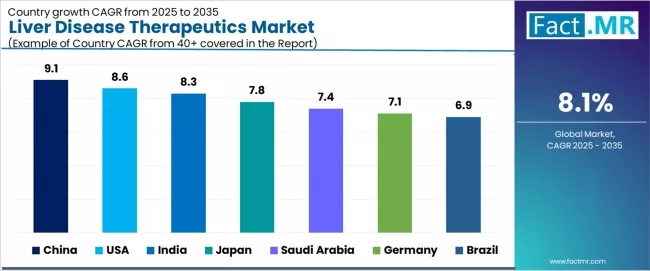
Liver Disease Therapeutics Market Cagr Analysis By Country | Source: Fact.MR
Market Outlook for Liver Disease Therapeutics in China
The China Liver Disease Therapeutics market is projected to grow at a CAGR of 9.1% through 2036. Growth is attributable to expanding healthcare access through provincial reimbursement programs, rising diagnosis rates in urban tertiary hospitals, and increasing demand for specialty biologics across major metropolitan areas.
- Provincial reimbursement inclusion and NRDL listing expand patient access to specialty treatments.
- Urban tertiary hospital infrastructure supports diagnosis and treatment initiation.
USA Liver Disease Therapeutics Demand Trends
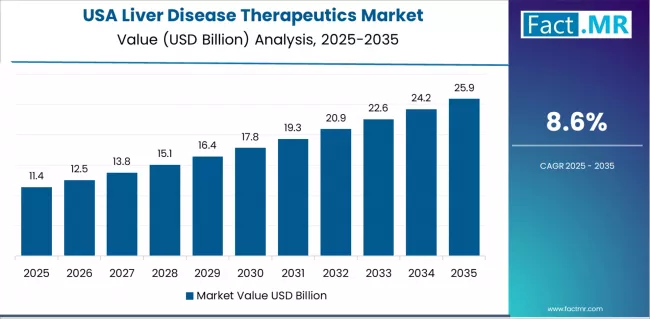
Liver Disease Therapeutics Market Country Value Analysis | Source: Fact.MR
The USA Liver Disease Therapeutics market is projected to grow at a CAGR of 8.6% through 2036. Demand is supported by established specialty care infrastructure, broad insurance coverage for approved therapies, and strong clinical adoption across major academic medical centers and community practice networks.
- Specialty pharmacy distribution and payer coverage support steady commercial uptake.
- Clinical guideline adoption across academic and community neurology practices sustains prescription volume.
Liver Disease Therapeutics Growth Assessment in India
The India Liver Disease Therapeutics market is projected to grow at a CAGR of 8.3% through 2036. Demand is shaped by rising urban healthcare spending, expanding private hospital networks, and growing awareness of specialty treatment options among physicians in metropolitan centers.
- Private healthcare investment and tertiary care expansion support specialty treatment adoption.
- Ayushman Bharat and state health insurance programs are beginning to cover select specialty therapies.
Japan Liver Disease Therapeutics Market Growth Outlook
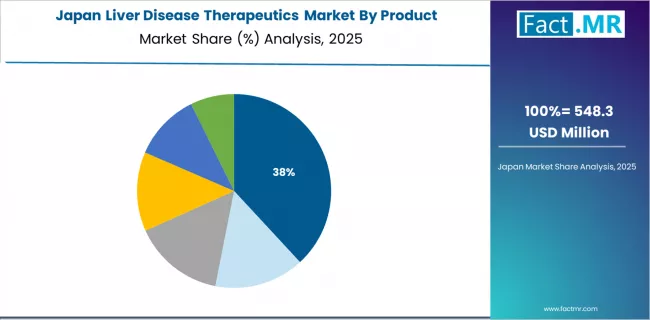
Liver Disease Therapeutics Market Japan Market Share Analysis By Product | Source: Fact.MR
The Japan Liver Disease Therapeutics market is projected to grow at a CAGR of 7.8% through 2036. Demand reflects an aging population profile, regulatory approval pathways through PMDA, and established specialty clinic infrastructure supporting therapy adoption in rare and chronic disease categories.
- PMDA regulatory approvals and national health insurance listing support therapy access.
- Aging population demographics increase prevalence of chronic autoimmune conditions.
Liver Disease Therapeutics Demand Analysis in Saudi Arabia
The Saudi Arabia Liver Disease Therapeutics market is projected to grow at a CAGR of 7.4% through 2036. Growth reflects Vision 2030 healthcare investment, expanding specialty care capacity across major hospital groups, and increasing alignment with international treatment protocols.
- Vision 2030 healthcare investment supports specialty infrastructure development.
- Major hospital groups are expanding neurology and specialty treatment capacity.
Germany Liver Disease Therapeutics Opportunity Outlook
The Germany Liver Disease Therapeutics market is projected to grow at a CAGR of 7.1% through 2036. Demand is supported by national rare disease programs, specialized treatment centers, and structured early benefit assessment under AMNOG that determines reimbursement positioning across statutory health insurers.
- AMNOG-based early benefit assessment determines pricing and reimbursement access.
- Specialized neuromuscular disorder centers concentrate prescribing and patient referrals.
Liver Disease Therapeutics Expansion Trajectory in Brazil
The Brazil Liver Disease Therapeutics market is projected to grow at a CAGR of 6.9% through 2036. Demand is supported by SUS coverage expansion for essential therapies, growing private healthcare sector investment, and federal procurement programs for rare and chronic disease treatments.
- SUS procurement programs and CONITEC assessments determine public sector treatment access.
- Private healthcare networks in southern and southeastern states support specialty prescribing.
Competitive Benchmarking and Company Positioning
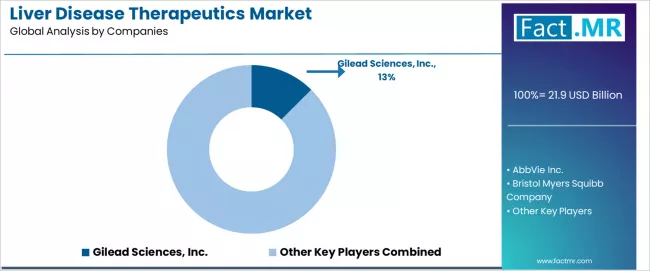
Liver Disease Therapeutics Market Analysis By Company | Source: Fact.MR
Liver Disease Therapeutics Market Analysis By Company
- Gilead Sciences, Inc., AbbVie Inc., Bristol Myers Squibb Company, F. Hoffmann-La Roche Ltd. hold established positions in the global liver disease therapeutics market through broad product portfolios, regulatory approvals, and commercial infrastructure.
- Takeda Pharmaceutical Company Limited, Johnson & Johnson, Merck & Co., Inc., Novartis AG participate across specific market segments, geographic regions, and distribution channels with competition shaped by clinical evidence and pricing strategy.
- Competition centers on clinical differentiation, market access capability, and commercial execution, with Gilead Sciences, Inc. accounting for approximately 13% of global market share.
Gilead Sciences, Inc., AbbVie Inc., Bristol Myers Squibb Company, F. Hoffmann-La Roche Ltd. hold established positions in the global liver disease therapeutics market through broad product portfolios, regulatory approvals across major markets, and established commercial infrastructure supporting sustained market presence.
Takeda Pharmaceutical Company Limited, Johnson & Johnson, Merck & Co., Inc., Novartis AG, Pfizer Inc., Sanofi S.A., GSK plc participate across specific therapeutic segments, geographic markets, and distribution channels, with competition shaped by clinical evidence depth, pricing strategy, and payer access positioning.
The competitive landscape is moderately fragmented, with Gilead Sciences, Inc. accounting for approximately 13% of global market share. Competition centers on clinical differentiation, geographic market access, and commercial execution.
Key Companies in the Liver Disease Therapeutics Market
- Gilead Sciences, Inc., AbbVie Inc., Bristol Myers Squibb Company, F. Hoffmann-La Roche Ltd. are among the leading players in the liver disease therapeutics market, supported by established product portfolios, strong commercial presence, and regulatory approvals across major markets.
- Takeda Pharmaceutical Company Limited, Johnson & Johnson, Merck & Co., Inc., Novartis AG hold positions across specific therapeutic areas, geographic markets, and distribution networks, contributing to a competitive market structure.
- Pfizer Inc., Sanofi S.A., GSK plc maintain relevance through focused product offerings, regional presence, and specialized capabilities within the broader market.
Recent Industry Developments
- Gilead Sciences, Inc. - Geographic Expansion / Market Access (2026)
- Gilead Sciences, Inc. expanded commercial availability of its liver disease therapeutics portfolio into additional markets, strengthening geographic coverage and patient access across underserved regions. The expansion supports broader treatment uptake and aligns with the company's long-term growth strategy in the hepatitis b category.
- AbbVie Inc. - Clinical Program Advancement / Pipeline Update (2025)
- AbbVie Inc. reported progress in its clinical development program targeting chronic hepatitis b, supporting potential portfolio expansion in the liver disease therapeutics market. The advancement reflects continued investment in clinical evidence generation and therapeutic differentiation.
- Bristol Myers Squibb Company - Distribution Partnership / Channel Expansion (2025)
- Bristol Myers Squibb Company entered into a distribution partnership to strengthen market access and availability of its liver disease therapeutics products across key growth markets. The partnership supports penetration in regions where specialty distribution infrastructure is still developing.
Leading Companies Shaping the Liver Disease Therapeutics Market
- Gilead Sciences, Inc.
- AbbVie Inc.
- Bristol Myers Squibb Company
- F. Hoffmann-La Roche Ltd.
- Takeda Pharmaceutical Company Limited
- Johnson & Johnson
- Merck & Co., Inc.
- Novartis AG
- Pfizer Inc.
- Sanofi S.A.
- GSK plc
Sources and Research References
- Gilead Sciences, Inc.. Product portfolio and market activity updates.
- AbbVie Inc.. Clinical development and commercial expansion updates.
- Bristol Myers Squibb Company. Distribution and market access updates.
- Industry association statistics, regulatory agency publications, clinical trial registries, and company product catalogs.
- Primary interviews with manufacturers, distributors, clinicians, payers, and institutional end users.
This bibliography is provided for reader reference and is not exhaustive. The full report contains the complete reference list and detailed citations.
Key Questions This Report Addresses
- What is the current and future size of the Liver Disease Therapeutics Market?
- How fast is the liver disease therapeutics market expected to grow between 2026 and 2036?
- Which product segment is likely to lead the market by 2026?
- Which disease indication segment is expected to account for the highest demand by 2026?
- What factors are supporting demand globally?
- How is the shift toward newer treatment approaches influencing the market?
- Why is China emerging as a fast-growing market?
- How are regulatory and reimbursement conditions supporting demand in key geographies?
- Which countries are projected to show the fastest growth through 2036?
- What is supporting market expansion in China, USA, and India?
- Who are the key companies active in the Liver Disease Therapeutics Market?
- How does Fact.MR estimate and validate the market forecast?
Liver Disease Therapeutics Market Definition
The liver disease therapeutics market covers antiviral therapies, nucleoside analogues, nucleotide analogues used across hepatitis b, chronic hepatitis b, acute hepatitis b applications. The scope includes global and regional forecasts for 2026 to 2036 across product, disease indication, drug class, route of administration, distribution channel, and region.
Liver Disease Therapeutics Market Inclusions
- The scope covers global and regional market size and forecasts for 2026 to 2036 across product, disease indication, drug class, route of administration, distribution channel, and region.
- It includes regional demand analysis across major geographies, based on factors such as disease prevalence, treatment access, regulatory conditions, and clinical adoption patterns.
- The report includes competitive landscape analysis covering product portfolios, pricing strategy, geographic reach, and distribution positioning of leading players.
- It covers technology trends, market drivers and constraints, and the regulatory environment shaping demand across major markets.
Liver Disease Therapeutics Market Exclusions
- The scope excludes general healthcare products and services not specifically related to liver disease therapeutics applications.
- It excludes investigational therapies and compounds in pre-clinical or early-stage development without commercial availability during the forecast period.
- The report excludes compounded or unlicensed preparations without commercial market visibility.
- It also excludes diagnostic devices, screening tools, and support services sold independently of therapeutic products.
Liver Disease Therapeutics Market Research Methodology
- The methodology combines secondary research, primary interviews, and forecast modelling.
- It draws on 120+ secondary sources and benchmarks 65+ company product portfolios.
- Market sizing covers 30+ countries through a demand-side model with top-down validation.
- Key inputs include disease prevalence, treatment rates, pricing benchmarks, and regulatory timelines.
- Primary validation includes 25+ interviews across manufacturers, distributors, clinicians, and payers.
- Final estimates go through trade-flow checks, sales-pattern review, and sensitivity testing.
Segmentation
Scope of Analysis
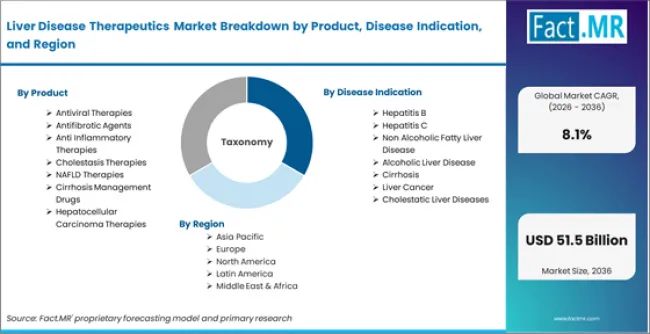
Liver Disease Therapeutics Market Breakdown By Product, Disease Indication, And Region | Source: Fact.MR
| Parameter | Details |
|---|---|
| Quantitative Units | USD 23.64 billion to USD 51.52 billion, at a CAGR of 8.1% |
| Market Definition | The Liver Disease Therapeutics Market covers antiviral therapies, nucleoside analogues, nucleotide analogues used across hepatitis b, chronic hepatitis b, acute hepatitis b applications. |
| Regions Covered | North America, Latin America, Europe, East Asia, South Asia and Pacific, Middle East and Africa |
| Countries Covered | China, USA, India, Japan, Saudi Arabia, Germany, Brazil, and 30 plus countries |
| Key Companies | Gilead Sciences, Inc., AbbVie Inc., Bristol Myers Squibb Company, F. Hoffmann-La Roche Ltd., Takeda Pharmaceutical Company Limited, Johnson & Johnson, Merck & Co., Inc., Novartis AG, Pfizer Inc., Sanofi S.A., GSK plc |
| Forecast Period | 2026 to 2036 |
| Approach | Hybrid demand-side and top-down methodology built on country-level demand analysis, product benchmarking, pricing analysis, primary interviews across manufacturers, distributors, clinicians, and end users |
Source: Fact.MR analysis. Updated May 28, 2026
Liver Disease Therapeutics Market Segmentation
-
Liver Disease Therapeutics Market Segmented by Product:
- Antiviral Therapies
- Nucleoside Analogues
- Nucleotide Analogues
- Interferon Based Therapies
- Antifibrotic Agents
- Collagen Inhibitors
- Hepatic Stellate Cell Inhibitors
- Anti Inflammatory Therapies
- Corticosteroid Based Therapies
- Cytokine Modulators
- Cholestasis Therapies
- Bile Acid Therapy
- Ursodeoxycholic Acid Based Treatments
- NAFLD Therapies
- Insulin Sensitizers
- Lipid Metabolism Modulators
- Cirrhosis Management Drugs
- Ammonia Lowering Agents
- Liver Supportive Therapies
- Hepatocellular Carcinoma Therapies
- Targeted Therapy Drugs
- Immunotherapy Agents
- Liver Transplant Support Drugs
- Antiviral Therapies
-
Liver Disease Therapeutics Market Segmented by Disease Indication:
- Hepatitis B
- Chronic Hepatitis B
- Acute Hepatitis B
- Hepatitis C
- Chronic Hepatitis C
- Treatment Resistant Hepatitis C
- Non Alcoholic Fatty Liver Disease
- Simple Steatosis
- Non Alcoholic Steatohepatitis
- Alcoholic Liver Disease
- Alcoholic Fatty Liver
- Alcoholic Hepatitis
- Cirrhosis
- Compensated Cirrhosis
- Decompensated Cirrhosis
- Liver Cancer
- Hepatocellular Carcinoma
- Secondary Liver Cancer
- Cholestatic Liver Diseases
- Primary Biliary Cholangitis
- Primary Sclerosing Cholangitis
-
Liver Disease Therapeutics Market Segmented by Drug Class:
- Antiviral Drugs
- Direct Acting Antivirals
- Nucleotide Polymerase Inhibitors
- Immunomodulators
- Interferon Alpha Based Drugs
- Immune Response Modifiers
- Antifibrotic Drugs
- TGF Beta Inhibitors
- Collagen Synthesis Inhibitors
- Metabolic Drugs
- Lipid Lowering Agents
- Insulin Sensitizers
- Biologics
- Monoclonal Antibodies
- Recombinant Proteins
- Antiviral Drugs
-
Liver Disease Therapeutics Market Segmented by Route of Administration:
- Oral
- Tablets
- Capsules
- Injectable
- Intravenous Injection
- Subcutaneous Injection
- Parenteral
- Infusion Therapy
- Long Acting Injectable Formulations
- Combination Therapy
- Oral
-
Liver Disease Therapeutics Market Segmented by Distribution Channel:
- Hospital Pharmacies
- Tertiary Care Hospitals
- Specialty Liver Clinics
- Retail Pharmacies
- Community Pharmacies
- Chain Pharmacies
- Online Pharmacies
- Digital Prescription Platforms
- Telemedicine Pharmacies
- Government Supply Channels
- Public Healthcare Programs
- Insurance Reimbursement Channels
- Hospital Pharmacies
-
Liver Disease Therapeutics Market by Region:
- North America
- USA
- Canada
- Mexico
- Latin America
- Brazil
- Chile
- Rest of Latin America
- Western Europe
- Germany
- UK
- Italy
- Spain
- France
- Nordic
- BENELUX
- Rest of Western Europe
- Eastern Europe
- Russia
- Poland
- Hungary
- Balkan & Baltic
- Rest of Eastern Europe
- East Asia
- China
- Japan
- South Korea
- South Asia and Pacific
- India
- ASEAN
- Australia & New Zealand
- Rest of South Asia and Pacific
- Middle East & Africa
- Kingdom of Saudi Arabia
- Other GCC Countries
- Turkiye
- South Africa
- Other African Union
- Rest of Middle East & Africa
- North America
Frequently Asked Questions
How big is the liver disease therapeutics market in 2026?
What will be the size of liver disease therapeutics market in 2036?
How much will be the liver disease therapeutics market growth between 2026 and 2036?
What are the key product types in the liver disease therapeutics market?
Which disease indication segment is expected to contribute significant share in the liver disease therapeutics market in 2026?
Who worked on this report


Preview the report firsthand - request a free sample
Free SampleGet the brochure for pricing and purchase details
Download PDF