- Base Value(2026): 7.2 Bn
- Estimated Value(2026): 7.2 Bn
- Forecast Value (2036): 15.8 Bn
- CAGR (2026 - 2036): 8.2%
Connected Drug Delivery Devices Market Forecast and Outlook 2026 to 2036
The global connected drug delivery devices market is valued at USD 7.2 billion in 2026 and is set to reach USD 15.8 billion by 2036, recording an absolute increase of USD 8.6 billion over the forecast period. This translates into a total growth of 119.4%, with the market forecast to expand at a compound annual growth rate (CAGR) of 8.2% between 2026 and 2036.
Quick Stats for Connected Drug Delivery Devices Market
- Connected Drug Delivery Devices Market Value (2026): USD 7.2 billion
- Connected Drug Delivery Devices Market Forecast Value (2036): USD 15.8 billion
- Connected Drug Delivery Devices Market Forecast CAGR: 8.2%
- Leading Device Type in Connected Drug Delivery Devices Market: Smart Inhalers (42.3%)
- Key Growth Regions in Connected Drug Delivery Devices Market: North America, Europe, Asia Pacific
- Key Players in Connected Drug Delivery Devices Market: Propeller Health Inc., AdhereHealth Inc., Insulet Corporation, Tandem Diabetes Care Inc., Medtronic PLC
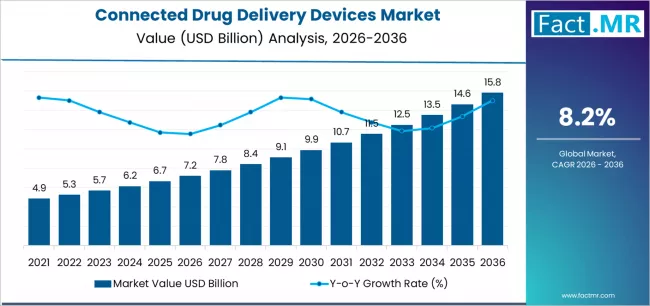
Connected Drug Delivery Devices Market Market Value Analysis | Source: Fact.MR
The market is expected to grow by approximately 2.2X during the same period, supported by increasing demand for chronic disease management solutions across healthcare facilities, growing emphasis on digital health technologies, and rising requirements for enhanced medication adherence infrastructure across hospitals, home care settings, and specialized treatment centers.
The smart inhalers segment is set to register 42.3% of the connected drug delivery devices market in 2026. Smart inhalers enable healthcare providers to deliver comprehensive respiratory care services with superior monitoring capabilities and real-time medication tracking across multiple clinical environments, providing enhanced patient care for chronic disease management and therapeutic applications.
Smart inhalers deliver performance characteristics that allow medical professionals to achieve optimal medication adherence monitoring and maintain efficient treatment workflow management during critical respiratory health assessments while maintaining consistent device reliability over extended operational periods.
Hospitals are projected to register 48.7% of the connected drug delivery devices market in 2026. Connected devices in hospital environments enable enhanced treatment delivery, patient medication monitoring, and clinical processes that are essential for healthcare facilities, outpatient centers, and specialized chronic care establishments.
Hospitals provide the infrastructure mechanisms necessary for medical operations to function reliably in demanding clinical applications while maintaining consistent performance characteristics and real-time medication tracking capabilities.
The market encompasses various delivery technologies, connectivity solutions, and specialized monitoring systems tailored for specific therapeutic applications. Modern connected drug delivery devices incorporate advanced sensor technology, cloud integration capabilities, and enhanced data analytics characteristics that can operate effectively across diverse healthcare environments while maintaining consistent performance over extended service cycles.
The integration of artificial intelligence innovations, patient engagement platforms, and multi-parameter monitoring functionality has further strengthened the value proposition of these delivery systems among healthcare administrators seeking operational efficiency and patient care reliability.
Between 2026 and 2030, the connected drug delivery devices market is projected to expand from USD 7.2 billion to USD 11.4 billion, resulting in a value increase of USD 4.2 billion, which represents 48.8% of the total forecast growth for the decade.
This phase of development will be shaped by increasing healthcare digitization worldwide, rising demand for remote patient monitoring solutions, and growing availability of advanced connectivity technologies across hospitals, home care environments, and chronic disease management applications.
Between 2030 and 2036, the market is forecast to grow from USD 11.4 billion to USD 15.8 billion, adding another USD 4.4 billion, which constitutes 51.2% of the overall ten-year expansion. This period is expected to be characterized by the advancement of AI-integrated monitoring systems, the development of comprehensive patient engagement platforms, and the expansion of personalized medicine delivery solutions across diverse healthcare applications.
The growing emphasis on operational efficiency and advanced therapeutic monitoring capabilities will drive demand for innovative device varieties with enhanced connectivity features, improved patient compliance tracking, and superior clinical integration functionalities.
Connected Drug Delivery Devices Market Key Takeaways
| Metric | Value |
|---|---|
| Estimated Value in (2026E) | USD 7.2 billion |
| Forecast Value in (2036F) | USD 15.8 billion |
| Forecast CAGR (2026 to 2036) | 8.2% |
Source: Fact.MR analysis. Updated Dec 12, 2025
Why is the Connected Drug Delivery Devices Market Growing?
Market expansion is being supported by the increasing global emphasis on chronic disease management standards and the corresponding shift toward advanced monitoring systems that can provide superior therapeutic compliance capabilities while meeting user requirements for enhanced medication adherence and cost-effective operation solutions. Healthcare providers are increasingly focused on incorporating delivery systems that can enhance patient outcomes while satisfying demands for consistent, precisely controlled medication administration and optimized treatment protocols.
Connected drug delivery devices' proven ability to deliver therapeutic excellence, patient benefits, and diverse application possibilities makes them essential components for healthcare-focused establishments and patient-focused medical professionals. The growing focus on remote patient monitoring and clinical efficiency is driving demand for high-performance delivery systems that can support distinctive therapeutic outcomes and comprehensive patient management across hospital environments, home care installations, and specialized chronic disease management systems.
User preference for devices that combines therapeutic excellence with monitoring intelligence is creating opportunities for innovative implementations in both traditional and emerging healthcare applications. The rising influence of digital health technologies and advanced device design is also contributing to increased adoption of intelligent delivery solutions that can provide authentic clinical benefits and reliable performance characteristics.
Opportunity Pathways - Connected Drug Delivery Devices Market
Across developed healthcare systems and emerging economies, there is escalating demand for solutions that offer enhanced medication adherence, improved patient engagement, better treatment outcomes, and streamlined clinical workflow. The push for personalized therapy protocols, the integration of artificial intelligence, and initiatives for comprehensive chronic disease management programs are powerful demand accelerators.
Manufacturers are competing through innovations in sensor technology, cloud connectivity platforms, and patient engagement applications, enabling more precise and accessible therapeutic pathways. Pathways focusing on AI-augmented compliance monitoring, integrated health platforms, and emerging market accessibility promise strong profitability, particularly in premium healthcare centers and high-growth geographic regions.
- Pathway A - AI-Augmented Adherence & Behavioral Analytics Platforms. The critical need to improve medication compliance, reduce hospital readmissions, and enable predictive health interventions drives demand for deeply integrated AI solutions. Developers creating FDA-approved algorithms for adherence prediction, behavioral pattern recognition, and personalized therapy optimization embedded within delivery systems can command premium pricing and subscription contracts. Expected revenue pool: USD 480.0 million - USD 620.0 million.
- Pathway B - Advanced Smart Insulin Delivery & Continuous Glucose Integration. As diabetes care evolves toward automated insulin delivery, demand grows for next-generation connected pumps with predictive algorithms, reduced user intervention, and seamless glucose monitoring integration. Opportunities exist in upgrading existing pump fleets and penetrating new diabetes management centers, especially with proprietary algorithm software. Opportunity: USD 420.0 million - USD 550.0 million.
- Pathway C - Respiratory Care & Multi-Therapy Connected Platforms. Advanced systems combining smart inhalers, nebulizers, and comprehensive respiratory monitoring target COPD, asthma, and complex pulmonary conditions. These integrated solutions enable complete disease management in a connected ecosystem, supporting both acute and chronic care environments. Revenue lift: USD 390.0 million - USD 480.0 million.
- Pathway D - Emerging Market & Home-Based Care Infrastructure. Massive unmet monitoring needs in Asia-Pacific, Latin America, and Africa drive demand for cost-effective, robust, and easy-to-use connected solutions. Manufacturers offering simplified connectivity devices, affordable monitoring platforms with telemedicine integration, and scalable service models will capture high-volume growth. Pool: USD 360.0 million - USD 450.0 million.
- Pathway E - Service, Data Analytics & Lifecycle Management. Given the critical nature of medication adherence and high-value patient data, a shift towards comprehensive service agreements, predictive analytics platforms, and continuous care optimization is key. This pathway creates stable recurring revenue and protects patient relationships from competitors. Expected upside: USD 330.0 million - USD 410.0 million.
- Pathway F - Private Label & OEM Components for Specialty Applications. Growing demand from specialty pharmaceutical companies, clinical research organizations, and veterinary care for tailored delivery systems creates opportunities for supplying key components (sensors, connectivity modules, drug reservoirs) or complete private-label systems meeting specific therapeutic and regulatory needs. USD 290.0 million - USD 360.0 million.
- Pathway G - Direct-to-Patient Digital Health Platforms & Analytics. Developing patient-facing mobile applications for medication management, health coaching, clinical trial participation, and peer support directly engages chronic disease populations. This enhances patient retention, generates valuable health insights, and supports high-value digital health service offerings. Pool: USD 270.0 million - USD 340.0 million.
Segmental Analysis
The market is segmented by device type, application sector, connectivity platform, end-user category, and region. By device type, the market is divided into smart inhalers, connected insulin delivery devices, smart injection systems, connected infusion pumps, and other delivery configurations. Based on application sector, the market is categorized into hospitals, home healthcare settings, specialty clinics, ambulatory care centers, and other healthcare categories.
By connectivity platform, the market includes Bluetooth connectivity, Wi-Fi systems, cellular networks, cloud-based platforms, and other connectivity platforms. By end-user category, the market encompasses healthcare providers, patients and caregivers, pharmaceutical companies, and other end-user services. Regionally, the market is divided into North America, Europe, Asia Pacific, Latin America, Middle East & Africa, and other regions.
By Device Type, Which Segment Holds the Dominant Market Share?

Connected Drug Delivery Devices Market Analysis By Device Type | Source: Fact.MR
Smart inhalers are projected to account for 42.3% of the connected drug delivery devices market in 2026, reaffirming its position as the leading delivery technology. Healthcare professionals and facility managers increasingly utilize smart inhalers for their superior monitoring characteristics, established performance standards, and essential functionality in diverse healthcare applications across multiple clinical sectors.
Smart inhalers' proven performance characteristics and established reliability directly address user requirements for comprehensive patient care and optimal therapeutic precision in chronic disease management applications. This technology segment forms the foundation of modern healthcare performance patterns, as it represents the device type with the greatest application versatility and established compatibility across multiple monitoring systems.
- Institutional investments in advanced medical technology and therapeutic optimization continue to strengthen adoption among healthcare-focused users.
- With healthcare providers prioritizing patient care reliability and medication adherence consistency, smart inhalers align with both clinical objectives and patient requirements, making them the central component of comprehensive respiratory health strategies.
By Application Sector, Which Segment Registers the Highest Share?

Connected Drug Delivery Devices Market Analysis By Application Sector | Source: Fact.MR
Hospitals represent 48.7% of all connected drug delivery devices applications in 2026, underscoring their critical role as the primary application sector for performance-focused users seeking superior therapeutic benefits and enhanced patient credentials. Healthcare facility users and medical operators prefer hospital applications for their established clinical requirements, proven operational demand, and ability to maintain exceptional performance while supporting versatile device coverage during diverse therapeutic activities.
Positioned as essential applications for healthcare-focused facility managers, hospital offerings provide both therapeutic excellence and efficiency optimization advantages. The segment is supported by continuous improvement in connectivity technology and the widespread availability of established performance standards that enable patient assurance and premium positioning at the facility level.
- Healthcare facility users are optimizing device selections to support sector-specific applications and comprehensive patient strategies.
- As connectivity technology continues to advance and facilities seek efficient therapeutic methods, hospital applications will continue to drive market growth while supporting patient performance and operational optimization strategies.
What are the Drivers, Restraints, and Key Trends of the Connected Drug Delivery Devices Market?
The connected drug delivery devices market is advancing rapidly due to increasing healthcare digitization adoption and growing need for advanced therapeutic solutions that emphasize superior performance across medical segments and clinical applications.
The market faces challenges, including competition from traditional delivery alternatives, device cost considerations, and regulatory compliance factors affecting adoption rates. Innovation in connectivity technology enhancement and advanced monitoring systems continues to influence market development and expansion patterns.
Expansion of AI Integration and Patient-Engagement Applications
The growing adoption of connected drug delivery devices with artificial intelligence processing and patient behavior optimization is enabling users to develop therapeutic strategies that provide distinctive clinical benefits while commanding intelligent adherence management and enhanced monitoring characteristics.
AI integration applications provide superior medication compliance consistency while allowing more advanced behavioral optimization features across various healthcare categories. Users are increasingly recognizing the operational advantages of AI positioning for comprehensive patient management outcomes and technology-integrated therapeutic processes.
Integration of Advanced Connectivity Technology and Care-Coordination Systems
Modern connected drug delivery device manufacturers are incorporating advanced wireless processing, real-time data synchronization capabilities, and intelligent analytics systems to enhance patient experience, improve therapeutic effectiveness, and meet facility demands for integrated healthcare solutions.
These systems improve therapeutic effectiveness while enabling new applications, including automated compliance programs and predictive therapy protocols. Advanced technology integration also allows users to support operational optimization positioning and patient management beyond traditional delivery performance requirements.
Analysis of the Connected Drug Delivery Devices Market by Key Countries
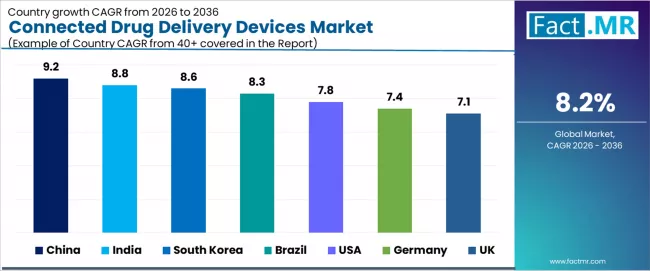
Connected Drug Delivery Devices Market Cagr Analysis By Country | Source: Fact.MR
| Country | CAGR (2026-2036) |
|---|---|
| China | 9.2% |
| India | 8.8% |
| Germany | 7.4% |
| Brazil | 8.3% |
| USA | 7.8% |
| UK | 7.1% |
| South Korea | 8.6% |
Source: Fact.MR analysis. Updated Dec 12, 2025
The connected drug delivery devices market is experiencing robust growth globally, with China leading at a 9.2% CAGR through 2036, driven by the expanding healthcare digitization initiatives, growing medical technology modernization requirements, and increasing adoption of advanced therapeutic monitoring systems. India follows at 8.8%, supported by rising healthcare industry investment, expanding chronic disease management programs, and growing acceptance of digital health technologies.
South Korea shows growth at 8.6%, emphasizing established healthcare technology standards and comprehensive therapeutic development. Brazil records 8.3%, focusing on medical modernization and operational optimization. USA demonstrates 7.8% growth, prioritizing advanced delivery technologies and therapeutic optimization. Germany shows growth at 7.4%, emphasizing established healthcare industry standards and comprehensive device development. The UK demonstrates 7.1% growth, prioritizing advanced therapeutic technologies and operational optimization.
Why does China Lead Global Market Growth?
The connected drug delivery devices market in China is projected to exhibit exceptional growth with a CAGR of 9.2% through 2036, driven by the country's rapidly expanding healthcare digitization sector, favorable government policies toward medical technology modernization, and initiatives promoting advanced therapeutic monitoring technologies across major urban regions.
China's position as a global healthcare development hub and increasing focus on chronic disease management are creating substantial demand for high-quality connected devices in both domestic and export markets. Major device manufacturers and technology distributors are establishing comprehensive installation capabilities to serve growing demand and emerging healthcare opportunities.
- Established healthcare culture and expanding medical consciousness are driving demand for connected drug delivery devices across healthcare facilities, hospital developments, and comprehensive therapeutic systems throughout Chinese urban markets.
- Strong infrastructure development and digitization initiatives are supporting the rapid adoption of premium monitoring systems among healthcare-focused institutions seeking to meet evolving operational standards and patient requirements.
Why does India Demonstrate Strong Market Potential?
The connected drug delivery devices market in India is expanding at a CAGR of 8.8%, supported by rising healthcare industry investment, growing chronic disease awareness, and expanding technology distributor capabilities.
The country's developing medical infrastructure and increasing investment in digital health technologies are driving demand for connected devices across both traditional and modern healthcare applications. International device companies and domestic distributors are establishing comprehensive operational networks to address growing market demand for high-performance therapeutic monitoring devices and efficient healthcare solutions.
- Rising hospital development and expanding medical capabilities are creating opportunities for device adoption across healthcare projects, modern medical developments, and distributor companies throughout major Indian healthcare regions.
- Growing healthcare industry awareness initiatives and therapeutic technology advancement are driving the adoption of specialized connected products and services among facility users seeking to enhance their operational performance and meet increasing patient reliability demand.
Why does South Korea Demonstrate Considerable Expansion?

Connected Drug Delivery Devices Market South Korea Market Share Analysis By Application Sector | Source: Fact.MR
The connected drug delivery devices market in South Korea is projected to grow at a CAGR of 8.6% through 2036, supported by the country's expanding healthcare technology standards, established government regulations, and leadership in digital health implementation.
South Korea's advanced medical development standards and strong support for innovative monitoring systems are creating steady demand for both traditional and advanced connected device varieties. Leading device manufacturers and specialty distributors are establishing comprehensive operational strategies to serve both domestic markets and growing regional opportunities.
- Advanced technology capabilities and established healthcare-focused markets are driving demand for premium monitoring systems across medical facilities, healthcare operations, and comprehensive therapeutic companies seeking superior performance profiles and operational innovation.
- Strong healthcare industry culture and regulatory development are supporting the adoption of innovative connectivity technology among users prioritizing operational reliability and therapeutic precision in medical applications.
Why does Brazil Show Significant Growth?
The connected drug delivery devices market in Brazil is projected to grow at a CAGR of 8.3% through 2036, driven by the country's emphasis on healthcare industry modernization, medical infrastructure development growth, and growing device distributor capabilities.
Brazilian facility users and healthcare establishments consistently seek efficiency-focused monitoring systems that enhance operational performance and support modernization excellence for both traditional and modern medical applications. The country's position as a Latin American healthcare leader continues to drive innovation in specialized therapeutic applications and operational performance standards.
- Expanding healthcare culture and growing medical markets are driving demand for hospital monitoring systems across facility consumers, healthcare providers, and efficiency-focused distributors seeking superior operational control and distinctive performance profiles.
- Increasing focus on operational efficiency and facility modernization systems is supporting the adoption of specialty connected varieties among users and distributors seeking authentic Brazilian healthcare-focused products in regional markets with established medical expertise.
What Factors underpin USA Connected Drug Delivery Devices Market Growth?
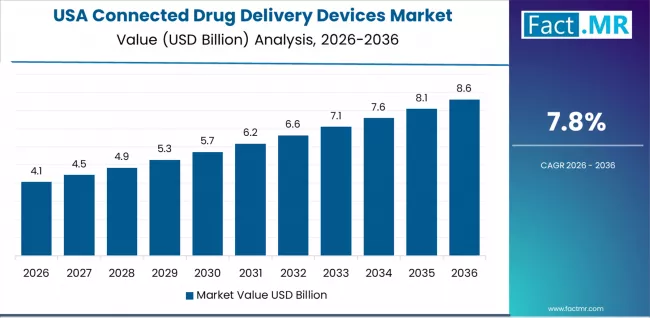
Connected Drug Delivery Devices Market Country Value Analysis | Source: Fact.MR
The connected drug delivery devices market in the USA is projected to grow at a CAGR of 7.8% through 2036, supported by the country's emphasis on digital health advancement, operational optimization, and advanced healthcare system integration requiring efficient monitoring solutions.
American facility users and healthcare-focused establishments prioritize performance reliability and therapeutic precision, making specialized connected systems essential components for both traditional and modern medical applications. The country's comprehensive medical technology leadership and advancing operational patterns support continued market expansion.
- Advanced digital health capabilities and growing precision operational management are driving demand for monitoring systems across specialty applications, modern healthcare formats, and technology-integrated therapeutic programs serving domestic markets with increasing performance requirements.
- Strong focus on operational optimization and performance excellence is encouraging users and distributors to adopt connected solutions that support operational objectives and meet American quality standards for medical applications.
Why does Germany Show Steady Growth?
The connected drug delivery devices market in Germany is projected to grow at a CAGR of 7.4% through 2036, supported by established healthcare standards, expanding facility markets, and emphasis on operational efficiency across hospital and therapeutic sectors.
German facility users and medical professionals prioritize quality performance and operational consistency, creating steady demand for premium connected solutions. The country's comprehensive market development and established healthcare performance practices support continued advancement in specialized applications.
- Established facility markets and expanding healthcare industry are driving demand for quality monitoring systems across hospital operations, medical facilities, and professional healthcare companies throughout German medical regions.
- Strong emphasis on quality standards and operational efficiency is supporting the adoption of premium connected varieties among users seeking proven performance and established medical credentials in facility applications.
Why does UK Show Strong Growth?
The connected drug delivery devices market in the UK is projected to grow at a CAGR of 7.1% through 2036, supported by the country's emphasis on operational precision, medical excellence, and advanced technology integration requiring efficient monitoring solutions.
British facility users and healthcare-focused establishments prioritize technical performance and operational precision, making specialized connected systems essential components for both traditional and modern medical applications. The country's comprehensive healthcare leadership and advancing precision patterns support continued market expansion.
- Advanced precision digital health capabilities and growing technical operational applications are driving demand for monitoring systems across specialty healthcare applications, modern precision formats, and technology-integrated therapeutic programs serving domestic markets with increasing quality requirements.
- Strong focus on technical precision and medical excellence is encouraging users and distributors to adopt connected solutions that support operational objectives and meet British precision standards for medical applications.
Europe Market Split by Country
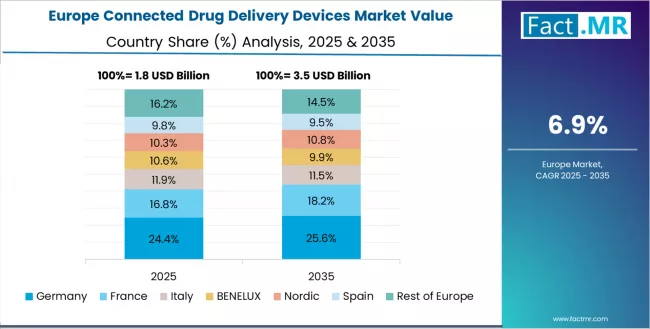
Connected Drug Delivery Devices Market Europe Country Market Share Analysis, 2025 & 2035 | Source: Fact.MR
The Europe connected drug delivery devices market is projected to grow from USD 1.6 billion in 2026 to USD 3.2 billion by 2036, recording a CAGR of 7.2% over the forecast period. Germany leads the region with a 36.4% share in 2026, moderating slightly to 35.9% by 2036, supported by its strong healthcare technology traditions and demand for premium, precision-manufactured monitoring solutions.
The UK follows with 28.3% in 2026, easing to 27.8% by 2036, driven by a mature healthcare market and emphasis on operational efficiency and quality performance. France accounts for 17.1% in 2026, rising to 17.6% by 2036, reflecting steady adoption of advanced connectivity technologies and operational optimization.
Italy holds 9.2% in 2026, expanding to 9.5% by 2036 as medical modernization and specialty healthcare applications grow. Spain contributes 4.7% in 2026, growing to 5.0% by 2036, supported by expanding facility development and healthcare performance awareness modernization.
The Nordic countries rise from 2.8% in 2026 to 2.9% by 2036 on the back of strong healthcare consciousness and advanced operational methodologies. BENELUX remains at 1.5% share across both 2026 and 2036, reflecting mature, efficiency-focused healthcare markets.
Competitive Landscape of the Connected Drug Delivery Devices Market
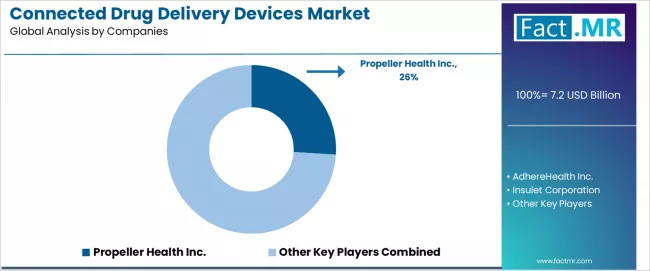
Connected Drug Delivery Devices Market Analysis By Company | Source: Fact.MR
The connected drug delivery devices market is characterized by competition among established medical device companies, specialized digital health manufacturers, and integrated healthcare technology providers. Companies are investing in advanced connectivity technologies, specialized monitoring platforms, product innovation capabilities, and comprehensive distribution networks to deliver consistent, high-quality, and reliable delivery systems. Innovation in sensor integration, cloud connectivity, and healthcare-focused product development is central to strengthening market position and customer satisfaction.
Propeller Health Inc. leads the market with a 26% share with a strong focus on respiratory monitoring innovation and comprehensive digital health solutions, offering institutional and clinical systems with emphasis on performance excellence and therapeutic heritage. AdhereHealth Inc. provides integrated medication adherence platforms with a focus on healthcare market applications and precision monitoring networks.
Insulet Corporation delivers comprehensive diabetes technology solutions with a focus on clinical positioning and operational efficiency. Tandem Diabetes Care Inc. specializes in comprehensive insulin delivery technologies with an emphasis on healthcare applications. Medtronic PLC focuses on comprehensive medical devices with advanced design and premium positioning capabilities.
Key Players in the Connected Drug Delivery Devices Market
- Propeller Health Inc.
- AdhereHealth Inc.
- Insulet Corporation
- Tandem Diabetes Care Inc.
- Medtronic PLC
- Dexcom Inc.
- Abbott Laboratories
- Novartis AG
- F. Hoffmann-La Roche Ltd.
- Johnson & Johnson Services Inc.
- Pfizer Inc.
- Merck & Co. Inc.
- Sanofi S.A.
- GlaxoSmithKline PLC
- AstraZeneca PLC
Segmentation
Scope of the Report
| Items | Values |
|---|---|
| Quantitative Units (2026) | USD 7.2 Billion |
| Device Type | Smart Inhalers, Connected Insulin Delivery Devices, Smart Injection Systems, Connected Infusion Pumps, Other Delivery Configurations |
| Application Sector | Hospitals, Home Healthcare Settings, Specialty Clinics, Ambulatory Care Centers, Others |
| Connectivity Platform | Bluetooth Connectivity, Wi-Fi Systems, Cellular Networks, Cloud-Based Platforms, Other Connectivity Platforms |
| End-User Category | Healthcare Providers, Patients and Caregivers, Pharmaceutical Companies, Other End-User Services |
| Regions Covered | North America, Europe, Asia Pacific, Latin America, Middle East & Africa, Other Regions |
| Countries Covered | China, India, Germany, Brazil, USA, UK, South Korea, and 40+ countries |
| Key Companies Profiled | Propeller Health Inc., AdhereHealth Inc., Insulet Corporation, Tandem Diabetes Care Inc., Medtronic PLC, and other leading connected device companies |
| Additional Attributes | Dollar sales by device type, application sector, connectivity platform, end-user category, and region; regional demand trends, competitive landscape, technological advancements in connectivity engineering, operational performance optimization initiatives, therapeutic enhancement programs, and premium product development strategies |
Source: Fact.MR analysis. Updated Dec 12, 2025
Connected Drug Delivery Devices Market by Segments
-
Device Type :
- Smart Inhalers
- Connected Insulin Delivery Devices
- Smart Injection Systems
- Connected Infusion Pumps
- Other Delivery Configurations
-
Application Sector :
- Hospitals
- Home Healthcare Settings
- Specialty Clinics
- Ambulatory Care Centers
- Others
-
Connectivity Platform :
- Bluetooth Connectivity
- Wi-Fi Systems
- Cellular Networks
- Cloud-Based Platforms
- Other Connectivity Platforms
-
End-User Category :
- Healthcare Providers
- Patients and Caregivers
- Pharmaceutical Companies
- Other End-User Services
-
Region :
-
North America
- USA
- Canada
- Mexico
-
Europe
- Germany
- UK
- France
- Italy
- Spain
- Nordic Countries
- BENELUX
- Rest of Europe
-
Asia Pacific
- China
- India
- Japan
- South Korea
- Australia
- Rest of Asia Pacific
-
Latin America
- Brazil
- Argentina
- Rest of Latin America
-
Middle East & Africa
- Kingdom of Saudi Arabia
- United Arab Emirates
- South Africa
- Rest of Middle East & Africa
-
Frequently Asked Questions
How big is the connected drug delivery devices market in 2026?
What will be the size of connected drug delivery devices market in 2036?
How much will be the connected drug delivery devices market growth between 2026 and 2036?
What are the key product types in the connected drug delivery devices market?
Which application sector segment to contribute significant share in the connected drug delivery devices market in 2026?
Who worked on this report


Preview the report firsthand - request a free sample
Free SampleGet the brochure for pricing and purchase details
Download PDF